Films I’d like to see remade (Part 2)


From wikipedia.org / © Metro-Goldwyn-Mayer


Here are some more films I remember fondly from my youth that, with sufficient love and skill, I think could be remade as wonderful new films.


Dark of the Sun (1968)

When, in my early teens, I saw this action / adventure / war movie on late-night TV, I believed it was the toughest movie ever.  At least, I believed that until I saw William Friedkin’s nail-biting Sorcerer (1977), itself a remake, of Henri-George Clouzot’s The Wages of Fear (1953), which promptly stole its crown as Most Badass Film I’d Ever Seen


But no matter – Dark of the Sun, or The Mercenaries as it was also known, still seemed pretty hardcore to me.  Why, it even had a chainsaw fight in it!  Thanks to the Texas Chainsaw Massacre movies (1974 onwards) and the Evil Dead movies (1981 onwards), and to one-off entries like Motel Hell (1980) and Mandy (2018), chainsaw fights are ten a penny nowadays.  But back then, seeing someone lunge at someone else with a whirring, metal-toothed power tool was an intense experience.


Based on a 1965 Wilbur Smith novel and directed by Jack Cardiff, Dark of the Sun tells the story of some mercenaries being sent into action amidst the Simbas rebellion in early 1960s Congo. It stars Robert Taylor, Yvette Mimieux – Taylor and Mimieux reunited eight years after appearing in George Pal’s charming 1960 adaptation of H.G. Wells’s The Time Machine – Jim Brown, Kenneth More (subverting his usual, cuddly English-gentleman image by playing an alcoholic doctor) and Peter Carsten (playing a vile, child-murdering Nazi).  At the time, critics lambasted the film for what they saw as its extreme violence.  However, as Cardiff noted, the violence depicted didn’t come anywhere near the real atrocities that’d happened in the Congo then, or near the violence featured in movies in later decades.


I’d like to see a remake of Dark of the Sun that updates the intensity, grittiness and violence to fit with 2026 sensibilities and that places the action within the context of 2026 geopolitics.  And is more racially sensitive – any racism in the original movie went over my 13-year-old head but I’m sure that, viewing it today, I’d cringe at parts of it.   At the very least, and despite the presence of Jim Brown as one of the mercenaries, I suspect I’d find it infused with a ‘white saviour’ or ‘white man’s burden’ complex.


Quentin Tarantino is a huge fan of this film (as is Martin Scorsese) so, as I did with Von Ryan’s Express (1965), I recommend old Quent as the man to helm a remake of it.  I know he’s sworn that he’s only going to make ten films in his lifetime, and his next one will be his last, but I don’t believe that for an instant.


Come to think of it, Dark of the Sun has quite a few things in common with Von Ryan’s Express, including a cracking movie film poster designed by the splendid Frank McCarthy and the presence of Nazis.  And like the earlier film, Dark of the Sun prominently features a train.


As does my next candidate for a modern remake, which is….


© Granada Films


Horror Express (1972)

The much-loved British-Spanish movie Horror Express is set on a train hurtling across Siberia in the early 20th century.  The train is being stalked by a decomposing ape-man fossil that’s seemingly come back to life – in fact, it’s possessed by an alien lifeforce and has the power to suck people’s brains out through their eyeballs.  Trying to thwart it are British scientists Sir Alexander Saxon (Christopher Lee) and Dr Wells (Peter Cushing).  Things become even more complicated in the film’s final act when the train is invaded by a bunch of Cossack soldiers, led by Telly Savalas’s villainous Captain Kazan.


Directed by Eugenio Martin, Horror Express is basically The Thing (1982) set on board the train from Alfred Hitchcock’s 1938 classic The Lady Vanishes.  Saxon and Wells are variations on the characters of Charters and Caldicott, the stuffy but unflappable English cricket-lovers in Hitchcock’s movie who get caught up in the chaos.  That said, you never feel Christopher Lee and Peter Cushing are playing anyone other than themselves in Horror Express.  During their careers, the two actors made 22 movies together, were close friends offscreen and have an effortless chemistry here.


The decaying ape-man in the original movie is still icky, but it would be nice to see it in a modern remake with a decent special-effects budget where it could do properly mind-blowing, spectacularly gruesome Thing-like things.  To play Saxon and Wells, you’d need a pair of British actors who’ve worked together already and possess some of that Lee-Cushing chemistry – maybe Benedict Cumberbatch and Martin Freeman, from the BBC TV show Sherlock (2010-17)?


And to play Savalas’s murderous Captain Kazan, there can be only one man: Nicolas Cage.


Theatre of Blood (1973)

Until recently, I’d have been aghast at the thought of anyone remaking Douglas Hickox’s brilliant horror comedy Theatre of Blood, wherein Vincent Price plays an insane and hammily over-the-top Shakespearean actor called Edward Lionheart.  Enraged by the snobbish London theatre critics who’ve bad-mouthed his performances, Lionheart murders them one by one using methods borrowed from the Bard’s plays.  “They’re not going to start killing critics for giving bad notices, are they?” exclaims the campest critic, played by Robert Morley, who eventually meets a grisly fate modelled on events in Titus Andronicus.  A very distinguished cast of English character actors goes the same way as Morley: Michael Hordern, Dennis Price, Arthur Lowe, Harry Andrews, Robert Coote and Coral Browne.


© Harbour Productions Ltd / Cineman Productions / United Artists


There’s no shortage of famous modern-day British thespians who could play the supporting cast of doomed theatre critics in a remake – I’d enjoy seeing James Corden get the Titus Andronicus treatment – but surely, surely nobody could recreate the absolutely delicious performance that Vincent Price gives as Lionheart in the original movie?


Well, I thought that until I saw Ralph Fiennes in this year’s 28 Years Later: The Bone Temple.  Now I’m pretty sure he could be the Vincent Price of 2026.  And actually, Fiennes has played a character not dissimilar to Lionheart in 2022’s The Menu.


And if Fiennes wasn’t available, I suppose they could always call on Matt Berry.


The Beast Must Die (1974)

Paul Annett’s The Beast Must Die is a low-budget horror movie with an irresistible premise.  It’s about a millionaire big-game hunter, played by Calvin Lockhart, determined to bag a werewolf.  He rigs up his country estate with CCTV cameras and motion sensors, procures a helicopter and invites five unsavoury people to visit for a few days convinced that one of them  is a werewolf.  Among those playing Lockhart’s house-guests and staff are Peter Cushing, Charles Gray, Anton Diffring and a youthful Michael Gambon.  Needless to say, there is a werewolf present, but it gradually turns the tables on Lockhart and his hi-tech equipment, whilst also bumping off the supporting cast.


The ideas is irresistible, as I said, but watching The Beast Must Die on TV as a kid was a frustrating experience.  Due to the inevitable budgetary constraints, Lockhart’s mansion house and grounds aren’t that hi-tech and the werewolf, when it appears, just looks like a big dog.  You’d think the sequence where the werewolf takes out a helicopter would be thrilling, but it isn’t.  Let’s remake this one with a proper budget, so that it’s as awesome as it sounded on paper in 1974.


From wikipedia.org / © Amicus Productions / British Lion Films


Juggernaut (1974)

The most underrated but, in my mind, the greatest of 1970s disaster movies, Richard Lester’s Juggernaut is mostly set on a British ocean liner stuck out in the stormy north Atlantic.  An anonymous call to the company that owns the liner informs it that half-a-dozen bombs have been stashed on board and they’ll explode unless a ransom is paid.  With weather conditions too severe to allow the ship’s crew and passengers to be evacuated, and the authorities forbidding the company to pay the ransom – which would be surrendering to terrorism – a team of bomb-disposal experts led by Fallon (Richard Harris) and his sidekick Charlie (David Hemmings) are sent to try and make the bombs safe.


Back on dry land, a policeman (Anthony Hopkins), whose family are among those trapped on the ship, tries to discover the bomber’s identity.  I don’t want to give away any spoilers, but when a twitchy Freddie Jones appears onscreen, you know who it is.


Juggernaut has a wonderful cast all round – not just the three ‘H’s of Harris, Hemmings and Hopkins, but also Omar Sharif, Ian Holm, Shirley Knight, Clifton James, Julian Glover and many more.  But the show is quietly stolen by Roy Kinnear, playing the ship’s entertainment officer, who has the thankless task of keeping the passengers’ spirits up when at any moment they could be blown to smithereens.  When he organises a fancy-dress party, one passenger appears dressed as the Grim Reaper and carrying a round black object with BOMB written on it.


As well as being massively suspenseful, the film offers social commentary. This ship is called the Britannic and it’s not difficult to see Juggernaut as a meditation on the sorry plight of Britain in the mid-1970s, its days as a world power well behind it, being battered by global events it had no power over, such as the Oil Crisis.  In 2026, a decade after Brexit and during the chaotic era of Trump, a remake of Juggernaut would be both more poignant and more cutting.


You could also cast, in a Juggernaut remake, the sons of three of its original stars, now well established as actors in their own right: Jared Harris, Toby Jones and Rory Kinnear.  But it’d be fun to see them in roles different from those their dads played.  Kinnear as the policeman, Jones as the entertainment officer, Harris as the bomber?


© Two Roads / United Artists

A Mayday from Jim Mountfield


© Schlock Webzine


Today is May 1st – May Day, halfway between the spring equinox and summer solstice and seen in ancient times as the beginning of summer.  It was – and, in some parts, still is – a day of celebration.  Bonfires would be lit and rituals conducted to ensure bountiful harvests and protect livestock being driven out to their summer pastures.  Flowers would be used to decorate the doors and windows of houses and byres.  Offerings would be made to the fairy folk.  Sacred wells would be visited, Beltane bannocks cooked, Jack-in-the-Greens and hobby horses paraded, May bushes assembled, Maypoles danced around and May Queens crowned.


And if you live on the Scottish island of Summerisle, I assume it’s still the day when you make sure any virginal and sanctimonious Free Presbyterian police officers have an appointment with the wicker man.


Today is also the day that my latest short story – appropriately a folk-horror one attributed to the penname Jim Mountfield – sees publication in Volume 20, Issue 1 of Schlock Webzine.  Entitled Encapsulated and set in rural England during the Covid-19 pandemic, it’s about a father trying to help his daughter combat the boredom of lockdown by assembling and burying a time capsule.  He suffers disturbing visions after the burial of the capsule results in something else, something strange and mysterious, being unearthed.


Though it’s May Day, and two paragraphs ago I invoked Robin Hardy’s The Wicker Man (1973), the greatest folk-horror movie of all time, Encapsulated is actually closer in spirit to another classic British folk-horror movie of the early 1970s, Piers Haggard’s Blood on Satan’s Claw (1970).  In fact, though I don’t make any explicit connections with Blood on Satan’s Claw, I’d like to think Encapsulated inhabits the same universe as it.


For the next month, Encapsulated can be read here.  Meanwhile, the main page of Schlock Webzine, Volume 20, Issue 1, can be accessed here.

Films I’d like to see remade (Part 1)


From imdb.com / © Rank Organisation


I still find it disconcerting when films I enjoyed in my youth are remade in the 21st century: for example, 1980’s The Fog (remade in 2005), 1981’s The Evil Dead (remade in 2013) and Clash of the Titans (remade in 2010), 1986’s The Hitcher (remade in 2007), 1987’s Robocop (remade in 2014) and 1988’s Hairspray (remade in 2007).  My immediate and automatic response to such remakes is, “What, they’re remaking that movie already?  Have you no shame, Hollywood?”


This is followed by a feeling of horror as I realise just how long ago it was when those original movies were released.  The first Evil Dead movie was 32 years old – 32 years! – when its remake surfaced, though in my mind it was only yesterday when Sam Raimi’s Deadites made their first-ever appearance and started making life difficult for Bruce Campbell.   And actually, three of the films I remember most fondly from my youth, Philip Kaufman’s Invasion of the Body Snatchers (1978), John Carpenter’s The Thing (1982) and Brian De Palma’s Scarface (1983) were remakes themselves.  Body Snatchers appeared just 22 years after the 1956 original and The Thing appeared 32 years after its 1950 one.  Scarface was an outlier, since the first Scarface came out in 1932, more than a half-century earlier.


Maybe I shouldn’t be so concerned about how soon after the original movie that a remake appears.  I should be concerned about the quality of it – for remakes tend to be shite.  I haven’t seen all those mentioned at the beginning of this entry, but the ones I have seen have been nowhere near as good as the originals.  (The Evil Dead remake probably comes closest, but I still much prefer the ramshackle and low-budget, but resourceful, charm of Raimi’s 1981 film.)  That said, remakes don’t have to be bad all the time – the aforementioned ones by Kaufman, Carpenter and De Palma testify to that.


So, without further ado, here are some films – and one series of films – I wouldn’t mind seeing remade in the 21st century, with bigger budgets and better special effects.  But remade decently.


From wikipedia.org / © Rank Organisation


Hell Drivers (1957)

Blacklisted by the House Committee on Un-American Activities in 1951, American director Cy Endfield moved to Britain where, half-a-dozen years later, he made Hell Drivers.  Given the persecution Endfield had suffered, it unsurprisingly takes a dim view of American-style, cut-throat capitalism.  It has that underrated but magnificent actor Stanley Baker as an ex-con who finds a job as a truck driver with a dodgy haulage company, which threatens its drivers with the sack if they don’t deliver loads of gravel across treacherous roads at breakneck speeds.  The reason there aren’t more drivers employed to relieve the pressure, and reduce the danger, is because of a scam involving the local depot manager (William Hartnell) and its off-his-head Irish foreman (Patrick McGoohan, coming across like a brawnier version of Shane MacGowan).  The latter soon becomes Baker’s nemesis.


As well as a political message, Endfield injects Hell Drivers with an American-style grittiness rarely seen in British films of the period.  But what really makes the film a joy to watch nowadays is the cast.  As Kim Newman has written of it in Empire Magazine, “how many other movies have an ensemble which includes the original Dr Who (Hartnell), the first James Bond (Sean Connery), the Prisoner (McGoohan), a Man From UNCLE (David McCallum), a Professional (Gordon Jackson), Clouseau’s boss (Herbert Lom), plus Alfie Bass, the excellent Peggy Cummins (of the cult items Gun Crazy and Night of the Demon), the inimitably boozy Wilfrid Lawson, Jill Ireland and Sid James?”


In 2026, with capitalism more cut-throat than ever, a remake of Hell Drivers would be timely.  I don’t think, though, setting it in the wilds of Middlesex, West Sussex and Buckinghamshire, where the original was filmed, would work now, so it’d have to have its hard-pressed truck drivers pounding the roads of a less hospitable locale – the Alaskan tundra, say, or somewhere that retains some near-impenetrable tropical rainforest.


And to pay proper homage to the original, you’d definitely need a cast made up of actors who’ve played iconic roles in iconic TV shows or movie series.  You could have one of the grittier Bonds (Daniel Craig or Timothy Dalton), one of the grittier Doctors Who (Christopher Eccleston or Peter Capaldi), plus a Sherlock Holmes (Benedict Cumberbatch, maybe), a Harry Potter (Daniel Radcliffe), perhaps someone from the Breaking Bad universe (Bryan Cranston, say, or Bob Odenkirk)…  The possibilities are endless.


From wikipedia.org


The Margaret Rutherford Miss Marple movies (1961-64)

This is a little different.  I’d like to see the four movies made about Agatha Christie’s genteel sleuth of a certain age, Miss Marple, which had the delightful Margaret Rutherford in the leading role – Murder She Said (1961), Murder at the Gallop (1963), Murder Most Foul (1964) and Murder Ahoy! (1964) – rebooted as a TV show.  Not just another show about Miss Marple per se – there have been ones with Joan Hickson, Geraldine McEwan and Julia McKenzie – but one set in the universe of the four Rutherford movies.


Thus, its episodes would be set against the tableau of early-1960s England, with Miss Marple depicted as an obstinate, feisty old lady who refuses to know her place and keeps barging into and solving mysteries.  There’d be as much as humour as tension and the show would have the films’ supporting characters, like the timid librarian Mr Stringer (Rutherford’s real-life husband Stringer Davis), who reluctantly helps Miss Marple out, and the exasperated copper Inspector Craddock (Charles Tingwell), who begins each instalment telling her to mind her own business but ends it taking orders from her.  Meanwhile, Ron Goodwin’s jaunty Miss Marple Theme would burble in the background.


I suspect in a 2026 version Mark Gatiss would make a lovely Mr Stringer, while Daniel Mays would nicely fill the shoes of the long-suffering Inspector Craddock.  But who would play Miss Marple – or more precisely, play Margaret Rutherford playing Miss Marple?  Perhaps Dawn French, though she’d have to spend a long time in the make-up chair to recreate Rutherford’s famously jowly, hangdog features.


In the original movies, each murder that Rutherford / Marple investigated involved a British institution – a country manor, horse riding, the theatre and the Navy.  She’d duly rattle establishment cages by sticking her nose in where it wasn’t welcome.  So perhaps each episode of this hypothetical series would have her ruffling the feathers of other British institutions of the time – the Army, the House of Lords, Savile Row, Crufts, the country’s nascent rock ‘n’ roll industry…  Miss Marple meets the young Rolling Stones?  I’d pay good money to see that.


From wikipedia.org / © 20th Century Fox
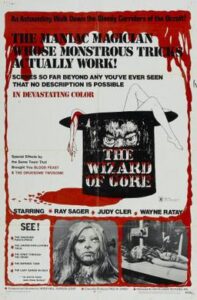
 

Von Ryan’s Express (1965)

I never had much time for Frank Sinatra, neither as an entertainer nor as a person, but he left an impression on my 10-year-old self the first time I saw the ripping World War II yarn Von Ryan’s Express.  It’s the story of an American airman, Ryan (Sinatra), downed in Italy, who joins forces with some Allied prisoners of war, led by Trevor Howard.  They attempt an audacious escape into neutral Switzerland by seizing control of a train and steering it up a railway line into the Alps.  Much derring-do is involved as German troops and aircraft go all-out to stop them reaching their destination.


It’s great, crowd-pleasing stuff until the ending – spoilers are coming! – which is depicted on the movie poster, painted by the great Frank McCarthy.  The train has almost made it to safety.  Having fought a rearguard action against the Germans, Sinatra is running after the train and has almost caught up with it.  But then….  What happened next put a dampener on things.  But it also lodged the film in my mind forever.


With 2009’s Inglourious Basterds, Quentin Tarantino showed his love for rip-roaring if cheesily improbable World War II adventures, so perhaps he could helm a remake of Von Ryan’s Express?  To stick to the innocent, uncomplicated spirit of the original, though, he’d have to forgo his use of the F-word and N-word, and his fetish for close-ups of ladies’ feet, and his nerdish references to ‘film-study criticism of the work of German director G.W. Pabst’.


© Hammer Film Productions / Seven Arts Productions


Quatermass and the Pit (1967)

Hammer Films’ sci-fi horror film Quatermass and the Pit was based on the 1958 BBC TV serial of the same name.  Both film and serial were written by Nigel Kneale.  It begins with workers on a London Underground extension project digging up an alien spacecraft full of dead, horned, insect-like creatures that are identified by scientist-hero Professor Bernard Quatermass (Andrew Keir) as inhabitants of the now-lifeless planet Mars.  It transpired that millions of years ago, these sneaky Martians arrived on earth and did some evolutionary tinkering on the apes who were the ancestors of modern humanity.  This tinkering included implanting in the apes an urge to conduct occasional culls whereby those with pure Martian programming exterminated those who’d developed mutations and lost that programming.


When some TV news crews descend on the scene, a power surge from their camera-cables reactivates the spacecraft and it triggers a new cull.  London becomes an apocalyptic hellscape where the human inhabitants who retain their Martian conditioning roam around, zombie-like, and use newly awoken telekinetic powers to kill everyone who’s lost it.


I still find Quatermass and the Pit impressive today, and scary, though inevitably there are special effects that reflect the limitations of Hammer’s budget.  I’d relish the prospect of a modern, big-budget retelling of the story.


One thing that makes the film effective, and affecting, is Kneale’s portrayal of the scientists.  Unlike usual movie-scientists, they aren’t cold-blooded, delusional, self-serving or plain weird.  Instead, Quatermass and his colleagues, Dr Roney (James Donald) and Barbara Judd (Barbara Shelley), are portrayed as decent human beings, working with an eager curiosity, a sense of duty and a sense of humour.  Keir and Donald were both Scots, so maybe a modern movie could cast Brian Cox as Quatermass and James McAvoy as Dr Roney.  Actually, I think a third Scottish actor, Karen Gillan, would be excellent as Barbara Judd.

 

To be continued…


© Metro-Goldwyn-Mayer

Back with the Chain gang


I once wrote on this blog that the Jesus and Mary Chain, the Scottish alternative rock band whose core members are brothers Jim and William Reid, was “on at least three days of the week… my favourite band of all time.”  Incidentally, I’d say on the other four days of the week my favourite all-time band is the Rolling Stones between 1969 and 1974, when Mick Taylor played with them.


However, when I heard that the Jesus and Mary Chain intended to perform in Singapore, my current abode, in the middle of this month, I felt a little apprehensive.  For one thing, though I often cite the first time I saw the band live – at London’s Brixton Academy in 1992, while they headlined the Rollercoaster tour and the support bands were American alternative rockers Dinosaur Jr, swirly shoegazers My Bloody Valentine, and a young, up-and-coming band called Blur (whatever happened to them?) – as one of the best gigs, if not the best gig I’ve ever attended, the last time I saw them was a different affair.   That was in Edinburgh in 1998, when relations between Jim and William had decayed so badly they spent the show telling each other to shut up.  It presaged a disastrous performance soon after at the Los Angeles venue House of Blues, where Jim turned up drunk and William stormed offstage.  To no one’s great surprise, the following year they announced the band had split up – though they reformed in 2007.


Would 2025’s Singapore gig be closer in spirit to the 1992 one or the 1998 one?


Also, last year, they released a new album called Glasgow Eyes whose sound was something of a departure.  Though simultaneously dreamy and scuzzy in the best Jesus and Mary Chain tradition, a strong dose of electronica infused it.  I assumed their 2025 set would contain a good number of songs from Glasgow Eyes, which was fine, but it’d mean a lot of the music wouldn’t be what I immediately associated with the Jesus and Mary Chain.


There was the age issue too. With Jim and William Reid now 64 and 67 years old respectively, I wondered how kind time had been to their performing abilities.  After all, I hadn’t seen these guys sing and play onstage for nearly 30 years.  30 years – wow!


And lastly, it just seemed weird that the Jesus and Mary Chain was playing in a famously sensible, serious and clean-living place like Singapore.  After all, this is a band that initially made its name with chaos and disreputability.  When the Reids first performed in 1983, they generated controversy with their habit of delivering gigs just 15 minutes long, with their backs to the audience and their sound cloaked in squalls of feedback, which went down so badly with the punters that – according to the British tabloid press – ‘riots’ ensued.  And their Singaporean show was scheduled for the Esplanade Concert Hall, a venue whose floorspace is entirely covered in seating.  I honestly couldn’t imagine a Jesus and Mary Chain gig where everyone had to sit.


Thus, as I entered the Esplanade Concert Hall on the evening of the show, I had plenty of concerns.  But I needn’t have worried.  This was a great concert.


Before things kicked off, I ordered a few beers at a bar just outside the auditorium’s entrance and sipped them whilst taking in the appearances of my fellow concert-goers.  It genuinely surprised me how many Singaporeans had come tonight.  They consisted mainly of young goths or middle-aged folk who looked like they’d been art-college students in an earlier era.  There was a lengthy queue, mainly of Singaporeans, to buy T-shirts.  An especially popular purchase was a T-shirt featuring the cover of the Jesus and Mary Chain’s 1985 debut album, Psychocandy, which depicted Jim and William in their svelte youth.


© Blanco y Negro


(Among the non-Jesus and Mary Chain T-shirts I observed folk wearing were, not unexpectedly, ones bearing the names of the Cure and the Cocteau Twins…  And, in one case, of Radio Clyde, which was unexpected.)


But there were Westerners around too. Whilst queuing for a beer, I got chatting to an English fellow who was wearing a T-shirt featuring the title of Blur’s 1993 album Modern Life is Rubbish.  “I actually saw Blur supporting the Jesus and Mary Chain,” I said, “back before they were famous.”


He replied, “That would have been the Rollercoaster tour.  I saw it in Birmingham.”  He added wistfully, “Don’t remember much about it, though.”


I should have come back with the obvious quip, “Yes, it was all a bit of a blur!”  But, alas, I wasn’t as quick-thinking as that.


Just before eight o’clock, the gig’s start-time, everyone made their way into the auditorium.  However, when the lights dimmed, it wasn’t for the Jesus and Mary Chain’s set but for that of a support act, the Singaporean singer-songwriter Shye.  Although Shye’s Wikipedia page describes the musical genres she works in as ‘folk-rock, neo-soul, electronic, R&B’, what she and her backing band served up tonight sounded pretty shoegazer-ish to me – not too far removed from the songs at the mellower end of the Jesus and Mary Chain’s repertoire.  Her performance went down well.


Then the main attraction appeared.  The moment the band – Jim, William, guitarist Scott Von Ryper, bassist Mark Crozer and drummer Justin Welch – came onstage and immediately tore into Jamcod, the most blistering track on Glasgow Eyes, the crowd rose to their feet as one and stayed on their feet for the entire 19-song set.  And I knew at once from the band’s poise and confidence, and the audience’s euphoric reaction to them, that everything about this show was going to be right.


Every phase in the Jesus and Mary Chain’s career was acknowledged tonight, with material played from all eight of the band’s studio albums – plus the 1986 Some Candy Talking EP, unsurprisingly represented by the song Some Candy Talking, whose ambiguous lyrics so upset the late disc jockey Mike Smith that he blacklisted it on the BBC’s Radio One.  As it turned out, four songs were performed from Glasgow Eyes: besides Jamcod, the lowkey Chemical Animal, the lumbering Poor Pure and the jaunty Venal Joy.  These actually fitted in seamlessly with the rest of the set.


I was delighted that the band played three songs from my favourite Jesus and Mary Chain album, 1989’s Automatic: Between Planets, Halfway to Crazy and Head On.  I always felt Automatic got a bad rap from the critics and was sorely underrated.  Also well-represented was 1987’s Darklands, whose brooding numbers added both melody and melancholy to proceedings and balanced the set’s more abrasive parts: the album’s title track, Happy When It Rains and, appropriately, April Skies.  (Well, the show was taking place under the April skies of Singapore.)  And for fans who’d been with the band from the very beginning, three numbers were aired from Psychocandy: In a Hole, Taste of Cindy and Just Like Honey.


On the original Just Like Honey, the female backing vocals were provided by Karen Parker, the then-girlfriend of then-Jesus and Mary Chain drummer Bobby Gillespie (who, of course, would go on to front Primal Scream).  So versatile was Ms. Parker that on one occasion she stepped in and played drums at one of their gigs after Gillespie had hurt his hand.  Also, Scarlett Johannson did those vocal duties when the band played Just Like Honey during their first performance after reforming in 2007.  Tonight, Jim Reid invited Shye, the support act, onstage again to sing it with him.  She also co-sang Sometimes Always from 1994’s Stoned & Dethroned – stepping into the shoes of Mazzy Star’s Hope Sandoval, who’d shared the vocals on the original recording.  Shye acquitted herself beautifully.


I doubt if many people would rate 1998’s Munki or 2017’s Damage and Joy as the best-ever Jesus and Mary Chain albums, but I had absolutely no problem with the songs played from them tonight: Cracking Up and I Hate Rock ‘n’ Roll off the former and All Things Pass off the latter.  Everything, in fact, was performed with great aplomb.  As frontman, Jim Reid kept the talk between songs to a minimum and just got on with delivering the goods, i.e., singing.  At the end of the main set, though, he did comment drily, “We have to go now… But if you make some noise, we might come back.”


My only regrets about the evening were a few songs I’d have liked them to play, but they didn’t.  These included Blues from a Gun and UV Ray from Automatic, and Nine Million Rainy Days from Darklands.  I would also have enjoyed hearing something off their two compilations of singles, B-sides and rarities, 1988’s Barbed Wire Kisses, (for example, Sidewalking) and 1993’s The Sound of Speed (for example, Heat and their cover of the 13th Floor Elevators’ Reverberation).  And I’d have loved to hear more from their excellent 1992 album Honey’s Dead, though the song they did play from it, Reverence, at the end of the encore brought proceedings to a stupendous close.  None of this, of course, was the band’s fault.  It’s a testimony to the greatness of their back catalogue that they could never cram everything you wanted to hear into a single set.


When I left the Esplanade Concert Hall and stepped out into the Singaporean night, I felt quite a buzz, to say the least.  In fact, I felt 30 years younger.


Temporarily, anyway.


Nostalgic wallows 6: 1970s visions of the future


From wikipedia.org / © NASA / Josh Valcarcel


Three days ago, the crew of Artemis II returned to earth.  They had taken part in a lunar flyby mission launched by the United States’ National Aeronautics and Space Administration (NASA) that saw human beings leave low earth orbit and travel around the moon for the first time in over 50 years.  I would have posted something on this blog about Artemis II before now, but didn’t want to tempt fate.  “Let’s wait until they get back safely,” I thought.  The fact that the current US government, which gives NASA its orders, seemingly doesn’t give a f*ck about matters such as health and safety or, indeed, science generally made me worry the mission had been insufficiently prepped and might end in disaster.


Happily, though, the Artemis II mission has been a resounding success.  It’s also made me think back to when I was a little kid, in the early 1970s, the last time that humans went to the moon.  In fact, it was in 1969, when I was three years old and NASA’s Apollo programme was underway, that the late Neil Armstrong became the first human to set foot on an alien world.  All right, it was only the moon, which is hardly in the same league as Krypton or Tatooine, but for a wee species that evolved out of the Homo genus just 200,000 years ago, Armstrong’s ‘small step’ 57 years ago was pretty impressive.


However, it has also made me wonder.  After all the excited expectations raised by the Apollo programme about space travel, how come the half-century between it and Artemis II has turned out to be so rubbish?


I’m too young to remember seeing Armstrong plant his spacesuit-encased foot on the lunar turf in 1969, but I can just about recall live TV pictures of a subsequent Apollo mission to the moon in the early 1970s.  Admittedly, I wasn’t altogether sure what I was watching.  At the time my family and I were huddled around a tiny black-and-white television in Northern Ireland, which only picked up one channel, the BBC.  (It showed a second channel, RTE, from the Republic of Ireland, if my Dad poked a screwdriver into a hole at the set’s side and did some awkward and potentially dangerous fiddling with the wiring.)  All I could make out on the screen were some fuzzy pale blobs floating against a fuzzy grey background.  However, my Dad assured me these were men walking about on the moon, high above us, at that very moment, so I took his word for it.


From wikipedia.org / © NASA


It must have been in 1973 that my imagination took a leap that was almost as giant as the ‘leap for mankind’ that Armstrong spoke of when he descended from the lunar landing module.  The cause of this were two sets of newly-published encyclopaedias that my parents had seen advertised somewhere and ordered – a 15-volume set with lemony-coloured covers called the Childcraft books that, accordingly, were for children; and a 24-volume set called the World Book series that were for adults and came in sombre, mossy-green covers.  That was 39 encyclopaedias in all and, amazingly, they fitted perfectly into the big display shelf that ran along the top of the sideboard in our living room.


I immediately set about reading these encyclopaedias, both the juvenile and adult ones, and my horizons were swiftly widened.  Not all the consequences of this were positive.  My parents had neglected to read the small print in the advertisement.  If they had, they would have discovered that the encyclopaedias had been printed in America, by Americans, for Americans, and their contents were duly biased towards America.  As a result, I wasted a lot of time searching in the fields of our farm for evidence that woodchucks, porcupines, prairie dogs and Gila monsters had been foraging there.  Also, some quaint words started to appear in my vocabulary – diaper, candy store, soda fountain, rest room – which inevitably had my classmates at primary school tearing the piss out of me.


One feature of these encyclopaedias that really rubbed off on me was that, because they were American and because they’d been published just after the moon landings, they were dripping with optimism.  And this was a scientific as well as an American optimism.  Yes, it’s hard to believe today, now that one of the two main American political parties is infested with far-right-wing religious fruitcakes who maintain that the universe was created in six days a few thousand years ago (and vaccines are bad, and manmade climate change is a hoax), but there was a time not long ago when America took science seriously and saw it as one of the key tools in converting the rest of the world to the glories of the American way.  At the age of eight or nine, I lapped all this up – even those assertions in the encyclopaedias that, with the benefit of hindsight, were a bit over-optimistic.

 

For example, the encyclopaedias predicted that, having reached the moon, it would only be a short time – the 1980s, at the latest – before human beings were tramping around the surface of Mars too.  The ‘S’ volume of the World Book encyclopaedias had a lengthy entry about ‘space travel’ and on one page I found a multi-pictured diagram showing how astronauts were going to get to Mars.  Admittedly, the Mars spaceship in that diagram, as well as having a long, sleek fuselage and a beak-like nose, had wings, which seemed a bit suspicious because by then I knew that in outer space there wasn’t any air and wings were thus superfluous.  (I suspect the artist behind those pictures had been unconsciously influenced by a non-space vehicle that was making a stir at the time, Concorde.)  Elsewhere, there were pictures of what a moonbase – only a few decades away in the future, I was told – would look like, although it was an unprepossessing cylindrical structure that resembled a giant tin can.


Anyway, I assumed this was what I could expect by the time I’d reached my thirties.  I’d be living on a moonbase, watching Concorde-like spaceships streak past on their way to Mars.


My expectations were buoyed further when in the mid-1970s my parents finally got round to buying a new TV set that got three channels, the BBC, RTE and ITV – Independent Television.  Although ITV had (and still has) a reputation for cheap and lowbrow programming in comparison with that made by the BBC, it did broadcast at the time various action / adventure series made by a subsidiary called ITC entertainment, run by the cigar-smoking impresario Lord Lew Grade.  Aimed at international markets and at the American market in particular, ITC’s shows commanded higher-than-average budgets and looked quite glossy by the standards of 1960s and 1970s British TV.  They included The Prisoner (1967-68), Department S (1969-70) and The Persuaders (1971) and a host of science-fiction shows made by the remarkable Gerry Anderson.  I was able to watch these for the first time.


From gerryanderson.com / © ITV Studios


It was watching repeats of Anderson’s live-action sci-fi show, UFO, made in 1970 and starring Ed Bishop, George Sewell, Michael Billington, Peter Gordeno, Wanda Ventham (Benedict Cumberbatch’s mum) and Gabrielle Drake (Nick Drake’s sister), that convinced me that the future was going to be absolutely brilliant.  For UFO, Anderson’s production team envisioned the shape of things to come through a prism of gaudy late-1960s design and fashion, with a smidgeon of then-fashionable psychedelia.  It didn’t just feature spaceships and moonbases, but also sleek super-cars, talking computers with hallucinogenic panels of flashing lights, giant submarines with detachable nose-modules that turned into aircraft when they reached the ocean surface, guys in groovy-looking suits that didn’t have lapels, and ladies wearing silver miniskirts and sporting purple hairdos.


So, I thought, I’d be living on a moonbase, watching spaceships streak past towards Mars, and Gabrielle Drake would be shimmying around me looking fetching in silver and purple.  The future seemed better than ever.


Needless to say, as the 1970s wore on, I began to get uneasy about the fact that very little futuristic stuff was happening any more.  As far as manned spaceflight was concerned, not much occurred after the Skylab project – yes, there was the space shuttle, but that didn’t venture beyond earth’s orbit and, frankly, seemed a bit shit.  Meanwhile, the Viking 1 probe landed on Mars but, alas, found nothing interesting.  There were no aliens, Martian canals or H.G. Wells-style three-legged war machines shooting death-rays – just some boring geological formations that had once been river valleys.  And what had happened to that you-can-do-anything-if-you-put-your-mind-to-it American optimism?  It seemed to fizzle out as the 1970s became one long litany of American trauma: the Vietnam War, the 1973 oil crisis, Watergate and the Iran hostage saga.


I still had hope, though.  In the mobile library that came to our village every week, I picked up a copy of Arthur C. Clarke’s novelisation of 2001: A Space Odyssey, the classic 1968 sci-fi movie he’d co-written with director Stanley Kubrick.  It was reassuring to read Clarke’s sober, matter-of-fact account of a journey from the earth to the moon and then on to Saturn.  (In Kubrick’s film, the final destination was changed to Jupiter because of the job of convincingly depicting Saturn’s rings was too much for his special effects team.)  By then I was well-versed in astronomy and space travel and the book seemed to reinforce everything I knew already about the subjects.  It also seemed to make the idea that humanity would be out exploring more of space in the early 21st century feasible and, indeed, logical.


© Signet Books


When I finally saw 2001 the movie, however, it was in 1982 and even I had to concede it’d become a bit of a museum piece.  In some ways it possessed an admirable, almost documentary-like realism – for instance, I was impressed by the fact that, unlike the spaceships in every other science fiction movie I’d seen, Kubrick’s spaceships didn’t make any noise (because sound doesn’t travel in the vacuum of space) – but it struck me as a historical artefact nonetheless because it was clearly rooted in a past time and in past conceptions of what lay ahead.  It offered a late-1960s view of the future, one that just wasn’t plausible any longer in the early 1980s.


By then, the Mad Max movies (1979, 81 & 85) had started to do the rounds and, after the oil shortages of the 1970s, they presented an unfortunately more credible vision of what the 21st century might be like.  It was also telling that a couple of years earlier, in 1978, Lord Grade’s ITC Entertainment, which had once stimulated my space-age fantasies with Gerry Anderson’s UFO, had produced the movie Capricorn One – a cynical sci-fi thriller about a NASA expedition to Mars that is actually a hoax, with the supposed landing on the Martian surface being filmed in a TV studio in the American desert.


And now in 2026 I find myself inhabiting a world far removed from the visions that Neil Armstrong, Gerry Anderson and Arthur C. Clarke inspired in me during my childhood.  The Artemis programme promises that human beings will once again set foot on the moon but I’m sceptical that people will get to Mars in my lifetime and I’m beginning to wonder if they’ll ever get there at all.  I know Elon Musk keeps vowing to do it but, given the logistics involved and given our current levels of technology, I think that’s bollocks.  (Talking bollocks comes as naturally to Musk as breathing.)


It doesn’t help that the orange narcissist currently residing in the White House is trying to cut 23 percent of NASA’s funding – though he’ll no doubt attempt to grab the credit for Artemis II’s success and make it all about himself.


Still, thank you, Artemis II crew. You’ve kindled some fond nostalgia in me and given me a sliver of hope, at least, that humanity’s future might extend beyond the gravitational pull of its home world.


From wikipedia.org / © NASA

Favourite temples 1: the silver temple in Chiang Mai


I’ve been thinking a lot about temples recently – maybe because, with the dire condition of the world these past few weeks (mainly due to US President Greg Stillson, sorry, Donald Trump), I’ve felt like I need a sacred place to retreat to and meditate in, away from the trials and tribulations of modern life.  Or just to pray in, for salvation.


Anyway, it’s occurred to me that I’ve visited loads of temples over the years, in loads of countries. So, this is the first post in a series where I describe my favourite ones.


The northern Thai city of Chiang Mai has larger and grander temples than Wat Sri Suphan.  However, this particular one, located some way south of the city centre, down a lane off Wualai Road and in the district containing Chiang Mai’s silversmith trade, is my favourite temple there.  That’s because of its key building, the ubosot (the ordination hall).  Since 2008, the neighbourhood’s silversmiths have worked on decorating its exterior and interior, and fashioned adornments in silver, aluminium and nickel, so that today it stands as a spectacular, shining showcase for their skills.


The building resembles a gothic armadillo, encased in concave slabs of silvery-tiled roofing that bristle with serpentine blades (bai raka) and pointed sculptures.  Its outside walls are covered in a fascinating array of engravings.  There are emblematic images for Asian nations with large Buddhist populations like Cambodia, Indonesia, Laos, Malaysia, Myanmar, the Philippines, Vietnam, Thailand itself, and my current place of abode, Singapore.  However, when I visited the temple in 2018, I was living in Sri Lanka and I was slightly perturbed to find no representation of that country (which is mostly Buddhist).  I hope they’ve rectified that omission since then.


Also adorning those outside walls are pictures of iconic historical landmarks from around the world like the Great Wall of China, the Leaning Tower of Pisa and the Roman Colosseum; pictures of the Seven Wonders of the Ancient World; the animals of the Chinese Zodiac; and, weirdly and unexpectedly, the Hulk, Spiderman, Captain America, Iron Man and various other characters from the Marvel superhero universe.  Actually, this was a pre-taste of the surprises that awaited me when I entered the building.


As a place of ordination, the inside of the hall is off-limits to women.  So, armed with my better half’s camera, I ventured in and snapped as many pictures as I could for her.  The gleaming Buddha at the far end of the room gives the interior a feeling of levity and serenity, but if you turn around to the walls and study some of their details, the effect is rather different.  It’s gloriously, at times crazily baroque and over-the-top.


Among the silvery adornments are a huge, barbed and intricately inscribed sword; a creepy-looking garuda (a part-human, part-human creature of Buddhist mythology, much featured in Thai religious architecture); a huge gaping maw rimmed with needle-like fangs and containing a whole crowd of ghouls and demons; and a couple of crowned and bearded Thai mermen.  Indeed, the amount of blades, shields, skulls, devils and monsters on display made me feel that I wasn’t so much inside a temple as inside a silver reproduction of a heavy metal fan’s bedroom.


Finally, outside again, you’ll see seated under a big shiny parasol a statue of the elephant-headed Hindu god Ganesha, looking resplendent amid copious yellow garlands.  In Thailand, Ganesha is known as Phra Phikanet and among the qualities he’s associated with are creativity and success.  No wonder they have him decorating the insignia for the country’s Department of Fine Arts.


You can’t say those things nowadays… unless you’re a politician


From wikipedia.org / © House of Lords / Roger Harris


In this post I’m not going to repeat the three most depraved and revolting jokes I’ve ever heard.  But I’ll say when and where I heard them, and from whom.


The first joke concerned a medical tragedy and a hideous crime, both involving children, which’d made headlines in the UK during the 1980s.  One night in a pub in Aberdeen, where I was a college student, a friend told a 13-word joke that combined the two cases.  The friend was a decent guy who was drunk at the time and he uttered the joke during a moment of reckless bravado.  Immediately afterwards, he looked disgusted with himself and spent the rest of the evening in a state of depression.  I don’t think I heard him tell an even vaguely risqué joke after that.


I wasn’t as shocked as I might have been because I’d already encountered the joke in written form.  Some degenerate had scribbled it on the back of a toilet-door in Aberdeen University’s Queen Mother Library and I’d noticed it whilst ‘on the john’.


The second joke was two words longer – 15 – and I heard it in the context of a supposedly real-life anecdote.  Another guy I’d known as a student had, following graduation, gone on a trip to the USA where, one day, he’d ended up at an outdoor music festival.  He too was somewhat inebriated.  The festival’s compere decided, at one point, to leave the stage and wander among the crowd, sticking his microphone into people’s faces and asking them how they were getting on.  He stopped by my old acquaintance and, discovering he was from ‘Scaaat-land’, asked him to tell a ‘Scaaat-tish’ joke.  So my acquaintance spewed those 15 words into the microphone, which boomed across the field from the festival’s speakers and left the entire crowd in mortified, disbelieving silence.  I’m not sure if I really believe that story happened – but if it did happen, it was quite something.


Incidentally, the same joke appears in William Boyd’s 2009 novel Ordinary Thunderstorms.  An unsavoury character tells it to the book’s hero, who responds by tipping him over a bridge and dropping him into the River Thames, where he drowns.  To be fair, the character had antagonized him a lot before that, so he wasn’t just reacting to the joke’s depravity.


© Bloomsbury


The third joke I heard in the early 1990s.  I was sitting at the counter of an Edinburgh pub when a drunken guy beside me told it.  It was a longer and more elaborate joke and featured Freddie Mercury, singer of the rock band Queen, who was famously gay and had died of AIDS a while earlier, and another famous showbusiness personage, also gay, who’s still with us in 2026.


Ooph, I thought, that’s really horrible. I hope I never hear a joke like that again.  


Well, I have just encountered a joke like that again.  In fact, it’s the same joke, though updated from the 1990s and now about the gay singer George Michael, who passed away in 2016, and his former partner Fadi Fawaz.  According to the Daily Record newspaper last week, it was told by Malcolm Offord, leader of the far-right-wing Reform party’s branch in Scotland.  In 2018, he included it in a speech he delivered at a Burns Supper held by a rugby club he was a director of.  In the kerfuffle following the Daily Record’s report, Offord admitted telling the joke was ‘a mistake’ and denied being homophobic.  “I don’t have any issue with homophobia,” he said.  “I’ve got a lot of gay friends.”


Nigel Farage, Reform’s Britain-wide leader, has defended Offord, saying, “If we’re going to drum people out of public life for telling a joke at a boozy rugby club dinner that’s amongst friends, we’ll finish up with the dullest group of individuals, looking a bit like, sounding a bit like Keir Starmer.”  Less forgiving was John Swinney, leader of the Scottish National Party and currently First Minister of Scotland – the post Offord aspires to take over following the Scottish parliamentary election this May.  Swinney said of Offord, “He’s unfit to be leader of any political party, unfit to be a member of the Scottish Parliament with views and attitudes like that…  I think we’ve got to be really careful as a country about where we are heading, and Reform have got no part to play in it if they represent views of intolerance, prejudice and hatred of that type.”


What are we to make of this?  Should we regard Offord’s faux pas as regrettable, alcohol-fuelled ‘banter’, accept his apology and move on?  And are we, as Farage suggests, in danger of becoming too puritanical, of scaring all the interesting people away from public office, of ending up with humourless dullards in power over us?  Is society getting – oh God, here we go again – too woke?


It calls to mind the lamentations of Monty Python (1969-74) and Fawlty Towers (1975-79) star John Clleese, who’s spent a good part of the last few years complaining that you can’t tell a good, impactful, close-to-the-bone joke anymore because folk get too offended: “I don’t think we should organize a society around the sensibilities of most easily upset people because then you have a very neurotic society.”  Incidentally, the 86-year-old Cleese appears to have thrown in his lot with Rupert Lowe’s party Restore UK, an outfit even further to the right than Farage’s Reform.


From wikipedia.org / © Paul Boxley


Well, in my view, we’re never going to stop hearing sick, horrible and downright racist / misogynist / homophobic / transphobic / etc. jokes.  For as long as the urge to be ‘edgy’ persists in the human psyche, such jokes will continue to be told in pubs and clubs, on sports terraces, in Internet forums, on WhatsApp and other messaging platforms, in countless situations where people interact.  But anyone who thinks it’s a good idea to spout a joke of that sort in public – supposedly 200 people attended Offord’s Burns Supper – shouldn’t be presenting themselves as a politician qualified to take over the highest political office in Scotland.  Especially when as holder of that office you’ll be representing, and making decisions that affect, the group of people your joke cruelly mocked.


Call me old-fashioned, but I prefer my political leaders to be dull – and serious, and sensible.  I remember British Prime Ministers like Labour’s Jim Callaghan and the Conservatives’ John Major, both rather grey and uninteresting, but whom I felt a lot safer having in Number 10, Downing Street than, say, an alleged laugh-a-minute ‘personality’ like Boris Johnson.  Between Callaghan and Major, of course, Britain was subjected to the 11-year reign of Margaret Thatcher, who had many qualities – mainly negative qualities, in my opinion – but being a barrel of laughs who told good jokes wasn’t one of them.


Offord must have thought he was on safe ground with his joke because he was at a well-lubricated rugby club event, not what you’d expect to be the most politically correct of gatherings.  But according to the Daily Record, even his rugby-loving audience was unimpressed.  One witness said, “I was sitting next to a gay man and it was clearly an extremely uncomfortable and unpleasant experience for him…  At the time I thought it pretty awful and indeed that was the feeling in the room.  Even for a rugby club it was a crude, bad taste and insulting spectacle…  I don’t know who in their right mind would say something like that.”


Even some of the usual suspects in Scotland’s mostly right-wing, Unionist media have turned on Offord because of this.  Scottish Times columnist Alex Massie penned a piece entitled Reform may already regret its choice of leader in Scotland, whilst Scottish journalist Stephen Daisley, who frequently writes for the very right-wing Spectator, messaged, “Malcolm Offord is single-handedly wrecking Reform’s chances in the Scottish parliament.  Can the Holyrood campaign be salvaged?”


I haven’t heard any reaction yet from Chris Deerin, who’s somehow the Scotland editor at the supposedly left-leaning New Statesman.  When Offord became Scottish Reform leader, Deerin tweeted, “Malcolm Offord is a seriously great get for Reform.  Very smart, ambitious for Scotland, excellent communicator, properly Scottish, experience of government, hugely successful in business – working class boy made good.  Ooft.”  (‘Ooft’, of course, was my first thought when I heard that joke.)  And in a couple of New Statesman articles Deerin penned about Offord, he talked breathlessly about the wealthy politician’s ‘gilded life’ and particularly admired his “vintage, open-top Jaguar sports car, Bond-esque in its sleek lines and growling power,” in which Offord “roared off into the countryside.”


Alas, despite everything, I don’t think Offord will be roaring off into the countryside, never to be seen or heard of again.  There are too many people who’ll rally to his cause rather than reject it after this furore.  That’s because they believe the line, fed to them endlessly by Britain’s right-wing media and pundits, that everything is too puritanically woke now, that you can’t crack a joke about gays or women or religious or ethnic minorities without the roof falling on your head, that you “can’t say those things nowadays”.  The irony is that you can say those things nowadays, and totally get away with them, at least if you’re a British politician.


Nigel Farage has recently courted controversy over the personalized messages he’s sent as Cameo videos – one of several lucrative side-projects he has in addition to being Reform party leader and a Member of Parliament.  A Guardian investigation found that the messages included ones “supporting a convicted rioter, repeating extremist slogans, and endorsing a neo-Nazi event” and where he “referenced antisemitic conspiracy theories, and made misogynistic remarks about leftwing politicians, including a comment about the US congresswoman Alexandria Ocasio-Cortez’s breasts.”


Previously, Farage was in hot water because of allegations made by over 30 people who’d known him during his schooldays.  According to their accounts, the teenaged Farage was quite the dedicated follower of fascism – among other things, singing Hitler Youth songs and growling “Hitler was right” and “Gas them” at Jewish pupils. He’s variously responded to these allegations by calling them ‘fantasies’, saying he can’t remember saying such stuff or dismissing it as – there’s that word again – ‘banter’.


Not that this has dented Farage’s popularity much.  His party is still leading in British opinion polls.


From wikipedia.org / © Roger Harris

From wikipedia.org / © Roger Harris


Elsewhere, Robert Jenrick, formerly the Conservatives’ Shadow Justice Secretary and now a defector to Reform, caused outrage last year when he said a 90-minute visit to the Handsworth part of Birmingham was “as close as I’ve come to a slum in this country” and one where he didn’t encounter “another white face“.  And earlier this month, the Conservatives’ Nick Timothy, who’s inherited Jenrick’s role as Shadow Justice Secretary, described an open Iftar event in Trafalgar Square as “an act of domination…  not welcome in our public places and shared institutions…  straight from the Islamist playbook.”  In previous years open Iftar events had been held in the square without anyone objecting, as had other religions’ celebrations such as Chanukah, Vaisakhi and Diwali.  And it had also hosted Christian events like mass prayers and Good Friday passion plays.


Rather than discipline them, Conservative party leader Kemi Badenoch backed both Jenrick and Timothy.  The latter case inspired the double-barreled, hard-right-wing rabble-rouser Stephen Yaxley-Lennon to crow on social media about how, just two years ago, a Conservative Member of Parliament making Timothy’s anti-Islamic comments would have been expelled from the party.  But not in 2026.


Yes, call me old-fashioned…  But I prefer the good old days when not only were British mainstream politicians grey and dull, but if they’d spouted anything blatantly racist, misogynistic, homophobic, or Islamophobic, they’d immediately have been out on their ear.

Spying economy class


© Gardner VI Books AMS006


So it’s farewell to Len Deighton, the author, military historian, screenwriter, illustrator and gastronomist who passed away on March 15th at the venerable age of 97.  As a tribute, here’s something I wrote a few years ago after I’d finally got around to reading The IPCRESS File (1962), the spy thriller that made Deighton’s name and supposedly provided an antidote to the more romanticised spy novels popular at the time featuring a certain James Bond.


Regular readers of this blog will know that I’m a James Bond buff.  Because of this, I’d wanted for a long time was get my hands on a copy of Len Deighton’s 1962 spy novel The IPCRESS File – my interest in it being that it’s often touted as the anti-Bond.


Whereas 007 is a posh ex-public schoolboy with oodles of money and charm at his disposal, Harry Palmer, spy hero of The IPCRESS File, is an unprivileged and ordinary-seeming bloke with only his working-class wits to help him negotiate the hazardous, occasionally dangerous world of espionage.  Whereas Bond swans around in glamorous international locations enjoying the finest in cuisine, liquor and cars, Palmer trudges the lugubrious streets of London peering at the rain and pigeons through an oversized pair of glasses.  Whereas Bond wins ladies’ hearts with his unflappable insouciance, Palmer gets dumped on by his superiors for his insolence, which to them signifies that he’s a troublesome oik who doesn’t know his place.


But hold on.  That’s the impression I always had of Deighton’s character thanks to seeing in my youth the 1965 film version of The IPCRESS File, which featured in its lead role that impeccably deadpan man of the people Michael Caine.  (At least, he was a man of the people until the 1970s, when he started moaning about having to pay tax.)  It was a surprise, then, to finally open the original novel recently and discover that it wasn’t what the film version had led me to believe.  It wasn’t quite as different from the Bond novels as I’d expected.


I should qualify that by saying I’m talking in terms of characterisation, not in terms of plot.  For unlike the straightforward, action-adventure plot dynamics of the average Bond novel, the narrative of The IPCRESS File is a twisty, at times head-scratching thing that produces plenty of surprises about who’s working for, and spying on, whom.


© Lowndes Productions / Rank Organisation


Anyway, firstly, forget about Harry Palmer.  The hero of Deighton’s novel goes through its 250-odd pages without ever revealing his name.  Early on, somebody calls him ‘Harry’, but he immediately muses: “Now my name isn’t Harry, but in this business it’s hard to remember whether it ever has been.”  All we have is an anonymous narrator recounting events with a laconic turn of phrase whilst giving few clues about his personality and background.  In other words, the main character in The IPCRESS File is a cypher, an empty space into which readers can project their own personalities and so imagine themselves at the centre of the intrigue.


A cypher was pretty much what James Bond was too – not so much a properly-rounded character as a device for drawing in the reader.  His creator Ian Fleming was careful not to give him too much individuality.  This policy extended from his bland name (famously borrowed from the ornithologist who wrote the book Birds of the West Indies) to his lack of a life-history – it was only in You Only Live Twice (1964), the last novel published in Fleming’s lifetime, that we learn much about it and even then it turns out that Bond was orphaned at an early age, i.e. denied anything as character-forming as a family background.


Being a blank canvas isn’t the only thing that Deighton’s protagonist has in common with Bond.  Both their jobs involve some globe-trotting.  Now this came as a shock to me after seeing the film The Ipcress File – unlike the book, ‘Ipcress’ isn’t capitalised in its title – which determinedly confines its action to the British capital.  However, the book sees him pursue a kidnapped scientist to Lebanon – resulting in a deadly blunder that the film has happening in a London car-park – and later being posted to a Pacific atoll that the American military have commandeered in order to observe and measure the explosion of a neutron bomb.  The Pacific episode, set in a remote and inhospitable fragment of the tropics that the Americans have converted into a base containing “two athletic fields, two movie theatres, a chapel, a clothing store, beach clubs for officers and enlisted men, a library, hobby shops, vast quarters for the Commanding General, a maintenance hangar, personnel landing pier, mess hall, dispensary, a PX, post office, a wonderful modern laundry and a power plant”, is at times so odd and surreal it doesn’t so much resemble a spy story as something by J.G. Ballard.


And like Bond, the hero of the literary IPCRESS File has refined taste buds.  We variously see him tucking into ‘Russian tea and apple strudel’, ‘Dgaj Muhshy (chicken stuffed with nutmeg, thyme, pine nuts, lamb and rice and cooked with celery)’, ‘totem poles of lamb, aubergine, onion and green pepper’, ‘iced Israeli melon’ and ‘fine lobster salad and carefully-made mayonnaise’.  Even his sandwiches seem classy by 1962 standards, consisting of ‘cream cheese with pineapple, and ham with mango chutney… with rye bread’.  Admittedly, this theme appears too in the film, which has a scene where Caine’s Harry Palmer bumps into a superior in a shop and is chided for paying “ten pence more for a fancy French label” of button mushrooms.  The disdainful superior adds: “You’re quite a gourmet, aren’t you, Palmer?”


The character’s enthusiasm for a quality meal reflects a similar enthusiasm on his creator’s part.  Indeed, when he was still working an illustrator, Deighton spent four years producing Cookstrips for the Observer newspaper.  These were what nowadays we’d call ‘infographics’.  Each presented a recipe for a particular dish, with pictures, arrows and a minimum of text making the preparation process as simple and clear as possible.


From Wikipedia / © Harper Collins


Where Deighton’s hero and Fleming’s hero part ways is in their relationships with their employers.  While Bond seems at ease in the secret service, Deighton’s character lacks the wealthy and privileged background that most of his colleagues and superiors have.  And he isn’t impressed by what that background has produced.  He begins the novel working for Military Intelligence under a man called Ross, “a regular officer, that is to say he didn’t drink gin after 7.30 P.M. or hit ladies without first removing his hat.”  Ross, we hear, has given him plenty of ‘toffee-nosed dressing downs’ and at one point he rambles at inordinate length about his huge and lavish garden.  “Ross,” the perplexed narrator breaks in, “Mrs Laing and Dorothy Perkins are roses, aren’t they?”


Early in The IPCRESS File, though, he’s transferred from Ross’s unit to a civilian intelligence department of the Home Office called the WOOC(P).  Not that he’s much happier with the person in charge there, a character called Dalby who’s “an elegant languid public-school Englishman of a type that can usually reconcile his duty with comfort and luxury.”  When Dalby asks him if he “can handle a tricky little special assignment,” he retorts, “If it doesn’t demand a classical education I might be able to grope around it.”


Having to work with people from moneyed backgrounds presents him with another problem.  His superiors don’t seem to appreciate the fact that he needs a steady income and regular payment of expenses to survive.  When he switches from Ross’s outfit to Dalby’s, he wonders how long he “would have to make the remnants of this month’s pay last before the new scale began.”  Later, he complains that he’s “still two months behind with pay and three with allowances” and that “a claim for £35 in overseas special pay” was “overdue by ten and a half months.”


This also surfaces in the film, with Ross and Dalby (played by Guy Doleman and Nigel Green) depicted as a pair of condescending bowler-hatted toffs who view Palmer as an irritant with ideas above his station.  But the unflattering commentary about Britain’s class system is diluted slightly by the addition of a military theme.  Ross and Dalby are both of upright army-officer stock while Palmer, we hear, had an inglorious time in uniform.  (I assume that as an ordinary soldier he was caught up in illegal black-market activities in Germany, though I could be wrong.)  Anyway, he’s spent time in a military prison and might be thrown into one again if he gets on the wrong side of his employers.


Thus, Palmer’s insolence isn’t just the result of a general social resentment – it comes too from a particular resentment against an institution, the army, that’s blighted his past and could potentially blight his future.  Meanwhile, the film plays down his financial frustrations and shows him protesting instead against the needless bureaucracy of his work.  Dalby, for instance, insists on a lengthy report being written after every excursion he makes ‘into the field’.


Incidentally, James Bond gets the best of both worlds.  He’s well-bred enough to know his way around a flashy casino or expensive golf club, and is choosy about what he eats, drinks and drives, but he knows how to avoid coming across as an arse when mingling with ordinary working folk.  Note how easily he gets into conversation with a pub landlord in Moonraker (1955), say, or with Tiffy, the bargirl at the bordello in The Man with the Golden Gun (1965).  As Henry Chancellor puts it, he’s a ‘snob about things’ but not ‘about people’.


To sum up then, I found the hero of Len Deighton’s The IPCRESS File rather more Bondian than I’d anticipated.  But what distinguishes him from Ian Fleming’s super-spy is class.  One has an ample supply of it.  For the other, it’s the bane of his bloody life.


From Wikipedia / © David Rose / The Daily Telegraph

Steve Cashel has the last laugh


© Close to the Bone Publishing


Steve Cashel, the pseudonym I use when I write fiction set in Scotland and without any elements of the fantastic, has had a new story published in Close to the Bone Magazine.  The magazine describes itself as “publishing weekly hard-hitting crime fiction since 2012”.


My story, entitled Last Laugh, doesn’t contain any crime that necessitates the involvement of the police force, detectives and / or private investigators.  But it does concern behaviour that’s criminal in nature.  It tells the tale of a man who suddenly finds himself reflecting on a boy he bullied in his schooldays, the bullying becoming more and more extreme until it got entirely out of hand.  The story owes something to Good and Bad at Games, the 1983 British TV drama written by William Boyd and directed by Jack Gold, which was published with another of Boyd’s TV plays in a volume called School Ties in 1985.


Good and Bad at Games was based on Boyd’s experiences at the posh private school Gordonstoun, to which he was packed at the age of nine.  Gordonstoun is famous for having helped to educate Prince Philip, the late Duke of Edinburgh, and his sons King Charles III, Prince Edward and Andrew Mountbatten-Windsor, the arsehole formerly known as ‘Prince’.


However, in Boyd’s introduction to School Ties, the author wrote that in his day the school was ”comparatively unknown and inexpensive, distinguished only by its remoteness (in the far north of Scotland), a reputation for its somewhat Spartan lifestyle (boys wore shorts throughout their school career) and the idiosyncrasies of the educational ethos of its founder, who thought a school could be run along principles laid down in Plato’s Republic.”  Boyd also described being a small boy there, at the mercy of bigger boys, as being ”like a medieval peasant during the Hundred Years War.  One never knew when another marauding army might march by, randomly distributing death and destruction.”


In a nod to Boyd, I made the imaginary posh school in Last Laugh a Scottish one, though in Edinburgh rather than the remote north.  It takes both day-pupils, who are mostly Scottish, and boarders, who are mostly English, which doesn’t exactly enhance its social cohesion.


For now, Last Laugh can be read here, while you can access the home page of Close to the Bone Magazine here.


© Channel 4

The Darkness descends on Singapore


Andy Warhol’s prediction that one day everyone would be famous for 15 minutes seems cruelly appropriate when I think about English glam rock / metal band the Darkness.  In 2003 they released their debut album Permission to Land and for the next year they were huge. The album went platinum and the band racked up three awards – Best British Group, Best British Rock Act and Best British Album – at 2004’s BRIT Awards.


But then…  Suddenly, they weren’t huge.  Their second album One Way Ticket to Hell… and Back (2005) being a flop and their singer and lead guitarist Justin Hawkins quitting the band after struggling with drug and alcohol addiction didn’t help, though overall they gave the impression their popularity would be brief.  With the over-the-top theatricality of their music – crowned by Hawkins’ falsetto vocals – and the cartoonish-ness of their videos and general image, the band obviously didn’t take themselves seriously, which was admirable.  Alas, there’s a problem with presenting yourself as something of a joke, i.e., even the funniest joke in the world stops being funny when you’ve heard it a number of times.


For the record, I should say I liked One Way Ticket to Hell… and Back, if only for its title track, which contained the immortal lyrics: “The first line hit me like a kick in the face / Thought I better have another one just in case…”  I also liked them because they came from Lowestoft, the rather rough-and-ready seaside resort in County Suffolk.  I was spending much of my time in Suffolk when, temporarily, they hit the big time.  Indeed, at the height of their celebrity, they threatened to buy big, fancy houses in Southwold, the more upmarket, snootier seaside resort a few miles along the coast from Lowestoft – a threat some Southwolders took seriously.  I seem to recall a newspaper article where the journalist visited Southwold and interviewed some locals about the prospect of having Justin Hawkins and co. as residents.  One old lady expressed her disapproval of them because they ‘had tattoos’.


However, as evidenced by John Travolta – who went from the highs of Saturday Night Fever (1977) and Grease (1978) to the lows of the Look Who’s Talking movies (1989-93), but then enjoyed a comeback with Pulp Fiction (1994) – or Robert Downey Jr – who, after Air America (1990) and Chaplin (1992), seemingly destroyed his career with cocaine and heroin abuse, but then made a half-billion dollars playing Iron Man in the Marvel Cinematic Universe – or even Sir Michael Caine – whose route from Zulu (1964) and Alfie (1966) to having roles in eight Christopher Nolan movies and becoming a British national treasure had to go through a mid-career trough containing the likes of The Swarm (1978), Beyond the Poseidon Adventure (1979), The Island (1980), The Hand (1981) and Jaws: the Revenge (1987) – just because you were once fashionable, but then went out of fashion, doesn’t mean you won’t ever come back into fashion.   So it is with the Darkness.  After being off the radar for a long time, they’ve lately acquired some retro-coolness.


Their eighth and most recent album, 2025’s Dreams on Toast, got to Number 2 in the British charts.  They’re due to support Iron Maiden at their 50th anniversary show at Knebworth Park in July this year.  And in December 2026 they’ve lined up no fewer than seven UK arenas to perform in for their Band of Brothers tour.  They even generated some headline-making controversy when Justin Hawkins, who reunited with the Darkness in 2011, and younger brother Dan, who plays lead guitar in the band too, criticized Yungblud’s performance at the late Ozzy Osbourne’s farewell concert last summer.  The elder Hawkins commented: “…if the future of rock comes from musical theatre and Disney, if this is Ozzy’s heir, we’re in trouble.”  Finally, it hasn’t done the band’s renewed popularity any harm that, since 2021, Justin Hawkins has had a YouTube channel where he reviews and analyses songs.  It currently has 600,000 subscribers.


Last week, the Darkness made their first-ever appearance in Singapore, my current abode, with a gig at the Capitol Theatre.  In terms of musicality, it wasn’t the best concert I’ve attended in the city-state.  That accolade probably belongs to Jack White, whom I saw at the same venue three-and-a-half years ago.  But in terms of showmanship… This gig was pretty awesome.


Yes, the band-members are two decades older than they were in their mid-noughties heyday – bassist Frankie Poullain, who once resembled a moustached villain from a spaghetti western, appears to have transformed into Kurt Vonnegut – but the encroachment of middle age hasn’t slowed, calmed or subdued them.  Justin Hawkins, for example, in an impressive display of spriteliness, performed a handstand at one point.  Also, admirably un-self-conscious, he stripped off to the waist early in the gig and flaunted a torso slathered in tattoos.  No wonder that old lady in Southwold objected to him.


When you list the bands that had an influence on the Darkness, the one topping the list is surely Queen.  Accordingly, there were moments tonight when I felt I was listening to the rockier end of Queen’s musical repertoire – without the detours into opera, funk, disco, music hall, electronica and so on that the older band were so fond of – with Justin Hawkins providing plenty of Freddie Mercury-style flamboyance.  But I mean that in a good way.  Those Queen-esque moments smacked of loving homage rather than slavish imitation.  And on the subject of Queen, I should mention that since 2015 the Darkness’s drummer has been Rufus Tiger Taylor, whose dad is none other than the legendary Queen tub-thumper Roger Taylor.  Justin Hawkins cracked a joke about this at one point, quipping that Rufus’s father used to ‘play the drums in Status Quo’.  I laughed, though nobody else in the crowd seemed to.  Maybe because I was the only audience-member old enough to know who Status Quo were.


The setlist balanced half-a-dozen songs from their first and still most famous album Permission to Land, including such crowd-pleasing items as I Believe in a Thing Called Love and Get Your Hands Off My Woman Motherf*cker, with half-a-dozen from their recent comeback Dreams on Toast.  Of the latter songs, Rock and Roll Party Cowboy, which served as the opening number and set the tone for what was to follow, was a particularly glorious slab of glam-metal genius / stupidity (“Leather jacket, no sleeves / Harley-Davidson? Yes, please!“).  Some of their in-between albums were represented by a song each and they also did a cover, a guitar-heavy rendition of Jennifer Rush’s The Power of Love (1984), which Hawkins’ voice was highly suited to.  The cover was fun, though one ironic take on a power ballad was enough.  They thankfully didn’t follow it up with versions of, say, Bonnie Tyler’s Total Eclipse of the Heart (1983) or Celine Dion’s It’s All Coming Back to Me Now (1996).


The band played epically with instruments cranked up to 11 at all times, Justin Hawkins antics’ as frontman achieved the right alchemy of melodrama and hilarity, and consequently the evening was high in entertainment value and the crowd had an excellent time. What helped, I felt, was that the Darkness came across as being a bunch of genuinely decent lads.  For instance, Justin Hawkins showed his appreciation of the guitar-tech guy who sporadically had to run on and off-stage.  The band also made sure their touring member, the keyboardist and guitarist Ian Norfolk – who, with his bald head, trimmed beard and sensible clothes looked as unlike the other performers as was possible – got a minute in the limelight.  By the way, I appreciate a guy called Norfolk playing with a band from Suffolk.


Moreover, the one moment that could have soured things – the band stopped a half-minute into I Believe in a Thing Called Love to ask certain members of the audience at the front of the stalls to stop filming on their phones – was well-handled by Hawkins.  Speaking like the nice, popular teacher at school who, once in a blue moon, has to discipline an unreasonably rowdy class, he pointed out in an I’m-not-angry-just-a-bit-disappointed voice, “Imagine if I sang the song while filming you on my phone…  It’d be really boring!”  He was more restrained than Brett Anderson of Suede, who in a 2023 gig at Singapore’s Star Theatre reacted to phone-filming spectators by tussling with them and knocking the infernal devices out of their hands.


Incidentally, when I arrived before the show, I noticed that one of the counters selling drinks at the back of the stalls belonged to the Flying V, Singapore’s premiere – well, probably only – heavy-metal bar.  And when I approached that counter to buy a beverage, I discovered they were selling Aspall Cyder.  The cidery producing this particular brew is located in the Suffolk village of Aspall, about 30 miles southwest of Lowestoft.  Wow, I thought, is this on sale because the Darkness are performing tonight?  Are they supporting the Suffolk economy whilst playing in Asia?  Momentarily, I had a vision of the Darkness’s tour-jet being accompanied by a cargo plane loaded with bottles of East Anglian scrumpy.  However, I visited the Flying V after the gig and learnt that they sell Aspall Cyder there all the time.  So it was just a coincidence.