Leave a light on


From wikipedia.org / © Mirrorme


Three days ago – June 23rd – marked ten years since the electorate of the United Kingdom voted on whether or not their country should leave the European Union.  And two days ago – June 24th – marked ten years since the result of that referendum was announced.  I remember switching on the TV that morning a decade ago and seeing Andrew Neil, who looked and sounded like he’d just been hit over the head with a shovel, reporting on the BBC that against all expectations a narrow majority of the UK’s population had voted for ‘Brexit’, i.e., for Britain exiting the EU.  51.9% had voted to leave and 48.1% had voted to remain.


Brexit’s impact on the UK since then, to anyone who isn’t a head-in-the-sand Brexiter, has been shite.  Writing on the BBC website recently, Fasial Islam cited findings by the National Bureau of Economic Research.  The consensus was that “the UK economy is smaller now than it would have been based on the trajectory it was on in 2016…  The numbers range from about 3% to 8%…. These calculations are based on modelling how a UK still within the EU could have been expected to perform economically had it still experienced the pandemic and the 2022 energy shock but not Brexit…  The most recent study by the NBER takes account of population growth, and says the UK lost 6-8% of per capita output.”


The result has been a country strapped for cash.  Which, in turn, has helped fuel the visceral hatred directed towards Keir Starmer’s Labour government since it was elected to power with a huge parliamentary majority in July 2024.  People voted for Labour desperate to see a respite from the austerity they’d suffered under the Conservatives.  Yet Starmer and co. were obsessed with hoarding their pennies and served up more of the same.  They refused to scrap the two-child benefit cap.  They went after the universal winter fuel payment.  They tried to cut incapacity benefits.  And when, following outcries, they backtracked or partially backtracked on these policies, they made themselves look incredibly weak.


Yet, despite everything, Britain’s economy is still ranked by the IMF as the fifth biggest in the world, so someone must be making money there post-Brexit.  Presumably ones with large, offshore bank accounts and home addresses in Dubai.  Certainly not the average British citizen.


Brexit also cut the UK off from Europe at a time when it desperately needed to be part of a larger bloc for its economic and military security.  In geopolitical terms, the country couldn’t have picked a worse time to pull up the drawbridge and retreat in on itself.  In the east, Vladimir Putin has spent four years trying to subjugate Ukraine and, heaven forbid, if he has his evil way there he’ll have designs on more of Europe.  In the west, Donald Trump has taken a wrecking ball to the military alliances, trade protocols and diplomatic norms Britain has relied on for stability and prosperity over the past 80 years.  The amount of groveling Starmer has done to Trump, the modern-day Caligula, in the hope of currying at least a little of his favour testifies to the enfeebled place Britain is nowadays.


Brexit has generated huge amounts of political instability.  Successive prime ministers struggled to negotiate to leave the EU on terms that satisfied the gibbering hardliners of the far right and to generally surf the waves of chaos the thing had created.  In fact, we’ve had half-a-dozen prime ministers in a decade: the overconfident David Cameron, who allowed the referendum in the first place; the hapless Teresa May; the unspeakable Boris Johnson; the catastrophic but mercifully short-lived Liz Truss; the inconsequential Rishi Sunak; and the tone-deaf and charisma-free Starmer.  We’re about to get a seventh, now that Starmer has just announced his resignation and the poisoned chalice, sorry, the crown seems there for Andy Burnham’s taking.


So, seven British prime ministers in just over a decade.  That’s an astonishing reflection of the political shitshow the UK has become, especially when you consider there were seven prime ministers during the 46 years prior to Cameron: Harold Wilson, Ted Heath, Jim Callaghan, Margaret Thatcher, John Major, Tony Blair and Gordon Brown.


While multiple prime ministers have crashed and burned since 2016, Nigel Farage, the main architect of the Brexit fiasco, has prospered.  He’s slithered with serpentine ease from the United Kingdom Independence Party to the Brexit Party and, most recently, to Reform UK, which he runs as a limited company, owning 53% of its shares.  Making an outrageous race-baiting statement here – and hiding under a rock when that statement provokes violence on the streets – and accepting a dodgy five-million-pound ‘gift’ from a Thailand-based cryptocurrency investor there, Farage is the most despicable figure in British politics today.


Farage certainly knows how to divert blame.  His championing of Brexit may have led to economic and social misery for the British public but he’s convinced many people that it’s not his or Brexit’s fault, but that of immigrants and asylum-seekers and the ‘establishment’.  How Farage manages to keep a straight face when he – a son of a stockbroker, pupil at Dulwich College and one-time commodities trader in the City of London – rails about that establishment, I’ll never know.  His policies of deflection and scapegoating have won him so much support that he’s in with a good shout of winning the next election and becoming Britain’s eighth prime minister since 2016.


A Farage government would be ruinous for Britain.  No doubt it’d exhibit all the malignancies of the regime currently destroying the USA under Trump, whom he greatly admires: authoritarianism, racism, censorship, misinformation, corruption, cronyism, pseudoscience, climate-change denial, incompetence, general ignorance and much sucking up to Putin.


From pixabay.org / © Stux


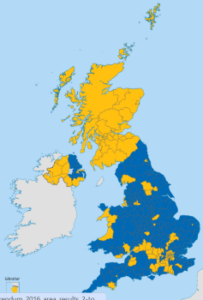
Finally, you may have noticed the UK map at the top of this entry, showing the 2016 council districts and unitary authorities that voted for leaving the EU in blue and those that voted for remaining in it in yellow.  Scotland is entirely yellow – not one Scottish district recorded a majority for ‘leave’ and, overall, 62% of Scottish voters supported ‘remain’.  Yet, because a majority of the electorate in England voted for Brexit, Scotland was dragged out of the EU against its will.  Two years earlier, when the Scots had a referendum on whether or not their country should be an independent country, the ‘no’ side claimed that staying in the UK was the safest option for Scotland retaining its membership of the EU.  The EU argument was surely a major reason why the anti-Scottish-independence, pro-UK lobby won in Scotland in 2014.  So much for that.  Incidentally, a recent academic study has estimated that, thanks to Brexit, Scotland is 30 billion pounds a year worse off.


In the aftermath of the 2016 referendum, Scottish Member of the European Parliament Alyn Smith gave a farewell speech to his fellow MEPs in which he summed up how many in Scotland felt.  He asked the European Parliament to “leave a light on so that we can find our way back home.”

 

Three days ago, on the Brexit vote’s tenth anniversary, I was in Edinburgh and found myself in the vicinity of the Scottish Parliament, outside which four flags flutter at the top of four flagpoles: the Scottish saltire, the Union Jack, the Ukrainian flag and the European Union flag with its dozen stars.  In 2020, in defiance of Brexit, a majority of Members of the Scottish Parliament voted to keep the European flag flying there.

 

The parliament now has a minority of far-right Reform MSPs and one of them, Senga Beresford – who in the past has called for mass deportations of British Muslims and expressed support for fascist rabble-rouser Stephen Yaxley-Lennon – marked the anniversary by demanding that the flag be brought down.  Well, to hell with that.  Especially when her party is currently planning to tear up agreements made with the EU and target EU nationals with settled status in Britain by evicting them from social housing and making it “notably more expensive for companies to employ them”.  I’m sure settled-status EU nationals in Scotland are glad to see that flag at the parliament, showing some Scottish solidarity with them.

 

And let’s hope it continues to fly there until Scotland does find a way back to Europe – with or without the rest of the UK.


How low will you go?


From pixabay.com / © Geralt


When The Simpsons was the greatest thing on television a long – a very long – time ago, I remember a 1999 episode, They Saved Lisa’s Brain, that began with a contest being held in Springfield and broadcast live on TV called How Low Will You Go?  According to the entry about it on the WikiSimpsons site, How Low Will You Go? was ‘sponsored by Grandma Plopwell’s Pudding’ and its winner ‘would be the person who did the stupidest thing on the stage.’  Contestants included Bart Simpson eating ‘everything that was thrown at him’, Homer Simpson wearing ‘a suit made of popcorn kernels’ and singing a song called Kernel Knowledge, and Moe Szyslak ‘dressed in a sailor suit with a giant lollipop.’


When I saw the episode more than a quarter-century ago, I remember reacting to this indictment of how people are humiliated and degraded by TV and its promises of instant celebrity by thinking: Wow, that is pretty low!  Of course, I didn’t know it at the time, but I hadn’t seen anything yet.  In the decades since, TV – often of the ‘reality’ variety – has induced folk to do far worse things and make far bigger dicks of themselves on camera, to the point where cavorting around in a suit made of popcorn kernels actually seems quite highbrow in comparison.


Anyway, I feel like How Low Will You Go? has now become a TV series that’s in the middle of its second season.  Each season lasts for four years and takes place in the White House whenever Donald Trump is the US president.  Season one lasted from 2016 to 2020.  Season two began in 2024 and is due to end in 2028.  That is, if the USA still exists by 2028.  Come to think of it, if the world still exists by 2028.


In season one, Trump proved that yes, he could go pretty low.  He shamelessly sucked up to Putin.  He belittled a war veteran, John McCain, who’d served his country in Vietnam and spent more than five years as a prisoner of war there.  (“I like people who weren’t captured!”)  He skipped attending an event in honour of American soldiers killed in World War One at France’s Aisne-Marne American Cemetery on the 100th anniversary of Armistice Day because he couldn’t handle the fact it was raining.  He mocked a reporter suffering from congenital joint condition in front of a rally by doing an impersonation of him that an obnoxious kid would do of someone with cerebral palsy.


He suggested injecting bleach as a cure for Covid-19.   He describing developing-world nations as ‘shithole countries’.  He leched after his own daughter, talking about her ‘breasts, her backside, and what it might be like to have sex with her.’  He told 30,573 lies, according to the Washington Post.  Oh, and when he lost the presidential election in 2020, he claimed, baselessly, it’d been ‘rigged’ and incited a mob of his dingbat supporters to attack the US Capitol, where they chanted about hanging Trump’s own vice-president and tried to prevent Joe Biden’s victory in the election being formalised.


The Trump version of How Will You Go?, season one, was a ratings hit.  In fact, a sufficient number of Americans thought it was so wonderful that they voted Trump back into the White House in 2024 for a second season.  And, so far, season two hasn’t disappointed.  How far can the man go this time?  Why, far, far lower!


He’s threatened to annex the USA’s next-door neighbour and important ally and trading partner Canada, so that now everyone in Canada hates his guts, won’t visit his country and spend money there, and won’t buy American products like American bourbon.  He’s threatened to annex Greenland, which belongs to a country in a military alliance the USA is in, an alliance whose basic doctrine would require all the other member countries to go to war with the USA if he attempted to annex it.  Makes sense, yes?


From wikipedia.org / © The White House


He’s shamelessly sucked up to Putin, again.  He’s insulted reporters, often female ones – intelligent and independent-minded women are obviously a group he has serious issues with – calling them ‘piggie’ and ‘crooked or stupid’ and ‘corrupt’ with ‘hatred in her eyes’.  He’s whinged like a spoilt brat about not receiving a Nobel Peace Prize.  He’s fallen asleep in meetings and press conferences after he sneeringly dubbed his presidential predecessor ‘Sleepy Joe’ Biden.  He’s relentlessly posted AI crap on his Truth Social platform, including footage of him in a plane dropping gigantic turds on ‘No Kings’ protestors, pictures of himself as Jesus, and images depicting Barack and Michelle Obama as apes.


He’s also allowed himself to be bounced into a war against Iran by Benjamin Netanyahu, with the result that the Strait of Hormuz, and the maritime route carrying 20 percent of the world’s oil supply, are now blocked.  The other day, he claimed his administration and the Iranians were on the brink of agreeing on a peace deal…  But as he’s already claimed this about 40 times since the conflict started in February, I’m not going to hold my breath.  At least for Trump, it takes folk’s minds off his sizeable presence in the Epstein Files.


To spice things up even further, the producers of season two of How Low Will You Go? have brought in additional cast-members to give Trump a run for his money in going low.  Thus, we’ve had Vice President J. D. Vance insulting single women who keep cats and being a malicious prick towards the Ukrainian president Volodymyr Zelensky, a leader with more courage in his little finger than Vance and Trump have in their entire, make-up-enhanced bodies.


They’ve also introduced the ultra-ridiculous Pete Hegseth, who was Trump’s Secretary of Defence until Hegseth persuaded him to change the title to the more manly and harder-sounding ‘Secretary of War’, and who pees his pants in rage when press photographers take pictures of him from what he considers unflattering angles.  At a recent gathering in France commemorating the 82nd anniversary of the D-Day landings, Hegseth gave a speech condemning European nations for allowing their beaches to be “stormed by different, dangerous ideologies”, i.e., people he considers not sufficiently white enough and Christian enough to be let in.  I really don’t know why Hegseth turned up at this event.  After all, 82 years ago, his side lost.


Today, June 14th, we get another episode in How Low Will You Go?  It’s Trump’s 80th birthday and he’s marking it by staging Ultimate Fighting Championship (UFC) bouts on the South Lawn of the White House.  The Las Vegas-based UFC organises ‘mixed martial-arts’ combat – basically, violent ‘anything-goes’ scraps – inside cages.  So, the seat of the American presidency is about to host cage fights.  That really resonates with the dignity of the place and those who’ve lived there in the past, one-time holders of the USA’s highest office like Abraham Lincoln, Teddy and Franklin D. Roosevelt, Harry S. Truman, Dwight D. Eisenhower and John F. Kennedy.  If Honest Abe, FDR, JFK and the rest are watching this from the clouds, they’ll be doing so between their fingers.


What’s been installed for those UFC bouts consists of an enclosed octagonal ring with a huge, claw-like superstructure built over it with clusters of lights and big TV screens attached.  The ring is emblazoned with the names of sponsors like Bud Light, Toyo Tires and Pit Boss Grills.  And, inevitably, the web address crypto.com features prominently too.


It makes me think of the 1986 movie Mad Max Beyond Thunderdome and the hemispherical gladiatorial arena where Max and Blaster had to fight it out with chainsaws and sledgehammers.  Trump’s spectacle at the White House sounds just as dystopian – though at least in the Mad Max movie, the dictator presiding over things was played by Tina Turner.  I’d have her as my dystopian overlord rather than the revolting, decaying Trump any day of the week.


From wikipedia.org / © Warner Bros / Kennedy Miller Productions


Oh well, I suppose there’s one silver lining to this.  Trump’s crass preoccupation with having UFC fighters slug it out on his lawn has at least diverted his attention from the Football World Cup, which kicked off in Canada, Mexico and the USA a few days ago.  He hasn’t tried to insert himself into that, so far.  I was particularly worried he’d turn up at yesterday’s match between Scotland and Haiti in Boston, since he loves talking about his Scottish roots – his mother hailed from the Isle of Lewis – and since he hates Haitians.  (During the run-up to the 2024 presidential election, both he and Vance yet again showed how low they’d go by lying about Haitian immigrants in Ohio eating people’s domestic pets.)  If he’d shown his orange face at the match, I think I would have found myself wanting Haiti to win, just to sicken him.*


*Trump didn’t appear, I was able to support Scotland as normal and Scotland won, just about.  Phew.       

The comeback kid


From wikipedia.org / © Scottish Government


I’ve always had an unhealthy obsession with politics.  Lately, however, I’ve written less about the subject on this blog because my obsession was becoming literally unhealthy – ruminating on politics and politicians in 2026 was filling my head with dark and depressing thoughts.  Nonetheless, I’ll now make some comments about the election for the Scottish Parliament, which happened on May 7th. That day also saw elections for the Welsh Senedd and for various local authorities in England, but I’ll only mention those in passing.


If you’re not a political anorak, you might want to skip this.


So: the results were 58 seats for the Scottish National Party (down six from the previous election in 2021); 17 for Scottish Labour (down five); 17 for Reform UK (up 17); 15 for the Scottish Greens (up seven); 12 for the Scottish Conservative and Unionist Party (down 19); and ten for the Scottish Liberal Democrats (up six).


Despite securing six seats less than their 2021 total, and seven seats short of a parliamentary majority, the result was impressive for the SNP in that this is the fifth election in a row where they’ve ended up as the biggest, government-forming party.  Keir Starmer’s Labour government at Westminster, which hasn’t been in power for two years yet and is already as popular as a fart in a spacesuit, would kill for such longevity and  durability.


It’s also quite a comeback for SNP leader John Swinney.  Originally Swinney served as SNP leader from 2000 to 2004, when his party was in opposition in the Scottish Parliament.  It wasn’t a happy experience for him.  In the 2003 Scottish election his party dropped from 35 to 28 seats and the following year he resigned.  He later described being opposition leader as “the worst, most awful, most sapping, most soul-destroying job in politics…”


Having enjoyed spells as a cabinet minister and Deputy First Minister, Swinney was planning to retire at this year’s election.  However,  in May 2024, after the affable but hapless Humza Yousaf resigned as First Minister, Swinney surprised everyone by standing unopposed for – with his famous negotiating skills, he managed to sweet-talk the formidable likes of Kate Forbes into not running against him – and winning the leadership again, 20 years after losing it.  And this time, he became First Minister of Scotland too.  Many assumed he would act as a ‘caretaker’ FM, until someone younger and with more chutzpah came along, but thanks to this election result he’s likely to be around for a while.


While I’d never describe Swinney as someone who sets the heather alight, and if he got a fiver every time someone likened his demeanour to that of a bank manager he’d probably be a billionaire by now, I have to say I think he’s a decent guy and I’d rather have him in charge of Scotland than most other Scottish politicians.  I’m biased in this regard.  As I wrote on this blog before, I encountered him a couple of times during my youth, via my old schoolmate Roger Small, who was best friends with him at university, and I liked him.  But it’s not just me.  Most people, political friends and foes alike, seem to like Swinney.


Even the world’s most horrible man, Donald Trump, has a soft spot for him.  In 2025, Trump declared, “John Swinney is a terrific guy — and loves golf and loves the people of this country, and we really appreciate it.”  Yes, I know that Trump thinks Vladimir Putin, Xi Jinping and Kim Jong Un are the bees’ knees, so being liked by him isn’t necessarily a ringing endorsement of your character.


More recently, when Trump announced the removal of US tariffs on Scotch whisky, Swinney claimed this was due in part to a meeting he had with the US president last September.  He was criticised for saying this by the UK government’s Secretary of State for Scotland Douglas Alexander, who argued that trade agreements weren’t in the remit of a leader of a devolved administration.  But after the election result, Trump messaged, “Congratulations to John Swinney on winning his Re-Election for First Minister of Scotland.  He is a good man, who worked very hard along with the King and Queen of the United Kingdom, with respect to Tariff Relief for Great Scottish Whiskey – and deserves this Big Electoral Victory!”  So now, Dougie Alexander looks a bit of a chump.


Trump, being a low IQ individual, misspelt ‘Scottish whisky’ as ‘Scottish whiskey’.  The stuff spelt with an ‘e’ is actually made in Ireland.


From wikipedia.org / © Scottish Parliament / youtube.com

 

Elsewhere, Scottish Labour and the Scottish Conservatives had their worst ever performances in a Scottish parliamentary election.  Labour leader Anas Sawar hit the headlines back in February when he demanded that Keir Starmer resign as British Prime Minister: “The situation in Downing Street is not good enough. There have been too many mistakes.”  Sarwar’s resignation-call distanced him and his branch of the Labour party from the wildly unpopular Starmer and it generated  a lot of publicity at the time.  But when Starmer said no, he wouldn’t be resigning, it looked less like a political earthquake and more like a mild political bowel-movement.  It highlighted Sarwar’s place as Scottish party leader in the great scheme of things – not high.  It also meant Starmer was embarrassingly conspicuous by his absence in Scotland when Labour started campaigning for the election there.


The Scottish Tories have been reduced to a rump, their number of Members of the Scottish Parliament (MSPs) barely in double figures.  Their leader Russell Findlay has tried to talk them up in the Tory-friendly pages of the Scottish Daily Mail, describing them as the ‘Dynamic Dozen’.  I wouldn’t describe any dozen that includes such numpties as Murdo Fraser, the man who once asked Donald Trump if he’d consider buying Glasgow Rangers Football Club, as ‘dynamic’.  Maybe ‘dysfunctional’ or ‘dystopian’.

 

Following a near-extinction event caused by their coalition with the Conservatives in Westminster in the early 2010s, the Liberal Democrats have enjoyed something of a revival.  The passing of time has clearly detoxified their reputation a little in folk’s memories.  That said, I don’t know how anyone can stomach their Scottish leader Alexander Cole-Hamilton, who to me comes across as being insufferably arrogant.


And the Scottish Greens have almost doubled their representation in the parliament.  Without wishing to downplay this achievement, I suspect they enjoyed the best of both worlds in relation to the English and Welsh Greens – a separate party – south of the border.  They benefited from the wave of enthusiasm, and publicity, that their southern counterparts experienced earlier this year.  Simultaneously, as a separate party, they were distant enough from them to escape the more recent backlash against the English / Welsh party’s leader Zack Polanski, who stupidly retweeted something about the attack on two Jewish men in Golders Green and then suffered an all-out assault from the right-wing media determined to portray him as an antisemite.  (This despite Polanski being Jewish himself and despite some of the media’s caricatures of him being… hideously antisemitic.)


The Scottish Greens are co-led by Gillian Mackay and the chirpy Ross Greer.  I know Greer is a ‘Marmite’ politician for many, but I like how he puts the wind up gammons like Piers Morgan.


From youtube.com / © ITV


With the SNP on 58 MSPs, and the pro-Scottish-independence Greens on 15, 73 MSPs now support Scotland leaving the United Kingdom, as opposed to 56 unionist MSPs who don’t.  It’s the parliament’s biggest ever pro-independence majority.  Of course, you won’t have heard much about that fact from Scotland’s (unionist-owned) mainstream media, who instead have obsessed on a different fact – that the parliament suddenly has 17 far-right Reform MPs.  Nigel Farage’s extremist party had representation there before, thanks to one MSP defecting to them from the Conservatives.  But today, with Labour, they’re the joint-second biggest party.

 

This has prompted journalists like the Times’s Kenny Farquharson to declare ‘the death of Scottish exceptionalism’ – Scottish exceptionalism being the idea that Scottish voters are more community-orientated, more considerate of their fellow citizens, more leftwing and, generally, nicer than voters than those elsewhere in the UK, especially in England.  Reform’s showing proves that, no, the Scots are just as right-wing and awful as everyone else.


Well, I find it nauseating that the  parliament contains 17 MSPs who, if their party ever came to power, would enact Trump-style authoritarian and racist policies.  One of them, Senga Beresford, representing the South Scotland region, has already caused controversy by expressing admiration for fascist lout Stephen Yaxley-Lennon on social media.  But I derive some comfort from the fact that none of those MSPs were elected through the parliament’s first-past-the-post, constituency-based voting system, responsible for deciding 73 of the 129 MSPs.  Reform’s 17 sneaked in afterwards, via the additional, regional-based ‘list’ system.  Also, the Conservatives won 31 seats at the previous election, but have been culled to 12, and that number plus Reform’s 17 puts the total number of right-wingers  at 29 – two less than before.

 

I certainly don’t see Scotland as being exceptional, i.e., better than anywhere else.  I’ve met plenty of Scots who’ve been arseholes as much as arsehole-y people from other places.  But Scotland is still different from other parts of the UK.  If it wasn’t different, it wouldn’t have its own languages, literature, music, sports teams, legal system, educational system, etc.  It wouldn’t have been scunnered by Margaret Thatcher in the 1980s while people elsewhere were proclaiming her the new, handbag-wielding messiah.  It wouldn’t have voted heavily against Brexit when people in England and Wales voted for it.  It wouldn’t have its own independence movement with, now, a 57% majority in the Scottish parliament.  I know that sticks in the craws of unionist politicians and journalists who’d have you believe that Scotland is absolutely indistinguishable from the rest of the UK, that a punter from Elgin is identical to a punter from Ely.

 

Talking of journalists, the coverage of the election in the Scottish mainstream media was woeful.  The unionist newspapers (i.e., nearly all of them) spent half the time wailing “Everything in Scotland is shite!” and the other half wailing, “How dare anyone suggest doing anything even vaguely radical to improve things!”  Swinney’s proposal that, in an emergency, the Scottish government should put a cap on the price of essential food products so that poor people could still buy them, was met with hoots of derision – and the sneering observation that the UK government would never allow it.  (A Labour government – “For the many, not the few” – denying someone the right to keep essential foodstuffs affordable for the nation’s poorest people?  Not a great look.)


I thought the recent opinion-piece by Scottish journalist Stephen Daisley in the Spectator, calling on the Labour and Conservative parties to get rid of the UK’s devolved parliaments (“Dr. Frankenstein would understand that it was his duty to put down the hideous creature his foolishness and vanity unleashed on the world”), was bad enough.  But the articles that his fellow Scottish journo Chris Deerin penned about Scottish Reform leader Malcolm Offord, for the supposedly left-wing New Statesman, went to arse-licking extremes where no article has gone before.


And now, with Plaid Cymru’s Rhun ap Iorwerth the First Minister in Cardiff, and Sinn Fein’s Michelle O’Neill the First Minister in Belfast, all three devolved governments in the United Kingdom are helmed by people who see their nations’ futures as being outside that supposedly united kingdom.  Interesting times indeed…


But you won’t ever read about that in the newspapers.


From wikipedia.org / © User Colin

The missiles are flying… Hallelujah! Hallelujah!


© Paramount Pictures / Dino De Laurentiis Company


With Donald Trump enacting his latest insanity – joining forces with Israel and bombing the bejeezus out of Iran, which has prompted the latter country to retaliate by firing ordinance in all directions and lighting up the Middle East like a Christmas tree – I find myself thinking of Greg Stillson, a character featuring prominently in Stephen King’s novel The Dead Zone (1979).  In the David Cronenberg-directed movie version of The Dead Zone (1983), Stillson is played by Martin Sheen.  It’s Sheen, as Stillson, who utters the quote that’s this blog-entry’s title.


Stillson is a psychotic bully who begins as a salesman, becomes a businessman and then a politician, and finally leads a populist movement that sweeps him into the White House.  Well, he does in one timeline.  Before winning the presidency, while he’s on the campaign trail, he shakes hands with The Dead Zone’s hero, Johnny Smith, who’s been blessed – or cursed – with the power to see into people’s futures just by touching them.  He has a vision of Stillson’s future wherein, as a despotic and unhinged US president, he presses the buttons that trigger an apocalyptic nuclear war.  Thereafter, Smith has to decide how he’s going to stop him.  (Spoiler – he does, but with tragic consequences for himself.)


I don’t know if anyone with clairvoyant visions touched one of Trump’s little hands a couple of decades ago and witnessed him pressing buttons and wiping out humanity in 2026, the 250th anniversary of American independence.  But it wouldn’t surprise me if someone had.


Anyway, it doesn’t need saying, but Trump’s actions – which began on February 27th, when in conjunction with the Israelis and under the moniker ‘Operation Epic Fury’, he had his military bombard Iran with missiles and drones; one source estimating on March 4th that nearly 900 people had been killed so far, including Iran’s Supreme Leader Ayatollah Ali Khamenei – are a vastly bad idea for many reasons.  Here are some of those reasons.


From wikipedia.org / farsi.khamenei.ir


One.  The attack is illegal under international law.  In the Conversation, Shannon Brincat and Juan Zahir Naranjo Caceres have written that “Israel said the strikes were ‘preventative’, meaning they were to prevent Iran from developing a capacity to be a threat.”  However, they point out that “preventative war has no legal basis under international law. The UN Security Council did not authorize any military action, meaning the sole lawful pathway for the use of force for self-defence was never pursued.”


Two.  The attack went against the American constitution.  The American historian Heather Cox Richardson has noted on her Substack: “In his letter to Congress notifying them of his attack, Trump said he had acted under the 1973 War Powers Act, which permits a president to attack another country if there is an urgent threat.  But the letter itself doesn’t identify any such urgent threat.  It simply said Iran is one of the world’s largest sponsors of state terrorism and that it ‘continues to seek the means to possess and employ nuclear weapons’…  The Framers of the Constitution placed the power to declare war in the hands of Congress and not in the president above all because they did not trust that much power in the hands of one man…”


Three.  It’s likely Benjamin Netanyahu bounced the USA into the attack.  Going back to Reason One, the supposedly ‘preventative’ nature of the USA and Israel’s assault on Iran is torturous to say the least.  A few days ago, US Secretary of State Marco Rubio said, “It was abundantly clear that if Iran came under attack by anyone – the United States or Israel or anyone – they were going to respond, and respond against the United States…  We knew that there was going to be an Israeli action. We knew that that would precipitate an attack against American forces, and we knew that if we didn’t pre-emptively go after them before they launched those attacks, we would suffer higher casualties.”


In other words..  We had to attack them before they attacked us, which they would surely do because Israel intended to attack them first.  This means the USA’s vast military firepower isn’t actually under the control of the American commander-in-chief, but under that of Israeli Prime Minister Benjamin Netanyahu.  The wily Netanyahu says ‘Jump’, the Americans say ‘How high?’


Four.  Dodgy Middle Eastern deals are possibly involved.  Who else, besides Netanyahu, has a finger in the pie here?  In 2025 Trump did investment deals with Saudi Arabia, Qatar and the United Arab Emirates, which he claimed were worth over two trillion dollars.  Qatar saw fit to gift – some would use the verb ‘bribe’ – Trump with a 400-million-dollar Boeing jumbo jet that he plans to turn into a new Air Force One, making one wonder how much of these investments will be enriching Trump and his clan rather than the USA itself.  Also, Trump’s son-in-law Jared Kushner and Steve Witkoff – the real-estate developer whom, laughably, Trump sent into negotiations with Russia about the Ukraine War even though he had zero diplomatic experience – have been in the Middle East lately as ‘envoys’, hawking the idea that the decimated Gaza should be reinvented as a luxury resort with ‘180 skyscrapers’ (and any remaining Palestinians, presumably, doing jobs like cleaning the toilets).


In the future, if a saner administration ever comes to power in Washington DC and launches an investigation into this debacle, it’d be wise to ‘follow the money’.  I’ll bet at least some of the encouragement for this war came from business interests and wealthy leaders in the Middle East who regarded the Iranian regime as an undesirable neighbour, lowering the tone and property value of the area, and wanted it removed.


Five.  It’s actually Operation Forget Epstein.  Trump likes to distract.  When the headlines look bad for him, he does something outrageous that generates different headlines – not necessarily favourable ones, but enough to banish the previous, bad headlines from people’s memories.  This works especially well in our screen-obsessed, social-media-fixated era where attention-spans are short.


On February 25th, the New York Times published a report under the headline EPSTEIN FILES ARE MISSING RECORDS ABOUT WOMAN WHO MADE CLAIMS AGAINST TRUMP.  This mentioned documents “released by the Justice Department” that “briefly mention a woman’s unverified accusation that Donald J. Trump assaulted her in the 1980s, when she was a minor.”  Yet other documents relating to these allegations have been withheld or removed from the public database about Trump’s paedophilic, sex-trafficking old buddy Jeffrey Epstein.


And two days later, the assault began on Iran.  Funny, that.


From wikipedia.org / © Jesse Monford


Six.  There’s no plan and no objectives.  The George Bush Jr-led invasion of Iraq in 2003, which toppled Saddam Hussein but created massive instability and led to huge numbers of fatalities – estimates of which range “from 151,000 violent deaths as of June 2006 (per the Iraq Family Health Survey) to 1,033,000 excess deaths (per the 2007 Opinion Research Business [ORB] Survey)” – was a ruinous fiasco. It was also built on the lie that Saddam possessed ‘Weapons of Mass Destruction’.  But compared to Trump’s Iran incursion, it looks like a masterpiece of planning.


For one thing, to have a plan, you actually need to have objectives, i.e., things to plan towards. Trump and his cabinet apparently have no idea what the goal of all this is.  Rubio, as we’ve seen, has said they’re waging war simply because that’s what the Israelis are doing.  Meanwhile, Trump has suggested at one point it’s to achieve regime-change in Iran and replace Khamenei with someone more compliant to US interests, as was allegedly done in Venezuela after the abduction of its former president, Nicolas Maduro.  Though the other day Trump admitted there was a problem with this because his airstrikes had killed all the possible candidates to take over: “…none of the people we had in mind are going to come to power, because they are all dead.”  No, so far, that doesn’t sound like a brilliantly executed plan.


Trump has also claimed the war is to prevent Iran developing nuclear weapons, even though after the USA carried out a bombing raid on Iran in June last year he was adamant that “Iran’s key nuclear enrichment facilities have been completely and totally obliterated.” Trump has tried to justify this new war by saying Iran was – here plucking a figure out of his arse – ‘two weeks’ away from acquiring a nuclear weapon.


Elsewhere, it’s been suggested the war is to encourage the Iranian people to rise up and overthrow the regime that’s oppressed and abused them for 47 years; to stop Iran sponsoring terrorism; and to destroy Iran’s navy.  But most likely it’s because Trump woke up the other morning, looked out of the window and thought, “Gee, this would be a good day to bomb Iran back to the Stone Age.”


Seven.  This sort of thing has been tried before.  Vietnam…  Afghanistan…  Iraq…  Libya.


Eight.  Possible destabilization of the Middle East.  Even if by some fluke Iran ends up with a Trump-and-Netanyahu-approved government, it’s difficult to see how it can impose order on a country so diverse and, after all this devastation and upheaval, febrile.  Iran’s population is 61 percent Persian, 16 percent Azerbaijani and 10 percent Kurdish, and the rest of it includes people like Lurs, Arabs, Baloch, Arabs and Turkish groups.  While it’s overwhelmingly Shia Muslim, 9 percent of the population are Sunni and other sects of Muslim and there are also Baha’i, Christians, Zoroastrians, Jews and Sabean Mandeans.  That’s before we get to political differences.  Has anyone in Washington DC considered this?  I doubt it.


Civil war in Iran could have devastating consequences for the Middle East.  We’ve already seen the current conflict’s knock-on effects on the world’s oil supply, especially the disruption of tanker-traffic in the Strait of Hormuz, and on air travel, with more than 20,000 flights grounded and a million people stranded around the world since late February.  The Middle East going J.G. Ballard is not good news for anyone.  Well, apart from Vladimir Putin, who’ll see an increase in demand for Russian oil.


Nine.  China may be thinking, “Hold my beer!”  Trump’s rhetoric about attacking Iran sounds uncomfortably like Putin’s excuse for invading Ukraine in 2022 – his goal was to ‘demilitarise’ and ‘denazify’ the country.  I also suspect China is watching keenly and wondering how it could cook up a similar motive for taking over Taiwan in the future.


Incidentally, Taiwan is the world’s foremost producer of Artificial Intelligence chips and according to the New York Times, without those chips, “the tech industry and the US economy would be crippled.”  Haven’t thought that one through either, have you, Donald?


From pixabay.com / © clecaux

Democracy dies in Donald-grovelling


From wikipedia.org / © The Washington Post


What would you say to Epstein survivors…?


You are so bad.  You are the worst reporter.  No wonder CNN has no ratings.  She’s a young woman.  I don’t think I’ve ever seen you smile.   They should be ashamed of you.”


On February 4th, CNN reporter Kaitlan Collins was cut off in the middle of a question about the victims of Jeffrey Epstein, notorious paedophile, human trafficker and friend to the rich and famous, at a White House press conference.  Cutting her off was President Donald Trump, coincidentally someone who receives, according to the New York Times, 38,000 mentions in the Epstein files so far released by the US Department of Justice.  Evidently, in Trump’s mind, you need to smile when you ask questions about victims of paedophilia and human trafficking.


I find his objection ironic considering that for the last 21 years Trump’s been married to Melania Trump, a woman on whose visage – gimlet-eyed and as smooth, hard and unyielding as an iron bedpan – anything resembling a smile rarely flickers.  Obviously, though, if you were expected to share a marital bed with Trump, your face wouldn’t be projecting sunbeams and rainbows either.


Lately, Melania Trump has been in the news because of the release of a new documentary movie about her.  Entitled Melania, it focuses on her during the run-up to her husband’s second inauguration as president.  Jeff Bezos’s Amazon paid 40 million dollars for the rights to the documentary – 28 million of that reportedly going straight into Ms. Trump’s pocket – and another 35 million to advertise it.


Reviews of Melania have not been, shall we say, overly enthusiastic.  The last time I checked the review aggregate site Rotten Tomatoes, its ‘Tomato-meter’ had it at seven percent.  William Thomas at Empire magazine advised, “Do try not to choke on your popcorn.”  Sean Burns at North Shore Movies observed, “At least Leni Riefenstahl could frame a shot.”  Mark Kermode at Kermode and Mayo’s Take – The Brand New Podcast described it as “the most depressing experience I have ever had in the cinema.”  He added, “I mean, I’ve seen A Serbian Film (2010), I’ve seen Cannibal Holocaust (1980), I have never felt this depressed…  I thought it was absolutely repugnant.”


By the way, the director of Melania is Brett Ratner, who in 2017 was accused of sexual assault and harassment by six women, accusations he’s denied.  In photos recently released from the Epstein files, he appears sitting on a sofa beside the late, loathsome paedophile, both of them cuddling young women.  The women’s faces are blocked to protect their identities, so you can’t tell how young they are.


I should also say that Melania made seven million dollars on its opening weekend, a decent haul for a documentary.  Obviously, it appeals to a certain audience in the USA, i.e., cultish MAGA dingbats so worshipful of her husband they’d spend a fortune on eBay to acquire pieces of his used toilet paper, which they’d then frame and hang prominently in their living rooms.  However, it still looks like it’ll be a long time before Amazon recoups anything like the 75 million dollars it invested in the movie.


From wikipedia.org / © White House


In totally unconnected developments during Trump’s first year as 47th president, the Orange One signed an executive order relaxing environmental rules about space launches (benefiting Bezos’s private space venture Blue Origin); signed an order preventing US states from enforcing their own AI regulations (benefiting Bezos’s AI start-up Project Prometheus); and generally created a oligarch-friendly climate that’s allowed Bezos and fellow magnificoes Elon Musk and Mark Zuckerberg to increase their collective wealth by approximately 250 billion dollars.


But I don’t know why Bezos would take a financial hit by getting involved in Melania, a vanity project that nobody apart from those hardcore MAGA nutters would pay money to see.  I really don’t know.


In other, totally unconnected news last week, the Washington Post, a once-respected newspaper whose motto is ‘Democracy dies in darkness’, and which broke the story about the Watergate scandal that brought down Richard Nixon’s presidency in 1974, has announced a ‘strategic reset’.  This reset involves showing a third of its current workforce the door.  It’s also “ending the current iteration of its popular sports desk… restructuring its local coverage, reducing its international reporting operation, cutting its books desk and suspending its flagship daily news podcast Post Reports.”  The loss of the Washington Post’s books desk means it’ll no longer publish its literary review supplement Book World.


The Washington Post has been on a downward spiral this past year, a spiral of its – or its proprietor’s – own making.  Previously, and unsurprisingly, it’d not been enamoured with Trump.  As 2024’s presidential race neared election day, however, and with Trump looking likely to regain the White House and launch his glorious new thousand-year Reich, the Washington Post’s editorial board was ordered not to publish an editorial endorsing Kamala Harris, Trump’s rival for the presidency.  As a result, more than 200,000 disgusted readers – eight percent of its 2.5 million-strong readership – cancelled their digital subscriptions to the newspaper.


After the announcement of the Washington Post‘s downsizing, its legendary Watergate  reporter Bob Woodward lamented, “I am crushed that so many of my beloved colleagues have lost their jobs and our readers have been given less news and sound analysis.  They deserve more.”  Meanwhile, Trump’s Communications Director Steve Cheung crowed on Twitter, “Just a reminder that printing fake news is not a profitable business model.”


Earlier, the Washington Post’s proprietor had defended his decision to have the newspaper sit on the fence before the 2024 election, which’d started the rot.  He wrote: “Presidential endorsements do nothing to tip the scales of an election…  What presidential endorsements actually do is create a perception of bias.  A perception of non-independence.  Ending them is a principled decision, and it’s the right one.”  Aye, right.  That’s the principled thing to do.  When there’s a choice between a candidate who’s a convicted criminal and convicted sexual abuser and a candidate who isn’t, you say nothing.  Heaven forbid anyone perceives you as being biased and non-independent.


From wikipedia.org / © Van Ha, US Space Force


And who’s the proprietor of the Washington Post?  Oh look, it’s Jeff Bezos.  Funny that he should take a hit by alienating his newspaper’s natural readership and sending it down the toilet, just as he took a hit by shelling out 75 million dollars for a dud like the Melania movie.  It’s almost like he has an ulterior motive.  Almost like he’s trying to… curry favour with someone.


But seriously.  A while ago, I posted about “an unholy alliance of authoritarians, kleptocrats, fascists, media tycoons, tech bros and oil barons”, working hard “at stripping freedoms from those of us living in societies that,  until now, have retained some freedoms; at transferring another huge chunk of wealth from our dwindling coffers to their swelling coffers; and at burning and poisoning the planet we live on in their quest for profits whilst aggressively pushing the line that any science questioning this policy is a ‘hoax’.”  You see that here.  Bezos grovelling to Trump by financing his missus’s dreadful movie and nuking the Washington Post.  As a reward, Trump throwing him a few legislative and financial scraps from the White House table so he can carry on making pots of money for himself.


And with Bezos and his ilk embracing automation and Artificial Intelligence to maximise profits by eliminating human employees, and salaries, the future looks grim.  Journalists will soon go the way of lamplighters, elevator operators, switchboard operators and video store clerks.  News copy will be written by AI technology, controlled by billionaires, who’ll make sure that copy panders to their interests and those of their political allies.  And if there’s bad news they can’t avoid reporting, it’ll be blamed on those people not plugged into their extreme-right-wing, white-Christian-nationalist gestalt: blacks, Latinos, Muslims, Jews, atheists, gays, trans-people, liberals, socialists, trade unionists.


Education will be similar.  Teachers will disappear too and kids will be taught by AI, with the likes of Elon Musk deciding what’s in the curriculum.  Indeed, Musk has done a deal with El Salvador’s government to “bring his artificial intelligence company’s chatbot, Grok, to more than 1 million students across the country… to ‘deploy’ the chatbot to more than 5,000 public schools in an ‘AI-powered education program’.”  Yes, that’s Grok, the lovable chatbot that praises Hitler and puts tweens in tiny bikinis for the gratification of paedophiles, coming to a school near you to teach your kids.


The stinking rich and stinking powerful won’t only hoard wealth – they’ll hoard information too, whilst making sure only small, approved increments of it leak down to the masses they regard as their serfs and inferiors.  Especially manipulated will be scientific information about the climate catastrophe posing an increasing threat to our civilisation’s survival on this planet.  So that their environmentally-ruinous cash-generating projects, like power-guzzling and water-guzzling AI data centres, escape censure, they’ll suppress this information or bury it under an avalanche of counter-arguing pseudoscientific gibberish, or not collect it in the first place.


But let’s end positively.  While it’s sickening to watch America’s business magnates, corporations, media organisations, law firms and universities bend over supinely and lick Trump’s gruesome arse, the way ordinary Americans have reacted to his policies gives glimmers of hope.


© MS NOW


I’m thinking especially of Minneapolis.  Since December, the city has been overrun and brutalised by up to 3000 of Trump’s masked, violent, badly-trained thugs from Immigration and Customs (ICE) and Customs and Border Patrol.  Ostensibly, they came to crack down on fraud allegedly committed by Minneapolis’s Somali-American community.  In reality, as Wikipedia reports, they’ve assaulted, harassed and detained people  “on the basis of their alleged or suspected immigration status”, including “restaurant, airport and hotel workers, Target employees, children and families, Native Americans, students and commuters”, many of whom “have been US citizens, legal residents with work authorisation, or asylum seekers.”


This has disastrously impacted on the city’s businesses, schools and whole social fabric.  ICE was accused of violating at least 96 court orders during four weeks in January alone; and they’ve executed two citizens during peaceful protests, Renee Good on January 7th and Alex Pretti on January 24th.


Obviously, the operation was designed to intimidate Minneapolis – whose state governor is Tim Walz, Kamala’s running mate against Trump in 2024 – and intimidate liberal-leaning cities generally.  But local people are having none of it.  They’ve protested peacefully, organized strikes, alerted neigbours about approaching ICE patrols, monitored and filmed their activities, and provided support for people at risk from those activities by helping them get to their schools and places of worship unmolested, running errands for them and raising money for them.  They’ve stood by their fellow citizens in a display of decent, old-fashioned community values – values Trump would despise if his reptile brain could ever understand them in the first place.


One thing that particularly impressed and moved me was a viral clip showing a white-bearded old man protesting against ICE on a snowbound and teargas-fogged Minneapolis street on January 24th.  When a reporter and camera crew approached him, he raged, “I’m just angry.  I’m 70 years old and I’m f**king angry.”  Then, wearing neither mask nor goggles, he strode off through a billowing wall of teargas.


That furious but defiant old-timer, it transpired, was Greg Ketter, founder and proprietor of the Minneapolis independent bookstore DreamHaven Books and Comics.  The renowned sci-fi and fantasy writer Harlan Ellison once described DreamHaven as “a book-seeker’s cave of miracles”.


I find it inspiring to see a man who’s devoted a lifetime to books taking a stand against Trump, someone who brags about not reading as if it’s a badge of honour.  And by extension, against Trump’s billionaire toadies, currently trying to create an AI dystopia wherein novels and other human art-forms are replaced by soulless, AI-generated slop.  And against Trump’s toady at Amazon, Jeff Bezos, who’s just axed the Washington Post’s Book World, one of the very few literary supplements the American newspaper industry had left.


From wikipedia.org / © DreamHaven Books & Comics

Paul Thomas Anderson wins this battle


© Warner Bros. Pictures / Ghoulardi Film Company


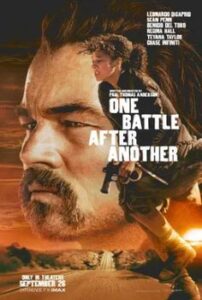
The critics have, almost universally, lavished praise on One Battle after Another (2025), the new movie written and directed by Paul Thomas Anderson.  (Though he didn’t try to adapt it directly, Anderson’s script took some inspiration from Thomas Pynchon’s 1990 novel Vineland.)  The praise is richly deserved.  I went to see it in my local cinema a few days ago and, afterwards, I hadn’t felt so exhilarated by a film since watching Mad Max: Fury Road (2015) on a big screen a decade earlier.


Heading the movie’s cast is Leonard DiCaprio, who plays Pat, a bomb-maker involved in a revolutionary American group called the French 75.  The ’75 stick it to The Man by freeing recent Latin-American immigrants from detention centres and blowing up banks and the offices of right-wing politicians.  Surprisingly, the plodding, unshowy Pat has a relationship, then sires a child, with fellow-revolutionary Perfidia Beverley Hills.  Essayed by Teyana Taylor in a short but devastating performance, Perfidia is the opposite of DiCaprio’s character.  She’s a force of nature: loud, fearless and given to flamboyant gestures, like humiliating the sleazy commander of a detention centre by forcing him to jerk off in front of her.  It’s entirely in keeping with her character when she’s shown firing a machine gun whilst massively pregnant.


To put an end to the French 75, the authorities appoint the ruthless and immoral Captain Steven Lockjaw (Sean Penn), coincidentally the detention-centre commander who was made to have that embarrassing, public wank.  Lockjaw captures Perfidia and compels her to rat on her colleagues, and thereafter it becomes open season on the ’75, with most of them being arrested or – more often – summarily executed.  Pat and his now-infant daughter manage to escape with new identities (‘Bob and Willa Ferguson’) and end up living a low-key, mostly off-grid existence in a Californian town called Baktan Cross.  Pat / Bob decays into a booze and dope-raddled paranoid, terrified the past will catch up with them.  Wilma (Chase Infiniti) grows up with no idea of her real origins and becomes a teenager bemused by, and frequently having to nursemaid, her eccentric old dad.


15 years later, Captain Lockjaw is invited to join an Illuminati-like organization called the Christmas Adventurers Club, whose members belong to the white American elite and are wealthy, powerful… and extremely racist.  Lockjaw’s relationship with Pefidia in the days of the French 75 was more than one of pursuer and quarry.  He came to fetishise her, his obsession triggered by that first, masturbatory encounter, and they were briefly intimate prior to her capture – which highlights what a wild, try-anything-once character Perfidia was.  Now Lockjaw fears that he might be Wilma’s father, not Pat / Bob, and having a mixed-race daughter would obviously torpedo his chances of joining the Christmas Adventurers.  So he launches a military crackdown on Baktan Cross, ostensibly to round up illegal immigrants, but really so he can find Pat / Bob and the inconvenient Wilma and erase them.


© Warner Bros. Pictures / Ghoulardi Film Company


That’s the set-up established during One Battle After Another’s first quarter and it’s all you need to know.  What follows is a cinematic rollercoaster ride as Pat / Bob and Wilma, in separate locations when Lockjaw and his uniformed, heavily-armed goons crash into Baktan Cross, flee, hide, fight back and try to find each other and escape.  Along the way, they  encounter Sensei Sergio St. Carlos (Benicio del Toro), Willa’s local karate teacher who’s much more than he seems; a bounty hunter with a conscience (Eric Schweig); an assassin sent by the Christmas Adventurers to clean up Lockjaw’s mess (John Hoogenakker); some skateboarding radicals; a nasty far-right militia who dispose of people for money; and a secret enclave of nuns with guns


As you’ll gather from the synopsis, One Battle After Another is a politically charged movie.  It regularly focuses on how how the USA reacts to immigrants,  often impoverished, frightened and vulnerable people, both mistreating them and unscrupulously using them as pawns in power games and culture wars.  This is timely considering what Trump and his minions are doing at the moment.  It has to be said, though, that Lockjaw and the police and troops under his command go about their business with much more precision, organization and efficiency than the masked, clumping thugs in Trump’s Immigration and Customs Enforcement (ICE) agency have managed so far.  Predictably, you don’t have to look far on the Internet before you find negative reviews of the movie posted by far-right frothers, incensed by what they see as its Marxist / communist / socialist / radical-leftist leanings.


But as well as being political, One Battle After Another is very funny.  DeCaprio’s Pat / Bob may have been a revolutionary once, but for most of the movie he’s an amusingly grumpy and befuddled middle-aged dad, showing zero patience, say, for his daughter’s insistence that he respects her schoolfriends’ preferred pronouns.  Particularly funny are the scenes where, on the run from Lockjaw, he tries to phone what’s left of the French 75 to beg them for help.  He’s far from impressed when they demand he reels off an array of code-phrases to prove he’s who he says he is – codes he’s mostly forgotten during the past 15 years.  DeCaprio’s subsequent meltdowns are hilarious, though these scenes will strike a chord with anyone who, in the days before voice-recognition, tried to phone their bank but failed to cite the right security numbers.


The film makes interesting parallels between the French 75 and the Christmas Adventurers Club.  Though they’re positioned at different ends of society, at the bottom and at the top, both are shrouded in secrecy and pompous security protocols and both believe they are doing great works and bending history to their wills.  Seen from outside, though, they seem like two groups of overgrown kids who’ve set up gangs with stroppy rules about who gets to be ‘in’ and who doesn’t.


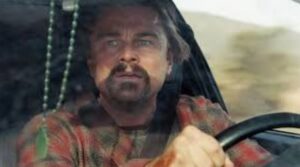
One Battle After Another features, perhaps, Leonardo DeCaprio’s best-ever performance.  His Pat / Bob character is an extension of Rick Dalton, the frustrated over-the-hill movie star he played in Quentin Tarantino’s Once Upon a Time in Hollywood (2019).  But while Dalton had his loyal buddy and stunt double Cliff Booth (Brad Pitt) to keep him from going off the rails, Pat / Bob has no one when the shit hits the fan.  His daughter Willa is elsewhere and he has to overcome his many insecurities and get his act together alone.  At the same time, DeCaprio convinces us that Pat / Bob, despite his chaotic nature, is a loving father.  It’s his desire to save her that keeps him going, no matter what fate throws at him.  And in this film, it throws a lot.


© Warner Bros. Pictures / Ghoulardi Film Company


He’s excellently partnered by Chase Infiniti as Willa.  Though in reality the actress is 25 years old, she convincingly plays a teenager – one who has her head well-screwed-on at the start of proceedings, but who still has to deal with a very steep learning curve.


Meanwhile, Sean Penn is splendidly villainous as Lockjaw.  He’s memorable both because of his grotesque physicality – with his contorted face, weird musculature and lurching gait, he looks like Popeye the Sailor Man rendered in human flesh – and because of his deeply screwed-up personality, which is simultaneously psychotic and pathetic and driven by a juvenile sense of entitlement.


Great though DeCaprio, Infiniti and Penn are, Benicio del Toro comes close to quietly stealing the show.  When he first appears, you see him as a character who’s popped up in DeCaprio’s movie.  But later, having learnt more about him – his character runs an extensive and meticulously-organised sanctuary and support-network for undocumented immigrants in the town – you begin to feel DeCaprio has strayed into his movie.


There’s also a lovely score courtesy of Radiohead’s Johnny Greenwood and, late on, a car chase that could become as legendary as the one in the Steve McQueen classic Bullit (1968).  And Paul Thomas Anderson handles things at all times with aplomb.


One Battle After Another should win a slew of Oscars at next year’s Academy Awards.  By then, though, Donald Trump may have banned all opposition parties in the USA and put the country under martial law, enforced by real-life Steven Lockjaws in ICE, the National Guard and various far-right militias.  So it might not.


If that proves to be the case, I can only say, “Viva la revolution!”


© Warner Bros. Pictures / Ghoulardi Film Company

A month of ironies


© Maverick / Warner Bros.


September 2025 reminds me of the song Ironic by Alanis Morissette.  The song’s lyrics contain many examples of things that are ironic, for example, “An old man turned ninety-eight / He won the lottery and died the next day,” or “a free ride when you’ve already paid”, or “ten thousand spoons when all you need is a knife.”  Although, as the comedian Ed Byrne has pointed out, some of the situations mentioned in the song aren’t actually ironic.  “A traffic jam when you’re already late,” for example.  As Byrne observed, that’s really only ironic if you’re a city planner.


Anyway, should Alanis Morissette ever write a sequel to Ironic, the month that has just passed should provide her with more than enough material.  To me, it’s the most ironic month I’ve ever experienced.  Here are a few reasons why I think so.


[Incidentally, this blog-entry contains references to American right-wing activist Charlie Kirk.  Please note that it’s possible to hold two opinions about Kirk at the same time, though many people out there are unable – or unwilling – to accept this.


Firstly, you can be horrified by Kirk’s murder, excoriate the fact that it happened while he was on a university campus exercising his right to free speech, and feel sorry for his young family.  Secondly and simultaneously, you can detest many of the things that came out of his mouth.  Things about black people.  (“Happening all the time in urban America, prowling blacks go around for fun to… target white people, that’s a fact.  It’s happening more and more.”)  About women.  (“Reject feminism.  Submit to your husband, Taylor.  You’re not in charge…  And most importantly, I can’t wait to go to a Taylor Kelce concert…  You’ve got to change your name.  If not, you don’t really mean it.”)  About Islam.  (“Islam is the sword the left is using to slit the throat of America.”)  About trans-people.  (“We need to have a Nuremberg-style trial for every gender-affirming clinic doctor.  We need it immediately.”).  And so on.  Also, you can be dismayed by the fact he made himself very wealthy by saying such things.]


September 10th

Charlie Kirk once said this of American gun ownership and the attendant, heavy toll of American gun-related deaths (16,576 in 2124, excluding suicides).  “You will never live in a society when you have an armed citizenry and you won’t have a single gun death. That is nonsense. It’s drivel…  I think it’s worth it.  I think it’s worth to have a cost of, unfortunately, some gun deaths every single year so that we can have the Second Amendment to protect our other God-given rights.”


Today, while speaking at Utah Valley University, Kirk was shot dead by an American citizen, using a gun, which it was his God-given right to own under the Second Amendment.  How tragically ironic and tragically American.


September 11th

UK prime minister Keir Starmer sacked Peter Mandelson from his job as British ambassador to the USA.  This was on account of Mandelson being an old friend of the late millionaire paedophile and human-trafficker Jeffrey Epstein.  Mandelson had even waxed lyrically about Epstein in writing: “Once upon a time, an intelligent, sharp-witted man they call ‘mysterious’ parachuted into my life…  wherever he is in the world, he remains my best pal!”


Five days later, another old friend of Jeffrey Epstein, who’d also, allegedly, waxed lyrically about him in writing (“We have certain things in common, Jeffrey.  Yes, we do, come to think of it.  Enigmas never age, have you noticed that…?”), arrived in Britain.  This was Donald Trump.  Starmer rolled out the red carpet and treated him to a state visit.


© Private Eye


September 13th

Led by double-barrelled far-right rabble-rouser Stephen Yaxley-Lennon, failed thespian nepo-baby Laurence Fox and others, and addressed on a big screen by Sieg Heil-ing billionaire Elon Musk, a crowd of more than 100,000 people marched through London to protest against immigrants.  They were particularly against foreigners who were criminals and a danger to women being allowed into Britain.  According to reports, some protestors wore MAGA – Make America Great Again – hats in honour of Donald Trump: a foreigner who’s a convicted criminal, and a proven danger to women, who was being allowed into Britain for a state visit the following week.


September 16th

Donald Trump landed in Britain and his hosts immediately went into full pomp-and-ceremony grovelling mode.  The orange American president got a royal salute, a lunch with the Royal Family, a tour of the Royal Collection, a ‘beating retreat’ military ceremony, a ride in a gilded coach, a state banquet at Windsor Castle, and a visit to Chequers, the prime minister’s country residence, for a look at the Winston Churchill archives and a press conference.


Speaking at the state banquet, Trump declared, “…this is truly one of the highest honours of my life. Such respect for you and such respect for your country…  The lionhearted people of this kingdom defeated Napoleon, unleashed the Industrial Revolution, destroyed slavery and defended civilization in the darkest days of fascism and communism.  The British gave the world the Magna Carta, the modern parliament and Francis Bacon’s scientific method.  They gave us the works of Locke, Hobbes, Smith and Burke, Newton and Blackstone.  The legal, intellectual, cultural and political traditions of this kingdom have been among the highest achievements of mankind.”


A week later, Trump gave a speech to the United Nations and had this to say about London, capital of Britain, and Western Europe, of which Britain is a part: “And I have to say, I look at London where you have a terrible mayor, a terrible, terrible mayor, and it’s been so changed, so changed.  Now they want to go to Sharia law, but you’re in a different country, you can’t do that.  Both the immigration and their suicidal energy ideas will be the death of Western Europe if something is not done immediately…  I’m really good at this stuff. Your countries are going to hell.”


Maybe the grovelling hadn’t worked.


From wikipedia.org / © Executive Office of the President of the US


September 17th

American late-night TV host Jimmy Kimmel was suspended indefinitely by the American Broadcasting Company (ABC), following comments he made about the assassination of Charlie Kirk.  These drew the ire of the Federal Communications Commission (FCC).  The FCC’s chair is Brendan Carr, a staunch Trump loyalist.  Trump applauded Carr as ‘a great American patriot’ for his actions.


Funnily enough, in 2022, Carr had declared: “Political satire is one of the oldest and most important forms of free speech.  It challenges those in power while using humour to draw more into the discussion.  That’s why people in influential positions have always targeted it for censorship.”  And Kirk himself once said of freedom of speech: “You should be allowed to say outrageous things.”  But perhaps what they meant was political satire and outrageous things should only be expressed by people they agreed with.


September 22nd

After an uproar from practically everybody, and their granny, and their dog, the forces that’d removed Jimmy Kimmel from the airwaves backtracked.  It was announced that he was being reinstated on ABC.  A new episode of his show was broadcast the following evening.  It achieved his highest ever ratings – 6.26 million viewers – and was viewed 26 million times on YouTube.  Kimmel quipped about Trump’s likely reaction: “He might have to release the Epstein files to distract us from this now.”


In other words…  The American right, which earlier in the month had worked so hard to make a martyr out of Charlie Kirk, blaming his death on the ‘radical left’ and threatening retribution against anyone who suggested he might be anything less than a saint, had inadvertently made a martyr out of Jimmy Kimmel instead.


September 23rd

Trump delivered an hour-long speech to the United Nations.  Besides condemning the institution for a malfunctioning teleprompter and an escalator that stopped working – him and his missus Melania had to climb the stationary escalator, which for someone of his considerable acreage must have been hard work – and besides ranting about ‘radicalised environmentalists’ (“No more cows.  We don’t want cows anymore.  I guess they want to kill all the cows.”), he boasted that he’d ended seven wars: “…Cambodia and Thailand, Kosovo and Serbia, the Congo and Rwanda…  Pakistan and India, Israel and Iran, Egypt and Ethiopia, and Armenia and Azerbaijan.”


In fact, two of these wars didn’t exist, two have continued in terms of ceasefire violations and ongoing bloodshed, one was a war Trump helped to start and then participated in, one was a war where one of the countries denies that Trump had anything to do with settling it, and one ended with a peace-deal that hasn’t yet been ratified.


That last war, the one Trump actually came closest to ending, was the Armenia-Azerbaijan conflict.  Previously, at the September 18th press conference with Keir Starmer, Trump claimed to have stopped a war between Albania and Azerbaijan.  And at a dinner in Vermont on September 20th, Trump announced that he’d ended a war between Armenia and Cambodia.  So maybe that’s why Armenia and Azerbaijan agreed on a peace-deal.   One was so busy fighting Albania, and the other so busy fighting Cambodia, that they no longer had time to fight each other.


Come to think of it, none of this was ironic.  It was just moronic.


September 26th

The Ryder Cup, golf’s biennial contest between Europe and the USA, teed off at Bethpage State Park in New York State.  Trump attended its opening day, making him the first sitting American president to do so.  It’s fair to say that his attitude towards golf – win at all costs, even if it means getting caddies to plant new balls for you when the old ones land in inconvenient places – and his attitude towards competition generally – win at all costs, no matter what a bullying, graceless, ignorant chump it makes you look – infected the crowd.  Taking their cue from their Dear Leader, they behaved like bullying, graceless, ignorant chumps for the next couple of days.  They chanted “F*ck you Rory!” at Northern Irish golfer Rory McIlroy.  They threw beer at McIlroy’s wife.  They hurled insults at McIlroy’s fellow Irish golfer Shane Lowry about his weight.  No wonder at one point McIlroy told them all to “Shut the f*ck up.”


Anyhow, Europe won the Ryder Cup by 15 to 13.  That wasn’t ironic either.  That was karma.


From wikipedia.org / © The White House

It has happened here


© Renard Press


Nowadays, Sinclair Lewis’s It Can’t Happen Here (1935) feels like a story of alternative history, exploring what would have happened in the USA if the historical timeline had taken a twist in the mid-1930s it didn’t actually take.  But when Lewis wrote it, the real timeline and his imaginary one were in the future.  He was peeking ahead to the presidential election of 1936, one year after his novel’s publication, and wondering, “What if…?”  In its original context, then, It Can’t Happen Here was a work of science fiction, though the future imagined was so barely ahead of the present that it probably didn’t seem like that.


It gives me no pleasure to report that reading the book in the middle of 2025, with the USA sliding remorselessly towards authoritarianism under the presidency of Donald Trump, It Can’t Happen Here doesn’t feel dated.  No, it’s surely more relevant than ever.


The novel explores what could have happened if the 1936 election hadn’t been won by Franklin D. Roosevelt – who in fact won it resoundingly, garnering over 60 percent of the popular vote and securing over 98 percent of the electoral college.  In Lewis’s version of events, the presidency is won by a populist maverick called Berzelius ‘Buzz’ Windrip.  It’s commonly assumed Lewis based Windrip on the controversial Louisiana governor and US Senate member Huey Long.  In an ironic twist of fate, Long was assassinated one month before It Can’t Happen Here was published.  The son-in-law of a political rival shot him, though it’s been claimed Long actually died of a wound from a ricocheting bullet fired by one of his trigger-happy bodyguards, who immediately responded to the attacker by pumping him ‘full of lead’.


Early on in It Can’t Happen Here, we get to read Buzz Windrip’s campaign manifesto, The Fifteen Points of Victory for the Forgotten Men.  This is a grab-bag of crowd-pleasing promises – the government giving every family 5000 dollars a year (point 11) while wealth being capped at 3,000,000 dollars per person (point 5) – and nakedly racist, reactionary and jingoistic rhetoric.  You have to swear allegiance to the New Testament and the flag if you want a job in the professions (point 4), threats are made against the Jews (point 9) and blacks and women are disenfranchised (points 10 and 12 respectively).  Oh, and there’s a sneaky final point, number 15, wherein Congress and the Supreme Court have to cede all authority to the Presidency.


The manifesto is popular enough to put Windrip in the White House and, thereafter, the USA experiences a rapid fascist takeover similar to the one Hitler engineered in Germany in 1933-34.  Windrip soon has his own militia / secret police making sure everyone toes the line, media, educational and economic institutions are bullied into acquiescence, and opponents, dissenters and anyone else the regime takes a dislike to are herded into concentration camps – that’s what the novel calls them, several years before the Nazis made the term ‘concentration camp’ synonymous with evil on an industrial scale.


The country’s lurch into dystopia is seen through the eyes of Doremus Jessop, a 60-year-old, liberal-minded editor of a smalltown newspaper in Vermont.  Jessop finds out the hard way that the new regime doesn’t take kindly to criticism – he pens a scathing editorial, which leads to an altercation with some officials, which results in his son-in-law being executed.  Afterwards, he’s forced to do an about-turn with his paper’s editorials and news coverage and make it a propaganda mouthpiece for Windrip and his government, as every other official news outlet in America had become.


Later, a disgusted and horrified Doremus hooks up with a resistance movement, the New Underground, run by a dissident senator called Walt Trowbridge who’s escaped to and based himself in Canada, and he begins surreptitiously writing and distributing an anti-Windrip newsletter called The Vermont Vigilance.  Later still, Doremus and his associates are rumbled and they wind up in a concentration camp.  But the story isn’t quite over yet for the dogged old editor…


© Penguin Books


As I said earlier, when you read It Can’t Happen Here today, there’s an elephant in the room – a corrupt, authoritarian, orange-skinned elephant, one with a bad combover, a ludicrously long red tie, a big mouth, a small pair of hands, a tiny but cunning brain, a criminal record, and a penchant for cheating at golf.  Yes, it’s shocking how much Lewis’s novel anticipates what Trump is up to in America at the moment.


As with Trump and his Immigration and Customs Enforcement (ICE) agency, which is now better funded than most countries’ armies and is no doubt attracting into its ranks all sorts of far-right nutjobs, Windrip sets up a militia called the Minute Men (MMs) and recruits into it thugs and low-life who relish having the power to intimidate, bully, beat up and murder their neighbors.  Doremus’s life gets progressively harder as Shad Ledue – his former handyman, who’s a lazy, ignorant brute and who lusts after his youngest daughter – joins the local Minute Men and, gradually, shins his way up the pole until he becomes District Commissioner.  And Trump’s enthusiasm for creating ‘immigration detention facilities’, like the notorious ‘Alligator Alcatraz’ in Florida, mirrors Windrip’s enthusiasm for creating concentration camps, like the one Doremus latterly finds himself an inmate of.


It Can’t Happen Here makes much of the regime’s assault on academia.  Early on, Doremus receives a worried letter from an acquaintance at his old alma mater, Isiah College, warning about how its Board of Trustees is bending to Windrip’s malevolent will.  “What,” he asks, “can we do with such fast exploding fascism?”  Trump has famously tried to do the same with America’s universities – some, like Columbia University, groveling to him pathetically; others, like Harvard, putting up slightly more of a fight.


Windrip sees to it that the ‘most liberal four members of the Supreme Court resigned and were replaced by surprisingly unknown lawyers who called President Windrip by his first name.”  Trump, of course, has made sure that the present-day Supreme Court is packed with yes-men and yes-women.


And in an effort to bolster its authority, Windrip’s regime launches an operation to end ‘all crime in America forever’.  Criminals are “tried under court-martial procedure; one in ten was shot immediately, four in ten were given prison sentences, three in ten released as innocent… and two in ten taken in the MMs as inspectors.”  That sounds suspiciously like Trump’s recent takeover of Washington D.C., supposedly in the name of ridding the capital city’s streets of crime, though more likely to divert attention from the possibility that Trump’s name appears in the US Justice Department’s files investigating Jeffrey Epstein.


Generally, Lewis’s descriptions of how Windrip manages to captivate the American public, or a section of it sufficiently large to get him into power, are depressingly similar to how Trump weaves a spell over his ‘MAGA faithful’ – portraying himself as an outsider and anti-establishment figure, despite the fact he’s the son of a real-estate millionaire and has had everything handed to him on a plate.  Of Windrip, Lewis says: “…he was the Common Man twenty-times-magnified by his oratory, so that while the other Commoners could understand his every purpose, which was exactly the same as their own, they saw him towering above them, and they raised their hands to him in worship.”


Meanwhile, Lewis highlights how the regime puts in positions of authority people who are worthless but unswervingly loyal to Windrip.  That loyalty, of course, rewards them with wealth, power and prestige.  Trump too has populated his government with sycophantic mediocrities, self-serving grifters and dangerous incompetents like Pete Hegseth, Kristi Noem, Robert F. Kennedy Jr, Tulsi Gabbard, Pam Bondi and Marco Rubio.  Their single virtue, in Trump’s eyes, is their ceaseless willingness to bow, scrape and debase themselves before him.


There’s even a parallel with Elon Musk who, as the world’s richest man and CEO of the social-media platform X, has a massive ability to inform and misinform people and shape their opinions.  The It Can’t Happen Here version of Musk is Bishop Paul Peter Prang, a priest who makes a hugely popular and influential weekly address on the radio.  Like Musk’s voice on social media, Prang’s voice ‘circled the world at 186,000 miles a second’ and practically ‘leapt to the farthest stars.’  (Prang’s character was inspired by a real-life demagogue, the ‘Radio Priest’ Charles Coughlin.)  And like Musk with Trump, Prang enthusiastically backs Windrip for president – but gets short shrift from the man he’s championed once he’s across the threshold of the White House.  Though while Trump merely dropped and humiliated Musk, Windrip sticks Prang in jail and then in an ‘insane asylum’: “No one willing to carry news about him ever saw Bishop Prang again.”


All that said, It Can’t Happen Here is not a perfect book.  It has certain features that earn it the dreaded sobriquet ‘of its time’.  The focus is almost entirely on a handful of comfortably well-off white Americans and, though there are brief references to the horrors Windrip visits upon the black community, the book shows no interest in exploring these.  Also, Lewis makes mocking references to sexuality of Lee Sarason, Windrip’s Machiavellian campaign manager, who wears ‘violet silk pajamas’ and obviously has a fondness for strapping young men.  But no mention is made of the regime’s official policy towards homosexuals, which presumably would have been as murderous as Nazi Germany’s.  And male chauvinists will appreciate how Doremus gets to have his cake and eat it throughout the book, in that he’s simultaneously married to one woman, dull, frumpy Emma, and engaged in an affair with another, the bewitching firebrand Lorinda.  He’s never taken to task for this.


And the book’s tone can be awkward at times.  Lewis writes it in a folksy, sardonic, Mark Twain-like style that sometimes works, especially when its poking fun at the general hypocrisies, absurdities and idiocies of Windrip’s regime.  It works less well when it’s detailing the brutal realities of that regime – the tortures and humiliations, for instance, that Doremus has to endure while he’s in a concentration camp.  For subject-matter as bleak as this, I suspect the only way to record it is with the precise and dispassionate prose of, say, George Orwell’s 1984 (1949).


Sinclair Lewis’s It Can’t Happen Here may not quite make it into the top tier of great dystopian novels, then.  However, in 2025, you’re unlikely to read one that feels more terrifyingly prescient.


From wikipedia.org / © Touring Club Italiano

The Boss versus the dross


From wikipedia.org / © Ralph_PH


I have another reason to loathe Donald Trump, the 45th and also, alas, 47th president of the United States of America.  He’s made me like Bruce Springsteen.


On May 14th, at Manchester’s Co-op Live Arena, on the opening night of his Land of Hope and Dreams tour, Springsteen – the famously sideburned, famously plaid-shirt-wearing singer-songwriter-guitarist from New Jersey – kicked off proceedings by making a speech.  He declared: “…my home, the America I love, the America I’ve written about, that has been a beacon of hope and liberty for 250 years, is currently in the hands of a corrupt, incompetent and treasonous administration.  Tonight, we ask all who believe in democracy and the best of our American experiment to rise with us, raise your voices against authoritarianism and let freedom ring!”  Later on, he described the head of that ‘corrupt, incompetent and treasonous administration’, i.e., Trump, as an ‘unfit president’ and proclaimed, “The America l’ve sung to you about for 50 years is real and regardless of its faults is a great country with a great people.  So we’ll survive this moment.”


Needless to say, it wasn’t long before Trump’s overworked posting-thumb was busy knocking out a retort on his Truth Social platform.  He called Springsteen ‘as dumb as a rock’ and added: “This dried out ‘prune’ of a rocker (his skin is all atrophied!) ought to KEEP HIS MOUTH SHUT until he gets back into the Country, that’s just ‘standard fare’. Then we’ll all see how it goes for him!”


Also joining in was Trump’s number-one music-industry sycophant Kid Rock, now a not-so-kiddish 54 years old.  It’s telling that the only song I’ve heard by him was the 2008 hit All Summer Long – a Kid Rock number whose best bits weren’t actually written by Kid Rock.  They come from Lynyrd Skynyrd’s Sweet Home Alabama (1974) and Warren Zevon’s Werewolves of London (1978).  “Just another person with TDS (Trump derangement syndrome) at the highest levels,” Kid Rock said of Springsteen.  “To be in Europe talking junk about our president who gets up and works his ass off for this country, every day, and his administration is doing such great things…  Thank God for him.  But to do that in Europe… what a punk move.”  Kid Rock, please note.  To me and many folk my age, calling Bruce Springsteen a ‘punk’ is amusing.  But it’s not the insult you think it is.


Since Kid Rock believes Trump’s administration is ‘doing such great things’ for the USA, he’s surely a big fan of Trump’s vicious anti-immigrant policies.  Incidentally, the restaurant he’s licensed in Nashville, the not-at-all-stupidly-titled Kid Rock’s Big Ass Honky Tonk Rock N’ Roll Steakhouse, lately and mysteriously sent kitchen-staff home during a weekend when Trump’s brutal Immigration and Customs Enforcement (ICE) agency were conducting operations in the city.  I’m sure the reason for this wasn’t anything dodgy.  Not because, say, the restaurant was employing people who were immigrants lacking permanent legal status and might get dragged off and incarcerated.


I first encountered the musical oeuvre of Bruce Springsteen, or ‘Loose Windscreen’ as I liked to call him, while I was a fifth-year pupil at Peebles High School in the early 1980s.  Fifth and sixth-years pupils, the senior members of the student body known as the ‘Upper School’, were entitled to their own common room, where there was an elderly record-player and speakers you could play music on during the morning, lunchtime and afternoon breaks.  This was normally monopolised by the Upper School’s sizeable heavy-metal contingent and it blasted out a lot of AC/DC, Deep Purple, Iron Maiden, Judas Priest, Led Zeppelin, Motorhead, Rainbow, the Scorpions, Thin Lizzy and Whitesnake.


© Columbia Records


However, once in a while, somebody would manage to get past the phalanx of heavy-metal fans surrounding the record player and slap something a little different on it.  One such record was Springsteen’s 1975 breakthrough album, Born to Run.  Hearing it, I thought it was all right and, at the time, the title track seemed a stormer.  (Nowadays,  having heard it a zillion times, I’m less keen on it.)  So, Mr Windscreen’s, sorry, Mr Springsteen’s music seemed perfectly fine to me.  But it wasn’t anything I’d go out of my way to listen to.


Incidentally, a few years earlier, my favourite band had been the Boomtown Rats, the new wave outfit fronted by Bob Geldof.  Last week, I listened to Rat Trap, the Boomtown Rats song that topped the UK charts in 1978, for the first time in decades.  And I was surprised by how, well, Springsteen-esque it sounds now.


By the mid-1980s I was a student at Aberdeen University.  I quickly discovered that a number of my fellow-students were seriously into Bruce Springsteen.  They were so into him they apparently knew everything about every second of music he’d ever committed to vinyl – that, say, if you played the third of the nine tracks on the Belgian version of the 1973 LP Greetings from Ashbury Park N.J. backwards, you’d hear him break wind in the studio.  Yes, stuff like that.


These Bruce-fans – whom some unkindly referred to as ‘Bruce-bores’ – were, without exception, male.  Actually, a good proportion of them seemed to be engineering students and had names like ‘Morris’.  Also, they never called their hero ‘Bruce’, but used the annoying moniker ‘The Boss’.  This struck me as paradoxical since they were always going on about what a man of the people he was.  Surely, then, a blue-collar, working-class guy like him would be against the bosses?


© Columbia Records


This was a bad time if, like me, you were surrounded by Bruce-bores, sorry, Bruce-fans, and you didn’t believe as they did that Springsteen was the greatest thing to have happened to music since Mrs Beethoven gave birth to little Ludwig van.  For, in 1984, he released Born in the USA, an album that sold over 30 million copies worldwide and spawned no fewer than seven singles.  As with most of Springsteen’s output, it struck me as perfectly decent, but not remarkable, journeyman rock music.  But it subsequently became annoying because people around me never seemed to stop playing it.


The Born in the USA singles received heavy rotation in the place where I worked part-time during my second year as a student, Ritzy’s Nightclub.  At Ritzy’s I was a member of the floor-staff – meaning I spent most of my time collecting empty glasses and loaded ashtrays from the punters’ tables, cleaning them, and returning the glasses to the bar-shelves and the ashtrays to the tables.


I’ve said before on this blog that of the many jobs I’ve had in my life, I hated the Ritzy’s one most.  I had to work until 2.00 AM every Friday and Saturday night while my mates were out partying.  The glasses I collected were often phenomenally grotty with cigarette ends and even puke floating around in them.  Many of the punters were workers in Aberdeen’s then-flourishing oil industry, who made tons of money and believed their hefty earnings allowed them to behave like knob-heads at all times, especially towards serfs like myself.  And the music spewing out of the nightclub’s speakers was gruesome – all the vacuous New Romantic stuff like Duran Duran, Spandau Ballet and Wham that dominated the UK charts during 1984-85.  In that company, Springsteen’s songs didn’t seem so bad.  But having to hear them repeatedly in that environment quickly made me sick of them too.


The first Born in the USA single out of the blocks was Dancing in the Dark, which I came to associate with a mid-week gig I had at Ritzy’s.  This was a regular evening the nightclub held for the over-30s, which was known in local parlance as ‘Grab-a-Granny Night’.  It featured a live band who performed cover versions of songs currently in the charts and Dancing in the Dark seemed a particular favourite of the band’s frontman, a bloke called Stan.  The sound of Stan warbling his way through the song, and the sight of him simultaneously attempting some Boss-like dancing onstage whilst apparently in possession of two left feet, are burned into my memory.


In the summer of 1985, I developed a fully-fledged aversion to Bruce Windscreen, sorry, Springsteen.  The summer was going badly for me for various financial, personal and health reasons, and my mood wasn’t helped by the fact that every single day that July and August saw rain piss down relentlessly on Aberdeen, turning the grey granite the city was built with oppressively black.  At one point I found myself sharing a flat with a good friend, one Andrew J. MacRury, who was also having a bad summer.  And yes, Andy was an avid Bruce-bore, sorry, Bruce-fan.  I worked night-shifts and, a dozen times each day, while I was in bed trying to snatch some sleep, I’d be rudely awoken by my friend playing the title track of Born in the USA in the next room, at full blast, in a desperate attempt to cheer himself up.  Repeatedly, every day, I was practically blasted out of bed by the sideburned one hollering: “Booooorn… in the US-Aaaa!  I wuz booooorn… in the US-Aaaa!”


Thereafter, if anyone show signs of talking enthusiastically about Bruce Springsteen, let alone play some music by him, I’d run for the hills.  In March 1992, when to great fanfare he released two albums on the same day (Human Touch and Lucky Town), I think I went into hiding.


© Columbia Records


Now any Bruce-bores, sorry, Bruce-fans reading this will no doubt be shocked by my attitude towards their hero and accuse me of being deficient in musical taste.  To that I would reply I wasn’t the only person on the planet unswayed by the charms of Mr Springsteen.  The legendary radio DJ John Peel, for example, once said of Springsteen’s appeal: “It utterly mystifies me.  I can’t see it at all.  I mean, when he first started out… it sounded to me like sub-Dylan stuff.  And it just doesn’t ring true.”  Indeed, the John Peel Wiki notes that Peel “almost never played any of Springsteen’s material on his show and scarcely missed an opportunity to compare him unfavourably with other artists such as Half Man Half Biscuit.”


Certain musicians have been less than enthralled by him too.  The Rolling Stones guitarist Keith Richards, while describing Springsteen as ‘a nice guy, a sweet guy’, has been scathing about his musical ability.  He wrote in his 2010 biography Life, “If there was anything better around, he’d still be working the bars of New Jersey.”  Meanwhile, Irish folk-rock troubadour Van Morrison once grumped about what he saw as Springsteen’s lack of originality.  As far as Van Morrison was concerned, he’d nicked all his ideas from, er, Van Morrison.  “For years people have been saying to me, ‘Have heard this guy Springsteen?  You should really check him out!’  I just ignored it.  Then four or five months ago I was in Amsterdam, and a friend of mine put on a video.  Springsteen came on the video, and that was the first time I ever saw him, and he’s definitely ripped me off.”


However, in times of great adversity, you have to take sides – even the sides of folk whom, until now, you’ve regarded as your enemies.  For instance, the cops had to join forces with the prisoners in John Carpenter’s Assault on Precinct 13 (1976) when faced with an onslaught by the murderous gang Street Thunder.  And James Bond (Roger Moore) had to team up with Jaws (Richard Kiel) in Lewis Gilbert’s Moonraker (1979) to overcome the genocidal plans of Hugo Drax (Michael Lonsdale).  I feel the same way about Bruce Springsteen.  I’ve found much of his music stodgy, and at times his fans have driven me up the walls, but I’ll back him all the way in his struggle against Trump, who’s busy turning Springsteen’s homeland into an authoritarian state run by white supremacists, loopy evangelical Christians, billionaire tech-bros and environment-wrecking oil barons.


Indeed, if Springsteen can do anything to get Trump out of office – arrange, say, for a million Bruce-bores, sorry, Bruce-fans to storm the White House – I’ll happily grow sideburns, and wear a plaid shirt for the rest of my life, and listen to Born in the USA a dozen times a day.  Hail to the Boss!


Also, while I don’t have much regard for Springsteen’s music, I still think it’s light-years better than that Big Ass Honky Tonk Rock N’ Roll shite peddled by Kid Rock.


From wikipedia.org / © Carl Lender