The comeback kid


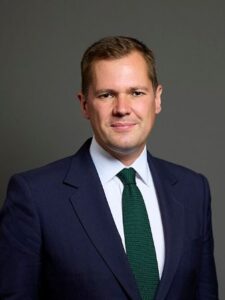
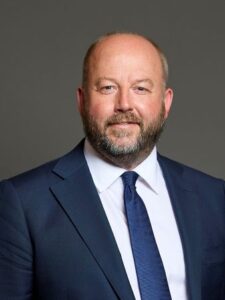
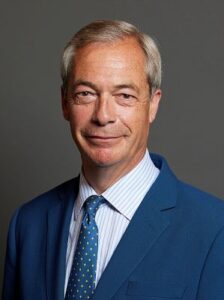
From wikipedia.org / © Scottish Government


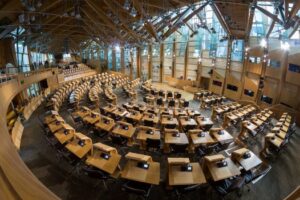
I’ve always had an unhealthy obsession with politics.  Lately, however, I’ve written less about the subject on this blog because my obsession was becoming literally unhealthy – ruminating on politics and politicians in 2026 was filling my head with dark and depressing thoughts.  Nonetheless, I’ll now make some comments about the election for the Scottish Parliament, which happened on May 7th. That day also saw elections for the Welsh Senedd and for various local authorities in England, but I’ll only mention those in passing.


If you’re not a political anorak, you might want to skip this.


So: the results were 58 seats for the Scottish National Party (down six from the previous election in 2021); 17 for Scottish Labour (down five); 17 for Reform UK (up 17); 15 for the Scottish Greens (up seven); 12 for the Scottish Conservative and Unionist Party (down 19); and ten for the Scottish Liberal Democrats (up six).


Despite securing six seats less than their 2021 total, and seven seats short of a parliamentary majority, the result was impressive for the SNP in that this is the fifth election in a row where they’ve ended up as the biggest, government-forming party.  Keir Starmer’s Labour government at Westminster, which hasn’t been in power for two years yet and is already as popular as a fart in a spacesuit, would kill for such longevity and  durability.


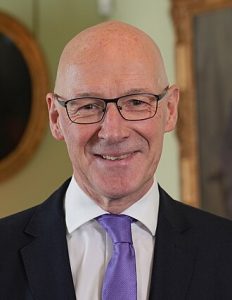
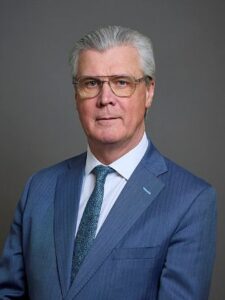
It’s also quite a comeback for SNP leader John Swinney.  Originally Swinney served as SNP leader from 2000 to 2004, when his party was in opposition in the Scottish Parliament.  It wasn’t a happy experience for him.  In the 2003 Scottish election his party dropped from 35 to 28 seats and the following year he resigned.  He later described being opposition leader as “the worst, most awful, most sapping, most soul-destroying job in politics…”


Having enjoyed spells as a cabinet minister and Deputy First Minister, Swinney was planning to retire at this year’s election.  However,  in May 2024, after the affable but hapless Humza Yousaf resigned as First Minister, Swinney surprised everyone by standing unopposed for – with his famous negotiating skills, he managed to sweet-talk the formidable likes of Kate Forbes into not running against him – and winning the leadership again, 20 years after losing it.  And this time, he became First Minister of Scotland too.  Many assumed he would act as a ‘caretaker’ FM, until someone younger and with more chutzpah came along, but thanks to this election result he’s likely to be around for a while.


While I’d never describe Swinney as someone who sets the heather alight, and if he got a fiver every time someone likened his demeanour to that of a bank manager he’d probably be a billionaire by now, I have to say I think he’s a decent guy and I’d rather have him in charge of Scotland than most other Scottish politicians.  I’m biased in this regard.  As I wrote on this blog before, I encountered him a couple of times during my youth, via my old schoolmate Roger Small, who was best friends with him at university, and I liked him.  But it’s not just me.  Most people, political friends and foes alike, seem to like Swinney.


Even the world’s most horrible man, Donald Trump, has a soft spot for him.  In 2025, Trump declared, “John Swinney is a terrific guy — and loves golf and loves the people of this country, and we really appreciate it.”  Yes, I know that Trump thinks Vladimir Putin, Xi Jinping and Kim Jong Un are the bees’ knees, so being liked by him isn’t necessarily a ringing endorsement of your character.


More recently, when Trump announced the removal of US tariffs on Scotch whisky, Swinney claimed this was due in part to a meeting he had with the US president last September.  He was criticised for saying this by the UK government’s Secretary of State for Scotland Douglas Alexander, who argued that trade agreements weren’t in the remit of a leader of a devolved administration.  But after the election result, Trump messaged, “Congratulations to John Swinney on winning his Re-Election for First Minister of Scotland.  He is a good man, who worked very hard along with the King and Queen of the United Kingdom, with respect to Tariff Relief for Great Scottish Whiskey – and deserves this Big Electoral Victory!”  So now, Dougie Alexander looks a bit of a chump.


Trump, being a low IQ individual, misspelt ‘Scottish whisky’ as ‘Scottish whiskey’.  The stuff spelt with an ‘e’ is actually made in Ireland.


From wikipedia.org / © Scottish Parliament / youtube.com


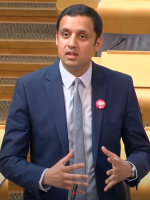
Elsewhere, Scottish Labour and the Scottish Conservatives had their worst ever performances in a Scottish parliamentary election.  Labour leader Anas Sawar hit the headlines back in February when he demanded that Keir Starmer resign as British Prime Minister: “The situation in Downing Street is not good enough. There have been too many mistakes.”  Sarwar’s resignation-call distanced him and his branch of the Labour party from the wildly unpopular Starmer and it generated  a lot of publicity at the time.  But when Starmer said no, he wouldn’t be resigning, it looked less like a political earthquake and more like a mild political bowel-movement.  It highlighted Sarwar’s place as Scottish party leader in the great scheme of things – not high.  It also meant Starmer was embarrassingly conspicuous by his absence in Scotland when Labour started campaigning for the election there.


The Scottish Tories have been reduced to a rump, their number of Members of the Scottish Parliament (MSPs) barely in double figures.  Their leader Russell Findlay has tried to talk them up in the Tory-friendly pages of the Scottish Daily Mail, describing them as the ‘Dynamic Dozen’.  I wouldn’t describe any dozen that includes such numpties as Murdo Fraser, the man who once asked Donald Trump if he’d consider buying Glasgow Rangers Football Club, as ‘dynamic’.  Maybe ‘dysfunctional’ or ‘dystopian’.


Following a near-extinction event caused by their coalition with the Conservatives in Westminster in the early 2010s, the Liberal Democrats have enjoyed something of a revival.  The passing of time has clearly detoxified their reputation a little in folk’s memories.  That said, I don’t know how anyone can stomach their Scottish leader Alexander Cole-Hamilton, who to me comes across as being insufferably arrogant.


And the Scottish Greens have almost doubled their representation in the parliament.  Without wishing to downplay this achievement, I suspect they enjoyed the best of both worlds in relation to the English and Welsh Greens – a separate party – south of the border.  They benefited from the wave of enthusiasm, and publicity, that their southern counterparts experienced earlier this year.  Simultaneously, as a separate party, they were distant enough from them to escape the more recent backlash against the English / Welsh party’s leader Zack Polanski, who stupidly retweeted something about the attack on two Jewish men in Golders Green and then suffered an all-out assault from the right-wing media determined to portray him as an antisemite.  (This despite Polanski being Jewish himself and despite some of the media’s caricatures of him being… hideously antisemitic.)


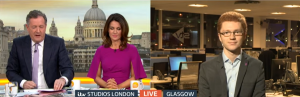
The Scottish Greens are co-led by Gillian Mackay and the chirpy Ross Greer.  I know Greer is a ‘Marmite’ politician for many, but I like how he puts the wind up gammons like Piers Morgan.


From youtube.com / © ITV


With the SNP on 58 MSPs, and the pro-Scottish-independence Greens on 15, 73 MSPs now support Scotland leaving the United Kingdom, as opposed to 56 unionist MSPs who don’t.  It’s the parliament’s biggest ever pro-independence majority.  Of course, you won’t have heard much about that fact from Scotland’s (unionist-owned) mainstream media, who instead have obsessed on a different fact – that the parliament suddenly has 17 far-right Reform MPs.  Nigel Farage’s extremist party had representation there before, thanks to one MSP defecting to them from the Conservatives.  But today, with Labour, they’re the joint-second biggest party.


This has prompted journalists like the Times’s Kenny Farquharson to declare ‘the death of Scottish exceptionalism’ – Scottish exceptionalism being the idea that Scottish voters are more community-orientated, more considerate of their fellow citizens, more leftwing and, generally, nicer than voters than those elsewhere in the UK, especially in England.  Reform’s showing proves that, no, the Scots are just as right-wing and awful as everyone else.


Well, I find it nauseating that the  parliament contains 17 MSPs who, if their party ever came to power, would enact Trump-style authoritarian and racist policies.  One of them, Senga Beresford, representing the South Scotland region, has already caused controversy by expressing admiration for fascist lout Stephen Yaxley-Lennon on social media.  But I derive some comfort from the fact that none of those MSPs were elected through the parliament’s first-past-the-post, constituency-based voting system, responsible for deciding 73 of the 129 MSPs.  Reform’s 17 sneaked in afterwards, via the additional, regional-based ‘list’ system.  Also, the Conservatives won 31 seats at the previous election, but have been culled to 12, and that number plus Reform’s 17 puts the total number of right-wingers  at 29 – two less than before.


I certainly don’t see Scotland as being exceptional, i.e., better than anywhere else.  I’ve met plenty of Scots who’ve been arseholes as much as arsehole-y people from other places.  But Scotland is still different from other parts of the UK.  If it wasn’t different, it wouldn’t have its own languages, literature, music, sports teams, legal system, educational system, etc.  It wouldn’t have been scunnered by Margaret Thatcher in the 1980s while people elsewhere were proclaiming her the new, handbag-wielding messiah.  It wouldn’t have voted heavily against Brexit when people in England and Wales voted for it.  It wouldn’t have its own independence movement with, now, a 57% majority in the Scottish parliament.  I know that sticks in the craws of unionist politicians and journalists who’d have you believe that Scotland is absolutely indistinguishable from the rest of the UK, that a punter from Elgin is identical to a punter from Ely.


Talking of journalists, the coverage of the election in the Scottish mainstream media was woeful.  The unionist newspapers (i.e., nearly all of them) spent half the time wailing “Everything in Scotland is shite!” and the other half wailing, “How dare anyone suggest doing anything even vaguely radical to improve things!”  Swinney’s proposal that, in an emergency, the Scottish government should put a cap on the price of essential food products so that poor people could still buy them, was met with hoots of derision – and the sneering observation that the UK government would never allow it.  (A Labour government – “For the many, not the few” – denying someone the right to keep essential foodstuffs affordable for the nation’s poorest people?  Not a great look.)


I thought the recent opinion-piece by Scottish journalist Stephen Daisley in the Spectator, calling on the Labour and Conservative parties to get rid of the UK’s devolved parliaments (“Dr. Frankenstein would understand that it was his duty to put down the hideous creature his foolishness and vanity unleashed on the world”), was bad enough.  But the articles that his fellow Scottish journo Chris Deerin penned about Scottish Reform leader Malcolm Offord, for the supposedly left-wing New Statesman, went to arse-licking extremes where no article has gone before.


And now, with Plaid Cymru’s Rhun ap Iorwerth the First Minister in Cardiff, and Sinn Fein’s Michelle O’Neill the First Minister in Belfast, all three devolved governments in the United Kingdom are helmed by people who see their nations’ futures as being outside that supposedly united kingdom.  Interesting times indeed…


But you won’t ever read about that in the newspapers.


From wikipedia.org / © User Colin

You can’t say those things nowadays… unless you’re a politician


From wikipedia.org / © House of Lords / Roger Harris


In this post I’m not going to repeat the three most depraved and revolting jokes I’ve ever heard.  But I’ll say when and where I heard them, and from whom.


The first joke concerned a medical tragedy and a hideous crime, both involving children, which’d made headlines in the UK during the 1980s.  One night in a pub in Aberdeen, where I was a college student, a friend told a 13-word joke that combined the two cases.  The friend was a decent guy who was drunk at the time and he uttered the joke during a moment of reckless bravado.  Immediately afterwards, he looked disgusted with himself and spent the rest of the evening in a state of depression.  I don’t think I heard him tell an even vaguely risqué joke after that.


I wasn’t as shocked as I might have been because I’d already encountered the joke in written form.  Some degenerate had scribbled it on the back of a toilet-door in Aberdeen University’s Queen Mother Library and I’d noticed it whilst ‘on the john’.


The second joke was two words longer – 15 – and I heard it in the context of a supposedly real-life anecdote.  Another guy I’d known as a student had, following graduation, gone on a trip to the USA where, one day, he’d ended up at an outdoor music festival.  He too was somewhat inebriated.  The festival’s compere decided, at one point, to leave the stage and wander among the crowd, sticking his microphone into people’s faces and asking them how they were getting on.  He stopped by my old acquaintance and, discovering he was from ‘Scaaat-land’, asked him to tell a ‘Scaaat-tish’ joke.  So my acquaintance spewed those 15 words into the microphone, which boomed across the field from the festival’s speakers and left the entire crowd in mortified, disbelieving silence.  I’m not sure if I really believe that story happened – but if it did happen, it was quite something.


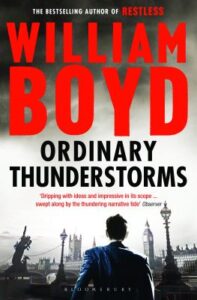
Incidentally, the same joke appears in William Boyd’s 2009 novel Ordinary Thunderstorms.  An unsavoury character tells it to the book’s hero, who responds by tipping him over a bridge and dropping him into the River Thames, where he drowns.  To be fair, the character had antagonized him a lot before that, so he wasn’t just reacting to the joke’s depravity.


© Bloomsbury


The third joke I heard in the early 1990s.  I was sitting at the counter of an Edinburgh pub when a drunken guy beside me told it.  It was a longer and more elaborate joke and featured Freddie Mercury, singer of the rock band Queen, who was famously gay and had died of AIDS a while earlier, and another famous showbusiness personage, also gay, who’s still with us in 2026.


Ooph, I thought, that’s really horrible. I hope I never hear a joke like that again.  


Well, I have just encountered a joke like that again.  In fact, it’s the same joke, though updated from the 1990s and now about the gay singer George Michael, who passed away in 2016, and his former partner Fadi Fawaz.  According to the Daily Record newspaper last week, it was told by Malcolm Offord, leader of the far-right-wing Reform party’s branch in Scotland.  In 2018, he included it in a speech he delivered at a Burns Supper held by a rugby club he was a director of.  In the kerfuffle following the Daily Record’s report, Offord admitted telling the joke was ‘a mistake’ and denied being homophobic.  “I don’t have any issue with homophobia,” he said.  “I’ve got a lot of gay friends.”


Nigel Farage, Reform’s Britain-wide leader, has defended Offord, saying, “If we’re going to drum people out of public life for telling a joke at a boozy rugby club dinner that’s amongst friends, we’ll finish up with the dullest group of individuals, looking a bit like, sounding a bit like Keir Starmer.”  Less forgiving was John Swinney, leader of the Scottish National Party and currently First Minister of Scotland – the post Offord aspires to take over following the Scottish parliamentary election this May.  Swinney said of Offord, “He’s unfit to be leader of any political party, unfit to be a member of the Scottish Parliament with views and attitudes like that…  I think we’ve got to be really careful as a country about where we are heading, and Reform have got no part to play in it if they represent views of intolerance, prejudice and hatred of that type.”


What are we to make of this?  Should we regard Offord’s faux pas as regrettable, alcohol-fuelled ‘banter’, accept his apology and move on?  And are we, as Farage suggests, in danger of becoming too puritanical, of scaring all the interesting people away from public office, of ending up with humourless dullards in power over us?  Is society getting – oh God, here we go again – too woke?


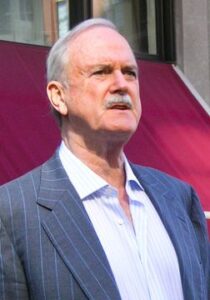
It calls to mind the lamentations of Monty Python (1969-74) and Fawlty Towers (1975-79) star John Clleese, who’s spent a good part of the last few years complaining that you can’t tell a good, impactful, close-to-the-bone joke anymore because folk get too offended: “I don’t think we should organize a society around the sensibilities of most easily upset people because then you have a very neurotic society.”  Incidentally, the 86-year-old Cleese appears to have thrown in his lot with Rupert Lowe’s party Restore UK, an outfit even further to the right than Farage’s Reform.


From wikipedia.org / © Paul Boxley


Well, in my view, we’re never going to stop hearing sick, horrible and downright racist / misogynist / homophobic / transphobic / etc. jokes.  For as long as the urge to be ‘edgy’ persists in the human psyche, such jokes will continue to be told in pubs and clubs, on sports terraces, in Internet forums, on WhatsApp and other messaging platforms, in countless situations where people interact.  But anyone who thinks it’s a good idea to spout a joke of that sort in public – supposedly 200 people attended Offord’s Burns Supper – shouldn’t be presenting themselves as a politician qualified to take over the highest political office in Scotland.  Especially when as holder of that office you’ll be representing, and making decisions that affect, the group of people your joke cruelly mocked.


Call me old-fashioned, but I prefer my political leaders to be dull – and serious, and sensible.  I remember British Prime Ministers like Labour’s Jim Callaghan and the Conservatives’ John Major, both rather grey and uninteresting, but whom I felt a lot safer having in Number 10, Downing Street than, say, an alleged laugh-a-minute ‘personality’ like Boris Johnson.  Between Callaghan and Major, of course, Britain was subjected to the 11-year reign of Margaret Thatcher, who had many qualities – mainly negative qualities, in my opinion – but being a barrel of laughs who told good jokes wasn’t one of them.


Offord must have thought he was on safe ground with his joke because he was at a well-lubricated rugby club event, not what you’d expect to be the most politically correct of gatherings.  But according to the Daily Record, even his rugby-loving audience was unimpressed.  One witness said, “I was sitting next to a gay man and it was clearly an extremely uncomfortable and unpleasant experience for him…  At the time I thought it pretty awful and indeed that was the feeling in the room.  Even for a rugby club it was a crude, bad taste and insulting spectacle…  I don’t know who in their right mind would say something like that.”


Even some of the usual suspects in Scotland’s mostly right-wing, Unionist media have turned on Offord because of this.  Scottish Times columnist Alex Massie penned a piece entitled Reform may already regret its choice of leader in Scotland, whilst Scottish journalist Stephen Daisley, who frequently writes for the very right-wing Spectator, messaged, “Malcolm Offord is single-handedly wrecking Reform’s chances in the Scottish parliament.  Can the Holyrood campaign be salvaged?”


I haven’t heard any reaction yet from Chris Deerin, who’s somehow the Scotland editor at the supposedly left-leaning New Statesman.  When Offord became Scottish Reform leader, Deerin tweeted, “Malcolm Offord is a seriously great get for Reform.  Very smart, ambitious for Scotland, excellent communicator, properly Scottish, experience of government, hugely successful in business – working class boy made good.  Ooft.”  (‘Ooft’, of course, was my first thought when I heard that joke.)  And in a couple of New Statesman articles Deerin penned about Offord, he talked breathlessly about the wealthy politician’s ‘gilded life’ and particularly admired his “vintage, open-top Jaguar sports car, Bond-esque in its sleek lines and growling power,” in which Offord “roared off into the countryside.”


Alas, despite everything, I don’t think Offord will be roaring off into the countryside, never to be seen or heard of again.  There are too many people who’ll rally to his cause rather than reject it after this furore.  That’s because they believe the line, fed to them endlessly by Britain’s right-wing media and pundits, that everything is too puritanically woke now, that you can’t crack a joke about gays or women or religious or ethnic minorities without the roof falling on your head, that you “can’t say those things nowadays”.  The irony is that you can say those things nowadays, and totally get away with them, at least if you’re a British politician.


Nigel Farage has recently courted controversy over the personalized messages he’s sent as Cameo videos – one of several lucrative side-projects he has in addition to being Reform party leader and a Member of Parliament.  A Guardian investigation found that the messages included ones “supporting a convicted rioter, repeating extremist slogans, and endorsing a neo-Nazi event” and where he “referenced antisemitic conspiracy theories, and made misogynistic remarks about leftwing politicians, including a comment about the US congresswoman Alexandria Ocasio-Cortez’s breasts.”


Previously, Farage was in hot water because of allegations made by over 30 people who’d known him during his schooldays.  According to their accounts, the teenaged Farage was quite the dedicated follower of fascism – among other things, singing Hitler Youth songs and growling “Hitler was right” and “Gas them” at Jewish pupils. He’s variously responded to these allegations by calling them ‘fantasies’, saying he can’t remember saying such stuff or dismissing it as – there’s that word again – ‘banter’.


Not that this has dented Farage’s popularity much.  His party is still leading in British opinion polls.


From wikipedia.org / © Roger Harris

From wikipedia.org / © Roger Harris


Elsewhere, Robert Jenrick, formerly the Conservatives’ Shadow Justice Secretary and now a defector to Reform, caused outrage last year when he said a 90-minute visit to the Handsworth part of Birmingham was “as close as I’ve come to a slum in this country” and one where he didn’t encounter “another white face“.  And earlier this month, the Conservatives’ Nick Timothy, who’s inherited Jenrick’s role as Shadow Justice Secretary, described an open Iftar event in Trafalgar Square as “an act of domination…  not welcome in our public places and shared institutions…  straight from the Islamist playbook.”  In previous years open Iftar events had been held in the square without anyone objecting, as had other religions’ celebrations such as Chanukah, Vaisakhi and Diwali.  And it had also hosted Christian events like mass prayers and Good Friday passion plays.


Rather than discipline them, Conservative party leader Kemi Badenoch backed both Jenrick and Timothy.  The latter case inspired the double-barreled, hard-right-wing rabble-rouser Stephen Yaxley-Lennon to crow on social media about how, just two years ago, a Conservative Member of Parliament making Timothy’s anti-Islamic comments would have been expelled from the party.  But not in 2026.


Yes, call me old-fashioned…  But I prefer the good old days when not only were British mainstream politicians grey and dull, but if they’d spouted anything blatantly racist, misogynistic, homophobic, or Islamophobic, they’d immediately have been out on their ear.

All the rage


© DNA Films / Sony Pictures Releasing


Danny Boyle is a venerated British filmmaker.  His resume includes nasty wee Edinburgh crime noir Shallow Grave (1993), zeitgeist-surfing ‘cool Britannia’ classic Trainspotting (1996), Oscar-winning Slumdog Millionaire (2008) and the opening ceremony to the 2012 London Olympics that, briefly, gave Britain a little street credibility in the eyes of the world.  Obviously, the small-minded and idiotic result of the Brexit referendum in 2016, when a narrow majority of British people voted to leave the European Union, put an end to that street cred.


However, as a connoisseur of zombie movies, I feel Boyle’s biggest cultural contribution might be directing the 2002 movie 28 Days Later, which was written by novelist and fellow-filmmaker Alex Garland.  This follows events after the escape from a research laboratory of a virus that transforms its victims into wrathful, slavering, hyperactive zombies.  28 Days Later helped to establish the idea that zombies don’t have to lumber mindlessly and slowly, as they had in nearly all zombie movies prior to 2002.  They could be fast.  They could run.  That’s although the film doesn’t actually feature typical, reanimated-corpse zombies, but virus-infected people who are duly referred to as ‘the infected’.


As in all good zombie movies, Boyle’s infected act as metaphors.  In 28 Days Later, they symbolise the rage that’d lately become common in British society.  Terms like road-rage, air-rage and even shopping-trolley rage had only recently entered the country’s vocabulary in 2002.


In the first sequel to 28 Days Later, Juan Carlos Fresnadillo’s underrated 28 Weeks Later (2007), the US Army occupy Britain after the epidemic.  There’s an obvious metaphor at work here too.  The Americans set up HQ (and marshal together the survivors) in a supposedly safe area of London they call the ‘Green Zone’, their efforts to end the contagion actually lead to it spreading among those who were hitherto uninfected, and their firepower ends up killing friend and foe alike…  All horribly reminiscent of what the real-life American military was doing in Iraq at the time.


Now Boyle and Garland have reunited to make 28 Years Later, the first part of a projected new trilogy in the franchise – the second film is already in the can and will be released next January, and the third one will be made if the first two make money.  Later in the trilogy, Cillian Murphy, the breakout star of 28 Days Later, is supposed to be returning in the role of Jim, the character he played in the original film. And before you read further, beware – from here on, there will be spoilers for all three movies made so far.


© DNA Films / Sony Pictures Releasing


Well, 28 Years Later‘s metaphor is pretty on the nose.  Britain, overrun by the infected, and with a few uninfected inhabitants surviving in isolated, heavily-fortified communities, has been quarantined from the rest of Europe.  Other European countries’ navies patrol it to make sure nobody carries the infection off its shores.  (28 Weeks Later ended with the virus making it to France, but we’re informed that that outbreak was contained.)  So infected Britain in the 28 Years Later universe is a symbol of Brexit Britain in our universe.


Actually, an expository map shows Ireland infected and quarantined too, though nobody mentions this in the film.  It’s a grim echo of the prediction once made by arch-Brexiter and gobshite Nigel Farage that, post-Brexit, Ireland would follow Britain out of the EU.


28 Years Later begins in a village on an island off the English coast, connected to the mainland by a causeway that, thanks to the tide, is underwater much of the time.  The villagers are depicted living a low-tech lifestyle: rearing sheep and pigs, growing vegetables, cooking full-English breakfasts on wood-burning Raeburn stoves, sipping home-brewed beer in the local pub and participating in singalongs under an ancient portrait of Queen Elizabeth II.  This would no doubt appeal to many of Nigel Farage’s supporters, longing for a simpler version of England back, say, in the 1940s, that never really existed – prior to multiculturalism, wokeness and other such evils.  And no, I can’t recall seeing anyone in 28 Years Later’s village scenes who’s a person of colour.


The movie centres on Spike (Alfie Williams), a twelve-year-old lad who’s grown up on the island and is facing a daunting rite of passage.  His father Jamie (Aaron Taylor-Johnson) is taking him for the first time to the mainland, where he’s expected to prove his manhood by using his bow and arrow on the infected and making a few ‘kills’.  (Bullets have run out by this point.)  Jamie’s timing of this seems tactless since his wife, Spike’s mum, Isla (Jodie Comer) is currently bedridden, stricken by a mysterious illness that has her oscillating between lucidity and delirium.


Following their sortie on the mainland, Spike learns of the existence of a man called Ian Kelson (Ralph Fiennes) who’s been living there alone and has dedicated himself to building a spectacular ‘bone temple’ using the remains of, and commemorating, all those who’ve perished since the contagion began 28 years ago.  Though evidently mad now, Kelson was, back in civilised times, a doctor – one thing Spike’s island home doesn’t have.  So he brings his sick mother to the mainland, in search of Kelson, hoping he’ll be able to cure her.  Along the way, they encounter a Swedish soldier (Edvin Ryding), stranded in England after the patrol-ship he was on sunk off its coast.  They acquire a baby, birthed by an infected woman but somehow uninfected itself.  And, predictably, they have to contend with the infected.


These are mostly similar to the infected in 28 Days and 28 Weeks Later, but some have devolved and others evolved. There are swollen, leprous-skinned specimens called Slow Lows, crawling along the ground and stuffing their mouths with worms.  Conversely, there are also Alphas: hulking, superstrong, superfast and relatively more intelligent, all beard, hair and muscles (and large, swinging willies), with a penchant for not only ripping their victims’ heads off but for pulling their spines out through their neck-stumps.


© DNA Films / Sony Pictures Releasing


Well, I’ll say first of all that 28 Years Later certainly isn’t perfect.  It has much that’s inconsistent and illogical.  Firstly, scriptwriter Garland shifts the goalposts regarding the infected.  In the 2002 film, the survivors realise they only need to stay alive for the length of time it takes for the infected to starve to death because, basically, they’re too crazy to eat.  They bite and infect their victims but don’t munch on them.  In 28 Weeks Later, they have all starved to death and the US Army decide it’s safe to enter Britain.  When the virus strikes again, it’s because of a survivor (Catherine McCormack) who’s a medical anomaly – she unwittingly carries the virus without showing any symptoms of it.  In the new movie, though, it transpires the infected can eat.  They’ve sustained themselves mostly by preying on the red deer that now roam Britain in huge herds.


It’s Boyle and Garland’s franchise, so they can reboot it any way they like, I suppose.  But it’ll be interesting to see how they square this with the return in the upcoming sequels of Cillian Murphy from 28 Days Later.


Also, the contagiousness of the infected’s bodily fluids that was so dangerous in the earlier films – Brendan Gleeson succumbs when a drop of blood falls into his eye in 28 Days Later, Robert Carlyle when he gets saliva on his lips in 28 Weeks Later – is disregarded here.  Humans cheerfully impale and hack at the infected at close quarters without fearing arterial sprays.  Taylor-Johnson encourages his son to fire arrows into the infected practically point-blank.  And I can’t see how a human embryo can gestate inside an infected mother for 40 weeks without the resulting baby emerging from the womb as a slavering, bite-y, red-eyed little monster itself.  Science goes out of the window sometimes.  The existence of the Alphas is explained as certain people reacting to the virus like they’re suddenly ‘on steroids’.  But I can’t imagine a virus transforming some of its victims into what are basically deranged versions of Jason Mamoa.


Other things are illogical too.  Fiennes’ character slathers himself in iodine until he’s almost as orange as Donald Trump because iodine seems to repel the virus.  In this post-apocalyptic world, where does he get all his iodine from?  He’s survived in the infected-infested wilderness for decades, gradually building his bone temple, but how?  He refers to a river helping to keep the infected at bay, but late on an Alpha comes stomping into his abode without any apparent difficulty.  And the temple’s centrepiece, a towering pillar of skulls, is alarmingly precarious when Alfie first encounters it.  He touches it and a few skulls immediately fall off.  Yet later, it’s strangely solid when Alfie has to climb to its very top.


But, despite all that, I did enjoy 28 Years Later and would probably give it eight out of ten.  Boyle orchestrates the horror sequences with customary panache, while the tension is leavened with both humour and pathos.  Much of the humour comes from Spike’s interactions with the Swedish soldier, who’s from an uninfected world where life has developed into the 2020s along lines we’re familiar with.  He talks of smartphones, being online, using delivery drivers and ladies having ‘work done’, all to the bewilderment of poor Spike (and to the amusement of the Singaporean audience with whom I saw the film).


© DNA Films / Sony Pictures Releasing


Meanwhile, there’s pathos when Spike finally gets his mum to Fiennes’ Dr Kelson.  The latter is not, as we’d expected, a dangerous madman like Marlon Brando’s Colonel Kurtz in Apocalypse Now, but a thoughtful, pacifistic man who, with his bone temple, has found an unconventional way of dealing with and acknowledging the massive horror he’s witnessed around him.  And Kelson helps Spike learn some painful life lessons.  I thought Gleeson’s death in 28 Days Later, caused by a freak accident that wouldn’t have happened if he’d been standing a few inches to the side, was one of the saddest scenes in horror movies.  But there’s one here that equals or surpasses it for tragedy.


The performances greatly enhance the movie.  Young Alfie Williams is a revelation as Spike, likeable from the start, but getting more likeable as we follow him through the often difficult and harrowing learning curves the plot throws at him.  Taylor-Johnson is effective as Jamie, a man who’s a good dad but not a good husband, while Comer makes Isla a rounded and convincing character.  During those moments when the script lets her be cogent, we understand why Spike takes the risks he does in getting her to a doctor.  But Fiennes ultimately steals the show.  After the intensity of the movie’s first two-thirds, his appearance as the kindly Kelson is a relief, indicating that some humanity and decency has survived in this brutal world.


But I’m not happy about the film’s ending, especially as it comes so soon after Fiennes’ gravitas.  Its final minutes have upset a few people with their unexpected reference to a dark episode in recent British history, but I don’t mind that.  I think it’s a pretty audacious move by Garland’s script.  Rather, I don’t appreciate the goofy, cartoony manner in which those last minutes are filmed, which jar with the sombre tone of everything that’s happened previously.  This makes me nervous about what the sequel will be like (and it isn’t directed by Boyle, but by Nia DaCosta).


One reason why I like 28 Years Later overall is its setting: northeast England, where I lived in the early 2000s.  The island the survivors are holed up on is actually Lindisfarne, Holy Island, which as far as I know hasn’t appeared in a film since Roman Polanksi directed Donald Pleasence in Cul-de-sac there in 1966.  I cycled to Lindisfarne once, and I can only assume that when Spike and Jamie go sprinting along the causeway to it in 28 Years Later, they don’t have a strong east wind blowing into their faces like I did when I struggled along it on my bike.  Here are a couple of photographs I took then:


Meanwhile, I’m no expert on northeastern accents and I couldn’t distinguish between a Geordie one, a Mackem one and a Smoggie one.  However, to me, most of the cast at least try to sound like they come from that part of the world, which is nice.


Also, the film is a welcome reminder of the northeast’s beautiful landscapes and I guess at least some of it was shot in Northumbria’s Kielder Forest.  Its depiction of local geography is rather barmy, though, giving the impression that you can walk in a few hours from Lindisfarne to the Angel of North (which is south of Gateshead) or to Sycamore Gap (which is off the A69 from Newcastle to Carlisle, between Hexham and Haltwhistle).  Sycamore Gap hit the headlines in 2023 when the iconic sycamore tree there was cut down by a pair of morons who deserved to have their heads ripped off and their spines pulled out of their neck-stumps.  Sweetly, in 28 Years Later, Boyle digitally restores the tree because, in the movie’s timeline, that act of vandalism never happened.


This brings the series full circle for me because it was in northeast England that I originally saw 28 Days Later.  Indeed, I saw it at a special premiere event at the Tyneside Cinema in Newcastle-upon-Tyne, which both Boyle and Garland attended.  They introduced the film beforehand and answered questions from the audience afterwards.   Boyle seemed laidback and was even unruffled when a member of the Geordie audience told him he hadn’t liked the look of the film, shot on digital video cameras, at all.  Garland was more combative and sounded particularly pissed off when someone mentioned the makers of another 2002 zombie movie, Resident Evil, who’d claimed he’d copied the beginning of 28 Days Later from the beginning of their film.  Garland pointed out that both films were obviously inspired by the opening chapter of John Wyndham’s classic end-of-the-world novel Day of the Triffids (1951).


After the screening, I was tempted to put up my hand and ask Garland why the infected took so long to die.  If they were too crazy to eat, wouldn’t they be too crazy to drink too, and wouldn’t they die of thirst a lot sooner?  But I decided not to, not wanting to infect him with the rage virus.


© DNA Films / Fox Searchlight Pictures

Bernard Cornwell’s (still the) King


© Penguin Books


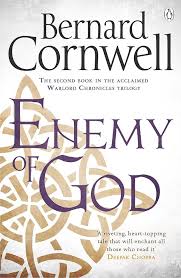
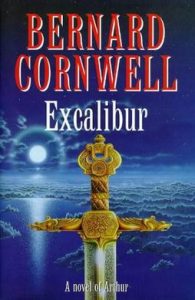
A while ago on this blog, I enthusiastically reviewed Bernard Cornwell’s The Winter King (1995), the first volume of his Warlord Chronicles.  These books are his take on the King Arthur legend, which he tells in a manner closer to the reality of the Dark Ages than most other interpretations of the legend.  As a gift last Christmas, my partner kindly bought me the second and third volumes of the Warlord Chronicles, Enemy of God (1996) and Excalibur (1997).  Here are my thoughts on Enemy of God, which I’ve recently finished reading.


Enemy of God’s framing device is the same as The Winter King’s.  In the sixth century, an elderly monk called Derfel is writing down the history of King Arthur at the behest of the young Queen Igraine, who’s obsessed with the Arthurian tales she’s heard.  As a young man Derfel knew Arthur and became one of his most trusted warriors.  A theme in the books is the tension between messy reality and fanciful legend.  Derfel’s version of events frequently disappoints Igraine, accustomed to hearing much more romanticised stories about the king.  At one point she tells him, “There are scullions who know how to tell a tale better than you!”  Derfel fatalistically assumes that Igraine, later, will doctor his writings and make them more compatible with the legend.


The Winter King ended with Arthur triumphing at the Battle of Lugg Vale, a contest brought about by his own foolishness in backing out of an arranged marriage to Princess Ceinwyn of Powys, which massively offended her father, and wedding instead the more alluring but also more calculating Guinevere.  Enemy of God continues Arthur and Derfel’s story by detailing three more major events in their lives.


Firstly, Derfel takes part in Merlin’s ongoing quest to retrieve some relics that according to legend were given to the ancient Britons by the old pagan Gods, are known as the ‘Treasures of Britain’ and will, Merlin believes, restore Britain to the golden age it supposedly enjoyed before the arrivals of the Romans and, more lately, the Saxons.  Specifically, they go hunting for a magical cauldron that’s hidden on the island of Ynys Mon (today the Welsh island of Anglesey) off the coast of the kingdom of Lleyn, controlled by the vicious Irish king Diwrnach.  Secondly, Arthur marshals the warriors of most of the Briton kingdoms and sets off to dislodge the most powerful Saxon king, Aelle, from the east of the island – a campaign that eventually brings him to Saxon-controlled London.  And lastly, Arthur finds himself facing a rebellion in his home kingdom of Dummonia.  The rebels have incited the Christian community to rise against the pagan one there, with Arthur unjustly portrayed as the oppressive, Christian-hating pagan-in-chief, i.e., the ‘Enemy of God’ of the title.


Along the way, Derfel finds happiness with Ceinwyn, the woman Arthur spurned in the previous book, and they start a family together.  He also makes a troubling discovery about who his father is.  Arthur, meanwhile, learns some hard truths about certain people close to him whom he’s loved or, at least, been willing to give the benefit of the doubt to.  That Mordred, the boy-king of Dummonia, for whom Arthur has been acting as the kingdom’s lord-protector until the lad reaches manhood, turns out to be a wrong ’un is the least of the book’s surprises.


From wikimedia.org


A couple of things make Enemy of God feel different from its predecessor.  Firstly, Christianity is portrayed much more negatively here.  In The Winter King, the Christian Britons co-existed peacefully alongside the pagan ones, and the Briton kings had priests as well as druids in their entourages, ensuring them the support of both the ‘old’ and ‘new’ Gods.  This harmoniousness was embodied in the character of the affable and loyal Bishop Bedwin, but Enemy of God bumps him off early on.  Thereafter, the only sympathetic Christian character is Sir Galahad, who’s so decent and broad-minded he even lends Merlin a hand in his quest for the pagan cauldron.


Amusingly, Cornwell portrays the Christians’ activities, wailing in tongues, flagellating themselves and generally behaving hysterically as the year 500 AD draw nears – likely, they believe, to be the year when their Saviour returns to the earth – as immensely disturbing to the pagans.  They react to the Christians’ shenanigans with as much distaste and fear as modern bourgeoisie Christians have reacted to the many loopy religious cults that have sprung up during the 20th and 21st centuries.


A second difference is that we get far more of Merlin in this book.  In The Winter King, he didn’t show up until page 282, more than halfway through.  I was slightly critical of how he was deployed in the previous book’s plot.  I wrote that “…the manner in which Merlin reappears undermines the narrative, because it’s all a bit too unlikely.  A couple of times, the cunning old wizard pops up out of nowhere and saves the day.  He might as well just whip off a Mission Impossible-style rubber face-mask / disguise and go, ‘Duh-dah!’”  This didn’t sit very comfortably with the book’s attempts to treat the Arthurian legend with non-fantastical seriousness.


Merlin’s still something of an issue In Enemy of God, though here it’s to do with how he manages to suddenly revitalise himself.  At different points he seems to be at death’s door, or to have lapsed into senile decrepitude, but then he stages startling comebacks.  He’s like Doctor Who regenerating when his old body is about to die though, unlike the TV Time Lord, Merlin doesn’t actually transform into someone new.


Still, Cornwell’s Merlin is an immensely engaging character and he gets the best lines.  While telling Derfel what a lion is, and describing one he once saw in Rome, he remarks: “It was a very unimpressive threadbare sort of thing.  I suspected it was receiving the wrong diet.  Maybe they were feeding it Mithraists instead of Christians?”  When he goes on to talk about a crocodile, and Derfel inquires what that is, he explains, “A thing like Lancelot.”


It’s more difficult to breathe life into the character of Arthur.  There’s a danger that his very worthiness will make him seem two-dimensional and dull.  However, Cornwell mostly avoids this trap by highlighting the character-flaws that spring from this worthiness: naivete, gullibility and – paradoxically – being so in thrall to his sense of duty that he becomes villainous.  This last thing is illustrated when Cornwell weaves the tragic, chivalric romance of Tristan and Iseult into his narrative.  Here, the loving but doomed couple incur the wrath of King Mark of Kernow and Arthur feels duty-bound to side with Mark, even though Tristan has helped him in earlier campaigns.  When this ends horribly, Derfel is so disgusted with Arthur that he shuns him for a long time afterwards.


© Cartwright Hall Art Gallery / Bradford Museums & Galleries


It’s surprising to read a book written almost 30 years ago, and set roughly 1500 years ago, and find elements in it reminding me of 2025.  But Enemy of God does this in different ways.  Living in an era of Trumpian fake news, often transmitted by social media, I found myself smiling ruefully at Derfel’s accounts of how the weaselly Lancelot propagates a false image of himself, one brave and virtuous, by getting the bards to sing songs in praise of him around the countryside.  And after Derfel falls out with Arthur, he goes to those bards and pays for “a dozen songs about Tristan and Iseult that are sung to this day in all the feasting halls.  I made sure, too, that the songs put the blame for their deaths on Arthur.”


Also pushing fake news are the Christians.  At one point, a Christian magistrate called Nabur is executed for treason: “These days, of course, he is called a saint and martyr, but I only remember Nabur as a smooth, corrupt liar.”  Later, Arthur has to fight off an ambush in a squalid Christian settlement in the mountains of Powys, led by a filthy, wild-haired fanatic called Bishop Cadoc.  This also gets the Dark Ages equivalent of being reported on Elon Musk’s X: “They say that Arthur surprised Cadoc’s refuge, raped the women, killed the men and stole all Cadoc’s treasures, but I saw no rape, we killed only those who tried to kill us, and I found no treasures to steal – but even if there had been, Arthur would not have touched it…”  Obviously, “Cadoc was elevated into a living saint…”


It’s also interesting to view Enemy of God through the prism of 2025’s Britain, when Nigel Farage’s far-right Reform Party is rallying its supporters with chants of “We want our country back.”  Although Merlin is a very appealing character overall, it’s not difficult to see parallels between his mission to restore the old pre-Roman Britain and the nostalgic British nationalism peddled by Farage.  Ceinwyn, who’s quite enamoured with Merlin, gives a startlingly Farage-like speech at one point: “When I was a child… I heard all the tales of old Britain, how the Gods lived among us and everyone was happy.  There was no famine then, and no plagues, just us and the Gods and peace.  I want that Britain back, Derfel.”


On the other hand, Arthur evokes a more forward-looking – dare I say inclusive? – Britain.  Early in the book, he rejects Merlin’s vision of the island, saying: “This isn’t the old Britain…  Maybe once we were a people of one blood, but now?  The Romans brought men from every corner of the world!  Sarmatians, Libyans, Gauls, Numidians, Greeks!  Their blood is mingled with ours, just as it seethes with Roman blood and mixes now with Saxon blood.  We are what we are, Derfel, not what we once were…”  Arthur might be the greatest hero of British legend, but Farage’s Reform Party wouldn’t want to cite Cornwell’s version of him in their campaign literature.


In nearly every respect, Enemy of God is as good as its predecessor.   The only area where I think it pales a little in comparison to The Winter King is its ending.  Whereas the first volume ended with the bang that was the Battle of Lugg Vale, this volume is slightly anti-climactic.  Cornwell was presumably more concerned with manoeuvring his characters into position for the third and final volume than with finishing the second instalment with a bang similar to the first’s.  This is, to be fair, a problem that has beset many a middle volume in many a trilogy.  However, with everything else about Enemy of God so captivating and entertaining, I’m happy to overlook that slight shortcoming.


And so, in the near-future, I’ll hopefully get to grips with Excalibur


© Michael Joseph / St Martin’s Press

Rishi sunk, Liz trussed, Penny dropped


From wikipedia.org / © Simon Walker, HM Treasury


Now the dust has settled after the British general election on July 4th, it’s time to offer my tuppence worth about the result.  This saw the Labour Party, led by Keir Starmer, brought to power for the first time in 14 years.  It also saw the Conservative Party, under Rishi Sunak, take an ignominious and well-deserved humping and get booted out of government.  They shed 244 seats in the Westminster parliament and ended up with just 121.


But first…  A message for viewers in Scotland.


As (a) someone who’s believed for a long time that Scotland would ultimately be better off as an independent nation rather than as a region of Britain, and (b) a total pessimist, I wasn’t surprised at the dire election result for the Scottish National Party, where it ceded many seats in Scotland to Labour and went from having 43 seats to having a mere nine.  As I said in a post a few weeks ago about the SNP’s new leader John Swinney – what a baptism in fire he’s had – “I suspect folk in Scotland are so scunnered by the SNP’s recent scandals and mishaps, and so desperate to see the back of the Tories, that they’ll vote for Labour en masse next month.”


The SNP having so few Scottish seats in parliament and Labour having so many – they’ve now got 37 in Scotland – isn’t something that thrills me.  Scotland has lost some decent SNP representatives in London, for example, Alison Thewliss, John Nicholson, Tommy Shepherd and Alwyn Smith.  To be fair, I have no idea what they were like as constituency MPs, but they impressed me with their capabilities and eloquence when I saw them speak in parliament.


Also, I’m old enough to remember the 1980s and 1990s – a period of almost continuous Conservative rule from London – when the Scottish seats were also packed with Labour MPs and, the joke went, in Glasgow you could stick a red rosette on a monkey and it’d get voted into Westminster.  The old Scottish Labour contingent contained several heavyweights like John Smith, Donald Dewar, Alistair Darling, Robin Cook and Gordon Brown, and also a few mavericks like the admirable Dennis Canavan and the gruesome George Galloway.  But the majority of those MPs were, for want of a better word, turnips.


As I wrote on this blog a few years ago: “I’m thinking of such specimens as Lanark and Hamilton East’s one-time Labour MP Jimmy Hood, who once declared he’d oppose Scottish independence even if it made the Scottish people better off – the fact that as an MP he was busy claiming £1000-a-month second-home expenses in London no doubt had something to do with his keenness to keep Westminster running the show.  And Midlothian’s David Hamilton, who in 2015 did his bit for the battle against sexism by describing Nicola Sturgeon (and her hairstyle) as ‘the wee lassie with a tin helmet on’.  And Glasgow South West’s Ian Davidson, who charmingly predicted that after 2014’s referendum on Scottish independence the debate would carry on only ‘in the sense there is a large number of wounded still to be bayoneted’.  This shower became known as the ‘low-flying Jimmies’ because of their lack of ambition in anything other than being cannon-fodder for Labour at Westminster and enjoying all the perks that came with being MPs.  And with numpties like these populating the Westminster opposition benches during the 1980s and 1990s, it’s no surprise Mrs Thatcher’s Tories had a free run to do whatever they liked in Scotland.”


It’s possible the new crop of Scottish Labour MPs will be more distinguished than their predecessors, but I’m not holding my breath.  That’s especially since the two most famous ones are the self-important Douglas Alexander and Blair McDougall, head of the ‘no’ campaign before the 2014 Scottish independence referendum, who famously reassured worried Scottish voters that Boris Johnson had no chance of ever becoming British prime minister: “I think that Boris Johnson’s a clown… he’s not even an MP let alone Prime Minister at the moment.


From wikipedia.org / © Lauren Hurley


Nor does it inspire confidence that new PM Keir Starmer has made Edinburgh Labour MP Ian Murray Secretary of State for Scotland.  Murray is more hardline-Unionist than many of the Tories.  When his predecessor as Scottish Secretary, Tory posho Alister Jack, was asked if a Conservative government would ever allow another referendum on Scottish independence, he mused that support for independence would have to be running at about 60% in opinion polls.  When Murray was asked if there were any circumstances in which he’d allow a referendum, he curtly replied: “None whatsoever.”


Not that I think Labour’s hegemony in Scotland this time will last as long as it did previously (when it had the bulk of Scottish MPs until 2015).  For one thing, the party situation and voting situation are now much too volatile.  Scotland today has six parties competing in a first-past-the-post electoral system – Labour, the SNP, the Tories, the Liberal Democrats, the Greens and, unfortunately, Nigel Farage’s far-right-wing Reform Party.  (I didn’t include Alex Salmond’s Alba Party in that list because they lost their deposit in every seat they contested.)  And Labour’s share of the vote in Scotland last week was just 5.3% ahead of that of the SNP, so their position is hardly unassailable.


Anyway, onto the results for Britain generally.  While I was delighted to see the Tories pulverized – and they thoroughly deserved to be pulverized, having presided over one of the most disastrous periods of government in British history, one that brought us austerity, Brexit, Prime Minister Boris ‘party during lockdown’ Johnson and Prime Minister Liz ‘crash the economy’ Truss – I have to say I’m worried.  Starmer’s Labour Party won the lion’s share of the seats in parliament, but the votes cast for them were not that many – they received 9,731,363 votes, 33.8% of the total cast.  That number is lower than those won by Starmer’s predecessor as Labour leader, the much-maligned Jeremy Corbyn, who managed 10,269,051 votes in 2019 and 12,877,918 votes in 2017.  What saved Labour’s bacon this time was a low turn-out and the presence of Farage’s Reform Party, luring right-wing voters away from the Tories.  If you add up the right-wing votes, those cast for the Conservative and Reform parties, they exceed Labour’s figures by more than a million votes and more than three percent of the vote-share.


Which is concerning, as I don’t think Starmer’s government is going to be popular for very long.  Again, as I wrote last month, his party was “so obsessed with attracting former Conservative Party voters they’ve made their policies a continuation of the right-wing ones that’ve damned Britain to rack and ruin during the past 14 years.  For instance, they’ve vowed not to revisit the terms of the Tories’ Brexit arrangement with the European Union, even though it’s hobbled British businesses and it’ll thwart their plans to ‘grow’ the economy; and they won’t countenance raising taxes, which makes you wonder how they’re ever going to lift Britain’s public services out of their current, dire state.”


Meanwhile, looking at what’s left of the Tory Party, I see that its surviving MPs include that self-promoting, hard-right-wing trio Priti Patel, Suella Braverman and Kemi Badenoch.  As MPs, and with Rishi Sunak on his way out, they’ll be able to run for the party leadership.  I can see one of them winning, swinging the Tories even further to the right and cutting a deal with Farage before the next election, probably in 2029.  Farage is the favourite British politician of both Vladimir Putin and Donald Trump, so I’m sure lots of foreign money would mysteriously arrive to ‘grease’ such an arrangement.


© BBC


Oh well.  You have to take your pleasures when you can, and there was much to enjoy on election night, when various Tory politicians I didn’t like lost their seats.  I shed no tears, for instance, when Penny Mordaunt got the boot in Portsmouth.  Another self-promoter, she’s always annoyed me with her jolly-hockey-sticks brand of patriotism and it confounded me how, for a while last year, she was hero-worshipped for carrying a big sword, whilst wrapped in patterned blue wallpaper, at a ridiculous Ruritanian ceremony in Westminster Abbey.  Mind you, she was talked about as potential future leadership material, and was a moderate by Tory standards, so she might have prevented the party from veering off into Farage-land if she’d kept her seat.


I was also tremendously cheered by the departures of that preposterous, top-hatted, Victorian undertaker Jacob Rees-Mogg in Somerset; the braying, bearded bovver-boy Jonathan Gullis in Stoke; the middle-finger-raising Andrea Jenkyns in Yorkshire; the absurdly-coiffured Boris-Johnson cosplayer Michael Fabricant in Lichfield; and Liam Fox, Grant Shapps, Thérèse Coffey, Johnny Mercer, Gilliam Keegan…  Oh, how I laughed.


Incidentally, on the non-Tory front, it was also fun to see the afore-mentioned gruesomeness that is George Galloway usurped from his seat in Rochdale, just four months after he’d won it in a by-election.


Obviously, the best result was the one that ended Liz Truss’s tenure as MP for South West Norfolk.  The shortest-lasting Prime Minister ever – she managed only 44 days in office, easily beating the previous record set in 1827 by George Canning (who at least had the excuse of dying after 119 days as PM) – Truss has spent her time since showing not one ounce of contrition for her brief but disastrous reign, during which her plan to bring in massive tax cuts and pay for them by increasing government borrowing resulted in the pound plummeting, banks and building societies pulling 40% of their mortgage products off the market, and 30 billion pounds getting added to the British Treasury’s fiscal hole, effectively doubling it.  Far from it.  Truss has been blaming everyone but herself.  She’s even accused a beastly ‘anti-growth coalition’ and woke ‘deep state’ of sabotaging her premiership.  Meanwhile, she’s also been ingratiating herself with the American far-right and cheerleading for Donald Trump.  I do hope July 4th’s result terminates her political career, as her industrial-scale arrogance, incompetence and lack of self-awareness are getting a bit terrifying.


From wikipedia.org / © Simon Dawson


Finally, I was pleased to see the Green Party win four seats – just one seat less than Farage’s mob, who secured five.  Does this mean the British media, including the BBC, will now be giving them nearly as much coverage as they give Farage?  Don’t bet your life savings on it.

It’s time Putin’s pals were put in the bin (Part 2)


© Cold War Steve


Continuing my rant about miscreants who support Putin and / or are generally making arses of themselves during the current crisis in Ukraine – this time miscreants in the United Kingdom.


Vladimir Putin – presently stuck in a big, bloody hole he’s dug for himself in Ukraine, but still determinedly digging, using thousands of Ukrainian and Russian lives as his shovel-blade – has never been short of pals in Britain.  Back in 2001, soon after Putin had won his first presidential election in Russia, and not long after the start of the second Chechen war, which saw the deaths of at least 25,000 civilians, a third of Chechnya deemed a ‘zone of ecological disaster’, and most Chechens left suffering ‘discernible symptoms of psychological distress’, then-British Prime Minister and Labour Party leader Tony Blair jetted out to Moscow and cosied up to Putin.  El Tone praised him for showing ‘real leadership’ and giving ‘strong support’ in the ‘fight against terrorism’.


Even today, Blair is hero-worshipped by certain centre-right politicians and commentators in Britain.  Ironically, while later Labour Party leader Jeremy Corbyn is commonly loathed and belittled as a traitorous, anti-Western, lefty scumbag, it’s worth recalling what Corbyn said about Blair’s visit to Moscow in 2001.  “When the Prime Minister… meets President Putin this evening, I hope that he will convey the condemnation of millions of people around the world of the activities of the Russian army in Chechnya and what it is doing to ordinary people there.  When images of what is happening are translated into other parts of the world, many people are horrified…”  Exchange ‘Ukraine’ for ‘Chechnya’ and you realise how Corbyn’s words resonate in 2022.


No doubt nowadays Blair keeps his mouth shut about Putin’s supposed statesmanship.  But another well-known British politician is less reluctant to express his admiration for the warmongering Russian ogre.  Right-winger, Europhobe and wannabe broadcaster Nigel Farage has said of him: “I wouldn’t trust him and I wouldn’t want to live in his country, but compared with the kids who run foreign policy in this country, I’ve more respect for him than our lot.”  Meanwhile, the donkey-faced, and full-of-donkey-shit, Farage has made copious appearances on Russia Today, coming out with such gems as the claim that Europe’s modern democracies have been run ‘by the worst people we have seen in Europe since 1945’.  Worse even than Putin?  Yes, I’m sure Nige thinks so.


By the way, let’s not forget Aaron Banks, Farage’s compadre in the Vote Leave campaign that managed in 2016 to tear the UK out of the European Union, possibly helped by a wee bit of Russian funding.  In 2017, Banks did his bit for the Putin cause by tweeting: “Ukraine is to Russia what the Isle of Wight is to the UK.  It’s Russian.”


Elsewhere, there’s multiple evidence suggesting that Boris Johnson’s Conservative government, if not totally in love with Putin’s habit of inflicting atrocities on neighbouring countries that annoy him, is certainly in love with the wealth of the Russian oligarchs who surround the man.  Recent claims about the amount of donations the Conservative party has received from such oligarchs have ranged from 1.93 million to 2.3 million pounds.
 

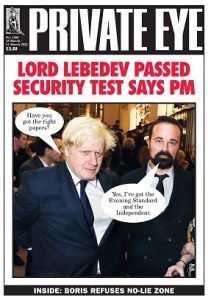
Johnson seems particularly enamoured with members of Russia’s mega-wealthy elite.  In 2018, while he was serving as Theresa May’s foreign secretary, he was seen stumbling about an Italian airport suffering from a hangover, and lacking his security detail, after attending a shindig thrown by Russian media magnate Evgeny Lebedev at his castle near Perugia.  Lebedev subsequently received a peerage and now, technically, is ‘Baron Lebedev, of Hampton in the London Borough of Richmond on Thames and of Siberia in the Russian Federation’.  Johnson has sheepishly denied allegations that he used his influence to secure the peerage for his buddy.


© Private Eye


Though late last week the British government announced it was freezing the assets of seven Russian billionaires (including Chelsea Football Club owner Roman Abramovich) with close ties to Putin, this only came after weeks of prevarication.  Originally, it looked like the UK wouldn’t be clamping down on dodgy Russian money until late in 2023, which would have given those likely to be affected a good year-and-a-half to sell their assets and move their money off British soil.  Even with this new change of heart, Abramovich and co. have already had a fortnight’s grace-period to shift some of their wealth.  Basically, Johnson’s regime is reluctant to do anything that might sully London’s reputation as a haven for dodgy money.


Summing up the absolute state of the Conservative Party on this issue is its wretched co-chairman Ben Elliot.  Simultaneously, Elliot’s been sourcing donations from super-rich Russians and been offering services to them in Britain through his ‘concierge’ company, Quintessentially.  “Quintessentially Russia has nearly 15 years’ experience providing luxury lifestyle management services to Russia’s elite and corporate members…”, ensuring that from “restaurant bookings to backstage concert access, a bespoke lifestyle is at our clients’ fingertips.”  So drooled the blurb on Quintessentially’s website until recently.  Then, suddenly and mysteriously, this obsequious drivel was deleted from it.


While we’re heaping abuse on the British government, we shouldn’t overlook the smirk-faced Priti Patel, who – until another apparent U-turn last week – seemed determined that the Ukrainian refugees Britain was allowing in should be vastly outnumbered by the Russian oligarchs it was welcoming with open arms.  At one point, while other European countries had taken in Ukrainian refugees in the tens of thousands, the UK had dished out a mere 50 additional visas to them.


Besides Patel, it’s worth castigating government minister Kevin Foster, who advised people fleeing Ukraine to apply to Britain’s ‘seasonal worker scheme’, which would allow them to spend their time in the country picking fruit.  Such humanity, Kev!  Also, some hatred should be directed towards whatever nasty piece of work in the Home Office complained to the Daily Telegraph that Ireland had allowed in too many Ukrainian refugees.  All those shifty Ukrainians, claimed the anonymous source, would “come through Dublin, into Belfast and across to the mainland to Liverpool”, thus creating “a drug cartel route.”


Needless to say, Britain’s resident community of publicity-seeking, rent-an-opinion gobshites have fastened onto the Ukrainian crisis like flies fastening onto a cow-plop.  George Galloway, that fedora-wearing gasbag whose rhetoric seems to weave between old-school socialism (when he’s in England) and hardline British nationalism (when he’s in Scotland), and who’s a fixture on the Russian-owned Sputnik radio channel, tweeted recently: “Me, Farage, Hitchens, Carlson and Rod Liddle are a pretty broad front of people who think NATO expansion to the borders of Russia was a pretty bad idea.  Maybe pause and think about that?”  When I paused and thought about it, my immediate thoughts were: “George Galloway, Nigel Farage, Peter Hitchens, Tucker Carlson, Rod Liddle…  Wow, what a team!  Couldn’t Marvel make a superhero movie about them?  Maybe call it Arseholes Assemble?”


Hilariously, Galloway’s Putin-sympathetic stance has ended all unity in the All for Unity party, the staunchly pro-UK outfit he set up in Scotland prior to the last Scottish parliamentary elections.  Jamie Blackett, the party’s former deputy leader, and also the Deputy Lieutenant for Dumfriesshire and a Daily Telegraph writer, recently disowned his old boss and announced the disbanding of the party.


Meanwhile, Neil Oliver, the alleged Scottish historian and talking head on right-wing outlet GB News, lately delivered a bewildering monologue, the gist of which was: “I’ll be honest.  I don’t know what’s happening in Ukraine.  I don’t understand it either.”  Oliver’s professed ignorance of the situation didn’t stop him talking about it for nine minutes, however.  It’s also strange that when it comes to Putin and Ukraine Oliver is so hesitant to climb off the fence, considering how quick he’d been in the past to condemn, say, the Scottish National Party (‘disastrously incompetent’, ‘small’, ‘not worth bothering about’), or the Black Lives Matter movement (‘anarchists and communists’ eating ‘into the built fabric of Britain’).  Very strange indeed.


One other thing bugging me about Putin’s current horror show is how certain people have pounced on it and tried to use it to promulgate the right-wing agendas they’ve been pushing for years already.  Take the ‘culture wars’, in which Putin’s ‘anti-woke’ position had until recently won accolades from Western pundits on the right of the spectrum.  Well, now that Putin is officially a Bad Lad, they can’t praise him directly anymore.  Instead, they’re pushing the narrative that woke stuff no longer matters during the crisis that good old Vlad, sorry, bad new Vlad has created.


Here’s the absurd Daily Telegraph columnist Allison Pearson, recently opining: “The outbreak of war has shone an unflattering light on our society… Watch issues like LGBT, net-zero, Partygate, Black Lives Matter and farcical ‘Stay Safe’ Covid restrictions all fade into well-deserved insignificance now that war is back.”  According to Pearson, in other words, now that Putin’s behaving like a c*nt, we should all stop fretting about being civil to our fellow human beings, about preventing them from dying of Covid, about preventing the planet from burning up, and about our leader Boris Johnson being a lying, unprincipled sack of shite.


And here’s the barmy Spectator pundit Lionel Shriver, writing: “Decolonisations, contextualisations, gender-neutralisations – it’s all a load of onanistic, diversionary crap, and the West having shoved its head up its backside is one reason that Putin feels free to do whatever he likes.”  Though I suspect Putin would still have attacked Ukraine if fewer people on Western social media had been using the pronouns ‘they’ / ‘them’ in their profiles.


One last thing for which Britain’s right-wingers must be thanking Putin is the attention he’s diverted from the looming issues of manmade climate change and the dire state of the environment.  Thanks to the headlines being dominated by Ukraine, not much attention has been given to, for instance, the apocalyptic floods that have stricken Queensland and New South Wales.  And, somewhat inevitably, the afore-mentioned Nigel Farage is currently trying to relaunch his political career by demanding a new national referendum – this time, not about the UK’s membership of the European Union, but about the British government’s supposed adoption of Net Zero policies to combat climate change.  Farage, of course, wants us to vote against them.


I wonder why he’s doing this.  Could he be thinking of a country that helped finance his previous, successful referendum campaign?  Or could he be thinking of an oil-exporting country that would stand to gain if Britain gave up on green energy and became wholly dependent on fossil fuels again?


I can’t possibly think of a country that falls into both categories.


© The Jewish Chronicle / twitter / @ VirendraSharma

Things get frosty for Tiger Tim


From durham.academia.edu


The other day I discovered that my old alma mater, Peebles High School in the Scottish Borders, had a Wikipedia entry.  Near the end of it was a ‘notable alumni’ section.  I reacted with a disgruntled “Oh God, him,” when I saw listed among those notable alumni ‘Tim Luckhurst, journalist and academic’.


Minutes later, I headed over to the Guardian’s website to check the news headlines.  It seemed a mighty coincidence when I started reading a story under the headline DURHAM HEAD STEPS BACK AFTER CALLING STUDENTS ‘PATHETIC’ AT ROD LIDDLE EVENT and discovered that the head in question, the principal of Durham University’s South College, was none other than Tim Luckhurst – that distinguished journalistic and academic graduate mentioned in Peebles High School’s Wikipedia entry.


During the mid-to-late 1970s, Tim was a few years ahead of me at school.  He was a well-kent figure, lanky, curly-haired, lugubrious-faced and sloping around the place in a combat jacket and a T-shirt saying LEGALISE CANNABIS – in those permissive times at Peebles High you weren’t obliged to wear a school uniform.  To my mates and I he was known contemptuously  as ‘Chairman Mao’.  I think he spoke to me just once, at a careers evening being held in the school.  I was about to go into a classroom where the affable Atholl Innes, then editor of local newspaper the Peeblesshire News, was dispensing advice to young people who were interested in becoming journalists.  Out of that classroom emerged Tim and, to me, he declared emphatically, “Well, I know what I want to be!”


Probably Tim had already resolved to become a journalist and Atholl Innes had been preaching to the already-converted.  But I sometimes wonder if he hadn’t made up his mind until entering that classroom and his meeting with Athol Innes had been a moment of revelation – “Yes, newspapers,” Tim had cried, “that’s the life for me!”  If the latter is the case, I can only say, “Atholl…  You created a monster.”


Incidentally, that Tim had to attend a lowly comprehensive school like Peebles High, up in the windy wilds of North Britain, full of horrible little oiks like myself, still rankles with the man.  Writing for the Guardian in 2010 he quoted Ellen Wilkinson, Secretary of State for Education in the post-war British Labour government, as saying of her childhood in non-selective schooling in Manchester: “The top few pupils were intelligent and could mop up facts like blotting paper, but we were made to wait for the rest of the huge classes…  We wanted to stretch our minds but were merely a nuisance.”  Tim noted sourly, “Thirty years later I experienced comparable misery at my Scottish comprehensive.”


From the Peeblesshire News


I should point out that although it denied Tim the chance to stretch his fabulous mind and soak up facts like a sheet of super-absorbent blotting paper, Peebles High School must have done something for his education.  In fact, it was good enough to get him into Cambridge University.  At Cambridge, incidentally, according to one Luckhurst-bio I’ve found online, “…he played bass guitar in Tony Tiger and the Frosties.”  I know it’s wrong to judge bands by their names alone, but Tony Tiger and the Frosties sound like the most horrible thing to have strutted onstage on the Oxbridge music scene since the early 1970s, when a student band called the Ugly Rumours featured one Tony Blair as their frontman.


I suspect the disdain Tim feels for his alma mater in Peebles is mutual.  I recall several years back chatting to one of my old teachers, now a sweet little pensioner, when Tim’s name somehow cropped up in the conversation.  The teacher underwent a startling metamorphosis, hands becoming clenched and claw-like, face dark and scowling, and blurted wrathfully, “Tim is just an ARSEHOLE!”


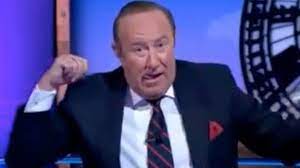
During the 1980s and 1990s, Tim served as press officer for the Labour Party’s then-sizeable cabal of Scottish MPs, including Shadow Secretary State for Scotland Donald Dewar; stood unsuccessfully as a Labour candidate in Roxburgh and Berwickshire in a general election; and worked for the BBC.  I’d forgotten that the guy existed until February 2000, when he was announced as the new editor of my Dad’s favourite newspaper, Edinburgh’s venerable and respected Scotsman.  Actually, by then, the Scotsman was a lot less respected.  It’d been acquired by the Barclay Brothers’ Press Holdings Group and for several years had suffered under the crass stewardship of Andrew Neil, the Group’s editor-in-chief.  Tim lasted as Scotsman editor only until May that same year, when he was replaced by Rebecca Hardy, whom I knew from a previous phase of my life too – but that’s a story for another day.


© BBC / From the Guardian


In 2013, Tim and his old boss at the Scotsman, Andrew Neil, had a rammy on twitter.  Tim contradicted Neil on something and Neil replied, “And I made you Editor of the The Scotsman.  Most stupid decision ever.  But at least I fired you six days later.”  When Tim countered with, “Would you care to retract that statement, Andrew?  It might be wise,” Neil retorted, “Bring it on.  And let me pay to straighten your teeth.”  For the record, I’ll print what the Evening Standard said about the row: “…Professor Luckhurst was not ‘sacked after six days’ from the Scotsman, as Neil claims, but resigned due to ill health after four months.”  And I assume that, following the debacle of his involvement with GB News, Andrew Neil now considers giving Tim the Scotsman’s editorship only his second most stupid decision ever.


Following the Scotsman, Tim spent seven years as political editor of the Scottish edition of the Daily Mail (which, with hindsight, was surely a good fit for him).  Then he entered academia with a job as Professor of Journalism at the University of Kent, and then joined Durham University in 2019.  Despite having been a one-time backroom operative with the Labour Party, his politics by this time had clearly shifted rightwards.  However, I’ll hazard a guess and say he views himself as a moderate, old-school Tory rather than a ranting, frothing, hard-right one.  From the occasional glances I’ve had at his twitter feed, he seems impressed neither by Brexit nor by the antics of Boris Johnson.


That said, his moderate Tory-ness stops at the English-Scottish border.  One step north of that border and his moderate Tory-ness changes to rabid Unionism.  He might once have worked for Donald Dewar, viewed as the ‘father’ of the Scottish devolution settlement and the devolved Scottish parliament, but by 2001 he was demanding in a Guardian opinion piece that Whitehall consider abolishing the parliament, Dewar’s baby: “Scotland needs Whitehall at least to threaten repeal.  To demand less in the present climate would be unpatriotic.”


That article was mild, though, compared with one he wrote for the New Statesman that same year.  Entitled SCOTLAND RETURNS TO THE DARK AGES, he used it to blame devolution for releasing a tsunami of evils like homophobia, sectarianism, misogyny, racism and, er, the banning of fox-hunting.  In the civilised days before devolution unleashed the Scots’ inner beastliness, he wrote, such things had been ‘diluted by the soothing balm of the British state’.  Strangely enough, that article is no longer available on the New Statesman’s website.


Meanwhile, his twitter feed has been punctuated by tone-deaf pronouncements on Scotland that surely only appeal to a minority of ultra-Unionist Scots for whom 1690 is as important a year as 1707.  I remember him expressing horror at the Scottish government punting a few million pounds towards the promotion of the Gaelic language; or retweeting a video of Ross Thomson – the demented hard-Brexiting, Boris-worshipping Tory ex-MP for Aberdeen South – professing his undying love for the United Kingdom amid a thicket of Union Jacks.  I wonder what will happen if Scotland becomes independent.  Poor Tim’s head will probably explode like the guy’s head did at the beginning of David Cronenberg’s Scanners (1981).


But onto 2021.  Tim landed himself in hot water when, as head of South College at Durham University, he invited his old mate and colleague Rod Liddle to give a speech at a ‘college formal’ event in early December.  He and Liddle have known each other since 1985 and worked together on BBC Radio 4’s Today programme.  Indeed, in 2010, Tim wrote a Guardian piece in support of Liddle’s candidacy to become editor of the Independent newspaper.  This was a prospect that alarmed many readers of the reasonably-liberal Independent because Liddle had earned himself a reputation for being misogynistic, homophobic and racist.  Pretty much all the things Tim once accused the Scottish parliament of being.


From twitter.com/sunapology


Liddle is a ‘columnist’ – i.e., gobshite-provocateur – with the Spectator, Sun and Sunday Times and even by the standards of the gobshite-provocateurs that infest the pages of Britain’s mostly right-wing press, forever seeking new ways to upset people, the charge-sheet against him is disproportionately long.  Here’s just a few of his low-points.  He was a pig towards Labour politician Harriet Harman.  (“So – Harriet Harman, then.  Would you?  I mean after a few beers obviously, not while you were sober.”  In his Guardian puff-piece about Liddle, Tim euphemistically described this remark as ‘not gallant’.)  He mocked another female Labour MP, Rosie Duffield, for speaking out about verbal abuse and humiliation she’d received from a former partner – “the sobbing and oppressed Rosie ‘MeToo’ Duffield”.  He’s complained about the Conservative party not being Islamophobic enough and suggested that elections be held on days when “Muslims are forbidden to do anything on pain of hell.”  He’s raved about “black savages”.  He’s dismissed Welsh language activists as “miserable, seaweed-munching, sheep-bothering pinch-faced hill-tribes”.  He’s explained: “…the one thing that stopped me from being a teacher was that I could not remotely conceive of not trying to shag the kids.”  And so on, and so forth.


When Liddle stood up at the event and launched into a speech filled with his predictably reactionary schtick – jokes about sex workers, comments about trans-women having ‘long, dangling penises’ and the charming hypothesis that British colonialism never did anyone any harm because its subjects weren’t intelligent anyway – members of the student audience started walking out.  Tim, tigerish about defending everyone’s right to freedom of expression, and everyone’s right to have Rod Liddle inflicted upon them, reportedly shouted at them that they were ‘pathetic’.  There’s also video footage in circulation on twitter showing Tim arguing with students after the event.  Meanwhile, his wife Dorothy Luckhurst, who might have been slightly over-refreshed at the time, can be seen shouting at those students things like, “I think you are an arse…  Arse, arse, arse, arse, arse…!  Arse, arse, arse, arse, arse…!”


From twitter.com/RDuskedd


Did Tim honestly believe that he could invite Liddle onto a university campus and there wouldn’t be trouble?  He must be a bit thick.  Or maybe he was deliberately trying to stir up a hornet’s nest – which, if that was the case, he succeeded in doing.


I’m actually not a fan of censorship by the left, in the form of ‘no-platforming’, ‘cancel culture’ or whatever you want to call it.  That’s because I’d always assumed censorship was an instrument used by the right and there was no excuse for the left to use it too.  But there’s a time and place for debates where extreme views, offensive to many, can be aired and argued with.  And the event at South College was clearly neither the time nor place.  For one thing, the attendees had paid ten pounds a head to be there and hadn’t been warned in advance that the entertainment included Rod ‘shag the kids’ Liddle.  If I’d been present, I’d have walked out too when Liddle started spewing his crap at me – just as I’d have done in the 1980s or 1990s if I’d bought a ticket for what I expected to be a mild-mannered comedy night and then Bernard Manning had lumbered on stage and started cracking jokes about ‘darkies’ and ‘poofs’ and ‘Paddies’.  And incidentally, isn’t walking out a legitimate form of expression in itself?  Especially when, as with Liddle’s audience, you don’t have access to a microphone.


It’s fascinating how Tim, and the whole media / political establishment that he’s a member of, claim to be champions of free speech when there’s a danger that people might stop listening to right-wing establishment opinions.  Yet it’s pretty difficult in Britain, if you interact with the media in anyway at all, not to be assailed relentlessly by right-wing opinions.  There’s the front-page headlines of reactionary rags like the Sun, Mail and Express screaming at you daily from the newsstands.  There’s the now completely cowed and broken-backed BBC parroting the right-wing agenda of the press when it does its morning newspaper round-ups.  There’s a seemingly endless parade of right-wing pundits from Nigel Farage downwards (and Farage is pretty far down already) getting platforms on TV news channels.  If Tim and co. are so desperate about promoting freedom of expression and making people experience views they wouldn’t otherwise hear, shouldn’t they be trying to expose hardcore readers of the Sun, Mail and Express to the opinions of Owen Jones, George Monbiot, Laurie Penny, John Pilger, Naomi Klein and Noam Chomsky?  Well, they should, but I’m not holding my breath.


Currently, following a storm of Liddle-related protests, Tim has been parked on the naughty step at Durham University while his employers decide what action, if any, should be taken against him.  But even if he’s shown the door, I’m sure that a lucrative future awaits him at one of Britain’s countless right-wing news and / or opinion outlets, which will take him to its bosom as a martyr to the cause of freedom of (right-wing) speech and as a blameless victim of horrible, lefty, woke, cancel culture.


Now that his old nemesis Andrew Neil has left the building, I could even see him ending up at GB News.  He could form a double act with Neil Oliver, where they both whinge and gurn about the ghastliness of modern-day Scotland under the leadership of Nicola Sturgeon and how the Scots need their uncivilised natures to be ‘diluted by the soothing balm of the British state’.  Meanwhile, Tim’s better half could get a gig there as well.  Perhaps Talking Pints with Nigel Farage?

Favourite Scots words, A-C


From the Scottish National Portrait Gallery


Today, November 30th, is Saint Andrew’s Day, the national day of Scotland.  To mark it, I’d like to post something about a favourite topic of mine, the Scots language.  And yes, the way that non-Gaelic and non-posh Scots have spoken for centuries has been classified as a language, a separate one from ‘standard’ English, by organisations like the EU and linguistic resources like Ethnologue.


Sadly, I think that Scots is now living on borrowed time.  It’s not likely to expire due to the disapproval of educators who dismiss it as a debased dialect (or accent) of standard English and regard it as the ‘wrong’ way to speak, although their hostility certainly didn’t help its status in the past.  No, the fatal damage to Scots has probably been inflicted by television, exposing Scottish kids to a non-stop diet of southern-England programming and conditioning them to speak in Eastenders-style Mockney or, worse, in bland, soulless ‘Estuary English’.


Personally, I love listening to and reading Scots.  Here are my favourite Scots words starting with the letters ‘A’, ‘B’ and ‘C’ that I’d be sad to see slip into linguistic extinction.  Most of the definitions given come from my heavily used copy of the Collins Pocket Scots Dictionary.


Agley (adv) – wrong, askew.  The saying, ‘The best-laid plans of mice and men often go awry’ (which provided John Steinbeck with the title of his second-most famous novel) is an anglicised version of lines from the poem To a Mouse by Scotland’s greatest bard Robert Burns: “The best-laid schemes o’ mice an’ men / Gang aft agley.”


Aiblins (adv) – perhaps.  The late, great Glaswegian writer Alasdair Gray borrowed this word for the surname of the title character in his short story Aiblins, which appeared in the collection The Ends of Our Tethers (2003).  This is about a creative writing professor being tormented by an eccentric student called Aiblins who is, perhaps, a literary genius or is, perhaps, just a fraud.


Avizandum (noun) – a word in Scots law meaning, to quote the Collins Pocket Scots Dictionary, ‘a judge’s or court’s consideration of a case before giving judgement’.  Avizandum is also the name of a bookshop on Edinburgh’s Candlemaker Row specialising in texts for Scottish lawyers and law students.  Not being a lawyer, I’ve never had cause to go into Avizandum-the-shop, but I do think it’s the most majestically titled bookstore in Scotland.


Bairn (n) – a baby or young child.  I once saw an episode of Star Trek (the original series) in which Scotty lamented, after Mr Spock had burned out his engines in some ill-advised space manoeuvre, “Och, ma poor wee bairns!”  So I guess this Scots word is safe until the 23rd century at least.  Also, the Bairns is the nickname of Falkirk Football Club, so it shouldn’t be dying out in Falkirk anytime soon, either.


Bahookie (n) – rump, bum, backside, ass or, to use its widely-deployed-in-Scotland variant, arse.


Bampot (n) – a foolish, stupid or crazy person.  During the documentary Big Banana Feet (1976), about Billy Connolly doing a stand-up tour of Ireland, Connolly responds to a heckler with the gruff and memorable putdown, “F**king bampot!”


Bawbag (n) – literally a scrotum, but normally, to quote the online Urban Dictionary site, ‘a derogatory name given to one who is annoying, useless or just plain stupid.’  Thus, when former United Kingdom Independence Party leader Nigel Farage steamed into Edinburgh in May 2013 in a bid to raise UKIP’s profile north of the border, he ended up besieged inside the Canon’s Gait pub on the Royal Mile by a horde of anti-racism protestors who chanted, “Nigel, ye’re a bawbag / Nigel, ye’re a bawbag / Na, na, na, hey!”


Bertie Auld (adj), as in “It’s Bertie Auld tonight!” – rhyming slang for cauld, the Scottish pronunciation of ‘cold’.  Bertie Auld was a Scottish footballer who played for Celtic, Hibernian, Dumbarton and Birmingham City and whose finest hour was surely his membership of the Lisbon Lions, the Celtic team that won the European Cup in 1967.


Bide (v) – to live.  Derived from this verb is the compound noun bidie-hame, which refers to a partner whom the speaker is living with but isn’t actually married to.


Blether (v) – to talk or chatter.  Journalist, editor and Rupert Murdoch’s one-time right-hand-man Andrew Neil used this word a lot while he was editor-in-chief at Scotsman publications.  He was forever fulminating against Scotland’s blethering classes – the equivalent of the ‘chattering classes’ in England who were so despised at the time by the English right-wing press, i.e. left-leaning middle-class people who spent their time holding dinner parties, drinking Chardonnay and indulging in airy-fairy political discussion about how Britain should have a written constitution, proportional representation, devolution, etc.  Then, however, Neil started working for the BBC in London and suddenly all his references to blethering ceased.


Boak (v / n) – to vomit / vomit, or something unpleasant enough to make you want to vomit.  One of those Scots words that convey their meaning with a near-onomatopoeic brilliance.  In his stream-of-consciousness novel 1982 Janine, Alasdair Gray – him again – represents the main character throwing up simply by printing the word BOAK across the page in huge letters.


From pinterest.co.uk


Bowffin’ (adj) – smelling strongly and unpleasantly.  Once upon a time, mingin’ was the favoured Scots adjective for ‘smelly’.  Now, however, mingin’ seems to have packed its bags, left home and become a standard UK-wide slang word – with a slight change of meaning, so that it denotes ugliness instead.  It has thus fallen upon the alternative Scots adjective bowffin’ to describe the olfactory impact of such things as manure, sewage, rotten eggs, mouldy cheese, used socks, on-heat billy goats, old hippies, etc.


Breenge (v) – to go, rush, dash.


Bourach (n) – sometimes a mound or hillock, but more commonly a mess or muddle.  Charmingly, this has recently evolved into the term clusterbourach (inspired by the less ceremonious ‘clusterf*ck’), which Scottish politicians have used to describe the absolute hash that the London government is making of the Brexit process.


Callant (n) – a lad or young man.  The Common Riding festival held annually in the Borders town of Jedburgh is called the Callant’s Festival.  Accordingly, the festival’s principal man is called the Callant.


Carlin (n) – an old woman, hag or witch.  Throughout Scotland there are stone circles, standing stones and odd rock formations that are known as carlin stones, presumably because people once linked them to the supernatural and imagined that witches would perform unsavoury rituals at them.


Carnaptious (adj) – grumpy, bad-tempered or irritable.  For example, “Thon Belfast singer-songwriter Van Morrison is a right carnaptious auld c**t.”  There’s a lot of carnaptiousness in Scotland and another common adjective for it is crabbit.


Chib (n/v) – a knife, or to stab someone.  Considering the popularity in modern times of wearing Highland dress at Scottish weddings, and considering the custom of having a ceremonial sgian-dhu (i.e. dagger) tucked down the side of the hose (i.e. socks) in said Highland dress, and considering the amount of alcohol consumed at such affairs, it’s amazing that Scottish weddings don’t see more chibbing than they do.


Chitter (v) – nothing to do with the sound that birds make, this means to shiver.


Clarty (adj) – dirty.  A dirty person, meanwhile, is often called a clart.  And a pre-pubescent boy who avoids soap, shampoo, showers and clean socks and underwear, like Pig Pen used to do in the Charlie Brown comic strips, would undoubtedly be described in Scotland as a wee clart.


Cleek (v) – to hook, catch or capture.  It’s also a noun denoting a large type of hook, especially the gaffe used by fishermen, and poachers, when landing fish.  At least once, in my hometown next to the salmon-populated River Tweed, a cleek has also been used as an offensive weapon.


From en.wikipedia.org


Cloots (n) – a plural noun meaning hooves.  By extension, Cloots came to be a nickname for the world’s most famous possessor of a pair of hooves, Auld Nick, a.k.a. the Devil.  In his poem Address to the Deil, Robert Burns not only mocks Auld Nick but brags that, despite his wild and wanton behaviour in this present life, he’ll escape the fiend’s clutches and avoid going to hell: “An’ now, auld Cloots, I ken ye’re thinkin’ / A certain bardie’s rantin’, drinkin’ / Some luckless hour will send him linkin’ / To your black pit / But faith! he’ll turn a corner jinkin’ / An’ cheat ye yet.”


Clype (n) – a contemptible sub-species of schoolchild, i.e. the type who’s always running to the teachers and telling tales on his or her schoolmates.


Colliebuckie (n) – a piggy-back.  Scottish playgrounds once echoed with cries of “Gie’s a colliebuckie!”


Corbie (n) – a crow or raven.  The knowledgeable Australian musician / singer / writer Nick Cave uses this word at the beginning of his gothic novel And the Ass Saw the Angel, which has a couple of ‘sly corbies’ circling in the sky above the dying hero.


Cowpt (adj) – overturned, fallen-over.  Often used to describe sheep when they fall onto their backs, can’t get up again and run the risk of breaking their spines.  Around where I live, there’s a story of a young farmer who was about to get married and, just before his stag party in Edinburgh, was collected at his farmhouse by a coachload of his mates.  As the coach was driving away from the farm, someone on board spotted a cowpt ewe in one of the fields.  Jocularly, the young farmer told the coach-driver to manoeuvre the vehicle off the road, into the field and across to the spot where the unfortunate beast was on its back, which he did.  The young farmer got out and put the cowpt ewe on its feet again; but meanwhile all the other sheep in the field, seeing the coach and not knowing the difference between it and a tractor carrying a load of hay, flocked around it expecting to be fed.  That left the stag-party and their transport marooned amidst a sea of woolly white fleeces.


I’ll return to this topic in this blog and cover further letters of the alphabet.


© Viz Unicorn Entertainment / Brent Walker

The sound of silence


From unsplash.com / © Vienna Reyes


Having perused the British media for the past week, I’ve reached the conclusion that the song that best sums up late-August Britain in this coronavirus-stricken year of 2020 is The Sound of Silence, recorded by Paul Simon and Art Garfunkel in 1964, although not a hit for them until two years later.


But it would have to be The Sound of Silence played with the volume turned down.  No sound.  Just silence.


The first silencing I’ve read about is one that’s caused the latest stramash in Britain’s seemingly never-ending culture wars.  Previous instalments in these culture wars have seen a statue of a notorious slave trader in Bristol get chucked into the sea and ridiculous long-haired historian Neil Oliver react to the deed by wailing about ‘anarchists and communists’ trying to destroy the British way of life…  Shaven-headed right-wing thugs giving Nazi salutes in London whilst attempting to protect another statue, one  of Winston Churchill, a man revered in Britain for, er, standing up to Nazis…  And a great deal of red-faced spluttering when the BBC, on its UKTV streaming service, temporarily suspended a 1975 episode of Fawlty Towers in which the dotty old Major character uttered some offensive racial epithets.


The BBC is also at the centre of the newest storm.  It’s decided to have the patriotic British songs Land of Hope and Glory and Rule, Britannia performed at this year’s Last Night of the Proms concert in the Royal Albert Hall without vocalists there to sing the lyrics.  The BBC claims this is to reduce the number of people onstage and allow for social distancing.  It detractors allege it’s because the lyrics have been deemed inappropriate in these overly sensitive, politically correct times.


In the clips of Last Night of the Proms concerts that I watched on TV in the past – in the distant past, because even as a teenager I found it a gruesome spectacle and never wanted to look at the thing again – most of the singing was done by the audience.  And the audience was a sea of drunken, Union Jack-waving Hooray Henrys and Hooray Henriettas making a cacophony that was as pleasant to listen to as a burning chicken-shed.  Due to Covid-19, the audience won’t be present this year.  That’s got to be an improvement, whether or not the songs are performed as instrumentals.


Predictably, the BBC’s decision to de-vocalise the songs was greeted by howls of outrage from the right-wing shit-sheets that make up much of the British national press, i.e. the Sun, Daily Telegraph, Daily Mail and Daily Express.  It was also seized upon by Prime Minister Boris Johnson who, after performing a veritable Gordian knot of humiliating U-turns recently, was desperate to direct attention away from his governmental crapness.  Johnson declared that it was time to ‘stop our cringing embarrassment’ about being British.  Actually, at this stage, the best way to stop people feeling embarrassed about being British would be to build a time machine, pop back in time 56 years and persuade Stanley Johnson to wear a condom.


Also climbing onto the anti-BBC bandwagon was publicity-seeking hybrid human-donkey mutant Nigel Farage, who promptly tweeted footage of himself singing a lusty rendition of Rule, Britannia at some pro-Brexit rally.  This in turn prompted comedian David Baddiel to remark: “There might be some who feel a little sad about Rule, Britannia, seeing it, now divorced of triumphalist origins, only as a Proms tradition.  Watching this, however, makes it clear how it’s still basically a C*nts’ Anthem.”


Well, I wouldn’t be quite as severe as Baddiel in his assessment of Rule, Britannia, though I too have difficulty thinking positively of it and Land of Hope and Glory when I see the likes of Nigel Farage belting them out.  But apart from that, in terms of actual musical quality, I’ve always thought Rule sounded a bit cheesy and Land was a pompous dirge.  I say that as someone who spent his childhood in a fairly Protestant part of Northern Ireland, where the air often reverberated with the sound of people singing patriotically pro-British tunes.  While these tunes were frequently offensive to Roman Catholic ears, they, unlike Rule and Land, at least managed to be catchy.


(I remember one good friend from a quarter-century ago, a university lecturer who was a skilful pianist.  His university would sometimes rope him into providing live background music at official receptions.  He confessed to me that during one such event, bored stiff with ‘tinkling the ivories’, he felt a sudden powerful urge to start playing The Sash.  When I pointed out to him that he was a Glaswegian Catholic, and had a cousin who’d once been skipper of the Glasgow Celtic football team, and therefore wasn’t supposed to be a fan of The Sash, he shrugged and said, “Aye…  But at least it stirs the blood.”)


© Warner Music Group – XS Music Group

© Victor


However, it hasn’t just been Rule, Britannia and Land of Hope and Glory that have been silenced lately.  Reading a separate news story, I learned how restauranteurs in Scotland have been complaining about a ban on music on their premises, prompted again by the current Covid-19 pandemic.  The Scottish government implemented the ban on August 14th, afraid that if eateries were full of loud music, people would have to tilt their heads close together and shout and thereby increase the risk of spreading the virus.  The restauranteurs have dismissed this thinking as ‘ridiculous’, ‘nonsense’, ‘a disgrace’ and having ‘no logic’.  One even complained that “We need background music to kill the deathly hush as people feel they have to start whispering when a restaurant is quiet.  Diners want to eat out in a place with atmosphere, not a library.”


This set me thinking of the half-dozen restaurants that my partner and I most often go to in Colombo, Sri Lanka, our current city of residence.  I can’t remember hearing music played in three of them.  If it was played, it was at such a low volume as to be unnoticeable.  One restaurant plays music but softly and unobtrusively – I recall Bob Dylan’s Ballad of a Thin Man (1965) getting an airing there the other week.  The fifth used to play some weird 1960s Euro-lounge / psychedelic / jazz stuff, like what you’d hear on the soundtrack of a Jess Franco movie, but they seem to have stopped that since the venue reopened after Sri Lanka’s two-month Covid-19 curfew.


In fact, only one of the six restaurants plays music at a distinctly discernible level and that makes it problematic for us.  Although the staff are lovely, the décor is charming and the food is decent, the music is often naff and intrusive.  Commonly featured on its aural menu from hell are Phil Collins, Robbie Williams, Coldplay, the Corrs and 1970s / 1980s-era Fleetwood Mac.  Come to think of it, there’s only thing I can think of it that’s more horrible than the Corrs and Fleetwood Mac, and that would be the Corrs doing a cover version of a Fleetwood Mac song.  And – oh yes! – the restaurant sometimes plays that puke-inducingly twee version of Fleetwood Mac’s Dreams that the Corrs did in 1998.


So in other words, the only restaurant we have an issue with is the one that plays music at any volume.  And the reason we like to eat in a quiet environment, or in a near-quiet one, is so that we can generate our own noise by indulging in the basic human art of conversation.  We like to communicate while we eat, and I certainly like to communicate without having to shout and risk spraying mouthfuls of grub into my dining companion’s face.  Also, I assume that any half-decent, welcoming restaurant will be one where the customers feel relaxed enough to strike up conversation immediately.  The afore-mentioned ‘deathly hush’ where people feel ‘they have to start whispering’ would suggest a venue that’s snobby and inhospitable.


The same news story contained one quote that made sense to me, however.  It came from a spokesman for a chain of pubs who snorted contemptuously, “We don’t go with the crowd so we don’t have music in any of our premises.  Our customers are used to it and like it.  We have shown you don’t need music to run a pub.”  Quite right.  Just let the punters chat to one another and create their own entertainment.


Alas, that spokesman represented the JD Wetherspoon chain, which run 75 pubs in Scotland.  It’s also the property of Tim Martin, who’s a well-known Brexit-loving, Faragist nincompoop.  Martin’s the sort of bloke who probably thinks Covid-19 is a leftist-woke conspiracy to stop patriotic folk from properly singing Rule, Britannia and Land of Hope of Glory by forcing them to wear facemasks.


Thus, realising that I’ve just agreed with a statement issued by Tim Martin’s outfit, I think I need to have a wee lie-down now.


© The Irish Times / Alan Betson