We’ve lost the other Mr. Mountfield


From wikipedia.org / © Katherine Barton and Gaz Davidson


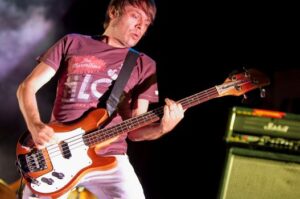
I was shocked and saddened to hear about the death on November 20th of Gary ‘Mani’ Mountfield, bass player with the Stone Roses from 1987 to 1996 and 2011 to 2017 and with Primal Scream for the 15 years between his spells in the Roses.


Shocked because Mani seemed such an exuberant figure (in keeping with his exuberant bass sound) that he was the very last rock-and-roll-related personage I’d expect to die at the relatively young age of 63.  I’ve seen plenty of other rock-and-roll figures on stage who did look ready to kick the bucket because of their frailty, ravaged-ness and general air of vulnerability.  But not Mani, who was always ebullient.   In fact, just days before his passing, he’d announced dates for a speaking tour of the United Kingdom planned for next year, which doesn’t sound like someone on their last legs.


Hailing – of course – from Manchester, Mani first played in two bands that were prototypes for the Stone Roses, the Fireside Chaps (with future Roses guitarist John Squire) and the Waterfront (with future Roses singer Ian Brown joining in 1983).  The Roses’ definite line-up finally coalesced in 1987 with him, Brown, Squire and drummer Alan ‘Reni’ Wren.  During the 1980s he also found time to play in a band called the Mill alongside Clint Boon, who’d later furnish humble but durable ‘Madchester’ band the Inspiral Carpets with their quirky keyboard sound.


Along with the Happy Mondays – and, okay, the Inspiral Carpets – the Stone Roses were the leading lights of the late 1980s / early 1990s Madchester movement, which irresistibly grafted the riffs of rock music onto the grooves of dance music and promoted a cheery, unpretentiously hedonistic vibe far removed from the posing and self-consciousness that’d plagued British popular music earlier in the 1980s.  It also paved away for the more internationally successful, but aesthetically less interesting, Britpop explosion of the mid-1990s.  Mani’s bass was an essential part of the formula.  For instance, it’s the first instrument you hear on I Want to be Adored, the opening track on the Stone Roses’ eponymous and massively acclaimed album of 1989.


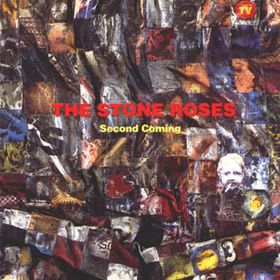
Sadly, legal wrangles and musical procrastination meant it was a long time before a second Stone Roses album appeared.  Second Coming finally saw the light of day in 1994, five-and-a-half years later.  Inevitably, after the wait and all the attendant anticipation, it was deemed a disappointment by the critics.  I have to say I think Second Coming is sorely underrated.  I fully understand why Simon Pegg, in Shaun of the Dead (2004), refuses to throw it along with the rest of his record collection at two advancing zombies.  “I like it,” he affirms.


I saw the Stone Roses for the first and last time during the tour they did on the back of Second Coming.  In 1995 they played a gig in the Japanese city of Sapporo, where I was living at the time.  It was not a happy experience.  Ian Brown was in a foul mood and gave the impression of wanting to be somewhere else – anywhere else.  To be fair, a trio of Australian bodybuilders had beaten Brown up in a club in Tokyo a few days earlier, which gave him a credible reason for his lack of enthusiasm.  Mani and the rest of the band played perfectly well.
 

© Geffen Records


Also slightly unhappy was the next occasion I saw Mani perform, which was after he’d joined Scottish band Primal Scream, another outfit intent on exploring the overlap between rock music and dance music.  The band were on the bill of a one-day event on Glasgow Green that I attended in 2000.  While they were limbering up to play the song Sick City from their new album XTRMNTR, Mani cheerfully barked into a microphone, “This is dedicated to Glasgow because it really is… a sick city!”  For a large portion of the Glaswegian crowd, this comment went down like a cup of – appropriately – cold sick.  (By the way, this was before ‘sick’ acquired its modern, slang meaning of ‘really good’.)   Later, Mani felt obliged to announce that he was only joking  and, really, “Glasgow isn’t a sick city at all!”  It’d been some banter that folk took the wrong way, but it impressed me that he was man enough to apologise for it.


I saw the Mani-era Primal Scream on two further occasions: at London’s Brixton Academy in 2003, when I thought they were pretty good; and at Norwich’s University of East Anglia in 2009, when they were on blistering form.  In fact, I’d include their 2009 Norwich show in my personal ‘Top Ten Gigs of All Time’.  With his jolly, everyman demeanour, Mani provided some balance to Primal Scream’s frontman Bobby Gillespie, whom I always found a bit too-cool-for-school when they played live.


Before joining the reformed Stone Roses in 2011, Mani found time to participate in another band, a ‘supergroup’ called Freebass whose gimmick was that it had three – three! – famous bass players, all from the Manchester area.  Its line-up also included Andy Rourke, former bassist with the Smiths, and Peter Hook, former bassist with Joy Division and New Order.  The project ended ignominiously, with Mani taking exception to what he saw as Hook unjustly exploiting the legacy of Joy Division and his late Joy Division bandmate Ian Curtis – Hook had also formed an outfit called Peter Hook and the Light that performed old Joy Division songs.  Hook’s wallet, Mani claimed on social media, was visible from space because it was ‘stuffed with Ian Curtis’s blood money.’  Needless to say, the two fell out, though later – again – Mani apologised and he and Hook made up.


Indeed, Hook has been one of the many musicians who’ve paid tribute to Mani since his death was announced a few days ago.  Other condolences have come from members of the Stone Roses, Primal Scream, the Happy Mondays, New Order, the Smiths, the Charlatans, the Verve, Echo and the Bunnymen, Elbow, the Courteneers, the Farm, Ocean Colour Scene, Kasabian, Shed Seven, Badly Drawn Boy…  I’m not a big fan of Oasis, but I thought it touching that, at their concert in Brazil the other night, Liam and Noel Gallagher projected Mani’s face onto the giant screen behind the stage whilst performing Live Forever (1994).  You get the impression you could go around everybody involved in the British music scene in the 1980s and 1990s and not find anyone with a bad word to say about the guy.


Finally, I owe Mani some gratitude.  Years ago – around 2010, I think – I was trying to think of a pseudonym to put on a horror short story I was about to submit to a magazine.  ‘Ian Smith’ seemed too dull a name to attach to a piece of short fiction that was meant to chill the blood.  At the time, I had a Primal Scream album playing in the background and I suddenly thought, “They’ve really had a second wind since Mani joined them.”  Then it occurred to me: Mani’s real name was Gary Mountfield.  ‘Mountfield’ sounded about right for a pseudonym – it wasn’t too exotic, but not too common either.  (Mountfield was also the name of a village in Country Tyrone, Northern Ireland, where I used to live, so it had a personal connection with me too.)  Thus, the penname Jim Mountfield was born.  It’s adorned nearly 70 published short stories since then.


So, thank you for the inspiration, Mani.
 

From wikipedia.org / © livepict.com
My life as a tape-head


From unsplash.com / © Tobias Tullius


I was surprised to hear the news last month that the inventor of the audio cassette, Lou Ottens, had passed away at the age of 94.  Surprised because the audio cassette seemed such an elderly piece of technology to me that I’d assumed its inventor had been dead for many years, indeed, many decades already.


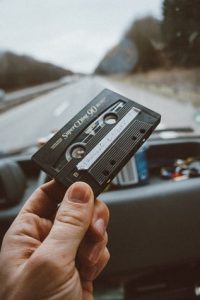
I used to love cassettes.  They were small, light and portable whilst at the same time durable and not vulnerable to the scratches and occasional breakages that bedevilled my vinyl records.  Though of course when their tape got caught in the tape-heads of a cassette player, having to free and unravel the ensuing tangle was a pain in the neck.  Much of my music collection consists of cassettes and I suspect I must have something in the region of a thousand albums in that format.  But, like most of my worldly possessions, they’ve spent the 21st century occupying boxes in my Dad’s attic in Scotland.


Cassettes seemed old-fashioned even in the days before the appearance of the compact disc, a type of technology that itself must seem prehistoric to modern youngsters brought up in a world of Internet streaming.  I remember in 2019 entering a second-hand record shop in Edinburgh and being amazed, and delighted, to find that it still had several shelf-loads of cassettes on sale.  (The shop was the Record Shak on Clerk Street and sadly, due to its owner’s death, it’s closed down since then.  But at least the Record Shak managed to outlive most of the other record shops that once populated south-central Edinburgh, like Avalanche, Coda Music, Ripping Records and Hog’s Head Music, so in its humble, durable way it was like the retailing equivalent of a cassette.)


I was such a tape-head that even during the 1990s, when the CD was supposed to have achieved market dominance, I still indulged in that most cassette-ish of pastimes – creating cassette compilations of my favourite music of the moment, which I’d then inflict on my friends.


I also made party cassettes.  For much of that decade I lived in the northern Japanese city of Sapporo, was something of a party animal and would hold regular shindigs in my apartment.  My home was a typically modest, urban-Japanese one, consisting of two normal-sized rooms plus a little bathroom and toilet, but that didn’t prevent me from piling in the guests.  During one do, I did a count and discovered I’d squeezed 48 people into the place.  I even managed somehow to set aside one room as the ‘dance floor’.  And before each party, for the dance-floor room, I’d compile a few cassettes of songs that I judged likely to get the guests shaking a leg.  How could anyone not shake a leg when, in quick succession, they were subjected to the boisterous likes of the Cramps singing Bend Over I’ll Drive, the Jesus and Mary Chain doing their cover of Guitar Man, Motorhead with Killed by Death, the Reverend Horton Heat with Wiggle Stick, AC/DC with Touch Too Much and the Ramones with I Wanna be Sedated?


At the party’s end, if somebody complimented me on the quality of the music, I’d simply give them the party cassettes and tell them to keep them as souvenirs.  By the time of my next hooley, I’d have discovered a new set of tunes and slapped them onto some new cassettes.  Who knows?  Maybe those 1990s party cassettes are still being played at gatherings in Sapporo, where the partygoers are no longer young and wild, but grey and arthritic instead.  Surely they’d be considered priceless antiques today – the cassettes, not the partygoers.


Anyway, feeling nostalgic, I thought I would list here the most memorable cassette compilations that other people have given to me over the years.


© Factory


Untitled compilation – Gareth Smith, 1991

I never imagined that in 2021 I’d still be humming tunes performed by the now-forgotten New Jersey alternative rock band the Smithereens or the equally forgotten 1980s Bath / London combo Eat.  The fact that I am is due to a splendid compilation cassette that my brother put together and sent to me while I was working in Japan. Actually, the reason why I’m humming those tunes today is probably because they weren’t actually written by the Smithereens or Eat.  The Smithereens’ track was a cover of the Who’s song The Seeker, while the Eat one was another cover, of The Lovin’ Spoonful’s Summer in the City.


As well as featuring those, the cassette contained the epic six-minute club mix of Hallelujah by the Happy Mondays.  No, this wasn’t a cover version of the Leonard Cohen song, but the Mondays’ impeccably shambling dance track that begins with a falsetto voice exclaiming, “Hallelujah!  Hallelujah!” and then proceeds with Shaun Ryder intoning such lyrical gems as, “Hallelujah, hallelujah, we’re here to pull ya!”


On the other hand, the cassette contained the hit single Right Here, Right Now by Jesus Jones, which I thought was quite good and which induced me to buy their new album when I saw it on sale soon afterwards in my local Japanese record shop.  Big mistake.


Songs from Brad’s Land – Brad Ambury, 1991

Around the same time, I received a compilation cassette from a Canadian guy called Brad Ambury, who worked on the same programme that I was working on but in a different part of northern Japan.  I think Brad saw it as his mission to convince me that there was more to Canadian music than the then-popular output of Bryan Adams.  He must have despaired when several years later Celine Dion popped up and usurped Bryan as Canada’s number-one international musical superstar.


Anyway, he made this cassette a smorgasbord of Canadian indie and alternative-rock bands with quirky names: Jr. Gone Wild, Blue Rodeo, the Northern Pikes, SNFU, Spirit of the West, the Doughboys and so on.  During the rest of the 1990s, whenever I was introduced to Canadian people, I’d waste no time in impressing them with my encyclopaedic knowledge – well, my shameless name-dropping – of their country’s indie / alt-rock musical scene.  All thanks to that one cassette.


Actually, stirred by curiosity 30 years on, I’ve tried Googling Brad and discovered he has a twitter feed that’s headed by the logo for the Edmonton ‘punk-country’ band Jr. Gone Wild.  So it’s good to know he hasn’t succumbed to senile old age and started listening to The Best of Bryan Adams just yet.


© Jr. Gone Wild


A Kick up the Eighties – Keith Sanderson, 1993

I must have received dozens of cassette compilations from my music-loving Scottish friend Keith Sanderson and this one was my favourite.  It even looked distinctive because, for a sleeve, he packaged it in a piece of flocked, crimson wallpaper.  As its title indicates, A Kick up the Eighties was a nostalgic collection of tunes from the then recently departed 1980s. These included pop hits, new wave and indie classics, Goth anthems and lesser-known tunes that were both ruminative and raucous: the Associates’ Party Fears Two, Blancmange’s Living on the Ceiling, Ian Dury and the Blockheads’ Hit Me with Your Rhythm Stick, Elvis Costello’s Watching the Detectives, Bauhaus’s Bela Lugosi’s Dead, Killing Joke’s Love Like Blood, Aztec Camera’s Down the Dip and Girlschool’s Emergency.  The collection was disparate yet weirdly balanced, and even songs I hadn’t particularly liked before, such as Rush’s Spirit of Radio and UFO’s Only You Can Rock Me, seemed good due to their calibration with the music around them.


However, when I played this cassette at parties, I had to make sure I stopped it before it reached the final track on Side A.  For my friend Keith had sneakily inserted there, like a street-credibility-destroying booby trap, Hungry Like the Wolf by Duran Duran.


Japanese and English Guitar Pop – Yoko Koyama, 1994    

By the mid-1990s I was lecturing in a university in Sapporo.  My Japanese students there gradually came to the realisation that, despite being a curmudgeonly git, I had one redeeming quality, which was that I was into music.  So a steady stream of them presented me with cassettes of tunes they’d recorded, which they thought I might be interested in.  I can’t remember who presented me with a recording of the Flower Travellin’ Band, but well done that person.


A smart indie-kid in one of my classes called Yoko Koyama gave me a cassette compilation of what she termed ‘modern guitar pop’, i.e. melodic pop-rock stuff with lots of pleasantly jangly guitars.  Apparently, this was a sound that a few Japanese bands of the time, like Flipper’s Guitar and Pizzicato Five, were into.  She’d interspersed their tracks with ones by what she described as four ‘English’ practitioners of the same sub-genre.  These were Teenage Fanclub and the BMX Bandits, from Bellshill near Glasgow; Aztec Camera, from East Kilbride in Lanarkshire; and the Trash Can Sinatras, from Irvine in North Ayrshire.


© Polystar


I expressed my thanks but observed with some bemusement that the four so-called English bands on the collection were actually all from Scotland.  Yoko smiled politely but said nothing.  However, a year later, she wrote a feature about this type of music for our faculty’s English-language students’ newspaper (which I edited) and made a point of talking about ‘Scottish guitar pop’.  So despite my multiple failings as a teacher, I managed at least to teach one fact to one person during the 1990s.


Guns N’ Roses bootlegs – the guy who collected my Daily Yomiuri payments, 1996

While living in Sapporo, I subscribed to the English-language newspaper the Daily Yomiuri, which is now the Japan News.  One evening every month, a young guy would arrive at my apartment door with the newspaper’s monthly bill, which I paid in cash.  (Direct debits didn’t seem to be a thing at the time.)  When I opened the door for him one evening, The Spaghetti Incident by Guns N’ Roses happened to be playing on my stereo.  The guy’s face immediately lit up and he exclaimed, “Ah, you like Guns N’ Roses?”  We then had an enthusiastic ten-minute conversation – well, as enthusiastic as my rudimentary Japanese would allow – about the gloriousness of Axl Rose, Slash and the gang.


A month later, when the guy came to collect my next Daily Yomiuri payment, I was immensely touched when he presented me with two cassettes, on which he’d recorded two Guns N’ Roses bootleg albums.


Okay, strictly speaking, these weren’t compilation cassettes.  But I’m mentioning them here as a testimony to the power of the audio cassette.  They allowed the Japanese guy who collected my newspaper-subscription money and I to bond over a shared love of Guns N’ Roses.


Yeah, beat that, Spotify.


From pinterest.com