Mither


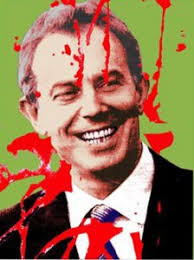
© Jim Barton / From wikipedia.org


Today, September 18th, is the tenth anniversary of 2014’s referendum on Scottish independence.  Yes, a decade has now passed since the Scottish electorate voted, by a majority of 55% to 45%, in favour of remaining part of the United Kingdom. 


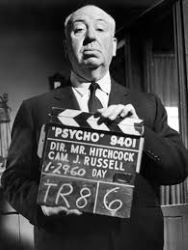
In the referendum’s aftermath, I was inspired to write a short story entitled Mither.  This poked fun at a narrative peddled by the mainstream media that the referendum had turned Scotland into a bitterly divided country – parents, children, siblings who’d previously lived together in harmony suddenly transformed into rabid yes-sers and no-ers who were at each other’s throats, families in turmoil, that sort of thing.  It also paid homage to a classic and highly influential movie.  Needless to say, the story was too weird and too daft to ever get published.


However, ten years on, I thought I would take advantage of the occasion and post it here.  I now give you…  Mither.

 

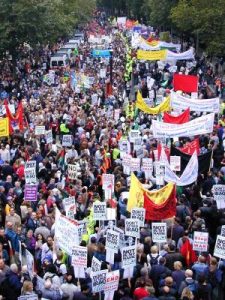
© Labour for Independence / From wikipedia.org


I must have dozed while I sat in the office and read the literature that’d landed on our porch floor that morning.  I hadn’t heard her go out.  I only heard the porch door scrape open and shut as she came back.


‘Mither,’ I said when she entered the office.  ‘You were outside.’


She settled into the armchair with the tartan-patterned cushions that’d been her seat – her throne, we called it – when she ran the business by herself.  Now that I was mostly in charge, I had my own seat in the office but I kept the throne there should she want to use it.  She smoothed her skirt across her knees.  She was a modern-minded woman – at times too modern-minded because she had some ideas you’d expect more in a giddy teenager – but she avoided trousers and stuck to old-fashioned long skirts.  ‘Aye, Norrie.  I’ve been out and about.’


I didn’t like the sound of that but before I could quiz her she leaned forward from the throne and took the leaflet out of my hand.  ‘What’s this you’re reading?  Don’t say they’ve shovelled more shite through our door.’


It pained me to hear her genteel voice soiled by coarse language.  But I stayed patient.  ‘It’s actually interesting, Mither.  It’s an interview with a normal young couple, a professional young couple, about what might happen if the referendum result is…’  I searched for a word that’d cause minimum offence.  ‘Unexpected.’


Mither sighed and her eyes swivelled up in their sockets.


‘Now I ken you’re sceptical, Mither.  But they seem decent.  He’s called Kenneth and she’s called Gina.  And they’re worried about the effect independence would have on them.’


Mither’s eyes swivelled down again.  Then I saw them twitch from side to side while they scanned the text on the leaflet.


I pressed on.  ‘It wouldn’t have a good effect, Mither.  It’d be bad for them.’  Why did my voice tremble?  Why was I afraid?  ‘The financial uncertainty. How would decent hardworking people like them – like me – cope if all the business fled south and the prices shot up?  And the banks…  Why, I read in the paper the other day about an expert who said the bank machines would stop dispensing cash if the vote was yes.’


‘Does,’ asked Mither, ‘this say what Kenneth does for a living?’


‘And even if we still have cash, Mither, what would our currency be?  We won’t have the pound – George Osborne and Ed Balls down in Westminster won’t allow it.  We’ll have to make do with some banana-republic-type currency.  Or worse, the euro!’


‘Norrie,’ said Mither, ‘calm down.  Does this leaflet actually say what Kenneth’s job is?’


‘Aye, of course it does.’  I faltered.  ‘Well, no. Maybe it doesn’t.’


She sighed.  ‘It certainly doesn’t, Norrie.  And I’ll tell you why.’  She raised the leaflet so that I could see a picture of Kenneth, Gina and their children on it.  She placed a fingertip against Kenneth.  ‘It’s because he’s Kenneth Braithwaite, who’s one of our local councillors.  One of our Conservative Party councillors.  But that fact isn’t mentioned here.  It pretends that he’s an ordinary unbiased person like you or me.’


I chuckled nervously.  ‘Now Mither.  I wouldn’t say you were unbiased.’


Mither rose from her throne.  ‘I am unbiased.  My mind’s open to facts and I form opinions and make decisions based on those facts.  Facts, mind you.  Not the propaganda, smears and scaremongering that’s poured out of the political, business and media establishments during the last year.  Not the drivel that’s clogged and befuddled your impressionable young mind.’


Before I could reply, she tore the leaflet down the middle and returned it to my hands in two pieces.  Then she hustled out of the office and shut the door behind her with enough force to make a stuffed owl wobble and almost fall off a nearby shelf.  I heard her shoes go clacking up the stairs and then another door slam, presumably the one leading into her room.


I seethed.  How I hated, how I loathed this referendum!  Setting family members against one another day after day!  I looked at the leaflet again and realised that by a creepy coincidence Mither had ripped it down the middle of the family-picture.  Now Kenneth and a little boy occupied one half of it while Gina and a little girl were sundered and separate in the other half.


A family literally torn apart.

***

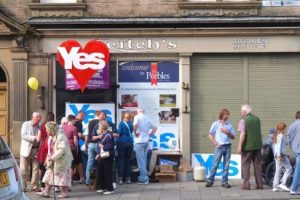
I hated the referendum but I couldn’t wait for the day of it, September 18th, to come – and take place and be over with.  The problem was that the time until then seemed to pass very slowly.  And during this time it felt like a war of attrition was being waged against me.  I grew more tired and depressed the longer those separatists raved in the media and on the streets and from the literature they popped through the slot in our porch door.  A rash of yes stickers and posters spread along the windows in the street-fronts of our neighbourhood.  Some of them even appeared on the houses of people I’d thought were decent and sensible.


I began to panic.  God, could it happen?  I had visions of the doors padlocked and the windows boarded up on the old family business and Mither and I living in poverty alongside hundreds of thousands of other suddenly-penniless Scots.  While around us, food prices and fuel prices skyrocketed, the banks and financial companies whisked all their offices away to London, the housing market disappeared into a giant hole, the hospitals became like those in the developing world, and terrorist cells congregated in Glasgow and Edinburgh and prepared to attack England across the new border.


But worst of all was the madness this referendum campaign inspired in Mither.


She sensed when I was worn out.  While I was napping, or nodding off behind the desk in the office, or slumped in a stupor in front of the TV, she’d leave her room and creep down the stairs and do things.


These might be wee things.  If I wasn’t in the office, she might use the computer and I’d discover hours later that it was open at frightful separatist websites like Bella Caledonia or National Collective or Wings over Scotland.  The day’s Scottish Daily Express might disappear from the kitchen table and turn up, scrunched into a ball, in the recycling bin in the corner.  Or if the Express was left on the table, any photographs in it of Alistair Darling or George Osborne might have shocking words like tosser or bampot graffiti-ed across them in Mither’s curly handwriting.


More worrying was her tendency sometimes to sneak outdoors.  It would’ve been bad enough in normal times because she was too old and frail to be wandering the streets alone.  But in these dangerous times, who knew what she was up to and who she was associating with?
 

© National Collective / From Stirling Centre of Scottish Studies


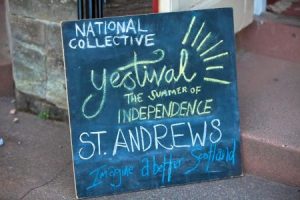
The evidence disturbed me.  When I visited her room I found a growing collection of things that she could only have acquired during trips outside – little Scottish saltire and lion-rampant flags, booklets of essays and poems written in support of independence, brochures for events with sinister titles like Imagi-Nation and Yestival, posters where the word can’t had the t scrawled out so that they read can instead.  She’d amassed badges, stickers and flyers with the word yes emblazoned on them.  What a disgusting-sounding word yes had become to me.  I’d contemplate Mither and imagine that horrible word spurting from her lips –


‘Yes!  Yes!  Yes – !’


And she’d argue.  Goodness me, what had got into the woman to make her so bloody-minded?  In between quoting names of people I’d never heard of, but who were undoubtedly up to no good, like Gerry Hassan, David Greig and Lesley Riddoch, she’d taunt me mercilessly.


‘So go on.  Tell me.  Explain.  Why can we not be independent?’


‘Because… We can’t!  We just can’t!  We’re too… too…’


‘Too wee?’


‘Aye!  Well, no.  Not that, not only that.  We’re also…’


‘Too poor?’


‘Aye, that’s true, Scotland’s too poor to be independent.  But the main reason is that we’re…’


‘Too stupid?’


‘Och stop it, Mither!  Stop!  You’re putting words in my mouth!’


‘But you agree with that basic proposition?  Scotland can’t be independent because it’s too small, its economy’s too weak and its people aren’t educated enough?’  She sighed.  ‘That’s what we’re up against.  A mass of our fellow Scots, yourself included, brainwashed by the establishment into believing their own inferiority!’


I stormed out of the room at that point.  What horrible people had she been talking to?


A few weeks before the referendum-day, her madness reached what I assumed was its peak.  After the last guests had left the premises and after I’d washed and put away the breakfast things, I took the vacuum cleaner into the porch and started on the carpet there.  It took me a minute to notice something odd about the rack on the porch wall where I stored leaflets about local attractions that our guests might be interested in: Rosslyn Chapel, Abbotsford, Traquair House, Melrose Abbey and so on.  The leaflets in the rack had changed.  The tourist ones had disappeared.  In their place were different ones.  Political ones.

 

© Women for Independence / From wikipedia.org


I put down the vacuum-hose and approached the rack.  Crammed into it now were leaflets I’d seen in her room advertising those sinister-sounding events like Imagi-Nation and Yestival and other ones promoting the unsavoury websites she’d consulted on the computer like National Collective, Bella Caledonia and Wings over Scotland.  Also there were leaflets for organisations with different but strangely-repetitive names: Women for Independence, Liberals for Independence, Polish for Independence, Asians for Independence, English for Independence, Farmers for Independence…  One organisation, whose leaflets were merely sheets of photocopied and folded-up A4 paper, was even called Hoteliers for Independence.


I couldn’t help reading that Hoteliers for Independence leaflet.  It ended with the exhortation, ‘Please contact Hoteliers for Independence for more information at…’ and gave an address.  My insides turned cold as I read the address.  I found myself pivoting around inside the porch and facing different internal doors that led to different parts of the guesthouse.  I half-expected one door to have hanging on it a sign that said HOTELIERS FOR INDEPENDENCE – THIS WAY.


Then I peered up towards the first floor, where a certain bedroom was located, and lamented, ‘Oh, Mither.’

***

One afternoon, close to September 18th, I woke from an unplanned doze at the desk in the office.  I’d been dreaming.  A voice in the dream had droned about – what else? – that ghastly referendum.  Disconcertingly, back in the conscious world, the voice continued to talk to me.  I realised it came from a shelf above me, where the radio was positioned between a stuffed gull and a stuffed pheasant.  The radio was tuned in to a local station and the voice belonged to a newsreader.  He was explaining that a politician, a Labour Party MP, was visiting our region today.


This MP had toured the high streets and town centres of Scotland lately.  To get people’s attention he’d place a crate on the pavement, stand on top of the crate and deliver a speech from it.  He’d speak bravely in favour of Great Britain and the Union of Parliaments and denounce the separatists and their vile foolish notions of independence.  And I’d heard from recent news reports that the separatists hadn’t taken kindly to his tour.  Well, as bullies, they wouldn’t.  They’d gone to his speaking appearances with the purpose of heckling him and shouting him down.


Then the newsreader named the town the MP was due to speak in this afternoon.  It was our town.


And immediately I felt uneasy because I realised I hadn’t seen or heard anything of Mither for the past while.  I went upstairs and knocked on her door.  There was no reply.  The guesthouse was empty that afternoon and so I hung the BACK SOON sign in the porch-window, went out and locked the door after me.  Then I headed for the middle of town.


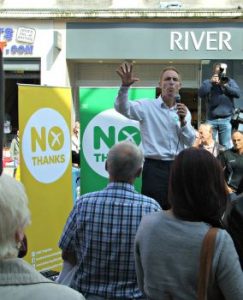
It wasn’t hard to find where the Labour MP was speaking because of the hubbub.  The MP seemed to have turned his microphone’s volume to maximum so that he could drown out the heckling and shouting from the separatists in his audience.  I emerged from a vennel, onto the high street, and saw the crowd ahead of me.  It contained fewer people than I’d expected.  Some of them wore no badges and carried no placards – among them, I thought I glimpsed Kenneth and Gina from the brochure that Mither had ripped up – and some had badges and placards saying yes.  Looming above everyone was the MP on his crate.
 

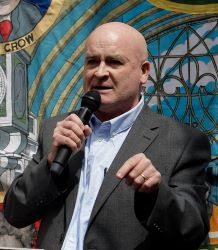
© Thomas Nugent / From wikipedia.org


The separatists present were trying to make themselves heard – without success, thanks to the MP’s bellowing voice and the amplification provided by the microphone.  It wasn’t until I reached the edge of the small crowd that I could understand what they were saying.


‘Answer the question, Murphy!’


‘He won’t answer the question!’


‘Quit shouting, man, and answer the question for God’s sake!’


Then I saw a figure standing at the back of the crowd a few yards along from me.  The figure wore a long flowing skirt, a woollen cardigan and a lacy Sunday bonnet that obscured its face.  A handbag dangled from one of its elbows and a small egg carton was clasped in its hands.  As I watched, the figure prised the lid off the carton,  lifted one of the six eggs inside and stretched back an arm in readiness to throw it –


I rushed at her and shouted, ‘Mither! Oh my God!’


What happened next is confusing.  I remember reaching her and knocking the carton from her hands so that eggs flew in all directions.  I remember not being able to halt myself in time and crashing into her so that she fell and I fell too, on top of her.  But then, somehow, I found myself lying alone on the ground.  Mither had disappeared.  She must’ve been sprightlier than I’d thought.  She’d gathered herself up and hurried away and left me there.


One of the eggs had made its way into my right hand.  Now it was a ruin of broken shell.  Meanwhile, the yolks, whites and shell-pieces of other eggs formed a gelatinous mess on the front of my woollen cardigan.


Then I was being helped to my feet.  Around me, I heard voices:


‘Who is it?’


‘Some auld lady.’


‘No, wait… Christ!  It’s a man!’


‘It’s young Bates.  You ken, Norrie Bates?  Him that runs the Bates Bed and Breakfast?’


‘Why’s he togged out like that?’


Someone took my arm and led me away.  Behind us, the MP, who seemed not to have noticed the commotion with Mither and me, kept roaring into his microphone.  We turned a corner into a side-street and paused there.  I identified the man steering me as Dougie Bremner, who was the proprietor of another B and B in the town, a few streets away from ours.  He’d always seemed a gentle friendly type and it surprised me to see a yes badge stuck to his jacket lapel.

 

© Yes Scotland / From wikipedia.org


Dougie looked perplexed.  He scanned me up and down as if my appearance was a puzzle he wanted to solve.  ‘Norrie,’ he said at last.  ‘I think you need to go home.  As fast as you can manage.’


My head ached.  Something was squeezing my skull, which in turn was squeezing my brain.  I raised a hand and found my head enclosed in a lady’s bonnet.  It exuded two ribbons that were knotted under my chin.  In a final gesture of spite Mither must’ve fastened it on my head before she’d escaped.  ‘Aye,’ I whispered.  ‘I’ll go home.’


‘By the way,’ added Dougie, who seemed greatly troubled now.  ‘How’s your mither?  I haven’t seen her for a while.’

***

It was the morning of September 19th.  The radio had disappeared from the office and I guessed it’d travelled upstairs to Mither’s room and informed her of the result.  Still, in case she hadn’t heard, I felt obliged to go to her room and let her know.


She looked very small, thin and frail as she huddled there amid the paraphernalia she’d acquired, the flags, placards, badges, posters, leaflets and booklets.  On the floor around her, in a serpentine coil, there even lay a blue-and-white woollen scarf with a pair of knitting needles embedded in one unfinished end of it.  That was another lark she’d been up to.  Knitting for independence.


Because she looked so weak and unwell now, I understood that she knew.  The result seemed to have drained the life from her, leaving her a husk.


But I repeated the news.  ‘Mither.  It’s a no.’


She didn’t answer.  No sound came from her mouth, which was stretched back in a rictus – if I hadn’t known she was grimacing in pain and dismay, I’d have thought she was grinning.  I looked into her eyes, trying to find a glimmer of acknowledgement for me, a spark of recognition that I was standing before her.  But the eyes were blank and gaping, almost like they weren’t eyes at all but two dark holes.


And although I was relieved and delighted about the result, I suddenly and inexplicably felt as though a part of me was dead.
 

© Paramount Pictures / From tvtropes.org


With apologies to Robert Bloch, Alfred Hitchcock and Anthony Perkins.  No apologies to Jim Murphy.


And tomorrow, on September 19th, I’ll raise a glass to the memory of the late Charlie Massie, who cheered me up after the result ten years ago by taking me on a pub crawl in Delhi.  Though it probably wasn’t wise to go into the bar in the British High Commission, where we ended up stuck at a table in front of a giant TV screen, showing the news, with a lengthy interview in progress with Boris Johnson.  Bojo was spewing shite about how great it was that the Jocks had embraced the Union and all the benefits that went with it.  Those future Union benefits would include Brexit and having him as Prime Minister. 

Rishi sunk, Liz trussed, Penny dropped


From wikipedia.org / © Simon Walker, HM Treasury


Now the dust has settled after the British general election on July 4th, it’s time to offer my tuppence worth about the result.  This saw the Labour Party, led by Keir Starmer, brought to power for the first time in 14 years.  It also saw the Conservative Party, under Rishi Sunak, take an ignominious and well-deserved humping and get booted out of government.  They shed 244 seats in the Westminster parliament and ended up with just 121.


But first…  A message for viewers in Scotland.


As (a) someone who’s believed for a long time that Scotland would ultimately be better off as an independent nation rather than as a region of Britain, and (b) a total pessimist, I wasn’t surprised at the dire election result for the Scottish National Party, where it ceded many seats in Scotland to Labour and went from having 43 seats to having a mere nine.  As I said in a post a few weeks ago about the SNP’s new leader John Swinney – what a baptism in fire he’s had – “I suspect folk in Scotland are so scunnered by the SNP’s recent scandals and mishaps, and so desperate to see the back of the Tories, that they’ll vote for Labour en masse next month.”


The SNP having so few Scottish seats in parliament and Labour having so many – they’ve now got 37 in Scotland – isn’t something that thrills me.  Scotland has lost some decent SNP representatives in London, for example, Alison Thewliss, John Nicholson, Tommy Shepherd and Alwyn Smith.  To be fair, I have no idea what they were like as constituency MPs, but they impressed me with their capabilities and eloquence when I saw them speak in parliament.


Also, I’m old enough to remember the 1980s and 1990s – a period of almost continuous Conservative rule from London – when the Scottish seats were also packed with Labour MPs and, the joke went, in Glasgow you could stick a red rosette on a monkey and it’d get voted into Westminster.  The old Scottish Labour contingent contained several heavyweights like John Smith, Donald Dewar, Alistair Darling, Robin Cook and Gordon Brown, and also a few mavericks like the admirable Dennis Canavan and the gruesome George Galloway.  But the majority of those MPs were, for want of a better word, turnips.


As I wrote on this blog a few years ago: “I’m thinking of such specimens as Lanark and Hamilton East’s one-time Labour MP Jimmy Hood, who once declared he’d oppose Scottish independence even if it made the Scottish people better off – the fact that as an MP he was busy claiming £1000-a-month second-home expenses in London no doubt had something to do with his keenness to keep Westminster running the show.  And Midlothian’s David Hamilton, who in 2015 did his bit for the battle against sexism by describing Nicola Sturgeon (and her hairstyle) as ‘the wee lassie with a tin helmet on’.  And Glasgow South West’s Ian Davidson, who charmingly predicted that after 2014’s referendum on Scottish independence the debate would carry on only ‘in the sense there is a large number of wounded still to be bayoneted’.  This shower became known as the ‘low-flying Jimmies’ because of their lack of ambition in anything other than being cannon-fodder for Labour at Westminster and enjoying all the perks that came with being MPs.  And with numpties like these populating the Westminster opposition benches during the 1980s and 1990s, it’s no surprise Mrs Thatcher’s Tories had a free run to do whatever they liked in Scotland.”


It’s possible the new crop of Scottish Labour MPs will be more distinguished than their predecessors, but I’m not holding my breath.  That’s especially since the two most famous ones are the self-important Douglas Alexander and Blair McDougall, head of the ‘no’ campaign before the 2014 Scottish independence referendum, who famously reassured worried Scottish voters that Boris Johnson had no chance of ever becoming British prime minister: “I think that Boris Johnson’s a clown… he’s not even an MP let alone Prime Minister at the moment.


From wikipedia.org / © Lauren Hurley


Nor does it inspire confidence that new PM Keir Starmer has made Edinburgh Labour MP Ian Murray Secretary of State for Scotland.  Murray is more hardline-Unionist than many of the Tories.  When his predecessor as Scottish Secretary, Tory posho Alister Jack, was asked if a Conservative government would ever allow another referendum on Scottish independence, he mused that support for independence would have to be running at about 60% in opinion polls.  When Murray was asked if there were any circumstances in which he’d allow a referendum, he curtly replied: “None whatsoever.”


Not that I think Labour’s hegemony in Scotland this time will last as long as it did previously (when it had the bulk of Scottish MPs until 2015).  For one thing, the party situation and voting situation are now much too volatile.  Scotland today has six parties competing in a first-past-the-post electoral system – Labour, the SNP, the Tories, the Liberal Democrats, the Greens and, unfortunately, Nigel Farage’s far-right-wing Reform Party.  (I didn’t include Alex Salmond’s Alba Party in that list because they lost their deposit in every seat they contested.)  And Labour’s share of the vote in Scotland last week was just 5.3% ahead of that of the SNP, so their position is hardly unassailable.


Anyway, onto the results for Britain generally.  While I was delighted to see the Tories pulverized – and they thoroughly deserved to be pulverized, having presided over one of the most disastrous periods of government in British history, one that brought us austerity, Brexit, Prime Minister Boris ‘party during lockdown’ Johnson and Prime Minister Liz ‘crash the economy’ Truss – I have to say I’m worried.  Starmer’s Labour Party won the lion’s share of the seats in parliament, but the votes cast for them were not that many – they received 9,731,363 votes, 33.8% of the total cast.  That number is lower than those won by Starmer’s predecessor as Labour leader, the much-maligned Jeremy Corbyn, who managed 10,269,051 votes in 2019 and 12,877,918 votes in 2017.  What saved Labour’s bacon this time was a low turn-out and the presence of Farage’s Reform Party, luring right-wing voters away from the Tories.  If you add up the right-wing votes, those cast for the Conservative and Reform parties, they exceed Labour’s figures by more than a million votes and more than three percent of the vote-share.


Which is concerning, as I don’t think Starmer’s government is going to be popular for very long.  Again, as I wrote last month, his party was “so obsessed with attracting former Conservative Party voters they’ve made their policies a continuation of the right-wing ones that’ve damned Britain to rack and ruin during the past 14 years.  For instance, they’ve vowed not to revisit the terms of the Tories’ Brexit arrangement with the European Union, even though it’s hobbled British businesses and it’ll thwart their plans to ‘grow’ the economy; and they won’t countenance raising taxes, which makes you wonder how they’re ever going to lift Britain’s public services out of their current, dire state.”


Meanwhile, looking at what’s left of the Tory Party, I see that its surviving MPs include that self-promoting, hard-right-wing trio Priti Patel, Suella Braverman and Kemi Badenoch.  As MPs, and with Rishi Sunak on his way out, they’ll be able to run for the party leadership.  I can see one of them winning, swinging the Tories even further to the right and cutting a deal with Farage before the next election, probably in 2029.  Farage is the favourite British politician of both Vladimir Putin and Donald Trump, so I’m sure lots of foreign money would mysteriously arrive to ‘grease’ such an arrangement.


© BBC


Oh well.  You have to take your pleasures when you can, and there was much to enjoy on election night, when various Tory politicians I didn’t like lost their seats.  I shed no tears, for instance, when Penny Mordaunt got the boot in Portsmouth.  Another self-promoter, she’s always annoyed me with her jolly-hockey-sticks brand of patriotism and it confounded me how, for a while last year, she was hero-worshipped for carrying a big sword, whilst wrapped in patterned blue wallpaper, at a ridiculous Ruritanian ceremony in Westminster Abbey.  Mind you, she was talked about as potential future leadership material, and was a moderate by Tory standards, so she might have prevented the party from veering off into Farage-land if she’d kept her seat.


I was also tremendously cheered by the departures of that preposterous, top-hatted, Victorian undertaker Jacob Rees-Mogg in Somerset; the braying, bearded bovver-boy Jonathan Gullis in Stoke; the middle-finger-raising Andrea Jenkyns in Yorkshire; the absurdly-coiffured Boris-Johnson cosplayer Michael Fabricant in Lichfield; and Liam Fox, Grant Shapps, Thérèse Coffey, Johnny Mercer, Gilliam Keegan…  Oh, how I laughed.


Incidentally, on the non-Tory front, it was also fun to see the afore-mentioned gruesomeness that is George Galloway usurped from his seat in Rochdale, just four months after he’d won it in a by-election.


Obviously, the best result was the one that ended Liz Truss’s tenure as MP for South West Norfolk.  The shortest-lasting Prime Minister ever – she managed only 44 days in office, easily beating the previous record set in 1827 by George Canning (who at least had the excuse of dying after 119 days as PM) – Truss has spent her time since showing not one ounce of contrition for her brief but disastrous reign, during which her plan to bring in massive tax cuts and pay for them by increasing government borrowing resulted in the pound plummeting, banks and building societies pulling 40% of their mortgage products off the market, and 30 billion pounds getting added to the British Treasury’s fiscal hole, effectively doubling it.  Far from it.  Truss has been blaming everyone but herself.  She’s even accused a beastly ‘anti-growth coalition’ and woke ‘deep state’ of sabotaging her premiership.  Meanwhile, she’s also been ingratiating herself with the American far-right and cheerleading for Donald Trump.  I do hope July 4th’s result terminates her political career, as her industrial-scale arrogance, incompetence and lack of self-awareness are getting a bit terrifying.


From wikipedia.org / © Simon Dawson


Finally, I was pleased to see the Green Party win four seats – just one seat less than Farage’s mob, who secured five.  Does this mean the British media, including the BBC, will now be giving them nearly as much coverage as they give Farage?  Don’t bet your life savings on it.

An honest John


From wikipedia.org / © Scottish Government


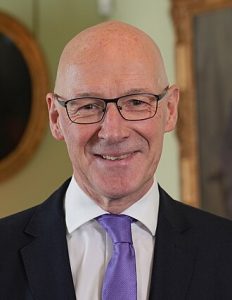
John Swinney became leader of the Scottish National Party on May 6th and was sworn into office as First Minister of Scotland two days later.  His arrival in the two roles comes during a difficult period for his party.  First, the SNP has had to endure the spectacle of its once-mightily-respected, once-seemingly-unassailable former boss Nicola Sturgeon, who served as First Minister from 2014 to 2023, mired in a scandal whereby her husband, Peter Murrell, has been investigated and arrested over possible mismanagement of the party’s finances.


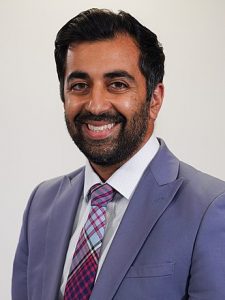
Then came the sorry saga of Sturgeon’s replacement as party leader and First Minister, Humza Yousaf.   Yousaf was brave enough to defy the British-establishment line and challenge Benjamin Netanyahu’s policy of killing huge numbers of innocent Palestinians in revenge for Hamas’s slaughter of Israeli civilians on October 7th, 2023.  But in most other respects, he was pretty hapless.


Most notably, he didn’t so much shoot himself in the foot as blow the foot off at the ankle when he ended his party’s alliance with Scotland’s other pro-independence party, the Scottish Greens. The Greens were so outraged they made it clear that they would vote against Yousaf in a no-confidence vote in the Scottish Parliament.  Realising he was going to lose that vote, Yousaf resigned.  His resignation at least seems principled compared with the behaviour of another First Minister recently.  Labour’s Vaughan Gething, First Minister of Wales, recently lost a no-confidence vote in the Welsh Senedd and blithely refused to quit, dismissing the vote as a ‘gimmick’.


Swinney’s arrival as Yousaf’s replacement happened at an incredibly inopportune time.  Barely had he got through the door of Bute House, the First Minister’s official residence in Edinburgh, than Rishi Sunak, British Prime Minister and a politician so clodhopping he makes Humza Yousaf look like a smooth operator, announced a general election for July 4th.  The polls say the SNP are going to lose a swathe of seats in the London parliament to Keir Starmer’s Labour Party.  Even if Swinney was the best politician in the world, I don’t see what he could do to avoid that.


Not that I think Scottish voters are enamoured with Labour, who are so obsessed with attracting former Conservative Party voters they’ve made their policies a continuation of the right-wing ones that’ve damned Britain to rack and ruin during the past 14 years.  For instance, they’ve vowed not to revisit the terms of the Tories’ Brexit arrangement with the European Union, even though it’s hobbled British businesses and it’ll thwart their plans to ‘grow’ the economy; and they won’t countenance raising taxes, which makes you wonder how they’re ever going to lift Britain’s public services out of their current, dire state.  But I suspect folk in Scotland are so scunnered by the SNP’s recent scandals and mishaps, and so desperate to see the back of the Tories, that they’ll vote for Labour en masse next month.


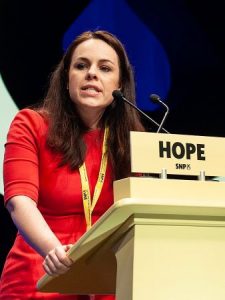
For this reason, and because of Swinney’s bespectacled, unexcitable and unshowy demeanour – he’s often likened to a ‘bank manager’ or an ‘accountant’, although I remember one Scottish hack comparing him to ‘Harry Potter’, which I’m sure didn’t please the famously anti-SNP J.K. Rowling – there’s been speculation that he’s serving merely as a ‘caretaker’ leader, steadying the helm until someone of more substance takes over.  In particular, many in the Scottish media expect the leadership to soon go to Kate Forbes, who’s currently Deputy First Minister.  Famous for his negotiating skills, Swinney managed to talk Forbes out of taking him on in a leadership contest in May.
 

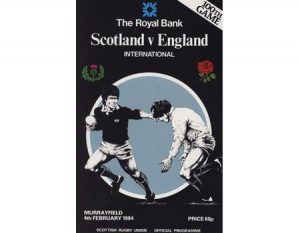
Anyway, I should say that back in my misspent youth, I crossed paths a few times with John Swinney – whose youth, I imagine, was somewhat less misspent than mine.  When I’d been a pupil at Peebles High School in the late 1970s and early 1980s, one of my best pals was a guy called Roger Small.  Once we finished school, Roger went to university in Edinburgh and I to university in Aberdeen.  I kept in touch with him and on a few weekends came down from Aberdeen to stay in his flat in Edinburgh.  My reasons for those visits were not wholly because of friendship.  They coincided with the Five Nations Rugby championship, as it was then, which was held every spring and saw two Scottish home-games played at Edinburgh’s Murrayfield Stadium.  I’d get a ticket, arrange to spend the night at Roger’s place, go to see the game in the afternoon and enjoy the post-match festivities in the evening.


From www.sportspages.com


On February 4th, 1984, I dropped my stuff off at Roger’s and went to Murrayfield to see Scotland play England.  Scotland won 18-6.  In the Scotsman newspaper, back in those long-ago, pre-Andrew Neil days when it was worth reading, Chris Rea – no, not that Chris Reaopined: “The Scottish forwards… were immense – a finely blended unit, alert and supportive. Their breakaways forced England into elementary errors.  They foraged with devastating accuracy…  Every Scot… played his part to the full.”


When the final whistle blew, I was extremely pleased that Scotland had demolished England, the Auld Enemy.  So pleased that, on my way back to Roger’s flat, I indulged in a wee, celebratory pub-crawl along Rose Street, taking in such hostelries as the Auld Hundred, the Kenilworth and the Abbotsford.  It probably didn’t help that I’d already done a pub crawl of Rose Street in the late morning and early afternoon, on my way to Murrayfield.  Anyway, the result was that I was well-refreshed when I returned to the flat.


Roger had told me he was entertaining some Edinburgh University mates that evening, with the intention of going to a party later on.  I was welcome to join them.  So, at about seven o’clock, I trotted into Roger’s living room, plonked myself on the sofa in the midst of some people I hadn’t met before and, trying to be sociable, joined in the conversation.  After a few minutes, a tall, lean, slightly intense-looking young man sitting on the sofa beside me turned his head towards me and asked incredulously, “Are you drunk?”


Ladies and gentlemen, meet John Swinney, future leader of the Scottish National Party, an outfit dedicated to the cause of Scottish independence, to freeing Scotland from the shackles of political rule from London, capital of England.  Shocked that someone in Edinburgh, capital of Scotland, should be a wee bit inebriated after Scotland had trounced England at rugby.


But I can’t have been that inebriated because I managed to accompany Roger, John and friends to the party that night and managed to participate in the conversation enough to form the opinion that Roger’s mate John was a decent-enough, if sober, bloke.  It turned out that the party was being held by someone from Peebles, the town where Roger and I had attended school, so I knew some of the folk there.  Actually, it amuses me to think that the future First Minister of Scotland was once at a party rubbing shoulders with such well-kent Peebles eccentrics as the late Andrew Cleghorn.


Thereafter, I encountered John Swinney a couple of times in Edinburgh, briefly, while I was in Roger’s company.  The last time was a summer or two later, during the Edinburgh Festival, when Teviot Row, the Edinburgh University students’ union building, had been turned into a venue and the pair of them were working there as bouncers.  What a pity Oxford University’s notorious Bullingdon Club didn’t arrange a field-trip to Edinburgh at the time and try to subject Teviot Row to their yobbish antics…  I would have paid good money to see John Swinney eject Boris Johnson from the premises.


I lost touch with Roger for a while after that, but bumped into him again in the late 1980s after I’d moved to Edinburgh.  He kindly fixed me up with a part-time job at the (now-long-gone) Greyfriars Bookshop at the bottom of George IV Bridge.  At some point I asked how John Swinney was getting on and Roger told me he was ascending in the ranks of the SNP.  Later, when I mentioned his name to some mates from Aberdeen who were heavily into the cause of Scottish independence, they reported they’d seen him deliver a speech at an SNP conference and were greatly impressed by him.


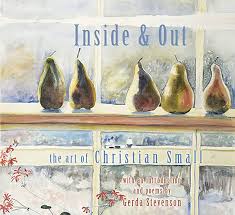
I completely lost touch with Roger Small in the 1990s – he took off for Australia – and, several years ago, wondering what’d happened to him, I tried Googling him.  I didn’t find him, but learnt something about his mother, Christian Small, who’d passed away in 2016 at the age of 90.  Christian had been an immensely-talented amateur painter, but according to a friend she was ‘extraordinarily diffident about her work’ and needed ‘a great deal of persuasion’ to allow her paintings to appear in local exhibitions.  Because of her modesty, presumably, it didn’t really dawn on people – family and friends alike – how good an artist she’d been until after her death.  However, in 2018 and 2019, some events were held to commemorate her and her art, including exhibitions and the launch of a book called Inside & Out.  The book featured her paintings interspersed with verse written by another friend, the poet and actress Gerda Stevenson.


One of those events was attended by John Swinney, who by then was Deputy First Minister of Scotland.  On Twitter, he remarked that Christian Small had been the mother ‘of my dear university friend Roger.’  So, I’m glad he still remembers his old mate and still holds him in high regard.


© Scotland Street Press


Though he’s made his name as a cautious type – too cautious for some people’s tastes, which has led to them questioning his political acumen – it’s hard to find anyone with a bad word to say about John Swinney as a person.  For example, the former Scottish Labour Party leader Jim Murphy once commented: “There’s nobody in Scotland who doesn’t like John Swinney.”  I recall my old English teacher, Ian Jenkins, who served in the Scottish Parliament for four years as the Liberal Democrat representative for Tweeddale, Ettrick and Lauderdale, speaking highly of him too.


Thus, I’m pleased that Swinney now holds the highest political office in his country.  He struck me as a decent guy and it’s good to see decency rewarded.  Unfortunately, politics isn’t an arena where being decent always works in your favour.  I suspect he has his work cut out for him – especially if the polls prove to be right and his party takes a pounding in the general election.

Jiggery-wokery


From abc.net.au / © BBC


‘Woke’…  What does that word even mean?


Here’s failed US presidential candidate and failed insurrectionist Donald Trump using it to denigrate the American women’s soccer team, who do un-Trumpian things like ‘taking the knee’ during the playing of the Star-Spangled Banner.  “Woke equals failure!” he barked on TruthSocial, his minor social-media platform, when the team was knocked out of this year’s Women’s Football World Cup.


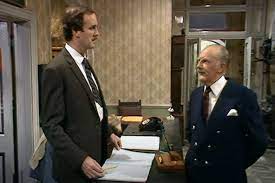
And here’s John Cleese grumping about the BBC being woke because it banned that episode of Fawlty Towers (1975-79) where the Major uses some unfashionable language to describe the West Indies cricket team.  (In fact, the episode was temporarily pulled from the BBC-owned streaming service UKTV, and reviewed, and reinstated with a content warning.)  Cleese is so incensed by wokeness that he’s started hosting a TV chat-show in which he fulminates against it.  His show is called The Dinosaur Hour (2023) and it’s broadcast on the right-wing, alleged ‘news’ channel GB News.  Amusingly, Cleese was peeved to discover that his new employers at GB News had just signed Boris Johnson, whom he considers a ‘serial liar’, to host a show too.  Well, John, when you lie down with dogs, expect to get up with fleas.  In this case, big, blonde, bloviating, bonking Boris-fleas.


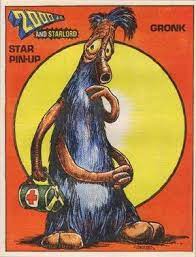
Another household name much concerned about woke behaviour is Elon Musk, who last year purchased Twitter (or X, as he calls it now) and set about purging it of wokeness.  He’s certainly done that.  He’s also purged the platform of half of its advertising revenue and half of the value of its acquisition price.  Musk has described wokeness as a ‘mind-virus’ and ‘communism rebranded’ – and communism, he’ll tell you, is a very bad thing.  Though that hasn’t stopped him opening a big Tesla plant in communist China, in Shanghai, and being warmly welcomed every time he visits the country, and declaring that democratic, capitalist Taiwan is actually Chinese property.  Musk is also introducing to Twitter a ‘snarky, anti-woke AI chatbot’ called ‘Grok’, which sounds like a character from the sci-fi comic 2000 AD (1977-present).


From britishcomic.fandom.com / © Rebellion Developments


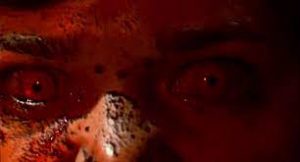
I don’t agree with Musk on much but he’s right to liken wokeness to a virus.  Because the moment that people with his right-wing politics come into contact with it, they seem to turn red-eyed, froth at the mouth and gibber insanely, like the infected did in Danny Boyle’s 28 Days Later (2003).


© DNA Films / UK Film Council / Fox Searchlight Pictures


But if you need refuge from wokeness, just move to Florida.  There, Governor Ron DeSantis has been pushing a ‘Stop-Woke Act’ in the hope that the state will be ‘the place where woke goes to die’.  In fact, DeSantis’s Florida is now so anti-woke, and so determinedly opposed to the teaching of wokey things like Critical Race Theory, that its State Board of Education has kids learning in school that slavery was a good thing because it helped the black slaves to develop ‘skills which, in some cases, could be applied for their personal benefit‘.  Wow.  Who knew?


I’m sure DeSantis’s achievements in Florida are admired by Suella Braverman, the belligerent and self-serving British Conservative politician who was very recently sacked from her position as the UK’s Home Secretary.  During her time in office, she slammed the British police force for being too woke.  One example was when she claimed to have reprimanded officers in Essex for the woke act of raiding a pub and removing a display of racist golliwogs.  (Except that she didn’t – it turned out that Suella had been disingenuous, or stupid, or both, which is perfectly possible in her case.)  Suella, or ‘Sewer-ella’ as I like to think of her, also famously condemned a faction she called the ‘Guardian-reading, tofu-eating wokerati’.  Supposedly, these have formed a ‘coalition of chaos’ with the opposition parties and are responsible for all of Britain’s ills.  She said this whilst serving in the brief but tumultuous government of Liz Truss.  Accusing someone else of being part of a coalition of chaos?  That’s a bit rich, given the context.


Elsewhere, the Daily Mail has complained that woke builders are daring to ‘enjoy yoga, muesli, listening to Radio 4 and sharing their feelings’ rather than ‘devouring greasy-spoon breakfasts and discussing sport.’  Xbox games consoles have been accused of being woke for getting updated with an ‘energy saver’ mode to lessen their power consumption – because, as you know, attempting to be more environmentally-friendly just drips with contemptible wokeness.  The makers of The Simpsons (1989-present) have been lambasted for being woke, coincidentally by Cleese’s associates at GB News, for no longer having scenes where Homer loses his rag at Bart, picks him up by the throat and strangles him until his eyes bulge and tongue protrudes.  Not wanting to strangle children?  How hideously woke.


So, what does ‘woke’ actually mean?  Well, according to Wikipedia, it’s “an adjective derived from African-American Vernacular English (AAVE) meaning ‘alert to racial prejudice and discrimination’.  Beginning in the 2010s, it came to encompass a broader awareness of social inequalities such as racial injustice, sexism and LGBT rights.”  Fascinatingly, the phrase ‘stay woke’ goes all the way back to 1938, when it was first heard on a recording of a song called Scottsboro Boys by the legendary blues singer Huddie Ledbetter, aka, Lead Belly.


From wikipedia.org / © William P. Gottlieb Collection


Though how the term ‘woke’ became elastic enough to encompass eating tofu, and builders talking about their feelings, and Xboxes having energy-saving modes, and Homer Simpson not throttling his offspring, is anyone’s guess.  Perhaps a simpler definition of the term – certainly when you look at the people mentioned above who’ve railed against it, like Trump, Musk, DeSantis, Braverman, the Daily Mail and GB News – might be: ‘Anything that right-wing tossers don’t like.’


Indeed, as somebody who considers himself partly Scottish, I felt a surge of pride a while ago when Gavin McInnes, founder of the neo-fascist American militia the Proud Boys, denounced Scotland as ‘the most woke country in the world.”  No wonder Scottish novelist Christopher Brookmyre responded to McInnes’s ravings by saying: “That delighted me…”


Unfortunately, nobody ever lost money by underestimating human beings’ intelligence.  There’s clearly political mileage in ranting endlessly about wokeness. Gradually, you brainwash millions of people, mainly older ones who don’t get out much, and sit and watch Rupert Murdoch’s Fox News all day, into believing that dark, malevolent woke forces do indeed lurk in the world, planning to deprive them of their Bibles, guns, gas-guzzling automobiles, Big Macs, racist jokes, un-politically-correct 1970s TV shows, etc.  It’s also convenient for the likes of Trump (currently facing 91 felony counts) and Britain’s Conservative government (trying to justify why the country is such a horrible, unhappy mess when they’ve been in charge of it for the past 13 years) to peddle the narrative that the establishment is riddled with hostile woke agents.  The civil service, the courts, the police…  A giant woke conspiracy is being implemented from society’s corridors of power and it’s trying to discredit them and stymie their every move.


I’m not claiming, by the way, that stupidity is confined to right-wingers.  The left is also capable of it.  In recent years the American right has infiltrated school-boards and removed books they disapprove of from syllabuses and libraries, books deemed too woke, often written by people of colour or members of the LGBT community, and often featuring characters of colour or LGBT characters.  There was even a book suspended in Alabama because officials didn’t like the sound of the author’s name, Marie-Louise Gay.  But left-wing educators have done themselves no favours by trying to ban books that offend their sensibilities too.


For example, I lately came across the case of a school board in Washington State pulling Harper Lee’s To Kill a Mockingbird (1960) off its required reading list for ninth-graders because a group of ‘progressive’ teachers objected to it.  Sure, you can argue that To Kill a Mockingbird portrays its black characters with less depth than its white characters and has a ‘white saviour’ narrative that’s offensive to many.  But shouldn’t teachers focus on developing their students’ powers of critical thinking, argument and self-expression so that they can articulate why they object to the book?  Engaging with – certainly, studying – literature shouldn’t be limited to books you’re personally comfortable with.  You should have to experience ones you find discomforting too, whilst developing the ability to formulate logical and coherent responses to them.


I don’t deny there are works that some people will find upsetting because of their beliefs or backgrounds or difficult experiences they’ve had in their lives.  And I don’t see anything wrong with books and stories having trigger warnings, which inform readers the content they’re about to immerse themselves in may be uncomfortable or even traumatising.  I say that as a writer who’s had trigger warnings attached to his fiction in the past.  But banning books altogether?  I don’t agree with censorship, unless it’s of something that’s completely off-the-scale in promulgating odious stereotypes and stirring up hatred.


Otherwise, I don’t have much of a problem with wokeness.  Especially as it seems to annoy all the right – and I mean ‘right’ – people.  So, now, it’s time to sign off and grab some lunch.  What will I have…?  Why, tofu of course.  Up yours, Sewer-ella.


From wikipedia.org / © UK Government Web Archive

Now expose it to garlic, holy water and sunlight


From wikipedia.org / © Eva Rinaldi


A while ago on this blog, I conducted the following thought-experiment.  Imagine that current trends result in the world becoming a globally-warmed, war-ravaged hellhole inhabited by only a few surviving remnants of humanity.  But those remnants somehow manage to lay their hands on a time machine and realise they can send an assassin back in time, in the manner of the James Cameron / Arnold Schwarzenegger movie The Terminator (1984).  Who would they have their assassin target in, say, the late 20th century to change the course of history and prevent the world from turning into crap?


As I mused at the time, “The young Donald Trump?  The young Vladimir Putin…?  Neither.  I suspect those guys would be considered small beer compared to the one the time-travelling assassin from the future would really go after…  Rupert Murdoch.”


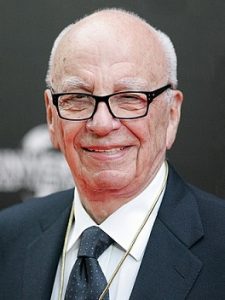
Wizened 92-year-old media mogul Murdoch was recently in the news because he announced his decision to step down as head of News Corp and the Fox Corporation in favour of his son Lachlan.  Murdoch certainly looks his age, but it sometimes felt like he was going to live forever and keep running his media empire forever.  Regular nocturnal blood-meals sucked from the throats of helpless victims are evidently good for the constitution.  That said, lately, the old monster had begun to look a little vulnerable, both in his business dealings and in his personal life.


April this year saw his Fox News network fork out nearly 790 million dollars to settle a lawsuit brought against it by the voting-equipment company Dominion.  This was after the network told outrageous porkies about the company switching votes in the 2020 US presidential election so that Donald Trump wouldn’t win it.  Among the guff peddled by Fox was the claim that the company was owned by Venezuelans and had experience of swinging elections for the late Hugo Chavez.


Meanwhile, though old Rupe had once wooed the ladies with confident charm, like an extremely shrivelled George Clooney, he’s also looked less sure-footed on the romantic front recently.  In 2022, he ended his fourth marriage, to Jerry Hall, by unchivalrously sending her an email to inform her that she’d been dumped.  Hall was unsurprisingly miffed, as during the Covid-19 pandemic she’d gone out of her way to ensure her aged husband stayed isolated and avoided getting the virus, which for someone of his years would probably have been a death sentence.  Earlier this year, he announced his engagement to former radio host Ann Lesley Smith, but this lasted just two weeks.  That’s even shorter than a Liz Truss premiership.  Apparently, Murdoch started to panic at Smith’s loopy evangelical-Christian pronouncements, which included the assertion that Tucker Carlson was ‘a messenger from God.’


But you can’t keep an old horn-dog down.  Rupe is currently engaged again, this time to Elena Zhukova, who was once married to the Russian billionaire – don’t mention the ‘O’ word – Alexander Zhukova.  At this rate, Murdoch will have got himself betrothed 16 more times before he reaches treble-figures.


© Prana Film / Film Arts Guild


Now that Murdoch has stepped back from the media-controlling activities that have kept him busy for the past 71 years, ever since the age of 21 when he inherited an Adelaide newspaper, the News, from his dad, what legacy does he leave?  If he had a shred of conscience, morality and decency – which of course he doesn’t have, which makes this an academic statement – he’d surely howl in despair and incarcerate himself in a Trappist monastery for the rest of his days to do penance for his multiple sins.  Or just top himself.  Murdoch’s media operations have, over decades, caused massive harm to the well-being of humanity.


He pushed the rapacious neoliberal agenda of Margaret Thatcher and Ronald Reagan in the 1980s, with its credo that greed is good, the market should be worshipped and the financial safety nets and infrastructure that held societies together, and looked after their most vulnerable members, weren’t worth bothering about.  Thatcher said it all when she declared in 1987, “There is no such thing as society.”  His outlets have gone to great lengths to ignore and discredit the overwhelming scientific evidence that manmade climate change is happening and poses a terrifying threat to our civilisation’s future.  In Australia, a country that’s already baking and burning as the climate catastrophe unfolds, Murdoch newspapers like the Australian and Sydney’s Daily Telegraph cheer-led right-wing moon-howler Tony Abbott into power in 2013 – Abbott once dismissed climate change as ‘absolute crap’.  And in the USA, Murdoch has used Fox News to build up a vast, paranoid, delusional, far-right-wing ecosystem whereby millions of gullible people now accept the lies of Donald Trump as gospel truth.  Fox could very well see to it that Trump wins the presidency again in 2024.  At which point, the world’s biggest superpower will make the transition into authoritarianism.


Murdoch is truly the man with the reverse-Midas touch.  Everything he sticks his finger in turns into manure.  Yet this never seems to stop him generating huge amounts of money, so he’s happy.  No wonder his son James, that rare thing indeed, a Murdoch with a conscience, quit the board of News Corp in 2020, sickened by the horrors his old man had empowered.


In the UK, Murdoch has long exerted his toxic influence through the swathe of national newspapers he owns: the Times, Sunday Times, Financial Times, Sun and Sun on Sunday.  His reign of terror began when he acquired the Sun in 1969.  The history of that particular tabloid since then, when it hasn’t devoted itself to gleeful, lowest-common-denominator stupidity with headlines like ‘WEREWOLF SEIZED IN SOUTHEND’ and ‘FREDDIE STARR ATE MY HAMSTER’, has been an unrelenting saga of horribleness.


In the 1980s, when the Sun was under the stewardship of the repugnant Kelvin MacKenzie, it revelled in homophobia and gloated over the AIDS epidemic, which it dubbed the ‘gay plague’ and insinuated straight people had nothing to worry about.  It catered for the ‘dirty mac’ brigade with its ‘page three’ girls, at least one of whom, Samantha Fox, was only 16 when it displayed her topless.  And it lied through its teeth about the behaviour of Liverpool football fans at the 1988 Hillsborough Disaster, to cover up the failings of the police that day.  That led an embargo of the Sun in Merseyside, which is still in force now.  If only the British population generally treated the rag with the same contempt that the Scousers do.  (I also admired the attitude of the late playwright Dennis Potter, whom the Sun dubbed ‘Old Flaky’ on account of his crippling psoriasis.  When he was diagnosed with pancreatic cancer, he named his cancer ‘Rupert’.)


More recently, the Sun provided a platform for Katie Hopkins, someone even more repellent than MacKenzie, who likened migrants to ‘cockroaches’ and advocated the use of gunboats to stop them.  And its incessant abuse of the European Union, European countries and European people (‘frogs’ and ‘krauts’ to a man and woman) climaxed with the newspaper’s enthusiastic support for Brexit – ‘BELEAVE IN BRITAIN’, its front page declared on the day of the referendum in 2016.  It was no surprise that Murdoch welcomed Brexit, regardless of the economic, diplomatic and reputational damage it inflicted on the UK.  He famously commented that while he could impose his will on one country’s leader, at No 10 Downing Street, he wasn’t powerful enough to do that with the combined force of 28 countries’ leaders, in Brussels.


From dailysabah.com / © Sun


Meanwhile, during the noughties, the Sun’s sister paper, the News of the World, under the editorship of flame-haired gorgon Rebakah Brooks, was so determinedly on the sniff for a good story that it hacked into the phones of, among others, murdered schoolgirl Milly Dowler, dead British soldiers and victims of the 2005 London bombings.  This proved too much for even its ghoulish proprietor and he axed the News of the World in 2011.  Mind you, he soon replaced it with the Sun on Sunday, so not much changed.


With the Sun leading the way, Britain’s other, supposedly more ‘respectable’ right-wing newspapers – the Daily Telegraph, Daily Mail and Daily Express – happily dived into the same midden of lies, slander and xenophobia, with the result that over the past half-century the popular press in Britain has done much to cheapen public discourse, making it shrill, prurient, mean-spirited and pig-ignorant.  Murdoch can also take credit for inspiring the birth, or spawning, of alleged news channel GB News in 2021, which clearly wanted to become the British equivalent of his ghastly Fox News.  The conspiracy theories it peddled about the Covid-19 pandemic and Covid-19 vaccines, often voiced by that havering bawbag Neil Oliver, mirror the work Fox News did in the USA to make people resistant to vaccinating themselves against the virus.  The fact that Murdoch was one of the first people on the planet to get the vaccine, yet he happily let his media outlets promote scepticism of it among their audience – who tended to be older and more at risk from Covid-19 – shows his ethics are non-existent.


Sadly, in Britain, non-Conservative politicians are so frightened of Murdoch’s newspapers that they feel obliged to cosy up to him.  In the late 1990s, Labour Party leader Tony Blair got so thick with Murdoch that he became godfather to one of Murdoch’s kids.  In return, the Sun displayed the front-page headline ‘THE SUN BACKS BLAIR’ prior to the 1997 general election that saw him win power.  Murdoch’s newspapers subsequently supported Blair during his participation in the 2003 invasion of Iraq, an operation founded on lies and resulting in disaster.  I have no doubt that Keir Starmer, the current Labour Party leader, and basically Tony-Blair-lite, will prostate himself before Murdoch in a similar, craven manner.


Though the Nosferatu-esque Murdoch is no longer at the helm of the media empire he’s built, he’s made it clear that he still intends to exert influence from the sidelines.  And his son Lachlan is such a piece of work it sounds like that empire will conduct its business with even more malevolence in the future.  The fact that Lachlan has just appointed Tony ‘climate-change-is-crap’ Abbott to the Fox board doesn’t bode well.


When Murdoch informed his employees of his decision to step down, he told them to “make the most of this great opportunity to improve the world we live in.”  Really, Rupe?  Improve?  You did nothing to improve the world.  Rather, your shitty news outlets helped turn it into a sewer.


© Prana Film / Film Arts Guild

Hapless Humza and heaven’s Kate


From wikipedia.org / © Scottish Government

From wikipedia.org / © ScottishPolitico


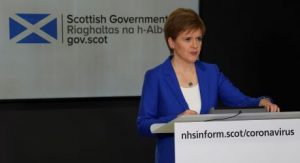
The devil and the deep blue sea.  A rock and a hard place.  Scylla and Charybdis.  These are a few phrases that spring to mind when I think of the choice facing members of the Scottish National Party as they vote for a new party leader and First Minister of Scotland to replace Nicola Sturgeon, who a month ago announced her intention to resign from those posts and last week made her final appearance at First Minister’s Questions in the Scottish Parliament.


Neither of the options offered as Sturgeon’s successor is particularly inspiring. There’s Humza Yousaf, current Scottish Cabinet Secretary for Health and Social Care, and previously Minister for Transport and the Islands.  And then there’s Kate Forbes, currently Cabinet Secretary for Finance and the Economy.


Okay, there’s also a third candidate in the running, Ash Regan, former Minister for Community Safety.  But, working on the assumption that the average SNP member has at least a couple of braincells in his or her head, I imagine Regan has zero chance of prevailing.  Her big idea so far has been to have an ‘independence-readiness thermometer’ displayed in a major Scottish city.  Plus, much of her support actually seems to lie outwith the SNP, i.e., among the opportunists, grifters, misfits, transphobes and Scottish-indy ultras who joined embittered former SNP leader, former Russia Today presenter and generally-accepted lech Alex Salmond when he set up the Alba Party as a way of getting revenge on Sturgeon and his old party (and secured 1.65% of the votes cast in the subsequent Scottish parliamentary election).


Anyway, onto the two real candidates. Yousaf strikes me as a bloke with his heart in the right place…  But his performance in government has been patchy and he’s prone to making gaffes, most recently when he met with a group of Ukrainian women and inquired, “Where are all the men?”  Okay, whilst being in charge of Health and Social Care in Scotland, he’s been under constant bombardment from Scotland’s newspapers, which are almost without exception right-wing, conservative, unionist and shite-holey – the Scottish Daily Mail, the Scottish Daily Express, the Scottish Sun, the Scotsman, the Herald and the Scottish edition of the Daily Telegraph.  While their beloved Conservative Party has, in government in London, under the leaderships of Boris Johnson, Liz Truss and Rishi Sunak, wallowed in mindboggling amounts of corruption and indulged in mindboggling amounts of incompetence, their response has been to shriek and scream that the Scottish government is equally, if not more, of a basket case.  They’ve fixated on and magnified every fault and incompetence they can discover and never stopped to draw breath in their criticisms.  Generally, their modus operandi has been, in the words of far-right strategist Steve Bannon, to ‘flood the zone with shit’. “Okay,” they seem to cry, “Britain is crap!  But Scotland is even crapper!  And an independent Scotland would be even, even crapper!”


From wikipedia.org


But I don’t think Yousaf has the dexterity, the gravitas and the general intelligence to establish himself the way Sturgeon did – who, though most of the mainstream media in Scotland hated her, was able to rise above their carping, convey a sense of competence, and convince everyone bar the most rabid Scottish Conservative that she was much more effective as an administrator than, say, the venal Johnson or the barking-mad Truss.  Unfortunately, I can’t see how Yousaf will escape being portrayed by the media as a bungling klutz – in the same way that they succeeded in discrediting former Labour Party leaders like Michael Foot (supposedly a befuddled old fool who went to Remembrance services at the Cenotaph dressed as a scarecrow), Neil Kinnock (a Welsh windbag who tripped over on a beach and fell into the sea) and Ed Miliband (a two-kitchen-owning faux socialist whose dad hated Britain and who couldn’t eat a bacon sandwich properly).  That said, I doubt if they’ll be able to absolutely demonise Yousaf like they did with Jeremy Corbyn.


Incidentally, it’s interesting to compare Yousaf’s troubled tenure as Health Secretary with that of Sturgeon, who held the brief for a couple of years when Salmond was First Minister.  And if anyone says they don’t remember anything of Sturgeon as Health Secretary – well, that says a lot for her skill in keeping it a non-issue at the time.


From what I’ve seen of her, in purely political terms, Kate Forbes seems the most capable of the candidates.  But there’s a big problem.  She’s a member of the Free Church of Scotland and claims its tenets are ‘essential’ to her ‘being’ – which would be fine if her particular Kirk treated people from all walks of life non-judgementally, but it doesn’t, and Forbes has ended up saying some things that cross the line into intolerant, Bible-bashing crankery.  She’s said she would have voted against same-sex marriage, and stated her opposition to the Scottish government’s trans-friendly Gender Recognition Act, and spoken out too against abortion and sex outside of marriage.  This has put a lot of noses in the SNP out of joint.  For instance, the party’s deputy leader in Westminster Mhairi Black, a lesbian who got wed last year, has tweeted that she was ‘incredibly hurt’ by Forbes’ stance on gay marriage.


Perversely, some right-wing commentators who, in right-wing news outlets, regularly castigate Forbes’ party have ridden to her defence during the controversy about her religious views.  On February 23rd, Fraser Nelson, editor of bilious far-right magazine the Spectator, wrote an opinion piece in the no-better Daily Telegraph under the headline PROTESTANTS ARE NOW HOUNDED OUT OF POLITICS, AS KATE FORBES HAS SHOWN.  A day later, in Rupert Murdoch’s Times, the fogey-ish author and Evelyn Waugh wannabe A.N. Wilson penned a similar-minded piece entitled THE HOUNDING OF KATE FORBES SHOWS GODLESS SQUAD HAVE WON.  And if the moral support of Nelson and Wilson wasn’t enough to drain all street credibility out of Forbes, and send it down a hole deep enough to reach Australia, the ridiculous Jacob Rees-Mogg got in on the act too.  He wrote in a Daily Mail column that: “The last Scottish female public figure to be treated so badly for her religion was Mary, Queen of Scots, who was chased out of her country and eventually beheaded by her cousin Elizabeth for her Catholicism.”


From wikipedia.org


Oh, and the centre-right journalist and commentator Chris Deerin – director of the think-tank Reform Scotland, crooner with arthritic dad-rock band the Fat Cops, worshipper of Ruth Davidson and, mind-shreddingly, Scottish Editor for the supposed left-leaning New Statesman – has been carrying a torch for her recently too.  Just in case the Kate Forbes Media Fan Club didn’t sound hellish enough.


Personally, I suspect the reason why so many personages in the right-wing press are currently batting for Forbes is because they’re licking their lips with anticipation about what might happen if she wins.  They’d have a field-day reporting on the latest messes involving the First Minister of Scotland as, speaking her Free Kirk mind, she upsets gay people, trans people, unmarried mothers, women who’ve had abortions, etc.  She could also very easily piss off Scotland’s sizeable Roman Catholic community, since the brand of old-school Scottish Presbyterianism she adheres to is not exactly known for its love of the Pope and the Church of Rome.  And her social conservatism would probably mean the SNP’s current, informal governing alliance with the Scottish Green Party would end.


All in all, the Yousaf / Forbes leadership race looks like a lose-lose situation for the SNP and a win-win one for the right-wing mainstream media that would love to see the back of the party.  Meanwhile, I have a feeling that a lot of people in the Scottish independence movement who’d expressed impatience, dissatisfaction and frustration with Nicola Sturgeon’s performance in recent years – well, apart from those bampots in Salmond’s wee faction – will soon realise how much they miss her.


From wikipedia.org / © Scottish Government

The butcher boy


From leftfutures.org


One feature of growing older is that every new day seems to be an anniversary of some sort or other – an anniversary of something you did, or something you experienced, or something big or small that you witnessed happening in the world.  For instance, just last Friday, March 17th – St Patrick’s Day 2023 – I realised it was 30 years exactly since some friends and I went to see the great Belfast punk band Stiff Little Fingers at Glasgow Barrowland.  Both Stiff Little Fingers and the Barrowland, I’m pleased to report, are still on the go; and their histories have been happily entwined during the three decades since.  As the latter’s Wikipedia entry reports: “Northern Irish punk band Stiff Little Fingers have played sold-out concerts at the venue every St Patrick’s Day since 1992, and recorded their Best Served Loud album there in 2016 to celebrate 25 years at Barrowland.”


Even if it reminds me of how ancient I am now, that’s at least an anniversary of something I remember fondly.  However, there’s nothing fond I remember about the event that today, March 20th, is the anniversary of.  It’s now been twenty years since Western military forces, mainly American and British ones directed by President George W. Bush and Prime Minister Tony Blair, blasted their way into Iraq.


The invasion was launched in order to depose Saddam Hussein who, it was claimed, possessed Weapons of Mass Destruction.  It transpired, though, that these WMDs didn’t exist and it became obvious that Bush and Blair had spun a web of lies beforehand to make people believe that they did.  In the two decades since the invasion, those WMDs haven’t been the only things to not exist.  The Iraq Body Count Project has calculated that, up until 2019, between 183,535 and 206,107 Iraqi people have stopped existing too.  Their deaths have been a result of Bush and Blair’s actions – of the invasion, the bungled Western occupation and its chaotic aftermath.


George Bush once donned a flak jacket, posed on the deck of an American aircraft-carrier and boasted that the ‘mission’ in Iraq was ‘accomplished’.  That seems a very long time ago now.  Mind you, through the dubious involvement in the supposed occupation and ‘reconstruction’ of Iraq by outfits such as Haliburton, the debacle succeeded in lining the likes of Dick Cheney’s pockets very nicely.  I suppose that was the real point of it.


Of course, the Iraq War helped to put some coinage into Tony Blair’s pockets too.  Thanks to his support for the second-most right-wing and incompetent president in American history, the former PM was for a long time revered in Republican sectors of the USA and he made more than a few bob on the public speaking circuit there.  (He also profited from a dodgy job negotiating the movement of oil between Iraq and South Korea.)  I suppose his popularity in America reduced his pain at being less admired in other parts of the world.  For instance, I was working in India during the worst phase of the ‘official’ Iraq War – Abu Ghraib and all that – and whenever I read the Indian English-language newspapers, his name seldom appeared in a sentence without being accompanied by the words ‘poodle’ or ‘lapdog’.


I’d never trusted Blair.  His big smile and ingratiating, want-to-be-your-pal manner struck me as phoney, especially compared to the plain-speaking, no-nonsense demeanour of his predecessor as Labour Party leader, John Smith, who died unexpectedly in 1994.  However, up until 2003, and having recently endured 18 years of Conservative government, I’d consoled myself with the thought that “At least he isn’t as bad as that other lot.”  He headed a political party that claimed to have some conscience, principles and scruples, the supposed antithesis of Maggie Thatcher and her cynical gang.  But events in March 2003 changed my opinion.


To be fair, in Britain, it wasn’t just Blair who willed the invasion into happening.  He had the support of many in his party, though with a few noble objectors like the late Robin Cook, and the Tories backed him to the hilt.  In fact, among the Westminster-based parties, it was only Charles Kennedy’s Liberal Democrats who showed some spine and opposed the bloody thing.  It goes without saying that the majority of Britain’s predominantly right-wing newspapers were cheerleaders for it too.


From wikipedia.org / © William M. Connelly


And, though people still talk about the anti-war protests on February 15th, 2003, which saw the biggest ever political demonstration in London’s history take to the capital’s streets (and was the subject of Ian McEwan’s rather annoying 2005 novel Saturday), I’m afraid to say it had the support of a good chunk of the British population as well. Before and during the initial invasion, I was living in Newcastle-upon-Tyne, but for personal reasons I also spent a lot of time down in East Anglia.  Nearly everyone I know in Newcastle – Labour supporters to a man and woman – was horrified by what Blair was doing.  But down south, it was a different story.  I heard people saying it in pubs, and saw it on stickers in car windows.  This war was right, Saddam Hussein was going to blow us up with his WMDs, we needed to hit him before he hit us, we had to support ‘our boys’, and if you were anti-war you were unpatriotic, a coward, a traitor.  It was the mentality that, nearly 80 years earlier, had seen young men humiliated by getting white feathers if they didn’t sign up to fight amid the mud and bloodshed of the trenches.


Everything that happened in Iraq was a reprehensible failure – morally, politically, even in terms of making ground against Osamu Bin Laden in the supposed War on Terror.  (It took a Navy SEALs raid in Pakistan during the Obama era to put an end to him.)  In Britain, it loosened the Labour Party’s hold on power and paved the way for the David Cameron government and its disastrous austerity policies.  It also shook the public’s faith in politicians and what they saw as ‘the establishment’ and, arguably, helped lead to the 2016 vote to leave the European Union, which was Britain’s other huge, idiotic mistake of the 21st century.  But all this never dented Blair’s belief that invading Iraq with Bush was the correct thing to do.  He was right and those millions of people who came onto the streets to protest against the invasion were wrong.


A lot of this, I suspect, was down to Blair being a devout Christian.  Since God was on his side, he reasoned, his decision to back Bush must have divine sanction.  Bush, of course, professed to being a Christian too, although I couldn’t imagine the gimlet-eyed Texan being as zealous about it as Blair.


Actually, Blair’s Christianity puts me in mind of something said by the late William S. Burroughs in his spoken lyrics for the Bill Laswell song Words of Advice for Young People: “If you’re doing business with a religious sonofabitch, get it in writing.  His word isn’t worth shit, not with the good Lord telling him how to f**k you on the deal.”


From unsplash.com / © Levi Meir Clancy

Mad-lands


From wikipedia.com / © gov.uk


The last time I gazed into the abyss of British politics and wrote about what I saw there, it was September 2022 and Liz Truss had just been crowned leader of the Conservative Party and Prime Minister of the United Kingdom, taking over from that unrepentant, lawbreaking blond blob Boris Johnson.  That was a mere four months ago.  What’s happened since then seems a cavalcade of chaos and insanity.  To contemplate it again, and attempt to make sense of it all, feels like a risk to my own sanity.  As Fredrich Nietzsche warned, “…when you gaze into the abyss, the abyss gazes also into you.”


But oh well.  Here goes.


So, Prime Minister Liz Truss.  What could go wrong?  Everything, basically, at top speed.  On September 23rd, she and her chancellor Kwasi Kwarteng unveiled a plan to cut tax on the largest scale for 50 years and pay for it all by increasing government borrowing.  This spooked the world’s markets in the abrupt and dramatic manner that uttering the name ‘Dracula’ would spook an inn-ful of 19th century Carpathian peasants.  The pound plummeted, banks and building societies yanked 40% of their mortgage products off the market, the Bank of England started buying UK government bonds to re-establish calm and save pension funds, and 30 billion pounds were added to the British Treasury’s fiscal hole, which effectively doubled it.


Acting on a comment in the Economist that Truss’s grip on power was likely to be as long as ‘the shelf-life of a lettuce’, the Daily Star – a tabloid newspaper not normally known for its political acumen – set up a live stream where a picture of Liz Truss sat beside a limp, green and gradually decaying leaf-vegetable and viewers were asked, “Which wet lettuce will last longer?”  On October 20th, by which time Truss’s live-stream opponent had evolved to acquire googly eyes and a wig, she threw in the towel and resigned as PM and the lettuce won.  It was a fittingly farcical denouement to a premiership of industrial-scale incompetence and self-delusion and of embarrassing brevity.  Managing just 44 days in office, she easily beat the previous record set by George Canning in 1827 (and Canning at least had the excuse of dying after 119 days as PM).


Still, Truss’s disastrous tenure provided much hilarity as the country’s many right-wing newspapers had to contort themselves in the style of a circus rubber-man.  Almost in the blink of an eye, they went from praising Truss, for being as loopily right-wing in her politics as they were, to lambasting her.  AT LAST!  A TRUE TORY BUDGET! trumpeted the Daily Mail headline on September 24th.  HOW MUCH MORE CAN SHE (AND THE REST OF US) TAKE? despaired the Daily Mail headline on October 15th.  LIZ PUTS HER FOOT ON THE GAS gushed The Sun’s Harry Cole one moment.  The next moment, he was writing: HOW LIZ LOST IT: INSIDE STORY OF LIZ TRUSS’ FIRST 40 DAYS IN POWER THAT ENDED IN BIGGEST POLITICAL MELTDOWN IN YEARS.  The Daily Telegraph’s Tim Stanley swerved from crowing LIZ TRUSS HAS RESURRECTED THE IDEA OF CONSERVATISM, AND THE LEFT WILL HATE HER FOR IT to lamenting TRUSS OFFERED US RISK AND AMBITION, BUT IS NOW LEFT FLOGGING AN UTTERLY DEAD HORSE.


It was also gratifying to see the policies advocated for years by those dodgy, mysteriously-funded ultra-right thinktanks and pressure groups congregated in or around No 55, Tufton Street get their moment in the sun, via their adherents Truss and Kwarteng, and immediately be shown to be utter bollocks.  After this shitshow, it would nice to think that the likes of the Institute for Economic Affairs, the Centre for Policy Studies, the TaxPayers’ Alliance, etc., would, out of shame, shut up about unfettering the rich, about deregulating everything, about letting the environment, workers’ rights and workers’ quality of life get ground to a pulp in the rush for profits.  But probably they won’t.


From wikipedia.com / © Tim Hammond, PM’s Office


By an uncanny coincidence, Truss’s departure occurred at the same time as another blond female departed from a vital role in British society – for Jodie Whittaker ended her tenure as the title character of the BBC’s long-running and much-loved science fiction series Doctor Who (1963-present).  There was almost another uncanny coincidence here for in a shock twist Whitaker regenerated not into a new Doctor, but back into a predecessor, the hunky and wildly popular 10th Doctor, David Tennant.  Whereas it looked for a while like Truss might regenerate into a predecessor too – the hunky and wildly popular in his own mind, though un-hunky and wildly unpopular to everyone else, 55th Prime Minister, Boris Johnson.


Since his resignation as PM in July, Johnson had been soaking up the sun and flashing his bronzed abs during seemingly non-stop holidays in Slovenia, Greece and the Dominican Republic.  Very occasionally, he stirred to attend to matters pertaining to his 84,000 pound-a-year job (plus perks) as a Member of Parliament.  Well, twice – he made a statement in the House of Commons about Ukraine and made another statement about the death of the Queen.  Great work if you can get it.  Following Truss’s demise, Johnson started sounding out support for him having another run at getting elected PM.  And for a surreal few days in October, it looked like he might be back in No 10, Downing Street just months after he’d left it amid a merry shambles of sleaze, lawbreaking and mass ministerial resignations.  However, he then announced – presumably realising that the human memory isn’t as short as he thought it was – that he wouldn’t run again after all, which left the field clear for his former chancellor Rishi Sunak.


Sunak became Prime Minister on October 25th.  This was after a rushed leadership contest designed to restrict the decision to Conservative parliamentarians, and keep it away from the party’s membership who last time, apparently stricken with dementia, had elected Truss and seemed capable this time of electing someone really stupid, like Jacob Rees-Mogg, or Rolf Harris, or Thomas the Tank Engine, or Vladimir Putin.  Despite his Indian heritage, Sunak is hardly a symbol of egalitarianism and fairness.  He seems more symbolic of Britain in the 19th century rather than the 21st.  He’s minted.  He and his wife Akshata Murty – believed, due to her non-domiciled status, to have avoided paying up to 20 million pounds in British tax – are worth a supposed fortune of 730 million pounds.  And during the previous leadership race, when he unsuccessfully ran against Truss, a 2011 video surfaced wherein the young Rishi bragged about having friends from all walks of life: “…friends who are aristocrats… friends who are upper-class… friends who are, you know, working class…”


Really, Rishi?  Working class?


“Well, not working class.”


From wikipedia.com / © Simon Walker, HM Treasury


In fact, Sunak was soon performing feats of contortion worthy of those right-wing newspaper  commentators who’d first applauded, then reviled Liz Truss. He became expert in the art of the political U-turn.  He announced he wasn’t going to attend the COP27 climate summit in Egypt in November, apparently feeling he had better things to do than join other world leaders in their attempts to figure out a way of preventing the planet burning.  Soon after – screech!  Sunak announced he would attend it after all.  (This change of heart came after Boris Johnson had announced he was going to pop along to COP27, presumably hoping there’d be someone there who hadn’t heard he’d stopped being British Prime Minister.)  Mandatory housing targets?  Screech!  No mandatory housing targets – Home Counties Tory MPs didn’t fancy suddenly being in earshot of construction work in their leafy back gardens.  A ban on onshore windfarms?  Screech!  “Yes,” Rishi decreed, “let there be onshore windfarms.”  Frakking, the proposed Schools Bill, fines if you missed a GP appointment?  Screech, screech, screech!


However, no U-turns yet from Sunak’s Home Secretary Sue-Ellen Braverman, who apparently likes to call herself ‘Suella’ because she hates being called ‘Sue-Ellen’ – her folks named her after Sue Ellen Ewing, the hard-boozing wife of Stetson-wearing villain J.R. Ewing in TV soap opera Dallas (1978-91).  Sue-Ellen is still pushing ahead with plans to stick newly-arrived asylum seekers on planes and fly them out to Rwanda for ‘processing’, in defiance of the European Convention on Human Rights (whose founders in 1948 included that pathetic, woke, lefty snowflake Winston Churchill).  At the Tory Party conference in early October, she told an audience: “I would love to have a front page of the Telegraph with a plane taking off to Rwanda, that’s my dream, it’s my obsession.”  Her dream?  She might have the name Sue-Ellen, but at heart she’s pure J.R.


To round off the year with a final dose of misery, the cost-of-living crisis that’s deeply troubling households the length and breadth of Britain, and that Sunak’s government seems unable and / or unwilling to do anything about, prompted everyone and their dog to go on strike or threaten to go on strike: rail workers, postal workers, teachers, driving examiners, highway workers, Border Force staff, G4S workers and, while the National Health Service is allowed to fall apart and hospitals start to resemble war zones, nurses and ambulance staff.


From wikipedia.org / © Steve Eason


Incidentally, I’m sure there are even some right-wingers out there who’ve felt the urge to join a trade union after hearing the admirably straightforward, no-nonsense tones of Rail, Maritime and Transport Union general secretary Mick Lynch.  After years of being subjected to the same old waffling, prevaricating, patronising, meaningless bollocks spouted by countless politicians and media pundits, Lynch’s ability to speak Human has been a breath of fresh air.


To Good Morning Britain’s Richard Madeley: “Richard, you do come up with the most remarkable twaddle sometimes.”  To Sky News’ Kay Burley: “Picketing is standing outside the workplace to try and encourage people who want to go to work, not to go to work.  What else do you think it involves?”  To knuckle-dragging Tory MP Jonathan Gullis: “I think Jonathan should apologise for talking nonsense… (He’s a) backbench MP who’s just learnt it off a script.”  To professional bawbag Piers Morgan, after Morgan had pointed out that his Facebook page featured a picture of the Hood, the villain in TV puppet show Thunderbirds (1965-66): “Is that the level journalism’s at these days?”


Talking of journalism again, don’t expect the UK’s predominantly right-wing press to do much just now to hold Sunak’s government to account.  When they aren’t castigating strikers – see the Daily Mail’s headline about ambulance crews: HOW WILL THEY LIVE WITH THEMSELVES IF PEOPLE DIE TODAY? – they’re happily employing smoke and mirrors to distract readers from the big issues of the moment and hide the fact that, under the Tories, the country has turned into a basket case.  Mainly, of course, they’re obsessing over the Royal Family – the latter-day British equivalent of Karl Marx’s ‘opiate of the masses’ – and promoting the current spat between Prince Harry and his spouse Meghan Markle and the rest of the so-called ‘Firm’.


Honestly, who cares?  Yes, it was hideous of Jeremy Clarkson to fantasise, in his column in the Sun, about having Markle paraded naked through every town in the land while people jeer and pelt her with shit.  But I don’t think the current shenanigans in the Royal Family, and the reactions to it in the media by beer-bellied, boob-chested, saggy-jowled manbabies like Clarkson, are of much importance to families panicking as inflation runs rampant, energy bills sky-rocket, and health and transport services disintegrate around them.


Still, after 2022 saw the UK become an absolute mad-lands…  Surely things are so bad now that at least they can’t get any worse?


The sound you hear is 2023 saying, “Hold my beer…”


From unsplash.com / © Peter Leong

London Bridge is down


From wikipedia.org / © Joel Rouse / Ministry of Defence


London Bridge is down.  No, I’m not referring to a movie that stars Gerald Butler.  I’m talking about the code-phrase used to communicate the news of the monarch’s death to the British government, police, armed forces and broadcasters, triggering the start of an elaborate and much-prepared plan that oversees the monarch’s funeral, the period of national mourning and the coronation of a successor.  Those words were sent to the British establishment earlier this week, for September 8th saw the passing of Queen Elizabeth II at the age of 96.


Not long ago, at the time of the Queen’s Platinum Jubilee, I expressed my thoughts about the British monarchy on this blog.  Namely that, while monarchies might work for other European countries, slimmed-down monarchies in countries with fewer historical neuroses and fewer modern delusions than Britain, the British monarchy just seemed to epitomise and encourage so much stupidity, unfairness and obsequiousness that it wasn’t worth conserving.


That’s been my view for most of my life.  Admittedly, for a few years around the 2012 London Olympics I took a slightly more benevolent view of the institution: “…my opinion was more sanguine, at least of Elizabeth.  It was one of indifference tempered with a certain, grudging respect.”  This was “partly because I’d concluded that countries needed their symbolic heads of state – someone to open the supermarkets, launch the ships and sit down and sip tea with the US President or the Pope or whatever foreign dignitary happened to be in town.  This was the stuff that the prime minister didn’t have time to do because he or she had a country to run….”


Furthermore, Danny Boyle’s Opening Ceremony at the 2012 London Olympics had temporarily fooled me into believing “that with a bit of tweaking – for instance, modifying but not removing the Royal Family – Britain could become a decent, balanced, good-humoured and modern-minded country.  Also, I was a big James Bond fan and, at the Opening Ceremony, I thought it was pretty cool when the Queen, or possibly her stunt double, parachuted out of a plane with Daniel Craig.”


By the time of her Platinum Jubilee earlier this year, however, and with the country infected by the jingoistic and backward-looking craziness of Brexit, which called to mind not Danny Boyle’s Olympic Opening Ceremony but Danny Boyle’s apocalyptic zombie movie 28 Days Later (2002), my tune had changed.  Britain had become such a basket-case that if it was to survive in any sane form, it needed drastic surgery carried out on its many, ridiculously-archaic institutions.  This included the abolition of its monarchy.


And I’m afraid the Platinum Jubilee’s sequel to the Queen’s hook-up with James Bond at the 2012 Olympics, which featured her having tea and marmalade sandwiches with Paddington Bear, didn’t work for me.  Paddington, after all, was an immigrant who’d arrived undocumented from Peru and, in the rabid atmosphere of 2022 Britain, Priti Patel would probably have stuck him on a plane and flown him off to Rwanda for ‘processing’.  Also, I thought it must have been terrifying for poor Paddington to find himself in a palace guarded by men wearing the skins of his relatives on top of their heads.


From unsplash.com / © Anika Mikkelson


The next days – weeks, months – will showcase all the idiocies that afflict modern-but-monarchist Britain. The Queen’s funeral and the coronation of son Charles will be a never-ending ordeal of Ruritanian faff and ritualistic flummery.  Many Britons, of course, approve of this and believe it represents threads of tradition that run back to the country’s distant past.  Actually, much of this arcane pomp was devised by that randy old goat Edward VII at the start of the last century.  I find it fascinating, incidentally, that one of Edward VII’s many mistresses was Alice Keppel, great-grandmother of a certain Camilla Parker-Bowles.


From wikipedia.org / © Udo Keppler 1901


There will also be tsunamis of sanctimonious and sycophantic drivel written and broadcast about the Queen by the toadies, grovellers, cap-doffers, forelock-tuggers and brown-nosers that infest Britain’s mainstream media.  One of life’s great ironies is that the media currently churning out drooling eulogies about the wonderfulness of the departed monarch was the same media that made life hell for many of her family’s members.  Her ex-daughter-in-law wouldn’t have died in a car-crash in 1997 if there hadn’t been a fleet of paparazzi pursuing her, desperate for photos to sell to the tabloids.  Incessant media hounding and tittle-tattle was a major reason why Prince Harry chose to bail out of the royal circus.  And who can blame him?  If British journalistic hacks thought they could accuse his wife Meghan Markle of murdering the Queen and get away with it, they would.


And inevitably, the Queen’s passing will add a tankerload of fuel to the culture-war fires that have burned across Britain since 2016 and Brexit.  Already, social media has been overrun by people, swivel of eye and gammon-pink of complexion, desperate to weaponise her death against the woke, lefty snowflakes they hate so much.  Spencer Morgan, son of the dreaded Piers Morgan and a supposed champion of free speech, opined the other day: “Sad thing is there will be people in this country celebrating this.  They’re the ones we need to focus on deporting.”  Correction: a champion only of free speech he agrees with.  In his case, obviously, the blighted apple hasn’t fallen far from the twisted old tree.


Meanwhile, Henry Bolton, embarrassingly short-lived leader of the United Kingdom Independence Party (he lasted less than five months), expressed his disgust that “most British schools no longer teach their pupils the National Anthem, or fly the Union flag” and called on Liz Truss to “issue an instruction to all schools to rectify this omission, and do so prior to Queen Elizabeth II’s funeral.”  Funnily enough, I went to school in the 1970s and 1980s and I don’t remember being taught the National Anthem or seeing the Union Jack flying back then.  And a couple of my schools were attended by Northern Irish Protestants, generally the most Queen-adoring, flag-respecting folk in the UK.


Meanwhile, at this moment, I’m sure social media accounts are being scoured the length and breadth of the country.  This is as right-wing journalists, politicians and rabble-rousers search for any off-message disloyalty towards Her Majesty expressed by supporters of political parties they disapprove of (Labour, the Scottish National Party, the Greens), members of news outlets they disapprove of (Novara Media), fans of football clubs they disapprove of (Liverpool, Celtic), comedians they disapprove of (Joe Lycett), etc., intent on starting a holy war if they find something.  Already on twitter, I’ve seen one right-wing gobshite fulminate at Jeremy Corbyn for, in a tweeted tribute to the Queen, reminiscing that he “enjoyed discussing our families, gardens and jam-making with her.”  Clearly, it was okay for Paddington Bear to discuss marmalade with the recently deceased Her Majesty, but not okay for Jeremy Corbyn to discuss jam with her.


From twitter.com/jeremycorbyn


Thanks to all the patriotic breast-beating and blabber, this is a golden opportunity too for newly-anointed Prime Minister Liz Truss and her government, a government in which talent is not so much lacking as non-existent, to sweep under the carpet the multiple crises facing the country.  Mind you, as those crises include skyrocketing energy bills and inflation, Brexit’s crippling of the economy, the war in Ukraine, the potential arrival of new, deadlier Covid variants and the climate-change emergency, the bulge created under the carpet will be pretty huge.  The right-wing mainstream media will aid and abet this.  Already, we’ve had the BBC’s Clive Myrie dismiss the energy-bill calamity as ‘insignificant’ compared to the royal news.


Personally, I won’t be grieving over the Queen’s departure, though I feel slightly sad to see her go.  That’s mainly because I liked the fact that she’d been a living link with so much history.  She was the last surviving world leader to have served (admittedly tenuously) during World War II – she’d been a member of the women’s Auxiliary Territorial Service (ATS).  She’d met 13 out of the 14 past US presidents, kicking off with Harry Truman, missing out on Lyndon B. Johnson for some reason, and surviving her encounter with the hideous, ignorant, orange-skinned one.  She came face to face with Marilyn Monroe when, coincidentally, both of them were 30.


She also had to deal with 15 UK prime ministers, firstly Winston Churchill and finally Liz Truss, which doesn’t suggest there’s been any progress in intellect and ability in British politics during the last 70 years.  Quite the reverse.  By the way, I’m glad she managed to outlast Boris Johnson’s premiership by a couple of days.  Perhaps it was her wish not to have that bloviating narcissist hogging the limelight as PM during her mourning and funeral that kept her going until September 8th.


I should add that I feel that same sense of historical loss whenever someone very old passes away.  When I was a kid in Northern Ireland, I knew an elderly lady who could recall the days when Victoria had been on the throne, and being around her when she reminisced was like being in the presence of a human time machine.  (Despite being a Northern Irish Protestant, she’d hated ‘the Widow at Windsor‘.)


I saw Queen Elizabeth II in the flesh once, back in 1999, when she attended the opening of the new Scottish Parliament in Edinburgh.  I was among the crowds along the sides of the Royal Mile when she and Prince Philip scooted past in an open carriage with horsemen riding behind and in front of them.  The crowd went, “Hurrah!”  Then one of the horses discharged several big dollops of dung onto the street’s surface.  While the royal cortege receded, two workers from the city council, a man and woman who looked near retirement-age, hurried onto the street and used brushes and shovels to scoop up the dung and put it in a binbag.  The crowd promptly saluted the council workers by shouting “Hurrah!” again.  Delighted, the workers accepted this with a gracious wave of their shovels.


Looking between those two humble council workers and the procession making its way up the Royal Mile, I knew where my sympathies lay.


From twitter.com/dalrymplewill

Britain gets Trussed


From wikipedia.com / © gov.uk


In a just world, the folk belonging to Britain’s Conservative Party would have been forced into mass exile by now, after foisting upon us the morally rancid Boris Johnson and the three years of lies, corruption, incompetence, embarrassment and disaster he presided over as Prime Minster.  They made him party leader and PM in 2019, long after his myriad character defects had become public knowledge.


But instead, the Tory Party members have just elected another leader who will govern Britain from No 10 Downing Street.  This is the gimlet-eyed careerist, self-publicist, charisma-vacuum and fifth-rate Margaret Thatcher impersonator that is Liz Truss.


Truss’s ascent to the top has seen many, convenient swerves in policy, belief and principle.  From being an atypically-radical Liberal Democrat (at the 1994 Lib Dem conference she called for the abolition of the monarchy, which turned Lib Dem leader Paddy Ashdown into Paddy Meltdown)  to being a hard-right Tory (in 2012 she co-authored the notorious treatise Britannia Unchained, which described British workers as ‘the worst idlers in the world’).  From being an enthusiastic pro-EU Remainer (before the 2016 Brexit referendum, it looked like the Remain side was heading for victory and Truss wanted to be on the winning side) to being an enthusiastic anti-EU Brexiteer (the Leave side won… Quick, Liz, get on that winning side!)  I know it’s an old cliché, but Groucho Marx’s observation, “Those are my principles, and if you don’t like them…  Well, I have others,” has never been truer here.


Her victory comes after a summer-long leadership contest that felt as interminable and punishing as Johnson’s premiership did.  The eight candidates confirmed on July 12th were less than inspiring.  They included far-right, culture-war-obsessed moon-howlers like Kemi Badenoch and the self-aggrandising Suella Braverman.  There was Nadhim Zahawi, estimated to be worth between 30 and 100 million pounds, who once claimed nearly 6000 pounds in taxpayers’ money to light and heat the stables on his estate in Warwickshire.  And there was Johnson’s former chancellor Rishi Sunak, who makes Zahawi look like a pauper.  Sunak and his wife Akshata Murty – reckoned, thanks to her non-domiciled status, to have avoided paying up to 20 million pounds in British tax – allegedly sit on a fortune of 730 million pounds.  During the leadership race, a 2011 video was dug up wherein a young Rishi boasted about having friends from all walks of life: “…friends who are aristocrats… friends who are upper-class… friends who are, you know, working class…”  Really, Rishi?  “Well, not working class.”


From wikipedia.com / © Simon Walker, HM Treasury


Eventually, the field was whittled down to two competitors, Truss and Sunak, and on September 5th, after a soul-destroying two months of never-ending hustings, debates and idiotic ‘I’m-more-anti-woke-than-you-are!’-type bickering, the results of the party-membership vote were announced.  It worked against Sunak that, by resigning as chancellor in early July, he helped set off the events that led to Johnson’s downfall.  Thus, he was regarded by many (obviously dementia-stricken) Tory members as the Judas who’d done for their beloved Boris.  And while I’m absolutely not implying that anyone in the Conservative Party is racist, there’s a teensy-weensy possibility that perhaps, just perhaps, Sunak’s ethnicity might not have worked in his favour either.


Mind you, Truss didn’t win by the landslide that many people had expected.  She secured just 47% of the support of those eligible to vote.  Amusingly, days earlier, there’d been speculation that as PM she’d change the rules of any future referendum on Scottish independence, making it compulsory for the pro-independence side to get the support of half of all eligible voters to win – anyone not bothering to vote would be automatically counted as a ‘no’.  If she’d applied that goalpost-shifting rule to her own leadership election, she’d have lost.


Now Prime Minister Truss has announced her new cabinet.  Looking at the, er, talent that’s featured in the cabinet, the future for Britain – beset by a cost-of-living crisis, energy crisis, war-in-Ukraine crisis, Brexit crisis and climate change crisis – looks bleak indeed.  Appointees include Braverman as Home Secretary, a post previously held by the demented Priti Patel, though Braverman has the potential to make Patel look like a bleeding-heart liberal in retrospect.  She’s expected to take Britain out of the European Convention on Human Rights, whose founders in 1948 included that pathetic, woke snowflake Winston Churchill.  Indulging in brazen, lefty virtue-signalling, Churchill declared, “In the centre of our movement stands the idea of a Charter of Human Rights, guarded by freedom and sustained by law.”  This will enable Braverman to get on with the business started by Patel of sticking newly-arrived asylum seekers on planes and flying them out to Rwanda for ‘processing’.


Elsewhere, getting the portfolio of Business, Energy and Industrial Strategy is the cobwebbed, monocled, top-hatted Jacob Rees-Mogg, surely history’s most Dickensian villain not actually devised by Charles Dickens.  In the past, Rees-Mogg, whose fund-management company Somerset Capital Investment puts money into oil extraction and coal mining, has vowed to squeeze ‘every last cubic inch of gas’ out of the North Sea; called fracking ‘an interesting opportunity’ and likened its damaging geological effects to ‘a rock fall in a disused coal mine’; deliberately misrepresented the Intergovernmental Panel on Climate Change to back his claims that efforts to combat climate change are ‘unrealistic’ and ‘unaffordable’; and, yes, blamed offshore windfarms for the rising cost of fish and chips.  With him in position, the likelihood of Britain honouring its pledge to achieve net zero greenhouse-gas emissions by 2050 is about as great as the likelihood that the famously stuck-up, affected and pompous Rees-Mogg has ever tasted fish and chips.


From wikipedia.com / © Cantab12


Meanwhile, casting a rotund shadow over everything is Boris Johnson, who hasn’t gone away.  It’s widely assumed that Johnson and his followers – in Trumpian feats of delusion and reality-denial – believe that the British public still love him.  Also, they believe it’s only a matter of time before Truss slips up and Johnson, ‘a prince across the water’ like a not-so-bonnie Bonnie Prince Charlie, will return to the fray, become PM again, save the Conservative Party and save the country.  I imagine Johnson and co. are already conspiring to facilitate Truss’s slipping-up, and sooner rather than later.


To conclude on a Scottish note…  On September 5th, in her painfully inept victory speech, Truss paid tribute to Johnson by claiming he was ‘admired from Kiev to Carlisle’.  This was meant to elicit a round of applause from the audience, but Truss was so flat of tone and lifeless of gaze that the audience didn’t get their cue and several moments of tumbleweed-infested silence ensued.  Carlisle is the most northerly town in England, which suggests that for once Truss had got something right.  Beyond Carlisle is Scotland and no one there can stand the sight of Johnson – not even the Scottish Tories.


And the next morning, in Boris Johnson’s farewell speech as PM, when he wasn’t comparing himself to Cincinnatus (the Roman statesman who retired from office to lead a quiet life on his farm but then, when duty called, returned to Rome to lead again – as a dictator, though Johnson didn’t mention that bit), he compared himself to a booster rocket: “Let me say that I am now like one of those booster rockets that has fulfilled its function and I will now be gently re-entering the atmosphere and splashing down invisibly in some remote and obscure corner of the Pacific.”


Boris Johnson calls himself a rocket?  At last, he’s said something that people in Scotland would agree with.  He’s a rocket.


From wikipedia.com / © Tim Hammond, PM’s Office