
Go west, young Scots (if you can)


From bellacaledonia.org.uk


Once upon a time, the misery involving Scotland and the FIFA World Cup hinged around the fact that, though the Scottish men’s football team usually qualified for the thing, they never, ever managed to progress beyond its first round.  This was irrespective of whether they played well (in 1974, managing a win and two draws, one of those draws with Brazil, but going out on goal difference); badly but with a flash of genius when it was too late (in 1978, getting beaten by Peru, drawing with Iran, finally finding their mojo and defeating the tournament’s eventual runners-up Holland, but going out on goal difference); or simply badly (most of the rest of the time).


My family moved from Northern Ireland to Scotland in 1977, in time for Scotland’s campaign in the 1978 World Cup.  As I noted above, that performance wasn’t all bad.  However, the team’s departure for Argentina, the host country, had been accompanied by a Scotland-wide tsunami of insane expectation and over-optimism.  The madness was caused by some witlessly hopeful predictions from Scotland manager, Ally MacLeod, which an irresponsible and headline-hungry Scottish press had amplified.  (The team had some good players, but not that good.)   When their country didn’t win the World Cup, as everyone had been braying they would, but flopped in the first round, the Scots treated it as a national humiliation.  And for years, if not decades, afterwards, they suffered from Post-Ally-MacLeod-Stress-Disorder.


During the 1982 World Cup, I was working in Northern Ireland.  I got caught up in the euphoria of Northern Ireland’s unexpected and brilliant run in it – they got past the first round and beat host nation Spain along the way – and, probably fortunately, I didn’t have to focus too much on Scotland.  By 1986, I was studying in Aberdeen.  For Scotland’s final first-round match of that competition, in Mexico, they needed to beat Uruguay by at least two goals.  A mate called Alan Kennedy invited me and a few others to his house to watch the game on TV.  For the occasion we ordered a keg of beer and tucked into it several hours before the kick-off.  Well lubricated, I dozed off in an armchair not long into the match.  What a lucky man I was.


Four years later, in 1990, I was working in Hokkaido in northern Japan.  This time, with the World Cup taking place in Italy, I invited a few of my friends to my apartment for Scotland’s final first-round game.  Their campaign had begun with another gut-wrenching, soul-destroying defeat – by Costa Rica – that added yet more scars to the nation’s psyche.  But then they’d beaten Sweden and now they needed to see off Brazil.  They didn’t.  The folk I invited to my apartment for the game consisted of some Japanese colleagues and a football-daft Glaswegian called Bill Quinn.  Afterwards, one Japanese colleague remarked, “I’ve never seen anyone look so sad as your friend Mr Quinn when the match finished.”


Scotland didn’t qualify for the 1994 World Cup in the USA but made it to the 1998 one in France.  By now the nation was well past any delusions that they might come near to winning the damned thing. They just prayed that their team would get past that f**king first round and into the second one.  Small wonder that for Scotland’s official 1998 World Cup anthem, the Scottish Football Association got Del Amitri to sing a wistful song called Don’t Come Home Too Soon.
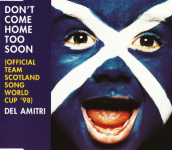
 

From wikipedia.org / © A&M Records


During this competition I was at my family’s home in the Borders town of Peebles and I watched all three Scotland games in the town’s cosy Bridge Inn, known locally as ‘the Trust’.  After the third game, a three-goal humping by Morocco that ensured that, yes, Scotland were coming home too soon, I left the Trust and headed for the Green Tree Hotel at the far end of the High Street.  The public bar there was full of people who’d just been watching the game in full regalia – team shirts, tammy hats, tartan scarves and kilts – and whom I expected to be miserable beyond belief.  They weren’t.  Their team had taken an early bath for the umpteenth time, but what the hell?  They’d decided they might as well party.  The ensuing evening was one of the best I’ve ever had in a pub.  Someone behind the bar stuck on a compilation record called The Best Scottish Album in the World Ever (1997) and I couldn’t believe how many grown men around me knew all the words to Shang-a-Lang (1974) by the Bay City Rollers.


That evening in 1998 was symbolic of what’d happened regarding the Scottish football team and its supporters.  While the former seemed doomed to flounder at these big events, the latter had given up on any expectation of their team doing well and were simply determined to enjoy themselves, win, lose or draw.  In the process, their self-deprecating humour and dedication to good-natured partying earned them the reputation of being one of the best sets of football fans in the world.  For instance, the city council of Bordeaux, where Scotland had played two of their 1998 World Cup games, took out a full-page advert in Scottish newspaper the Daily Record to thank the fans for their behaviour: “We will never forget your ‘joie de vivre, the way you know how to have a good time and your sense of fair play.  Come back soon.  We miss you already!”  I’m sure those sentiments were shared by Bordeaux’s bar and off-licence industry.


Indeed, I felt sorry for bigger countries with a reputation for greater footballing prowess, whose fans did expect them to deliver the goods.  I’d see those countries’ fans gather to watch a make-or-break World Cup game…  And, when the final whistle blew and their country had messed up, lost the game and exited the competition, those fans immediately headed home with scowls on their faces.  Wait, I’d think, aren’t you at least going to hang around and party?  (Yes, I’m looking at you, England fans.)


We’re more than a quarter-century on from the 1998 World Cup.  The issue with Scotland since then is that they’ve failed to qualify for the competition at all.  Bellyaching about them never progressing beyond the first round of it seems like an unobtainable luxury now.  We didn’t know how lucky we were back in the late 20th century.


Happily, though, all that has changed.  November 18th saw Scotland clinch qualification for next year’s World Cup tournament in Mexico, Canada and the USA by beating Denmark 4-2 at Hampden Park in Glasgow.  Sure, Denmark had the lion’s share of the play, and John McGinn was perhaps not being too modest when he commented afterwards, “I thought we were pretty rubbish to be honest, but who cares?”  But three of Scotland’s four goals were amazing: Scott McTominay managing to backwards / overhead-kick the ball into the Danish net whilst seemingly levitating in the air; Kieran Tierney sending the ball scouring around the penalty area and just making it inside the Danes’ goalpost; and, with brilliant insouciance, Kenny McLean punting the ball in the final seconds from the halfway line – and seeing it go over the Danish goalie’s head and into the net.


Mads Mikkelsen, your boys took a hell of a beating.
 

From wikipedia.org / © Luca Faz


My excitement about Scotland being on their way to a World Cup for the first time in 28 years is tempered, though, by the fact that it’s being held in North America.  Under the FIFA presidency of Gianni Infantino – a man who’s managed the difficult feat of making Sepp Blatter look wholesome – the sale of tickets has been, in the words of the Guardian, ‘a late capitalist hellscape’ plagued by ‘dynamic pricing, crypto detritus and corporate doublespeak’.  How many ordinary Scotland fans, whose presence at past matches has created such a memorable atmosphere, can afford to attend a game?  Not so many, I imagine.  Plus, if Scotland’s games are played in the USA, the fans will have to get past that country’s increasingly autocratic rules on who gets allowed in.  Dare to criticize President Trump on social media and you get barred, apparently.  And I’d guess that, online, more than a few Scotland fans have referred to the American Commander-in-Chief as ‘a big orange bawbag’ at some point.


No, I have a horrible suspicion that the majority of Scotland’s support at any USA-held games would consist of well-heeled, conservative and sober Americans who happen to have a ‘Mac’ in their surnames thanks to some Scottish ancestor – folk who like to see a few kilts at their weddings but who quietly prefer American football and baseball to what they call ‘soccer’.  The atmosphere at those games could be terribly lame.


That’s on top of my horrible suspicion, based on past experience, that Scotland will screw up against some embarrassing opposition.  I have a bad feeling about the Dutch Caribbean island of Curaçao, who have just become the smallest-ever country to qualify for a World Cup, under the management of none other than former Glasgow Rangers boss Dick Advocaat.  I can just imagine them ending up in Scotland’s first-round group.  And then Scotland making a giant hash of things against them…


Meanwhile, as the USA’s orange Commander-in-Chief loves bragging about his Scottish roots – his mother came from the Isle of Lewis – I bet he’d make a great show of turning up in person to watch any Scottish World Cup game that takes place on American soil.  Mind you, he might not survive the ordeal.
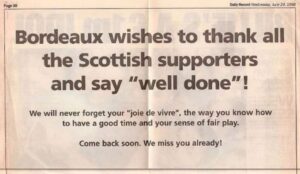
 

From the Daily Record / © Bordeaux City Council
 

The Eck’s Factor


From the Jersey Evening Post


So it’s farewell to Alex Salmond, former First Minister of Scotland, former leader of the Scottish National Party and the man who gave Scots their first opportunity in 300 years to make their country independent again.  The most formidable Scottish politician of his generation – of a couple of generations, surely – Salmond was apparently the victim of a heart attack soon after he’d given a speech in North Macedonia on October 12th


To say I had conflicted feelings about Salmond is an understatement.  For a quarter-century, from his election to the London parliament in 1987 to his resignation as Scotland’s First Minister in 2014, after the referendum on Scottish independence went against him and 55% of the Scottish electorate voted to remain in the United Kingdom, he was a man who achieved what had previously seemed impossible – he made Scottish politics interesting. His eloquence, wit and energy gave Scottish politics some oomph.  He gave it the elusive ‘X’ factor.


And then… It went pear-shaped.  I’ll stress the fact that in 2020 Salmond was cleared of the charges of sexual misconduct levelled against him.  Also, the Scottish government, which bungled the initial investigation into him, and the Scottish media, which gleefully turned the coverage of Salmond’s trial into a circus, came out of the affair poorly too.  But Salmond’s own lawyer admitted his client “could have been a better man.”  All too often in Scotland’s top political job, he’d behaved with the decorum of a lewd schoolboy – to the point where staffing procedures around him were changed to prevent women having to work with him on their own.  Also, after the trial, which had been a traumatic experience for the women who’d spoken out against him, Salmond displayed zero contrition.  He could have shown himself to be ‘a better man’, but didn’t.     


Anyway, here’s a slightly revised excerpt from something I wrote about him in 2021.  It was just after the Alba party, which he’d formed in the wake of his acquittal, had flopped at that year’s elections to the Scottish parliament.  Obviously, since I wrote it, the electoral shine has faded from the SNP too.


From en.wikipedia.org / © The Scottish Government


For the last 35 years, since the dark days when Margaret Thatcher ran Scotland with the imperious disregard one would give a colonial possession, Scottish politics has felt like a rollercoaster with both giddy peaks and despairing troughs.  And Salmond has been a constant presence on that rollercoaster.  I know plenty of people who detest him but I’ve seen him as a force for both the good and the bad, the good earlier on and bad more recently.  It’s the memory of the good things that makes me sad to see him end up like this, even if he brought a lot of it upon himself.


I remember when I first saw him.  One afternoon in early 1987, while a fourth-year undergraduate student, I was nursing a pint in the Central Refectory building at Aberdeen University.  I noticed from the corner of my eye a group of students whom I knew as members of the campus branch of the SNP – Alan Kennedy, Val Bremner, Gillian Pollock, Nick Goode – enter and wander over to the counter.  They were in the company of a young, round-faced bloke in an un-studenty suit, shirt and tie.  I identified him as an up-and-coming SNP politician whom Alan Kennedy, a good mate of mine, had told me was standing in the next general election in nearby Banff and Buchan against the incumbent Conservative Party MP Albert McQuarrie.  He’d come to the university that day to address the SNP group and this was the SNP students showing their visitor some post-talk hospitality.  The politician, I’d been assured, was one to watch.  Indeed, Alan said something along the lines of: “He’s going to do great things.”


A few months later, on June 11th, the general election took place and this rising SNP star wrestled Banff and Buchan away from Albert McQuarrie and became its new MP.  I recall McQuarrie, a doughty old-school Scottish Tory MP who revelled in the nickname ‘the Buchan Bulldog’, bursting into tears during a subsequent interview at what he saw as the unfairness and indignity of losing his beloved constituency to an SNP whippersnapper.  He was perhaps the first politician, but certainly not the last, to have his nose put out of joint by Alexander Elliot Anderson Salmond.


By the early 1990s, Salmond was SNP leader.  I lived in London at the time and occasionally I’d drink with a Labour Party spin doctor, also from Scotland.  He had no inhibitions about telling me, at every opportunity, what a detestable creep he thought Salmond was.  With his smartass manner and habitual smirk, which frequently expanded into a Cheshire-cat grin, and a general arrogance that no doubt came from knowing he was intellectually and rhetorically streets ahead of the numpties making up the majority of Westminster’s Scottish Labour MPs, you could understand how much of an annoyance Salmond was to his opponents.  But back then the SNP had just three MPs, so at least he could be dismissed as a minor annoyance.


How long ago that seems now.  In those far-off days, the Labour Party controlled much of Scotland at council level, provided the lion’s share of Scottish MPs for Westminster and, when it arrived in 1999, dominated the Scottish parliament too.  If their party also happened to be in power at Westminster, which it was occasionally, Scottish Labour-ites surely felt like masters of all they surveyed.  If the Conservatives were in power at Westminster, which they were most of the time, those Scottish Labour-ites grumbled a bit, but diplomatically kept their heads down while right-wing Tory policies were imposed on Scotland.


Then in 2007 the sky fell in.  Salmond’s SNP won the biggest number of seats in the Scottish parliament and he became Scotland’s First Minister.  The SNP have remained in power there during the 17 years and three Scottish parliamentary elections since.  They also won the majority of Scotland’s Westminster seats in the UK general elections in 2015, 2017 and 2019.  They lost the independence referendum in 2014 – an event that led to Salmond resigning as First Minister and making way for his deputy and supposed protégé Nicola Sturgeon – but the percentage of the vote they got, 45%, was still far more than what anyone had expected at the campaign’s start.  They upended the cosy old tradition of Scottish deference to the London-based overlords.  Thank God for that, in my opinion.


© William Collins


This stuck in many craws. Not just in those of the Scottish Labour Party, with its historical sense of entitlement, but in those of the majority of Scotland’s newspapers, whose hacks had enjoyed a close relationship with the old political clique and liked to see themselves as part of Scotland’s establishment. It must have horrified them to discover that, no matter how negatively they reported the SNP and its performance in government, a significant proportion of the Scottish public ignored them and kept on voting SNP.  Meanwhile, the grin of Alex Salmond, the bastard who seemed emblematic of their good times coming to an end, grew ever wider, his mood grew ever merrier and his girth grew ever more Falstaffian.


However, from 2017 onwards, Salmond’s many foes scented blood.  2017 saw him lose the Westminster seat that, after quitting as Scottish First Minister, he’d been elected to in 2015. That same year, he put on at the Edinburgh Festival a chat-show called Alex Salmond: Unleashed, which from all accounts was a graceless, self-indulgent and ego-driven mess.  Soon after, he developed his stage-show into a programme called The Alex Salmond Show, which was broadcast on RT, Russia’s international English-language news channel.  Associating himself with Vladimir Putin’s televisual voice to the world was not a wise move. Salmond hadn’t just given his detractors ammunition to use against him.  He’d handed them a whole arsenal.


I’d always assumed there was no dirt to dig up on Alex Salmond, for the simple reason that if there had been, his enemies in the old Scottish establishment would have dug it up and used it to wreck his reputation long ago.  Thus, it was a surprise in 2018 when the Daily Record newspaper reported that Salmond faced allegations of sexual misconduct while he’d been First Minister.  This had lately been the subject of an inquiry by the Scottish government and its findings had been passed on to the police.  Although Salmond made sure there was a legal review of this, which resulted in the Scottish government admitting that its investigative procedures had been flawed and paying him half a million pounds in legal expenses, the police still charged him with 14 offences, including two counts of attempted rape, in 2019.


One year later, Salmond was cleared of these charges. The prosecutors dropped one charge, the jury found him not guilty in 12 more and the final charge was deemed ‘not proven’.  Nonetheless, Salmond’s defence admitted he’d acted inappropriately, been overly ‘touchy feely’ with female staff and ‘could certainly have been a better man’.


Meanwhile, the Scottish government and First Minister Nicola Sturgeon, now totally at odds with Salmond, were subject to both an investigation by a Scottish Parliamentary committee and an independent investigation about how they’d handled, or mishandled, the affair. The committee concluded there’d been both individual and corporate incompetence but these conclusions weren’t enough to topple Sturgeon. The independent investigation judged that Sturgeon hadn’t breached the ministerial code, something that Salmond and his supporters, convinced of a conspiracy against him in high places, maintained she had.


From facebook.com


In 2021 Salmond founded the Alba Party, supposedly more gung-ho in its desire for Scottish independence than the cautious SNP, and claimed this wasn’t an attempt to undermine Sturgeon. But it was generally perceived as an effort to diminish her party’s vote in the Scottish election that year – Salmond’s revenge after his acquittal.  Whether Alba’s purpose was malevolent or benevolent, it didn’t work because the SNP ended up with 64 seats in the new parliament, with the Greens bumping up the number of pro-independence MSPs to 72, compared with the Unionist parties’ tally of 57 MSPs and Alba’s tally of zero.


It didn’t help Alba’s cause that it attracted a lot of fringe-dwelling dingbats in the independence movement, dingbats whom I’m sure Sturgeon’s SNP was delighted to see head Salmond’s way.  These included conspiracy fantasists (former ambassador Craig Murray, a man who couldn’t pop out to the shops to buy a pint of milk without claiming to have met an MI5 operative and uncovered an evil plot by the British government along the way), frothing social conservatives (Margaret Lynch, who peddled the lie that LGBT organisations were trying to lower the age of consent to ‘ten’) and the generally ‘hard of thinking’ (MSP Ash Regan, whose big idea was to create an ‘independence thermometer’, measuring Scotland’s readiness to leave the UK).


Finally, one thing I will say in Salmond’s defence.  The Scottish press was pretty disgraceful in how it reported the case.  From columnist Alex Massie declaring at the investigation’s outset that ‘WHATEVER HAPPENS, IT’S OVER FOR SALMOND’, to the Herald previewing the trial with a ‘Big Read’ feature that it illustrated with pictures of the Yorkshire Ripper, Fred and Rosemary West, the Moors Murderers, Dennis Nilsen, Charles Manson and Adolf Eichmann, to a dodgy, nod-and-a-wink post-trial documentary by the BBC’s Kirsty Wark, the tone of the coverage didn’t suggest that a person is ‘innocent until proven guilty’.  Rather, it suggested that a person is ‘guilty because we want them to be guilty’.

***

The piece I wrote in 2021 ended with an observation, “the Salmond Rollercoaster has run out of track,” and a plea to him: “Call it a day for Christ’s sake.” 


Since then, of course, Nicola Sturgeon’s reign as Scottish First Minister has come to an ignominious end too.  These events call to mind the famous quote by that old Conservative politician and racist Enoch Powell: “All political lives, unless they are cut off in midstream at a happy juncture, end in failure, because that is the nature of politics and of human affairs.”


If only Alex Salmond had kept his hands to himself whilst First Minister.  And if only he’d retired and accepted the role of distinguished ‘elder statesman’ in 2014.  He wouldn’t have disproven Powell’s famous edict, because his career would still have ended with the disappointment of the referendum.  But at least today I’d be remembering him as ‘a better man’.  And it’s as ‘a better man’ that I’d like to remember him.


© Slainte Media / RT / From archive.org

Don’t play it again, Salm


© Slainte Media / RT / From archive.org


On March 26th, six weeks before the elections for the Scottish Parliament, former Scottish First Minister and former Scottish National Party (SNP) leader Alex Salmond launched his new Alba party to contest those elections.


In response to the news, George Galloway – a man with a lengthy political CV himself, having been Labour MP for Glasgow Hillhead, Respect MP for Bethnal Green and Bow and Bradford West and leader of the Respect Party, and now leader of the Alliance for Unity party, which he launched last year in anticipation of the Scottish parliamentary elections too – tweeted: “So it’s me and Alex Salmond in the ring.  Heavyweights.  Him for separatism, me for the union.  Seconds away…”


In the event, neither Salmond’s Alba nor Galloway’s Alliance for Unity got enough votes to send any of their representatives to the Scottish Parliament.  The former amassed 44,913 votes and the latter managed 23,299 out of a total of 2,716,547 votes cast.  So that tweet, as they say, aged well.  Both heavyweights got their arses kicked.


I’m not shedding any tears over Galloway’s humiliation.  He’s a politician whose couple of good deeds – his involvement with the Scotland United campaign for the creation of a devolved Scottish parliament in the early 1990s; squaring up to a US Senate committee investigating the Food for Oil programme in the aftermath of the disastrous invasion of Iraq in 2005 – have been obliterated in the public memory by the tsunami of crap things he’s done in his endless quest to promote himself.  These include dishing religious-related dirt on his political opponents during his campaigns with the Respect Party; defending the execution of a gay man by the Iranian government whilst working for Press TV, funded by the same government, in 2008; climbing onto the Nigel Farage bandwagon by endorsing a vote for Brexit in 2016; hugging extreme right-wing strategist and evil incarnate Steve Bannon in 2019; and, let us never forget, pretending to be a cat slurping cream off Rula Lenska’s lap on the 2006 series of Celebrity Big Brother.


Meanwhile, lately, Galloway’s antics during his doomed campaign to get into the Scottish Parliament via the second-vote / proportional-representation ‘list’ system have included him urging voters to give their first vote to the Conservative Party (the former left-wing firebrand had declared a few years earlier, “If you ever see me standing under a Union Jack shoulder-to-shoulder with a Conservative, please shoot me”); causing a twitter pile-on, intentionally or unintentionally, against Scots-language poet Len Pennie; making unsavoury references to the ethnicity of Scottish Justice Secretary Humza Yousaf (“You are not a Celt like me”); making a hilarious video where he sucked up to the Scottish Gamekeepers Association and promised to end Green Party ‘tyranny over rural communities’ whilst resembling a cast member from Last of the Summer Wine (he obviously believed gamekeepers had short memories considering that in 2002, as an MP, he’d supported a hunting ban); and generally trying to reinvent himself as a true-blue, Union Jack-waving, Churchill-and-spitfires-obsessed slab of gammon.


Now that he’s torched every left-wing principle he once professed to have for the sake of self-promotion, it’d be nice to think that this beyond-disastrous election result will make Galloway slink off beneath a rock and never show his face again.  But of course he won’t.  He’ll be back.  The creature knows no shame.


I’m not shedding tears for Alex Salmond either, but I’ll admit to feeling at least slightly conflicted.  For the last 35 years, since the dark days when Margaret Thatcher ran Scotland with the imperious disregard one would give a colonial possession, Scottish politics have felt like a rollercoaster with both giddy peaks and despairing troughs.  And Salmond has been a constant presence on that rollercoaster.  I know plenty of people who loathe him but I’ve seen him as a force for both the good and the bad, the good earlier on and bad more recently.  It’s the memory of the good things that gives me a twinge of sadness to see him end up like this, even if he brought most of it upon himself.


From en.wikipedia.org


I remember when I first saw him.  One afternoon in early 1987, while a fourth-year undergraduate student, I was nursing a pint in the Central Refectory building at Aberdeen University.  I noticed from the corner of my eye a group of students whom I knew as members of the campus branch of the SNP – Alan Kennedy, Val Bremner, Gillian Pollock, Nick Goode – enter and wander over to the counter.  They were in the company of a young, round-faced bloke in an un-studenty suit, shirt and tie.  I identified him as an up-and-coming SNP politician whom Alan Kennedy, a good mate of mine, had told me was standing in the next general election in nearby Banff and Buchan against the incumbent Conservative Party MP Albert McQuarrie.  He’d come to the university that day to address the SNP group and this was the SNP students showing their visitor some post-talk hospitality.  The politician, I’d been assured, was one to watch.  Indeed, Alan said something along the lines of: “He’s going to do great things.”


A few months later, on June 11th, the general election took place and this rising SNP star wrestled Banff and Buchan away from Albert McQuarrie and became its new MP.  I recall McQuarrie, a doughty old-school Scottish Tory MP who revelled in the nickname ‘the Buchan Bulldog’, bursting into tears during a subsequent interview at what he saw as the unfairness and indignity of losing his beloved constituency to an SNP whippersnapper.  He was perhaps the first politician, but certainly not the last, to have his nose put out of joint by Alex Salmond.


By the early 1990s, Salmond was SNP leader.  I lived in London at the time and occasionally I’d drink with a Labour Party spin doctor, also from Scotland.  He had no inhibitions about telling me, at every opportunity, what a detestable creep he thought Salmond was.  With his appropriately smart-Alec manner and habitual smirk, which frequently expanded into a Cheshire-cat grin, and a general arrogance that no doubt came from knowing he was intellectually streets ahead of the numpties making up the majority of Westminster’s Scottish Labour MPs, you could understand how much of an annoyance Salmond was to his opponents.  But back then the SNP had just three MPs, so at least he could be dismissed as a minor annoyance.


How long ago that seems now.  In those far-off days, the Labour Party controlled much of Scotland at council level, provided the lion’s share of Scottish MPs for Westminster and, when it arrived in 1999, dominated the Scottish parliament too.  If their party also happened to be in power at Westminster, which it was occasionally, Scottish Labour-ites surely felt like masters of all they surveyed.  If the Conservatives were in power at Westminster, which they were most of the time, those Scottish Labour-ites grumbled a bit, but diplomatically kept their heads down while right-wing Tory policies were imposed on Scotland.


Then in 2007 the sky fell in.  Salmond’s SNP won the biggest number of seats in the Scottish parliament and he became Scotland’s First Minister.  The SNP have remained in power there during the 14 years and three Scottish parliamentary elections since.  They also won the majority of Scotland’s Westminster seats in the UK general elections in 2015, 2017 and 2019.  They lost the independence referendum in 2014 – an event that led to Salmond resigning as First Minister and making way for his deputy and supposed protégé Nicola Sturgeon – but the percentage of the vote they got, 45%, was still far more than what anyone had expected at the campaign’s start.  They upended the cosy old tradition of Scottish deference to the London-based overlords.  Thank God for that, in my opinion.


© William Collins


This stuck in many craws. Not just in those of the Scottish Labour Party, with its historical sense of entitlement, but in those of the majority of Scotland’s newspapers, whose hacks had enjoyed a close relationship with the old political clique and liked to see themselves as part of Scotland’s establishment. It must have horrified them to discover that, no matter how negatively they reported the SNP and its performance in government, a significant proportion of the Scottish public ignored them and kept on voting SNP.  Meanwhile, the grin of Alex Salmond, the bastard who seemed emblematic of their good times coming to an end, grew ever wider, his mood grew ever merrier and his girth grew ever more Falstaffian.


However, from 2017 onwards, Salmond’s many foes scented blood.  2017 saw him lose the Westminster seat that, after quitting as Scottish First Minister, he’d been elected to in 2015.  That same year, he put on at the Edinburgh Festival a chat-show called Alex Salmond: Unleashed, which from all accounts was a graceless, self-indulgent and ego-driven mess.  Soon after, he developed his stage-show into a programme called The Alex Salmond Show, which was broadcast on RT, Russia’s international English-language news channel.  Associating himself with Vladimir Putin’s televisual voice to the world was not a wise move.  Salmond hadn’t just given his detractors ammunition to use against him.  He’d handed them a whole arsenal.


I’d always assumed there was no dirt to dig up on Salmond, for the simple reason that if there had been, his enemies in the old Scottish establishment would have dug it up and used it to wreck his reputation long ago.  Thus, it was a surprise in 2018 when the Daily Record newspaper reported that Salmond faced allegations of sexual misconduct while he’d been First Minister.  This had lately been the subject of an inquiry by the Scottish government and its findings had been passed on to the police.  Although Salmond made sure there was a legal review of this, which resulted in the Scottish government admitting that its investigative procedures had been flawed and paying him half a million pounds in legal expenses, the police still charged him with 14 offences, including two counts of attempted rape, in 2019.


One year later, Salmond was cleared of these charges. The prosecutors dropped one charge, the jury found him not guilty of 12 more and the final charge was deemed ‘not proven’.  Nonetheless, Salmond’s defence admitted he’d acted inappropriately, had been overly ‘touchy feely’ with female staff and ‘could certainly have been a better man’.


Meanwhile, the Scottish government and First Minister Nicola Sturgeon, now totally at odds with Salmond, were subject to both an investigation by a Scottish Parliamentary committee and an independent investigation by Irish lawyer James Hamilton about how they’d handled, or mishandled, the affair.  The committee concluded there’d been both individual and corporate incompetence but these conclusions weren’t enough to topple Sturgeon.  Hamilton judged that Sturgeon hadn’t breached the ministerial code, something that Salmond and his supporters, convinced of a conspiracy against him in high places, maintained she had.


From facebook.com


Salmond claimed his new Alba Party, supposedly more gung-ho in its desire for Scottish independence than the cautious SNP, was not another attempt to undermine Sturgeon.  But it was generally perceived as an effort to diminish her party’s vote in the May 6th Scottish election – Salmond’s revenge as a dish served cold, a year after his acquittal.  Whether Alba’s purpose was malevolent or benevolent, it didn’t succeed.  The SNP ended up with 64 seats in the new parliament, with the Greens bumping up the number of pro-independence MSPs to 72, compared with the Unionist parties’ tally of 57 MSPs and Alba’s tally of zero.


It didn’t help Alba’s cause that it attracted a lot of fringe-dwelling dingbats in the independence movement, dingbats whom I’m sure Sturgeon’s SNP will be glad to see the back of.  These included one vocal faction who seemed to spend all their time baiting and frothing against trans people.  It also didn’t help that Salmond showed little contrition for his past misbehaviour.  Fair enough, that misbehaviour hadn’t been enough to warrant a court conviction and prison sentence.  But it did make him come across as a sleazebag whom no young woman would want to be around.


One thing I will say in Salmond’s defence.  While I find claims of a conspiracy against Salmond in the upper echelons of the Scottish government, legal system and police force fanciful – conspiracies imply objectives, strategies and clear thinking, and to me the messiness of Salmond’s investigation and trial simply suggests witless blundering – I agree with his supporters that the Scottish press was pretty disgraceful in how it reported the case.  From columnist Alex Massie trumpeting at the investigation’s outset that ‘whatever happens, it’s over for Salmond’, to the Herald previewing the trial with a ‘Big Read’ feature that it illustrated with pictures of the Yorkshire Ripper, Fred and Rosemary West, the Moors Murderers, Dennis Nilsen, Charles Manson and Adolf Eichmann, to a dodgy, nod-and-a-wink post-trial documentary by the BBC’s Kirsty Wark, the tone of the coverage didn’t suggest that a person is ‘innocent until proven guilty’.  Rather, it suggested that a person is ‘guilty because we want them to be guilty’.


But that’s the only thing I’ll say in his defence.


Meanwhile, post-election, Salmond has announced his intention to become an influential Twitter presence, just as a certain former US president once was.  “I am going to unleash myself on Twitter,” he said the other day, “now that Donald Trump has created a vacuum for me.” No, Alex, don’t.  Just don’t.  Call it a day for Christ’s sake.


It isn’t so much that the Salmond Rollercoaster has reached the bottom of the deepest dip yet.  It’s more that the Salmond Rollercoaster has run out of track.


From the Jersey Evening Post