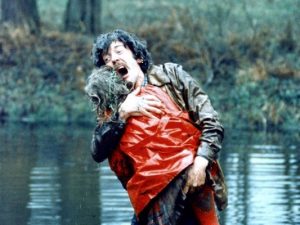
More things that terrified the young me


From wikipedia.org / © Group Three Productions


Here’s the second half of my account of things that scared me, to the point of scarring me, when I was wee.


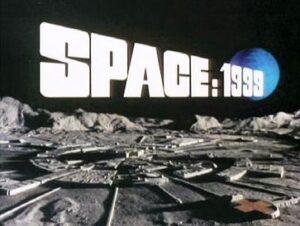
Space: 1999 – Dragon’s Domain (1975)

Even as a kid, I knew the TV show Space: 1999 was silly.  I already had enough awareness of science to realise the ridiculousness of its premise – a titanic explosion on the moon in the then-future year of 1999 sends it, and 300 human beings crewing a base there called Moonbase Alpha, careering out of earth’s orbit and into deep space.  Particularly ridiculous was how every second episode the moon hurtled into a new solar system and came close enough to an earth-type planet for the Moonbase Alpha folk to explore it.  Space: 1999 depicted the universe as a giant pinball machine with the moon bouncing between earth-type planets like the silver ball bouncing between the machine’s flippers and bumpers.


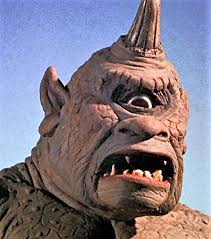
And yet…  A Space: 1999 episode called Dragon’s Domain petrified me.  It has the runaway moon approaching a sinister graveyard of abandoned spaceships in which a horrifying, one-eyed, tentacled monstrosity lurks.  Okay, seen today, the monster in Dragon’s Domain doesn’t impress, being a mass of wavy tentacles obviously animated by wires.  But the barrage of things that accompany it still inspire fear – it initially materialises as a swirling pattern of lights, it makes hideous shrieking noises and its victims are battered by gusts of wind.  Most horribly, moments after those victims are dragged into its maw, they’re spat out again as desiccated corpses, apparently drained of all their moisture.


There’s something about the episode’s ineluctability that got me too.  It focuses on a Moonbase Alpha member (Gianni Garko) who’s encountered the monster before.  While he was captaining a mission into deep space, it ate his crew and only he managed to escape.  Now stuck on the moon after its unexpected departure from earth’s orbit, fate has cruelly decreed that he’ll meet the thing again.


The pictures in The Horrific World of Monsters (1974)

I might have been terrified by monsters like that Space: 1999 one, but I was also fascinated by them and in the mid-1970s I bought a hardcover, kids-orientated book called The Horrific World of Monsters by Dulan Barber.  This provided an A-Z of monsters from myth, folklore, cryptozoology, movies, TV and comics.
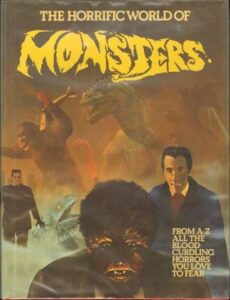
 

© Marshall Cavendish


Lavishly illustrated, a couple of the book’s page-sized movie-stills troubled me, lodged themselves in my psyche and occasionally caused me nightmares.  These depicted the mummy, played by Lon Chaney Jr in 1944’s The Mummy’s Ghost, throttling a victim; a fanged, hairy Michael Landon pouncing on a victim in I was a Teenage Werewolf (1957); and, in unflinching close-up, the title character of The Return of the Fly (1959), the second film in the series about a scientist experimenting with a teleportation device who gets his molecules mixed up with those of a fly and acquires a massive, insectile head.  Just as well it wasn’t a close-up of Jeff Goldblum from late in David Cronenberg’s 1986 remake of The Fly.  That sight would have left me gibbering.


Eventually, I sold the book to a schoolmate called Geoff Simmons, who was a gifted artist and who used some of its illustrations as inspiration for pictures – I remember him showing me one he’d drawn based on the mummy.  Geoff is now a graphic designer (and also a community historian) in London.  I’d like to think The Horrific World of Monsters played a small part in shaping his future career.


Bodega Bay gets attacked in The Birds (1963)

By the mid-1970s, someone had informed me that the Americans and Russians both had ‘bombs that could blow up the world’, so I had a new thing to worry about – the end of humanity.  Accordingly, apocalyptic movies frightened the bejesus out of me.  For example, Steve Sekely’s Day of the Triffids (1963), a cheap adaptation of John Wyndham’s 1951 novel, scared me with its depiction of a world where nearly everyone has gone blind.  Even at 10 years old, unfortunately, I could tell how shoddy its special effects were, especially the ones involving the triffids.


But the apocalyptic movie that traumatised me was 1963’s The Birds, directed by the impeccable Alfred Hitchcock and based on a 1952 short story by the equally impeccable Daphne du Maurier.  Most traumatic for me was the part where Tippi Hedren and Rod Taylor find themselves in a diner in the middle of the little coastal town of Bodega Bay, trying to convince the locals – who react with varying degrees of scepticism – that the area’s feathered population is behaving very strangely.  After seven minutes of conversation that mingles humour with growing unease, and is brilliantly performed by character actors like Doreen Lang (as an increasingly frightened mother), Charles McGraw (as a gruff fisherman), Ethel Griffies (as an elderly, know-all ornithologist) and Karl Swenson (as a Bible-quoting Irish drunkard), all hell breaks loose.


Multitudinous seagulls swoop down and cars and petrol pumps explode (thanks to fuel spewing from a dropped hose), more cars crash, horses run wild and many townspeople get clawed and pecked.  Hedren spends a nightmarish minute trapped inside a telephone booth with birds, plus one unlucky human victim, smashing into its sides.  Taylor rescues her and gets her into the diner again, but…  The atmosphere there is suddenly less welcoming.
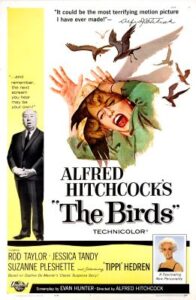
 

From wikipedia.com / © Universal Pictures


Hitchcock’s orchestration of this blew me away.  The telephone-booth bit was possibly the first time I’d been exposed to what film-fans would describe as ‘pure cinema’.  But Taylor and Hedren’s return to the diner provides the chilling coup de grâce.  The people inside are cowering in terror, including Griffies’s no-longer-cocky ornithologist, and already a superstitious irrationality is taking hold of them.  This crystalises when a now-crazed Lang accuses Hedren of, basically, being a witch: “Who are you?”  What are you?  Where did you come from?  I think you’re the cause of all this.  I think you’re evil.  Evil!”  No doubt a young Stephen King was taking notes at this point.  Similar things happen in his 1980 novella The Mist, with many of its characters reacting to another apocalyptic event by succumbing to medieval-style hysteria.


Doctor Who – The Seeds of Doom, episode 4 (1976)

I could write a whole article based only on moments from the BBC’s long running science-fiction / fantasy / horror series Doctor Who (1963-89, 2005-25) that scared me: the shop dummies coming to life in the serial Spearhead from Space (1970); the killer plastic chair in Terror of the Autons (1971); the murderous Morris dancers in The Daemons (1971); a scaly hand appearing over a boat’s gunwale in The Sea Devils (1972); an infected crewman removing his hand from his pocket and revealing it transformed into a slab of glistening green slime (okay, it’s really green-painted bubble-wrap, but hardly anyone at the time knew what bubble-wrap was) in The Ark in Space (1975)…  But scariest of all was the 1976 serial The Seeds of Doom, about alien seed-pods that infect humans and transform them into malevolent, carnivorous plant-monsters.  Episode 4 of The Seeds of Doom, to be precise.


One alien pod becomes the possession of an insane millionaire plant-lover called Harrison Chase – played by character actor Tony Beckley, who’d been in The Italian Job (1969) and Get Carter (1971) – and at the start of episode 4 it germinates, infecting one of Chase’s minions, a hapless botanist called Arnold Keeler (Mark Jones).  Ignoring Keeler’s pleas to be taken to a hospital, Chase has him chained to a bed, purring in delight, “The rate of increase is astonishing…  Protein absorption from the animal, of course…  We shall have to give you some food soon…  You’re changing into a plant, Keeler…  a marvellous new species of plant!”
 

© BBC


With Keeler turning green, then fibrous, then tentacular, and Chase trying to speed up the metamorphosis by feeding him pieces of raw meat, what I was witnessing here was the icky sub-genre of horror known as ‘body horror’.  But it was the performances of Beckley and Jones, one disturbingly malevolent, the other distressingly pathetic, that truly conveyed the horribleness of the situation.


Legend Horror Classics, issue 4 (1976)

The same impulse that made me buy The Horrific World of Monsters inspired me to purchase issue 4 of a British film magazine called Legend Horror Classics, edited by Gent Shaw, who’d also edited the scary-movie magazine World of Horror in 1974-75.  Issue 4 of Legend Horror Classics was devoted to zombies, which until then I’d understood to be dead people brought back to life by voodoo and put to work on Caribbean sugar plantations.  By the 1970s, however, thanks to the influence of George A. Romero’s Night of the Living Dead (1968), zombie stories and films had become less voodoo-reliant and a lot grislier and more visceral.  This issue contained several gruesome photos that, like those in the Monsters book, gave me nightmares.


However…  Since then, I’ve discovered, indignantly, that the yuckiest pictures in the issue weren’t actually from zombie movies!  There was one of the mouldering, prehistoric ape-creature inhabited by an evil alien intelligence in the Christopher Lee / Peter Cushing horror film Horror Express (1972); and one of a rotting corpse (not reanimated as a zombie) from another 1972 movie featuring Christopher Lee, Deathline.  If you’re reading this, Gent Shaw, I’m accusing you of breaking the Trade Descriptions Act.
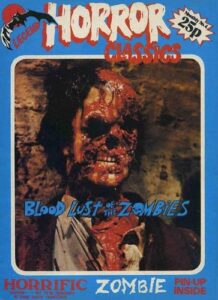
 

© Legend Publishing


The Nationwide report about the Hexham Heads (1976)

The Hexham heads were two little stone heads, possibly Celtic in origin, discovered in the northeast English town of Hexham in 1971.  Reputedly, the heads triggered paranormal activity in the homes of whoever had custody of them.  And that paranormal activity manifested itself spectacularly in the form of a werewolf that was glimpsed stalking through their homes after dark.


Infamously, Nationwide (1969-83) – normally a family-friendly TV current-affairs programme, which aired on the BBC every weekday evening after six o’clock – featured a report on the story in 1976.  The makers of the report had the not-so-family-friendly idea of spicing it up with ghastly screams, images of severed human heads and an unexpected jump-cut of Oliver Reed lurching towards the camera in 1961’s Curse of the Werewolf.  This approach traumatised every kid who happened to be watching, me included.


One eyewitness reported seeing the Hexham Heads werewolf after arriving home late at night – allegedly she spotted it prowling about her dark house before she switched on the lights.  Soon afterwards, my family moved from Northern Ireland to Scotland.  My parents frequently received invitations to Sunday lunch and dinner at the homes of Northern Irish folk they knew directly, or knew as friends of friends, who were now living in Scotland.  After much food, whisky and blethering, we wouldn’t get home until late on Sunday evening.  While my parents unlocked the front door and we entered a black, silent house, I’d think of the Nationwide report and wonder, “What if there’s a werewolf waiting in there?”


From wikipedia.org / © Archaeology Data Service / Dr Anne Ross


Footage of that legendary 1976 TV report on the Hexham Heads was long believed lost but it’s now been discovered and restored – see here and here.


Jon Voight’s dream at the end of Deliverance (1972)

By the time I was 12, I believed I was a mature, hardened type who’d seen everything and couldn’t be frightened anymore.  But then on TV one evening I watched John Boorman’s Deliverance (1972), about four Atlanta business men whose canoeing holiday in remote north Georgia turns into an ordeal, and was freaked out by it.


Oddly, it wasn’t the notorious sequence where some hillbillies rape Ned Beatty’s character and insist that he squeals ‘like a pig’ that upset me most.  Maybe I wasn’t old enough to fully understand what was happening.  No, it was the bit near the end where Jon Voigt’s character has a nightmare about the river they canoed on – which has since been dammed and turned into a lake – and sees a pale, bloated hand rising out of its water.  The image of that emerging hand haunted me for weeks afterwards.  I obviously wasn’t as tough as I thought I was.


© Elmer Enterprises / Warner Bros.


Thinking about it, I suppose I must have been a complete scaredy-cat whose childhood was one long procession of moments of terror.  So now, half-a-century later, why do I write short horror stories under the penname of Jim Mountfield?  I’ve had nearly 70 such stories published.


Perhaps it’s a case of ‘if you can’t beat ’em, join ‘em.”
Things that terrified the young me


From wikipedia.org / © Warner Bros Entertainment


We’ve entered October, the month that ends with the spooky and supernatural-tinged festival of Halloween.  I usually mark this time of year by posting some entries related to the macabre – well, I am a published writer of horror stories.  So, here is a piece listing the various things, in real life, in print, on TV or in the cinema, that terrified me as a kid and, possibly, affected my development and made me the person I am today.


The Tom and Jerry cartoon Heavenly Puss (1949)

When I was five or six years old, popular children’s cartoons that suddenly and without warning turned creepy were like booby traps for my delicate psyche.  For example, I remember watching an episode of The Inspector, which was part of The Pink Panther Show (1969-78), where the Inspector’s sleepy sidekick Sergeant Deux-Deux accidently drinks a mad scientist’s potion and turns into a hulking Mr Hyde-like monster.  This horrified me.


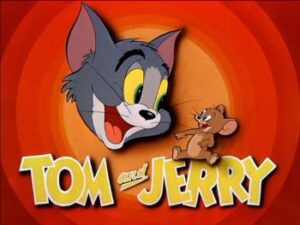
But my all-time cartoon nightmare came when I watched a Tom and Jerry short called Heavenly Puss, in which Tom is terrorised by a horned, red-pelted, green-eyed devil-dog – basically a satanic version of Spike the Bulldog – who keeps appearing and threatening to boil him alive in a cauldron.  I was living in Northern Ireland at the time, and was already having my head filled with warnings about the devil by the multiple religious personages who populated the place.  Seeing a similar, infernal figure intrude on something as innocuous as Tom and Jerry was deeply upsetting.


Incidentally, the 1942 Tom and Jerry short Fraidy Cat freaked me out too, though not quite as much as Heavenly Puss did.


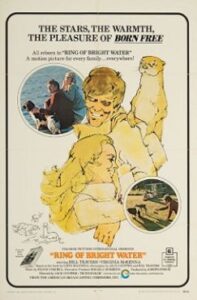
Mij gets it in Ring of Bright Water (1969)

With this one I was less terrified than traumatised.  Many people my age go on about how they were reduced to quivering wrecks when they watched the animated, leporine bloodbath Watership Down (1978).  But a far worse experience for me was the movie Ring of Bright Water, based on the 1960 book of the same name by Gavin Maxwell, in which Bill Travers plays a hapless Londoner who rescues a rambunctious otter called Mij from a pet shop and ends up moving with him to the more otter-friendly environment of Scotland’s remote west coast.  Not only Mij thrives there – Travers does too, especially when he makes the acquaintance of the fanciable local doctor (Virginia McKenna).


© Palomar Pictures International / Rank Film Distributors


I saw Ring of Bright Water on TV in the early 1970s.  For most of its running time, it’s an amiable comedy in which Travers and Mij get up to amusing high-jinks.  Nothing prepares you for the ending.  McKenna is taking Mij for a walk when he gets his head flattened in a random act of violence by a shovel-wielding ditch-digger who regards otters as vermin.  It’s made even worse by the fact that Travers is in London at the time.  In the next scene he returns, cheerfully believing all is well, and McKenna has to interrupt his garrulous blather with the bald statement, “Mij is dead.”


It’s a sobering reminder of the fact that, no matter how much we sentimentalise animals, they frequently live or die – more often die – by the whims of humans beings.  But sneaking that reminder into what’d been, for the most part, a fun, good-natured family film seemed a bit rotten.


Playing the ditch-digger was the Glaswegian actor Archie Duncan, who passed away in 1976.  I wonder if that’s inscribed on his headstone: ‘HE KILLED MIJ.’


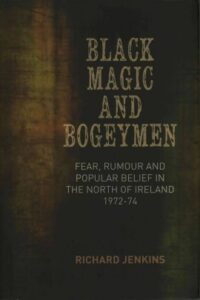
The Northern Irish satanic panic in 1973

According to the 2014 book Black Magic and Bogeymen by Richard Jenkins, Professor of Sociology at the University of Sheffield, a “wave of rumours about black magic, Satanism, animal sacrifice and child abduction… swept across the north of Ireland in late 1973 and early 1974.”  Jenkins notes that “(b)etween 5th August and mid-December 1973, sixty-five items about witchcraft and black magic appeared in the mainstream press north and south of the Irish border: news reports, features, editorials, letters to the editor, church reports, and what appeared to be religious announcements…  The reports peaked between mid-October and the third week in November, clustering around Hallowe’en.”


© Cork University Press


This was a classic example of what today we’d call a ‘satanic panic’ though, with the Northern Irish Troubles in progress at the time, Jenkins offers intriguing evidence that the British Army was stirring the pot with ‘black propaganda’ operations – i.e., trying to convince superstitious Northern Irish parents that the province was overrun with devil-worshippers so they wouldn’t let their kids outdoors at night.  Keeping them indoors meant there was less chance of them getting into genuine bother with the paramilitaries or the security forces.


Jenkins also observes that children were among the worst culprits for spreading the rumours.  I can testify to that.  I remember a girl in my class gleefully assuring me there was a family in nearby Enniskillen who drew their curtains as soon as it got dark and then spent all night performing ghastly black-magic rituals.  She also told me about goat-carcasses being found beside the river in Enniskillen with their hearts cut out and, worst of all, a child being abducted there, sacrificed and chopped into pieces.  Needless to say, gullible me swallowed every word of this and, for the next few months, the prospect of visiting Enniskillen petrified me.


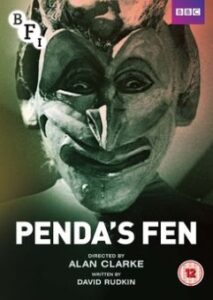
The trailer for Penda’s Fen (1974)

Today, Penda’s Fen is regarded as a visionary piece of TV drama.  Time Out magazine has described it, rather pompously, as a “multi-layered reading of contemporary society and its personal, social, sexual, psychic and metaphysical fault lines…” that fuses “Elgar’s Dream of Gerontius with a heightened socialism of vibrantly localist empathy, and pagan belief systems with pre-Norman histories and a seriously committed – and prescient – ecological awareness.”   Written by David Rudkin and directed by Alan Clarke, it was, however, seriously offbeat even by the standards of Play for Today (1970-84), the anthology series whose fourth season contained it as an episode.   Maybe that’s why I remember the trailer the BBC showed prior to its broadcast being so scary – the channel couldn’t make head nor tail of it and decided to market it as a folk-horror film.


© BBC


Two creepy moments of Penda’s Fen were included in that trailer.  Firstly, there was a sequence where the young hero (Spencer Banks) sits by the edge of a pool and sees reflected in it a statue of an angel – the statue stands behind him, but when he looks around it suddenly isn’t there anymore.  I wonder if the TV writer Steven Moffat saw this as a kid and, three decades later, it inspired him to create the Weeping Angels for the 21st-century reboot of Doctor Who (2005-25).  Even worse for my tender sensibilities was a sequence where Banks cowers in his bed while a devilish face hovers over him.  Living in super-religious Northern Ireland, I had no doubt at the time that devils and demons were real.  I didn’t want to wake up in the middle of the night and be confronted by a face like that.


Haunted by the images in its trailer, I didn’t watch Penda’s Fen when it was broadcast a few evenings later.  In fact, I didn’t see it in its entirety until several years ago and, of course, it was nothing like what my eight-year-old self had been led to believe.


Talos comes to life in Jason and the Argonauts (1963)

In my childhood I loved the movie Jason and the Argonauts, based on the Greek myth of Jason and the Golden Fleece.  I especially loved the mythical creatures in it like the hydra and harpies, which were animated by stop-motion-animation / special effects genius Ray Harryhausen.  One scene absolutely creeped me out, however, and has stuck in my memory ever since.  That’s when Jason and co. arrive on an island populated by gigantic bronze statues and Hercules (Nigel Green) and Hylas (John Cairney) not very smartly steal a giant broach from a treasure chamber inside the plinth of the statue of Talos.  They’re discombobulated, to say the least, when the head of the titanic statue slowly turns and its bronze face gazes down at them, impassively but accusingly.


© Morningside Productions / Columbia Pictures


I think it’s the creaking noise that accompanies the twisting of Talos’s neck that gets me – every time I watch it.


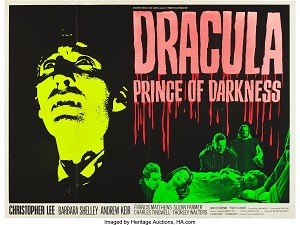
The first half of Dracula, Prince of Darkness (1966)

The horror movies made by the famous British studio Hammer Films aren’t regarded today as being particularly frightening.  At their best, they have a wonderful gothic flamboyance.  At their worst, they’re endearingly tacky.  But genuinely frightening?  Not really.  However, when I was a kid, some of them turned up on TV for the first time and, to me then, they did seem scary.  For instance, Quatermass and the Pit (1968) left me shaken.  But it was the first half of Hammer’s Dracula, Prince of Darkness that truly gave me the willies.  I say ‘first half’ because when I initially saw it on TV, that was all of it I could take.  At its midpoint, I threw in the towel and retreated to bed.


In part, the film’s impact on me was due to misleading expectations.  I knew Dracula was villainous but didn’t think he could be frightening.  I’d already seen a couple of old black-and-white films featuring the character, made by Universal Studios, where he was played in a raffish fashion, by John Carradine in House of Dracula (1945), or in an urbane and slightly camp one, by Bela Lugosi in Abbott and Costello Meet Frankenstein (1948).  So I wasn’t ready for Christopher Lee’s portrayal of him in Dracula, Prince of Darkness, where he alternates between being chillingly imperious – he unsettlingly doesn’t utter a word of dialogue during the whole film – and being a hissing, spitting hell-fiend.


In fact, Dracula is hardly in the movie’s first half.  It begins with a prologue showing him being reduced to ashes, by Peter Cushing, at the climax of the previous instalment in Hammer’s Dracula series.  What follows is a grim tale in which four naïve English travellers (Francis Matthews, Suzan Farmer, Barbara Shelley and Charles Tingwell) end up spending the night at Castle Dracula and an acolyte (Philip Latham) slaughters one of them and uses his blood to revive his dead master.  The sight and sound of copious blood splattering down onto the Count’s powdery remains inflicted another scar on my already heavily-scarred young psyche.


© Warner Pathé / Hammer Films


I’ll post about more things that terrified my juvenile self shortly.

Films I’d like to see remade (Part 2)


From wikipedia.org / © Metro-Goldwyn-Mayer


Here are some more films I remember fondly from my youth that, with sufficient love and skill, I think could be remade as wonderful new films.


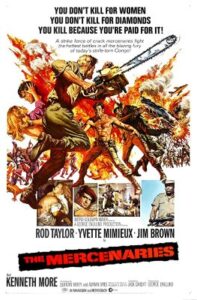
Dark of the Sun (1968)

When, in my early teens, I saw this action / adventure / war movie on late-night TV, I believed it was the toughest movie ever.  At least, I believed that until I saw William Friedkin’s nail-biting Sorcerer (1977), itself a remake, of Henri-George Clouzot’s The Wages of Fear (1953), which promptly stole its crown as Most Badass Film I’d Ever Seen. 


But no matter – Dark of the Sun, or The Mercenaries as it was also known, still seemed pretty hardcore to me.  Why, it even had a chainsaw fight in it!  Thanks to the Texas Chainsaw Massacre movies (1974 onwards) and the Evil Dead movies (1981 onwards), and to one-off entries like Motel Hell (1980) and Mandy (2018), chainsaw fights are ten a penny nowadays.  But back then, seeing someone lunge at someone else with a whirring, metal-toothed power tool was an intense experience.


Based on a 1965 Wilbur Smith novel and directed by Jack Cardiff, Dark of the Sun tells the story of some mercenaries being sent into action amidst the Simbas rebellion in early 1960s Congo. It stars Robert Taylor, Yvette Mimieux – Taylor and Mimieux reunited eight years after appearing in George Pal’s charming 1960 adaptation of H.G. Wells’s The Time Machine – Jim Brown, Kenneth More (subverting his usual, cuddly English-gentleman image by playing an alcoholic doctor) and Peter Carsten (playing a vile, child-murdering Nazi).  At the time, critics lambasted the film for what they saw as its extreme violence.  However, as Cardiff noted, the violence depicted didn’t come anywhere near the real atrocities that’d happened in the Congo then, or near the violence featured in movies in later decades.


I’d like to see a remake of Dark of the Sun that updates the intensity, grittiness and violence to fit with 2026 sensibilities and that places the action within the context of 2026 geopolitics.  And is more racially sensitive – any racism in the original movie went over my 13-year-old head but I’m sure that, viewing it today, I’d cringe at parts of it.   At the very least, and despite the presence of Jim Brown as one of the mercenaries, I suspect I’d find it infused with a ‘white saviour’ or ‘white man’s burden’ complex.


Quentin Tarantino is a huge fan of this film (as is Martin Scorsese) so, as I did with Von Ryan’s Express (1965), I recommend old Quent as the man to helm a remake of it.  I know he’s sworn that he’s only going to make ten films in his lifetime, and his next one will be his last, but I don’t believe that for an instant.


Come to think of it, Dark of the Sun has quite a few things in common with Von Ryan’s Express, including a cracking movie film poster designed by the splendid Frank McCarthy and the presence of Nazis.  And like the earlier film, Dark of the Sun prominently features a train.


As does my next candidate for a modern remake, which is….


© Granada Films


Horror Express (1972)

The much-loved British-Spanish movie Horror Express is set on a train hurtling across Siberia in the early 20th century.  The train is being stalked by a decomposing ape-man fossil that’s seemingly come back to life – in fact, it’s possessed by an alien lifeforce and has the power to suck people’s brains out through their eyeballs.  Trying to thwart it are British scientists Sir Alexander Saxon (Christopher Lee) and Dr Wells (Peter Cushing).  Things become even more complicated in the film’s final act when the train is invaded by a bunch of Cossack soldiers, led by Telly Savalas’s villainous Captain Kazan.


Directed by Eugenio Martin, Horror Express is basically The Thing (1982) set on board the train from Alfred Hitchcock’s 1938 classic The Lady Vanishes.  Saxon and Wells are variations on the characters of Charters and Caldicott, the stuffy but unflappable English cricket-lovers in Hitchcock’s movie who get caught up in the chaos.  That said, you never feel Christopher Lee and Peter Cushing are playing anyone other than themselves in Horror Express.  During their careers, the two actors made 22 movies together, were close friends offscreen and have an effortless chemistry here.


The decaying ape-man in the original movie is still icky, but it would be nice to see it in a modern remake with a decent special-effects budget where it could do properly mind-blowing, spectacularly gruesome Thing-like things.  To play Saxon and Wells, you’d need a pair of British actors who’ve worked together already and possess some of that Lee-Cushing chemistry – maybe Benedict Cumberbatch and Martin Freeman, from the BBC TV show Sherlock (2010-17)?


And to play Savalas’s murderous Captain Kazan, there can be only one man: Nicolas Cage.


Theatre of Blood (1973)

Until recently, I’d have been aghast at the thought of anyone remaking Douglas Hickox’s brilliant horror comedy Theatre of Blood, wherein Vincent Price plays an insane and hammily over-the-top Shakespearean actor called Edward Lionheart.  Enraged by the snobbish London theatre critics who’ve bad-mouthed his performances, Lionheart murders them one by one using methods borrowed from the Bard’s plays.  “They’re not going to start killing critics for giving bad notices, are they?” exclaims the campest critic, played by Robert Morley, who eventually meets a grisly fate modelled on events in Titus Andronicus.  A very distinguished cast of English character actors goes the same way as Morley: Michael Hordern, Dennis Price, Arthur Lowe, Harry Andrews, Robert Coote and Coral Browne.


© Harbour Productions Ltd / Cineman Productions / United Artists


There’s no shortage of famous modern-day British thespians who could play the supporting cast of doomed theatre critics in a remake – I’d enjoy seeing James Corden get the Titus Andronicus treatment – but surely, surely nobody could recreate the absolutely delicious performance that Vincent Price gives as Lionheart in the original movie?


Well, I thought that until I saw Ralph Fiennes in this year’s 28 Years Later: The Bone Temple.  Now I’m pretty sure he could be the Vincent Price of 2026.  And actually, Fiennes has played a character not dissimilar to Lionheart in 2022’s The Menu.


And if Fiennes wasn’t available, I suppose they could always call on Matt Berry.


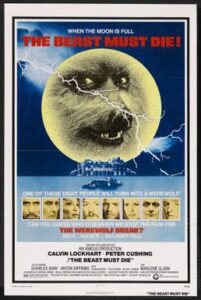
The Beast Must Die (1974)

Paul Annett’s The Beast Must Die is a low-budget horror movie with an irresistible premise.  It’s about a millionaire big-game hunter, played by Calvin Lockhart, determined to bag a werewolf.  He rigs up his country estate with CCTV cameras and motion sensors, procures a helicopter and invites five unsavoury people to visit for a few days convinced that one of them  is a werewolf.  Among those playing Lockhart’s house-guests and staff are Peter Cushing, Charles Gray, Anton Diffring and a youthful Michael Gambon.  Needless to say, there is a werewolf present, but it gradually turns the tables on Lockhart and his hi-tech equipment, whilst also bumping off the supporting cast.


The ideas is irresistible, as I said, but watching The Beast Must Die on TV as a kid was a frustrating experience.  Due to the inevitable budgetary constraints, Lockhart’s mansion house and grounds aren’t that hi-tech and the werewolf, when it appears, just looks like a big dog.  You’d think the sequence where the werewolf takes out a helicopter would be thrilling, but it isn’t.  Let’s remake this one with a proper budget, so that it’s as awesome as it sounded on paper in 1974.


From wikipedia.org / © Amicus Productions / British Lion Films


Juggernaut (1974)

The most underrated but, in my mind, the greatest of 1970s disaster movies, Richard Lester’s Juggernaut is mostly set on a British ocean liner stuck out in the stormy north Atlantic.  An anonymous call to the company that owns the liner informs it that half-a-dozen bombs have been stashed on board and they’ll explode unless a ransom is paid.  With weather conditions too severe to allow the ship’s crew and passengers to be evacuated, and the authorities forbidding the company to pay the ransom – which would be surrendering to terrorism – a team of bomb-disposal experts led by Fallon (Richard Harris) and his sidekick Charlie (David Hemmings) are sent to try and make the bombs safe.


Back on dry land, a policeman (Anthony Hopkins), whose family are among those trapped on the ship, tries to discover the bomber’s identity.  I don’t want to give away any spoilers, but when a twitchy Freddie Jones appears onscreen, you know who it is.


Juggernaut has a wonderful cast all round – not just the three ‘H’s of Harris, Hemmings and Hopkins, but also Omar Sharif, Ian Holm, Shirley Knight, Clifton James, Julian Glover and many more.  But the show is quietly stolen by Roy Kinnear, playing the ship’s entertainment officer, who has the thankless task of keeping the passengers’ spirits up when at any moment they could be blown to smithereens.  When he organises a fancy-dress party, one passenger appears dressed as the Grim Reaper and carrying a round black object with BOMB written on it.


As well as being massively suspenseful, the film offers social commentary.  The ship is called the Britannic and it’s not difficult to see Juggernaut as a meditation on the sorry plight of Britain in the mid-1970s, its days as a world power well behind it, being battered by global events it had no power over, such as the Oil Crisis.  In 2026, a decade after Brexit and during the chaotic era of Trump, a remake of Juggernaut would be both more poignant and more cutting.


You could also cast, in a Juggernaut remake, the sons of three of its original stars, now well established as actors in their own right: Jared Harris, Toby Jones and Rory Kinnear.  But it’d be fun to see them in roles different from those their dads played.  Kinnear as the policeman, Jones as the entertainment officer, Harris as the bomber?


© Two Roads / United Artists

Rab Foster has another river to cross


© Crimson Quill Quarterly


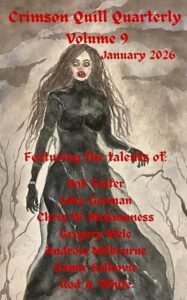
My sword-and-sorcery story The Voice of the River is now available to read in Volume 9 of the magazine Crimson Quill Quarterly, which was published at the end of last month.  As with all my fantasy fiction, it’s attributed to the pseudonym Rab Foster.


Someone once observed – it might have been Stephen King in his forward to his 1978 collection Night Shift – that a writer’s mind is like the grating on a storm drain.  Just as water flows in through a real grating and the bigger debris it carries gets stuck there, so a writer’s mental grating gets clogged with ideas, impressions and images while his or her life-experiences seep through it – all things that can inspire or be incorporated into stories.  The gunk trapped in my grating, from which I fashioned The Voice of the River, contained some disparate things indeed.


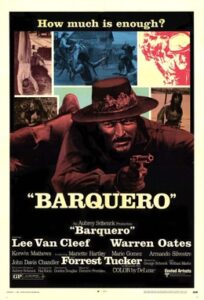
When I was 11 or 12 years old, I watched a western on late-night TV called Barquero (1970).  I assumed at the time it was a spaghetti western, because Lee Van Cleef was in it, but since then I’ve discovered it was an American movie directed by the prolific Gordon Douglas, whose best-remembered film is probably the giant-ants-on-the-loose sci-fi / horror classic Them! (1954).  The cast also included Warren Oates, Forest Tucker and Kerwin Matthews, so I should have twigged onto Barquero’s American-ness sooner.  Anyway, as Van Cleef’s character was a river ferryman, who gets caught up in shenanigans with some bandits, and as I’d recently been reading Robert E. Howard’s Conan the Barbarian stories, I suddenly had an idea: Wow, what if Conan retired from being a barbarian and took up a supposedly easier job, running a barge that ferried people across a river?


The notion sank to the back of my head and remained dormant for several decades – until last year, in fact, when I read Cormac McCarthy’s Outer Dark (1968), which contains an episode set on a river ferry.  That reminded me of my long-ago idea about ‘Conan the Ferryman’ – though I realised an unruly, adventure-loving character like Conan would balk at such a job.  So I modified the premise to ‘a sword-and-sorcery story involving a river ferry’.


Other debris stuck in that mental grating, also from movies, gave me inspiration for the story’s characters.  I’ve long been interested in the late Northern Irish character actor John Hallam, who appeared as hard men and coppers in a string of 1970s British crime movies – Villain (1971), The Offence (1972), Hennessey (1975) – though he’s maybe best-known for playing Luro, Brian Blessed’s winged sidekick in Flash Gordon (1980).  I visualised The Voice of the River’s main character as being like the tall, gangly, craggy Hallam and took his name, Halym, from the actor’s surname.  Meanwhile, both the appearance and personality of another character in the story were inspired by Peter Cushing in the role of Gustav Weil, the fanatical anti-hero of one of my favourite Hammer horror movies, 1972’s Twins of Evil.


© BBC / London Films


Finally, The Voice of the River pays tribute, sort of, to a scene from a TV show that’s always haunted me.  It comes at the end of the final episode of I, Claudius (1976), the BBC’s acclaimed adaptation of Robert Graves’s novels I, Claudius (1934) and Claudius the God (1935), when Claudius (Derek Jacobi), on his deathbed, has a conversation with a supernatural entity – the oracle the Sybil (Freda Dowie), who’s come to usher him to the River Styx and the underworld.  I love how, though one is flesh-and-blood and the other is ethereal, they speak as equals and both have seen so much of the world that they’re weary of it.  (“It all sounds depressingly familiar,” Claudius sighs after the Sybil has told him what will happen to Rome after his death. “Yes,” she replies, “isn’t it?”)  I tried to replicate a little of that magic in this newly-published story.


So, The Voice of the River owes its genesis to a 1970 Lee Van Cleef western, Cormac McCarthy, a tough Northern Irish character actor, some Hammer horror villainy by Peter Cushing and I, Claudius.  Not bad for a simple sword-and-sorcery tale.


One thing about Crimson Quill Quarterly that impresses me is the time and effort its editors spend on the editing process – including consulting and reconsulting the writers of its stories about suggested improvements – to ensure that the fiction in its volumes is in its best possible form when they go on sale.  Containing seven stirring tales of fantasy, magic and derring-do, its ninth edition can be purchased here.


© United Artists

Eggers’ banquet


© Focus Features / Universal Pictures


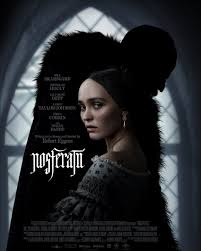
Robert Eggers’ Nosferatu (2024) has finally reached Singapore and a few days ago I watched it in the city-state’s excellent arthouse cinema The Projector.  This is Eggers’ reimagining of the 1922 silent horror-movie classic Nosferatu: A Symphony of Horror, which was directed by F.W. Murnau and based surreptitiously on Bram Stoker’s 1897 novel Dracula – though not so surreptitiously that Murnau and his producers escaped being sued by Stoker’s widow for breach of copyright.


The new Nosferatu has provoked some extreme responses.  The reaction has been as polarised as the weird relationship at the film’s core, wherein the beautiful, fragrant Ellen (Lily-Rose Depp) gets intimate with the gaunt, rotting, pustuled Count Orlok (Bill Skarsgård), the dreaded nosferatu – vampire – of the title.  A while back, I read a very positive review of it by Wendy Ide in the Guardian but was taken aback by the negativity of the some of the comments below the line: “A turd…” “Just awful…” “Absolutely terrible…” “Beyond boring, absolute crap…”


Well, I lean towards the Wendy Ide end of the Nosferatu debate because I thought the film was great.  At least, I thought so during the two hours and 12 minutes I sat before it in The Projector.  When my critical faculties started to function again – they’d been in a daze during the film itself – I became aware of a few flaws.  But generally, thanks to its atmosphere, its visuals, its sumptuous (if drained) palette and its overall craftsmanship, I found it the most impressive version of Stoker’s novel I’ve seen.  And yes, though it retains the original Nosferatu’s German setting and German character-names, this is essentially another retelling of Dracula.


Not that I’m saying it’s my favourite version of Dracula.  That accolade belongs to the 1958 Dracula made by Hammer Films, directed by Terence Fisher and starring Christopher Lee and Peter Cushing as Dracula and Van Helsing, which I saw when I was 13 years old.  13 is a formative age, when certain things tend to imprint themselves on your consciousness and become your favourites for life.  Also, I feel uncomfortable saying this Nosferatu is better than Murnau’s Nosferatu.  More than a century separates the two films, with huge differences in their historical contexts, themes, styles and filmmaking technology, and to me they’re like chalk and cheese.  That said, I noticed some of the flaws in Eggers’ Nosferatu when I did compare it with the old one.


© Focus Features / Universal Pictures


While we’re on the subject of comparisons, I should say I massively preferred this film to the 1992 Francis Ford Coppola one, Bram Stoker’s Dracula.  Despite having the peerless Gary Oldman in the title role, it was one of the few films I’ve come close to walking out of in a cinema.  I stayed the course in the hope it would improve in its later stages, but it didn’t.  Eggers’ Nosferatu is as operatic in its tone and as flamboyant in its visuals as Coppola’s Dracula.  However, while Coppola threw everything at the wall – restless camera movements, gimmicky special effects and make-up, over-the-top costumes, hammy performances – in the hope at least some of it would stick and hold the attentions of the raised-on-MTV teenagers he assumed would be the film’s audience, Eggers doesn’t merely show off In Nosferatu.  There are also moments of stillness and silence, of subtlety and holding back, of allowing atmosphere to ferment and ripen.  Actually, for my money, comparing it to Coppola’s Dracula is like comparing a moody and detail-laden work by a Dutch Master to a hyperactive kids’ cartoon.


Nosferatu’s storyline follows the Dracula template.  Young estate agent Thomas Hutter (the stand-in for Stoker’s Jonathan Harker, here played by Nicholas Hoult) is despatched from the fictional German port-city of Wisburg to a castle in Transylvania, where he has to supervise the paperwork for the purchase of a Wisburg mansion by the mysterious Transylvanian aristocrat Count Orlok.  Hutter’s sojourn in Orlok’s castle becomes a terrifying ordeal as he discovers the vampirical nature of his host.  He ends up plunging from one of its windows, into a river, while the Count sets off for Wisburg.


The Count’s chosen mode of travel is by ship – Romania, which Transylvania is part of now, borders on the Black Sea and Germany’s coast runs along the North and Baltic Seas, so this is evidently a long voyage – and he brings with him a horde of plague-carrying rats, which first destroy the ship’s crew and then start infecting the citizens of Wisburg when he reaches his destination.  These plague-rats are both a physical manifestation of Orlok’s evil and, presumably, a way of disguising his activities – with people dropping dead of plague left, right and centre, nobody’s going to notice a few blood-drained corpses.


But Orlok’s presence has been felt in Wisburg long before his arrival there.  Hutter’s wife Ellen – the Nosferatu equivalent of Stoker’s Mina Harker – has had an inexplicable psychic link to the ghoulish Count since her childhood and has already, in her dreams, pledged herself to him.  Also, Hutter’s boss Knock (Simon McBurney) has been communing with Orlok via some occult rituals.  Sending Hutter off to Transylvania was clearly part of a plan to relocate the vampire to the feeding-grounds of Wisburg.  Knock is the film’s version of Milo Renfield, the asylum-inmate who in Stoker’s novel becomes Dracula’s disciple.  Accordingly, Knock goes insane, gets incarcerated,  escapes and does Orlok’s bidding in the city.  Meanwhile, the thirsty Count makes a beeline for Ellen and those around her…


© Focus Features / Universal Pictures


Eggers’ cast-members acquit themselves well.  Lily-Rose Depp is extremely impressive in a role that requires her to be frightened, helpless, yearning, lascivious, possessed and defiant – often a couple of those things in one scene.  As a female foil to Dracula, she’s as good as Eva Green’s character Vanessa Ives in John Logan’s gothic-horror TV show Penny Dreadful (2014-16).  Likening someone to the mighty Eva Green is big praise from me.


Playing Jonathan Harker in a Dracula film is a thankless task.  You have to be bland and bloodless enough to add spice to the forthcoming dalliance between your missus and the Count, to suggest she’s a desperate 19th-century housewife who might actually welcome the vampire’s kiss.  But you also have to be interesting enough to make the audience root for you while you’re trapped in Castle Dracula.  And Nicholas Hoult does what’s required as the Harker-esque Hutter.  His restraint contrasts with the silent-movie acting of the original Hutter, Gustav von Wangenheim, who spent the early scenes of the 1922 Nosferatu grinning like a maniac.


On the other hand, Simon McBurney is unnervingly off-the-scale as Knock.  The 1922 Knock, Alexander Granach, was off-the-scale too, but McBurney’s one is allowed to slather himself in some full-on, 2024-stye blood and gore.  (He follows the hallowed Renfield tradition of chomping on small animals.)  If there’s a criticism, it’s that he doesn’t get enough to do.  More on that in a minute.


Ralph Ineson and Willem Dafoe respectively play a beleaguered Wisburg physician, Dr Sievers, and a Swiss expert on the occult, Professor Von Franz, who correspond to Stoker’s Dr Seward and Professor Van Helsing.  When Hutter gets back to Wisburg, they team up with him to put a stop to Count Orlok’s onslaught.  Willem Dafoe won’t replace Peter Cushing in my affections as the ultimate cinematic Van Helsing, but he’s delightful as the eccentric, cat-loving Von Franz.  Kind old gent though he is, Von Franz concocts a plan to destroy the vampire that may have tragic consequences for the people he’s supposed to be protecting.


© Focus Features / Universal Pictures


As for Bill Skarsgård and the film’s depiction of Count Orlok…  I can see why it’s been controversial.  Some have been disappointed that Eggers and Skarsgård didn’t replicate the iconic look of actor Max Schreck, who played the Count in 1922 as a bald, gaunt creature with rodentlike incisors, Spock ears and unseemly tufts of ear and eyebrow hair.  Indeed, in the first part of the film, we hardly see Orlok.  During the scenes set in his castle, he’s unsettlingly obscured by a haze of firelight, candlelight, shadows and darkness.  But when Eggers’ cameras finally reveal him, he’s an icky, mouldering thing, from the neck down at least, and he sports a monstrous and frankly distracting moustache.


I know Dracula had a moustache in the novel, and certain actors have played him with one, such as John Carradine in the Universal movies House of Frankenstein (1944) and House of Dracula (1945), and Christopher Lee in Jess Franco’s Count Dracula (1970).  But this must be the droopiest, shaggiest Drac-tache ever.


Maybe Eggers avoided the Max-Schreck look because he was sensitive to the accusations of antisemitism that dogged the old Nosferatu – that Schreck’s Orlok played on common German stereotypes and caricatures of Jewish people at the time.  Or maybe he just decided that look had become too much of a cliché.  As well as a slap-headed, pointy-eared vampire featuring in the previous remake of Nosferatu, Werner Herzog’s Nosferatu the Vampyre (1977), similar ones have appeared in the 1979 TV version of Stephen King’s Salem’s Lot, the original film version of What We Do In The Shadows (2014), and Guillermo del Toro’s Blade II (2002), where the leader of the baldy-vampires was played by Luke Goss.  (Yes… a Bros-feratu.)


© Focus Features / Universal Pictures


It’s also debatable if Eggers and Skarsgård made the right choice for Orlok’s loud, guttural voice, which booms out of the screen like the Voice of the Mysterons from Gerry Anderson’s TV show Captain Scarlet (1967-68) with a Slavic accent.  At least it’s different…  And Skarsgård put a lot of work into creating those vocals, training with an Icelandic opera singer and even studying Mongolian throat singing.  But I actually found Yorkshireman Ralph Ineson’s deep, gruff, north-of-England tones more menacing, even though his character, Dr Sievers, is one of the good guys.  (Sievers must have had a medical practice in Leeds before moving to Wisburg.)


Elsewhere, not a great deal happens during the second half of the film, though Dafoe’s charming performance keeps us engaged.  The latter part of the 1922 film is enlivened by a sub-plot involving Knock, who gets blamed for the mayhem in Wisburg after Orlok’s ship arrives.  Believing him to be the real vampire, the townspeople pursue him through the streets and the surrounding countryside, in scenes that are still impressive today – Knock perched like a gargoyle atop a vertiginous rooftop, for instance, or the mob mistaking a distant scarecrow for him, rushing at it and tearing it to pieces.  Eggers removes this sub-plot, however, and Knock (who in the original film didn’t even meet Orlok physically) serves as a conventional vampire’s acolyte.  If nothing else, this gives the Count someone to transport his coffin from the Wisburg docks to the mansion he’s bought.  In the 1922 Nosferatu, he suffered the indignity of having to carry the coffin himself.


So, the film drifts somewhat later on and I’m not fully convinced by its portrayal of Count Orlok.  But overall I really enjoyed Robert Eggers’ Nosferatu.  It’s a feast – an Eggers’ banquet – of gorgeousness, gloom, sensuality, repulsiveness, grue, humour, absurdity and tragedy.  It has fabulous visuals, entertaining performances and a smart balance between the aesthetically pleasing and the grotesquely yucky, meaning it should satisfy both cerebral arthouse types and horror-movie aficionados more interested in blood, gore and plague-rats.


And I can’t understand why some people disliked it so much.  This Nosferatu isn’t Dross-feratu, it’s the Absolute-boss-feratu.


© Focus Features / Universal Pictures

Nostalgic wallows 3: the Ritz Cinema, Enniskillen


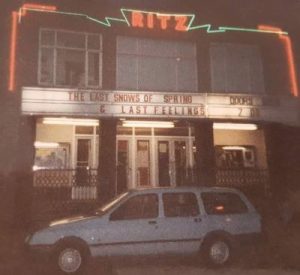
From Old Enniskillen / © Neil P. Reid


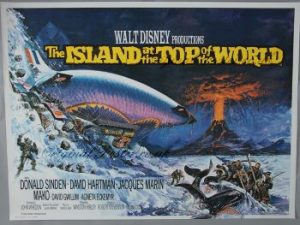
Two things inspired me to write this.  Firstly, I recently discovered that the Ritz Cinema in Enniskillen, Northern Ireland, began business in 1954, making 2024 the 70th anniversary of its opening.  Secondly, I discovered that the Walt Disney live-action movie The Island at the Top of the World, the first film I saw in the Ritz or in any cinema, was released in 1974 – a half-century ago.


The Ritz was located on Enniskillen’s Forthill Street, next to the Railway Hotel and opposite and along from the local ‘mart’, as agricultural markets are called in Ireland.  It struck me as a distinctive building during my visits to Enniskillen.  I usually accompanied my mum on shopping trips, though she didn’t bring me to traipse around the shops with her.  The town centre, with the main shops, was a control zone, which meant if you parked your car there you needed to leave someone sitting inside it.  The 1970s were the most violent years of Northern Ireland’s Troubles, with the province’s retailing areas under threat from car-bombs. The security forces reasoned that if parked cars had people inside them, they were unlikely to be rigged to explode.  So that was my function – to prove our car wouldn’t blow up while my mum was shopping.


Anyway, the Ritz’s façade was a two-storey rectangle of red brick, with three archways at street level opening into a narrow veranda before the building’s entrance-doors, and with three big windows above.  It was particularly striking when lit at night.  Its upper half acquired an Art Deco-like frame of illuminated red and white neon, with the name ‘Ritz’ emblazoned in red capitals at the very top.


From an early age I was eager to get inside this mysterious and exotic-looking building, but there were problems.  I lived in a village called Kilskeery that was nine miles from Enniskillen.  To see a film in the Ritz one evening, I’d have to persuade my parents to make an 18-mile round-trip – or 36 miles if they took me, returned home and then went to collect me again when the film was done.  And unfortunately my parents weren’t film enthusiasts.  My mum had last gone to the ‘pictures’, as they were called in those days, to see a Tarzan movie.  I suspect it’d been one of the late-1950s series starring Gordon Scott as the yodelling, loincloth-wearing, vine-swinging jungle man.  My dad, meanwhile, never hinted at when he’d last been in a cinema.  He didn’t call it going to the ‘pictures’ but to the ‘flicks’ – an even older term dating back to the 1920s, when silent, black-and-white films had flickered on the screens. So I assumed it’d been a long time ago indeed.


© Walt Disney Productions / Buena Vista Distribution


As I grew older and read the What’s On pages of the local newspaper, the Impartial Reporter, and saw the films that were showing at the Ritz, I waged a verbal war of attrition against my parents, begging them to let me go to the cinema to see such items as Bedknobs and Broomsticks (1971), The Poseidon Adventure (1972), The Golden Voyage of Sinbad (1973), Disney’s animated version of Robin Hood (1973) and Roger Moore’s first Bond move, Live and Let Die (1973).  Long before the Internet and YouTube, my only idea of what those films were like came from brief clips of them I’d seen on a kids’ TV quiz-show called Screen Test (1970-84), in which the contestants would watch excerpts from films, including newly-released ones, and then answer questions about them that tested their powers of observation and memory.  The clips, predictably, were gathered from the films’ most exciting bits, which convinced me they were equally exciting for their entire running times and were thus the best things ever.


In the mid-1970s, having seen a bit of The Island at the Top of the World on Screen Test, and read in the newspaper that it was about to play at the Ritz, I resumed my pleading – and, finally, my parents gave in.  Or rather, they talked my Uncle Robin into taking me to see it.  I got what I wanted, and my parents didn’t have to go anywhere near the Ritz themselves, so it was a win-win solution.  Except, of course, for Uncle Robin.  My mother’s younger brother, Robin was a kindly and infinitely patient man, who usually got saddled with having to amuse and entertain the kids at family get-togethers.  He had to listen to an immense amount of rubbish from me – I’d bombard him with questions like, “If Mytek the Mighty from the Valiant comic had a fight with the crew of the Seaview from Voyage to the Bottom of the Sea, who would win?”  (More than 30 years later, on the day of my mother’s funeral, I noticed my young niece and nephew instinctively making a beeline for him.  Nothing’s changed, I thought.)


The fateful evening arrived.  Uncle Robin escorted me into the Ritz and bought  us tickets for balcony seats.  And The Island at the Top of the World, a piece of undemanding hokum in which a crusty Englishman played by  Donald Sinden charters an airship, travels to the North Pole in search of his missing explorer son, and discovers a lost world heated by volcanic activity and populated by Vikings, became the first film I ever saw in a cinema.  Well, actually, it wasn’t the first film.  No, that honour belongs to a documentary, whose title I don’t remember, about Ghana.


In the 1970s, going to the cinema in the United Kingdom – Northern Ireland was and still is a part of the UK, though a contested part – was an endurance test.  The main film, the one you’d paid money to see, came at the end of what was innocuously called a ‘full supporting programme’.  This programme usually consisted of a couple of tedious documentaries, travelogues or ‘experimental’ short films, ‘quota-quickies’ that were apparently made and shoehorned into cinema schedules as a way of keeping British filmmaking personnel in employment and keeping the British film industry alive.  So, totally desperate to see some Donald-Sinden-in-an-airship-versus-Vikings action, I had to sit through a very dull documentary about modern-day Ghana.  Then came a weird dialogue-free short film about two boys tormenting each other on the roof of a block of flats, which even my mild-mannered Uncle Robin, normally reluctant to criticise, said was a load of rubbish.


With all that out of the way, surely now Donald Sinden and his airship would be swooping up to the North Pole to take on those pesky Vikings.  Right?  Wrong.  Presaged by the irritating, parping Pearl and Dean music, there followed a bunch of crackling, washed-out-looking commercials for eateries, car dealers and other businesses in Enniskillen – all, we were assured, just “yards from this cinema.”  At some point too, the houselights came on and we were exhorted to go down to the front and buy some confectionary from the usherette.  And furthermore,  there were the trailers for forthcoming films to get through…


© Hammer Films / Shaw Brothers


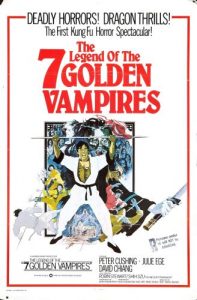
In fact, for me, the trailers were one of the evening’s highlights.  In 1970s Northern Ireland, at least, it was common practice for cinemas to show trailers for AA-rated (14 plus) and even X-rated  (18 plus) movies before screenings of ones deemed suitable for all ages, like the Disney production we’d come to see.  So, the Ritz aired a trailer for the Shaw Brothers / Hammer kung fu-horror film Legend of the Seven Golden Vampires, which was on the following week.  In this, Count Dracula relocates to 19th century China and takes over a cult of Chinese vampires.  Dracula’s old enemy Van Helsing and a team of local martial-arts experts have to hunt the bloodsuckers down.  I thought this trailer was the best two-and-a-half minutes of celluloid I’d laid eyes on.  I mean, kung fu fighting and vampires!  When veteran horror star Peter Cushing shouted to martial arts expert David Chan, “Strike at their hearts!”, I wanted to punch my hand in the air and shout, “YES!”


Even after that, it still wasn’t time for The Island at the Top of the World.  This was because Disney had released it as the second part of a double-bill, the first part being a 25-minute cartoon called Winnie the Pooh and Tigger Too.  But I found the Pooh cartoon entertaining.  And then, at long last, Donald Sinden boarded his airship and flew to the Viking-infested North Pole.  Like nearly all the films I saw in a cinema at an impressionable young age, I thought the movie was awesome – though no doubt if I watched Island now, it would seem a lot less good.  (In the 50 years since, I’ve avoided watching it again for that reason.)  I walked out of the Ritz that evening feeling exhilarated – though the stuff about Ghana and the weird kids on top of the block of flats left me feeling slightly bemused too.


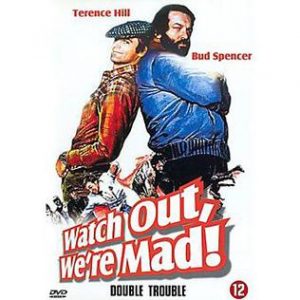
My second visit to the cinema was to see the 1975 re-release of The Seventh Voyage of Sinbad (1958), which featured monsters brought to life by the stop-motion-animation of special-effects wizard Ray Harryhausen.  It was a lot easier to persuade my parents to let me go to this one.  Noting that the Railway Hotel was next door to the Ritz, my Dad arranged to meet a farming mate (who’d done business earlier in the mart across the road) in the hotel bar.  He dropped me at the cinema entrance, had a chat and a drink with his mate, and picked me up afterwards.  In fact, Seventh Voyage was also part of a double-bill – the other half being the Italian comedy Watch Out, We’re Mad!, in which comic duo Bud Spencer and Terence Hill (real names Carlo Pedersoli and Mario Girotti) defended a funfair and its staff against some Mafia-type gangsters.  This involved much comic fisticuffs and slapstick violence.  It hardly constituted Kubrickian cinematic brilliance, but it seemed to my 10-year-old self the best movie ever.  Also, though I’d watched Ray Harryhausen’s giant animated creatures on TV before, it was epic seeing  them in Seventh Voyage on a big screen.  So, I left the Ritz feeling well-satisfied that evening too.


© Morningside Productions / Columbia Pictures

© Columbia Pictures


To make things even better, the trailers that evening included ones for Norman Jewison’s essay in science-fictional sporting violence  Rollerball (1975), and Gary Sherman’s cannibalistic-mutants-roaming-the-London-Underground horror classic Death Line (1972).


Another memorable Ritz visit came a year later when Steven Spielberg’s Jaws (1975) surfaced at the cinema.  For this, I was again entrusted to Uncle Robin.  When we got there, we were astonished to see a queue snaking back from the entrance and along Forthill Street.  “I’ve never seen a queue at the Ritz before!” marvelled my uncle.  I had a sense that something seismic was happening – which was true, for Jaws marked the advent of huge, crowd-pleasing blockbusters and special-effects-laden franchises, plus the arrival of Spielberg, George Lucas and a generation of young filmmakers happy to give the public what they wanted, big-budget-style.  It would eventually usher in the era of the multiplex cinema, which consigned the Ritz and similar small-scale cinemas to the dustbin, but more on that later.


Jaws was the first movie I saw in a cinema crammed to the bulwarks with people.  Everyone was entranced by the events on the screen.  As the communal sense of excitement heightened, their reactions became increasingly dramatic.   And with Jaws, you had John Williams’ minimalist but brilliant theme music cranking up the audience’s feeling of apprehension and dread too: Duh… Duh!  Duh… Duh!  Duh, duh, duh, duh…


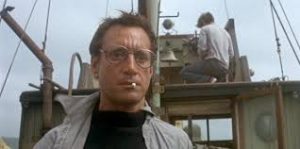
When the head of the unfortunate fisherman Ben Gardner dropped into view under his wrecked boat, squishily minus an eye, the auditorium filled with a whooshing noise that sounded like a great gust of wind – and then, all that breath inhaled, it was released again as a cacophony of screams.  Later, when the shark popped his big face out of the water in front of the unsuspecting Chief Brody (Roy Scheider), prompting the famous quip, “You’re gonna need a bigger boat,” there was another chorus  of screams – though this time tempered with laughter, because the moment was funny as well as scary.  I know it has a lot to do with me being 11 years old at the time, but I can’t think of another cinematic experience in my life as exciting or visceral.


© Zanuck/Brown Company / Universal Pictures


My relationship with the Ritz ended soon afterwards, for in February 1977 my family moved from Northern Ireland to Scotland, settling close to the town of Peebles in the Scottish Borders.  In fact, we lived only half-a-mile out of the town, and because Peebles High Street was home to a cinema called the Playhouse, I was suddenly able to see new films much more often.  Tragically, this happy state of affairs lasted just seven months, for in September that same year the Playhouse closed down.  After that, the nearest cinema – also called the Playhouse – was in the town of Penicuik ten miles north of Peebles.  Hence, suddenly, my filmgoing situation became even worse than it’d been in Northern Ireland.


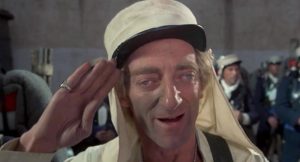
I occasionally returned to Northern Ireland to see relatives in the hinterlands of Enniskillen, so I got a few further opportunities to pop into the Ritz.  For example, I remember going to see Marty Feldman‘s spoof of Foreign Legion movies, The Last Remake of Beau Geste (1977).  I mainly remember it because a woman sitting in the row behind me would erupt into ear-splittingly loud, hysterical laughter every time the bug-eyed Feldman – who suffered from Graves’ ophthalmopathy – appeared onscreen.  That was very weird.


© Universal Pictures


During the 1970s and 1980s, TV ownership, then the invention of video cassettes and VCRs, and then the coming of multiplex cinemas – which started in 1985 with the opening of Milton Keynes’ ten-screen The Point – all contributed to the demise of small-town, single-screen cinemas in the UK.  The Ritz lasted longer than most, not shutting its doors until 1992.


Remarkably, the building – pitifully boarded up – still stands.  Or at least, it still did in 2022, which is when the image of it currently on Google Maps was taken.  The also-derelict Railway Hotel next door, where my Dad hung out after he’d dropped me off to see The Seventh Voyage of Sinbad, looks even more pitiful, closed off behind corrugated iron.  They’re monuments – melancholy ones – to the days when taking a seat in a cinema auditorium seemed one of the most thrilling moments in my life.


And when I had Donald Sinden to look forward to, voyaging in an airship to the North Pole to take on Vikings, how could it not be thrilling?


© Walt Disney Productions / Buena Vista Distribution

One Donald I’m sad to see go


© Avala Film / Metro-Goldwyn-Mayer


It’s often said you don’t appreciate the value of something until after it’s gone.  I felt like that last week on hearing of the death of the great Canadian actor Donald Sutherland.  If someone had asked me to list my all-time favourite actors, I wouldn’t have thought of including Sutherland.  Yet when he passed away at the age of 88 – having kept working in film and TV until last year – it suddenly struck me how much I was going to miss him.


Sutherland was an actor who could inhabit a range of personalities and project many different moods and emotions, yet whom you always recognised as, basically, himself.  His characters might be heroic, dignified, fatherly, tragic, eccentric, sinister, venal, slow-witted, juvenile, gormless or demented – yet you always knew you were watching Donald Sutherland.  Whoever he played, he retained that unique quality of Donald Sutherland-ness.


Born in St John, New Brunswick, Sutherland graduated from Victoria University with an interesting-sounding degree in Engineering and Drama, then relocated to Britain in 1957 and studied at the London Academy of Music and Dramatic Art.  A few years later, he found his way into Europe’s then-flourishing horror-movie industry.  He appeared in the monochrome Italian-French chiller Castle of the Living Dead (1964), starring Christopher Lee, directed by Warren Kiefer, and with a 20-year-old Michael Reeves, who four years later would make 1968’s masterly Witchfinder General, working as assistant director.  No doubt for budgetary reasons, Sutherland was cast in three roles, most amusingly in drag, as a witch.  He played a good-natured simpleton in Hammer Films’ Fanatic (1965), a blend of the low-key psychological thrillers the studio made when it wasn’t cranking out full-blooded gothic-horror melodramas and the fashionable 1960s sub-genre of ‘hagsploitation’ – the hag here being a dangerous religious nutcase played by Tallulah Bankhead. If the cast wasn’t interesting enough with Sutherland and Bankhead, it also included Stephanie Powers, Yootha Joyce and Peter Vaughan, future stars of TV shows Hart to Hart (1979-84), George and Mildred (1976-79) and Porridge (1974-77) respectively.


© Amicus Productions / Paramount Pictures


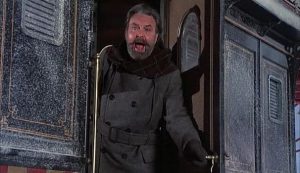
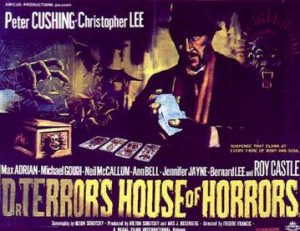
The best remembered of Sutherland’s early horror films is Dr Terror’s House of Horrors (1965), directed by Freddie Francis and produced by Milton Subotsky and Max J. Rosenberg – the first of seven anthology horror movies that Subotsky and Rosenberg’s British-based Amicus Productions would specialise in.  To be honest, I don’t think the film’s five stories are up to much, but the framing device, wherein five night-time travellers find themselves sharing a train compartment with the mysterious Dr Shreck (Peter Cushing), who uses Tarot cards to foretell each man’s future, is wonderfully atmospheric.  Dr Terror also has a fascinating cast.  In addition to Sutherland and Cushing, there’s Christopher Lee (again) and another horror-movie veteran, Michael Gough; trumpeter, tap-dancer and TV presenter Roy Castle; disc jockey Alan ‘Fluff’ Freeman; and the original M from the James Bond films, Bernard Lee.  Sutherland’s segment even has a fleeting appearance by his fellow Canadian Al Mulock, who along with Woody Strode and Jack Elam was gunned down by Charles Bronson in the astonishing opening sequence of Sergio Leone’s masterpiece Once Upon a Time in the West (1968).


Sutherland also featured in 1960s British TV, most memorably in 1967 when he played a villain in an episode of the surreal and stylish espionage series The Avengers (1961-69) called The Superlative Seven.  This has Patrick Macnee’s debonair John Steed being invited to a bizarre fancy-dress party on board a private jet plane, which, after it takes off, is discovered to be remote-controlled.  Eventually, the plane lands Steed and the other, equally-baffled guests on a seemingly deserted island.  There, the party start to be murdered one by one.  As well as riffing on Agatha Christie’s And Then There Were None (1939), the episode has a science-fictional sub-plot where Sutherland attempts to create a race of super-soldiers.  And the guest cast includes Charlotte Rampling and Brian Blessed before they became famous too.


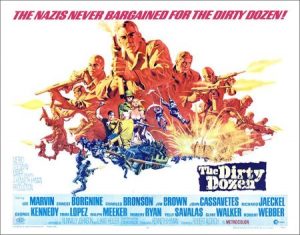
That same year, Sutherland turned up in Robert Aldrich’s loud, raucous and violent war movie The Dirty Dozen, about 12 convicts trained by the US Army and sent to France on a suicide mission against the Wehrmacht prior to the D-Day Landings   The movie contained so many famous actors playing characters who weren’t among the 12 convicts – Lee Marvin, Ernest Borgnine, Richard Jaeckel, George Kennedy, Ralph Meeker and Robert Ryan – that, over the years, folk have become confused about who actually played the Dirty Dozen.  I’ve even heard a few people declare that, with Sutherland dead, that’s all the Dozen gone.  Well, no – because actors Stuart Cooper and Colin Maitland, who played two more of the Dozen, are still on the go.


© Kenneth Hyman Productions / Metro-Goldwyn-Mayer


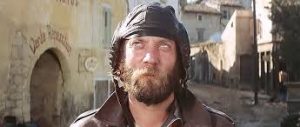
The Dirty Dozen’s success led to Sutherland being cast in more World War II movies.  Most notable of these was 1970’s Kelly’s Heroes, in which Clint Eastwood’s Private Kelly, a soldier in an American platoon in 1944 France, learns there’s a fortune in Nazi gold stashed in a bank behind enemy lines and persuades his fellow soldiers, including Sutherland and Telly Savalas, to help him steal it.  Sutherland’s character is a loopy tank commander called Oddball who, with a blatant disregard for historical authenticity, was added to the script to satirise the then-ubiquitous hippy movement.  He says spaced-out things like, “Don’t hit me with those negative waves so early in the morning!” or, “Woof, woof, woof!  That’s my other dog imitation.”  I suspect that for people my age – well, males my age – in the UK, Oddball is the character we’ll remember Sutherland best as, because British TV seemed to show Kelly’s Heroes every other week when we were kids.


Sutherland was also in 1976’s The Eagle Has Landed, playing an IRA man who aids some German commandoes, headed by that well-known German, Michael Caine, on a mission in England to assassinate Winston Churchill.  Of Sutherland’s performance, the best that can said is that there are non-Irish actors who’ve played Irishmen with worse Irish accents.


Another war movie was M*A*S*H (1970), Robert Altman’s scabrous black comedy set during the 1950s conflict in Korea, in which Sutherland played insolent and rebellious US Army surgeon Hawkeye Pierce.  The film won the Palme d’Or at the Cannes Film Festival, was the third-most popular movie of its year and gave Sutherland iconic status.  I have to say that, though I like Robert Altman’s movies generally, M*A*S*H has not aged well.  Today, much of its humour feels juvenile and mean-spirited, especially when directed towards Sally Kellerman’s Major Houlihan character, rather than ‘anti-establishment’, which it was hailed as at the time.  Altman famously loathed the M*A*S*H TV show that was spun off from his movie and ran from 1972 to 1983, but I suspect time has been kinder to its gentler brand of humour.


© Casey Productions / Eldorado Productions / British Lion Films


Afterwards, Sutherland was in prestigious films like Alan J. Pakula’s Klute (1971), Fellini’s Casanova (1975) and Bernard Bertolucci’s 1900 (1975) – none of which I’ve seen.  But it’s in Nicolas Roeg’s masterly horror film Don’t Look Now (1973) that, of his movies I have seen, I believe he does his best work.  Don’t Look Now is an adaptation of a Daphne du Maurier story in which a grief-stricken couple try to get over the death of their daughter by immersing themselves in a restoration project in Venice – only to be haunted by sightings of a small figure in a red coat who at least resembles their deceased daughter.  The film has two set-pieces at its beginning and end whose emotional impact has rarely been matched in the horror genre – Sutherland features heavily in both.  Films about the supernatural, despite focusing on death, memories of the departed and the possibility of an afterlife, don’t usually capture the feeling of grief that well.  But the pained, brittle performances by Sutherland and his co-star Julie Christie convey it with extreme poignancy.  With their performances augmented by Nicolas Roeg’s camerawork, visual imagery and memorably-elliptical approach to storytelling, Don’t Look Now is a film for the ages.


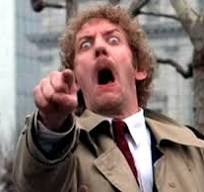
Though for me Don’t Look Now gives Sutherland his best role, it’s Philip Kaufman’s Invasion of the Body Snatchers (1978) that gives him his best image.  This is Hollywood’s second adaptation of Jack Finney’s novel The Body Snatchers (1955), wherein a low-key invasion of earth is staged by alien pod-people who gradually replace all the real people.  The image in question, now a popular meme, comes in the final moments when Sutherland, the film’s hero, reacts to another character by pointing at her, adopting a grotesque, gawking expression and emitting an inhuman squeal.  This tells us the pod-people have now replaced him too.  The original Body Snatchers movie, made by Don Siegel in 1956, was set in small-town America, but Kaufman’s version audaciously shifts the action to San Francisco, and the result is just as good.  Actually, I was going to say filmmakers have treated Finney’s novel well, for in 1993 Abel Ferrara directed another version that was decent too.  But then I remembered there was a fourth version made in 2007 with Nicole Kidman and Daniel Craig, and it was rubbish.


© Solofilm / United Artists


As he grew older, Sutherland’s work in films and television inevitably saw him shift from being a leading man to being a grizzled character actor and then an esteemed ‘elder-statesman’ guest-star.  His movies included star-laden Oscar-bait (1980’s Ordinary People), daft Alistair Maclean adaptations (1979’s Bear Island), slightly less daft Ken Follett adaptations (1981’s Eye of the Needle), overripe John Grisham adaptations (1996’s A Time to Kill), overstuffed British flops (1985’s Revolution), Sylvester Stallone movies (1989’s Lock Up), Clint Eastwood movies (2000’s Space Cowboys), paranoid Oliver Stone conspiracy thrillers (1991’s JFK), preposterous Roland Emmerich disaster movies (2022’s Moonfall) and Emma Thompson-scripted Jane Austen costume-dramas (2005’s Pride and Prejudice).


He made three films with his son Kiefer – who, when I first saw him onscreen in the 1980s, made me think, “Wow, he looks just like his dad!” – the afore-mentioned A Time to Kill, plus 1983’s Max Dugan Returns and 2015’s Forsaken.  And he featured in four Hunger Games movies (2012-15), playing Snow, the despot running the future North American territory of Panem.  I haven’t seen any of the Hunger Games series, but a future dystopian America ruled by a president called Donald sounds terrifyingly prescient.


Ironically, in the 1990s, Sutherland returned to his 1960s roots and started making horror movies again.  He was in Buffy the Vampire Slayer (1992), a clodhopping film that a few years later led to a sublime TV show; 1994’s The Puppet Masters, based on a short story by Robert Heinlein, which was a low-budget but not unenjoyable retread of Invasion of the Body Snatchers; 1998’s police-occult thriller Fallen, in which he rubbed shoulders with Denzel Washington and John Goodman; and 1999’s Virus, an Alien rip-off set on board a ship, in which Sutherland’s over-the-top villain is one of the few redeeming features – his old seadog is so sea-doggish he only lacks a pegleg and a parrot on his shoulder.  Horror-adjacent is his role as Ronald Bartel in Ron Howard’s Backdraft (1991).  He’s an incarcerated pyromaniac whom William Baldwin and Robert De Niro’s firemen-investigators turn to for help when they’re trying to catch the person responsible for a series of deadly, fiery arson attacks.  Thus, he’s the Hannibal Lector of the fire-raising world.


However, while I write this, the Donald Sutherland performance that keeps coming to mind – accompanied by the lovely, plaintive song that accompanies it – is the one he essayed in the video for Kate Bush’s single Cloudbusting (1985).  He’s a kindly inventor who creates a rainmaking machine, only to be taken away by some sinister men in suits, who obviously believe there are things man was not meant to know.  This rather vitiates the song’s optimistic lyric, “Ooh, I just know that something good is gonna happen…”  It’s left for Sutherland’s son, played by Bush, to complete his work.  I visited the video on YouTube the other day and was touched to discover how the comments below were packed with people paying tribute to Sutherland.


© EMI

Cinematic heroines 2: Sheila Keith


© Peter Walker (Heritage) Ltd


Every year, March is designated ‘Women in Horror Month’.  This is when fans of horror fiction, cinema, television, comics, games, etc., are encouraged “to learn about and showcase the underrepresented work of women in the horror industries. Whether they are on the screen, behind the scenes, or contributing in their other various artistic ways, it is clear that women love, appreciate, and contribute to the horror genre.”


As an occasional writer of horror fiction, and just before the month ends, here’s my contribution.  I pay tribute to a lady who, during a unique run of movies, did much to give me nightmares – or indeed, frightmares – during my impressionable youth.


Scottish actress Sheila Keith had a remarkable dual career.  Though not a household name, she was certainly a familiar face – with a familiar, haughty, often-disapproving voice – to a couple of generations of British TV viewers.  This was because of her appearances as prim ladies of a certain age, frequently nuns, or aristocrats with double-barrelled names, in cosy situation comedies like The Liver Birds (1969-78), Some Mothers do ‘Ave ‘Em (1973-78), Rings on their Fingers (1978-80), Bless Me Father (1978-81), Agony (1979-81), The Other ‘Arf (1980-84), Never The Twain (1981-91), A Fine Romance (1981-84) and The Brittas Empire (1991-97).


On top of that, she put in time in ITV’s long-running but much-derided soap opera Crossroads (1964-88), where she played cook Betty Cornet, toiling in the Crossroads Motel kitchen for 31 episodes in 1967.  Poor Betty perished when workmen extending the motel’s premises accidently uncovered and set off a World War II bomb.


The second, less conventional strand of Keith’s resumé came from her involvement in a series of movies made by British director Pete Walker.  Having started off making sex-comedies like 1969’s School for Sex and 1970’s Cool It Carol!, Walker hit his stride making horror movies during the 1970s, with Keith as a regular collaborator.  A combination of exploitation cinema and social commentary, these were memorably grim – serving up (for the time) disturbingly graphic violence, attacking institutions like the judiciary and the Catholic church, and generally showing how depressingly grotty life was in 1970s Britain.  And Keith’s performances, as ladies doing unspeakable things whilst maintaining the veneer of snootiness that’d served her well in her TV sitcom work, made the films even more memorable.


The first Keith-Walker collaboration was 1974’s House of Whipcord (1974), wherein a young woman called Ann-Marie (Penny Irving) suffers some spectacularly bad luck.  Firstly, she discovers that a nude photograph of her has been put on public display.  Then the nice young man who befriends her (Robert Tayman, who’d recently played the villain in the 1971 Hammer horror flick Vampire Circus), and takes her to his country estate to escape the scandal, turns out to be a ‘honey-trap‘.  His parents are a demented anti-permissive-society campaigner called Margaret Wakehurst (Barbara Markham) and a reactionary, but now blind and senile judge called Justice Bailey (Patrick Barr).  They’ve turned the country house into a secret, illegal prison where women they deem to have ‘fallen’ are brutally punished.  And Ann-Marie, they’ve decided, has fallen.


© Peter Walker (Heritage) Ltd


The remainder of the film is basically a race against time, with Ann-Marie’s friends (Ray Brooks and Ann Michelle) trying to track her down and rescue her, before her repeated attempts to escape the prison incur the ultimate penalty – execution.  You might not want to bet your life savings on there being a happy ending.


Though not the lead villainess, Keith is memorable as Walker, one of Wakehurst and Bailey’s prison wardens.  Walker may not be doing the job just for the money and from a misguided sense of justice — seeing the young inmates flogged seems to turn her on.  Meanwhile, the other Walker, Pete, and his scriptwriter David McGillivray make it clear who their target is in a sarcastic opening-credits statement: “This film is dedicated to those who are disturbed by today’s lax moral codes and who eagerly await the return of corporal and capital punishment…”  They may have had in mind the Nationwide Festival of Light, in vogue at the time, described by Wikipedia as a ‘grassroots movement formed by British Christians concerned about the rise of the permissive society and social changes in English society by the late 1960s’ and whose supporters included Lord Longford, Malcolm Muggeridge, Cliff Richard and the inevitable Mary Whitehouse.


A year later, Keith got a bigger role in House of Mortal Sin (1975), which this time took a swipe at organised religion and the Catholic church in particular.  This had a slightly starrier cast too.  Stephanie Beacham and Susan Penhaligon play Vanessa and Jenny, sisters who, through their friendship with a well-meaning young priest (Norman Eshley, later to find fame as snobby neighbour Jeffrey Fourmile in the 1976-79 TV sitcom George and Mildred), unwittingly enter the orbit of the deranged Father Xavier Meldrum (Anthony Sharp).  Not only is Meldrum a stalker who’s soon targeting Jenny, but he’s a homicidal maniac who uses some appropriately ecclesiastical methods to murder people – bludgeoning them with incense-burners, feeding them poisonous communion wafers, throttling them with rosary beads.


Keith plays Meldrum’s housekeeper Miss Brabazon, who turns a blind eye – literally a blind eye, because she’s missing one – to the old monster’s crimes due to her love for him.  She has responsibility for looking after Meldrum’s extremely elderly and ailing mother, and particularly gruelling are the scenes where she abuses her charge, blaming her for making her son enter the priesthood and a lifetime of celibacy.  Again, don’t expect a happy ending.


© Peter Walker (Heritage) Ltd / Columbia Pictures


However, it’s the film Keith made for Walker between the two Houses, Whipcord and Mortal Sin, that saw her at her terrifying best.  In Frightmare (1974), she plays Dorothy Yates, a character who spends the film shifting gears between being a confused, pathetic, middle-aged housewife and a demented brain-eating cannibal.  In the late 1950s Dorothy and her husband Edmund (Rupert Davies) were placed in an asylum after a string of murders – though innocent, such was Edmund’s love for Dorothy that he allowed himself to be incarcerated alongside her.  Dorothy’s last 1950s victim, incidentally, is played by Andrew Sachs, soon to become a star as Manuel, John Cleese’s Spanish waiter / punchbag in Fawlty Towers (1975-79).


Released from the mental institution in the mid-1970s, the couple become a headache for Jackie (Deborah Fairfax), Edmund’s daughter from a previous marriage.  She has to supply her father and stepmum, who’ve holed up in a remote farmhouse, with parcels of sheep’s brains in an attempt to satisfy Dorothy’s cravings.  Also, she’s keen to keep her tearaway half-sister Debbie (Kim Butcher), Edmund and Dorothy’s daughter, away from her parents for obvious reasons.  Things don’t work out well.  Dorothy is soon demanding brains of the human variety, lures people into her parlour (full of chintzy ornaments and cups of tea) for Tarot card readings, kills them and eats them.  Meanwhile, there are disturbing signs that her cannibalistic urges may be running in the family.


Frightmare climaxes with some nasty stuff involving a Black-and-Decker drill, but nothing quite compares to the image of Dorothy that assails Jackie during a dream – her mad stepmother stalks up to her, white-faced and grinning, chewing brains from a red-soaked parcel, blood oozing down her chin.  In its less sensational, buttoned-up way, Frightmare is the English Home Counties’ answer to The Texas Chainsaw Massacre, which was released the same year.


© Peter Walker (Heritage) Ltd / Lone Star Pictures


Walker cast her in two later horror movies, 1978’s The Comeback and 1982’s House of the Long Shadows, but neither was to the standard of their earlier work.  The Comeback has an interesting idea – an elderly couple (one of whom is Keith) take gruesome revenge on a faded rock star whom they believe induced their daughter to commit suicide.  Confronting the rocker at the end, Keith admonishes him in a hate-filled voice for his decadence, his depravity and even his ‘foul contortions’ onstage.  This would have worked if the rock star had been played by someone properly decadent like Mick Jagger or Iggy Pop but, laughably, he’s played by Jack Jones, housewives’ favourite and singer of the Love Boat theme (1977).  Jones’s performance was likened by one critic to that of a ‘hibernating bear’.


Some of the other casting is distracting too.  Jones’s manager is played by David Doyle, who at the time was a regular in the popular American TV show Charlie’s Angels (1976-81) – wow, I thought the moment he appeared, it’s Bosley!  Meanwhile, in the role of Keith’s husband is Bill Owen, famous in Britain for playing the wellie-wearing, ferret-loving Compo in the BBC’s Last of the Summer Wine, which ran from 1973 to 2010 and became the longest-running TV sitcom in the world.  Just to round out the weirdness of The Comeback’s cast, Jack Jones, Bosley and Compo are joined by Pamela Stephenson, soon to hit it big as a comedienne in the BBC’s satirical sketch-show Not the Nine O’Clock News (1979-82).


You couldn’t nitpick about the cast of House of the Long Shadows, the last of Keith and Walker’s movies and, indeed, the last film Walker made.  For horror fans, it’s awesome – horror legends Vincent Price, Christopher Lee, Peter Cushing and (from an earlier period of macabre cinema) John Carradine.  Long Shadows tells the story of a hotshot young author (Desi Arnaz Jr) who makes a bet with his publisher (Richard Todd) that he can write a novel in 24 hours in a suitably-inspiring environment – a creepy, deserted mansion house in Wales.  However, Arnaz Jr soon discovers that the mansion isn’t deserted at all.  It’s still home to a decrepit lord (Carradine) and his sons (Price and Cushing) and daughter (Keith).  Complicating matters is Lee as a pompous businessman, turning up to declare his intention to buy the property, and then the revelation that there’s a madman on the loose, killing the house’s occupants one by one.


House of the Long Shadows is a disappointment, which is hardly a surprise considering the disparate elements involved in its making.  Price, Lee and Cushing had become stars in the 1950s and 1960s working for studios like Hammer Films and American International Pictures, making films that were colourful, gothic-horror costume-dramas – for example, instalments in the studios’ Dracula, Frankenstein and Edgar Allan Poe series.  Made later, in the 1970s, Walker’s brutal, contemporary-set horror films were obviously a reaction against these.  Similarly, his scriptwriter here, Michael Armstrong, had directed gory films like The Haunted House of Horror (1969) and Mark of the Devil (1970), which definitely weren’t of the gothic fairy-tale school either.  Armstrong’s script, though, was based on a very old novel and play, Seven Keys to Baldpate, both from 1913.  And the producers were none other than Menahem Golan and Yoram Globus of that very 1980s-esque outfit, Cannon Films.  Thus, the stars, the director and scriptwriter, the source material and the producers belonged to wildly-different eras.  Long Shadows unsurprisingly doesn’t gel.


© Cannon Film Distributors


It doesn’t help that Armstrong’s script ends with a couple of twists that don’t so much amaze the audience with their cleverness as make them groan at their corniness.  But still, it’s a pleasure to see Price, Lee, Cushing and Carradine together, and Keith has fun playing an eccentric who fancies herself as a singer, even though she’s painfully tone-deaf.  Small wonder she’s eventually done in with a length of piano wire.


Thereafter, Keith’s film appearances were few, although she turned up in the 1986 John Cleese movie Clockwise.  She also kept busy into the 1990s with TV appearances.  Fittingly, her last role – three years before her death in 2004 – was in an episode of the 2001 spoof anthology show Dr Terrible’s House of Horrible, written by Graham Duff and Steve Coogan and designed as an affectionate piss-take of old British horror movies from the 1950s, 1960s and 1970s.  Though handsomely staged, it wasn’t particularly good.  However, it was nice to see Keith appear in an episode called And Now the Fearing…, playing a gypsy woman who crosses swords with an architect (Alexander Armstrong) who wants to clear her encampment to make way for a new development.  Keith, predictably, draws on some old gypsy magic and has fun turning the tables on the smug, smarmy Armstrong.


The actresses who found fame in British horror movies tended to be of the young, sexy, ‘starlet’ variety – Ingrid Pitt, Caroline Munro, Linda Hayden and so on.  Sheila Keith was already in her fifties when she arrived on the scene and didn’t have youth or sexiness on her side.  Rather, splendidly playing a succession of harridans who were psychotic, sadistic, embittered and / or pitiful, she represented grey power.  With power tools.


© Peter Walker (Heritage) Ltd

The alternative Christmas movie list


© Pan-Canadian Film Distributors


The cinema at Singapore’s ArtScience Museum is currently showing a season of Christmas-themed films so a few days ago my partner and I visited it to catch a showing of John McTiernan’s action classic Die Hard (1987).  My partner hadn’t seen it before and I’d only seen it on a small screen back in the prehistoric days of Betamax video cassettes.


I know every festive season an argument erupts on social media about whether Die Hard is or isn’t a Christmas movie, but seeing it again in 2022 I have to say it seems very Christmassy, much more than I remembered.  It’s got Christmas trees, Christmas decorations, Christmas presents, Christmas carols and Christmas Santa hats – one gets planted cheekily on the corpse of a dead terrorist which Bruce Willis’s John McClane sends down in a lift to taunt the remaining bad guys.  There’s also a limousine stereo playing Run DMC’s Christmas in Hollis (1987) – ”Don’t you have any Christmas music?” McClane grumbles from the back seat.  And Die Hard has Alan Rickman as the villainous and sublimely withering Hans Gruber, who’s a sort of anti-Santa Claus.  Gruber’s intonation is priceless as he reads the message McClane has written in blood on the dead terrorist’s chest: “Now I have a machine gun.  Ho… ho… ho.”


From amazon.com / © 20th Century Fox


However, I tend not to be aficionado of Christmas movies, for two reasons.  Firstly, the way that Christmas is presented in these movies has never corresponded to Christmas as I know it.  For example, as a kid, when I heard Bing Crosby crooning White Christmas in the 1954 film of the same name and then looked out of my window in Scotland at the late-December weather, what I saw wasn’t Bing’s white, fluffy snow-scape.   What I saw was usually a charcoal-grey sky, leaking charcoal-grey rain down onto a charcoal-grey terrain.


Secondly, Christmas movies are, nearly without exception, rubbish.  Most of them eschew anything resembling quality and dial the schmaltz and saccharine up to 11 and assume that’ll satisfy audiences instead – which unfortunately, in many cases, it does.  The biggest offender in my opinion is Richard Curtis’s Love, Actually (2003), which I prefer to think of as Shite, Actually.  That thing wouldn’t have got anywhere near being a good film even if they’d rewritten the Alan Rickman character and allowed him to start killing people.


Still, there’s a small handful of what are officially deemed ‘Christmas movies’ that I like.  Die Hard is one and others include The Snowman (1982), Gremlins (1986), The Nightmare Before Christmas (1993), Rare Exports (2010) and The Muppet Christmas Carol (1992) – any film that has Gonzo the Great playing Charles Dickens is fine by me.


There’s also a number of movies that aren’t officially counted as Christmas movies, even though they take place during the festive season, that I like too.  No doubt they aren’t included in the accepted Christmas canon because they’re dark in tone and don’t conform to the Richard Curtis Law of Christmas-Movie Pap and Sentimentality.  Anyway, it’s in honour of those non-conforming films that I offer the following – my list of favourite alternative Christmas movies.


© Embassy International Pictures / Universal Pictures


Brazil (1985)

Terry Gilliam’s take on George Orwell’s 1984 (1949) has so much going on thematically and visually that it’s easy to forget it’s set at Christmas-time.  But while we try to get our heads around the workings of the dystopian society depicted in Brazil – where labyrinthine bureaucratic systems and labyrinthine plumbing systems go wrong with equal regularity, one with deadly results and the other with disgustingly gloopy ones – we’re assailed by Yuletide trappings: Christmas parties, presents, trees, music.  There’s a family reading Dickens’ A Christmas Carol (1843) – just before a terrifying squad of secret-police goons come crashing into their home, wrongly sent by a bureaucratic mistake involving a fly getting stuck inside a typewriter.  There are Christmas-decorated department stores that become hellholes – even more hellish than normal at this time of year – when terrorist bombs explode.


On a more symbolic level, the fate that befalls Robert DeNiro’s Harry Tuttle character – surreally engulfed in a mass of paper – suggests the horror of frantic, last-minute Christmas present-wrapping, when you begin to fear the unruly, recalcitrant paper is going to swallow you up.  And, late on, when Brazil’s everyman hero Sam (Jonathan Pryce) is imprisoned and facing torture, he gets a visit from Helpmann (Peter Vaughan), a senior official in the Ministry of Information, who ironically shows up wearing a Santa Claus outfit.  This underlines the fact that, like many an authoritarian, Helpmann believes he’s being benevolent towards his subjects, though in reality he’s anything but.


© Cinema Entertainment Enterprises


Rabid (1977)

As you might expect, Christmas with Canadian director David Cronenberg is not exactly cosy.  Set during the festive season in and around Montreal, Cronenberg’s Rabid tells the tale of a woman (Marilyn Chambers) developing a weird, parasitic skin-puncturing / blood-draining orifice under her armpit following some experimental surgery.  She soon becomes a plague-spreader – her new body part infecting people who turn into ravening, blood-craving monsters.  One negative thing I always felt about Christmas was the sense of confinement – being stuck indoors because the weather was foul and because there was nothing to do outside anyway due to everything being closed.  Rabid conveys a similar feeling by showing Montreal under martial law, its wintry streets silent save for the trucks prowling around removing corpses from the sidewalks.  Though a more obvious Christmassy moment is when carnage erupts in a shopping mall and the cops unwittingly gun down the store Santa Claus.


The Silent Partner (1978)

You have to hand it to those Canadians – back in the 1970s, at least, they knew how to stage a dark Christmas movie.  Daryl Duke’s The Silent Partner (1978) is an excellent thriller, often amusing but with a few moments of nasty violence to keep the audience on edge.  Its villain is the psychotic but intelligent criminal Harry Reikle (Christopher Plummer).  Reikle becomes a formidable opponent for – and, as the film progresses, the title’s sinister ‘silent partner’ to – the film’s hero, Miles Cullen (Elliot Gould), a mild-mannered teller working in the Toronto bank that Reikle decides to rob.  As it’s Christmas time, and the shopping mall where the bank’s located is overflowing with festive cheer, Reikle carries out the crime disguised as a mall Santa Claus.  However, he meets his match in Miles.  After Reikle botches the robbery, Miles uses it as an opportunity to fill his own pockets with the supposedly ‘stolen’ money.  Reikle is predictably disgruntled by this and a game of cat-and-mouse ensues between them.


The Silent Partner later moves its action to a different time of year, but not before we see Miles at that traditional festive fixture, the staff Christmas party, where he has to listen to his weary, cynical workmates speculating longingly about what they’d do with the stolen money if they had it.  His colleagues include a very young John Candy, sporting an alarming 1970s side-parted hairdo.


© Hammer Films / British Lion Films


Cash on Demand (1961)

While we’re on the subject of movies about bank workers finding themselves in unhappy alliances with bank robbers, let’s mention the superlative Hammer Films B-movie Cash on Demand, directed by Quentin Lawrence, with Peter Cushing – better known for appearing in the studio’s horror films – as a snotty, uptight bank manager called Fordyce, who’s forced to help a criminal, Hepburn (Andre Morell), intent on robbing his bank.  Unlike The Silent Partner, Cash on Demand doesn’t show any violence but a lot of nastiness is implied, with Hepburn matter-of-factly informing Fordyce that he’s kidnapped his family and is going to start torturing them with electrical shocks if he doesn’t cooperate.


And, like The Silent Partner, the attempted robbery in Cash on Demand takes place during Christmas, with a Salvation Army band playing carols outside Fordyce’s bank.  Indeed, there’s a Scrooge / Christmas Carol subtext to the plot.  Fordyce begins the film as an insufferable prick, contemptuous of his workers, who are more interested in their upcoming Christmas do than the day’s toil at their desks.  However, by the ordeal’s end – and after his staff have come to his rescue – Fordyce is a much more appreciative soul, not just of his family but of the people who work for him.


© Amicus Productions / Metromedia Producers Corporation


Tales from the Crypt (1972)

Cushing also appears in the cast of the British horror anthology movie Tales from the Crypt, along with such notables as Sir Ralph Richardson, Ian Hendry and Patrick Magee.  Its first episode, All through the House, has the future Alexis Colby and all-round super-diva Joan Collins murdering her wealthy husband on Christmas Eve.  Just before she can make the murder – bashing his head in with a poker while he was reading a newspaper, smoking a cigar and wearing a Santa hat – look like an accident – falling down the cellar stairs – fate intervenes in the form of an escaped homicidal maniac who’s prowling outside and is dressed as Santa Claus.  We spend the story waiting to hear why he’s dressed as Santa Claus, but we never do – he just is.  In the climactic scene, Ms Collins gets her just desserts by being strangled by the maniac.  Actually, it looks like he’s just giving her a shoulder massage, but it’s still good, grisly, Yuletide fun.


© Rizzoli Film / Seda Spettacoll / Cineriz


Deep Red (1976)

Dario Argento’s ultra-stylish giallo movie Deep Red (Italian title Profondo Rosso) has David Hemmings investigating a string of gruesome murders around Turin.  It’s only tenuously a Christmas movie – the opening scene involves a child witnessing a murder next to a Christmas tree – but generally, in its dark way, the film feels Christmasy.  It’s due in part to the richness of Argento’s visuals and in part to the Christmas-like music by Argento’s frequent collaborators, German progressive-rock band Goblin, which alternates between a baroque organ-driven theme and a plaintive child’s refrain.  Meanwhile, the cackling clockwork puppet that makes a brief but unforgettable appearance is the sort of Christmas present you’d give to a child you really don’t like.


The Proposition (2005)

What does this Nick Cave-scripted, John Hillcoat-directed Australian western have to do with Christmas?  Well, the movie’s finale is a masterpiece of festive-season irony.  It has a beleaguered police captain and his wife, played by Ray Winstone and Emily Watson, prepare for their Christmas dinner – turkey, sprouts, pudding et al – with civilised English decorum in the midst of the festering, dusty, fly-ridden hellhole that was the 1880s Australian Outback.  There’s also a gang of vengeful, blood-crazed bushrangers on their way intending to kill Winstone and rape Watson, even while Winstone and Watson arrange the Christmas cutlery and crackers on their dining table.


Australians I know have described the weirdness of trying to celebrate a European-style Christmas against the backdrop of Australia’s sweltering December climate, and Cave’s script taps into that weirdness.  The Proposition is, incidentally, one of the mankiest films I’ve seen, with the grime-encrusted, matted-haired characters on view paying absolutely no attention to their personal hygiene.  The best thing Santa Claus could do for this lot is leave a few bottles of shampoo and conditioner in their stockings.


© UK Film Council / Sony Pictures Releasing


The Proposition would make a great Australian double-bill with my favourite Christmas movie of all time, which is…  Drum-roll…


Wake in Fright (1973)

One of the films that helped kick-start what is now known as Australia’s cinematic New Wave, Ted Kotcheff’s Wake in Fright is a reworking of William Golding’s Lord of the Flies (1954) – with a schoolteacher called John Grant (Gary Bond), not some schoolchildren, stranded in an isolated, primitive environment where the onion-skins of civilisation are gradually peeled off him and he descends into savagery.  The twist is that Grant isn’t stuck on a desert island but in a hellish Australian Outback town called Bundanyabba, where he’s foolishly gambled away the money he was using to travel home to Sydney.  And the brutish behaviour of Bundanyabba’s locals that infects him and drags him down isn’t, it’s implied, any different from that in any other Australian Outback town.


Famous for its scenes of squalor, drunkenness, brawling, vandalism, vomit, sweat-stains, flies, animal-slaughter and Donald Pleasence going bananas, Wake in Fright still qualifies as a Christmas movie.  Grant is trying to get back to Sydney for the Christmas vacation and events in Bundanyabba take place against a festive background of Christmas trees, decorations and carols.  Meanwhile, a scene near the end where a stained and begrimed Grant wakes up on a floor, haunted by memories from the night before of drinking about a hundred pints, gunning down about two dozen kangaroos, wrecking a pub, and shagging Donald Pleasance, will strike a chord with anyone who’s woken up in a similar state, with similarly traumatic memories, the morning after the work Christmas party.


© NLT Productions / Group W Films / United Artists


Merry Christmas!

A Lee-centennial


© British Lion Films


The British actor Sir Christopher Lee, who was born on this day exactly 100 years ago, was a man who embodied evil to generations of film-goers.  He played Lord Summerisle, Dracula, Fu Manchu, Rasputin, Scaramanga, Comte de Rochefort, Frankenstein’s monster, the mummy, Doctor Jekyll and Mr Hyde, Blind Pew, Saruman, Count Dooku, the Jabberwocky, the Devil and, in the 2008 adaptation of Terry Pratchett’s The Colour of Magic, Death himself.  But up until his passing in 2015, I didn’t so much regard him as the embodiment of evil as one of the coolest people on the planet.


Lee did a lot during his 93 years and not just in terms of acting – though his movie resume was awesome, with some 275 titles to his name by the time he entered his tenth decade.


He was, incidentally, an incredibly literary actor too, because his massive film and television CV contained adaptations of stories by Lewis Carroll, Agatha Christie, Sir Arthur Conan Doyle, Roald Dahl, Alexandre Dumas, Rider Haggard, Washington Irving, H.P. Lovecraft, Mervyn Peake, Edgar Allan Poe, Sax Rohmer, Sir Walter Scott, Mary Shelley, Robert Louis Stevenson, Bram Stoker and Jules Verne.  In real life, he was step-cousin of James Bond’s creator, Ian Fleming; and by the time Peter Jackson got around to filming the Lord of the Rings trilogy (2002-2004), he could boast that he was the only member of the movies’ cast and crew who’d actually met J.R.R. Tolkien.  He was also good friends with Robert Bloch, author of Psycho (1959), the fabulous Ray Bradbury, and posh occult-thriller-writer Dennis Wheatley, whose potboiler The Devil Rides Out Lee would persuade Hammer Films to adapt to celluloid in 1968.  And he was one of the last people alive who could claim to have met M.R. James, the greatest ghost story writer in English literature.  As a lad Lee encountered James, who was then Provost of Eton College, when his family tried, unsuccessfully, to enrol him there.  Lee obviously didn’t hold his failure to get into Eton against James because in 2000 he played the writer in the BBC miniseries Ghost Stories for Christmas.


Before getting into acting in the late 1940s, Lee did military service during World War II, which included attachments with the Special Operations Executive and the Long Range Desert Patrol , the forerunner to the SAS.  He kept schtum about what he actually did with them.  Decades later, though, he may have unintentionally dropped a hint about his secret wartime activities to Peter Jackson when, on set, he discreetly advised the Kiwi director about the sound a dying man would really make if he’d just had a knife planted in his back.


His first years as an actor did not see much success, due to his being too tall (six-foot-four) and too foreign-looking (he had Italian ancestry).  During this period he at least learned how to swordfight, a skill he drew on when appearing in various low-budget swashbucklers.  During the making of one such film, 1955’s The Dark Avenger, the famously sozzled Errol Flynn nearly hacked off Lee’s little finger; although later Lee got revenge when, during a TV shoot with the same actor, a slightly-misaimed sword-thrust knocked off Flynn’s toupee, much to the Hollywood star’s mortification and no doubt to everyone else’s amusement.  Incidentally, I love the fact that Lee could boast of being the only actor in history who’d conducted sword fights with Errol Flynn and Yoda.


© 20th Century Fox


And I’ve read somewhere that when he made the swashbuckler The Scarlet Blade for Hammer Films in 1963, Lee taught a young Oliver Reed the basics of sword-fighting.  I’m sure fight-choreographer William Hobbs and the stunt crew who worked on The Three Musketeers a decade later quietly cursed Lee for this.  (Lee starred alongside Reed in the film, playing the memorably eye-patched Comte de Rochefort.)  From all accounts, the ever-enthusiastic Ollie threw himself into the Musketeers’ sword-fights like a whirling dervish, and eventually one stuntman had to ‘accidentally’ stab him in the hand and put him out of action before he killed someone.


In 1956 and 1957 Lee got two gigs for Hammer films that’d change his fortunes and make him a star – playing the monster in The Curse of Frankenstein and then, on the strength of that, Bram Stoker’s famous vampire count in Dracula.  Apparently, Hammer wanted originally to hire the hulking comedic actor Bernard Bresslaw to play Frankenstein’s monster.  I suppose there’s a parallel universe out there somewhere where Bresslaw actually got the job; so that the man we know as Little Heap in Carry On Cowboy (1965), Bernie Lugg in Carry On Camping (1969) and Peter Potter in Carry On Girls (1973) went on in that universe to play Count Dooku in the Star Wars movies and Saruman the White in the Lord of the Rings ones.


Playing Baron Frankenstein in The Curse of Frankenstein and Van Helsing in Dracula was the legendary Peter Cushing and he and Lee would hit it off immediately, become best mates and make another 18 films together, in which for much of the time they did bad things to each other.  As a mad-scientist-cum-asylum-keeper in The Creeping Flesh (1972), Lee brought a monster to life and then, after the monster had attacked Cushing and driven him insane with terror, he coolly incarcerated Cushing in his asylum.  Whereas in The Satanic Rites of Dracula (1973) Cushing chased him, as Dracula, through a prickly hawthorn bush – hawthorns are apparently harmful to vampires and the experience, Lee recalled in his autobiography Tall, Dark and Gruesome (1977), left him ‘shedding genuine Lee blood like a garden sprinkler’ – before impaling him on a sharp, uprooted fence-post.  Meanwhile, the 1972 British-Spanish movie Horror Express featured a decomposing ape-man fossil that’d come back to life, was possessed by an alien force and had the power to suck people’s brains out through their eyeballs.  It was such an evil motherf***er that Lee and Cushing had to join forces, for once, to defeat it.


© Granada Films


Lee was famously uncomfortable about being branded a horror-movie star and about being associated with Dracula, an association that might thwart his ambitions for a serious acting career.  He did, though, play the character another six times for Hammer, and an eighth time in the Spanish production El Conde Dracula.  Tweeting a tribute to him when he passed away, Stephen King said, “He was the King of the Vampires.”  So sorry, Sir Christopher, but when the man who wrote Salem’s Lot (1975) says you’re the King of the Vampires, you’re the King of the Vampires.


As Dracula, he got to bite Barbara Shelley, Barbara Ewing, Linda Hayden, Anouska Hempel, Marcia Hunt, Caroline Munro and Valerie Van Ost.  Last-minute interventions by Peter Cushing in Dracula AD 1972 (1972) and The Satanic Rites of Dracula (1973) prevented him from biting Stephanie Beacham and Joanna Lumley, which must have been frustrating.  Meanwhile, the 1965 movie Dracula, Prince of Darkness was the first really scary horror movie I ever saw, on TV, back when I was eight or nine years old.  I’d watched old horror films made by Universal Studios in the 1940s, like House of Frankenstein (1944) and House of Dracula (1945), in which everything was discreetly black-and-white and bloodless, so I wasn’t prepared for an early scene in Dracula, Prince of Darkness where Lee / the count is revived during a ceremony that involves a luckless traveller (Charles Tingwell) being suspended upside-down over a coffin and having his throat cut.  The sight and sound of the blood splattering noisily onto the supposedly dead vampire’s ashes traumatised me.


© Warner Pathé / Hammer Films


Thanks to Hammer’s success in the horror genre, the late 1950s, 1960s and early 1970s saw a boom in British, usually gothic, horror filmmaking.  And during that boom, Lee did many memorable, often evil, things.  He drove his car into Michael Gough and squidged off Gough’s hand in Doctor Terror’s House of Horrors (1965).  He forced Vincent Price to immerse himself in a vat of acid in Scream and Scream Again (1969).  He turned up as a snobbish senior-civil-servant type and tormented Donald Pleasance in Deathline (1972).


Lee was probably Britain’s most linguistic actor, speaking German, French, Italian and Spanish and also knowing a bit of Swedish, Russian and Greek.  Thus, he also found it easy to find employment making horror movies on mainland Europe, where the gothic tradition was raunchier, more lurid and looser in its plot logic than its counterpart in Britain.  He worked with the Italian maestro Mario Bava in 1963’s The Whip and the Body and on several occasions with the fascinatingly prolific, but erratic, Spanish director Jess Franco.  Despite Franco’s cheeky habit of shooting scenes with Lee and then inserting them into a totally different and usually pornographic movie – something Lee would only discover later, when he strolled past a blue-movie theatre in Soho and noticed that he was starring in something like Eugenie and the Story of her Journey into Perversion (1970) – Lee held the Spaniard in esteem and championed his work at a time it wasn’t fashionable to do so.  Since his death in 2013, Franco’s reputation has improved and art-house director Peter Strickland’s movie The Duke of Burgundy (2014) is a tribute, in part, to him.


Franco directed the later entries in a series of movies about Fu Manchu that Lee made in the 1960s, in which he played Sax Rohmer’s supervillain in un-PC Oriental makeup and spent his time barking orders at Chinese minions, who were usually played by Burt Kwouk.  As well as retaining some of the racism that was prominent in Rohmer’s books, the series generally wasn’t up to much in terms of quality.  However, the film’s endings have always haunted me.  Invariably, Fu Manchu’s secret headquarters would blow up and then Lee’s voice would boom imperiously through the smoke, “The world will hear of me again!”


© Eon Productions


In the early 1970s, Lee finally got opportunities to make the sort of films he wanted to make, including Richard Lester’s two Musketeers movies (1974 and 1975); the ninth official Bond movie The Man with the Golden Gun (1975), in which he taunted Roger Moore, “You work for peanuts – a hearty well-done from Her Majesty the Queen and a pittance of a pension.  Apart from that, we are the same.  To us, Mr Bond.  We are the best…  Oh come, come, Mr Bond.  You get as much fulfilment out of killing as I do, so why don’t you admit it?”; and Billy Wilder’s The Private Life of Sherlock Holmes (1970), regarded by many as the best attempt at bringing Sir Arthur Conan Doyle’s deerstalker-wearing super-sleuth to the screen.


In that latter film, Lee played Holmes’s snooty brother Mycroft.  Lee also played Sherlock Holmes himself several times, including in a couple of early-1990s TV movies with Dr Watson played by the impeccable Patrick Macnee, whom decades earlier had been Lee’s schoolmate at Summer Fields School in Oxford.  And he played Henry Baskerville in the 1959 Hammer adaptation of The Hound of the Baskervilles, which had Peter Cushing in the role of Holmes.  But for some strange reason, nobody ever thought of casting Lee as Professor Moriarty.


In 1973, he also played Lord Summerisle in The Wicker Man, a film that needs no introduction from me.  Actually, next year is the film’s fiftieth anniversary.  I trust the Scottish Tourist Board will celebrate this fact on May 1st, 2023, by lighting lots of wicker men, with lots of sanctimonious, virginal, Free Presbyterian policemen inside them, along the coasts of Scotland.


Later in the 1970s, no longer so typecast in horror movies and with the British film industry on its deathbed, Lee decamped to Hollywood.  He ended up appearing in some big-budget puddings like dire 1977 disaster movie Airport 77 and Steven Spielberg’s supposed comedy 1941 (1979), but at least he was able to rub shoulders with icons such as Muhammad Ali and John Belushi.  And he didn’t, strictly speaking, stop appearing in horror movies.  He was in the likes of House of the Long Shadows (1982), The Howling II: Your Sister is a Werewolf (1985), The Funny Man (1994) and Talos the Mummy (1998).  Amusingly, Lee usually explained this by arguing that these weren’t really horror films.  The Howling II: Your Sister is a Werewolf wasn’t a horror film?  Aye, right.


© New Line Cinema / WingNut Films


Though he never relented in his workload, it wasn’t until the 1990s that Lee experienced a late-term career renaissance – no doubt because many of the nerdish kids who’d sneaked into cinemas or stayed up late in front of the TV to watch his old horror movies had now grown up, become major players in the film industry and were only too happy to cast him in their movies: Joe Dante, John Landis, Martin Scorsese, George Lucas, Peter Jackson and Tim Burton.  Hence his roles in two of the biggest franchises in cinematic history, the Star Wars and the Lord of the Rings / Hobbit ones, plus five movies directed by Burton.


When he was in his eighties, Lee must have wondered if there were any territories left for him to conquer – and he realised that yes, there was one.  Heavy metal!  He had a fine baritone singing voice but only occasionally in his film career, for example, in The Wicker Man and The Return of Captain Invincible (1983), did he get a chance to show it off.  In the mid-noughties, however, he started recording with symphonic / power-metal bands Rhapsody of Fire and Manowar and soon after he was releasing his own metal albums such as Charlemagne: By the Sword and the Cross and Charlemagne: The Omens of Death, which had contributions by guitarist Hedras Ramos and Judas Priest’s Richie Faulkner.  He also released two collections of Christmas songs, done heavy-metal style.  The festive season will never seem the same after you’ve heard Lee thundering his way through The Little Drummer Boy with electric guitars caterwauling in the background.


© Charlemagne Productions Ltd


Obviously, the heavy metal community, which sees itself as a crowd of badasses, was flattered when the cinema’s supreme badass – Lord Summerisle, Dracula, Fu Manchu, Rasputin, etc. – elected to join them and they welcomed Lee with open arms.  They even gave him, as the genre’s oldest practitioner, the Spirit of Metal Award at the Metal Hammer Golden Gods ceremony in 2010.


So: singing heavy metal, speaking eight languages, being perhaps the 20th century’s greatest screen villain and, probably, bayoneting Nazis to death.  Was there anything this man couldn’t do?  Well, it seems the only thing he couldn’t quite manage was to live forever.  Mind you, for someone who spent his cinema career dying – even when he penned his autobiography in his mid-fifties, he reckoned he’d been killed onscreen more than any other actor in history – but kept coming back, it feels a bit odd to be writing about Christopher Lee in the past tense.


Actually, if anybody wants to congregate in a Carpathian castle after dark and perform a blood-soaked ritual to resurrect the great man, I’m up for it.


From the Independent