Murder most Margaret


© George H. Brown Productions / Metro-Goldwyn-Mayer


During the past fortnight I’ve wondered if I should post something about big, recent news stories. About, for example, the draw for next year’s FIFA World Cup in Canada, Mexico and the USA, which happened on December 5th and saw FIFA President Gianni Infantino present Donald Trump with something called the FIFA Peace Prize.  Doing this, boldly going where no brown-noser has gone before, Infantino surely set a new record in how far a shameless groveller could wedge their head up Trump’s arse.  Or about the cascade of claims by pupils at London’s Dulwich College in the 1970s that the young Nigel Farage was a dedicated follower of fascism, taunting Jewish schoolmates with comments like “Hitler was right” and telling black ones, “That’s the way back to Africa.”


But no.  It’s Christmas-time.  I don’t want to soil the festive atmosphere of good will by writing about revolting specimens of humanity like Infantino, Trump and Farage.  So, instead, here’s a post about someone wholly wonderful and cherishable – Margaret Rutherford.


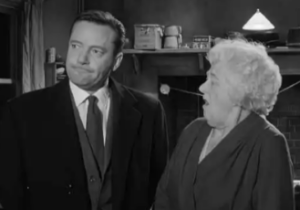
Wake Up Dead Man (2025), the new whodunnit written and directed by Rian Johnson, starring Daniel Craig as the gloriously accented Benoit Blanc, has just arrived on Netflix.  The Blanc movies – which also include Knives Out (2019) and Glass Onion (2022) – are reminders of how entertaining whodunnits can be when done well.  They put me in mind of an earlier series of cinematic whodunnits I find delightful and turn to whenever I need a comfort watch.  These are the four Agatha Christie adaptations made in Britain in the early 1960s that have veteran English actress Margaret Rutherford playing Christie’s formidable, if elderly, crime-solver, Miss Jane Marple.


By then, Rutherford had become a national treasure in Britain for her comic roles in the theatre and cinema, for example, in stage and screen versions of Oscar Wilde’s The Importance of Being Earnest (1939 and 1951 respectively) and Noel Coward’s Blithe Spirit (1941 and 1945).  The Miss Marple movies represent the last great hurrah of her career.


One aspect of the films I have a problem talking about is their faithfulness to the original novels.  That’s because I’ve never read any of Agatha Christie’s Miss Marple stories.  Indeed, I’ve only read one Agatha Christie novel ever, 1932’s Peril at End House, which featured her other famous sleuth, the Belgian Hercule Poirot.  However, having seen later versions of Miss Marple in TV adaptations where she was played by Joan Hickson, Geraldine McEwan and Julie McKenzie, it seems fair to say that the persona Rutherford invests the character with is not the persona Christie had in mind.  Subsequent Marples have been quiet, focused and forensic, people you’d barely notice sitting in the corner of the drawing room while skullduggery was afoot.  Rutherford’s Marple is a force of nature – you’d definitely notice her before long.


Christie was reportedly unhappy with the Rutherford movies, regarding them as comedies rather than the mystery stories she’d written originally.  That’s true – they are comedies, very funny ones, rather than mysteries.  But Christie seemed appreciative of Rutherford herself and even dedicated her 1963 novel The Mirror Crack’d from Side to Side to her.


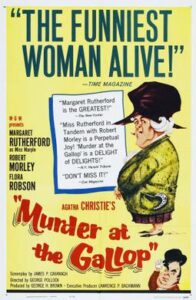
Though based on the works of a writer closely associated with the sub-genre known as the ‘country house mystery’, only one of the four Rutherford / Marple films mainly takes place in a country house.  That’s the first one, 1961’s Murder She Said, based on Christie’s 1957 novel 4.50 from Paddington.  Next up is Murder at the Gallop (1963), mostly set in a hotel run by an enthusiastic equestrian and foxhunter.  It’s based on Christie’s book After the Funeral (1953), which actually featured Hercule Poirot.  Murder Most Foul (1964), inspired by another Poirot novel, McGinty’s Dead (1952), is about murderous goings-on among the members of a theatre company.  The same year’s Murder Ahoy! is almost an original screenplay, though it uses elements of the 1952 novel They Do It with Mirrors.  Its story takes place on a former Royal Navy warship that’s become a floating reform school for juvenile criminals.


© Metro-Goldwyn-Mayer


So, we’ve got a stately home, horse-riding, the theatre and the Royal Navy – four great British institutions.  Accordingly, in the films, the heads of these four institutions are played by four much-loved British character actors of the period, James Robertson Justice, Robert Morley, Ron Moody and Lionel Jeffries respectively.  Each is pompous and stuffy and when Rutherford’s Miss Marple arrives on the scene, determined to sniff out the rottenness in each institution – rottenness that’s led to murder – they aren’t happy.  That’s largely what makes these movies enjoyable.  We get to see some old-fashioned, patriarchal British pomposity being relentlessly pricked by an eccentric, infuriating old lady who refuses to know her place.


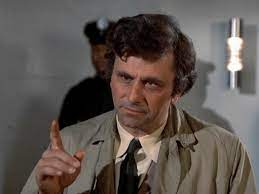
Indeed, I’d argue these movies are subversive in their quiet way.  Rutherford’s Miss Marple is almost a forerunner to Columbo, the disheveled, blue-collar detective played by Peter Falk in the TV show of the same name (1971-78, 1989-2003).  The murderers in that show are always rich, powerful bigshots who totally patronize and underestimate Columbo, but he manages to nab them in the end.  Usually by mercilessly annoying them.


I’ve seen people – usually diehard Christie fans – criticise Rutherford’s portrayal of Miss Marple for being ‘dotty’ or ‘batty’, but she’s not that way at all.  Rather, her Marple is admirably proactive.  In Murder She Said, convinced the body of a woman she saw being strangled on a passing train is concealed somewhere on the premises of Ackenthorpe Hall, she infiltrates the mansion by taking on the job of its housekeeper.  There, in the kitchen, she has to deploy all her culinary skills to feed the sizeable and demanding Ackenthorpe family.  Meanwhile, she uses her enthusiasm for the game of golf as cover while she searches the grounds.


In Murder at the Gallop, she climbs on top of a cartload of beer-barrels so that she can peer through a top window and spy on the reading of a will.  Later, she proves herself to be an accomplished horsewoman and she dances to some new-fangled rock-and-roll music.  (“One must be tolerant of the young…  I remember my dear mama was quite horrified when she caught me dancing the Charleston in public.”)  Okay, she apparently incurs a heart attack while dancing, but that’s only a ruse designed to trick the murderer into giving away their identity.  In Murder Most Foul she reveals herself as a past ladies’ pistol champion and, at the finale of Murder Ahoy!, as a fencing champion too.  That’s before she takes on the villain in a swordfight – a sequence Rutherford spent a month training for.


So, a skilled cook, golfer, horse-rider, dancer, shooter and fencer – she might be light-years removed from Christie’s concept of her, but Rutherford’s Miss Marple is a shining example of, simultaneously, girl-power and grey-power.


Her feistiness even wins her the admiration of those pompous authority figures she’s spent the films irritating.  At the end of Murder She Said, for instance, she gets a surprise when Luther Ackenthorpe, the irascible and bearish aristocrat played by James Robertson Justice, concludes that she’s just the woman to share his matrimonial bed.  His proposal of marriage hardly drips with romance, though.  “You’re a fair cook,” he tells her, “and you seem to have your wits about you and, well, I’ve decided to marry you.”  Predictably, Miss Marple decides there are some things a girl has to say ‘no’ to – and this is one of them.


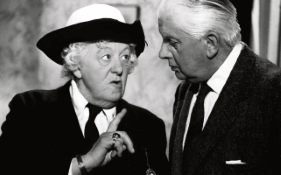
Another unexpected marriage proposal comes her way at the end of Murder at the Gallop, this time from Robert Morley’s horse-loving character Hector Enderby.  Miss Marple isn’t taken by Enderby because he’s a keen foxhunter.  “I disapprove of blood sports!” she tells him sternly.  After she’s gone, Enderby sighs, “That was a very narrow escape.”
 

© Metro-Goldwyn-Mayer


While Rutherford’s Miss Marple maintains her spinsterhood in these movies, the actress’s real-life husband, the actor Stringer Davis, has a prominent role in all four.  At Rutherford’s insistence, the filmmakers invented a recurring character, ‘Mr. Stringer’, for him to play.  No such character appears in the books.  It could have been a disastrous piece of self-indulgence, but in the context of the films this addition works beautifully.  Tweedy and timid, Mr. Stringer is the librarian in Miss Marple’s village.  She turns to him when she needs research done or information dug up and he invariably, and unwillingly, gets drawn into her unorthodox investigations.  He becomes a faint-hearted Dr. Watson to her gregarious Sherlock Holmes.


Davis and Rutherford dated for 15 years and didn’t tie the knot until 1945 when he was 46 and she 53.  The delay was due to Davis’s mother, who deeply disapproved of Rutherford, and the couple only got married after she died.  That might suggest Davis, intimidated by his mum, was as retiring as the character he plays in the films. But he was courageous enough to fight in both World Wars.  During the first one, he served as a young officer at the front in 1918.  At the start of the second one, he re-enlisted at the age of 40 and served for its duration.  His World War II experiences included being evacuated from Dunkirk in 1940.


The films’ other recurring character is a genuine Agatha Christie creation who appears in four of her books.  This is Inspector Craddock, played by Australian actor Charles ‘Bud’ Tingwell.  Craddock starts each movie having his patience tested by Miss Marple’s meddling and wild claims but, of course, by the end of it, he’s reluctantly conceded she was right all along and is fighting her corner.  A veteran of the Australian film industry, Tingwell moved to Britain in the 1950s.  He’s forever etched in my memory as Alan Kent, the unfortunate traveller whose blood is used in a gory scene to revive Christopher Lee in the 1966 Hammer horror film Dracula, Prince of Darkness (1966) – the first scary movie I saw that genuinely scared me.  In the 1970s he returned to Australia, where his later films included the delightful and highly popular comedy The Castle (1997).  By the time of his death in 2009, he was so respected that he received a state funeral in Melbourne.
 

© Lawrence P. Bachman Productions / Metro-Goldwyn-Mayer


Meanwhile, the guest casts in these films are a joy for someone of my vintage and geographical background.  They’re choc-a-bloc with faces familiar to me from watching TV as a kid – from either the 1960s and 1970s British TV shows or the 1950s and 1960s British movies that were broadcast then.  As well as Robertson Justice, Morley, Moody and Jeffries, there’s Francesca Annis, James Bolam, Richard Briars, Peter Buttersworth, Andrew Cruickshank, Finlay Currie, Windsor Davies, Meg Jenkins, Arthur Kennedy, Duncan Lamont, Miles Malleson, Francis Matthews, William Mervyn, Derek Nimmo, Nicholas Parsons, Conrad Philips, Dennis Price, Flora Robson, Terry Scott, Robert Urquhart, James Villiers and Thorley Walters.  Even a future Miss Marple, Joan Hickson, turns up in Murder She Said.


After Murder Ahoy!, Rutherford made one more appearance as Miss Marple.  She and Stringer Davis appeared fleetingly in 1965’s The Alphabet Murders, a Hercule Poirot movie with Tony Randall playing the Belgian detective and none other than Robert Morley playing his sidekick, Hastings.  I haven’t watched The Alphabet Murders, but it’s reportedly dreadful and Rutherford and Davis’s cameo may be the only good thing in it.


Admittedly, something that tinges my enjoyment of the Rutherford / Marple movies with a little sadness is knowing that a few years after making them Rutherford started to suffer from Alzheimer’s disease.  Devoted to his wife, Stringer Davis cared for her until her death in 1972.  He died himself just 15 months later.


Anyway, I shall finish here as it’s time to go and watch Wake Up Dead Man on Netflix.  Hey, you know what?  If that Daniel Craig plays his cards right, he could become the new Margaret Rutherford.


From wikipedia.org
First blood to Rampo


© Tuttle


And another Halloween-inspired post…


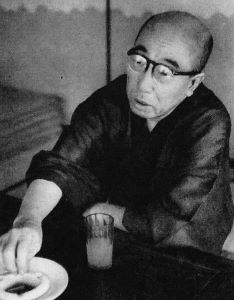
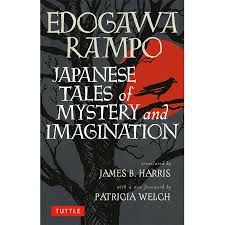
Japanese writer Hirai Taro, who lived from 1894 to 1965, was such a fan of Edgar Allan Poe, America’s doyen of macabre and mysterious fiction, that he used the penname ‘Edogawa Rampo’.  English-language names sound somewhat stretched and distorted when converted to the syllable-systems of Japanese – my own name is pronounced ‘Ee-an Sumisu’ – and Taro’s penname was basically a Japan-ised version of ‘Edgar Allan Poe’.  Say ‘Edogawa Rampo’ quickly a few times and you’ll find yourself reciting the name of Baltimore’s greatest man of letters.


Accordingly, during his literary career, Rampo wrote in similar genres to Poe.  He didn’t merely pen horror stories.  Poe’s name is now so synonymous in the West with tales of terror like The Tell-Tale Heart (1843), The Masque of the Red Death (1842), The Fall of the House of Usher (1839), The Pit and the Pendulum (1842), The Facts in the Case of M. Valdemar (1845) and so on that it’s often forgotten how innovative he was working in other genres.  In particular, he helped create the detective story with his trilogy of stories about crime investigator C. Auguste Dupin, The Murders in the Rue Morgue (1841), The Mystery of Maire Roget (1842) and The Purloined Letter (1844).  And it was largely in detective and crime fiction that Rampo made his name.  He even helped to found the Japanese Mystery Writers’ Club.


Rampo’s Japanese Tales of Mystery and Imagination (1956) is an English-language collection of nine of his best short stories.  Not only does it take its name from Tales of Mystery and Imagination, described by Wikipedia as ‘a popular title for posthumous compilations of writings by American author, essayist and poet Edgar Allan Poe’, but it combines stories from those two genres Poe helped to popularise in the early 19th century, the horror and the detective / mystery ones.  It has to be said the two styles mesh together nicely in this collection.  There’s a weirdness in Rampo’s detective fiction that ensures it doesn’t feel that different, tonally, from his morbid horror stories.


Among the crime stories, you get villains attempting to commit the perfect murder with schemes that involve living a double life as an invented character (The Cliff), impersonating someone who looks exactly like them (The Twins) and the fear of sleepwalkers that they might do something ghastly whilst moving in a trance-like state (Two Crippled Men).  All three have a last-minute twist wherein the main characters get their come-uppance from someone who’s even smarter than they are, or by a small but fatal act of negligence – the sort of minor blunder that would have Peter Falk’s Lieutenant Columbo swooping down like a hawk.  Talking of Falk’s beloved shabby-but-canny TV detective, The Psychological Test is a very Columbo-esque tale of how a pair of investigators use an ingenious method to get a suspect in a murder case to incriminate himself.


Meanwhile, The Red Chamber takes a trope popular in 19th and early 20th century English fiction, that of a comfortable, wooden-panelled gentlemen’s club where the tweedy members congregate after dark and, with the lights turned down, proceed to tell each other scary stories.  In Rampo’s gentlemen’s club, however, things get shaken up when the evening’s storyteller, a newcomer, boasts about being responsible for “the murder of nearly a hundred people, all as yet undetected’ and proceeds to explain how he did it and got away with it.  Several harrowing twists later, it’s no surprise that the story’s narrator, a long-term member of the club, concludes: “…we unanimously agreed to disband.”


The other four stories in Japanese Tales of Mystery and Imagination are macabre ones.  They possess the same oddness and intensity of his crime stories, but cranked up to higher levels.  The Hell of Mirrors is about a man who becomes obsessed with optics, with ‘anything capable of reflecting an image… magic lanterns, telescopes, magnifying glasses, kaleidoscopes, prisms and the like’ and with mirrors: ‘concave, convex, corrugated, prismatic.’  Typically with Rampo’s fiction, this obsession spills over into another obsession, a sexual one.  The protagonist is soon using telescopes to pry through the windows of his female neighbours and using periscopes to ‘get a full view of the rooms of his many young maidservants.’  The story reaches its climax when he devises a mirrored, optical device so depraved it ultimately induces madness.


The Traveller with the Pasted Rag Picture, on the other hand, is the one Rampo story in this collection that veers off into the supernatural.  It reminded me very slightly of the M.R. James story The Mezzotint, though the picture in that story was a spookily lifelike one that recorded a horrific event.  In Rampo’s story, a similarly lifelike picture serves as a testimony to a sad, doomed and one-sided romance.


That leaves two stories, The Human Chair and The Caterpillar, which I think are masterpieces.  The Human Chair concerns an ugly and reclusive craftsman who makes a living fashioning luxurious chairs, whilst getting a perverse kick out of imagining ‘the types of people who would eventually curl up’ in them.  Eventually, driven insane by his desire to get intimate with the folk who’ll acquire and use his chairs, he designs a bulky one containing a secret, human-sized cavity, inside which he hides himself.  The chair and its maker end up in a hotel lobby, where the latter gets his jollies from feeling the bodies of the guests rest on top of him.  No one “suspected even for a fleeting moment that the soft ‘cushion’ on which they were sitting was actually human flesh with blood circulating in its veins – confined in a strange world of darkness.”


The story is told in the form of a confession, sent as a letter to a famous lady novelist.  While she reads it, she begins to wonder about the suspiciously large and comfy chair she’s seated in, which has found its way to her study after being in a hotel.  There comes a final twist that nullifies what’s happened before – or perhaps doesn’t.


The Caterpillar, written in 1929, is an early, literary example of ‘body horror’.  The central character is an unfortunate young army officer so maimed and mutilated in battle that he comes home resembling the larval-form insect of the title.  This puts understandable strain on the officer’s wife, upon whom, totally helpless, he depends for care and attention.  In fact, The Caterpillar is more about the wife than the husband, with the hideous situation gradually pushing her into the realms of madness – of sadistic madness, because she starts taking her woes out on her husband, who can’t do anything to defend himself.  The story works both as a feminist tract, showing the plight of women whom society expects to be wholly devoted and subservient to their husbands, and as a horror story exploiting male fears of emasculation.  It’s a grim and powerful read, packing as much of a punch as it did when it first appeared, nearly a century ago.


I think the original Edgar Allan Poe would approve of Rampo’s tales.  They’re deliciously dark and twisted, and frequently ingenious, and sometimes funny too – a lot of the humour derives from how his villains, when telling their stories, like to revel in their own cleverness and degeneracy.  It’s just a pity that Japanese Tales of Mystery and Imagination is the only English-language collection by Rampo I’ve come across.  I’d really like to read more of his stuff.  Unlike a certain character played by Sylvester Stallone, I wouldn’t mind seeing a Rampo 2, Rampo 3, Rampo 4 and Rampo 5.


From wikipedia.org / © The Mainichi Graphic

Some thoughts on Columbo – from Colombo


© Universal Television


When I was a kid during the 1970s, British television was awash with imported American detective and police series.  My schoolmates and I agreed that the genre had a ‘big five’ – maybe because the title characters of these five shows had gimmicks that impressed them deeply on our young consciousnesses.


There was Kojak (1973-78), whose detective hero was unashamedly bald, which meant anyone coming to school with a new haircut would be nicknamed ‘Kojak’ for days afterwards; Ironside (1967-75), whose hero was confined to a wheelchair; Cannon (1971-76), whose hero was fat – cue more cruel nicknames at school for kids slightly on the stout side; McCloud (1970-77), whose hero was a cowboy; and Columbo (1971-78), whose hero, essayed by Peter Falk, sported a grubby raincoat, unkempt head of hair and smelly-looking cigar and generally looked a bit manky.  Such was Columbo’s level of scruffiness that, whilst carrying out investigations in a soup kitchen in the 1974 episode Negative Reaction, a nun working there (Joyce Van Patten) mistook him for one of its homeless patrons.


In the half-century since, I’ve seen episodes of those shows repeated on TV, often on obscure satellite channels, and I have to say most of them have fallen victim to what is known in contemporary slang as the ‘suck fairy’.  This is neatly defined on fanlore.org as a “mythical creature who comes to old favourite books, art, TV shows or other media that one has not revisited in years, takes away everything in them that one loved, and refills them instead with suck.”


The shows seem formulaic, unmemorable, even dreary now, indistinguishable from a million other pieces of conveyor-belt-produced 1970s American TV.  Was this really the stuff that inspired us as ten-year-old kids to strut around the playground speaking in wavery drawls, like Dennis Weaver’s Deputy Marshall Sam McCloud, applying his cowboy law-enforcement techniques to the bad guys of New York (where he was on seemingly never-ending loan to the NYPD from the police department of Taos, New Mexico)?  Or inspired us to puff out our bellies and lurch / amble across the playground in imitation of William Conrad’s Private Detective Frank Cannon chasing the villains?  (Cannon, despite his obvious lack of athleticism, was able to not only run after those villains but also, somehow, catch them.)


However, there are two exceptions to the suck fairy rule.  One is the earlier episodes of Kojak, which capture something of 1970s New York’s sleazier side.  The other is Columbo, which although the episodes vary in quality, is frequently brilliant.  Today is September 15th, 2021, exactly 50 years to the day since Columbo debuted on American TV – not as a show with a weekly slot, but as ‘rotating episodes’ in the NDB Mystery Movie series, where it alternated with McCloud and McMillan & Wife (1971-77).  Incidentally, surely even Quentin Tarantino has difficulty remembering McMillan & Wife these days.


To mark the occasion, and because I’m currently living in the capital city of Sri Lanka, here are some thoughts on Columbo – from Colombo.


© Universal Television


Actually, there’s little I can say about Columbo that hasn’t already been said in this feature by Shaun Curran, which recently appeared in the BBC website’s ‘Culture’ section.  I’d take issue with one of the feature’s comments, though, that the ‘concept of class warfare wasn’t central to the creators’ thinking’.


Well, class warfare may not have been on the radar of William Link and Richard Levinson, the writing-producing duo who invented the character.  But I’m pretty damn sure it was at the forefront of most viewers’ minds while, episode after episode, they watched Columbo, the most humbly blue-collar of detectives, use his softly-spoken but bloody-minded persistence to wear down a succession of rich, arrogant, entitled sophisticates who, convinced of their own brilliance, believe they’ve just committed the perfect murder.  I’m certain those viewers cheered when, at the end of each episode, Columbo comprehensively outsmarted those bigshots and nabbed them for their misdeeds.


The show’s atypical structure saw each episode begin with some stinkingly rich, stinkingly amoral character – an art dealer, a bestselling novelist, a company CEO – commit a murder in some ingenious fashion.  Immediately, we’d be plonked into that person’s affluent world: mansions, penthouses, country retreats, exclusive clubs, golf courses, fancy cars, swimming pools, yes-men, servants, hangers-on.  Columbo wouldn’t appear until after 20 minutes or so, when the police are called.  You can imagine the murderer’s mental cry of delight when they realise that this bumbling, zero-class klutz is handling the investigation.


Ah, but the viewers know better.  Columbo is on the case and the disgustingly wealthy git is going to suffer.


His apparent obsequiousness (“The wife thinks you’re terrific!”) gives way to a gradual but relentless process of psychological torture as some teensy-weensy inconsistency (“Just one more thing… One thing that’s bothering me…”) arouses the wily detective’s suspicions and he starts tightening the screws on his quarry.  No wonder that when the climax of each episode arrives and Columbo reveals all – usually by setting some final trap in which the culprit irrefutably incriminates him or herself – arrest is usually accepted with a minimum of fuss.  The bigshot murderer has been thoroughly ground down by this disheveled, raincoated dispenser of justice.  Prison will seem a blessed relief after what they’ve just been through.


Colombo, with his rubbish clothes, hair and car (an elderly Peugeot 403), his clumsiness, his dozy dog and his bossy wife who, despite never making an appearance, lurks as a formidable presence in the background, might be an everyman figure.  But he also helps rectify the injustices in the American Dream that allow such unprincipled scum to rise to the top while the decent folk get stuck at the bottom.  As Joyce Van Patten’s nun remarks in Negative Reaction, “A man’s worth is not judged by the size of his purse.”  Really, each episode of Colombo ought to be watched with L’Internationale playing softly in the background.


© Universal Television


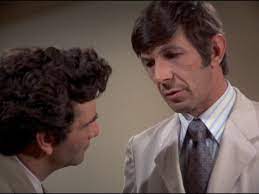
So, which are my favourite Columbo episodes?  Well, there’s 1973’s A Stitch in Crime, which is fascinating because Columbo is pitted against Mr. Spock himself, Leonard Nimoy, who plays an ambitious heart surgeon using his medical know-how to bump off a colleague so he can take control of a research project.  Ironically, this episode has less logic and more emotion on display than usual.  We get a rare glimpse of Columbo losing his cool.  When Nimoy laughs at him condescendingly, he smashes a water pitcher onto the former Vulcan’s desk and spits: “I believe you killed Sharon Martin… and I believe you’re trying to kill Dr Heideman!”


Then there’s Double Shock, also from 1973, in which smug – okay, all Columbo villains are smug – identical twins, played by Martin Landau, conspire to kill their wealthy uncle by electrocuting him while he’s having a bath.  What makes this episode a joy is the horror shown by the victim’s prim, cleanliness-obsessed housekeeper (played by Jeanette Nolan) while Columbo trudges about her pristine household with his dirty shoes and crumbling cigar.  You get the impression she’d rather have her employer’s murder go unsolved than have this apparent oaf tramp over her expensive carpets.  “You belong in some pigsty!” she shouts at him, patience finally snapping.


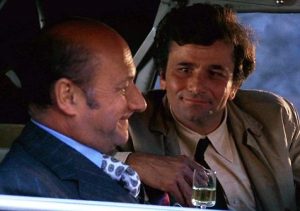
The shiny-pated, bug-eyed Donald Pleasence was everywhere in 1970s films and television, so it was inevitable that he’d turn up in Columbo.  In the episode Any Old Port in a Storm, yet another one from 1973, he plays a fanatical wine connoisseur who at one point rages at a waiter: “This wine has been oxidized by overheating…!  An exciting meal has been spoiled by the presence of this liquid filth!”  However, unusually, Pleasence’s character is sympathetic overall.  Indeed, he only murders his dastardly half-brother when that half-brother threatens his beloved winery.  And, unlike most of Columbo’s adversaries, he’s sporting in defeat.  When he realises the game is up, he even shares a final glass of wine with the detective.


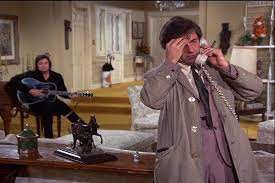
1974’s Swan Song has Colombo investigating a plane crash that’s resulted in the deaths of two women. One is the wife and the other is the backing singer of country-and-western star Tommy Brown, who was piloting the plane and miraculously got thrown clear during the impact and suffered only minor injuries.  But the truth is less miraculous.  Brown had got himself into a compromising situation with the background singer when she was way too young for such things, and his wife (played by the marvellous Ida Lupino) was blackmailing him into donating large sums to a religious project she championed.  To rid himself of these two sources of torment, he drugged them when they were on the plane, bailed out with a parachute, and turned up at the crash scene to make it look like he was on board when it went down, but survived.  I find this episode’s script far-fetched, but as Brown is played by Johnny Cash, and it’s basically Columbo versus the Man in Black, it makes my pick of favourites.


© Universal Television


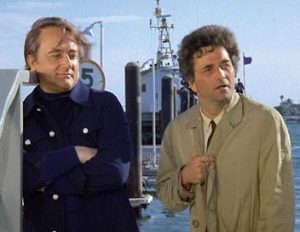
However, my all-time favourite Columbo episode is Troubled Waters, a 1975 episode that has Columbo and the missus taking a break on a 1970s cruise ship, an experience that I have to say looks like hell on earth.  Columbo is asked to help after rich slimeball passenger Robert Vaughn murders the ship’s lounge singer and tries to pin the blame on a pianist (played by Dean Stockwell).  What makes this episode a pleasure is not only that Columbo is up against Vaughn, The Man from UNCLE (1964-68), but also that he’s allied with John Steed from The Avengers (1961-69), for playing the perplexed ship’s captain is none other than the splendid Patrick Macnee.  While Columbo drives Macnee and his crew to distraction by insisting on calling their beloved ship a ‘boat’, we get tantalising suggestions that we’re going to see Mrs. Columbo at last – though inevitably, Columbo, and the viewers, keep ‘just missing’ her.  (When the purser informs Columbo that the captain would like to see him, he asks worriedly, “It’s not about my wife, is it?  I mean… she likes to have a good time, sometimes she gets carried away…”)


Columbo was revived in 1989 and carried on with another two dozen episodes and specials until 2003, eight years before Peter Falk’s death.  These later Columbo-es weren’t as good as the ones from the 1970s, although it was always a pleasure to see the character on screen, still socking it to the high and mighty.


With Falk gone, there’s been talk of remaking the show, the most promising talk proposing Mark Ruffalo as the actor who’d take over the raincoat.  Now, while Columbo obviously wouldn’t be the same without Falk, I’d still welcome a modern-day version of the show that has the rumpled detective shuffling into luxury 2021 penthouses with his shabby raincoat and malodorous cigar, first inviting derision from, then causing irritation to, and finally striking terror into the likes of the Trumps, the Kardashians, the Kochs, the Murdochs, the Musks and so on.  I’d welcome the sight of him annoying villainous investment bankers, hedge fund managers, real estate tycoons, arms dealers, celebrity reality-TV stars and pampered YouTube influencers into submission, before collaring them and sticking them behind bars.


Yes, today, when a quarter of the world’s wealth now resides in the pockets of some 175,000 billionaires and multi-millionaires, and much of it didn’t get into those pockets through honest means, we need Detective Lieutenant Columbo more than ever.


© Universal Television