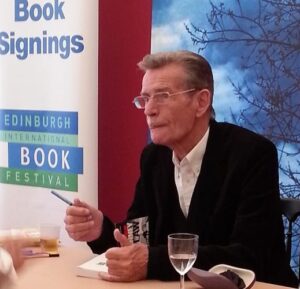
The big Mc


From wikipedia.org / © Nonsenseferret


It’s exactly a decade since the Scottish writer, poet and columnist William McIlvanney passed away on December 5th, 2015.  Here’s something to mark this melancholy anniversary.


For myself and many book-lovers in Scotland in the 1980s, William McIlvanney was both a source of pride and exasperation.  Pride that modern Scottish literature was capable of producing someone as good as he was; but exasperation that the British literary establishment seemed to have little interest in him or his peers (like Alasdair Gray and James Kelman) north of the border.  On their radar, Scottish writers didn’t make much of a blip.


Back then, the clique of authors, critics and academics who, through Britain’s highbrow media outlets, decided what was fashionable were a privileged Oxford / Cambridge-educated bunch who lived in London and seemingly lived up their own arses too.  I always find it telling that in 1984, when things felt at their very worst, the Booker Prize – the flagship award for the UK literary establishment – managed to have on its short-list five books that had novelists, biographers, literary critics and literary lecturers as their main characters.  The only shortlisted book that was about people who didn’t make a living out of literature (you know, like 99.999% of the human population) was J.G. Ballard’s Empire of the Sun.  And it didn’t win, though it should have.


The novel that helped put McIlvanney on the map was 1975’s Docherty, which was about a tough west-of-Scotland miner and his family trying to cope with everything that the early decades of the 20th century threw at them.  Thus, McIlvanney was never going to ingratiate himself with the ‘in’ crowd by writing about writers, biographers, critics or lecturers either.


I’d read McIlvanney’s 1977 novel Laidlaw as a teenager – more about that in a minute – but it wasn’t until I was at college that one of my tutors (Isobel Murray) urged me to read a book of his that’d just been published, 1986’s The Big Man.  I’m glad I listened to her because The Big Man proved to be one of my favourite books of the 1980s.  It features another miner, called Dan Scoular.  He’s an ex-miner, actually, because this is the post-miners’-strike 1980s, Scoular has lost his job and he and his family are struggling to make ends meet.  The imposing Scoular happens to be good at fighting, though it’s a side of him that he’s suppressed for a long time.  Then he’s approached by a Glaswegian gangster who offers to pay him a small fortune if he takes part in an illegal bare-knuckle fight.  Thus, Scoular faces a dilemma – does he do something that he finds abhorrent if it saves him and his loved ones from penury?  Inevitably, after he ignores his better instincts and agrees to the proposal, he finds out that there are more complicated and even nastier things going on in the background.


© Hodder and Stoughton


The Big Man is the most cinematic of McIlvanney’s books and it was no surprise that it was filmed, in 1990, by David Leland.  The film gets some things right.  The villains, played by Ian Bannen and Maurice Roëves, are good.  However, it gets a lot wrong, including a Hollywood-esque, feel-good ending far removed from the bleak, ambiguous note with which McIlvanney closes the book.  Another problem is that, at the time, there wasn’t a bankable-enough Scottish star for the filmmakers to cast in the role of Scoular.  So they had to search around and the next best thing they could find was a Northern Irishman, Liam Neeson.


Now I like Neeson, but every time in The Big Man that he opens his mouth and those dulcet County Antrim tones of his emerge, the sense that you’re in a hard-pressed mining town in the West of Scotland goes out of the window.  It’s a pity that the film wasn’t made during the years since, when some bankable Scottish actors have come to prominence (though it might be difficult to find one with the necessary, hulking physicality that Neeson had).  Incidentally, The Big Man – a movie about Scottish ex-mining communities and ruthless Glasgow criminals – also has Hugh Grant in its cast.  I’ll give you all a minute to pick your jaws up off the floor.


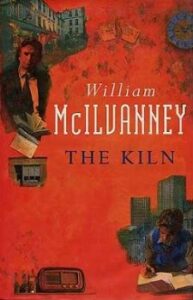
A later novel by McIlvanney, 1996’s The Kiln, received a lot of acclaim.  It even had a recommendation on its cover from Sean Connery.  I’ve just praised McIlvanney for not writing books about writers, but The Kiln actually has a writer as its central character, one in the throes of a mid-life crisis.  However, the novel is more a coming-of-age novel because its hero spends much of it looking back on his working-class youth, especially on a period he spent toiling in a local brickworks.


When The Kiln appeared, it seemed to cement – an appropriate verb for a book about bricks – McIlvanney’s status as a major figure in Scottish letters.  But it seemed the last time that he commanded such attention.  Recently, I was thinking about The Kiln and I remembered reading it while I was making a long-distance bus trip during the only occasion I was in Australia – which was in 1997, almost thirty years ago and almost twenty years before McIlvanney’s death.  What on earth happened to him after that?  I’d come across an occasional interview with him or article by him in the Scottish press, but that was about it.  In 2006 he published one more novel, Weekend, though it arrived with little fanfare – the antithesis of the reception The Kiln got a decade earlier.
 

© Hodder and Stoughton


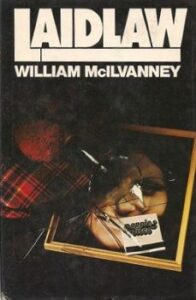
Though as far as mainstream literature was concerned McIlvanney seemed to disappear from view after The Kiln, he did in recent years win belated acknowledgement for his work as a crime writer – specifically, for his 1977 novel Laidlaw, which was republished in 2013, and its sequels The Papers of Tony Veitch (1983) and Strange Loyalties (1991).  (The latter book also serves as a grim semi-sequel to The Big Man.)  All are about a tough but intellectual and philosophical Glasgow detective called Jack Laidlaw.  Since then, crime novels set in Scotland have sold by the barrow-load and Scottish crime writers like Iain Rankin, Val McDiarmid, Denise Mina, Christopher Brookmyre and Stuart MacBride have enjoyed lucrative careers, so McIlvanney can be seen as the man who started it all.  His Jack Laidlaw was the prototype for Inspector Rebus and the rest.  In effect, McIlvanney created ‘Tartan Noir’.


Even when I read Laidlaw at a young age, I found it a bit uneven (as prototypes usually are), its prose shifting slightly uncomfortably between Glasgow-speak and Raymond Chandler-isms.  It wasn’t helped by the way it was marketed, either – “Turn down a Glaswegian when he offers you a drink,” intoned the blurb on the back, “And he’ll break your legs,” which wasn’t what the book was about.  Laidlaw focuses more on psychology than on violence, and I found it disconcerting that in its final pages the hero isn’t rushing to catch the murderer so much as he’s rushing to save the murderer from gangland-backed vigilante justice.  But all power to McIlvanney for inventing what would become Scotland’s biggest literary export.  Iain Rankin, in particular, has always admitted his debt to him.


McIlvanney was a political thinker too and during the 1990s – back in those long-ago days when Scotsman Publications produced material that was worth reading – he was a perceptive columnist in the Scotland on Sunday newspaper.  I also remember him delivering a speech in Edinburgh’s Meadows during the March for Scottish Democracy rally held on December 12th, 1992, demanding the creation of a Scottish parliament.  On stage, in front a crowd of 30,000 people, he performed far better than any of the politicians in attendance.  He memorably summed up the case for a parliament saying: “We gather here like refugees in the capital of our own country, wondering what we want to be when we grow up.  Scotland – the oldest teenager amongst nations.”


But at the same time he pleaded for racial tolerance.  “Scottishness,” he pointed out, “isn’t some pedigree lineage.  It’s a mongrel tradition.”  I suspect that with McIlvanney’s speech that day began the emphasis on ‘civic nationalism’ that Scottish nationalists – at least, the decent, mainstream ones, not the fringe, far-right heidbangers – have been at pains to cultivate ever since.


Finally, William McIlvanney played an indirect role in the start of my writing career.  My very first short story to see publication, a slice-of-life piece set on a Scottish farm with the self-explanatory title Lambing Time, appeared in a magazine called Scratchings, then produced annually by Aberdeen University’s Creative Writing Society.  Scratchings had been launched in the early 1980s with the help of a financial contribution from McIlvanney.  At the time he was Aberdeen University’s writer-in-residence and he was approached by two young students who “wanted to borrow 40 pounds to start a poetry magazine.  Would he be able to lend them the money?”  He did, Scratchings was born, and it provided a home for Lambing Time a few years later.


Incidentally, the two students who successfully tapped McIlvanney for 40 pounds were Dundonian Kenny Farquharson, now a columnist with the Times newspaper; and Invernessian Alison Smith, now better known as the novelist Ali Smith, who’s been shortlisted three times for the Booker Prize – yes, the award whose shortlist bugged me so much back in 1984.
 

© Hodder and Stoughton

It’s all gone J.G.


© Fay Godwin / The Paris Review


Recent events have inspired me to update and repost this, which first appeared on this blog in 2019, on the tenth anniversary of J.G. Ballard’s death.


The visionary writer James Graham Ballard, known to his readers as ‘J.G.’, officially succumbed to prostate cancer and ceased to be a presence in our universe in April 2009.  However, the past 13 years have been so baroquely and surreally insane that at times I’ve had a troubling thought.  In 2009, did Ballard cease to exist in the universe or did the reverse happen?  Did the universe stop existing as a physical entity at that moment and, since then,  has it continued only as a figment of J.G. Ballard’s imagination?


Could we be living now as ghosts in Ballard’s fiction without realising it?


Recent historical trends have suggested this is not merely a crazy hypothesis on my part.  The fact that people are finally talking seriously about the dire threat to human civilisation posed by global warming – talking seriously but, alas, still doing very little about it – makes me think of Ballard’s 1962 novel The Drowned World, where climate change has jacked up the temperatures, melted the ice caps, inundated London with water and turned the city into a balmy and hallucinogenic landscape of lagoons and tropical flora and fauna; or the following year’s novel with the self-explanatory title The Drought; or his 1961 short story Deep End, where ‘oxygen mining’ has drained the oceans and a few remaining humans skulk around their dried-out beds at night-time, when the heat and radiation levels aren’t as lethal as they are in the daytime.


Meanwhile, our ever-spiralling-out-of-control and ecologically suicidal dependency on the internal combustion engine, and the social maladies (like road rage) that go with it, make me think of 1973’s Crash – the initial manuscript of which caused one publisher’s reader to splutter, “This author is beyond psychiatric help.”  Whereas the increasing fragmentation of society through the proliferation of social media platforms and devices brings to mind Ballard’s short story The Intensive Care Unit, which turned up in the 1982 collection Myths of the Near Future and contained the prophetic line, “All interaction is mediated through personal cameras and TV screens.”  And the tendency among the elite to shut themselves off in gated communities, where they not only relax, play and sleep but also, increasingly, work, evokes such novels as 1975’s High Rise and 2000’s Super-Cannes – where in both cases the set-up memorably ends in tears.


© Penguin Books / David Pelham


More generally, spending a few minutes channel-surfing through TV’s 24/7 news outlets is enough to make you feel you’re inhabiting Ballard’s experimental, narrative-less collage of ‘condensed novels’, 1970’s aptly-titled The Atrocity Exhibition.  And the sorry state of America, where the now openly authoritarian Republican Party could easily win the presidency in 2024 and return Donald Trump to the White House, reminds me of his 1981 novel Hello America, which has an ecologically devastated USA run by someone calling himself ‘President Charles Manson’.


And as I witness the madness of Brexit in the UK, facilitated by a cadre of rich, privately-educated posh-boys like Nigel Farage, Jacob Rees Mogg and Boris Johnson, I can think of half-a-dozen Ballard stories that have rich, privately-educated Britishers losing their marbles, becoming unhinged and embracing chaos and catastrophe.


Indeed, events in the UK at the moment, with all of its media, most of its politicians and a large part of its public indulging in near-deranged displays of grief over the death of a 96-year-old lady worth something between 370 and 500 million pounds while the country totters into a potentially disastrous cost-of-living crisis, are all very ‘Ballardian’.  ‘The Queue’ – the term applied to the line of mourners spending 24 hours shuffling across ten kilometres of London in order to view the Queen’s coffin at Westminster Abbey – could easily have been the title, and plot-premise, of one of Ballard’s novels or short stories.  Meanwhile, the much-publicised behaviour of the Centre Parcs holiday-villages company, which first tried to evict its vacationing residents on the day of the Queen’s funeral, then relented but warned them to stay inside their lodges on the day, prompted author Paul McAuley to send out a tweet slightly rephrasing Ballard’s most famous opening sentence, the one that kicked off High Rise: “Later, as he sat on his balcony eating the dog, Dr Robert Laing reflected on the unusual events that had taken place within this Centre Parcs village the previous three months.”


Occasionally, the idea that we could be living unawares in a giant virtual-reality system dreamed into existence by J.G. Ballard strikes me on a personal level.  For example, while I was living in Tunisia just after the 2011 revolution and the advent of the so-called Arab Spring, I arranged one afternoon to meet up with friends in Carthage, the swankiest of Tunis’s suburbs.  My friends hadn’t appeared yet when I got off at the TCM station, next door to Carthage’s branch of the French supermarket-chain Monoprix.  So, I waited there and passed the time by reading a few pages of Ballard’s final novel, 2006’s Kingdom Come.  It took me a minute to notice that the Monoprix was closed.  And not just closed.  During the revolution, it’d been trashed and looted and left a razed shell.  Its ruins looked sinisterly incongruous in the middle of this plush neighbourhood of high white walls and thick iron gates, four-by-fours and swimming pools, orange trees and jasmine plants.  And what was Kingdom Come about?  A community succumbing to dystopian chaos thanks to the arrival of a fancy new shopping centre.


It’s been claimed that Ballard’s writing wasn’t influenced so much by other fiction (except perhaps that of William S. Burroughs) as by visual forces like surrealism and Dadaism and the ‘media landscape’ of modern-day advertising and consumerism.  But I have to say I find him a very traditional author in some ways.  Reality may be crumbling around the edges of his scenarios, but at the same time he shows an admirable commitment to telling a gripping, old-fashioned yarn.  Stiff-upper-lipped British types – emotionally-repressed, able only to address each other by their surnames as if they were still back at boarding school – have adventures in exotic locales while they try to do the right thing, though as some hallucinogenic apocalypse unfolds and madness leaks into their thought processes, they invariably end up doing the wrong thing.


© Penguin Books / David Pelham


Ballard’s work calls to mind – my mind, anyway – the work of another storyteller not adverse to spicing his highbrow themes with derring-do and intrigue, Graham Greene.  Indeed, I’ve sometimes thought of Greene as a mirror image of Ballard.  That’s with Greene in the real world, though, posing before a fairground mirror and with Ballard as his warped, twisted reflection.  While Greene’s characters are usually tortured by Catholicism, Ballard’s usually have to contend with creeping and finally overwhelming psychosis.


And besides Greene, another literary influence on Ballard is surely Joseph Conrad.  I wouldn’t say Conrad’s Heart of Darkness (1899) lurks in the DNA of every Ballard story, but a good many of them feature darkness of some form and, yes, a character who feels duty-bound to journey into the heart of it.  When I was in my mid-teens, the first book by Ballard I ever read was his short-story collection The Terminal Beach (1964) and its opening story, A Question of Re-entry, begins with these deliciously Conradian lines: “All day they had moved steadily upstream, occasionally pausing to raise the propeller and cut away the knots of weed, and by two o’clock had covered some 75 miles…  Now and then the channel would widen into a flat expanse of what appeared to be stationary water, the slow oily swells which disturbed its surface transforming it into a sluggish mirror of the distant, enigmatic sky, the islands of rotten balsa logs refracted by the layers of haze like the drifting archipelagos of a dream.  Then the channel would narrow again and the cooling jungle darkness enveloped the launch.”


Those introductory lines so captivated me that, from that moment on, I was completely hooked on Ballard’s work.


Now, 40 years later, I still haven’t quite read everything by him.  For the record, though, here are my favourite things among what I have read.  Among his novels, The Drowned World, Crash, High Rise, Hello America, Empire of the Sun (1984) and Rushing to Paradise (1994).


Good though his novels are, I think his short fiction is even better.  Picking a favourite dozen from his short stories is a near-impossible task, but I’ll have a go.  Off the top of my head, I would nominate A Question of Re-entry, Deep End, The Illuminated Man – later expanded into the 1966 novel The Crystal World – and The Drowned Giant from The Terminal Beach; Chronopolis, The Garden of Time and The Watch Towers from the collection The 4-Dimensional Nightmare (1963); Concentration City and Now Wakes the Sea from The Disaster Area (1967); The Smile from Myths of the Near Future; and The Enormous Space and The Air Disaster from War Fever (1990).


Meanwhile, of his 19 novels, I have yet to read 1961’s The Wind from Nowhere, 1988’s Running Wild and 1996’s Cocaine Nights.  And there’s at least one of his short story collections, 1976’s Low-Flying Aircraft, that I haven’t read either.  Which is good.  I might be an old git now, but I’m glad that reading some new stuff by J.G. Ballard is still one of the things I can look forward to in life.


© Penguin Books / David Pelham