Weird Penguin: Ancient Sorceries


© Penguin Books


In 2024 Penguin books inaugurated its Weird Fiction series, which to date has seen the republication of five venerable titles: Robert Chambers’ The King in Yellow (1895), William Hope Hodgson’s The House on the Borderland (1908), Gertrude Barrows Bennett’s Claimed! (1920), Algernon Blackwood’s Ancient Sorceries and a collection, Weird Fiction: An Anthology (2024).  Well, I assume Weird Fiction: An Anthology is a new collection, but it consists of some venerable short stories.


I’d already read those first two novels and most of the tales in the anthology, whose line-up includes such well-kent scribblers as Edgar Allan Poe, H.P. Lovecraft, W.W. Jacobs, May Sinclair, M.R. James and Sir Arthur Conan Doyle.  But I hadn’t read the Bennett and Blackwood books.  Recently, their striking covers – illustrated in pastel colours, especially pink – caught my eye while I was in a Singaporean bookshop I frequent, Kinokuniya Books in Orchard Road’s Takashimaya Shopping Centre, and I wasted no time in buying them.


Here are my thoughts on the volume by Algernon Blackwood.  I’ll write about the Gertrude Barrows Bennet one later.


Ancient Sorceries contains five stories, the title one plus A Psychical Invasion, The Nemesis of Fire, Secret Worship and A Victim of Higher Space.  All feature Dr John Silence, described in the book’s blurb as “Physician Extraordinary… the greatest occult detective of the age.”  Yes, Silence is what in modern parlance we’d call a ‘paranormal investigator’ – but when the paranormal manifests itself in malevolent forms, he also battles against it.


Series of stories about occult detectives have been common in horror fiction… and I have to say I have a problem with them.  That problem is one of believability.  You can swallow the notion of the hero having one dramatic encounter with the supernatural in one story, maybe even of them having a second dramatic encounter with it in a second story.  But when that hero deals in story after story with supernatural jiggery-pokery, cropping up in different forms – ghosts, werewolves, poltergeists, whatever – it becomes almost impossible to take seriously.  That’s especially so when you consider how most human beings go through their lives with no contact at all with what might be defined as ‘occult’ or ‘paranormal’.  (During my many years on the planet, I’ve had one strange experience, lasting all of half-a-minute, which I couldn’t explain and which, if I was so inclined, I could attribute to the supernatural.)  This means a writer of such tales has to show a great deal of skill in making them seem plausible.


Also implausible is the idea that the occult detective, a mortal human being, can constantly take on dark forces of immense, unnatural power and triumph over them.  The success rate for the heroes of these stories suggests that the forces of darkness are, in reality, pretty weak sauce.


The afore-mentioned William Hope Hodgson wrote stories about an occult detective called Carnacki the Ghost Finder, first published as a collection in 1913.  He managed, I feel, to get away with it.  Hope Hodgson helped make his tales more believable by interspersing the ones where the threat was genuinely supernatural with ones where, Scooby Doo-style, it turned out to be a hoax.  Also, his usual narrative device – Carnacki told each story to a group of mates with whom he’d just had dinner – helped too, since it’s possible Carnacki could be exaggerating what happened or even just making it up.


On the other hand, I’ve read a few stories that the prolific pulp writer Seabury Quinn wrote about a French occult detective called Jules de Grandin and found them bloody awful.  (It doesn’t help that de Grandin’s patois – “Sang du diable…!  Behold what is there, my friend…  Parbleu, he was caduo – mad as a hatter, this one, or I am much mistaken!” – is closer to Inspector Clouseau than Hercule Poirot.)


Usually, the best I can hope for is to regard the stories as out-and-out fantasies – which is the case with Manley Wade Wellman’s stories of Silver John, set in the Appalachian Mountains.  Or as ‘silly but fun’ – the reaction I had to Alice and Claude Askew’s stories about Aylmer Vance (‘Ghost-seer’).  But in no way do I find them scary.


Blackwood, in his day a celebrated author, journalist, broadcaster and, generally, someone who ‘lived the life’ – his CV includes stints as a farmer, hotelier, barman, model, secretary, businessman and violin teacher and he was also a Theosophist and eager outdoorsman – has a big reputation as a writer of chilling stories.  The literary critic S.T. Joshi lauded his fiction as “more consistently meritorious than any weird writer’s except Dunsany’s”, and anything by him I’ve read before now I’ve found impressive.  I was thus looking forward to seeing how he would tackle this subgenre and its believability issue.
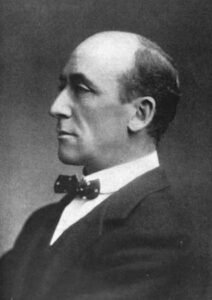
 

From wikipedia.org / © The Outlook


In fact, I’m afraid the trouble with a couple of the stories in Ancient Stories is that Blackwood is so keen to make them appear believable that he over-compensates.  They end up with more prose in them is necessary.  They would have been more digestible if they’d been a dozen pages shorter.


The title story, Ancient Sorceries, is a case in point. Dr John Silence doesn’t feature much in this one.  He just interviews its main character, Arthur Vezin, about some strange experiences and passes comment at the end.  Vezin was travelling by train across northern France when, impulsively, he decided to get off at a remote station, stay in the locality for the night and resume his journey the next day.  (A quiet sort, Vezin had been put off his train journey by the unwelcome presence of many noisy tourists, mainly ‘unredeemed holiday English’.)  Vezin ended up staying in a little town that seemed normal on the surface but, of course, had weird things going on underneath.  A mysterious mental torpor began to affect him.  Rather than get the next day’s train, he remained in the town longer and longer and became increasingly listless:


“It was, I think on the fifth day – though in his detail his story sometimes varied – that he made a definite discovery, which increased his alarm and brought him up to a rather sharp climax…  At the best of times he was never very positive, always negative rather, compliant and acquiescent; yet, when necessity arose, he was capable of reasonably vigorous action and could take a strongish decision.  The discovery he now made that brought him up with such a sharp turn was that this power had positively dwindled to nothing.  He found it impossible to make up his mind…”


Alas, Blackwood’s description of Vezin’s gradual – very gradual – descent into this torpor goes on for too long.  He’s trying to make it sound realistic and credible, but as you read it over several pages, you feel a similar torpor taking possession of your senses.  Things admittedly liven up near the end, but the climax feels like it’s been a long time coming.


Also guilty of this is The Nemesis of Fire, whose action takes place on a remote English country estate, involves artefacts from ancient Egypt and features a fearsome fiery phenomenon that causes things, and people, to burst into flames.  This is narrated by one of Silence’s associates and immediately we’re reminded of a Sherlock Holmes story being told by Holmes’ loyal sidekick, Dr Watson.


This time, too much prose is spent describing, and adulating, Silence’s character.  For example: “His voice had that quiet mastery in it which leads men to face death with a sort of happiness and pride.  I would have followed him anywhere at that moment.  At the same time his words conveyed a sense of dread seriousness.  I caught the thrill of his confidence; but also, in this broad light of day, I felt the measure of alarm that lay behind.”  Yes, this helps us believe Silence is a remarkable man, capable of taking on and defeating supernatural horrors.  But again, it goes on too long.  Sir Arthur Conan Doyle made it plain that Watson greatly admired Holmes, but did so economically and didn’t let it get in the way of the actual story.


That said, the other three tales in this volume are fine.  The Psychical Invasion is a sturdy haunted-house story that benefits from a novel idea.  Rather than bring a team of ghost-hunters with him into the house, Silence comes accompanied by a cat and dog – working on the belief that animals are more sensitive to the paranormal than humans.


Secret Worship is about a man returning to a monastic school in the mountains of southern Germany where he studied as a child – again, this is a ‘Silence-lite’ entry where the detective remains in the background most of the time – and is increasingly disturbed by the hospitality he gets from the brothers / teachers there.  I thought it was the strongest story of the lot, a masterpiece of mounting unease.


The last tale, A Victim of Higher Space, is agreeably wonky and I wonder if a young Ian McEwan read it prior to writing his short story Solid Geometry, which featured in his early collection First Love, Last Rites (1975).


One thing that’s slightly annoying about this book is its incompleteness.  For some reason it omits a sixth Silence story, The Camp of God.  This is included in an earlier collection, The Complete John Silence Stories (2011), which comes with an introduction by S.T. Joshi.  I can’t understand how a publishing company as mighty as Penguin allowed that sixth instalment to slip through the net.
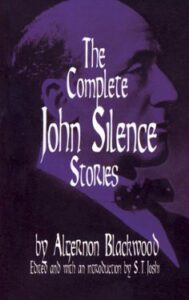
 

© Dover Publications

Rab Foster gets a book deal


© Swords and Sorcery Magazine


Rab Foster, the pseudonym under which I write fantasy fiction, has just had a new short story published in the ezine Swords and Sorcery Magazine.  It’s entitled The Library of Vadargarn and is about a tough, unscrupulous swordsman – is there any other type in sword-and-sorcery stories? – who agrees to transport a strange book in a city where books, reading and libraries are banned.


I should say I’ve always been fascinated by stories involving imaginary, fantastical and / or sinister books, such as The Grasshopper Lies Heavy in Philip K. Dick’s novel The Man in the High Castle (1962); The Book of Sand in Jorge Luis Borges’ 1975 short story of the same name; The King in Yellow in Robert W. Chambers’ 1895 short-story collection of the same name (okay, actually an imaginary play rather than an imaginary book); and the granddaddy of spooky made-up books, The Necronomicon in H.P. Lovecraft’s stories of the Cthulhu Mythos, which was supposedly written by ‘the mad Arab Abdul Alhazred’ in the 8th century and translated into English in Elizabethan times by Dr John Dee, no less.


I’m also a sucker for fantastical or sinister libraries, like the one featured in the short story The Library of Babel (1962) by Jorge Luis Borges again; or the one that appears near the end of Umberto Eco’s medieval detective novel The Name of the Rose (1980) – Eco gently takes the piss out of Borges by having it run by a blind, malevolent librarian called Jorge of Burgos.


Not that any of the above works had any influence on The Library of Vadargarn.  Weirdly enough, the only thing that might have influenced it was the novel I was reading at the time I wrote it, Still Midnight (2009) by the Scottish writer Denise Mina.  This ‘tartan noir’ crime thriller is about a businessman getting kidnapped and, while his family try to put together the ransom money, being held prisoner in a disused furnace in an old Glaswegian factory…  Which may have had some bearing on where the climax of my story takes place.


For the next few weeks, The Library of Vadargarn can be accessed here.

Making room in 2022 for Harry Harrison


© Penguin


As 2022 dawned, I noticed people on social media drawing attention to the fact that this new year is the year in which the famous 1973 sci-fi movie Soylent Green is set.  Starring Charlton Heston, Soylent Green depicts 2022 as a hellish time when overpopulation has exhausted the world’s resources and left many people dependent on a cheap, mass-produced foodstuff called Soylent Green, which is supposed to be made from plankton.  But, as Heston’s policeman hero finds out at the film’s finale, Soylent Green is actually made from – surprise! – people.  Yes, with human civilisation on its knees, capitalism has incorporated cannibalism.


With Soylent Green topical again, I thought I’d write a few words about the book on which the movie is based, Harry Harrison’s Make Room! Make Room! (1966).  It’s less showy but more credible than the movie, a classic of dystopian cinema though it is.  And dare I say it, I think the book is better.


The edition of Make Room! Make Room! I read was one published by Penguin Modern Classics in 2009.  This feels ironic considering that for most of his career Harry Harrison (who died in 2012) was regarded as a solid, meat-and-two-veg-type science fiction writer.  Not the sort of person you’d expect to find favour among mainstream literary critics or have work published by a company synonymous with highbrow literature like Penguin.


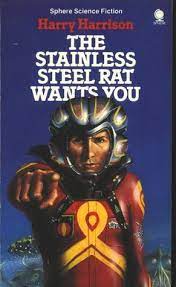
Harrison’s first creative job was actually as an artist, not as a writer.  Following stints in the Air Corps and military police during World War II, which left him disdainful of military culture – in the introduction to one book he wrote that the armed forces’ “mixture of sadism, unquestioned authority, brutality, racism, intolerance, vulgarity, to name but a few, was the antithesis of everything that I believed in” – he spent much of the late 1940s and 1950s drawing and editing comic-books.  It wasn’t until a bout of illness left him, temporarily, unable to draw that he tried his hand at writing.  In the decades that followed, he established himself as one of science fiction’s most popular authors, thanks largely to swashbuckling and tongue-in-cheek space operas like the Stainless Steel Rat books.  I read some of these in my youth and have always thought their comedic and satirical elements helped pave the way for Douglas Adams and his Hitchhiker’s Guide to the Galaxy franchise.


© Sphere


However, space operas and humour were two things unlikely to curry favour with literary critics, which meant that Harrison, though popular, was underrated as a writer.  This was a pity.  For one thing, for a long time, science fiction was a genre whose practitioners included many right-wing dingbats – see Robert Heinlein (whose gung-ho 1959 novel Starship Troopers Harrison took the piss out of with 1965’s Bill the Galactic Hero), Poul Anderson, Jerry Pournelle and Orson Scott Card.  Actually, there’s plenty of them still on the go, such as arsehole extraordinaire Theodore Beale.  Among that lot, Harrison’s authorial voice seemed refreshingly liberal and anti-militaristic and it would’ve been good to see him get more attention.


Anyway, I trust Harrison enjoyed a wry chuckle about Penguin’s decision to label Make Room! Make Room! a ‘modern classic’ three years before his death.


Like the film, Make Room! Make Room! is set in New York, but not in 2022.  The book’s set in 1999, 33 years into the future from when Harrison wrote it.  It describes a New York that’s bursting at its concrete seams with 35 million inhabitants.  Gasoline is all but gone and supplies of food and water are running dangerously low.  While Harrison is warning us of the danger of letting the human population grow unchecked, with the resultant depletion of resources, it’s interesting that the story in the opening chapters unfolds against the backdrop of a sweltering heatwave: “After the damp hallway the heat of Twenty-fifth Street hit him in a musty wave, a stifling miasma compounded of decay, dirt and unwashed humanity…  Days of heat had softened the tar so that it gave underfoot, then clutched at the soles of his shoes.”  This gives the modern-day reader an uncomfortable feeling that what’s really blighting the city is the relentlessly-climbing temperatures of manmade climate change.


The novel’s hero is a tough but dutiful cop called Andy Rusch who’s investigating the murder of a gangster called Michael O’Brien.  Cruelly, O’Brien has been living it up in a swanky gated-community apartment with near-unobtainable luxuries such as liquor and red meat, while Rusch is stuck in a partitioned room cohabited by an old man called Sol.  (Sol spends much of his time pedalling on a wheel-less bicycle that’s wired to an electrical generator, which keeps his ancient TV and fridge running).  Although the city authorities believe that O’Brien was rubbed out by a rival syndicate keen to muscle their way into the city, the murderer is really a hapless young petty criminal called Billy Chung who accidentally killed O’Brien during a bungled robbery.


The book has a double narrative, focusing both on Rusch pursuing the killer and on Chung fleeing and trying to evade capture.  But the plot has a darker momentum too – downwards.  We see Rusch’s life gradually disintegrate as the polluted, over-populated, under-resourced city around him goes from bad to worse and, despite his best efforts, he fails to hold onto the two people who matter most to him: the feisty but vulnerable Sol and the gorgeous and good-hearted Shirl, moll of the late Michael O’Brien, whom Rusch falls in love with during the course of his investigations.


It’s a smart move by Harrison to wrap the apocalyptic content of Make Room! Make Room! in the trimmings of a crime / detective story.  Rather than thrust the horrors of this hellhole New York into our faces, he lets us concentrate, mainly, on the story of Rusch tracking down Chung; while slipping in disturbing details about what’s going on in the background.  There are casual mentions of ‘tugtrucks’ – which we realise are wagons pulled along by teams of sweating, straining human beings, there being no more fuel left for conventional, engine-powered trucks.  Shirl pays a visit to a heavily fortified, heavily guarded hideout that’s not selling drugs, as we initially expect, but selling beefsteaks.  And there are references to Rusch stepping over sleeping or huddling bodies in hallways and stairwells, indicating that hell isn’t quite Jean-Paul Satre’s definition of it as ‘other people’.  No, hell is lots of other people.


© Metro-Goldwyn-Mayer


Returning to Soylent Green, the movie adaptation of Make Room! Make Room!, I should say I remember reading about the film in a book called Future Tense: the Cinema of Science Fiction (1979) written by the movie critic John Brosnan.  As part of his coverage of the film, Brosnan interviewed Harrison and the author had mixed feelings about how his story had been transferred from the page to the screen.


He certainly admired the job that the director Richard Fleischer (another underrated talent) had made of Soylent Green, but he begrudged some of the changes wrought by the filmmakers.  For instance, Sol – who in Soylent Green is played by Edward G. Robinson – dies in the book from injuries he sustains after he takes part in a demonstration, in support of family planning, that turns into a riot.  In the movie, Sol decides he’s had enough of the increasingly-shitty world and goes to a ‘euthanasia clinic’ to end it all.  Harrison wasn’t impressed by this because, unbeknownst to the filmmakers, euthanasia clinics and suicide machines are something of a cliché in science fiction.  (At the time that I read Make Room! Make Room!, I also read Robert W. Chambers’ The King in Yellow, first published in 1895, and it had something in it called a ‘government lethal chamber’.)  However, he conceded that the depiction of Sol’s death in the film was powerful.  While the old man expires, calming images of fields, forests, flowers, wildlife, unpolluted oceans and other things that he probably hasn’t seen since his youth are projected around him.


And Harrison didn’t like Soylent Green’s ending, which ironically has become its best-remembered moment – wherein Charlton Heston makes the discovery that everyone’s favourite snack in 2022 is secretly made out of recycled human corpses and, wounded, he’s carried away yelling, “Soylent Green is people!”  Harrison had researched Make Room! Make Room! meticulously to make its apocalypse seem as realistic as possible, so he knew that the idea of humanity relying on industrialised cannibalism to survive wasn’t feasible.  Human beings don’t fatten up very quickly and they require a lot of feeding and looking after, so as a form of livestock to meet the world’s dietary needs, they’re economically a bad idea.  And as this study has shown, they’re not even that rich in calories.


By way of contrast, Make Room! Make Room! ends with Rusch on duty in Times Square on the eve of the Millennium – and while the beleaguered city enters the 21st century, he’s given a bitter reminder that no matter how bad things get for the great mass of humanity, there’ll always be a wealthy minority who carry on living in luxury.


I assume Harrison set Make Room! Make Room! in 1999 because he couldn’t resist having its final scene occur at the dawn of the new Millennium, a moment loaded with significance.  However, that doesn’t make the book any less terrifying in 2022.  After all, the human population is quite likely to hit the eight-billion mark before the end of this year.  As well as putting intolerable strains on the world’s supplies of soil, water, vegetation and animal life, this burgeoning number of people means greater production of greenhouse gases and worsening manmade climate change.  And it means more human encroachment on the natural world, with the danger that lethal viruses may mutate and switch from living in animal hosts to living in human ones.  The past two years have seen us struggling to deal with just one instance of that happening.


Today more than ever, Make Room! Make Room! is an example of ‘science fiction’ threatening to become ‘science fact’ – in the worst possible way.


From philosophyofscienceportal.blogspot.com