The girl and boys who cried wolf


I was not in the best of moods last Thursday evening when I arrived at the concert English alternative-rock band Wolf Alice played in Singapore as part of their current world tour.  A while earlier, I’d been on a bus when I messaged my wife, who was working an evening shift, to inform her I was now making my way ‘to see Wolf Alice at the Star Theatre.’  Then I thought: Hold on, something’s wrongThe Star Theatre?  In the months ahead, some big musical acts are certainly scheduled to perform at the Star – Dream Theatre, The Darkness, Kraftwerk…  But was I absolutely sure Wolf Alice were playing there too?


So I consulted my Wolf Alice ticket – and discovered I’d screwed up.  Their show was actually at the Capitol Theatre, meaning I was on the wrong bus, travelling in the wrong direction.  I jumped out when the bus stopped at the next MRT station and got to the Capitol Theatre as fast as I could on Singapore’s MRT system, though the fact that en route I had to change from its Circle Line to its East West Line slowed me down.  And when I got to the Capitol, Wolf Alice had already played 20 minutes of their set.


Concert tickets are expensive in Singapore and you really don’t want to miss 20 minutes’ worth of live music…  Anyhow.  Maybe I’m suffering from the start of early-onset dementia.


A residue of my bad humour remained at the end.  After the band had finished their encore and left the stage, and the auditorium lights had come on, the theatre’s PA system started playing that perennially popular anthem by Queen, Bohemian Rhapsody (1975).  Okay, I’m not quite as sick of Bohemian Rhapsody as I am of, say, of Led Zeppelin’s Stairway to Heaven (1971) or the Eagles’ Hotel California (1976), but having heard Rhapsody about 10,000 times now it does put my teeth on edge.  For some reason, many in the crowd started to sing along to it.  They gesticulated flamboyantly, in keeping with the song’s operatic sound, and also huddled together to pose for multiple selfies.  I just wanted to leave.  However, countless Freddy Mercury-impersonating, selfie-snapping exhibitionists were blocking my way to the exits.  I found myself snarling under my breath, “I don’t care if Beelzebub’s got a devil set aside for you.  Just get out the f**king road.”



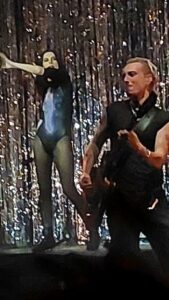
But what of Wolf Alice themselves?  Tonight the band performed picturesquely in front of a simple but effective backdrop – a curtain of dangling, billowing and spangly strands that, depending on what colour of light shone upon it, sparkled like red rubies, green emeralds, purple amethysts and silvery… er, pieces of silver.


They’re currently promoting their fourth album to date, 2025’s The Clearing, and their Capitol Theatre setlist featured nine of its songs.  Critics have found The Clearing a quieter, mellower affair after the more raucous sound of its predecessors.  The New Musical Express described it as “the kind of album that could only be written after the dust has settled on your twenties and the post-30 clarity sets in.”  Well, it’s been a long time indeed since the dust settled on both my twenties and my thirties, but I have to say I prefer Wolf Alice’s brasher twenties stuff and would have liked slightly more of their older songs and slightly fewer of their newer ones.  Then again, I’m someone whose musical tastes gravitate towards the heavier end of the spectrum.


I should add that the crowd, who seemed equally divided between locals and foreigners, greeted the old and new with equal enthusiasm.  Actually, I grimaced when, during a couple of the ballads, the crowd reacted by turning on the torches on their phones and slowly waving them above their heads.  Flashlight waves should be banned from concerts.  Banned from the planet, full-stop.



That said, I really liked the recent song Safe in the World, where guitarist Joff Oddie’s twangy country-rock hook hinted at Lynyrd Skynyrd’s Sweet Home Alabama (1974).  The song is a lot better than another one that, less subtly, references Sweet Home Alabama, that super-annoying Kid Rock thing, All Summer Long, from 2007.


And when they did play their old, rocky stuff, the gig was great.  Particularly good was the manner in which they rounded off the main part of their set, prior to the encore, with the belters Giant Peach (2015) and Smile (2021).  These had the audience bouncing up and down so energetically that I felt tremors coursing through the Capitol Theatre’s floor.  Also praiseworthy was singer and front-woman Ellie Rowsell, who projects true star quality and attitude.  She’s a worthy addition to a long and distinguished line of rock-music front-women that includes Siouxsie Sioux, Chrissie Hynde, Kim Gordon and Shirley Mansun.


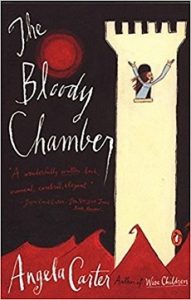
A couple of other things I like about Wolf Alice.  Firstly, they seem to be genuinely good guys – they’ve put their names and voices to campaigns to keep British live-music venues in business and to help up-and-coming bands to be able to tour, earn money and meet the generally high costs of working in the music industry in 2025.  Also, they’re named after a short-story by Angela Carter, WolfAlice, which appeared in her 1979 collection The Bloody Chamber.  And any rock band smart enough to take their name from a work by the sublime Ms. Carter has my respect.
 

In good company


© Palace Productions / ITC / Cannon


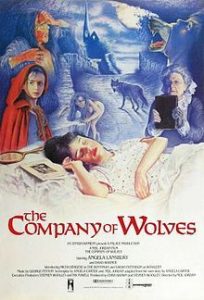
The fact that it’s almost Halloween, and the death a week ago of venerable film, theatre and TV actress Angela Lansbury, give me an excuse to repost this item that I originally wrote in 2018 about the elegant fantasy-horror movie The Company of Wolves (1984).  I wasn’t a great fan of her long-running ‘cosy’ detective series Murder She Wrote (1984-96), so I consider this to be Angela’s finest hour. 


The Company of Wolves, the 1984 werewolf movie directed by Neil Jordan, based on fiction by Angela Carter and co-scripted by Jordan and Carter, is one of my favourite films of the 1980s – of any genre, not just horror.


No doubt part of my fondness for the film stems from its source material, because I’m a big fan of the late Angela Carter and her sumptuous gothic prose.  While I was doing an MA in 2008-2009 at the University of East Anglia in Norwich, where Carter had once taught creative writing, I was delighted one day when I got chatting with an elderly assistant at the campus bookshop and she reminisced about Carter and how she used to wander around “in a big billowy dress.”


© Penguin Books


The Company of Wolves began life as a short story featured in her 1979 collection The Bloody Chamber.  Considering how other stories in the book are adult, gothic reworkings of such fairy tales and myths as Beauty and the Beast (The Courtship of Mr Lyon), Snow White (The Snow Child) and Bluebeard (the title story), it’s no surprise that The Company of Wolves is a version of Little Red Riding Hood with, as its villain, not a big bad wolf but an even bigger and badder werewolf.


Carter’s Company of Wolves takes its time getting to its main plotline, though.  It begins by recounting several shorter tales and anecdotes that explore wolf and werewolf lore, and the Red Riding Hood character doesn’t set off into the forest to visit Grandmother’s house until halfway through its ten pages.  Additionally, The Company of Wolves is part of a triptych of werewolf-related stories in The Bloody Chamber – it’s sandwiched between ones called The Werewolf and Wolf-Alice (which as well as being an Angela Carter story is the name of a not-bad alternative rock / indie band).  Not only does Jordan’s movie copy the rambling, episodic and anecdotal structure of the fictional Company of Wolves, but it also borrows elements from its two hairy neighbours in the collection.


Translating into celluloid Carter’s ornate prose style – which, for example, describes a midwinter forest with “huddled mounds of birds, succumbed to the lethargy of the season, heaped on the creaking boughs and too forlorn to sing” and “bright frills of the winter fungi on the blotched trunks of the trees” and “a hare as lean as a rasher of bacon streaking across the path where the thin sunlight dapples the russet brakes of last year’s bracken” – was a job to which the Irish director and writer Neil Jordan was well suited.   His CV includes atmospheric and flamboyant supernatural movies like Interview with the Vampire (1994) and Byzantium (2012), plus the twisted, gothic Irish psycho-comedy The Butcher Boy (1997); and many of his supposedly more realistic films like Angel (1982), Mona Lisa (1986) and The Crying Game (1992) are imbued with a phantasmagorical quality too.


With The Company of Wolves, Jordan and his production team – take a bow, cinematographer Bryan Loftus, production designer Anton Furst and art director Stuart Rose – excel themselves in crafting   a physical setting for Carter’s stories.  The movie mostly takes place in a pre-industrial village and a huge, surrounding, Ruritanian forest.  It’s an environment that’s both quaint with thatched cottages, cobbled streets, mossy churchyards and humped stone bridges and lush with bright-coloured flowers, shaggy trees, trailing vines,  beds of fallen leaves and nests of speckled eggs (which, disconcertingly, hatch and release tiny homunculi).  Yet it’s also a claustrophobic place of misshapen branches, drifting fogs, deep snowbanks and, obviously, wolf-howls that pierce out of the dark recesses of the forest.  In other words, it’s part Romantic poem, part fevered dream and part Hammer horror.


© Palace Productions / ITC / Cannon


If anything, the plotting in the film of The Company of Wolves is more disorientating than that in the original story.  The central structure is similar.  We get a clutch of little stories about werewolves – here told to teenage heroine Rosaleen (Sarah Patterson) by her grandmother (Angela Lansbury) and then, later, told by Rosaleen herself – before the film settles down to its main narrative, which is what happens one day when Rosaleen dons a red woollen shawl, leaves her village and takes a walk through the forest to her grandmother’s secluded cottage.


However, the film places this within a framing device that has Rosaleen as a modern-day girl who, while taking an afternoon nap in her bedroom, dreams about being in a fairy-tale village in a fairy-tale forest.  As we descend through Rosaleen’s subconscious to the main part of the dream, we also pass through a creepy transitional zone populated by human-sized versions of the dolls and toys in her bedroom, which calls to mind another Angela Carter work, the 1967 novel The Magic Toyshop.  At the film’s end, this stories-told-within-a-dream framework collapses, for poor modern-day Rosaleen wakes from her dream to find real wolves crashing through the walls of her room.  None of which matters, of course.  The Company of Wolves isn’t a film to be processed logically.  It’s one to be experienced.


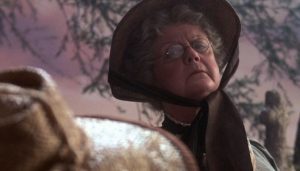
It hasn’t much character development, since the characters are archetypes rather than proper human beings, but it’s still well acted by a first-rate cast.  Sarah Patterson does what’s required of her as Rosaleen and German actor, dancer and choreographer Micha Bergese is appropriately lithe, flirtatious and predatory as the young hunstsman whom Rosaleen encounters on the way to her grandmother’s house.  (His eyebrows meet above his nose, which is a dead giveaway.)  Angela Lansbury makes a wonderfully spry and wily grandmother and the film also features the excellent trio of David Warner as Rosaleen’s father in both the dream world and the real one, Graham Crowden as the village’s amiable priest, and Brian Glover as the village’s resident Yorkshireman.  At one point, Glover pontificates in true Yorkshire fashion: “If you think wolves are big now, you should have seen them when I were a lad!”


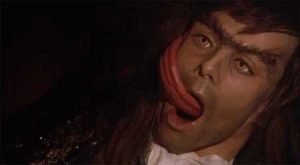
In the cast too are Terence Stamp and Jordan’s long-time collaborator Stephen Rea, both of whom appear in the first two stories narrated by Lansbury.  Stamp has a cameo as the Devil, selling a youth a magical balm that, once applied, has lycanthropic consequences.  Rea plays a man who mysteriously disappears on his wedding night and then equally mysteriously reappears seven years later, to discover that his wife has since remarried and sired a brood of children with her new husband.  In the film’s most gruesome sequence, Rea shows his displeasure by becoming a werewolf – a painful process because, to facilitate the transformation, he has to tear his own skin off.


© Palace Productions / ITC / Cannon


With the young, virginal Rosaleen setting out on a journey and being waylaid by a literally beastly male, but then taking control of the situation and resolving it in her own fashion, there’s obviously a lot happening beneath the film’s surface.  However, I like the fact that while The Company of Wolves is concerned with themes of female empowerment and sexuality, it isn’t a polemic.  Yes, one of Lansbury’s tales ends with an instance of domestic violence, and one of Rosaleen’s tales deals with a wronged woman getting her revenge on the cad responsible.  But her parents are depicted as having a loving and sharing relationship.  Despite coming to this film after villainous roles in Time After Time (1979), The Time Bandits (1981) and Tron (1982), Warner plays a gentle soul here; and Rosaleen’s mother (Tusse Silberg) points out to her that “if there’s a beast in man, it meets its match in women too.”  Meanwhile, a village boy (Shane Johnstone) who takes a shine to Rosaleen, while evidently a lustful scamp, is good-hearted enough and shows concern for her safety.


This nuance extends to the film’s portrayal of the church.  It’s hardly an institution of oppressive patriarchy.  Rosaleen’s final tale has Graham Crowden’s priest showing kindness to a feral wolf-girl, played by experimental 1980s singer-musician Danielle Dax.  “Are you God’s work or the Devil’s?” he asks her.  “Oh, what do I care whose work you are.  You poor, silent creature…”


You appreciate Jordan and Carter’s achievement with The Company of Wolves when you consider how many filmmakers since then have tried, and failed, to transform children’s fairy stories into darker, more adult and more gothic movies.  I’m thinking of Terry Gilliam’s disappointingly uneven Brothers Grimm (2005) or the blah Kristen Stewart vehicle Snow White and the Huntsman (2012) or crud like Red Riding Hood (2011) and Hansel and Gretel: Witch Hunters (2013).


Probably the best effort has been Matteo Garrone’s Italian / French / British movie Tale of Tales (2015) which, like The Company of Wolves, isn’t afraid to confound expectations and twist and distort logic.  Which, when you think about it, is what the original fairy tales and folk tales that inspired both films did in the first place.


© Palace Productions / ITC / Cannon