The girl and boys who cried wolf


I was not in the best of moods last Thursday evening when I arrived at the concert English alternative-rock band Wolf Alice played in Singapore as part of their current world tour.  A while earlier, I’d been on a bus when I messaged my wife, who was working an evening shift, to inform her I was now making my way ‘to see Wolf Alice at the Star Theatre.’  Then I thought: Hold on, something’s wrongThe Star Theatre?  In the months ahead, some big musical acts are certainly scheduled to perform at the Star – Dream Theatre, The Darkness, Kraftwerk…  But was I absolutely sure Wolf Alice were playing there too?


So I consulted my Wolf Alice ticket – and discovered I’d screwed up.  Their show was actually at the Capitol Theatre, meaning I was on the wrong bus, travelling in the wrong direction.  I jumped out when the bus stopped at the next MRT station and got to the Capitol Theatre as fast as I could on Singapore’s MRT system, though the fact that en route I had to change from its Circle Line to its East West Line slowed me down.  And when I got to the Capitol, Wolf Alice had already played 20 minutes of their set.


Concert tickets are expensive in Singapore and you really don’t want to miss 20 minutes’ worth of live music…  Anyhow.  Maybe I’m suffering from the start of early-onset dementia.


A residue of my bad humour remained at the end.  After the band had finished their encore and left the stage, and the auditorium lights had come on, the theatre’s PA system started playing that perennially popular anthem by Queen, Bohemian Rhapsody (1975).  Okay, I’m not quite as sick of Bohemian Rhapsody as I am of, say, of Led Zeppelin’s Stairway to Heaven (1971) or the Eagles’ Hotel California (1976), but having heard Rhapsody about 10,000 times now it does put my teeth on edge.  For some reason, many in the crowd started to sing along to it.  They gesticulated flamboyantly, in keeping with the song’s operatic sound, and also huddled together to pose for multiple selfies.  I just wanted to leave.  However, countless Freddy Mercury-impersonating, selfie-snapping exhibitionists were blocking my way to the exits.  I found myself snarling under my breath, “I don’t care if Beelzebub’s got a devil set aside for you.  Just get out the f**king road.”


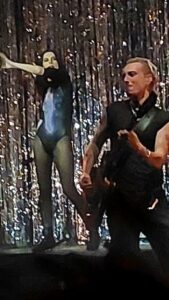
But what of Wolf Alice themselves?  Tonight the band performed picturesquely in front of a simple but effective backdrop – a curtain of dangling, billowing and spangly strands that, depending on what colour of light shone upon it, sparkled like red rubies, green emeralds, purple amethysts and silvery… er, pieces of silver.


They’re currently promoting their fourth album to date, 2025’s The Clearing, and their Capitol Theatre setlist featured nine of its songs.  Critics have found The Clearing a quieter, mellower affair after the more raucous sound of its predecessors.  The New Musical Express described it as “the kind of album that could only be written after the dust has settled on your twenties and the post-30 clarity sets in.”  Well, it’s been a long time indeed since the dust settled on both my twenties and my thirties, but I have to say I prefer Wolf Alice’s brasher twenties stuff and would have liked slightly more of their older songs and slightly fewer of their newer ones.  Then again, I’m someone whose musical tastes gravitate towards the heavier end of the spectrum.


I should add that the crowd, who seemed equally divided between locals and foreigners, greeted the old and new with equal enthusiasm.  Actually, I grimaced when, during a couple of the ballads, the crowd reacted by turning on the torches on their phones and slowly waving them above their heads.  Flashlight waves should be banned from concerts.  Banned from the planet, full-stop.


That said, I really liked the recent song Safe in the World, where guitarist Joff Oddie’s twangy country-rock hook hinted at Lynyrd Skynyrd’s Sweet Home Alabama (1974).  The song is a lot better than another one that, less subtly, references Sweet Home Alabama, that super-annoying Kid Rock thing, All Summer Long, from 2007.


And when they did play their old, rocky stuff, the gig was great.  Particularly good was the manner in which they rounded off the main part of their set, prior to the encore, with the belters Giant Peach (2015) and Smile (2021).  These had the audience bouncing up and down so energetically that I felt tremors coursing through the Capitol Theatre’s floor.  Also praiseworthy was singer and front-woman Ellie Rowsell, who projects true star quality and attitude.  She’s a worthy addition to a long and distinguished line of rock-music front-women that includes Siouxsie Sioux, Chrissie Hynde, Kim Gordon and Shirley Mansun.


A couple of other things I like about Wolf Alice.  Firstly, they seem to be genuinely good guys – they’ve put their names and voices to campaigns to keep British live-music venues in business and to help up-and-coming bands to be able to tour, earn money and meet the generally high costs of working in the music industry in 2025.  Also, they’re named after a short-story by Angela Carter, WolfAlice, which appeared in her 1979 collection The Bloody Chamber.  And any rock band smart enough to take their name from a work by the sublime Ms. Carter has my respect.


Jim Mountfield downloads the app again


© The Stygian Lepus


I’m happy to announce that I’ve just had my first fiction published in 2026 – though it’s the second half of a story whose first instalment appeared in print at the end of last year.


Appopolis Now, Part Two is available to read in Issue 31 of the Stygian Lepus – a magazine whose prose and poetry, says its editorial, take place in “regions where the boundaries of thought dissolve, where shadows are not merely the absence of light but living participants in the stories that unfold.”  If you think that makes the contents of the Stygian Lepus sound macabre in nature, you’re right.  For that reason, Appopolis Now, a tale about a near-future society that’s outwardly utopian but where citizenship comes at a grim cost to the individual’s sense of physical and mental self, is attributed to Jim Mountfield, the pseudonym under which I write scary stories.


Over the next month, to access the 31st edition of the Stygian Lepus and its 11 stories and five poems, please go to this webpage here.  And as a kind bonus from the Stygian Lepus team, the same webpage also gives access to a self-contained edition of Appopolis Now that presents the story in its entirety.


© The Stygian Lepus

Weird Penguin: Ancient Sorceries


© Penguin Books


In 2024 Penguin books inaugurated its Weird Fiction series, which to date has seen the republication of five venerable titles: Robert Chambers’ The King in Yellow (1895), William Hope Hodgson’s The House on the Borderland (1908), Gertrude Barrows Bennett’s Claimed! (1920), Algernon Blackwood’s Ancient Sorceries and a collection, Weird Fiction: An Anthology (2024).  Well, I assume Weird Fiction: An Anthology is a new collection, but it consists of some venerable short stories.


I’d already read those first two novels and most of the tales in the anthology, whose line-up includes such well-kent scribblers as Edgar Allan Poe, H.P. Lovecraft, W.W. Jacobs, May Sinclair, M.R. James and Sir Arthur Conan Doyle.  But I hadn’t read the Bennett and Blackwood books.  Recently, their striking covers – illustrated in pastel colours, especially pink – caught my eye while I was in a Singaporean bookshop I frequent, Kinokuniya Books in Orchard Road’s Takashimaya Shopping Centre, and I wasted no time in buying them.


Here are my thoughts on the volume by Algernon Blackwood.  I’ll write about the Gertrude Barrows Bennet one later.


Ancient Sorceries contains five stories, the title one plus A Psychical Invasion, The Nemesis of Fire, Secret Worship and A Victim of Higher Space.  All feature Dr John Silence, described in the book’s blurb as “Physician Extraordinary… the greatest occult detective of the age.”  Yes, Silence is what in modern parlance we’d call a ‘paranormal investigator’ – but when the paranormal manifests itself in malevolent forms, he also battles against it.


Series of stories about occult detectives have been common in horror fiction… and I have to say I have a problem with them.  That problem is one of believability.  You can swallow the notion of the hero having one dramatic encounter with the supernatural in one story, maybe even of them having a second dramatic encounter with it in a second story.  But when that hero deals in story after story with supernatural jiggery-pokery, cropping up in different forms – ghosts, werewolves, poltergeists, whatever – it becomes almost impossible to take seriously.  That’s especially so when you consider how most human beings go through their lives with no contact at all with what might be defined as ‘occult’ or ‘paranormal’.  (During my many years on the planet, I’ve had one strange experience, lasting all of half-a-minute, which I couldn’t explain and which, if I was so inclined, I could attribute to the supernatural.)  This means a writer of such tales has to show a great deal of skill in making them seem plausible.


Also implausible is the idea that the occult detective, a mortal human being, can constantly take on dark forces of immense, unnatural power and triumph over them.  The success rate for the heroes of these stories suggests that the forces of darkness are, in reality, pretty weak sauce.


The afore-mentioned William Hope Hodgson wrote stories about an occult detective called Carnacki the Ghost Finder, first published as a collection in 1913.  He managed, I feel, to get away with it.  Hope Hodgson helped make his tales more believable by interspersing the ones where the threat was genuinely supernatural with ones where, Scooby Doo-style, it turned out to be a hoax.  Also, his usual narrative device – Carnacki told each story to a group of mates with whom he’d just had dinner – helped too, since it’s possible Carnacki could be exaggerating what happened or even just making it up.


On the other hand, I’ve read a few stories that the prolific pulp writer Seabury Quinn wrote about a French occult detective called Jules de Grandin and found them bloody awful.  (It doesn’t help that de Grandin’s patois – “Sang du diable…!  Behold what is there, my friend…  Parbleu, he was caduo – mad as a hatter, this one, or I am much mistaken!” – is closer to Inspector Clouseau than Hercule Poirot.)


Usually, the best I can hope for is to regard the stories as out-and-out fantasies – which is the case with Manley Wade Wellman’s stories of Silver John, set in the Appalachian Mountains.  Or as ‘silly but fun’ – the reaction I had to Alice and Claude Askew’s stories about Aylmer Vance (‘Ghost-seer’).  But in no way do I find them scary.


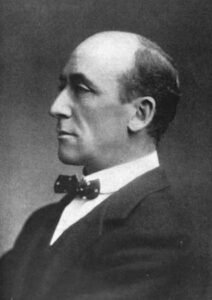
Blackwood, in his day a celebrated author, journalist, broadcaster and, generally, someone who ‘lived the life’ – his CV includes stints as a farmer, hotelier, barman, model, secretary, businessman and violin teacher and he was also a Theosophist and eager outdoorsman – has a big reputation as a writer of chilling stories.  The literary critic S.T. Joshi lauded his fiction as “more consistently meritorious than any weird writer’s except Dunsany’s”, and anything by him I’ve read before now I’ve found impressive.  I was thus looking forward to seeing how he would tackle this subgenre and its believability issue.


From wikipedia.org / © The Outlook


In fact, I’m afraid the trouble with a couple of the stories in Ancient Stories is that Blackwood is so keen to make them appear believable that he over-compensates.  They end up with more prose in them is necessary.  They would have been more digestible if they’d been a dozen pages shorter.


The title story, Ancient Sorceries, is a case in point. Dr John Silence doesn’t feature much in this one.  He just interviews its main character, Arthur Vezin, about some strange experiences and passes comment at the end.  Vezin was travelling by train across northern France when, impulsively, he decided to get off at a remote station, stay in the locality for the night and resume his journey the next day.  (A quiet sort, Vezin had been put off his train journey by the unwelcome presence of many noisy tourists, mainly ‘unredeemed holiday English’.)  Vezin ended up staying in a little town that seemed normal on the surface but, of course, had weird things going on underneath.  A mysterious mental torpor began to affect him.  Rather than get the next day’s train, he remained in the town longer and longer and became increasingly listless:


“It was, I think on the fifth day – though in his detail his story sometimes varied – that he made a definite discovery, which increased his alarm and brought him up to a rather sharp climax…  At the best of times he was never very positive, always negative rather, compliant and acquiescent; yet, when necessity arose, he was capable of reasonably vigorous action and could take a strongish decision.  The discovery he now made that brought him up with such a sharp turn was that this power had positively dwindled to nothing.  He found it impossible to make up his mind…”


Alas, Blackwood’s description of Vezin’s gradual – very gradual – descent into this torpor goes on for too long.  He’s trying to make it sound realistic and credible, but as you read it over several pages, you feel a similar torpor taking possession of your senses.  Things admittedly liven up near the end, but the climax feels like it’s been a long time coming.


Also guilty of this is The Nemesis of Fire, whose action takes place on a remote English country estate, involves artefacts from ancient Egypt and features a fearsome fiery phenomenon that causes things, and people, to burst into flames.  This is narrated by one of Silence’s associates and immediately we’re reminded of a Sherlock Holmes story being told by Holmes’ loyal sidekick, Dr Watson.


This time, too much prose is spent describing, and adulating, Silence’s character.  For example: “His voice had that quiet mastery in it which leads men to face death with a sort of happiness and pride.  I would have followed him anywhere at that moment.  At the same time his words conveyed a sense of dread seriousness.  I caught the thrill of his confidence; but also, in this broad light of day, I felt the measure of alarm that lay behind.”  Yes, this helps us believe Silence is a remarkable man, capable of taking on and defeating supernatural horrors.  But again, it goes on too long.  Sir Arthur Conan Doyle made it plain that Watson greatly admired Holmes, but did so economically and didn’t let it get in the way of the actual story.


That said, the other three tales in this volume are fine.  The Psychical Invasion is a sturdy haunted-house story that benefits from a novel idea.  Rather than bring a team of ghost-hunters with him into the house, Silence comes accompanied by a cat and dog – working on the belief that animals are more sensitive to the paranormal than humans.


Secret Worship is about a man returning to a monastic school in the mountains of southern Germany where he studied as a child – again, this is a ‘Silence-lite’ entry where the detective remains in the background most of the time – and is increasingly disturbed by the hospitality he gets from the brothers / teachers there.  I thought it was the strongest story of the lot, a masterpiece of mounting unease.


The last tale, A Victim of Higher Space, is agreeably wonky and I wonder if a young Ian McEwan read it prior to writing his short story Solid Geometry, which featured in his early collection First Love, Last Rites (1975).


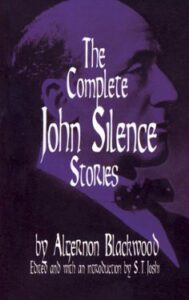
One thing that’s slightly annoying about this book is its incompleteness.  For some reason it omits a sixth Silence story, The Camp of God.  This is included in an earlier collection, The Complete John Silence Stories (2011), which comes with an introduction by S.T. Joshi.  I can’t understand how a publishing company as mighty as Penguin allowed that sixth instalment to slip through the net.


© Dover Publications

My 2025 writing round-up


© Schlock! Webzine


All in all, 2025 was a horrible year: one in which an unholy alliance of authoritarians, kleptocrats, fascists, media tycoons, tech bros and oil barons worked hard at stripping freedoms from those of us living in societies that have, until now, retained some freedoms; at transferring another huge chunk of wealth from our dwindling coffers to their swelling coffers; and at burning and poisoning the planet we live on in their quest for profits whilst aggressively pushing the line that any science questioning this policy is a ‘hoax’.  But you’ve probably noticed that.  You don’t need me to tell you.


On a personal level, and regarding my writing career, 2025 for a time looked like it would be horrible too.  The previous year, 2024, had been my most successful one ever, with its twelve months seeing 17 of my short stories published.  However, in my writing round-up for 2024, I noted warily that “I will be hard-pressed to equal or better that record in 2025…  That’s because of the recent disappearances of certain magazines (like The Sirens Call) and publishers (like Midnight Street Press) who have published my stuff regularly in the past.”  Yes, those closures impacted on me this year.  But for a period of four of five months in the middle of 2025, I really felt that, submissions-wise, I couldn’t get myself arrested.  I sent story after story to publication after publication and, relentlessly, rejection after rejection came back.


For a while, my efforts at fiction seemed about as popular as a Cybertruck in a Tesla showroom in a district of Washington DC heavily populated by ex-government employees.


But…  “If at first you don’t succeed, Mr Kidd…”  “…Try, try again, Mr Wint.”


In keeping with the philosophy of Mr Kidd and Mr Wint, the two camp assassins in Diamonds are Forever (1971) who indefatigably persevere in their efforts to dispose of Sean Connery, I tried and tried again.  And unexpectedly, I had a breakthrough near the end of the year.  Half-a-dozen of my stories got into print in November and December.  Also surprising – since I’ve never considered myself a particularly Christmassy person – was the fact that three of these stories appeared in anthologies or magazine issues dedicated to the festive season.


Anyway, here’s a summary of the fiction I’ve had published in 2025.  It includes details of where they were published, which pseudonym they were published under and how they can be accessed today.


As Jim Mountfield:

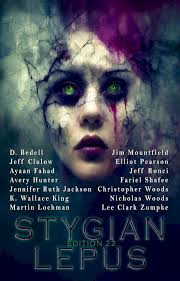
  • Jim Mountfield, the penname under which I write horror stories, had his first 2025 success with a story that appeared in Issue 22 of the Stygian Lepus magazine.  It was entitled Beach Bodies, was set in Bali, and was about an older man coming into conflict with an extreme manifestation of the foreign backpacker and influencer culture that overruns the island’s tourist spots.  Issue 22 of the Stygian Lepus can be purchased here.
  • In July, a Mountfield story called Slot Boy was featured in Volume 19, Issue 6 of Schlock! Webzine.  At the time I described Slot Boy, which was set in Scotland and not wholly serious in tone, as having a “Scottish backdrop of parochial wee towns, middle-aged neds, cranky auld wifies, mobility scooters, and terrible football.”  You can buy that particular issue of Schlock! Webzine here.


© Spiral Tower Press


  • My next two Mountfield stories were also set in Scotland. Halloween 2025 saw the release of Issue 5 of Witch House Magazine, whose contents included The Bustle in the Hedgerow.  This story drew on a number of inspirations: a historian who once visited my family’s farm while hunting for the remains of a Roman fort; a hedge my father once planted on the farm after receiving an environmental grant; and the supposedly true story of two ancient Celtic stone heads, known as the Hexham Heads, which caused terrifying paranormal activity to assail anyone who came into ownership of them.  The Hexham Heads traumatized a generation of kids in the UK in the 1970s when the BBC current-affairs show Nationwide broadcast a report about them.  Issue 5 of Witch House can be downloaded here.
  • Early in December, a Mountfield story called The Dark Crooked One appeared in a seasonal anthology from Black Hare Press, Eerie Christmas 4. This combined a legend about Scottish bogeyman who supposedly appears during the shortest days of the year, including December 25th, with the real-life tensions that can arise at Christmas – namely, when you stick a not-particularly-happy family together in a room all day, make them eat and drink too much, and pressurise them into acting like they’re having a good time when, in fact, they’re not.  Go here to buy a copy of Eerie Christmas 4.
  • And later in December, Jim Mountfield was responsible for the first part of a science-fictional horror story, entitled Appopolis Now and set in an imaginary Asian country in the near-future, that turned up in Issue 30 of the Stygian LepusAppopolis Now is currently available to read here.  Its second and final part should appear in the 31st issue of the Stygian Lepus next month.


As Rab Foster:

  • Meanwhile, my fantasy-writing alter-ego Rab Foster had his first 2025 story published in April when one called The Cats and the Crimson was accepted for Issue 159 of the monthly webzine Swords and Sorcery Magazine. The first half of the title reflects the fact that the story contains cats – both domestic cats and some ghoulish, demonic variations on the feline species.  The second half of it indicates the presence in its cast of Cranna the Crimson, a fearless and rather incorrigible swordswoman who’s already been a character in two of my earlier published stories.  You can read the story in Swords and Sorcery Magazine’s archive, here.
  • The next month, a Foster story called The Shrine on the Moor appeared in Volume 19, Issue 4 of Schlock! Webzine. This featured another recurring character of mine, the mercenary Drayak Shathsprey, and was a sequel to a story called Pit of the Orybadak, which had been published in the magazine Savage Realms Monthly at the start of the previous year.  Volume 19, Issue 4 can be purchased here.


© Cloaked Press, LLC


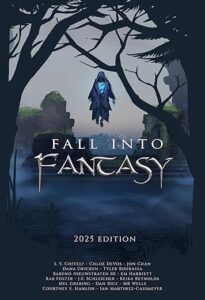
  • September saw the publication of another instalment in the yearly Fall into Fantasy anthology series published by Cloaked Press.  Fall into Fantasy 2025’s line-up of stories included a Rab Foster one called From Out the Boundless Deep.  Its main character, Kayra, had previously featured in a story called The Trap Master, published in the webzine Aphelion in 2018.  As I wrote on this blog: “The premise of both stories is that Kayra inhabits a world where all the creatures of myth and legend – griffins, hydras, harpies, kelpies, minotaurs, etc. – are real and she makes a living by hunting and trapping them.”  In From Out the Boundless Deep, Karya gets summoned to a remote beach where something large and mysterious has just been washed up.  Fall into Fantasy 2025 is on sale here.
  • The year ended with Rab Foster getting another story placed in Swords and Sorcery Magazine, this time one entitled The Palanquin. It’s an attempt to tell a fantasy story set within the confines of a very limited space – the interior of the conveyance of the title.  It features yet another recurring character in the Foster universe, the swordswoman and mercenary Keeshan, who appears sometimes as a partner to Drayak Shathsprey and sometimes as a lone agent.  Shathsprey has a role in The Palanquin too, but it’s a minor one.  Currently, the story can be read here.


As Steve Cashel:

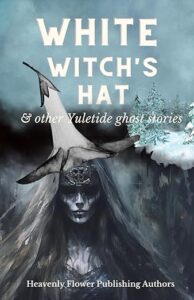
  • I usually write non-horror and non-fantasy fiction that’s set in Scotland under the pseudonym Steve Cashel. This year, atypically, he had a story turn up in another anthology of supernatural Christmas tales, White Witch’s Hat and Other Yuletide Ghost Stories from Heavenly Flower Publishing.  The reason for this was because the story in question, Southbound Traveller, was set in a Scottish household on Christmas Day in the early 1990s and for most of its length was realistic in tone.  Only near the end does something strange happen – and it’s more a ‘paranormal incident’ than a manifestation by a ghost or other supernatural entity.  (An inspiration for the story was actually Hans Christian Anderson’s 1845 fairy tale The Little Match Girl.)  It seemed more like a Steve Cashel story than a Jim Mountfield one, so Cashel got the credit.  To purchase a copy of White Witch’s Hat and Other Yuletide Ghost Stories, please click here.


© Heavenly Flower Publishing


As Paul McAllister

  • Finally, I managed to get two short stories published in December 2025 under the penname of Paul McAllister, which I use for non-scary, non-fantastical fiction set in Ireland.  This felt like scoring two goals in injury time at the end of a football match.  The first of the stories was called That Time and was based on a memory of a brief but harrowing incident that happened to me when I was about eight years old and living in Northern Ireland.  That Time was included in Issue 2 of the digital magazine Still Here, whose title and theme was Ghosts of our Pasts.  A pdf of Issue 2 can be downloaded here.
  • And the team behind Still Here also decided to put out a mini-issue to coincide with Christmas Day, entitled A Light in December.  I managed to get a Paul McAllister story selected for that as well.  Called The Recovery, it’s another one that takes place in Northern Ireland.  It involves a funeral, during the run-up to Christmas, and a case of mistaken identity.  Again, you can download a pdf of the mini-issue here.


In the end, despite my pessimistic predictions, I managed to get twelve short stories published during 2025.  Prior to the bumper year of 2024, a dozen published stories was my average total each year.  So, I didn’t fare so badly after all.  From this experience, I would give budding writers two pieces of advice: (1) never give up (which is the advice all writers give aspiring writers); and (2) have lots of Christmas stories ready in your arsenal for the next round of seasonal anthologies.  I’ve already started writing a couple for Christmas 2026.


Meanwhile… A Happy New Year to you all.


© Stygian Lepus