Weird Penguin: Claimed!


© Penguin Books


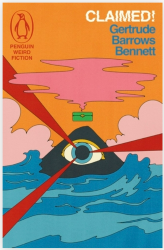
In 2024, Penguin Books launched its Weird Fiction series.  So far, this series has consisted of five classic titles: Robert Chambers’ The King in Yellow (1895); William Hope Hodgeson’s The House on the Borderland (1908); Gertrude Barrows Bennett’s Claimed! (1920); Algernon Blackwood’s Ancient Sorceries; and a collection of well-known stories of the weird by the likes of Edgar Allan Poe, H.P. Lovecraft, W.W. Jacobs, May Sinclair, M.R. James and Sir Arthur Conan Doyle called Weird Fiction: An Anthology (2024).  When I saw these books on sale in my local bookstore, I bought the two by Gertrude Barrows Bennett and Algernon Blackwood, which I hadn’t read before.


A while back, I posted my thoughts on Blackwood’s Ancient Sorceries.  Here’s what I made of Bennett’s Claimed!


While the content of Ancient Sorceries could be described as horror with a strong dose of the weird, Claimed! is a banquet of weirdness with the occasional plate of horror placed here and there.  It’s a short novel whose plot hinges around a strange box – “an oblong, bluish-green box, about a dozen inches long by half as many wide, highly polished, but severely simple of workmanship.  Its sole decoration was a single short line of characters belonging to some foreign language, which had apparently been incised across the top with an engineer’s tool and the lines filled in with scarlet enamel.”  The box won’t open and the inscription has a disconcerting habit of disappearing from its top surface and reappearing on its bottom surface, making those who possess it wonder if they’d turned the thing upside down without remembering doing so.


Ownership of the box passes from a mad sailor to a shopkeeper, who soon becomes mad, and then to a wealthy and irascible old industrialist called J.J. Robinson.  The latter doesn’t quite tip over into madness, but he certainly develops an unhealthy obsession with the box and with deciphering its secrets.  After an assault by a mysterious nighttime intruder, Robinson is left ailing and bedridden, though he insists on keeping the box by his side: “…he sank back, clasping the thing right to his breast…  ‘I got it!’ he croaked.  ‘What I want I get, and – what I get I keep! They can’t take it away from – old Jesse Robinson!  Nobody – can take it!  You – hear me?’”


At this point, Robinson’s niece Leilah and a young doctor called John Vanaman get involved in the strangeness while they try to care for the stricken but uncooperative old man.  Vanaman realises something odd is afoot when he sits by the slumbering Robinson’s bed one night and has a vision whereby a sea-tide seems to sluice in under the door and across the floor, even though he’s “sitting in the bedroom on the second floor of a house in Tremont, over fifty miles from the Atlantic shore.”


Even worse, something unspeakable enters the room with that impossible tide: “That which was in the room beneath the tide, and which had pushed the tide hither – before it, now gathered, took form, and rose up, sudden and monstrous…  Exactly what shape it had, Vanaman could not later clearly remember.  He could recall only his own fear and intuitive sense of it as a thing of awful force and of a potential destructiveness terrific beyond finite comprehension.”


Bennett sets up this scenario in the first 20 pages of the novel and it’s great, phantasmagorical stuff.  Alas, the mid-section of the book is less gripping.  There are a few incidents that set the pulse racing, such as a mysterious suicide and a bit where a hapless spiritualist tries to help, only to get her come-uppance.  But mainly it’s about the romance that inevitably brews between Leilah and Vanaman while they look after Robinson and try to work out what’s wrong with him.  As the straightforward, clean-cut hero and heroine of the story, they aren’t terribly interesting – and neither is their romance.


However, after the plot has become bogged down in Robinson’s mansion, page 65 sees a dramatic and welcome shift of gears.  Restored, the old man informs Vanaman: “We’re going to sea, my son.”  The action then shifts to a ship Robinson has chartered in order “to meet the party that wants my property, fair and square.”  He’s referring to the people, or beings, who created the box and who belonged to an ancient land that long ago sank below the ocean during a natural cataclysm.  In due course, we’re introduced to the Jack-London-esque character of the ship’s master, Captain Tom Porter – “well known and liked among the blunt, outspoken fraternity of his own kind” – and his hardy crew.  Happily, these new characters and the new locale give the novel a second wind.


There follows an unexpected abduction, a stirring nautical chase, and an impressively psychedelic finale wherein the protagonists cross a portal in time and space.  And this ties up all the mysteries surrounding the box…  Well, at least, I think it does.  For a 127-page novel, there’s been an awful lot going on.


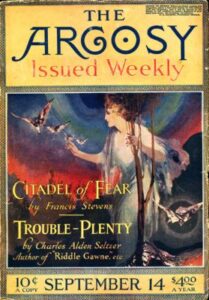
One nice thing about Claimed! was that it introduced me to its remarkable author, whom I hadn’t heard of before.  The Minneapolis-born Gertrude Barrows Bennett spent her adult life working as a stenographer, but for three years from 1917 to 1920 – a fraught period when she had to support both a daughter and an invalid mother – she also earned money as a writer.  She had short stories and novellas published in magazines like Argosy and All-Story Weekly and produced four novels: The Citadel of Fear (1918), The Heads of Cerberus (1919), Avalon (1919) and finally Claimed!  According to her Wikipedia entry, her writing ceased when her mother passed away and she was suddenly under less financial pressure.


Brief though her writing career was, Bennett did enough for the noted science-fiction critic and historian Sam Moskowitz to hail her as “the great woman writer of science fiction in the period between Mary Wollstonecraft Shelley and C.L. Moore.”  And though there’s debate about whether or not the legendary H.P. Lovecraft – who started his writing career around the same time she did – was aware of and influenced by Gertrude Barrows Bennett, there’s so much mind-boggling weirdness present in Claimed! that it wouldn’t surprise me if he was.


From philsp.com

Cinematically stoned (Part 2)


© Taplin-Perry-Scorsese Productions / Warner Bros


I ended my previous post by promising I’d give a list of my favourite movie scenes wherein songs by the Rolling Stones are employed to memorable effect.  Here it is.


Jumpin’ Jack Flash (1968) in Mean Streets (1973)

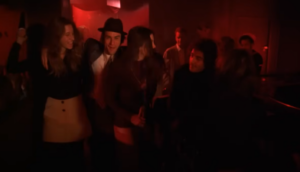
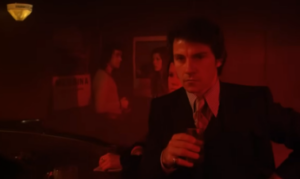
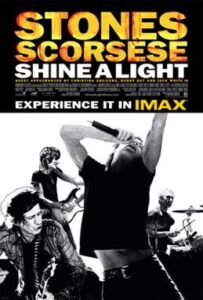
Wow.  Martin Scorsese really likes the Rolling Stones.  Not only has he made a concert movie about them, 2008’s Shine a Light, but he’s used their music in umpteen films: Goodfellas (1990), Casino (1995), The Departed (2006) and the one that first put him on the map, 1973’s Mean Streets.  Even today, more than 50 years later, the scene in Mean Streets where a young Robert De Niro comes swaggering through a bar, in slow motion, towards a pensive Harvey Keitel, while Mick Jagger hollers in the background about being “born in a cross-fire hurricane”, is a great synthesis of rock ‘n’ roll music and rock ‘n’ roll cinema.  Indeed, Jumpin’ Jack Flash is a fitting accompaniment for the arrival in popular consciousness of De Niro, who’d spend the rest of the 20th century showing Hollywood how to do proper acting.  The 21st century, featuring such efforts as The Adventures of Rocky and Bullwinkle (2000), Little Fockers (2010), New Year’s Eve (2011) and Dirty Grandpa (2016)…  Okay, not so much.


Satisfaction (1965) in Apocalypse Now (1979)

The Stones’ early, primordial and still potent stomper Satisfaction gets a brief but memorable airing in Francis Ford Coppola’s baroque Vietnam War masterpiece, playing on the radio while Captain Martin Sheen and his not-exactly-fighting-fit crew go cruising up the Nùng River in search of Marlon Brando.  Cue some funky on-deck dance moves by a frighteningly young-looking Laurence Fishburne and some funny / cringeworthy water-skiing moves by Sam Bottoms that knock various Vietnamese people out of their fishing boats.


© Omni Zoetrope / United Artists


Sympathy for the Devil (1968) in Alien Nation (1988) and in Interview with the Vampire (1994)

Graham Baker’s sci-fi / cop movie Alien Nation isn’t very good.  Its premise of an alien community getting stranded on earth and having to integrate as best as they can with the curmudgeonly human natives was handled much better in Neill Blomkamp’s District 9 (2009).  But I do like a woozy, hypnotic scene in it where alien-loathing cop James Caan enters a sleazy alien bar while a lady-alien performs an erotic dance to the strains of Sympathy for the Devil.  Not the original Stones song, but a correspondingly woozy, hypnotic cover-version of it by the great Jane’s Addiction.  I can’t find a film-clip of the scene, but here’s the Jane’s Addiction cover.


Meanwhile, Neil Jordan’s adaptation of Anne Rice’s Interview with the Vampire ends with Sympathy for the Devil on the soundtrack.  Again, this isn’t the Rolling Stones version but a cover, this time by Guns n’ Roses.  It’s every bit as ramshackle, shonky and (for me) enjoyable as the other covers Guns n’ Roses have done, for example, of Wings’ Live and Let Die (1973) and Bob Dylan’s Knockin’ on Heaven’s Door (1973).  Sympathy for the Devil kicks in when the vampire Lestat – Tom Cruise in one of his rare interesting roles – pops up to claim Christian Slater as his new vampirical companion for eternity.


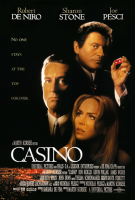
Can’t You Hear Me Knocking? (1971) in Casino (1995)

While Martin Scorsese serenades Robert De Niro and Harvey Keitel with Jumpin’ Jack Flash in Mean Streets, he employs the Stones song Can’t You Hear Me Knocking? for another of his regulars, Joe Pesci, in Casino.  Remarkably, Scorsese plays all seven minutes of the Santana-esque Can’t You… as an accompaniment to a lengthy sequence showing how Pesci’s Casino character Nicky Santoro gets established in Las Vegas.  Predictably, the sequence has Pesci doing what Pesci usually does in Scorsese movies: being a psychotic shit, barking orders at hoodlum sidekicks twice his size, eating in restaurants, ingratiating himself with fellow Mafiosi, being a psychotic shit, cursing and swearing, getting a blow-job, being a psychotic shit, talking about food, knocking off jewellery stores, acting the loving family man with his non-criminal relatives… and being a psychotic shit.


© Légende Entreprises / Universal Pictures


Ruby Tuesday (1967) in Children of Men (2006)

Wistful Stones ballad Ruby Tuesday features briefly on the soundtrack of Alfonso Cuarón’s gruellingly pessimistic science-fiction thriller Children of Men.  It’s another cover, sung by Franco Battiato.  We hear it during one of the movie’s calmer moments when Theo (Clive Owen) is visiting his old mate Jasper (Michael Caine), whose home provides a small pocket of sanity amid the unfolding dystopian grimness.  Amusingly, Caine, well known in real life for being a right-wing old grump with an aversion to paying tax, here plays an elderly anarcho-hippy with a fondness for smoking exceptionally strong pot.


Gimme Shelter (1969) in The Departed (2006)

Martin Scorsese loves the Rolling Stones and he loves their apocalyptic number Gimme Shelter in particular.  By my count he’s used it in three movies: Goodfellas, Casino and The Departed.  It’s best deployed at the beginning of The Departed, rumbling in the background while gangland thug Frank Costello (Jack Nicholson) expounds his philosophy.  “I don’t want to be a part of my environment,” he intones, imbuing his words with that leery, languid menace that only Nicholson is capable of.  “I want my environment to be a part of me.”  Strangely, in Scorsese’s Shine a Light two years later, Gimme Shelter was one of the songs the Stones didn’t perform on stage.  Marty missed a trick there.


© Plan B Entertainment / Warner Bros


Street Fighting Man (1968) in Fantastic Mr Fox (2009)

Director Wes Anderson also sticks Rolling Stones into his movies, but so far I haven’t mentioned him because I think most of his work is smug, pretentious and annoying.  For example, Play with Fire (1965) figures prominently in 2007’s The Darjeeling Limited, an Anderson movie so twee I find it the cinematic equivalent of being force-fed with chocolate-cake mix.  However, I like the scene in his stop-motion-animation adaptation of Roald Dahl’s Fantastic Mr Fox where, to the sound of the rabblerousing Stones anthem Street Fighting Man, Farmers Bean, Boggis and Bunce use three diggers to tear up the den of the titular Mr Fox; forcing the den’s inhabitants to frantically dig an escape-route.  Yes, they really ‘dig’ that song.  Sorry.


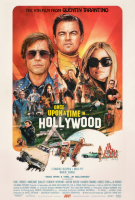
And finally…  Out of Time (1968) in Once Upon a Time in Hollywood (2019)

I’m not the biggest fan of the Stones song Out of Time – Jagger’s vocals get a bit too caterwauling for my liking – but it sees good satirical use in Once Upon a Time in Hollywood, Quentin Tarantino’s paean to the American movie-making capital in the late 1960s, a fascinating period when traditional notions about what made a good film were rapidly being undermined by an uppity younger generation.  Played when Rick Dalton (Leonardo DiCaprio), his new Italian spouse Francesca Capucci (Lorenza Izzo) and sidekick Cliff Booth (Brad Pitt) return from Italy, where Rick has been making spaghetti westerns and action thrillers with the likes of Sergio Corbucci and Antonio Margheriti, Out of Time gives an one-the-nose summation of DiCaprio’s sad-sack character – an actor a bit too old, un-hip and uncomprehending of the changing world around him to get the leading roles he once did, now doomed to playing villains in second-rate TV shows.


© Columbia Pictures / Sony Pictures Releasing 

Cinematically stoned (Part 1)


© Goodtimes Enterprises / Warner Bros.


Oh God.  I’ve just discovered that the soundtrack of Melania (2026), the vanity-documentary about Melania Trump, financed by Jeff Bezos and directed by Brett Ratner – a man accused of sexual assault by six women (allegations Ratner has always denied) – contains a song I just might identify as my favourite one of all time.   That is Gimme Shelter, the opening track on the Rolling Stones’ 1969 album Let It Bleed.  Yes, a tune that means so much to me features in a movie pithily described by Mikey Smith, deputy political editor at the Daily Mirror, as ‘a bad film made by bad people about bad people’, and about which Variety suggested if they showed it on an airplane ‘people would still walk out’.  I feel besmirched.


It’s quite possible, though, that the Trumps and Brett Ratner bunged Gimme Shelter onto the soundtrack without actually listening to the words.  Supposedly played as an accompaniment to Melania’s preparations for her husband’s inauguration as 47th President of the USA, which one year later would lead to masked, paramilitary-style thugs abducting young children from their homes and schools and executing peaceful protesters on the street, the song has such lyrics as “Rape, murder / It’s just a shot away” and “War, children / It’s just a shot away.”  Very apt, when you think about it.


Anyway, this has at least got me thinking about a different, and nicer, Rolling Stones-related topic – the band and movies.  After all, over the years, there have been plenty of Beatles films: A Hard Day’s Night (1964), Help! (1965), Yellow Submarine (1968), Let It Be (1970), I Wanna Hold Your Hand (1978), Sergeant Pepper’s Lonely Hearts Club Band (1978), The Birth of the Beatles (1979), Give my Regards to Broad Street (1984), The Hours and Times (1991), Backbeat (1994), Two of Us (2000), The Beatles: Get Back (2021) (which is actually a miniseries, but Peter Jackson made it, so it feels like a movie to me) and Sam Mendes’s forthcoming project, The Beatles – A Four-Film Cinematic Event (2027).  But what about the Rolling Stones?  What contribution to cinema has been made by the Liverpudlian mop-tops’ less wholesome London rivals?


© Shangri-La Entertainment / Paramount Classics


On the face of it, there isn’t a lot.  That is, if you don’t count the various documentaries made about them like Charlie is my Darling (1966), Jean Luc Godard’s oddball Sympathy for the Devil (1968) and Gimme Shelter (1970), a chronicle of their 1969 American tour that ended bloodily with Hells Angels-perpetrated carnage at the Altamont Speedway Free Festival.   And if you don’t count their many concert movies like The Stones in the Park (1969), Let’s Spend the Night Together (1982), Julien Temple’s The Stones at the Max (1991) (the first feature-length movie to be filmed in IMAX – because what you really want to see is a 100-feet-tall close-up of Keith Richards’ face, right?), The Rolling Stones Rock and Roll Circus (1996) (plug your ears for the bit with Yoko Ono) and the Martin Scorsese-directed Shine a Light (2008), which provided the gruesome spectacle of a leathery 60-something Jagger duetting with 20-something pop-moppet Christina Aguilera and prowling around her like a randy velociraptor.


There’s been little effort to film key events in the history of the Rolling Stones.  Off the top of my head, the only one I can think of is the little-known Stoned (2005), about the possible circumstances of Brian Jones’s death.  And as for movies featuring Stones-members as actors, well, there’s just a couple of items with Mick Jagger – epics such as Ned Kelly (1970) and Freejack (1992).  Ouch.


Actually, you could make a case for the Pirates of the Caribbean series being Rolling Stones films as their star Johnny Depp famously based the voice, mannerisms and swagger of his Captain Jack Sparrow character on Keith Richards.  I thought Depp-playing-Keith-playing-a-pirate was a rib-tickling gimmick that elevated the first Pirates of the Caribbean instalment, back in 2003, from being a middling film to being an entertaining one.  Alas, the sequels to it became ever-more convoluted, repetitious and tedious and, by the time of the third in the franchise, At World’s End (2007), when the filmmakers had the bright idea of bringing in the real Keith Richards to cameo as Captain Jack’s pirate dad, the idea had lost its novelty value.


© Buena Vista / Walt Disney Productions / Jerry Bruckheimer Films


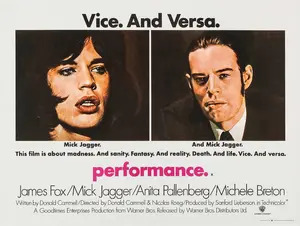
Arguably, the most Rolling Stones-esque film of all is Performance (1968), the psychedelically weird crime-rock movie co-directed by Donald Cammell and Nicholas Roeg.  Its cast includes Mick Jagger and Anita Pallenberg, then lover of Keith Richards.  The story of an on-the-run gangster (James Fox) who holes up in a mansion belonging to a burnt-out rock star (Jagger) and gets involved in some mind-bendingly druggy goings-on, the film neatly captures the dark, dangerous aura that was popularly associated with the Stones at the time.  Neither did it do the film’s scary reputation any harm that afterwards Fox underwent a ‘crisis’, dropped out of acting for the next decade-and-a-half and became an evangelical Christian.  As if the poor man hadn’t suffered enough, during the late 2010s, his son Laurence came out of the closet as a whinging, entitled, far-right-wing rentagob.


Keith Richards had and still has a deep-rooted aversion to Performance, thanks to the sexual shenanigans that Pallenberg supposedly got up to with Jagger during filming.  He believed these shenanigans were orchestrated by Donald Cammell, presumably as a way of getting Pallenberg and Jagger further ‘in character’.  In his autobiography Life (2020) – which was written with the help of a journalist also, confusingly, called James Fox – Richards describes Cammell as “the most destructive little turd I have ever met.”


Because of Richards’ loathing of Performance, one Jagger-Richards song that’s never been played at Rolling Stones gigs and is unlikely to ever be played at future ones is Memo from Turner (1968), which soundtracks a particularly strange sequence at the movie’s climax when everyone is out of their faces, the gangsters start stripping off and Jagger dances amid veering lights.  On the Performance recording of the song, Jagger is the only Stone involved, doing vocal duties, while Ry Cooder plays slide-guitar (wonderfully) and Randy Newman plays piano.  It’s a shame that we’ll never hear a live Stones version of it because it’s a belter.  I’m also partial to this cover of it by forgotten 1980s retro-rockers Diesel Park West.


Anyway, there’s one thing you can say about the Rolling Stones and celluloid.  In the right film, blasting over the soundtrack at the right moment, a Stones song can help create a splendid musical, visual and dramatic alchemy, turning a good cinematic scene into one that’s truly awesome.  In Part 2 of this post, I’ll list my favourite uses of Rolling Stones songs in the movies.  Stay tuned…


© Goodtimes Enterprises / Warner Bros.

No shuffling off this Lacuna Coil


In 2022, the year I arrived in Singapore, the Italian gothic metal band Lacuna Coil played a gig at the city-state’s Esplanade Annex Studio.  Although I’d really enjoyed several of the band’s early albums, such as Comalies (2002) and Shallow Life (2009), I somehow, stupidly, missed seeing them on that occasion.  When I heard that the band would be paying a return visit to Singapore on February 9th this year, playing in the same venue, I made sure I didn’t make the same mistake again.


Lacuna Coil are currently touring in promotion of their 2025 album Sleepless Empire.  The album was well-received by critics, who noted that it showed the band moving towards a darker, heavier sound.


Though plentifully equipped with chugging guitars, earlier Lacuna Coil albums like those I’d mentioned above had prioritised melody over volume.   This was embodied in the band’s use of two vocalists, the operatic Christina Scabbia and the rougher, more aggressive-sounding Andrea Ferro.  Indeed, to me, they sounded like a goth-metal version of the 1980s Icelandic indie-band the Sugarcubes – wherein a very young Björk’s charmingly fey vocals were offset by the more discordant ones of Einar Ӧrn, allegedly ‘the first punk in Iceland’.  Nonetheless, Ferro’s rawer voice was still in synch with the tunes.


At tonight’s gig, I was discombobulated at first to encounter a louder, crunchier, snarlier incarnation of Lacuna Coil than I’d expected – songs from Sleepless Empire made up nearly half the setlist, with previous, gentler albums represented by one or two tracks only.  It was also a surprise to hear those alternating vocals.  While Scabbia was as operatic as ever, Ferro sometimes indulged in death-growling, Cannibal Corpse-style.  Actually, one of Sleepless Empire’s tracks, Hosting the Shadow, was recorded with guest vocals from Randy Blythe of the American thrash / groove metal band Lamb of God, who in the past has provided guest vocals for – surprise! – Cannibal Corpse.


But a few songs into Lacuna Coil’s set, my brain had adjusted and I enjoyed the rest of the gig enormously.  And the heaviness of Sleepless Empire was leavened by a few old tracks I’m fond of: Heaven’s a Lie and Swamped off Comalies, Spellbound off Shallow Life.  No room, alas, for Survive, the first track on Shallow Life, which is maybe my favourite Lacuna Coil song thanks to its use of a spooky, children’s-nursery-rhyme-like refrain, which sounds like something off the soundtrack of an old giallo movie.  (Giallo were a sub-genre of stylish but brutal horror-thrillers developed in Italy in the 1960s and 1970s by directors like Mario Bava, Dario Argento, Sergio Martino and Lucio Fulci.  Frequently, the murders in them were the result of someone having suffered childhood trauma, which necessitated flashback scenes accompanied by the sounds of creepy children.)  And that brings me nicely to my next point…


One thing I liked about Lacuna Coil’s show tonight was how, visually, they echoed old Italian horror movies, of which I’m a big fan.  Bassist Marco Coti Zelati, who also composes the music for and produces their records – Scabbia and Ferro write the lyrics – was slathered in white corpse-paint, except for a dish-shaped portion at the top of his head, which had been painted red and brain-like to suggest his brainpan had been removed.  Indeed, he resembled a lumbering, reanimated cadaver from the zombie epics that Lucio Fulci started making after he stopped making giallo.  Meanwhile, recently recruited guitarist Daniele Salomone wore a cowl and resembled the hooded villain in Antonio Margheriti’s 1963 horror film The Virgin of Nuremberg.


The colours bathing the stage veered from garish blue to garish red with the abandon of the stylised lighting that drenched the movies of Mario Bava and Dario Argento.  And the dark-haired, red-dressed Scabbia would have made a good female lead in an Italian gothic horror, either being menaced (à la Jessica Harper) or doing the menacing (à la Barbara Steele).


Finally, I should say the crowd were appreciative of Lacuna Coil’s artistry, though a few too many phone-cameras were in operation.  I’d secured a good position near the front of the stage, but my view of the band was sometimes disrupted by a girl standing before me who held her phone permanently aloft, seemingly hellbent on filming the entire gig.  Occasionally, she’d turn and, with a sweep of the arm, try to film the audience behind her too. Whenever she did this, I noticed how her arm swooped up and down so as to avoid getting a close-up of my grizzled, decrepit visage amid these panoramic shots.  Heaven forbid — that would have ruined all her footage.


Democracy dies in Donald-grovelling


From wikipedia.org / © The Washington Post


What would you say to Epstein survivors…?


You are so bad.  You are the worst reporter.  No wonder CNN has no ratings.  She’s a young woman.  I don’t think I’ve ever seen you smile.   They should be ashamed of you.”


On February 4th, CNN reporter Kaitlan Collins was cut off in the middle of a question about the victims of Jeffrey Epstein, notorious paedophile, human trafficker and friend to the rich and famous, at a White House press conference.  Cutting her off was President Donald Trump, coincidentally someone who receives, according to the New York Times, 38,000 mentions in the Epstein files so far released by the US Department of Justice.  Evidently, in Trump’s mind, you need to smile when you ask questions about victims of paedophilia and human trafficking.


I find his objection ironic considering that for the last 21 years Trump’s been married to Melania Trump, a woman on whose visage – gimlet-eyed and as smooth, hard and unyielding as an iron bedpan – anything resembling a smile rarely flickers.  Obviously, though, if you were expected to share a marital bed with Trump, your face wouldn’t be projecting sunbeams and rainbows either.


Lately, Melania Trump has been in the news because of the release of a new documentary movie about her.  Entitled Melania, it focuses on her during the run-up to her husband’s second inauguration as president.  Jeff Bezos’s Amazon paid 40 million dollars for the rights to the documentary – 28 million of that reportedly going straight into Ms. Trump’s pocket – and another 35 million to advertise it.


Reviews of Melania have not been, shall we say, overly enthusiastic.  The last time I checked the review aggregate site Rotten Tomatoes, its ‘Tomato-meter’ had it at seven percent.  William Thomas at Empire magazine advised, “Do try not to choke on your popcorn.”  Sean Burns at North Shore Movies observed, “At least Leni Riefenstahl could frame a shot.”  Mark Kermode at Kermode and Mayo’s Take – The Brand New Podcast described it as “the most depressing experience I have ever had in the cinema.”  He added, “I mean, I’ve seen A Serbian Film (2010), I’ve seen Cannibal Holocaust (1980), I have never felt this depressed…  I thought it was absolutely repugnant.”


By the way, the director of Melania is Brett Ratner, who in 2017 was accused of sexual assault and harassment by six women, accusations he’s denied.  In photos recently released from the Epstein files, he appears sitting on a sofa beside the late, loathsome paedophile, both of them cuddling young women.  The women’s faces are blocked to protect their identities, so you can’t tell how young they are.


I should also say that Melania made seven million dollars on its opening weekend, a decent haul for a documentary.  Obviously, it appeals to a certain audience in the USA, i.e., cultish MAGA dingbats so worshipful of her husband they’d spend a fortune on eBay to acquire pieces of his used toilet paper, which they’d then frame and hang prominently in their living rooms.  However, it still looks like it’ll be a long time before Amazon recoups anything like the 75 million dollars it invested in the movie.

 

From wikipedia.org / © White House


In totally unconnected developments during Trump’s first year as 47th president, the Orange One signed an executive order relaxing environmental rules about space launches (benefiting Bezos’s private space venture Blue Origin); signed an order preventing US states from enforcing their own AI regulations (benefiting Bezos’s AI start-up Project Prometheus); and generally created a oligarch-friendly climate that’s allowed Bezos and fellow magnificoes Elon Musk and Mark Zuckerberg to increase their collective wealth by approximately 250 billion dollars.


But I don’t know why Bezos would take a financial hit by getting involved in Melania, a vanity project that nobody apart from those hardcore MAGA nutters would pay money to see.  I really don’t know.


In other, totally unconnected news last week, the Washington Post, a once-respected newspaper whose motto is ‘Democracy dies in darkness’, and which broke the story about the Watergate scandal that brought down Richard Nixon’s presidency in 1974, has announced a ‘strategic reset’.  This reset involves showing a third of its current workforce the door.  It’s also “ending the current iteration of its popular sports desk… restructuring its local coverage, reducing its international reporting operation, cutting its books desk and suspending its flagship daily news podcast Post Reports.”  The loss of the Washington Post’s books desk means it’ll no longer publish its literary review supplement Book World.


The Washington Post has been on a downward spiral this past year, a spiral of its – or its proprietor’s – own making.  Previously, and unsurprisingly, it’d not been enamoured with Trump.  As 2024’s presidential race neared election day, however, and with Trump looking likely to regain the White House and launch his glorious new thousand-year Reich, the Washington Post’s editorial board was ordered not to publish an editorial endorsing Kamala Harris, Trump’s rival for the presidency.  As a result, more than 200,000 disgusted readers – eight percent of its 2.5 million-strong readership – cancelled their digital subscriptions to the newspaper.


After the announcement of the Washington Post‘s downsizing, its legendary Watergate  reporter Bob Woodward lamented, “I am crushed that so many of my beloved colleagues have lost their jobs and our readers have been given less news and sound analysis.  They deserve more.”  Meanwhile, Trump’s Communications Director Steve Cheung crowed on Twitter, “Just a reminder that printing fake news is not a profitable business model.”


Earlier, the Washington Post’s proprietor had defended his decision to have the newspaper sit on the fence before the 2024 election, which’d started the rot.  He wrote: “Presidential endorsements do nothing to tip the scales of an election…  What presidential endorsements actually do is create a perception of bias.  A perception of non-independence.  Ending them is a principled decision, and it’s the right one.”  Aye, right.  That’s the principled thing to do.  When there’s a choice between a candidate who’s a convicted criminal and convicted sexual abuser and a candidate who isn’t, you say nothing.  Heaven forbid anyone perceives you as being biased and non-independent.

 

From wikipedia.org / © Van Ha, US Space Force


And who’s the proprietor of the Washington Post?  Oh look, it’s Jeff Bezos.  Funny that he should take a hit by alienating his newspaper’s natural readership and sending it down the toilet, just as he took a hit by shelling out 75 million dollars for a dud like the Melania movie.  It’s almost like he has an ulterior motive.  Almost like he’s trying to… curry favour with someone.


But seriously.  A while ago, I posted about “an unholy alliance of authoritarians, kleptocrats, fascists, media tycoons, tech bros and oil barons”, working hard “at stripping freedoms from those of us living in societies that,  until now, have retained some freedoms; at transferring another huge chunk of wealth from our dwindling coffers to their swelling coffers; and at burning and poisoning the planet we live on in their quest for profits whilst aggressively pushing the line that any science questioning this policy is a ‘hoax’.”  You see that here.  Bezos grovelling to Trump by financing his missus’s dreadful movie and nuking the Washington Post.  As a reward, Trump throwing him a few legislative and financial scraps from the White House table so he can carry on making pots of money for himself.


And with Bezos and his ilk embracing automation and Artificial Intelligence to maximise profits by eliminating human employees, and salaries, the future looks grim.  Journalists will soon go the way of lamplighters, elevator operators, switchboard operators and video store clerks.  News copy will be written by AI technology, controlled by billionaires, who’ll make sure that copy panders to their interests and those of their political allies.  And if there’s bad news they can’t avoid reporting, it’ll be blamed on those people not plugged into their extreme-right-wing, white-Christian-nationalist gestalt: blacks, Latinos, Muslims, Jews, atheists, gays, trans-people, liberals, socialists, trade unionists.


Education will be similar.  Teachers will disappear too and kids will be taught by AI, with the likes of Elon Musk deciding what’s in the curriculum.  Indeed, Musk has done a deal with El Salvador’s government to “bring his artificial intelligence company’s chatbot, Grok, to more than 1 million students across the country… to ‘deploy’ the chatbot to more than 5,000 public schools in an ‘AI-powered education program’.”  Yes, that’s Grok, the lovable chatbot that praises Hitler and puts tweens in tiny bikinis for the gratification of paedophiles, coming to a school near you to teach your kids.


The stinking rich and stinking powerful won’t only hoard wealth – they’ll hoard information too, whilst making sure only small, approved increments of it leak down to the masses they regard as their serfs and inferiors.  Especially manipulated will be scientific information about the climate catastrophe posing an increasing threat to our civilisation’s survival on this planet.  So that their environmentally-ruinous cash-generating projects, like power-guzzling and water-guzzling AI data centres, escape censure, they’ll suppress this information or bury it under an avalanche of counter-arguing pseudoscientific gibberish, or not collect it in the first place.


But let’s end positively.  While it’s sickening to watch America’s business magnates, corporations, media organisations, law firms and universities bend over supinely and lick Trump’s gruesome arse, the way ordinary Americans have reacted to his policies gives glimmers of hope.

 

© MS NOW


I’m thinking especially of Minneapolis.  Since December, the city has been overrun and brutalised by up to 3000 of Trump’s masked, violent, badly-trained thugs from Immigration and Customs (ICE) and Customs and Border Patrol.  Ostensibly, they came to crack down on fraud allegedly committed by Minneapolis’s Somali-American community.  In reality, as Wikipedia reports, they’ve assaulted, harassed and detained people  “on the basis of their alleged or suspected immigration status”, including “restaurant, airport and hotel workers, Target employees, children and families, Native Americans, students and commuters”, many of whom “have been US citizens, legal residents with work authorisation, or asylum seekers.”


This has disastrously impacted on the city’s businesses, schools and whole social fabric.  ICE was accused of violating at least 96 court orders during four weeks in January alone; and they’ve executed two citizens during peaceful protests, Renee Good on January 7th and Alex Pretti on January 24th.


Obviously, the operation was designed to intimidate Minneapolis – whose state governor is Tim Walz, Kamala’s running mate against Trump in 2024 – and intimidate liberal-leaning cities generally.  But local people are having none of it.  They’ve protested peacefully, organized strikes, alerted neigbours about approaching ICE patrols, monitored and filmed their activities, and provided support for people at risk from those activities by helping them get to their schools and places of worship unmolested, running errands for them and raising money for them.  They’ve stood by their fellow citizens in a display of decent, old-fashioned community values – values Trump would despise if his reptile brain could ever understand them in the first place.


One thing that particularly impressed and moved me was a viral clip showing a white-bearded old man protesting against ICE on a snowbound and teargas-fogged Minneapolis street on January 24th.  When a reporter and camera crew approached him, he raged, “I’m just angry.  I’m 70 years old and I’m f**king angry.”  Then, wearing neither mask nor goggles, he strode off through a billowing wall of teargas.


That furious but defiant old-timer, it transpired, was Greg Ketter, founder and proprietor of the Minneapolis independent bookstore DreamHaven Books and Comics.  The renowned sci-fi and fantasy writer Harlan Ellison once described DreamHaven as “a book-seeker’s cave of miracles”.


I find it inspiring to see a man who’s devoted a lifetime to books taking a stand against Trump, someone who brags about not reading as if it’s a badge of honour.  And by extension, against Trump’s billionaire toadies, currently trying to create an AI dystopia wherein novels and other human art-forms are replaced by soulless, AI-generated slop.  And against Trump’s toady at Amazon, Jeff Bezos, who’s just axed the Washington Post’s Book World, one of the very few literary supplements the American newspaper industry had left.

 

From wikipedia.org / © DreamHaven Books & Comics

Rab Foster has another river to cross


© Crimson Quill Quarterly


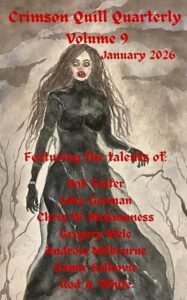
My sword-and-sorcery story The Voice of the River is now available to read in Volume 9 of the magazine Crimson Quill Quarterly, which was published at the end of last month.  As with all my fantasy fiction, it’s attributed to the pseudonym Rab Foster.


Someone once observed – it might have been Stephen King in his forward to his 1978 collection Night Shift – that a writer’s mind is like the grating on a storm drain.  Just as water flows in through a real grating and the bigger debris it carries gets stuck there, so a writer’s mental grating gets clogged with ideas, impressions and images while his or her life-experiences seep through it – all things that can inspire or be incorporated into stories.  The gunk trapped in my grating, from which I fashioned The Voice of the River, contained some disparate things indeed.


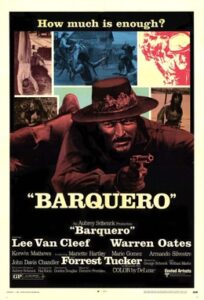
When I was 11 or 12 years old, I watched a western on late-night TV called Barquero (1970).  I assumed at the time it was a spaghetti western, because Lee Van Cleef was in it, but since then I’ve discovered it was an American movie directed by the prolific Gordon Douglas, whose best-remembered film is probably the giant-ants-on-the-loose sci-fi / horror classic Them! (1954).  The cast also included Warren Oates, Forest Tucker and Kerwin Matthews, so I should have twigged onto Barquero’s American-ness sooner.  Anyway, as Van Cleef’s character was a river ferryman, who gets caught up in shenanigans with some bandits, and as I’d recently been reading Robert E. Howard’s Conan the Barbarian stories, I suddenly had an idea: Wow, what if Conan retired from being a barbarian and took up a supposedly easier job, running a barge that ferried people across a river?


The notion sank to the back of my head and remained dormant for several decades – until last year, in fact, when I read Cormac McCarthy’s Outer Dark (1968), which contains an episode set on a river ferry.  That reminded me of my long-ago idea about ‘Conan the Ferryman’ – though I realised an unruly, adventure-loving character like Conan would balk at such a job.  So I modified the premise to ‘a sword-and-sorcery story involving a river ferry’.


Other debris stuck in that mental grating, also from movies, gave me inspiration for the story’s characters.  I’ve long been interested in the late Northern Irish character actor John Hallam, who appeared as hard men and coppers in a string of 1970s British crime movies – Villain (1971), The Offence (1972), Hennessey (1975) – though he’s maybe best-known for playing Luro, Brian Blessed’s winged sidekick in Flash Gordon (1980).  I visualised The Voice of the River’s main character as being like the tall, gangly, craggy Hallam and took his name, Halym, from the actor’s surname.  Meanwhile, both the appearance and personality of another character in the story were inspired by Peter Cushing in the role of Gustav Weil, the fanatical anti-hero of one of my favourite Hammer horror movies, 1972’s Twins of Evil.


© BBC / London Films


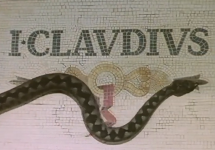
Finally, The Voice of the River pays tribute, sort of, to a scene from a TV show that’s always haunted me.  It comes at the end of the final episode of I, Claudius (1976), the BBC’s acclaimed adaptation of Robert Graves’s novels I, Claudius (1934) and Claudius the God (1935), when Claudius (Derek Jacobi), on his deathbed, has a conversation with a supernatural entity – the oracle the Sybil (Freda Dowie), who’s come to usher him to the River Styx and the underworld.  I love how, though one is flesh-and-blood and the other is ethereal, they speak as equals and both have seen so much of the world that they’re weary of it.  (“It all sounds depressingly familiar,” Claudius sighs after the Sybil has told him what will happen to Rome after his death. “Yes,” she replies, “isn’t it?”)  I tried to replicate a little of that magic in this newly-published story.


So, The Voice of the River owes its genesis to a 1970 Lee Van Cleef western, Cormac McCarthy, a tough Northern Irish character actor, some Hammer horror villainy by Peter Cushing and I, Claudius.  Not bad for a simple sword-and-sorcery tale.


One thing about Crimson Quill Quarterly that impresses me is the time and effort its editors spend on the editing process – including consulting and reconsulting the writers of its stories about suggested improvements – to ensure that the fiction in its volumes is in its best possible form when they go on sale.  Containing seven stirring tales of fantasy, magic and derring-do, its ninth edition can be purchased here.


© United Artists