When Stan was the man


From YouTube / © BBC


The great Scottish comic performer Stanley Baxter passed away earlier this month at the venerable age of 99.  Newspaper obituaries for him noted that, though he was a bright star indeed in 1970s British television, by the late 1980s his star had seemingly vanished from the firmament.  He’d gone.  It was almost as if he hadn’t been there in the first place.


As a result, one obituarist wrote, it was unlikely that anybody under the age of 40 in modern Britain had heard of him.  That does seem strange.  I can remember his TV shows being, in their day, very big events.  Over two decades, he only made six series – four of the Stanley Baxter Show between 1963 and 1971, one of the Stanley Baxter Picture Show in 1972 and one of the Stanley Baxter Series in 1981.  But during the intervening years, he staged several lavish, one-off specials that kept his face in the public consciousness, especially in the 1970s.  And his viewing figures were huge.


The reason Baxter himself gave for his abrupt disappearance during the 1980s was that his shows, full of song-and-dance extravaganzas and loving reproductions of old movie classics, became too expensive to make.  In particular, the television executive John Birt – once described memorably by playwright Dennis Potter as a ‘croak-voiced Dalek’ – had a hand in pulling the plug on him.  “It’s not that we don’t like your work,” he told Baxter. “It just all costs so much.”


It probably didn’t help that the type of entertainment Baxter was obviously smitten with, and slavishly reproduced and fondly parodied in his shows, had started to seem old-school by the 1980s.  Much of his material was drawn from the black-and-white days of Hollywood and he clearly took pleasure of impersonating the likes of Marlene Dietrich or Shirley Temple.  He also commonly referenced a former era of British cinema and theatre when accents were cut-glass and upper lips were stiff and he poked gentle fun at people like Sir John Gielgud and Noel Coward.  But by the time of his later shows, the audience familiar with those reference points was surely ageing.  A younger generation had arrived, more attuned to the 1970s New Hollywood movies of Martin Scorsese and Francis Ford Coppola and the blockbusters of George Lucas and Steven Spielberg.  Maybe Stanley Baxter’s TV career simply reached the end of its natural lifespan.


Incidentally, offscreen, Baxter was a quiet man who avoided publicity.  This was partly due to the fact he was gay and for a long time he worried about the world finding out – sadly, he worried about this well after the point when most British people no longer gave a damn whether someone was gay or not.  Anyway, by the 1980s, he was entering his sixties and probably welcomed retirement and being out of the public’s gaze.


I have to say, watching some of his sketches now, I find myself agreeing with a comment posted below one of the recent obituaries.  The comment-writer said he thought much of Baxter’s TV work was ‘clever’ rather than ‘funny’.  In fact, technically, those sketches are sometimes astonishing.  Baxter played all the parts in them.  However, because the digital compositing technology didn’t exist at the time to layer several images of him together in the same shot (and older techniques like multiple exposure and split-screen effect weren’t very convincing), the sketches were filmed from multiple camera angles with Baxter in different roles at different times.  Copious use was made of filmed-from-behind body doubles and much editing was done afterwards.  They must have been meticulously planned and taken ages to put together.  No wonder, most years, we only saw him in a one-off special.  Also, their writing was smart and Baxter’s impersonations were impeccable.  But as far as comic value is concerned – well, I find myself smiling, perhaps chuckling, at them at best.


An example is his spoof of Upstairs Downstairs, the masters-and-servants-in-a-big-house costume drama that aired on British TV from 1971 to 1975 and was the Downton Abbey (2010-15) of its day.  Baxter’s take on it is surprisingly meta.  The servants downstairs are discussing how many of the toffs upstairs have been written out of the scripts recently and replaced by new characters played by bigger-name stars.  Surely, they think, that can’t happen to them, since they’re all played by sturdy, salt-of-the-earth character actors?  But it does – the punchline comes when housekeeper Mrs. Bridges is informed that she’s about to be replaced by Glenda Jackson.  As usual, Baxter plays everyone during the eight-minute sketch and his impersonation of the starchy butler Mr. Hudson (in the real Upstairs Downstairs played by Baxter’s fellow Scot Gordon Jackson) is absolutely spot-on.  But while I might be full of admiration by the end of it, I haven’t done much laughing during it.

 

From wiki.scotlandonaire.com


In his sketches, Baxter plays women as well as men and his female impersonations are frequently great.  British comedy has a long tradition of men dressing up as women: the Carry On movies (1958-92), Monty Python (1969-74), The League of Gentlemen (1999-2002, 2017), Little Britain (2003-6), Dick Emery, Benny Hill, Les Dawson and practically every pantomime ever.  But those drag acts were invariably grotesque, their grotesqueness designed to provoke laughter.  Baxter, though, delights in making his female characters as believable and, well, feminine, as possible.  The novelist and critic Anne Billson responded to Baxter’s death the other day by observing how she now can’t watch Barbra Streisand singing Don’t Rain on My Parade in Funny Girl (1968) without thinking of Baxter impersonating Streisand and singing that song on one of his shows.  I have no doubt that Baxter as Streisand was awesome.


For me, Stanley Baxter’s work was funnier when it left the showbiz world behind and focused on other things – especially things inspired by his Scottish roots.  I fondly remember a sketch from one of his last specials, in the mid-1980s, wherein a strict Free Presbyterian clergyman (played by mighty character actor Andrew Keir) in the Scottish islands is enraged to hear sounds of partying coming from a house.  It’s Sunday – the Sabbath.  When he confronts the little old lady (Baxter) living in the house, she pertly informs him, “Oh, but we’re not dancing.  We’re having an orgy.”  She then describes a game being played inside.  “The men-folk take all their clothes off and stand in a long line…  The women are blindfolded and they have to identify the men by touch.”  She invites the clergyman in, saying, “As a matter of fact, your name has come up twice.”


Also Scottish were perhaps his greatest achievements, the Parliamo Glasgow sketches, filmed in the manner of TV language-learning programmes of the time.  The characters perform a skit in the target language, then change to English and inform the viewers about some of the useful words and phrases they’ve just heard.  This being a Stanley Baxter piss-take, however, the target language is Glaswegian and the skits involve such expressions as “Thatzum bahookey yu-voan-yu” or, fabulously, “Zarra marra oanra barra, Clarra?”  When the instructors switch to English, it’s in the ridiculously posh tones of Received Pronunciation (then a requirement for British TV presenters): “Again, an amorous young lady might use the word romantically to her bashful lover – ‘Zarra bestye kindae?’”


This fascination with language, dialect and accent informs another Baxter sketch, involving Nationwide (1969-83), the current affairs TV show broadcast on weekday evenings that consisted of reports from the BBC’s newsrooms across the regions and nations of the United Kingdom.  The joke is that each presenter in each newsroom, in Belfast, Leeds, Cardiff and so on, speaks the local dialect there so strongly that nobody else can understand them.  Finally, the programme switches to the main newsroom in London – where its presenter speaks with such exaggerated Received Pronunciation that he’s unintelligible too.


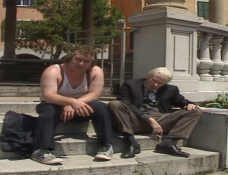
Though his television fame faded elsewhere in Britain, Baxter remained a name in Scotland.  Throughout his career he’d appeared in Scottish pantomimes and in the 1980s and early 1990s he starred in a number of productions at Glasgow’s King’s Theatre: Cinderella (1980-81), Mother Goose (1983-84), Aladdin (1986-87) and, again, Cinderella (1991-92).  I remember that last production getting much attention in the Scottish press because it was billed as his farewell to the stage.  His pantomime work was often done in tandem with another Scot, Angus Lennie, who was best known for playing Steve McQueen’s sidekick, the ill-fated Archibald Ives, in The Great Escape (1962).  Baxter and Lennie’s performances as the Ugly Stepsisters in Cinderella are legendary.
 

From YouTube / © BBC


He also turned up in Fitba, a 1990 episode of the Scottish TV sitcom Rab C. Nesbitt (1988-99, 2008-14).  Here, he plays an elderly man, at death’s door, who’s a football fan.  He’s so determined to see the Scottish men’s football team perform in the 1990 World Cup before he passes that he pays the titular character, the garrulous though rough-and-tumble Rab C. Nesbitt, to take him to the country hosting the tournament, Italy.  Baxter’s character is decrepit and moribund and Rab is understandably sceptical about the undertaking.  But he gradually wins Rab’s respect with his determination to make the most of what he has left.  “My time is precious,” he tells Rab in Rome.  “I’m taking a taxi into town.  Then I’ll walk to Via Garibaldi and into Palazzo Doria Tursi to see, among other treasures, Paganini’s violin.”  When he asks about Rab’s plans that afternoon, and is told he’ll maybe get a pizza, he retorts, “A pizza?  In Italy?  My, you’re full of ideas!”  Thanks to Scotland’s recent qualification for the 2026 World Cup in North America, I was thinking about this episode and Stanley Baxter just a few days before he died.


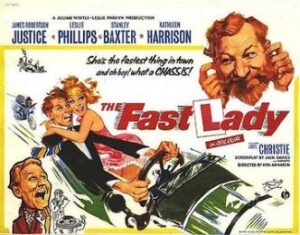
Finally, he featured in a handful of movies too: Geordie (1955), Very Important Person (1961), The Fast Lady (1962), Crooks Anonymous (1962) and Father Came Too! (1963).  Decades later, he was one of the many people (also including Vincent Price, Donald Pleasance, Anthony Quayle, Joan Sims, Kenneth Williams, George Melly and Joss Ackland) who did voice-work for Richard Williams’ legendary, but never properly finished, animated epic The Thief and the Cobbler (1993).


As a kid, I loved The Fast Lady, though I daresay I’d find it juvenile and knockabout if I saw it today.  But what a sublime cast it has – Baxter as the bumbling hero, Julie Christie as the woman he’s in love with, James Robertson Justice as Christie’s irascible and deeply disapproving father, and Leslie Philips as Baxter’s smooth best friend who tries to aid him in his love-life but only makes matters worse.


Ah, it makes me nostalgic.  Who would you get in a British comedy film nowadays?  Danny bloody Dyer – if you’re lucky.
 

© Independent Artists / Rank Organisation / Continental Distributing
Respect South Park’s authority


© South Park Studios


I remember the moment I fell in love with Trey Parker and Matt Stone’s animated TV comedy show South Park, which first aired a quarter-century – yes, 25 years! – ago last weekend.


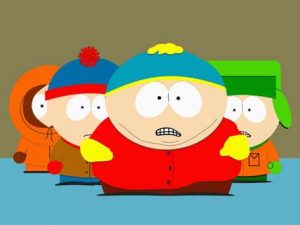
It was 1998 and I was watching episode twelve, entitled MechaStreisand, of the show’s first season.  Until then, South Park had seemed amusing enough.  Chronicling the adventures of four kids – ‘everyman’ Stan Marsh, sharp-tongued Jewish lad Kyle Broflovski, parka-shrouded, working-class Kenny McCormick (whose relationship with life, and death, is complicated) and the epically sociopathic Eric Cartman – in the Colorado town of the title, its low-fi animation had been enlivened by some moments of outrageous, by 1998 standards, bad taste.


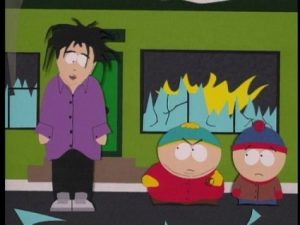
But for me, with Mecha-Streisand, South Park seemed to become something altogether more audacious and surreal.  The episode has Barbra Streisand transforming into a giant Godzilla-style kaiju and stomping all over the town until Robert Smith of the Cure – referred to as ‘Robert Smith of the Cure’ – arrives and transforms too.  He becomes a giant moth and ejects the monster-Streisand into outer space.  No wonder Kyle cries out in gratitude, “Disintegration is the best album ever!”


© South Park Studios


Since then, I’ve been a big fan of the show, though it definitely enjoyed its glory years during the noughties, when over seven or eight seasons it went into overdrive and churned out magnificent episodes on a regular basis.  It’s never quite scaled the same heights afterwards.  One problem is that since 2016 American politics have been so insane and, well, South Park-like, that the country has existed beyond the show’s powers to satirise it.  Indeed, in a 2015 episode, while the prospect of Donald Trump becoming president still seemed a joke, the show killed off the orange-skinned tycoon.  When the real Trump ended up in the White House the following year, South Park had to run an unconvincing parallel-universe storyline where the kids’ unhinged teacher Mr Garrison becomes US president and behaves like Trump for four years.


That’s not to say it isn’t good these days.  Unlike other long-running cartoon shows I could mention, which have declined into weary irrelevance, the twenty-something South Park has nobly, if not always successfully, tried to experiment.  It’s had full-season story arcs and, during the Covid-19 pandemic, longer-length specials satirising America’s response to the virus. It’s spent much time exploring the topic of political correctness, with surprising depth considering how crudely the show started out in 1998.  In 2015, to increase its commentary on this, it introduced the character of PC Principal (“Watch your micro-aggressions, bro!”), who could have been portrayed as just a woke idiot but was rather more nuanced.


© South Park Studios


And it hasn’t been afraid to take much-loved characters off on dark tangents.  Witness Stan’s dad Randy, once a gormless but lovable dolt, now a ruthless, profit-obsessed dealer in marijuana.  In 2019, Randy even accepted the filthy lucre of the Disney Corporation and murdered Winne the Pooh, whose unfortunate resemblance to Xi Jinping had been holding back Disney’s fortunes in China.


Here, then, are my ten favourite episodes of South Park – though picking just ten has been an almost impossible task.


Scott Tenorman Must Die (2001)

Scott Tenorman Must Die is the first South Park episode to show the full, depraved depths of Cartman’s sociopathy.  Glib older kid Scott Tenorman humiliates Cartman, who then plots his revenge.   This culminates in Scott being tricked into eating the bodies of his dead parents, which Cartman has cunningly turned into chili.  To make things that bit worse, Scott’s favourite band Radiohead show up just as he discovers the truth and bursts into tears.  “You know, everyone has problems, but it doesn’t mean you have to be a little cry-baby about it,” snorts Thom Yorke before he and his bandmates walk off in disgust.


Casa Bonita (2003)

More top-notch Cartman sociopathy.  He convinces the sweet but idiotically naïve and gullible Butters Stotch – South Park’s unofficial ‘fifth Beatle’ to Cartman, Stan, Kyle and Kenny – that a huge meteor is on a collision course with earth and hides him away in a secret bunker.  To keep him hiding there, he later convinces him that the post-collision earth has been overrun by ravenous, radioactive cannibals.  The reason?  Butters is on the guest list for Kyle’s birthday party at the kitschy Mexican-themed restaurant Casa Bonita and Cartman isn’t.  Casa Bonita is, weirdly, Cartman’s idea of heaven and he reasons his name will be added to that precious guest list if Butters disappears.  Trey Parker and Matt Stone actually bought the real-life Casa Bonita in 2021.


You Got F’d in the A (2004)

This is the perfect South Park episode if you felt you were the terminally uncool kid at school, forever overshadowed by much trendier schoolmates.  Stan is challenged to a ‘dance-off’ by a squad of obnoxiously hip kids from Orange County, California, and is humbled when the best he can do is shuffle his feet to Billy Ray Cyrus’s Achy Breaky Heart (1992).  Urged on by his dad Randy – back then hapless but good-hearted, rather than the out-and-out arsehole he is nowadays – Stan puts together a team to represent South Park and take on the Orange County kids at an official dance competition.  The team includes one of the town’s Goth Kids (catchphrase: “If you want to be one of the non-conformists, all you have to do is dress just like us and listen to the same music we do”), a dancing chicken called Jeffy, and Butters, who’s been suffering from severe PTSD since a tap-dancing routine went wrong.  Therefore, hopes of success are not high.  The outcome is unexpected, brutal and gratifying.


© South Park Studios


AWESOM-O (2004)

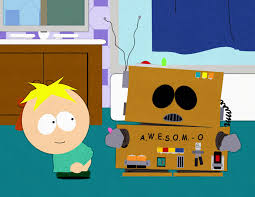
Butters receives a mysterious present, a sentient robot called AWESOM-O.  It’s really Cartman in disguise, the little scumbag intent on digging up more dirt on Butters so that he can humiliate him further.  What he discovers, though, is that Butters has a secret video of Cartman, showing him cross-dressing as Britney Spears. Thus, Cartman has to remain in disguise for longer than planned, until he learns the location of the incriminating video.  During the episode, Butters and his new robot pal end up in LA, where AWESOM-Os remarkable artificial intelligence earns him the attention of, first, some Hollywood executives, and then the top brass in the military-industrial complex.  None of the adults seem to notice that AWESOM-O is, in fact, a portly kid wearing a couple of cardboard boxes.  AWESOM-O is another classic featuring the Cartman-Butters double-act.  As is…


The Death of Eric Cartman (2005)

Cartman does something even more reprehensible than tricking Scott Tenorman into eating his parents – he scoffs all the delicious, crispy chicken-skins on a Kentucky Fried Chicken takeaway when the other kids aren’t looking.  (Kenny is so upset when he finds out that he bursts into tears.)  The kids retaliate by totally ignoring Cartman the next day.  Cartman, trying to fathom why everybody appears not to see or hear him anymore, decides it must be because he died during the night.  For some reason, though, his spirit remains marooned on earth just like Patrick Swayze’s was in Ghost (1990).  However, the kids have forgotten to tell Butters that no one’s speaking to Cartman.  When he finds himself able to communicate with Cartman as usual, the duo conclude he’s the equivalent of the medium in Ghost played by Whoopi Goldberg.  Much hilarity / stupidity ensues as Butters and Cartman try to get the latter’s spirit to pass on to the great hereafter.


Erection Day (2005)

If The Death of Eric Cartman spoofs Ghost, the closing minutes of Erection Day provide a piss-take, both funny and gruelling, of the most famous scene in An Officer and a Gentleman (1982).  This episode centres on Jimmy Valmer, the crutch-using, stuttering kid in class whose catchphrase is, “I’m not handicapped, I’m handi-capable!” and whose ambition is become a stand-up comedian.  Obviously, Jimmy is determined to win the school’s annual talent contest – other contestants include Cartman doing an impersonation of Tony Montana from Scarface (1983) and the Goth Kids performing a synth number called Talent Shows are for Fags – but a strange affliction threatens to ruin his act.  He keeps suffering sudden, unprovoked and massive erections.  Some misguided advice leads him to believe that the only way to cure the affliction is to lose his virginity.  Then, venturing into South Park’s red-light district, he becomes involved with a decrepit prostitute called Nutgobbler and her ultra-violent pimp.


© South Park Studios


Tsst (2006)

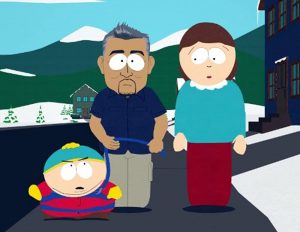
One reliably depressing character in South Park is Eric Cartman’s spineless mother Liane, devoted to her hideous offspring while he bullies, manipulates and torments her.  In Tsst, Liane Cartman finally tries to tame her son by enlisting the help of some reality TV show hosts.  She brings in Jo Frost from Supernanny (2004-08), who ends up in an asylum eating her own faeces.  (“It’s from hell!”)  Then she tries Cesar Millan from Dog Whisperer (2004-12).  Millan’s approach, of treating Cartman like a badly-behaved canine, has better results.


Go God Go / Go God Go XII (2006)

An ambitious two-parter making fun of everything from Richard Dawkins’ book The God Delusion (2006) to hoary old sci-fi TV show Buck Rogers in the 25th Century (1979-81), Go God Go has Cartman unable to wait a few weeks until the new Nintendo Wii console appears in the shops.  Instead, he has himself cryogenically frozen until it goes on sale.  Inevitably, things go wrong and he overshoots his target-date by 500 years and wakes up in a strange future world where everyone is an atheist and Richard Dawkins is hailed as a prophet, yet different factions with different interpretations of Dawkins’ pronouncements fight their own ‘holy’ wars.  For funniness, though, nothing quite matches an early scene where Ms Garrison (who by this time has had a gender re-assignment) reluctantly teaches the kids the theory of evolution: “So there you go.  You’re the retarded offspring of five monkeys having butt-sex with a fish-squirrel.  Congratulations!”


© South Park Studios


Breast Cancer Show Ever (2008)

The finest hour of Wendy Testaburger, Stan’s prim, pink-clad but formidable girlfriend.  One morning she gives a speech to her class about the threat breast cancer poses to women and gets heckled by Cartman, who’s greatly amused by her repeated use of the word ‘breast’.  Enraged, she challenges him to a fight after school.  Cartman agrees, then gets increasingly worried about what’s coming to him and tries increasingly desperate strategies to wheedle out of it.  Breast Cancer Show Ever ends the way it should, with Wendy beating the crap out of the evil little shit.


The Ungroundable (2008)

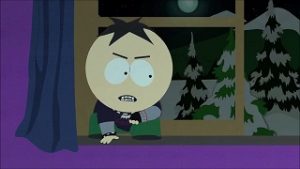
The Ungroundable uses a common South Park trope, that of the confusion caused when the kids interpret the grown-up (or more grown-up) world according to their own juvenile and fanciful logic.  Butters assumes that some older kids at the school, obsessed with Stephanie Meyer’s Twilight books and modelling themselves on vampires, really are vampires.  To destroy them, he joins forces with the Goth Kids – who merely object to the Vampire Kids on the grounds of them being douchebags.  Before then, Butters mistakenly believes he’s been bitten and has become a vampire himself.  And whose blood must he drain?  Cartman’s, of course: “…if someone must die so that I can feed… I choose thee!”


© South Park Studios


I know – all the episodes I’ve listed are more than a decade old.  But give 2020s South Park a go.  It’s still pretty funny.  And it’s a hell of a lot funnier than The Simpsons is these days.