10 years ago, Lemmy was killed by death


From wikipedia.org / © Mark Marek


Following the recent death of singer and guitarist Chris Rea, whose 1986 song Driving Home for Christmas has become something of a festive-season classic, a mate of mine observed that this was yet another example of a ‘musician who’s associated with a perennial Christmas song’ expiring at Christmastime.


To support his thesis, he mentioned George Michael (responsible for 1984’s Last Christmas and died on Christmas Day 2015) and Shane MacGowan (co-singer and co-writer of 1987’s Fairy Tale of New York and died on November 30th, 2023 – okay, not quite in the festive season but I’m sure the Christmas lights were already up in Dublin at the time).  Referencing the singers of Merry Christmas Everybody (1973) and I Wish It Could Be Christmas Every Day (1973) and the perpetrator of Mistletoe and Wine (1988) and Saviour’s Day (1990), my mate concluded, “…Noddy, Roy and Cliff better take extra care in Decembers to come.”


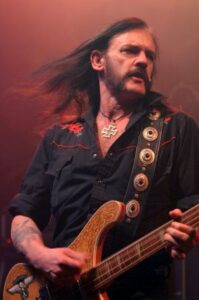
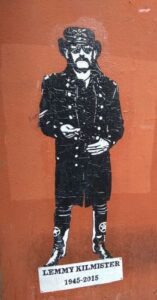
Well, today is the festive-season day of December 28th, 2025.  And it marks the tenth anniversary of the death of a titan of popular music: Lemmy, front-man with one of heavy metal’s most brilliant bands, Motörhead, and a general all-round role model for how to live your life (i.e. loudly, always disreputably and occasionally downright badly).


I was going to say that Lemmy’s passing at Christmastime disproves my mate’s theory that only the singers of Christmas songs die during this period.  But I’ve just checked and discovered that, though Motörhead never recorded a Christmas song, in 2008 Lemmy did get together with ZZ Top’s Billy Gibbons and the Foo Fighters’ Dave Grohl and made a cover version of Chuck Berry’s Run, Rudolph, Run (1958) for the same year’s album We Wish You a Metal Christmas and a Headbanging New Year.  (Google AI informs me the song’s vibe was ‘heavy, aggressive and sinister’.)   So maybe there’s something in it after all.


Anyway, Lemmy.  What an amazing career he had.  Legend has it that he managed the remarkable feat of being thrown out of Hawkwind for taking too many drugs – though more likely he was thrown out for taking the wrong sort of drugs, i.e., amphetamines, which the other, hallucinogenic-loving band-members looked down on.  He tried to teach Sid Vicious how to play bass (with a predictable lack of success).  He composed the greatest rock ‘n’ roll song ever, Ace of Spades (1980).  He also gave rise to the greatest joke ever – “If Lemmy had a fight with God, who would win?”  “It’s a trick question: Lemmy is God.” – which was funny because it was true.


Here, by way of a tribute to the great man, is a review of a Motörhead concert that I wrote back in 2008 for the University of East Anglia’s student newspaper, Concrete.  It’s an excitable and breathless piece of writing but, well, I had just been at a Motörhead concert.  Reading it now, I have a few regrets.  I should apologise to the late Ronnie James Dio – in the years since, I’ve come to realise I like ‘strutting spandex-clad idiots singing songs about elves and wizards’.  Plus, Ronnie was no idiot.


And obviously, I regret the fact that the prediction made in the final sentence didn’t come true.

*

MOTÖRHEAD

UEA, November 21st, 2008

If the Nobel Foundation in Stockholm ever creates a Nobel Prize for Heavy Metal, surely its first recipient will be Lemmy, singer, bassist and general driving force of Motörhead.


Founded in the 1970s, a decade when heavy metal consisted of strutting spandex-clad idiots singing songs about elves and wizards (e.g. Rainbow) or about their abilities in making vigorous love to the ladies (e.g. Whitesnake), Motörhead were a revelation.


Lemmy’s hoarse roar was stuck onto a racket of guitars played at the loudest possible volume and at the fastest possible speed, a sound that helped to spawn the speed and thrash metal sub-genres and supplied Metallica, Slayer, Anthrax and co. with at least 666 tons of inspiration.


Lemmy was also an early and crucial champion of Girlschool, the groundbreaking all-female metal band who helped the music to shed some of its reputation for sexism.  And in the segregated pre-grunge era, when heavy metal and punk fans weren’t supposed to associate with each another, Motörhead was the one metal band it was okay for punks to like.  Lemmy and the Sex Pistols’ Sid Vicious were good mates and he even tried to teach Sid how to play bass guitar – unsuccessfully, it must be said.


Taking the stage tonight after a short-but-well-received set from Toronto band Danko Jones and a ludicrous-but-loveable one from Saxon – ironically one of those hoary old-style metal bands that Motorhead helped to make obsolete – Lemmy, guitarist Phil Campbell and drummer Mikkey Dee went to work with their usual, blistering single-mindedness.  Old favourites like Bomber (1979) and Killed by Dead (1984) got blasted out alongside items from their new album Motörizer – though unsurprisingly the new stuff didn’t sound entirely different from the old stuff.


Apart from a blues pastiche where Lemmy displayed some unexpected harmonica-playing skills, this was business-as-usual in the best sense of the phrase.  Rounding off a perfect evening for the head-grinding crowd was an encore containing Ace of Spades, surely the most brain-batteringly brilliant song in heavy metal – and possibly in 7000 years of human civilisation as well.


The big heavy-metal news this week was that Guns n’ Roses had finally put out Chinese Democracy – an album so named because it’d taken so long to record that democracy could have feasibly come to China by the time of its release.   From tonight’s showing, however, Motörhead will be going strong long after China has taken over Wall Street, bought up Coca Cola and put a man on the moon.
 

From blabbermouth.net / © Pedro Alonso
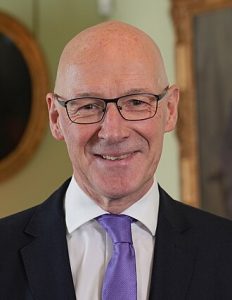
An honest John


From wikipedia.org / © Scottish Government


John Swinney became leader of the Scottish National Party on May 6th and was sworn into office as First Minister of Scotland two days later.  His arrival in the two roles comes during a difficult period for his party.  First, the SNP has had to endure the spectacle of its once-mightily-respected, once-seemingly-unassailable former boss Nicola Sturgeon, who served as First Minister from 2014 to 2023, mired in a scandal whereby her husband, Peter Murrell, has been investigated and arrested over possible mismanagement of the party’s finances.


Then came the sorry saga of Sturgeon’s replacement as party leader and First Minister, Humza Yousaf.   Yousaf was brave enough to defy the British-establishment line and challenge Benjamin Netanyahu’s policy of killing huge numbers of innocent Palestinians in revenge for Hamas’s slaughter of Israeli civilians on October 7th, 2023.  But in most other respects, he was pretty hapless.


Most notably, he didn’t so much shoot himself in the foot as blow the foot off at the ankle when he ended his party’s alliance with Scotland’s other pro-independence party, the Scottish Greens. The Greens were so outraged they made it clear that they would vote against Yousaf in a no-confidence vote in the Scottish Parliament.  Realising he was going to lose that vote, Yousaf resigned.  His resignation at least seems principled compared with the behaviour of another First Minister recently.  Labour’s Vaughan Gething, First Minister of Wales, recently lost a no-confidence vote in the Welsh Senedd and blithely refused to quit, dismissing the vote as a ‘gimmick’.


Swinney’s arrival as Yousaf’s replacement happened at an incredibly inopportune time.  Barely had he got through the door of Bute House, the First Minister’s official residence in Edinburgh, than Rishi Sunak, British Prime Minister and a politician so clodhopping he makes Humza Yousaf look like a smooth operator, announced a general election for July 4th.  The polls say the SNP are going to lose a swathe of seats in the London parliament to Keir Starmer’s Labour Party.  Even if Swinney was the best politician in the world, I don’t see what he could do to avoid that.


Not that I think Scottish voters are enamoured with Labour, who are so obsessed with attracting former Conservative Party voters they’ve made their policies a continuation of the right-wing ones that’ve damned Britain to rack and ruin during the past 14 years.  For instance, they’ve vowed not to revisit the terms of the Tories’ Brexit arrangement with the European Union, even though it’s hobbled British businesses and it’ll thwart their plans to ‘grow’ the economy; and they won’t countenance raising taxes, which makes you wonder how they’re ever going to lift Britain’s public services out of their current, dire state.  But I suspect folk in Scotland are so scunnered by the SNP’s recent scandals and mishaps, and so desperate to see the back of the Tories, that they’ll vote for Labour en masse next month.


For this reason, and because of Swinney’s bespectacled, unexcitable and unshowy demeanour – he’s often likened to a ‘bank manager’ or an ‘accountant’, although I remember one Scottish hack comparing him to ‘Harry Potter’, which I’m sure didn’t please the famously anti-SNP J.K. Rowling – there’s been speculation that he’s serving merely as a ‘caretaker’ leader, steadying the helm until someone of more substance takes over.  In particular, many in the Scottish media expect the leadership to soon go to Kate Forbes, who’s currently Deputy First Minister.  Famous for his negotiating skills, Swinney managed to talk Forbes out of taking him on in a leadership contest in May.


Anyway, I should say that back in my misspent youth, I crossed paths a few times with John Swinney – whose youth, I imagine, was somewhat less misspent than mine.  When I’d been a pupil at Peebles High School in the late 1970s and early 1980s, one of my best pals was a guy called Roger Small.  Once we finished school, Roger went to university in Edinburgh and I to university in Aberdeen.  I kept in touch with him and on a few weekends came down from Aberdeen to stay in his flat in Edinburgh.  My reasons for those visits were not wholly because of friendship.  They coincided with the Five Nations Rugby championship, as it was then, which was held every spring and saw two Scottish home-games played at Edinburgh’s Murrayfield Stadium.  I’d get a ticket, arrange to spend the night at Roger’s place, go to see the game in the afternoon and enjoy the post-match festivities in the evening.


From www.sportspages.com


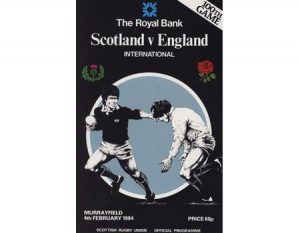
On February 4th, 1984, I dropped my stuff off at Roger’s and went to Murrayfield to see Scotland play England.  Scotland won 18-6.  In the Scotsman newspaper, back in those long-ago, pre-Andrew Neil days when it was worth reading, Chris Rea – no, not that Chris Reaopined: “The Scottish forwards… were immense – a finely blended unit, alert and supportive. Their breakaways forced England into elementary errors.  They foraged with devastating accuracy…  Every Scot… played his part to the full.”


When the final whistle blew, I was extremely pleased that Scotland had demolished England, the Auld Enemy.  So pleased that, on my way back to Roger’s flat, I indulged in a wee, celebratory pub-crawl along Rose Street, taking in such hostelries as the Auld Hundred, the Kenilworth and the Abbotsford.  It probably didn’t help that I’d already done a pub crawl of Rose Street in the late morning and early afternoon, on my way to Murrayfield.  Anyway, the result was that I was well-refreshed when I returned to the flat.


Roger had told me he was entertaining some Edinburgh University mates that evening, with the intention of going to a party later on.  I was welcome to join them.  So, at about seven o’clock, I trotted into Roger’s living room, plonked myself on the sofa in the midst of some people I hadn’t met before and, trying to be sociable, joined in the conversation.  After a few minutes, a tall, lean, slightly intense-looking young man sitting on the sofa beside me turned his head towards me and asked incredulously, “Are you drunk?”


Ladies and gentlemen, meet John Swinney, future leader of the Scottish National Party, an outfit dedicated to the cause of Scottish independence, to freeing Scotland from the shackles of political rule from London, capital of England.  Shocked that someone in Edinburgh, capital of Scotland, should be a wee bit inebriated after Scotland had trounced England at rugby.


But I can’t have been that inebriated because I managed to accompany Roger, John and friends to the party that night and managed to participate in the conversation enough to form the opinion that Roger’s mate John was a decent-enough, if sober, bloke.  It turned out that the party was being held by someone from Peebles, the town where Roger and I had attended school, so I knew some of the folk there.  Actually, it amuses me to think that the future First Minister of Scotland was once at a party rubbing shoulders with such well-kent Peebles eccentrics as the late Andrew Cleghorn.


Thereafter, I encountered John Swinney a couple of times in Edinburgh, briefly, while I was in Roger’s company.  The last time was a summer or two later, during the Edinburgh Festival, when Teviot Row, the Edinburgh University students’ union building, had been turned into a venue and the pair of them were working there as bouncers.  What a pity Oxford University’s notorious Bullingdon Club didn’t arrange a field-trip to Edinburgh at the time and try to subject Teviot Row to their yobbish antics…  I would have paid good money to see John Swinney eject Boris Johnson from the premises.


I lost touch with Roger for a while after that, but bumped into him again in the late 1980s after I’d moved to Edinburgh.  He kindly fixed me up with a part-time job at the (now-long-gone) Greyfriars Bookshop at the bottom of George IV Bridge.  At some point I asked how John Swinney was getting on and Roger told me he was ascending in the ranks of the SNP.  Later, when I mentioned his name to some mates from Aberdeen who were heavily into the cause of Scottish independence, they reported they’d seen him deliver a speech at an SNP conference and were greatly impressed by him.


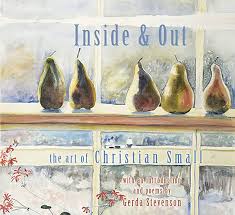
I completely lost touch with Roger Small in the 1990s – he took off for Australia – and, several years ago, wondering what’d happened to him, I tried Googling him.  I didn’t find him, but learnt something about his mother, Christian Small, who’d passed away in 2016 at the age of 90.  Christian had been an immensely-talented amateur painter, but according to a friend she was ‘extraordinarily diffident about her work’ and needed ‘a great deal of persuasion’ to allow her paintings to appear in local exhibitions.  Because of her modesty, presumably, it didn’t really dawn on people – family and friends alike – how good an artist she’d been until after her death.  However, in 2018 and 2019, some events were held to commemorate her and her art, including exhibitions and the launch of a book called Inside & Out.  The book featured her paintings interspersed with verse written by another friend, the poet and actress Gerda Stevenson.


One of those events was attended by John Swinney, who by then was Deputy First Minister of Scotland.  On Twitter, he remarked that Christian Small had been the mother ‘of my dear university friend Roger.’  So, I’m glad he still remembers his old mate and still holds him in high regard.


© Scotland Street Press


Though he’s made his name as a cautious type – too cautious for some people’s tastes, which has led to them questioning his political acumen – it’s hard to find anyone with a bad word to say about John Swinney as a person.  For example, the former Scottish Labour Party leader Jim Murphy once commented: “There’s nobody in Scotland who doesn’t like John Swinney.”  I recall my old English teacher, Ian Jenkins, who served in the Scottish Parliament for four years as the Liberal Democrat representative for Tweeddale, Ettrick and Lauderdale, speaking highly of him too.


Thus, I’m pleased that Swinney now holds the highest political office in his country.  He struck me as a decent guy and it’s good to see decency rewarded.  Unfortunately, politics isn’t an arena where being decent always works in your favour.  I suspect he has his work cut out for him – especially if the polls prove to be right and his party takes a pounding in the general election.