10 years ago, Lemmy was killed by death


From wikipedia.org / © Mark Marek


Following the recent death of singer and guitarist Chris Rea, whose 1986 song Driving Home for Christmas has become something of a festive-season classic, a mate of mine observed that this was yet another example of a ‘musician who’s associated with a perennial Christmas song’ expiring at Christmastime.


To support his thesis, he mentioned George Michael (responsible for 1984’s Last Christmas and died on Christmas Day 2015) and Shane MacGowan (co-singer and co-writer of 1987’s Fairy Tale of New York and died on November 30th, 2023 – okay, not quite in the festive season but I’m sure the Christmas lights were already up in Dublin at the time).  Referencing the singers of Merry Christmas Everybody (1973) and I Wish It Could Be Christmas Every Day (1973) and the perpetrator of Mistletoe and Wine (1988) and Saviour’s Day (1990), my mate concluded, “…Noddy, Roy and Cliff better take extra care in Decembers to come.”


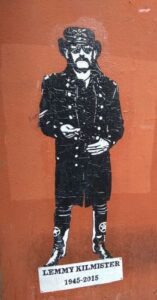
Well, today is the festive-season day of December 28th, 2025.  And it marks the tenth anniversary of the death of a titan of popular music: Lemmy, front-man with one of heavy metal’s most brilliant bands, Motörhead, and a general all-round role model for how to live your life (i.e. loudly, always disreputably and occasionally downright badly).


I was going to say that Lemmy’s passing at Christmastime disproves my mate’s theory that only the singers of Christmas songs die during this period.  But I’ve just checked and discovered that, though Motörhead never recorded a Christmas song, in 2008 Lemmy did get together with ZZ Top’s Billy Gibbons and the Foo Fighters’ Dave Grohl and made a cover version of Chuck Berry’s Run, Rudolph, Run (1958) for the same year’s album We Wish You a Metal Christmas and a Headbanging New Year.  (Google AI informs me the song’s vibe was ‘heavy, aggressive and sinister’.)   So maybe there’s something in it after all.


Anyway, Lemmy.  What an amazing career he had.  Legend has it that he managed the remarkable feat of being thrown out of Hawkwind for taking too many drugs – though more likely he was thrown out for taking the wrong sort of drugs, i.e., amphetamines, which the other, hallucinogenic-loving band-members looked down on.  He tried to teach Sid Vicious how to play bass (with a predictable lack of success).  He composed the greatest rock ‘n’ roll song ever, Ace of Spades (1980).  He also gave rise to the greatest joke ever – “If Lemmy had a fight with God, who would win?”  “It’s a trick question: Lemmy is God.” – which was funny because it was true.


Here, by way of a tribute to the great man, is a review of a Motörhead concert that I wrote back in 2008 for the University of East Anglia’s student newspaper, Concrete.  It’s an excitable and breathless piece of writing but, well, I had just been at a Motörhead concert.  Reading it now, I have a few regrets.  I should apologise to the late Ronnie James Dio – in the years since, I’ve come to realise I like ‘strutting spandex-clad idiots singing songs about elves and wizards’.  Plus, Ronnie was no idiot.


And obviously, I regret the fact that the prediction made in the final sentence didn’t come true.

*

MOTÖRHEAD

UEA, November 21st, 2008

If the Nobel Foundation in Stockholm ever creates a Nobel Prize for Heavy Metal, surely its first recipient will be Lemmy, singer, bassist and general driving force of Motörhead.


Founded in the 1970s, a decade when heavy metal consisted of strutting spandex-clad idiots singing songs about elves and wizards (e.g. Rainbow) or about their abilities in making vigorous love to the ladies (e.g. Whitesnake), Motörhead were a revelation.


Lemmy’s hoarse roar was stuck onto a racket of guitars played at the loudest possible volume and at the fastest possible speed, a sound that helped to spawn the speed and thrash metal sub-genres and supplied Metallica, Slayer, Anthrax and co. with at least 666 tons of inspiration.


Lemmy was also an early and crucial champion of Girlschool, the groundbreaking all-female metal band who helped the music to shed some of its reputation for sexism.  And in the segregated pre-grunge era, when heavy metal and punk fans weren’t supposed to associate with each another, Motörhead was the one metal band it was okay for punks to like.  Lemmy and the Sex Pistols’ Sid Vicious were good mates and he even tried to teach Sid how to play bass guitar – unsuccessfully, it must be said.


Taking the stage tonight after a short-but-well-received set from Toronto band Danko Jones and a ludicrous-but-loveable one from Saxon – ironically one of those hoary old-style metal bands that Motorhead helped to make obsolete – Lemmy, guitarist Phil Campbell and drummer Mikkey Dee went to work with their usual, blistering single-mindedness.  Old favourites like Bomber (1979) and Killed by Dead (1984) got blasted out alongside items from their new album Motörizer – though unsurprisingly the new stuff didn’t sound entirely different from the old stuff.


Apart from a blues pastiche where Lemmy displayed some unexpected harmonica-playing skills, this was business-as-usual in the best sense of the phrase.  Rounding off a perfect evening for the head-grinding crowd was an encore containing Ace of Spades, surely the most brain-batteringly brilliant song in heavy metal – and possibly in 7000 years of human civilisation as well.


The big heavy-metal news this week was that Guns n’ Roses had finally put out Chinese Democracy – an album so named because it’d taken so long to record that democracy could have feasibly come to China by the time of its release.   From tonight’s showing, however, Motörhead will be going strong long after China has taken over Wall Street, bought up Coca Cola and put a man on the moon.
 

From blabbermouth.net / © Pedro Alonso

Seven reasons why Robert Burns still rocks


From wikipedia.org / © Ron Waller


This is a revised and expanded version of a piece I had published one January 25th in the Arts section of Concrete, the students’ newspaper at the University of East Anglia, where I did a Master’s Degree many years ago.


Tonight, whisky will be guzzled, haggis devoured, bagpipes blasted and Scots-language poetry recited with gusto at thousands of special suppers and get-togethers around the globe.  This is because today, January 25th, is the 265th anniversary of the birth of Robert Burns, Scotland’s national bard and one of its most popular contributions to international culture.


Why, more than two-and-a-half centuries after he died at the age of 37, is Robert Burns such big deal?  Here are some reasons.


One.  Burns was a champion of the common man.  Born in humble circumstances, as one of seven children to a farmer in Ayrshire, he was much more in tune with the ordinary masses than any of his literary contemporaries.  The American poet Waldo Emerson described him as the poet of ‘the poor, anxious, cheerful, working humanity’.  The fullest expression of his egalitarian instincts was the song A Man’s a Man for a’ That (1795), which was adopted as an anthem by the anti-slavery abolitionist movement.  That, however, highlights an uncomfortable fact…


In 1786, Burns came within a hair’s breadth of travelling to Jamaica and taking up a job-offer as a bookkeeper on a sugar plantation – run on slave labour.  Burns’ defenders argue that as a young man at the time, pre-fame, facing destitution, and desperate to get out of Scotland, he probably didn’t consider the hideous moral implications of the job he was about to undertake.  Also, by 1792, he seemed aware enough of slavery’s horrors to pen The Slave’s Lament, which begins: “It was in sweet Senegal that my foes did me enthral / For the lands of Virginia-ginia, O.“  But the issue is murkier still, because Burns’ authorship of The Slave’s Lament has been disputed.


Anyhow, later, socialists claimed Burns as one of their own.  A 1929 translation of his works into Russian sold a million copies and the Soviet Union honoured him with a commemorative stamp in 1954.  However, Burns obviously had appeal for capitalists too, for there are allegedly more statues of him in North America than of any other writer.


Two.  Burns was a songwriter too.  Indeed, if anything, he is more pervasive as a songwriter than as a poet.  In addition to A Man’s a Man…, he put Auld Lang Syne on paper in 1788 – which, by virtue of being belted out at New Year celebrations everywhere, is arguably the most universally-sung song in the world.  In Japan it is played at everything from high school graduation ceremonies to evening closing-time in department stores.


Three.  Burns wasn’t afraid to criticise the moral and religious mores of his time.  His contempt for the censorious regime of Scotland’s Presbyterian Church was expressed most famously in Holy Willie’s Prayer (1785), wherein a supposedly pious pillar of the church prays to God and unwittingly reveals himself as a scheming, bitter, drunken hypocrite.  Particularly pathetic are his pleas to be forgiven for his lechery, which has targeted ladies by the name of Meg (“And I’ll ne’er lift a lawless leg / Again upon her”) and ‘Leezie’s lass’ (“…that Friday I was fou / When I cam near her”).  John Betjeman was so impressed by the conceit that he borrowed it for his 1940s poem In Westminster Abbey.


Four.  Burns has a massive cult that keeps his memory alive.  The first Burns societies began to congregate in his honour in about 1800, four years after his death. In 1859, the first centenary of his birth, almost 900 events were staged – 60 of them taking place outside Britain and the US.  Today, Burns societies are to be found everywhere from Rio de Janeiro to Tokyo and from Winnipeg to Jakarta.


It’s claimed that the Russians have more such societies than even the Scots do.  Well, in the unlikely of event of Vladimir Putin sticking his head into a Burns supper this evening, I hope he’s regaled with Burns’ 1792 rewrite of the song Ye Jacobites by Name, whose anti-war lyrics include: “What makes heroic strife? / To whet th’ assassin’s knife / Or hunt a parent’s life, wi’ bluidy war?


From wikipedia.org / © Melissa Highton


Burns suppers on January 25th are marked by lusty recitals of his greatest poems, speeches and copious consumption of whisky and haggis.  Praised as the ‘great chieftain o’ the puddin’ race’ in Burns’ Address to a Haggis (1786), haggis is surely the only offal-based foodstuff to have a piece of world-class literature written in its honour.  No other writer is commemorated by a yearly celebration on this scale.  Dublin’s James Joyce-themed Bloomsday on June 16th doesn’t come close.


Five.  Burns invented the concept of the doomed, decadent romantic poet.  Long before Byron and Shelley were painting the towns of Europe red and proving themselves mad, bad and dangerous to know, Burns had earned himself a mighty reputation for dissipation, both in the pub and in the bedchamber.  His love of strong drink is obvious in poems like John Barleycorn (1782) while his promiscuity led to him siring at least a dozen children with at least four different women – a common jibe at the time was that you could see his face in every pram on Edinburgh’s Princes Street.


Six.  Burns is controversial.  And no doubt the arguments that have raged about him over the centuries have helped keep his fame alive.  Much debate has centred on whether or not someone with Burns’ obvious character flaws deserves such veneration.  At the beginning of 2009, just before the 250th anniversary of his birth, right-wing Scottish historian Michael Fry caused a storm when he denounced Burns as a ‘racist misogynist drunk’ who didn’t deserve to be presented to people as a role model.  Fry sounded a bit like a rock-and-roll era parent expressing concern about the examples the likes of Jim Morrison, Sid Vicious, Liam Gallagher, Pete Docherty, Amy Winehouse, etc., set for young people.


Seven.  Burns’ work has had a considerable influence on the English language and on English-language culture.  Here are a few examples:


Proverbs:

  • The best laid plans of mice and men will go astray (‘The best-laid schemes o’ mice an’ men gang aft agley’ / from 1785’s To a Mouse).
  • To see ourselves as others see us (‘To see ousel’s as ithers see us’ / from 1786’s To a Louse).
  • There is no such uncertainty as a sure thing (attributed to Burns).


Phrases:


Burns-inspired titles:

  • John Steinbeck’s novel, Of Mice and Men (1937).
  • R. James’ short story, reckoned by some to be the greatest ghost story in English literature, O, Whistle and I’ll Come to you my Lad (1904) – which is also the title of a 1793 Burns poem.
  • Ken Loach’s film, Ae Fond Kiss (2004) – which is also the title of a 1791 Burns song.
  • The Vin Diesel car-chase / street-racing movie The Fast and the Furious (2001) – ‘fast and furious’ was a phrase Burns coined in Tam O’Shanter.


All right, with that that last example, the producers may not have been aware of the Robert Burns connection when they chose the title.


© National Trust for Scotland / Robert Burns Birthplace Museum