Nostalgic wallows 6: 1970s visions of the future


From wikipedia.org / © NASA / Josh Valcarcel


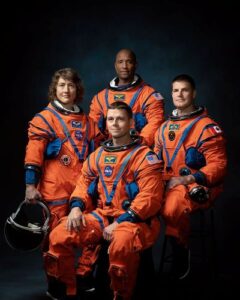
Three days ago, the crew of Artemis II returned to earth.  They had taken part in a lunar flyby mission launched by the United States’ National Aeronautics and Space Administration (NASA) that saw human beings leave low earth orbit and travel around the moon for the first time in over 50 years.  I would have posted something on this blog about Artemis II before now, but didn’t want to tempt fate.  “Let’s wait until they get back safely,” I thought.  The fact that the current US government, which gives NASA its orders, seemingly doesn’t give a f*ck about matters such as health and safety or, indeed, science generally made me worry the mission had been insufficiently prepped and might end in disaster.


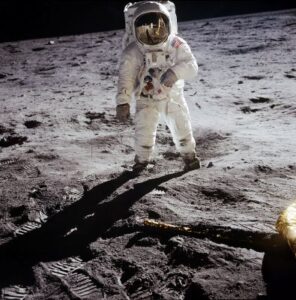
Happily, though, the Artemis II mission has been a resounding success.  It’s also made me think back to when I was a little kid, in the early 1970s, the last time that humans went to the moon.  In fact, it was in 1969, when I was three years old and NASA’s Apollo programme was underway, that the late Neil Armstrong became the first human to set foot on an alien world.  All right, it was only the moon, which is hardly in the same league as Krypton or Tatooine, but for a wee species that evolved out of the Homo genus just 200,000 years ago, Armstrong’s ‘small step’ 57 years ago was pretty impressive.


However, it has also made me wonder.  After all the excited expectations raised by the Apollo programme about space travel, how come the half-century between it and Artemis II has turned out to be so rubbish?


I’m too young to remember seeing Armstrong plant his spacesuit-encased foot on the lunar turf in 1969, but I can just about recall live TV pictures of a subsequent Apollo mission to the moon in the early 1970s.  Admittedly, I wasn’t altogether sure what I was watching.  At the time my family and I were huddled around a tiny black-and-white television in Northern Ireland, which only picked up one channel, the BBC.  (It showed a second channel, RTE, from the Republic of Ireland, if my Dad poked a screwdriver into a hole at the set’s side and did some awkward and potentially dangerous fiddling with the wiring.)  All I could make out on the screen were some fuzzy pale blobs floating against a fuzzy grey background.  However, my Dad assured me these were men walking about on the moon, high above us, at that very moment, so I took his word for it.
 

From wikipedia.org / © NASA


It must have been in 1973 that my imagination took a leap that was almost as giant as the ‘leap for mankind’ that Armstrong spoke of when he descended from the lunar landing module.  The cause of this were two sets of newly-published encyclopaedias that my parents had seen advertised somewhere and ordered – a 15-volume set with lemony-coloured covers called the Childcraft books that, accordingly, were for children; and a 24-volume set called the World Book series that were for adults and came in sombre, mossy-green covers.  That was 39 encyclopaedias in all and, amazingly, they fitted perfectly into the big display shelf that ran along the top of the sideboard in our living room.


I immediately set about reading these encyclopaedias, both the juvenile and adult ones, and my horizons were swiftly widened.  Not all the consequences of this were positive.  My parents had neglected to read the small print in the advertisement.  If they had, they would have discovered that the encyclopaedias had been printed in America, by Americans, for Americans, and their contents were duly biased towards America.  As a result, I wasted a lot of time searching in the fields of our farm for evidence that woodchucks, porcupines, prairie dogs and Gila monsters had been foraging there.  Also, some quaint words started to appear in my vocabulary – diaper, candy store, soda fountain, rest room – which inevitably had my classmates at primary school tearing the piss out of me.


One feature of these encyclopaedias that really rubbed off on me was that, because they were American and because they’d been published just after the moon landings, they were dripping with optimism.  And this was a scientific as well as an American optimism.  Yes, it’s hard to believe today, now that one of the two main American political parties is infested with far-right-wing religious fruitcakes who maintain that the universe was created in six days a few thousand years ago (and vaccines are bad, and manmade climate change is a hoax), but there was a time not long ago when America took science seriously and saw it as one of the key tools in converting the rest of the world to the glories of the American way.  At the age of eight or nine, I lapped all this up – even those assertions in the encyclopaedias that, with the benefit of hindsight, were a bit over-optimistic.


For example, the encyclopaedias predicted that, having reached the moon, it would only be a short time – the 1980s, at the latest – before human beings were tramping around the surface of Mars too.  The ‘S’ volume of the World Book encyclopaedias had a lengthy entry about ‘space travel’ and on one page I found a multi-pictured diagram showing how astronauts were going to get to Mars.  Admittedly, the Mars spaceship in that diagram, as well as having a long, sleek fuselage and a beak-like nose, had wings, which seemed a bit suspicious because by then I knew that in outer space there wasn’t any air and wings were thus superfluous.  (I suspect the artist behind those pictures had been unconsciously influenced by a non-space vehicle that was making a stir at the time, Concorde.)  Elsewhere, there were pictures of what a moonbase – only a few decades away in the future, I was told – would look like, although it was an unprepossessing cylindrical structure that resembled a giant tin can.


Anyway, I assumed this was what I could expect by the time I’d reached my thirties.  I’d be living on a moonbase, watching Concorde-like spaceships streak past on their way to Mars.


My expectations were buoyed further when in the mid-1970s my parents finally got round to buying a new TV set that got three channels, the BBC, RTE and ITV – Independent Television.  Although ITV had (and still has) a reputation for cheap and lowbrow programming in comparison with that made by the BBC, it did broadcast at the time various action / adventure series made by a subsidiary called ITC entertainment, run by the cigar-smoking impresario Lord Lew Grade.  Aimed at international markets and at the American market in particular, ITC’s shows commanded higher-than-average budgets and looked quite glossy by the standards of 1960s and 1970s British TV.  They included The Prisoner (1967-68), Department S (1969-70) and The Persuaders (1971) and a host of science-fiction shows made by the remarkable Gerry Anderson.  I was able to watch these for the first time.
 

From gerryanderson.com / © ITV Studios


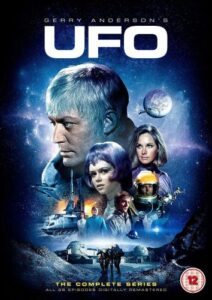
It was watching repeats of Anderson’s live-action sci-fi show, UFO, made in 1970 and starring Ed Bishop, George Sewell, Michael Billington, Peter Gordeno, Wanda Ventham (Benedict Cumberbatch’s mum) and Gabrielle Drake (Nick Drake’s sister), that convinced me that the future was going to be absolutely brilliant.  For UFO, Anderson’s production team envisioned the shape of things to come through a prism of gaudy late-1960s design and fashion, with a smidgeon of then-fashionable psychedelia.  It didn’t just feature spaceships and moonbases, but also sleek super-cars, talking computers with hallucinogenic panels of flashing lights, giant submarines with detachable nose-modules that turned into aircraft when they reached the ocean surface, guys in groovy-looking suits that didn’t have lapels, and ladies wearing silver miniskirts and sporting purple hairdos.


So, I thought, I’d be living on a moonbase, watching spaceships streak past towards Mars, and Gabrielle Drake would be shimmying around me looking fetching in silver and purple.  The future seemed better than ever.


Needless to say, as the 1970s wore on, I began to get uneasy about the fact that very little futuristic stuff was happening any more.  As far as manned spaceflight was concerned, not much occurred after the Skylab project – yes, there was the space shuttle, but that didn’t venture beyond earth’s orbit and, frankly, seemed a bit shit.  Meanwhile, the Viking 1 probe landed on Mars but, alas, found nothing interesting.  There were no aliens, Martian canals or H.G. Wells-style three-legged war machines shooting death-rays – just some boring geological formations that had once been river valleys.  And what had happened to that you-can-do-anything-if-you-put-your-mind-to-it American optimism?  It seemed to fizzle out as the 1970s became one long litany of American trauma: the Vietnam War, the 1973 oil crisis, Watergate and the Iran hostage saga.


I still had hope, though.  In the mobile library that came to our village every week, I picked up a copy of Arthur C. Clarke’s novelisation of 2001: A Space Odyssey, the classic 1968 sci-fi movie he’d co-written with director Stanley Kubrick.  It was reassuring to read Clarke’s sober, matter-of-fact account of a journey from the earth to the moon and then on to Saturn.  (In Kubrick’s film, the final destination was changed to Jupiter because of the job of convincingly depicting Saturn’s rings was too much for his special effects team.)  By then I was well-versed in astronomy and space travel and the book seemed to reinforce everything I knew already about the subjects.  It also seemed to make the idea that humanity would be out exploring more of space in the early 21st century feasible and, indeed, logical.

 

© Signet Books


When I finally saw 2001 the movie, however, it was in 1982 and even I had to concede it’d become a bit of a museum piece.  In some ways it possessed an admirable, almost documentary-like realism – for instance, I was impressed by the fact that, unlike the spaceships in every other science fiction movie I’d seen, Kubrick’s spaceships didn’t make any noise (because sound doesn’t travel in the vacuum of space) – but it struck me as a historical artefact nonetheless because it was clearly rooted in a past time and in past conceptions of what lay ahead.  It offered a late-1960s view of the future, one that just wasn’t plausible any longer in the early 1980s.


By then, the Mad Max movies (1979, 81 & 85) had started to do the rounds and, after the oil shortages of the 1970s, they presented an unfortunately more credible vision of what the 21st century might be like.  It was also telling that a couple of years earlier, in 1978, Lord Grade’s ITC Entertainment, which had once stimulated my space-age fantasies with Gerry Anderson’s UFO, had produced the movie Capricorn One – a cynical sci-fi thriller about a NASA expedition to Mars that is actually a hoax, with the supposed landing on the Martian surface being filmed in a TV studio in the American desert.


And now in 2026 I find myself inhabiting a world far removed from the visions that Neil Armstrong, Gerry Anderson and Arthur C. Clarke inspired in me during my childhood.  The Artemis programme promises that human beings will once again set foot on the moon but I’m sceptical that people will get to Mars in my lifetime and I’m beginning to wonder if they’ll ever get there at all.  I know Elon Musk keeps vowing to do it but, given the logistics involved and given our current levels of technology, I think that’s bollocks.  (Talking bollocks comes as naturally to Musk as breathing.)


It doesn’t help that the orange narcissist currently residing in the White House is trying to cut 23 percent of NASA’s funding – though he’ll no doubt attempt to grab the credit for Artemis II’s success and make it all about himself.


Still, thank you, Artemis II crew. You’ve kindled some fond nostalgia in me and given me a sliver of hope, at least, that humanity’s future might extend beyond the gravitational pull of its home world.

 

From wikipedia.org / © NASA

Democracy dies in Donald-grovelling


From wikipedia.org / © The Washington Post


What would you say to Epstein survivors…?


You are so bad.  You are the worst reporter.  No wonder CNN has no ratings.  She’s a young woman.  I don’t think I’ve ever seen you smile.   They should be ashamed of you.”


On February 4th, CNN reporter Kaitlan Collins was cut off in the middle of a question about the victims of Jeffrey Epstein, notorious paedophile, human trafficker and friend to the rich and famous, at a White House press conference.  Cutting her off was President Donald Trump, coincidentally someone who receives, according to the New York Times, 38,000 mentions in the Epstein files so far released by the US Department of Justice.  Evidently, in Trump’s mind, you need to smile when you ask questions about victims of paedophilia and human trafficking.


I find his objection ironic considering that for the last 21 years Trump’s been married to Melania Trump, a woman on whose visage – gimlet-eyed and as smooth, hard and unyielding as an iron bedpan – anything resembling a smile rarely flickers.  Obviously, though, if you were expected to share a marital bed with Trump, your face wouldn’t be projecting sunbeams and rainbows either.


Lately, Melania Trump has been in the news because of the release of a new documentary movie about her.  Entitled Melania, it focuses on her during the run-up to her husband’s second inauguration as president.  Jeff Bezos’s Amazon paid 40 million dollars for the rights to the documentary – 28 million of that reportedly going straight into Ms. Trump’s pocket – and another 35 million to advertise it.


Reviews of Melania have not been, shall we say, overly enthusiastic.  The last time I checked the review aggregate site Rotten Tomatoes, its ‘Tomato-meter’ had it at seven percent.  William Thomas at Empire magazine advised, “Do try not to choke on your popcorn.”  Sean Burns at North Shore Movies observed, “At least Leni Riefenstahl could frame a shot.”  Mark Kermode at Kermode and Mayo’s Take – The Brand New Podcast described it as “the most depressing experience I have ever had in the cinema.”  He added, “I mean, I’ve seen A Serbian Film (2010), I’ve seen Cannibal Holocaust (1980), I have never felt this depressed…  I thought it was absolutely repugnant.”


By the way, the director of Melania is Brett Ratner, who in 2017 was accused of sexual assault and harassment by six women, accusations he’s denied.  In photos recently released from the Epstein files, he appears sitting on a sofa beside the late, loathsome paedophile, both of them cuddling young women.  The women’s faces are blocked to protect their identities, so you can’t tell how young they are.


I should also say that Melania made seven million dollars on its opening weekend, a decent haul for a documentary.  Obviously, it appeals to a certain audience in the USA, i.e., cultish MAGA dingbats so worshipful of her husband they’d spend a fortune on eBay to acquire pieces of his used toilet paper, which they’d then frame and hang prominently in their living rooms.  However, it still looks like it’ll be a long time before Amazon recoups anything like the 75 million dollars it invested in the movie.


From wikipedia.org / © White House


In totally unconnected developments during Trump’s first year as 47th president, the Orange One signed an executive order relaxing environmental rules about space launches (benefiting Bezos’s private space venture Blue Origin); signed an order preventing US states from enforcing their own AI regulations (benefiting Bezos’s AI start-up Project Prometheus); and generally created a oligarch-friendly climate that’s allowed Bezos and fellow magnificoes Elon Musk and Mark Zuckerberg to increase their collective wealth by approximately 250 billion dollars.


But I don’t know why Bezos would take a financial hit by getting involved in Melania, a vanity project that nobody apart from those hardcore MAGA nutters would pay money to see.  I really don’t know.


In other, totally unconnected news last week, the Washington Post, a once-respected newspaper whose motto is ‘Democracy dies in darkness’, and which broke the story about the Watergate scandal that brought down Richard Nixon’s presidency in 1974, has announced a ‘strategic reset’.  This reset involves showing a third of its current workforce the door.  It’s also “ending the current iteration of its popular sports desk… restructuring its local coverage, reducing its international reporting operation, cutting its books desk and suspending its flagship daily news podcast Post Reports.”  The loss of the Washington Post’s books desk means it’ll no longer publish its literary review supplement Book World.


The Washington Post has been on a downward spiral this past year, a spiral of its – or its proprietor’s – own making.  Previously, and unsurprisingly, it’d not been enamoured with Trump.  As 2024’s presidential race neared election day, however, and with Trump looking likely to regain the White House and launch his glorious new thousand-year Reich, the Washington Post’s editorial board was ordered not to publish an editorial endorsing Kamala Harris, Trump’s rival for the presidency.  As a result, more than 200,000 disgusted readers – eight percent of its 2.5 million-strong readership – cancelled their digital subscriptions to the newspaper.


After the announcement of the Washington Post‘s downsizing, its legendary Watergate  reporter Bob Woodward lamented, “I am crushed that so many of my beloved colleagues have lost their jobs and our readers have been given less news and sound analysis.  They deserve more.”  Meanwhile, Trump’s Communications Director Steve Cheung crowed on Twitter, “Just a reminder that printing fake news is not a profitable business model.”


Earlier, the Washington Post’s proprietor had defended his decision to have the newspaper sit on the fence before the 2024 election, which’d started the rot.  He wrote: “Presidential endorsements do nothing to tip the scales of an election…  What presidential endorsements actually do is create a perception of bias.  A perception of non-independence.  Ending them is a principled decision, and it’s the right one.”  Aye, right.  That’s the principled thing to do.  When there’s a choice between a candidate who’s a convicted criminal and convicted sexual abuser and a candidate who isn’t, you say nothing.  Heaven forbid anyone perceives you as being biased and non-independent.


From wikipedia.org / © Van Ha, US Space Force


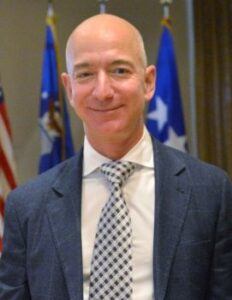
And who’s the proprietor of the Washington Post?  Oh look, it’s Jeff Bezos.  Funny that he should take a hit by alienating his newspaper’s natural readership and sending it down the toilet, just as he took a hit by shelling out 75 million dollars for a dud like the Melania movie.  It’s almost like he has an ulterior motive.  Almost like he’s trying to… curry favour with someone.


But seriously.  A while ago, I posted about “an unholy alliance of authoritarians, kleptocrats, fascists, media tycoons, tech bros and oil barons”, working hard “at stripping freedoms from those of us living in societies that,  until now, have retained some freedoms; at transferring another huge chunk of wealth from our dwindling coffers to their swelling coffers; and at burning and poisoning the planet we live on in their quest for profits whilst aggressively pushing the line that any science questioning this policy is a ‘hoax’.”  You see that here.  Bezos grovelling to Trump by financing his missus’s dreadful movie and nuking the Washington Post.  As a reward, Trump throwing him a few legislative and financial scraps from the White House table so he can carry on making pots of money for himself.


And with Bezos and his ilk embracing automation and Artificial Intelligence to maximise profits by eliminating human employees, and salaries, the future looks grim.  Journalists will soon go the way of lamplighters, elevator operators, switchboard operators and video store clerks.  News copy will be written by AI technology, controlled by billionaires, who’ll make sure that copy panders to their interests and those of their political allies.  And if there’s bad news they can’t avoid reporting, it’ll be blamed on those people not plugged into their extreme-right-wing, white-Christian-nationalist gestalt: blacks, Latinos, Muslims, Jews, atheists, gays, trans-people, liberals, socialists, trade unionists.


Education will be similar.  Teachers will disappear too and kids will be taught by AI, with the likes of Elon Musk deciding what’s in the curriculum.  Indeed, Musk has done a deal with El Salvador’s government to “bring his artificial intelligence company’s chatbot, Grok, to more than 1 million students across the country… to ‘deploy’ the chatbot to more than 5,000 public schools in an ‘AI-powered education program’.”  Yes, that’s Grok, the lovable chatbot that praises Hitler and puts tweens in tiny bikinis for the gratification of paedophiles, coming to a school near you to teach your kids.


The stinking rich and stinking powerful won’t only hoard wealth – they’ll hoard information too, whilst making sure only small, approved increments of it leak down to the masses they regard as their serfs and inferiors.  Especially manipulated will be scientific information about the climate catastrophe posing an increasing threat to our civilisation’s survival on this planet.  So that their environmentally-ruinous cash-generating projects, like power-guzzling and water-guzzling AI data centres, escape censure, they’ll suppress this information or bury it under an avalanche of counter-arguing pseudoscientific gibberish, or not collect it in the first place.


But let’s end positively.  While it’s sickening to watch America’s business magnates, corporations, media organisations, law firms and universities bend over supinely and lick Trump’s gruesome arse, the way ordinary Americans have reacted to his policies gives glimmers of hope.


© MS NOW


I’m thinking especially of Minneapolis.  Since December, the city has been overrun and brutalised by up to 3000 of Trump’s masked, violent, badly-trained thugs from Immigration and Customs (ICE) and Customs and Border Patrol.  Ostensibly, they came to crack down on fraud allegedly committed by Minneapolis’s Somali-American community.  In reality, as Wikipedia reports, they’ve assaulted, harassed and detained people  “on the basis of their alleged or suspected immigration status”, including “restaurant, airport and hotel workers, Target employees, children and families, Native Americans, students and commuters”, many of whom “have been US citizens, legal residents with work authorisation, or asylum seekers.”


This has disastrously impacted on the city’s businesses, schools and whole social fabric.  ICE was accused of violating at least 96 court orders during four weeks in January alone; and they’ve executed two citizens during peaceful protests, Renee Good on January 7th and Alex Pretti on January 24th.


Obviously, the operation was designed to intimidate Minneapolis – whose state governor is Tim Walz, Kamala’s running mate against Trump in 2024 – and intimidate liberal-leaning cities generally.  But local people are having none of it.  They’ve protested peacefully, organized strikes, alerted neigbours about approaching ICE patrols, monitored and filmed their activities, and provided support for people at risk from those activities by helping them get to their schools and places of worship unmolested, running errands for them and raising money for them.  They’ve stood by their fellow citizens in a display of decent, old-fashioned community values – values Trump would despise if his reptile brain could ever understand them in the first place.


One thing that particularly impressed and moved me was a viral clip showing a white-bearded old man protesting against ICE on a snowbound and teargas-fogged Minneapolis street on January 24th.  When a reporter and camera crew approached him, he raged, “I’m just angry.  I’m 70 years old and I’m f**king angry.”  Then, wearing neither mask nor goggles, he strode off through a billowing wall of teargas.


That furious but defiant old-timer, it transpired, was Greg Ketter, founder and proprietor of the Minneapolis independent bookstore DreamHaven Books and Comics.  The renowned sci-fi and fantasy writer Harlan Ellison once described DreamHaven as “a book-seeker’s cave of miracles”.


I find it inspiring to see a man who’s devoted a lifetime to books taking a stand against Trump, someone who brags about not reading as if it’s a badge of honour.  And by extension, against Trump’s billionaire toadies, currently trying to create an AI dystopia wherein novels and other human art-forms are replaced by soulless, AI-generated slop.  And against Trump’s toady at Amazon, Jeff Bezos, who’s just axed the Washington Post’s Book World, one of the very few literary supplements the American newspaper industry had left.


From wikipedia.org / © DreamHaven Books & Comics

A month of ironies


© Maverick / Warner Bros.


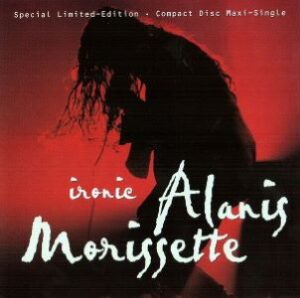
September 2025 reminds me of the song Ironic by Alanis Morissette.  The song’s lyrics contain many examples of things that are ironic, for example, “An old man turned ninety-eight / He won the lottery and died the next day,” or “a free ride when you’ve already paid”, or “ten thousand spoons when all you need is a knife.”  Although, as the comedian Ed Byrne has pointed out, some of the situations mentioned in the song aren’t actually ironic.  “A traffic jam when you’re already late,” for example.  As Byrne observed, that’s really only ironic if you’re a city planner.


Anyway, should Alanis Morissette ever write a sequel to Ironic, the month that has just passed should provide her with more than enough material.  To me, it’s the most ironic month I’ve ever experienced.  Here are a few reasons why I think so.


[Incidentally, this blog-entry contains references to American right-wing activist Charlie Kirk.  Please note that it’s possible to hold two opinions about Kirk at the same time, though many people out there are unable – or unwilling – to accept this.


Firstly, you can be horrified by Kirk’s murder, excoriate the fact that it happened while he was on a university campus exercising his right to free speech, and feel sorry for his young family.  Secondly and simultaneously, you can detest many of the things that came out of his mouth.  Things about black people.  (“Happening all the time in urban America, prowling blacks go around for fun to… target white people, that’s a fact.  It’s happening more and more.”)  About women.  (“Reject feminism.  Submit to your husband, Taylor.  You’re not in charge…  And most importantly, I can’t wait to go to a Taylor Kelce concert…  You’ve got to change your name.  If not, you don’t really mean it.”)  About Islam.  (“Islam is the sword the left is using to slit the throat of America.”)  About trans-people.  (“We need to have a Nuremberg-style trial for every gender-affirming clinic doctor.  We need it immediately.”).  And so on.  Also, you can be dismayed by the fact he made himself very wealthy by saying such things.]


September 10th

Charlie Kirk once said this of American gun ownership and the attendant, heavy toll of American gun-related deaths (16,576 in 2124, excluding suicides).  “You will never live in a society when you have an armed citizenry and you won’t have a single gun death. That is nonsense. It’s drivel…  I think it’s worth it.  I think it’s worth to have a cost of, unfortunately, some gun deaths every single year so that we can have the Second Amendment to protect our other God-given rights.”


Today, while speaking at Utah Valley University, Kirk was shot dead by an American citizen, using a gun, which it was his God-given right to own under the Second Amendment.  How tragically ironic and tragically American.


September 11th

UK prime minister Keir Starmer sacked Peter Mandelson from his job as British ambassador to the USA.  This was on account of Mandelson being an old friend of the late millionaire paedophile and human-trafficker Jeffrey Epstein.  Mandelson had even waxed lyrically about Epstein in writing: “Once upon a time, an intelligent, sharp-witted man they call ‘mysterious’ parachuted into my life…  wherever he is in the world, he remains my best pal!”


Five days later, another old friend of Jeffrey Epstein, who’d also, allegedly, waxed lyrically about him in writing (“We have certain things in common, Jeffrey.  Yes, we do, come to think of it.  Enigmas never age, have you noticed that…?”), arrived in Britain.  This was Donald Trump.  Starmer rolled out the red carpet and treated him to a state visit.


© Private Eye


September 13th

Led by double-barrelled far-right rabble-rouser Stephen Yaxley-Lennon, failed thespian nepo-baby Laurence Fox and others, and addressed on a big screen by Sieg Heil-ing billionaire Elon Musk, a crowd of more than 100,000 people marched through London to protest against immigrants.  They were particularly against foreigners who were criminals and a danger to women being allowed into Britain.  According to reports, some protestors wore MAGA – Make America Great Again – hats in honour of Donald Trump: a foreigner who’s a convicted criminal, and a proven danger to women, who was being allowed into Britain for a state visit the following week.


September 16th

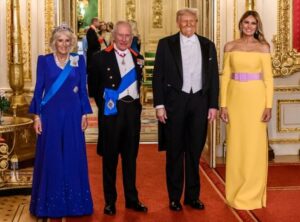
Donald Trump landed in Britain and his hosts immediately went into full pomp-and-ceremony grovelling mode.  The orange American president got a royal salute, a lunch with the Royal Family, a tour of the Royal Collection, a ‘beating retreat’ military ceremony, a ride in a gilded coach, a state banquet at Windsor Castle, and a visit to Chequers, the prime minister’s country residence, for a look at the Winston Churchill archives and a press conference.


Speaking at the state banquet, Trump declared, “…this is truly one of the highest honours of my life. Such respect for you and such respect for your country…  The lionhearted people of this kingdom defeated Napoleon, unleashed the Industrial Revolution, destroyed slavery and defended civilization in the darkest days of fascism and communism.  The British gave the world the Magna Carta, the modern parliament and Francis Bacon’s scientific method.  They gave us the works of Locke, Hobbes, Smith and Burke, Newton and Blackstone.  The legal, intellectual, cultural and political traditions of this kingdom have been among the highest achievements of mankind.”


A week later, Trump gave a speech to the United Nations and had this to say about London, capital of Britain, and Western Europe, of which Britain is a part: “And I have to say, I look at London where you have a terrible mayor, a terrible, terrible mayor, and it’s been so changed, so changed.  Now they want to go to Sharia law, but you’re in a different country, you can’t do that.  Both the immigration and their suicidal energy ideas will be the death of Western Europe if something is not done immediately…  I’m really good at this stuff. Your countries are going to hell.”


Maybe the grovelling hadn’t worked.


From wikipedia.org / © Executive Office of the President of the US


September 17th

American late-night TV host Jimmy Kimmel was suspended indefinitely by the American Broadcasting Company (ABC), following comments he made about the assassination of Charlie Kirk.  These drew the ire of the Federal Communications Commission (FCC).  The FCC’s chair is Brendan Carr, a staunch Trump loyalist.  Trump applauded Carr as ‘a great American patriot’ for his actions.


Funnily enough, in 2022, Carr had declared: “Political satire is one of the oldest and most important forms of free speech.  It challenges those in power while using humour to draw more into the discussion.  That’s why people in influential positions have always targeted it for censorship.”  And Kirk himself once said of freedom of speech: “You should be allowed to say outrageous things.”  But perhaps what they meant was political satire and outrageous things should only be expressed by people they agreed with.


September 22nd

After an uproar from practically everybody, and their granny, and their dog, the forces that’d removed Jimmy Kimmel from the airwaves backtracked.  It was announced that he was being reinstated on ABC.  A new episode of his show was broadcast the following evening.  It achieved his highest ever ratings – 6.26 million viewers – and was viewed 26 million times on YouTube.  Kimmel quipped about Trump’s likely reaction: “He might have to release the Epstein files to distract us from this now.”


In other words…  The American right, which earlier in the month had worked so hard to make a martyr out of Charlie Kirk, blaming his death on the ‘radical left’ and threatening retribution against anyone who suggested he might be anything less than a saint, had inadvertently made a martyr out of Jimmy Kimmel instead.


September 23rd

Trump delivered an hour-long speech to the United Nations.  Besides condemning the institution for a malfunctioning teleprompter and an escalator that stopped working – him and his missus Melania had to climb the stationary escalator, which for someone of his considerable acreage must have been hard work – and besides ranting about ‘radicalised environmentalists’ (“No more cows.  We don’t want cows anymore.  I guess they want to kill all the cows.”), he boasted that he’d ended seven wars: “…Cambodia and Thailand, Kosovo and Serbia, the Congo and Rwanda…  Pakistan and India, Israel and Iran, Egypt and Ethiopia, and Armenia and Azerbaijan.”


In fact, two of these wars didn’t exist, two have continued in terms of ceasefire violations and ongoing bloodshed, one was a war Trump helped to start and then participated in, one was a war where one of the countries denies that Trump had anything to do with settling it, and one ended with a peace-deal that hasn’t yet been ratified.


That last war, the one Trump actually came closest to ending, was the Armenia-Azerbaijan conflict.  Previously, at the September 18th press conference with Keir Starmer, Trump claimed to have stopped a war between Albania and Azerbaijan.  And at a dinner in Vermont on September 20th, Trump announced that he’d ended a war between Armenia and Cambodia.  So maybe that’s why Armenia and Azerbaijan agreed on a peace-deal.   One was so busy fighting Albania, and the other so busy fighting Cambodia, that they no longer had time to fight each other.


Come to think of it, none of this was ironic.  It was just moronic.


September 26th

The Ryder Cup, golf’s biennial contest between Europe and the USA, teed off at Bethpage State Park in New York State.  Trump attended its opening day, making him the first sitting American president to do so.  It’s fair to say that his attitude towards golf – win at all costs, even if it means getting caddies to plant new balls for you when the old ones land in inconvenient places – and his attitude towards competition generally – win at all costs, no matter what a bullying, graceless, ignorant chump it makes you look – infected the crowd.  Taking their cue from their Dear Leader, they behaved like bullying, graceless, ignorant chumps for the next couple of days.  They chanted “F*ck you Rory!” at Northern Irish golfer Rory McIlroy.  They threw beer at McIlroy’s wife.  They hurled insults at McIlroy’s fellow Irish golfer Shane Lowry about his weight.  No wonder at one point McIlroy told them all to “Shut the f*ck up.”


Anyhow, Europe won the Ryder Cup by 15 to 13.  That wasn’t ironic either.  That was karma.


From wikipedia.org / © The White House

It has happened here


© Renard Press


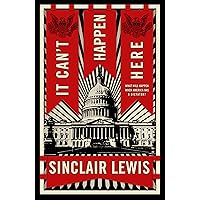
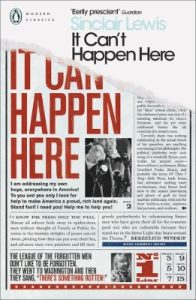
Nowadays, Sinclair Lewis’s It Can’t Happen Here (1935) feels like a story of alternative history, exploring what would have happened in the USA if the historical timeline had taken a twist in the mid-1930s it didn’t actually take.  But when Lewis wrote it, the real timeline and his imaginary one were in the future.  He was peeking ahead to the presidential election of 1936, one year after his novel’s publication, and wondering, “What if…?”  In its original context, then, It Can’t Happen Here was a work of science fiction, though the future imagined was so barely ahead of the present that it probably didn’t seem like that.


It gives me no pleasure to report that reading the book in the middle of 2025, with the USA sliding remorselessly towards authoritarianism under the presidency of Donald Trump, It Can’t Happen Here doesn’t feel dated.  No, it’s surely more relevant than ever.


The novel explores what could have happened if the 1936 election hadn’t been won by Franklin D. Roosevelt – who in fact won it resoundingly, garnering over 60 percent of the popular vote and securing over 98 percent of the electoral college.  In Lewis’s version of events, the presidency is won by a populist maverick called Berzelius ‘Buzz’ Windrip.  It’s commonly assumed Lewis based Windrip on the controversial Louisiana governor and US Senate member Huey Long.  In an ironic twist of fate, Long was assassinated one month before It Can’t Happen Here was published.  The son-in-law of a political rival shot him, though it’s been claimed Long actually died of a wound from a ricocheting bullet fired by one of his trigger-happy bodyguards, who immediately responded to the attacker by pumping him ‘full of lead’.


Early on in It Can’t Happen Here, we get to read Buzz Windrip’s campaign manifesto, The Fifteen Points of Victory for the Forgotten Men.  This is a grab-bag of crowd-pleasing promises – the government giving every family 5000 dollars a year (point 11) while wealth being capped at 3,000,000 dollars per person (point 5) – and nakedly racist, reactionary and jingoistic rhetoric.  You have to swear allegiance to the New Testament and the flag if you want a job in the professions (point 4), threats are made against the Jews (point 9) and blacks and women are disenfranchised (points 10 and 12 respectively).  Oh, and there’s a sneaky final point, number 15, wherein Congress and the Supreme Court have to cede all authority to the Presidency.


The manifesto is popular enough to put Windrip in the White House and, thereafter, the USA experiences a rapid fascist takeover similar to the one Hitler engineered in Germany in 1933-34.  Windrip soon has his own militia / secret police making sure everyone toes the line, media, educational and economic institutions are bullied into acquiescence, and opponents, dissenters and anyone else the regime takes a dislike to are herded into concentration camps – that’s what the novel calls them, several years before the Nazis made the term ‘concentration camp’ synonymous with evil on an industrial scale.


The country’s lurch into dystopia is seen through the eyes of Doremus Jessop, a 60-year-old, liberal-minded editor of a smalltown newspaper in Vermont.  Jessop finds out the hard way that the new regime doesn’t take kindly to criticism – he pens a scathing editorial, which leads to an altercation with some officials, which results in his son-in-law being executed.  Afterwards, he’s forced to do an about-turn with his paper’s editorials and news coverage and make it a propaganda mouthpiece for Windrip and his government, as every other official news outlet in America had become.


Later, a disgusted and horrified Doremus hooks up with a resistance movement, the New Underground, run by a dissident senator called Walt Trowbridge who’s escaped to and based himself in Canada, and he begins surreptitiously writing and distributing an anti-Windrip newsletter called The Vermont Vigilance.  Later still, Doremus and his associates are rumbled and they wind up in a concentration camp.  But the story isn’t quite over yet for the dogged old editor…


© Penguin Books


As I said earlier, when you read It Can’t Happen Here today, there’s an elephant in the room – a corrupt, authoritarian, orange-skinned elephant, one with a bad combover, a ludicrously long red tie, a big mouth, a small pair of hands, a tiny but cunning brain, a criminal record, and a penchant for cheating at golf.  Yes, it’s shocking how much Lewis’s novel anticipates what Trump is up to in America at the moment.


As with Trump and his Immigration and Customs Enforcement (ICE) agency, which is now better funded than most countries’ armies and is no doubt attracting into its ranks all sorts of far-right nutjobs, Windrip sets up a militia called the Minute Men (MMs) and recruits into it thugs and low-life who relish having the power to intimidate, bully, beat up and murder their neighbors.  Doremus’s life gets progressively harder as Shad Ledue – his former handyman, who’s a lazy, ignorant brute and who lusts after his youngest daughter – joins the local Minute Men and, gradually, shins his way up the pole until he becomes District Commissioner.  And Trump’s enthusiasm for creating ‘immigration detention facilities’, like the notorious ‘Alligator Alcatraz’ in Florida, mirrors Windrip’s enthusiasm for creating concentration camps, like the one Doremus latterly finds himself an inmate of.


It Can’t Happen Here makes much of the regime’s assault on academia.  Early on, Doremus receives a worried letter from an acquaintance at his old alma mater, Isiah College, warning about how its Board of Trustees is bending to Windrip’s malevolent will.  “What,” he asks, “can we do with such fast exploding fascism?”  Trump has famously tried to do the same with America’s universities – some, like Columbia University, groveling to him pathetically; others, like Harvard, putting up slightly more of a fight.


Windrip sees to it that the ‘most liberal four members of the Supreme Court resigned and were replaced by surprisingly unknown lawyers who called President Windrip by his first name.”  Trump, of course, has made sure that the present-day Supreme Court is packed with yes-men and yes-women.


And in an effort to bolster its authority, Windrip’s regime launches an operation to end ‘all crime in America forever’.  Criminals are “tried under court-martial procedure; one in ten was shot immediately, four in ten were given prison sentences, three in ten released as innocent… and two in ten taken in the MMs as inspectors.”  That sounds suspiciously like Trump’s recent takeover of Washington D.C., supposedly in the name of ridding the capital city’s streets of crime, though more likely to divert attention from the possibility that Trump’s name appears in the US Justice Department’s files investigating Jeffrey Epstein.


Generally, Lewis’s descriptions of how Windrip manages to captivate the American public, or a section of it sufficiently large to get him into power, are depressingly similar to how Trump weaves a spell over his ‘MAGA faithful’ – portraying himself as an outsider and anti-establishment figure, despite the fact he’s the son of a real-estate millionaire and has had everything handed to him on a plate.  Of Windrip, Lewis says: “…he was the Common Man twenty-times-magnified by his oratory, so that while the other Commoners could understand his every purpose, which was exactly the same as their own, they saw him towering above them, and they raised their hands to him in worship.”


Meanwhile, Lewis highlights how the regime puts in positions of authority people who are worthless but unswervingly loyal to Windrip.  That loyalty, of course, rewards them with wealth, power and prestige.  Trump too has populated his government with sycophantic mediocrities, self-serving grifters and dangerous incompetents like Pete Hegseth, Kristi Noem, Robert F. Kennedy Jr, Tulsi Gabbard, Pam Bondi and Marco Rubio.  Their single virtue, in Trump’s eyes, is their ceaseless willingness to bow, scrape and debase themselves before him.


There’s even a parallel with Elon Musk who, as the world’s richest man and CEO of the social-media platform X, has a massive ability to inform and misinform people and shape their opinions.  The It Can’t Happen Here version of Musk is Bishop Paul Peter Prang, a priest who makes a hugely popular and influential weekly address on the radio.  Like Musk’s voice on social media, Prang’s voice ‘circled the world at 186,000 miles a second’ and practically ‘leapt to the farthest stars.’  (Prang’s character was inspired by a real-life demagogue, the ‘Radio Priest’ Charles Coughlin.)  And like Musk with Trump, Prang enthusiastically backs Windrip for president – but gets short shrift from the man he’s championed once he’s across the threshold of the White House.  Though while Trump merely dropped and humiliated Musk, Windrip sticks Prang in jail and then in an ‘insane asylum’: “No one willing to carry news about him ever saw Bishop Prang again.”


All that said, It Can’t Happen Here is not a perfect book.  It has certain features that earn it the dreaded sobriquet ‘of its time’.  The focus is almost entirely on a handful of comfortably well-off white Americans and, though there are brief references to the horrors Windrip visits upon the black community, the book shows no interest in exploring these.  Also, Lewis makes mocking references to sexuality of Lee Sarason, Windrip’s Machiavellian campaign manager, who wears ‘violet silk pajamas’ and obviously has a fondness for strapping young men.  But no mention is made of the regime’s official policy towards homosexuals, which presumably would have been as murderous as Nazi Germany’s.  And male chauvinists will appreciate how Doremus gets to have his cake and eat it throughout the book, in that he’s simultaneously married to one woman, dull, frumpy Emma, and engaged in an affair with another, the bewitching firebrand Lorinda.  He’s never taken to task for this.


And the book’s tone can be awkward at times.  Lewis writes it in a folksy, sardonic, Mark Twain-like style that sometimes works, especially when its poking fun at the general hypocrisies, absurdities and idiocies of Windrip’s regime.  It works less well when it’s detailing the brutal realities of that regime – the tortures and humiliations, for instance, that Doremus has to endure while he’s in a concentration camp.  For subject-matter as bleak as this, I suspect the only way to record it is with the precise and dispassionate prose of, say, George Orwell’s 1984 (1949).


Sinclair Lewis’s It Can’t Happen Here may not quite make it into the top tier of great dystopian novels, then.  However, in 2025, you’re unlikely to read one that feels more terrifyingly prescient.


From wikipedia.org / © Touring Club Italiano

Even bloodsuckers get the blues


© Warner Bros / Proximity Media


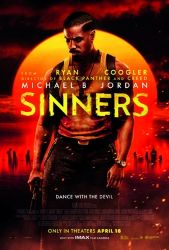
A few days ago my partner and I went to see Sinners, the new horror-cum-gangster film directed, written and co-produced by Ryan Coogler.  Here are my thoughts on it.  And before I go any further, a word of warning: there will be spoilers.


To be honest, I wasn’t expecting a great deal, as I’d heard something about its plot and it sounded horribly like 1996’s Robert Rodriguez-directed, Quentin Tarantino-scripted From Dusk till Dawn.  Although a few misguided souls nowadays look back on that film as a neglected and misunderstood classic, I have to say I f**king hated it.  In part, this was because From Dusk till Dawn began so well, as a nastily-effective little crime thriller wherein two fleeing bank-robbing brothers (Tarantino and George Clooney) kidnap a pastor (Harvey Keitel) and his family and force them to smuggle them over the US / Mexico border.  Disappointingly, things then go south in all senses of the phrase.  The group arrives at a mysterious Mexican bar called the Titty Twister where the staff and many of the patrons prove to be – surprise! – vampires.  The rest of the film is a ludicrous, tongue-in-cheek splatterfest where the humans battle against waves of bloodsucking undead.  While From Dusk Till Dawn’s sudden change of tone has been praised in some quarters for its audacity, I found it a vertiginous plunge into cheesy bollocks.


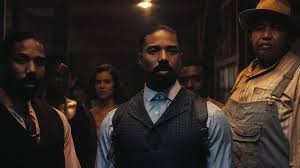
Anyway, the structure of Sinners is not dissimilar.  Its first half plays out as a period gangster story, then vampires show up and its latter half becomes an exercise in horror.  Set in the Mississippi Delta in 1932, it’s about the homecoming of black gangster twin brothers Stack and Smoke (both played by Michael B. Jordan) who’ve recently left Chicago where, it’s suggested, they worked for Al Capone.  On their home turf, they embark on a new project – purchasing a disused sawmill and turning it into a juke joint, i.e.. a place for live music, dancing, drinking and gambling whose customers are from the local African American community.


To ensure the juke joint’s opening night is a success, they staff it with trusted friends, family members and associates: Smoke’s ex-wife, the occult-dabbling Annie (Wunmi Mosaku), and Chinese shopkeepers Grace (Li Jun Li) and Bo (Yao) to handle the catering; hulking buddy Cornbread (Omar Miller) to man the door; and boozy old bluesman Delta Slim (Delroy Lindo), slinky singer Pearline (Jayme Lawson) and young, startlingly-talented guitarist Sammie (Miles Caton) to provide the music.


© Warner Bros / Proximity Media


Despite a few obstacles – two thieves who soon regret tangling with the take-no-prisoners Stack, the fact that the sawmill’s former owner is head of the local chapter of the Ku Klux Klan, and the disapproval of Sammie’s dad, a preacher who believes music is only virtuous if it’s used to further the word of the Lord – the juke joint opens, pulls in the crowds and is soon swinging.  And then the vampires arrive.


Yes, I was dreading this moment – because I had really enjoyed the non-fantastical part of the film.  Coogler did a great job depicting the minutiae of the 1932 Mississippi Delta.  This was a world where the black population was just a couple of generations removed from the official slavery of the Confederacy and most of them now toiled in the racket that was sharecropping, a form of unofficial slavery.  At the same time, they were crafting a musical culture, the blues, that would ultimately revolutionise American and global music through its influence on rock and roll.  One touch among many that I liked here was the portrayal of the Chinese shopkeepers, Grace and Bo, who thanks to their ethnicity are able to run stores in both districts of the Mississippi town of Clarksdale, the black one and the white one.


Anyway, when the vampires show up, does the film turn to shite as From Dusk till Dawn did?  Thankfully, no.  Coogler provides some foreshadowing to prepare us for the twist, so it doesn’t come as a credibility-straining bolt from the blue.  During the opening sequence, a voice-over talks about certain types of music being “so pure it can pierce the veil between life and death, past and future” and attract supernatural creatures – an idea that’s echoed later when the vampires admit Sammie’s miraculous guitar-playing has drawn them to the juke joint.  (Even before the vampires arrive, Coogler treats us to a phantasmagorical sequence where Sammie’s playing seems to conjure up among the dancing crowd the spectres of music past and future – West African shamans, Chinese Xiqu performers, hip-hop DJs and an electric guitarist who looks like he’s a member of George Clinton’s P-Funk collective.)


Also preparing viewers for the tonal switch is an earlier sequence where a white man, Remmick (Jack O’Connell), flees from a squad of Choctaw Native Americans and takes refuge in a cabin inhabited by a hard-up white couple.  The pursuing Native Americans politely warn the couple that they’re sheltering something evil.  But as KKK robes are visible inside the cabin, it’s no surprise that the couple believe the story of their white visitor rather than that of the ‘Injuns’.  Noticing the sun is setting, and with a shotgun pointed at them, the Choctaw decide discretion is the better part of valour and retreat.  Which leaves Remmick to reveal himself as a vampire and infect his two saviours.


Coogler leaves this bit of world-building unexplored – which makes it wonderfully intriguing.  Why are the Choctaw acting as vampire hunters?  It also reminds me of the start of John Carpenter’s The Thing (1982), where a dog – actually the titular thing in canine form – is chased by a pair of wrathful Norwegians in a helicopter.  Compared to the Norwegians, though, the Native Americans are more pragmatic and level-headed.


© Warner Bros / Proximity Media


Later, Remmick and the vampirised Klan couple appear on the threshold of Smoke and Stack’s new juke joint, bearing musical instruments and pleading to be let in (“We heard tell of a party”) so that they can have a jamming session with Sammie.  Sinners makes much of the belief that to get onto a premises, a vampire has to be invited – and Smoke and Stack, suspicious of white folks, are in no hurry to invite this trio inside.  So they bide their time outside, biting and vampirising anyone who goes home early or nips out of the building for a pee.  While they wait for their opportunity to get inside, their numbers grow…


In a smart move, Coogler makes Remmick Irish and gives him a taste for music as strong as his taste for blood.  So, lurking outside, the vampires knock out a few tunes themselves – a charming version of the Irish / Scottish folk number Wild Mountain Thyme, for instance, and when there’s enough of them to stage a full-scale vampire hooley, a raucous rendition of Rocky Road to Dublin, during which Remmick indulges in some step-dancing.  This makes being a vampire look like fun and Remmick, entreating the folks in the juke joint to surrender to him and his horde, makes a persuasive-sounding case for being vampirised.  Once you’re a vampire, it doesn’t matter what skin-tone you have.  Black vampires are treated no worse than white ones: “This world already left you for dead.  I can save you from your fate.  I am your way out.”


There’s a snag, of course.  Remmick, as the Count Dracula / Mr. Barlow-style lead vampire, calls the shots and his minions have to do his bidding.  Indeed, they seem parts of a giant hive-mind – evidenced by their chorused singing of Rocky Road to Dublin, which contrasts with the individuality Sammie expresses with his guitar.  And Remmick’s interest in Sammie and his music isn’t motivated by an impulse of sharing but by a desire to assimilate them.


It’s fun to speculate who or what Remmick symbolizes.  When he makes his first pitch at the juke joint’s door, begging to be let inside while Sammie, Delta Slim and Pearline perform, I was reminded of those white British rock-and-roll bands of the 1960s, like the Rolling Stones, the Animals and the Yardbirds.  Influenced by the likes of Robert Johnson and Muddy Waters, they started their careers desperate to play blues music and become known as bluesmen themselves.  Which prompted Sonny Boy Williamson II to quip caustically: “These English boys want to play the blues real bad… And they do, real bad.”


But maybe it makes more sense to compare Remmick to the white-owned American music industry.  His hunger for Sammie parallels how that industry gobbled up black artists, of blues, jazz, gospel, soul, funk, whatever, and made a fortune off their music whilst giving them as little credit, money and control over their work as possible.  Often, their songs ended up being sung by someone else, someone white – see Pat Boone singing a version of Little Richard’s Tutti Frutti just five months after its release in 1955 – with precious few royalties making it their way.


Incidentally, late on, Remmick comes out with a sob story about how he was persecuted and deprived of his land in Ireland – presumably at the hands of the British and presumably back in the days when he was still human.  That a victim of oppression has become a supernatural killing machine, one with a fascistic disregard for the lives of the people he feeds on, is Coogler’s way of reminding us that many poor white people, treated like dirt in their home countries, emigrated to other parts of the world where they treated indigenous people and black people like dirt too.  It’s a sad reflection on human nature that people near the bottom of the pile have a psychological need to believe there are people even further down the pile whom they can mistreat and regard as inferior.  Though this observation would no doubt delight Elon Musk, who recently grumbled that the “fundamental weakness of Western civilization is empathy”.


I’ve spent a lot of time analysing Sinners but I should also say it’s a supremely entertaining movie.  It’s exciting, scary, funny and atmospheric.  Furthermore, it proves a point that many filmmakers overlook – if you want a horror film to grip an audience, give them likeable and sympathetic characters to identify with.  That way, they have an investment in those characters and things feel much more tense when bad stuff starts happening.


© Cedric Burnside Project

© Silvertone Records


It goes without saying that the soundtrack is great too.  I’m particularly pleased to see that Cedric Burnside had a hand in performing some of the blues tunes – I attended a cool gig by Burnside at the Edinburgh Jazz and Blues Festival in 2015 and afterwards got his signature on a CD as a present for one of my mates.  Also, don’t rush off when the credits start rolling at the end.  There’s still a scene to come, one set in the early 1990s and featuring the venerable bluesman Buddy Guy.  (By a coincidence I saw Guy perform in the early 1990s, though obviously the early-1990s Guy in Sinners is a good bit older than the one I witnessed.)  It’s a coda that’s both sinister and affecting.


And the acting is excellent.  Michael B. Jordan is impressive in the twin roles of Smoke and Stack.  I soon forgot that both characters were being played by the same person.  It’s a pleasure seeing Delroy Lindo again, whom I fondly remember as the villain in the 1995 adaptation of Elmore Leonard’s Get Shorty and from numerous Spike Lee movies.  And as Sammie, Michael Caton is a revelation.  He’s young and naïve, as the script demands, but he’s blessed with a deep, prematurely-old voice that totally persuades you this lad can sing and play the blues.


One thing about the casting, though.  Jack O’Connell is perfectly fine as Remmick.  But since the character is a scary old monster who’s Irish and musical, I don’t know why they didn’t cast the obvious candidate for the role: Van Morrison.


© Warner Bros / Proximity Media

Eco chamber


From wikipedia.org / © Rob Bogaerts


A follow-on from my previous post…


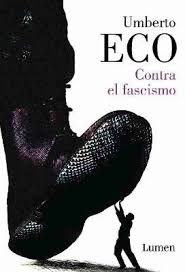
Elon Musk’s stiff-armed salutes at Donald Trump’s presidential inauguration on January 24th – at least, unlike Dr Strangelove, he didn’t address Trump as “Mein Führer!” – inspired me to read again Umberto Eco’s 1995 essay Ur-Fascism or Eternal Fascism: 14 Ways of Looking at a Blackshirt.


This begins with Eco reminiscing: “In 1942, at the age of ten, I received the First Provincial Award of Ludi Juveniles (a voluntary, compulsory competition for young Italian Fascists—that is, for every young Italian).  I elaborated with rhetorical skill on the subject ‘Should we die for the glory of Mussolini and the immortal destiny of Italy?’  My answer was positive.  I was a smart boy.”  It goes on to describe Eco’s hometown being taken over in 1945 first by the partisans and then by American soldiers (all of whom were African-Americans) and then muses on the nature of Italian fascism, as helmed by Mussolini, and of fascism generally.  It ends with Eco identifying 14 key traits that he believes appear in fascist movements and quoting Franklin D. Roosevelt in 1938: “I venture the challenging statement that if American democracy ceases to move forward as a living force, seeking day and night by peaceful means to better the lot of our citizens, fascism will grow in strength in our land.”


Well, Roosevelt’s words seem sadly ironic now.  Under Trump, American democracy appears to be moving backwards as a dying force, and the only citizens whose lot he’s seeking day and night to better are rich, white, straight, male ones.  But what about those 14 traits of fascism?  How many of them are detectible in Trump’s America at the moment?


Spoilers…  A lot.


The American far-right’s modus operandi of ‘moving fast and breaking things’ was a concept originally attributed to Mark Zuckerberg, one of the new Trump-grovellers-in-chief, and is something Trump’s been doing ever since his inauguration three weeks ago: ‘Tariffs!’ / ‘Drill, baby, drill!’ / ‘Invade Greenland!’ / ‘Invade Panama!’ / ‘Make Canada the 51st state!’ / ‘Leave the WHO!’ / ‘Leave the Paris agreement!’ / ‘More tariffs!’ / ‘Abolish DEI!’ / ‘Abolish USAID!’ / ‘Abolish trans-people!’ / ‘Abolish Gaza and turn it into the new Riviera!’ / etc.  This obviously corresponds to Eco’s fascist trait number three: “the cult of action for action for action’s sake… Action being beautiful in itself, it must be taken before, or without, any previous reflection.”


Also Trump down to a ‘T’ is trait number four: ‘disagreement is treason’.  So too is number five: ‘fear of difference’.  I can’t see life in America over the next four years being much fun if you’re different from one of those aforementioned rich, white, straight males.  And absolutely so too is number six: “appeal to a frustrated middle class… a class suffering from an economic crisis or feelings of political humiliation, and frightened by the pressure of lower social groups.”


Number seven is: ‘obsession with a plot’.  Yup, Trump has never shut up about the ‘deep state’, whatever that is, being out to get him and he’s happily courted all those delusional QAnon believers and other conspiracy fantasists.  Number eight is the belief that one’s ‘enemies are at the same time too strong and too weak’?  Well, listen to Trump’s speeches and you’ll hear him ranting simultaneously about how shit the US has become in the face of international competition and how it’s still somehow the greatest country on earth.


© Lumen Press


Number nine, the notion that ‘pacifism is trafficking with the enemy… life is permanent warfare’?  Well, see what I wrote in my previous post, about how “when things aren’t going wrong, Trump will still dial up the panic, make it look like there’s a crisis, and blame immigrants, liberals, working mothers, people of colour, etc.  That’s because he can’t afford to let his base relax and simply get on with their lives.  To ensure their ongoing support, he has to keep them in a constant state of anxiety and in constant readiness to lash out about it.”


Numbers ten, eleven, twelve and thirteen, which are respectively, ‘contempt for the weak,’ ‘everyone is educated to become a hero’ (heroism is especially easy when your population has ready access to AR-15s), ‘machismo’ (note Trump’s conviction in a civil court in 2023 for sexual abuse) and ‘selective populism’?  Tick, tick, tick and tick.


I don’t think Trump’s smart enough to have entertained thoughts about number fourteen, ‘newspeak’, wherein, for example, “Nazi or Fascist schoolbooks made use of an impoverished vocabulary, and an elementary syntax, in order to limit the instruments for complex and critical reasoning”.  In George Orwell’s 1984 (1949), this was the project that Winston Smith’s colleague Syme was working on at the Ministry of Truth, whittling down the size of dictionaries so that people has less vocabulary to articulate such abstract concepts as free will and self-expression.  Mind you, the many social-media platforms now doing Trump’s bidding are infested with so much short, simplistic, soundbite messaging – ranting, basically – that’s there’s little room for critical reasoning in them.


I haven’t mentioned numbers one and two yet, which are the ‘cult of tradition’ and ‘rejection of modernism’, wherein fascists deny the “advancement of learning. Truth has been already spelled out once and for all, and we can only keep interpreting its obscure message” and the “Enlightenment, the Age of Reason, is seen as the beginning of modern depravity. In this sense Ur-Fascism can be defined as irrationalism.”  But obviously, that’s written large across Trump and his operation, from his rejection of what the overwhelming majority of climate scientists are warning us about, to his efforts to put the anti-vaxxer grifter Robert F. Kennedy in charge of America’s public health, to his lackey Musk getting rid of fact-checking on X and lackey Zuckerberg doing the same on Facebook, Instagram and Threads, to the idea that you can turn any untruth into a truth by repeating it often and loudly and brazenly enough: Haitian immigrants are eating pets, vaccines cause autism, DEI policies caused a mid-air collision, USAID supplied condoms to Hamas and so on, and so forth.


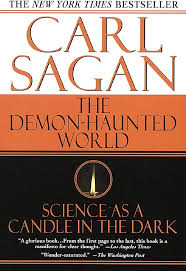
And that brings me to another piece of writing I’ve encountered recently.  It’s a passage from the book The Demon-Haunted World (1995) by the late, great American astrophysicist and writer Carl Sagan, which I’ve seen quoted on several people’s social-media pages.  Sagan’s mid-1990s fears about a near-future America were, shall we say, troublingly prescient.


“I have a foreboding of an America in my children’s or grandchildren’s time — when the United States is a service and information economy; when nearly all the manufacturing industries have slipped away to other countries; when awesome technological powers are in the hands of a very few, and no one representing the public interest can even grasp the issues; when the people have lost the ability to set their own agendas or knowledgeably question those in authority; when, clutching our crystals and nervously consulting our horoscopes, our critical faculties in decline, unable to distinguish between what feels good and what’s true, we slide, almost without noticing, back into superstition and darkness…


“The dumbing down of American is most evident in the slow decay of substantive content in the enormously influential media, the 30 second soundbites (now down to 10 seconds or less), lowest common denominator programming, credulous presentations on pseudoscience and superstition, but especially a kind of celebration of ignorance”


Awesome technological powers in the hands of a very few…  Public representatives unable to grasp the issues…  Critical faculties in decline…  Dumbing down…  Soundbites…  Pseudoscience…  Superstition…  Yes, Carl, you nailed it.  I’m glad, though, that you (and Umberto Eco) aren’t around to witness the ultimate, apocalyptic celebration of ignorance that’s erupted with the advent of Trump Mark II.


© Random House

You won’t ever be happy


From pixabay.com / © clecaux


It’s been two weeks since Donald Trump’s inauguration as 47th president of the United States.  For the 49.8 percent of Americans who voted in November 2024’s presidential election and voted for him, his previous four-year stint as 45th president obviously wasn’t enough.


Already those two weeks feel like two decades.  I live in Singapore, a long way away from Trump’s USA, and yet his orange visage assails me non-stop, smirking and scowling out of photos in the news websites and social media accounts I peruse.  I feel sorry for the poor folk who can’t stand the sight of him but have to live within the same country-borders as him.


It’s been relentless.  One moment he’s pardoning the 1600-odd dingbats who attacked the US Capitol on January 6th, 2021, including 600 who were charged with attacking or impeding law-enforcement officers, and including the lunatic shaman-guy in the buffalo horns who reacted to his pardon by posting on Twitter, “Now I am gonna by some motha f**kin guns!”  The next moment he’s pulling the USA out of the Paris climate agreement (again) and halting Joe Biden’s Green New Deal – much to the delight, I’m sure, of the Chinese government, whom he blames for pushing the ‘hoax’ of man-made climate change.  They’ll now seize the opportunity to establish their country as the world’s renewable-energy superpower.


And the next moment again he’s halting all American foreign aid, giving Elon Musk’s ‘Department of Governmental Efficiency’ (DOGE) free rein to destroy the US Agency for International Development (USAID), or as Musk calls it, ‘a viper’s nest of radical left-Marxists who hate America’.  Again, I’m sure the Chinese government is cheering.  As the US’s disease-prevention, food security, water security, education, etc., programmes in the Global South and elsewhere grind to a halt, they’ll swoop in and replace them, thus greatly extending China’s global soft power and influence.


What else?  Trump’s pulled the US out of the World Health Organisation (WHO) – obviously, when there’s a deadly global pandemic, he doesn’t want medical experts interfering in how he runs his country and warning him that his proposed ‘inject yourself with bleach’ cure isn’t a good idea.  He’s banned all Diversity, Equity and Inclusion (DEI) programmes in the belief that important jobs must be left to straight, fully-abled white men, who are inherently smarter than everyone else.  Why, even before the bodies of those killed in January 29th’s mid-air collision at Washington DC were cold, Trump raged that DEI policies were responsible for the tragedy.


He’s renamed the Gulf of Mexico ‘the Gulf of America’.  (What next?  One wag speculated on social media that he might rename the Oxford comma ‘the Comma of America’.)  He’s tried to bully Denmark into handing over Greenland to him, as part of his expand-the-American-Empire project (no doubt inspired by his buddy Putin’s expand-the-Russian-Empire project).  And he’s also tried to bully Mexico and Canada, by threatening to slap tariffs on their goods.  I’m not a big fan of Pierre Trudeau, but his riposte to Trump’s blustering bollocks showed he has more class and statesmanship in the tip of his little finger than Trump has in his whole, gross body.


From pixabay.com / © StockSnap


However, I’m sure that for tens of millions of Trump’s supporters, this is music to their ears.  They must feel like they’re in heaven.  Thanks to the antics of their orange hero, they’re now owning the libtards.  They’re bathing in libtard tears.  They’re loving the smell of napalmed libtards in the morning.  They’re achieving their number-one objective, which is to cause maximum distress to those libtard snowflakes who want to deny them their constitutional right to stockpile huge quantities of military assault rifles, and their right to go ‘rolling coal’ in their modified diesel-engine trucks, and their right to grab women by the pussy without suffering consequences, and their right to live in neighbourhoods with zero numbers of people of colour, and so on.  They’re all on Twitter, or ‘X’ as Musk insists on calling it, yeehawing their joy in their echo-chambers of MAGA-ites, incels, neo-Nazis and Russian bots at how President Trump is blasting those libtard wusses with both barrels.


Well, to the vast majority of Trump’s supporters – i.e., those not rich enough to qualify as being in the top 10 percent who own half the nation’s wealth – I have some bad news.  You won’t ever be happy.


Firstly, your lives aren’t going to improve materially.  The involvement in Trump’s project of Elon Musk, who’s the world’s richest human being and whose right arm had a Dr Strangelove-style tendency to slip into troubling, sloping salutes at the inauguration, should be a warning of that.  So too should the prominent places given at that inauguration to Jeff Bezos and Mark Zuckerberg.  Big tax-cuts are coming for Trump’s wealthy and super-wealthy friends.  A large part of the bill for those will be shifted onto the working and middle-classes, for example, through the extra they’ll have to pay for goods when Trump starts imposing his beloved tariffs.


Some of these tax-cuts will also be financed through the axing of government services, which Musk is doing in his new, DOGE-eat-dog world right now.  There’s always much whinging about how much is removed from your pay-packet and sent off to fund distant government departments.  But when departments overseeing such things as social security, medical care, education, tax refunds, disease control, environmental protection, disaster relief and so on receive the chop, and the effects of their loss are felt, I suspect people’s tunes will change.


Incidentally, it’s ironic that far-right-wing commentators, influencers and social-media grifters have for years belched out claims that the world’s governments are secretly controlled by liberal-minded billionaires like Bill Gates or George Soros.  They’ve also indulged in antisemitic dog-whistling by suggesting that billionaire banking family the Rothschilds are pulling the levers.  (See, for instance, a 2023 complaint by the Board of Deputies of British Jews to GB News about their presenter and conspiracy fantasist Neil Oliver referencing the antisemitic, Rothschild-accusing document Silent Weapons for Silent Wars during one of his diatribes about impending ‘one-world government’.)  Yet here we have a billionaire who, unelected and in plain sight, is heavily financing, influencing and manipulating an elected government for his own benefit.  And there’s not a peep out of them.


From unsplash.com / © Larissa Avononmadegbe


Musk has even got access to classified US treasury files, which are full of confidential data about citizens’ social security and Medicare payment systems.  You’d think this violation of people’s private information would give right-wing conspiracy nuts the heebie-geebies.  But no, they’ve been strangely quiet.  Maybe Musk’s salute at the inauguration did it.  He showed these guys that they didn’t have to worry – he’s the type of billionaire they’d want to have controlling their government.


But returning to Trump, I don’t see how his antics are going to improve life for the average citizen who voted for him.  If he carries out his witless threats to impose tariffs, he’ll drive up prices.  Meanwhile, his belief that, conveniently, climate change is just a sham will no doubt see the American economy take a severe battering in the years ahead as the country itself takes a battering from increasingly inclement weather.  Imagine what home-insurance bills will be like after a good chunk of Florida tips into the Atlantic Ocean.


Not that I think his supporters will be loudly belly-aching about their lives continuing to be shit, or being even shitter than they were previously.  A lot of them will be conditioned by sunk-cost fallacy and keep quiet – having invested so much time and energy in backing Trump and his MAGA movement, they’ll be reluctant to admit they were wrong.  Also, Trump now has X, Facebook, Instagram, Threads and, most recently, Tik Tok singing his praises.  He also has newspapers like Jeff Bezos’s Washington Post and Patrick Soon-Shiong’s Los Angeles Times kowtowing and kissing his ring.  The bulk of the American media will spend the next four years assuring the public they’ve never had it so good, when in all probability they’ve never had it so bad.


And that’s not all, Trump supporters.  Even in the unlikely case of your circumstances getting better, you still won’t ever be happy.  Trump and his lackeys won’t allow you to be happy.  To illustrate what I mean, you only have to look at Britain and the nearest institution Britain has to Trumpism – that toxic far-right-wing newspaper the Daily Mail.  Paul Dacre, its former editor and now the editor-in-chief of its publisher DMG Media, once remarked that the perfect Daily Mail story was one that (1) confirmed its readers’ worst fears and (2) gave them someone to blame for it.  You can expect something similar in the US over the next few years.  (Maybe forever, if Trump can change the constitution so that it resembles that of Putin’s Russia, and politicians who might oppose him in future elections start falling to their deaths out of windows.)


Everything that goes wrong will be the fault of immigrants eating people’s pets, or environmentalists not pumping enough water to put out wildfires, or Democrats controlling the weatheror Jewish space-lasers, or deadly aircraft-destroying DEI programmes.  Even when things aren’t going wrong, Trump will still dial up the panic, make it look like crises are happening, and blame immigrants, liberals, working mothers, people of colour, etc.  That’s because he can’t afford to let his base relax and simply get on with their lives.  To ensure their ongoing support, he has to keep them in a constant state of anxiety and in constant readiness to lash out about it.  They’re to be riled up, permanently.


So, Trump people, I’m sorry, but you won’t ever be happy.  As someone once put it: “Hell is getting what you think it is you want.”


From pixabay.com / © heblo

Set the controls for the heart of the sun


© Val Guest Productions / Pax Films / British Lion Films


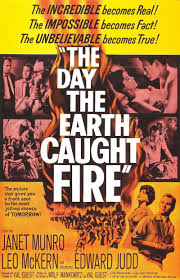
One my favourite British science-fiction movies is The Day the Earth Caught Fire (1961), starring Edward Judd, Janet Munro and Leo McKern, directed by Val Guest and scripted by Guest and Wolf Mankowitz.  (The underrated Guest made three other movies, 1955’s The Quatermass Experiment, 1957’s Quatermass II and 1960’s Hell is a City, that I also like a lot.)


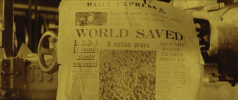
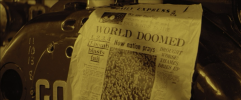
The Day the Earth Caught Fire is an apocalyptic tale wherein the USA and the Soviet Union carry out simultaneous nuclear-bomb tests at the earth’s poles and, subsequently, the planet experiences weird meteorological events.  Rivers dry up in some places and rain falls in unexpected torrents in others.  The general trend, though, is that temperatures rise.  The film’s heroes – a pair of London-based journalists – discover that those nuclear tests have disrupted the earth’s nutation, its axis of rotation.  Our planet is now spiralling closer and closer to the sun and in a few months’ time will plunge into it.


Yes, the film’s science is wonky.  A full-force hurricane has a heat-release every 20 minutes that’s similar to one 10-megaton nuclear bomb going off, so a few such nuclear explosions are nowhere near enough to knock the earth out of its orbit.  Also, what’s amusing about the film from a 2024 viewpoint is that its journalist heroes work for the Daily Express – a newspaper now so moon-howlingly rubbish it makes the Daily Mail look comparatively sane and reasonable.  Today, while the Thames evaporated, the Express would be denouncing the earth-knocked-out-of-orbit / crashing-into-the-sun scenario as a woke hoax and politically-correct fearmongering.


However, as a dystopian sci-fi movie showing a gradually-unfolding catastrophe through the eyes of some ordinary people who are powerless to do anything about it, The Day the Earth Caught Fire is both affecting and chilling.


The film ends ambiguously.  The world’s governments make a last-ditch attempt to reverse the damage, exploding more nuclear bombs in the desperate hope they’ll nudge the earth back into its proper orbit.  Meanwhile, in the Daily Express’s offices in now-utterly-sweltering London, we see that two versions of the next day’s front page have been prepared.  One bears the headline WORLD SAVED, the other the headline WORLD DOOMED.  And we leave the film’s characters there, not knowing their fate.


I’ve been thinking about the ending of The Day the Earth Caught Fire a lot today.  November 5th, 2024, is when Americans go to the polls to elect a new president.  That will either be Kamala Harris or Donald Trump.  The latter was once memorably and accurately described by the New Yorker writer Mark Singer as someone whose existence is ‘unmolested by the rumbling of a soul’.  A few years ago, less eloquently, I called him ‘that rancid man-slug of evil.’


Trump has been open about what he’ll do to the USA if he’s re-elected president.  He’ll transform the world’s most powerful country from a democracy into an authoritarian state, with him as despot-in-chief.  Even if the American public are stricken with buyers’ remorse after voting him in, he’ll change the election laws and fiddle the constitution so that they can’t ever get rid of him and his far-right Republican successors (who’ll no doubt be led by the repulsive J.D. Vance).  The Trump Reich will be here to stay.


Along the way, he’ll also embolden other fascists in other countries around the world, hand over Ukraine to his buddy, hero and idol Vladimir Putin and allow Putin’s malignant influence to extend right into Europe, make American women second-class citizens with zero control over their bodies, persecute LGBT people and probably erase trans ones, put the lunatic anti-vaxxer Robert F. Kennedy in charge of American health policy and appoint Elon Musk as his Joseph Goebbels-style head of propaganda who’ll pump out misinformation and hate on Twitter (or ‘X’ as Musk calls his debased platform these days).  Science will be derided, suppressed and defunded.  Pig-ignorance will be lauded, promoted and revelled in.


Worst of all, Trump, a climate-change denialist, will add billions of tonnes of US carbon emissions to the earth’s atmosphere, probably thwarting any last chances of humanity doing anything to mitigate the effects of the climate catastrophe.  Yes, the earth really will be catching fire, if slightly more slowly than it did in Guest’s movie.


So, world saved or world doomed?  We’ll find out a little later this week.


© Val Guest Productions / Pax Films / British Lion Films

Jiggery-wokery


From abc.net.au / © BBC


‘Woke’…  What does that word even mean?


Here’s failed US presidential candidate and failed insurrectionist Donald Trump using it to denigrate the American women’s soccer team, who do un-Trumpian things like ‘taking the knee’ during the playing of the Star-Spangled Banner.  “Woke equals failure!” he barked on TruthSocial, his minor social-media platform, when the team was knocked out of this year’s Women’s Football World Cup.


And here’s John Cleese grumping about the BBC being woke because it banned that episode of Fawlty Towers (1975-79) where the Major uses some unfashionable language to describe the West Indies cricket team.  (In fact, the episode was temporarily pulled from the BBC-owned streaming service UKTV, and reviewed, and reinstated with a content warning.)  Cleese is so incensed by wokeness that he’s started hosting a TV chat-show in which he fulminates against it.  His show is called The Dinosaur Hour (2023) and it’s broadcast on the right-wing, alleged ‘news’ channel GB News.  Amusingly, Cleese was peeved to discover that his new employers at GB News had just signed Boris Johnson, whom he considers a ‘serial liar’, to host a show too.  Well, John, when you lie down with dogs, expect to get up with fleas.  In this case, big, blonde, bloviating, bonking Boris-fleas.


Another household name much concerned about woke behaviour is Elon Musk, who last year purchased Twitter (or X, as he calls it now) and set about purging it of wokeness.  He’s certainly done that.  He’s also purged the platform of half of its advertising revenue and half of the value of its acquisition price.  Musk has described wokeness as a ‘mind-virus’ and ‘communism rebranded’ – and communism, he’ll tell you, is a very bad thing.  Though that hasn’t stopped him opening a big Tesla plant in communist China, in Shanghai, and being warmly welcomed every time he visits the country, and declaring that democratic, capitalist Taiwan is actually Chinese property.  Musk is also introducing to Twitter a ‘snarky, anti-woke AI chatbot’ called ‘Grok’, which sounds like a character from the sci-fi comic 2000 AD (1977-present).


From britishcomic.fandom.com / © Rebellion Developments


I don’t agree with Musk on much but he’s right to liken wokeness to a virus.  Because the moment that people with his right-wing politics come into contact with it, they seem to turn red-eyed, froth at the mouth and gibber insanely, like the infected did in Danny Boyle’s 28 Days Later (2003).


© DNA Films / UK Film Council / Fox Searchlight Pictures


But if you need refuge from wokeness, just move to Florida.  There, Governor Ron DeSantis has been pushing a ‘Stop-Woke Act’ in the hope that the state will be ‘the place where woke goes to die’.  In fact, DeSantis’s Florida is now so anti-woke, and so determinedly opposed to the teaching of wokey things like Critical Race Theory, that its State Board of Education has kids learning in school that slavery was a good thing because it helped the black slaves to develop ‘skills which, in some cases, could be applied for their personal benefit‘.  Wow.  Who knew?


I’m sure DeSantis’s achievements in Florida are admired by Suella Braverman, the belligerent and self-serving British Conservative politician who was very recently sacked from her position as the UK’s Home Secretary.  During her time in office, she slammed the British police force for being too woke.  One example was when she claimed to have reprimanded officers in Essex for the woke act of raiding a pub and removing a display of racist golliwogs.  (Except that she didn’t – it turned out that Suella had been disingenuous, or stupid, or both, which is perfectly possible in her case.)  Suella, or ‘Sewer-ella’ as I like to think of her, also famously condemned a faction she called the ‘Guardian-reading, tofu-eating wokerati’.  Supposedly, these have formed a ‘coalition of chaos’ with the opposition parties and are responsible for all of Britain’s ills.  She said this whilst serving in the brief but tumultuous government of Liz Truss.  Accusing someone else of being part of a coalition of chaos?  That’s a bit rich, given the context.


Elsewhere, the Daily Mail has complained that woke builders are daring to ‘enjoy yoga, muesli, listening to Radio 4 and sharing their feelings’ rather than ‘devouring greasy-spoon breakfasts and discussing sport.’  Xbox games consoles have been accused of being woke for getting updated with an ‘energy saver’ mode to lessen their power consumption – because, as you know, attempting to be more environmentally-friendly just drips with contemptible wokeness.  The makers of The Simpsons (1989-present) have been lambasted for being woke, coincidentally by Cleese’s associates at GB News, for no longer having scenes where Homer loses his rag at Bart, picks him up by the throat and strangles him until his eyes bulge and tongue protrudes.  Not wanting to strangle children?  How hideously woke.


So, what does ‘woke’ actually mean?  Well, according to Wikipedia, it’s “an adjective derived from African-American Vernacular English (AAVE) meaning ‘alert to racial prejudice and discrimination’.  Beginning in the 2010s, it came to encompass a broader awareness of social inequalities such as racial injustice, sexism and LGBT rights.”  Fascinatingly, the phrase ‘stay woke’ goes all the way back to 1938, when it was first heard on a recording of a song called Scottsboro Boys by the legendary blues singer Huddie Ledbetter, aka, Lead Belly.


From wikipedia.org / © William P. Gottlieb Collection


Though how the term ‘woke’ became elastic enough to encompass eating tofu, and builders talking about their feelings, and Xboxes having energy-saving modes, and Homer Simpson not throttling his offspring, is anyone’s guess.  Perhaps a simpler definition of the term – certainly when you look at the people mentioned above who’ve railed against it, like Trump, Musk, DeSantis, Braverman, the Daily Mail and GB News – might be: ‘Anything that right-wing tossers don’t like.’


Indeed, as somebody who considers himself partly Scottish, I felt a surge of pride a while ago when Gavin McInnes, founder of the neo-fascist American militia the Proud Boys, denounced Scotland as ‘the most woke country in the world.”  No wonder Scottish novelist Christopher Brookmyre responded to McInnes’s ravings by saying: “That delighted me…”


Unfortunately, nobody ever lost money by underestimating human beings’ intelligence.  There’s clearly political mileage in ranting endlessly about wokeness. Gradually, you brainwash millions of people, mainly older ones who don’t get out much, and sit and watch Rupert Murdoch’s Fox News all day, into believing that dark, malevolent woke forces do indeed lurk in the world, planning to deprive them of their Bibles, guns, gas-guzzling automobiles, Big Macs, racist jokes, un-politically-correct 1970s TV shows, etc.  It’s also convenient for the likes of Trump (currently facing 91 felony counts) and Britain’s Conservative government (trying to justify why the country is such a horrible, unhappy mess when they’ve been in charge of it for the past 13 years) to peddle the narrative that the establishment is riddled with hostile woke agents.  The civil service, the courts, the police…  A giant woke conspiracy is being implemented from society’s corridors of power and it’s trying to discredit them and stymie their every move.


I’m not claiming, by the way, that stupidity is confined to right-wingers.  The left is also capable of it.  In recent years the American right has infiltrated school-boards and removed books they disapprove of from syllabuses and libraries, books deemed too woke, often written by people of colour or members of the LGBT community, and often featuring characters of colour or LGBT characters.  There was even a book suspended in Alabama because officials didn’t like the sound of the author’s name, Marie-Louise Gay.  But left-wing educators have done themselves no favours by trying to ban books that offend their sensibilities too.


For example, I lately came across the case of a school board in Washington State pulling Harper Lee’s To Kill a Mockingbird (1960) off its required reading list for ninth-graders because a group of ‘progressive’ teachers objected to it.  Sure, you can argue that To Kill a Mockingbird portrays its black characters with less depth than its white characters and has a ‘white saviour’ narrative that’s offensive to many.  But shouldn’t teachers focus on developing their students’ powers of critical thinking, argument and self-expression so that they can articulate why they object to the book?  Engaging with – certainly, studying – literature shouldn’t be limited to books you’re personally comfortable with.  You should have to experience ones you find discomforting too, whilst developing the ability to formulate logical and coherent responses to them.


I don’t deny there are works that some people will find upsetting because of their beliefs or backgrounds or difficult experiences they’ve had in their lives.  And I don’t see anything wrong with books and stories having trigger warnings, which inform readers the content they’re about to immerse themselves in may be uncomfortable or even traumatising.  I say that as a writer who’s had trigger warnings attached to his fiction in the past.  But banning books altogether?  I don’t agree with censorship, unless it’s of something that’s completely off-the-scale in promulgating odious stereotypes and stirring up hatred.


Otherwise, I don’t have much of a problem with wokeness.  Especially as it seems to annoy all the right – and I mean ‘right’ – people.  So, now, it’s time to sign off and grab some lunch.  What will I have…?  Why, tofu of course.  Up yours, Sewer-ella.


From wikipedia.org / © UK Government Web Archive

The Twittering has gone


From unsplash.com / © Brett Jordan


At the end of last month, the amount of time I spend roaming the Internet was suddenly halved. This was because when I went Twitter-browsing, and tried to look at the Twitter threads of the numerous people, publications and organisations I read regularly, I was greeted by something new – a page inviting me to ‘sign in to Twitter’.  At its bottom, the page made the teasing comment: ‘Don’t have an account?  Sign up.’


Yes, billionaire Elon Musk, who took over the platform last year in a blaze of publicity, if hardly a blaze of glory, had blocked access to it for non-members.  If you want to see what’s on Twitter, you now have to join Twitter.  Musk had previously expressed disapproval at AI companies using Twitter’s data to train their models, which this move would put a stop to.  But there’s an equally feasible, more desperate explanation for it.  Since Musk’s taking of the Twitter helm, it’s been well-documented how the platform has all but gone down the plughole in terms of membership, advertising revenue, technical reliability and overall credibility.  Perhaps this blocking represents a last-throw-of-the-dice attempt to encourage a few million people, who’d hitherto enjoyed seeing Twitter without being on Twitter, to come aboard.


Sorry, Elon.  Thanks but no thanks.  I had fun peering into Twitter in the past, and I no doubt wasted far too much time doing so, but being denied access to it now is not going to turn me into a committed, signed-up Twitterer.  Indeed, I avoid social-media membership, not being on Facebook, Instagram or anything similar.  Using WhatsApp is about as far as I go.  This is partly because I’m a technophobe at heart and have a distrust of shiny new forms of communication pushed upon me by eager super-rich tech-tycoons.  I have good reasons for that mistrust.  See, for example, the affair of the dodgy British political consultancy firm Cambridge Analytica, which among other things had a helping hand in Donald Trump’s 2016 election campaign.  The firm’s shady activities were helped by a data breach involving the personal details of up to 87 million people, ‘inappropriately’ taken from Mark Zuckerberg’s Facebook.


Also, it’s partly because if I was active on social media, I suspect I’d spend most of my time arguing with idiots and arseholes.  And there are a lot of those on Twitter.  There always have been, though there seem to be many more now since Musk did away with much of the site’s moderation and declared an ‘anything goes’ policy on ‘freedom of speech’.  Well, that’s what he calls ‘freedom of speech’, though most sane people would call it ‘havering and slabbering by far-right-wing turnips’.


I’d always thought Musk was a jerk, but I’d assumed too he possessed some intelligence and business acumen.  For one thing, he was a vocal admirer of the works of the late Iain Banks, especially Banks’ science-fiction series of Culture novels, with which he claimed to share a ‘utopian anarchism’.  The fact that he read books – unlike Trump, who’s allegedly never read one in his adult life – suggested to me that at least some of his grey matter was working.  Although I imagine knowing that Musk, the world’s number-one, right-wing, libertarian, billionaire man-boy, was a fan of his would send poor old Banks twirling in his grave.*


© Time Warner Books UK


Well, since he took over Twitter, I’ve had to revise my opinion of Musk’s IQ downwards.  He’s overseen the platform with the finesse of Leatherface from the Texas Chainsaw Massacre movies trying to run the kitchen in a Michelin-starred sashimi restaurant.


His proprietorship began in late October 2022.  Before the year was out, he’d shed 50% of Twitter’s employees and reportedly 80% of its contractor workforce, while warning remaining staff to adapt to a ‘hardcore’ working culture of long hours and high pressure.  His efforts to charge users for verified accounts were a shambles – as evidenced by a notorious, supposedly-verified ‘Twitter Blue’ account by one George W. Bush who tweeted, “I miss killing Iraqis”  The platform swelled with troll accounts because there was neither the manpower left, nor the inclination on Musk’s part, to curb them.  And an end-of-the-year poll by Musk inviting Twitter users to vote on whether or not he should stay as its Chief Executive, presumably meant to shore up his position, didn’t go the way he’d intended.  57.5% of respondents told him to quit.


2023 has brought Musk no respite.  Only yesterday, the BBC reported that Twitter has lost half its advertising revenue since Musk’s takeover – something he’s admitted himself.  Besides not wanting to have their services and products featured next to comments by charmers like Andrew Tate and the Taliban leader Anas Aqqani (who recently praised Twitter for its ‘freedom of speech’, ‘public nature’ and ‘credibility’ – I bet that made Elon feel better), advertisers can’t have been happy at limits imposed earlier this month on the number of tweets users can view per day.  The maximum is 1000 for non-verified users, 10,000 for verified ones.  This on top of the fact that their adverts aren’t reaching outsiders like me anymore.


Making Musk’s life even harder is sneaky Mark Zuckerberg’s recent decision to launch a rival, Twitter-lookalike platform called Threads.  This got 30 million sign-ups on the first day of its existence and 100 million within a week.  (Having one of Zuckerberg’s Instagram accounts automatically entitles you to a Threads one, so the new platform was bound to start life with impressive membership numbers.)  Musk, predictably, was not happy about this.  In addition to calling the pasty-faced, blank-eyed Zuckerberg a ‘cuck’, he said he was ready to take him on in both a cage-fight and a penis-measuring contest.  Not being a fan of Zuckerberg either (see the aforementioned Cambridge Analytica scandal for one reason), I have to say there hasn’t been a confrontation where I’ve so badly wanted both parties to lose since…  Since….  Well, since last month, when Yevgeny Prigozhin squared up to Vladimir Putin.


Incidentally, Musk has a fan-club of ‘edge-lords’, who are predominantly young, male, white and (I’d hazard a guess) virginal, and whose thinking seems to be: “Oooh, I’m really edgy because I’m very right-wing and I say offensive things about women, black people, Muslims, lefties, gays and transpeople on social media!  Though always from the safety of my parents’ basement.”  These types worship the ground Musk treads upon and, lately, I’ve noticed their comments below online news articles reporting Twitter’s woes.  Obviously, they defend their hero to the hilt.  They claim he’s engaged in a cunning game of three-dimensional chess.  What Musk’s doing, they say, is part of some brilliant strategy that’ll outfox the evil, liberal establishment and result in him and Twitter taking over the world.  Though if, say, Bill Gates was responding to queries from journalists by sending them poop emojis, as Musk has been doing for the last four months, I suspect they’d be less inclined to hail that as a sign of genius.


From wikipedia.org / © The Royal Society


So anyway, that’s Twitter off my radar.  It’s a shame, because for many years pre-Musk it’d been a good source of information and entertainment.  Occasionally, I’d find stuff on it that was thought-provoking.


For a long period I was obsessed with Scottish and British politics – I’m less so now – and regularly visited the Twitter-threads of a wide range of political pundits, polemicists and bloggers: David Aaronovitch, Derek Bateman, Bella Caledonia, Alastair Campbell, Nick Cohen, Chris Deerin, Ian Dunt, Kenny Farquharson, Flying Rodent, Gerry Hassan, Owen Jones, Pat Kane, Alex Massie, Darren McGarvey, Iain McWhirter, Craig Murray, Laurie Penny, Scot Goes Pop, Wings Over Scotland, Mic Wright…  I obviously didn’t agree with all the opinions they expressed, but I felt it important to know what people with different views to mine were thinking.  I should add that, for various reasons, I stopped reading some of those folks’ thoughts.  Either they became bitter and twisted (McWhirter), or were embroiled in scandal (Cohen), or went howling-at-the-moon mad (Murray, Wings Over Scotland), or simply got too annoying (Deerin, Massie).  Or they died, which was sadly the case with Bateman.


Also, as someone who writes a little fiction, I found access to other writers’ Twitter threads invaluable.  Writers commonly tweet and retweet names of magazines, anthologies and publishing houses that are looking for new work, and these heads-ups led to me getting a good amount of stuff published.  Plus, it was good to know the thoughts of writers who tweeted regularly – not just about writing, but about life generally.  These ranged from big names such as Stephen King, William Gibson, Irvine Welsh and Ian Rankin to less famous, but equally engaging, ones such as Anne Billson, Simon Bestwick, Charlie Stross and the late Christopher Fowler.


Twitter also alerted me to a few magazines and publishing houses I should stay clear of.  Usually, this was because their staff and associated writers turned out to be extreme-right-wing dingbats who tweeted approvingly about the likes of Jordan Peterson, Tucker Carlson, Tommy Robinson, Laurence Fox, Giorgia Meloni – the only woman worth listening to, apparently – and the bare-chested, horse-riding, bear-wrestling Russian he-man Vladimir Putin.  Oh, and they all thought Elon Musk was the bees’ knees.  No surprise there.


One thing’s for sure now.  I feel as little urge to sign up with Threads as I do with Twitter.  One reason is my antipathy towards Zuckerberg.  Another reason is that I don’t want to be on a social media platform that shares its name with the most horrifying and apocalyptic film of all time.


© BBC / Nine Network Australia


* For the record, Banks was cremated and his ashes were scattered in Venice, Paris and the Firth of Forth.