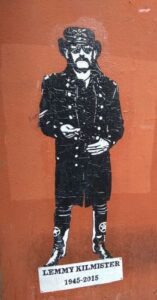
10 years ago, Lemmy was killed by death


From wikipedia.org / © Mark Marek


Following the recent death of singer and guitarist Chris Rea, whose 1986 song Driving Home for Christmas has become something of a festive-season classic, a mate of mine observed that this was yet another example of a ‘musician who’s associated with a perennial Christmas song’ expiring at Christmastime.


To support his thesis, he mentioned George Michael (responsible for 1984’s Last Christmas and died on Christmas Day 2015) and Shane MacGowan (co-singer and co-writer of 1987’s Fairy Tale of New York and died on November 30th, 2023 – okay, not quite in the festive season but I’m sure the Christmas lights were already up in Dublin at the time).  Referencing the singers of Merry Christmas Everybody (1973) and I Wish It Could Be Christmas Every Day (1973) and the perpetrator of Mistletoe and Wine (1988) and Saviour’s Day (1990), my mate concluded, “…Noddy, Roy and Cliff better take extra care in Decembers to come.”


Well, today is the festive-season day of December 28th, 2025.  And it marks the tenth anniversary of the death of a titan of popular music: Lemmy, front-man with one of heavy metal’s most brilliant bands, Motörhead, and a general all-round role model for how to live your life (i.e. loudly, always disreputably and occasionally downright badly).


I was going to say that Lemmy’s passing at Christmastime disproves my mate’s theory that only the singers of Christmas songs die during this period.  But I’ve just checked and discovered that, though Motörhead never recorded a Christmas song, in 2008 Lemmy did get together with ZZ Top’s Billy Gibbons and the Foo Fighters’ Dave Grohl and made a cover version of Chuck Berry’s Run, Rudolph, Run (1958) for the same year’s album We Wish You a Metal Christmas and a Headbanging New Year.  (Google AI informs me the song’s vibe was ‘heavy, aggressive and sinister’.)   So maybe there’s something in it after all.


Anyway, Lemmy.  What an amazing career he had.  Legend has it that he managed the remarkable feat of being thrown out of Hawkwind for taking too many drugs – though more likely he was thrown out for taking the wrong sort of drugs, i.e., amphetamines, which the other, hallucinogenic-loving band-members looked down on.  He tried to teach Sid Vicious how to play bass (with a predictable lack of success).  He composed the greatest rock ‘n’ roll song ever, Ace of Spades (1980).  He also gave rise to the greatest joke ever – “If Lemmy had a fight with God, who would win?”  “It’s a trick question: Lemmy is God.” – which was funny because it was true.


Here, by way of a tribute to the great man, is a review of a Motörhead concert that I wrote back in 2008 for the University of East Anglia’s student newspaper, Concrete.  It’s an excitable and breathless piece of writing but, well, I had just been at a Motörhead concert.  Reading it now, I have a few regrets.  I should apologise to the late Ronnie James Dio – in the years since, I’ve come to realise I like ‘strutting spandex-clad idiots singing songs about elves and wizards’.  Plus, Ronnie was no idiot.


And obviously, I regret the fact that the prediction made in the final sentence didn’t come true.

*

MOTÖRHEAD

UEA, November 21st, 2008

If the Nobel Foundation in Stockholm ever creates a Nobel Prize for Heavy Metal, surely its first recipient will be Lemmy, singer, bassist and general driving force of Motörhead.


Founded in the 1970s, a decade when heavy metal consisted of strutting spandex-clad idiots singing songs about elves and wizards (e.g. Rainbow) or about their abilities in making vigorous love to the ladies (e.g. Whitesnake), Motörhead were a revelation.


Lemmy’s hoarse roar was stuck onto a racket of guitars played at the loudest possible volume and at the fastest possible speed, a sound that helped to spawn the speed and thrash metal sub-genres and supplied Metallica, Slayer, Anthrax and co. with at least 666 tons of inspiration.


Lemmy was also an early and crucial champion of Girlschool, the groundbreaking all-female metal band who helped the music to shed some of its reputation for sexism.  And in the segregated pre-grunge era, when heavy metal and punk fans weren’t supposed to associate with each another, Motörhead was the one metal band it was okay for punks to like.  Lemmy and the Sex Pistols’ Sid Vicious were good mates and he even tried to teach Sid how to play bass guitar – unsuccessfully, it must be said.


Taking the stage tonight after a short-but-well-received set from Toronto band Danko Jones and a ludicrous-but-loveable one from Saxon – ironically one of those hoary old-style metal bands that Motorhead helped to make obsolete – Lemmy, guitarist Phil Campbell and drummer Mikkey Dee went to work with their usual, blistering single-mindedness.  Old favourites like Bomber (1979) and Killed by Dead (1984) got blasted out alongside items from their new album Motörizer – though unsurprisingly the new stuff didn’t sound entirely different from the old stuff.


Apart from a blues pastiche where Lemmy displayed some unexpected harmonica-playing skills, this was business-as-usual in the best sense of the phrase.  Rounding off a perfect evening for the head-grinding crowd was an encore containing Ace of Spades, surely the most brain-batteringly brilliant song in heavy metal – and possibly in 7000 years of human civilisation as well.


The big heavy-metal news this week was that Guns n’ Roses had finally put out Chinese Democracy – an album so named because it’d taken so long to record that democracy could have feasibly come to China by the time of its release.   From tonight’s showing, however, Motörhead will be going strong long after China has taken over Wall Street, bought up Coca Cola and put a man on the moon.
 

From blabbermouth.net / © Pedro Alonso
My life as a tape-head


From unsplash.com / © Tobias Tullius


I was surprised to hear the news last month that the inventor of the audio cassette, Lou Ottens, had passed away at the age of 94.  Surprised because the audio cassette seemed such an elderly piece of technology to me that I’d assumed its inventor had been dead for many years, indeed, many decades already.


I used to love cassettes.  They were small, light and portable whilst at the same time durable and not vulnerable to the scratches and occasional breakages that bedevilled my vinyl records.  Though of course when their tape got caught in the tape-heads of a cassette player, having to free and unravel the ensuing tangle was a pain in the neck.  Much of my music collection consists of cassettes and I suspect I must have something in the region of a thousand albums in that format.  But, like most of my worldly possessions, they’ve spent the 21st century occupying boxes in my Dad’s attic in Scotland.


Cassettes seemed old-fashioned even in the days before the appearance of the compact disc, a type of technology that itself must seem prehistoric to modern youngsters brought up in a world of Internet streaming.  I remember in 2019 entering a second-hand record shop in Edinburgh and being amazed, and delighted, to find that it still had several shelf-loads of cassettes on sale.  (The shop was the Record Shak on Clerk Street and sadly, due to its owner’s death, it’s closed down since then.  But at least the Record Shak managed to outlive most of the other record shops that once populated south-central Edinburgh, like Avalanche, Coda Music, Ripping Records and Hog’s Head Music, so in its humble, durable way it was like the retailing equivalent of a cassette.)


I was such a tape-head that even during the 1990s, when the CD was supposed to have achieved market dominance, I still indulged in that most cassette-ish of pastimes – creating cassette compilations of my favourite music of the moment, which I’d then inflict on my friends.


I also made party cassettes.  For much of that decade I lived in the northern Japanese city of Sapporo, was something of a party animal and would hold regular shindigs in my apartment.  My home was a typically modest, urban-Japanese one, consisting of two normal-sized rooms plus a little bathroom and toilet, but that didn’t prevent me from piling in the guests.  During one do, I did a count and discovered I’d squeezed 48 people into the place.  I even managed somehow to set aside one room as the ‘dance floor’.  And before each party, for the dance-floor room, I’d compile a few cassettes of songs that I judged likely to get the guests shaking a leg.  How could anyone not shake a leg when, in quick succession, they were subjected to the boisterous likes of the Cramps singing Bend Over I’ll Drive, the Jesus and Mary Chain doing their cover of Guitar Man, Motorhead with Killed by Death, the Reverend Horton Heat with Wiggle Stick, AC/DC with Touch Too Much and the Ramones with I Wanna be Sedated?


At the party’s end, if somebody complimented me on the quality of the music, I’d simply give them the party cassettes and tell them to keep them as souvenirs.  By the time of my next hooley, I’d have discovered a new set of tunes and slapped them onto some new cassettes.  Who knows?  Maybe those 1990s party cassettes are still being played at gatherings in Sapporo, where the partygoers are no longer young and wild, but grey and arthritic instead.  Surely they’d be considered priceless antiques today – the cassettes, not the partygoers.


Anyway, feeling nostalgic, I thought I would list here the most memorable cassette compilations that other people have given to me over the years.


© Factory


Untitled compilation – Gareth Smith, 1991

I never imagined that in 2021 I’d still be humming tunes performed by the now-forgotten New Jersey alternative rock band the Smithereens or the equally forgotten 1980s Bath / London combo Eat.  The fact that I am is due to a splendid compilation cassette that my brother put together and sent to me while I was working in Japan. Actually, the reason why I’m humming those tunes today is probably because they weren’t actually written by the Smithereens or Eat.  The Smithereens’ track was a cover of the Who’s song The Seeker, while the Eat one was another cover, of The Lovin’ Spoonful’s Summer in the City.


As well as featuring those, the cassette contained the epic six-minute club mix of Hallelujah by the Happy Mondays.  No, this wasn’t a cover version of the Leonard Cohen song, but the Mondays’ impeccably shambling dance track that begins with a falsetto voice exclaiming, “Hallelujah!  Hallelujah!” and then proceeds with Shaun Ryder intoning such lyrical gems as, “Hallelujah, hallelujah, we’re here to pull ya!”


On the other hand, the cassette contained the hit single Right Here, Right Now by Jesus Jones, which I thought was quite good and which induced me to buy their new album when I saw it on sale soon afterwards in my local Japanese record shop.  Big mistake.


Songs from Brad’s Land – Brad Ambury, 1991

Around the same time, I received a compilation cassette from a Canadian guy called Brad Ambury, who worked on the same programme that I was working on but in a different part of northern Japan.  I think Brad saw it as his mission to convince me that there was more to Canadian music than the then-popular output of Bryan Adams.  He must have despaired when several years later Celine Dion popped up and usurped Bryan as Canada’s number-one international musical superstar.


Anyway, he made this cassette a smorgasbord of Canadian indie and alternative-rock bands with quirky names: Jr. Gone Wild, Blue Rodeo, the Northern Pikes, SNFU, Spirit of the West, the Doughboys and so on.  During the rest of the 1990s, whenever I was introduced to Canadian people, I’d waste no time in impressing them with my encyclopaedic knowledge – well, my shameless name-dropping – of their country’s indie / alt-rock musical scene.  All thanks to that one cassette.


Actually, stirred by curiosity 30 years on, I’ve tried Googling Brad and discovered he has a twitter feed that’s headed by the logo for the Edmonton ‘punk-country’ band Jr. Gone Wild.  So it’s good to know he hasn’t succumbed to senile old age and started listening to The Best of Bryan Adams just yet.


© Jr. Gone Wild


A Kick up the Eighties – Keith Sanderson, 1993

I must have received dozens of cassette compilations from my music-loving Scottish friend Keith Sanderson and this one was my favourite.  It even looked distinctive because, for a sleeve, he packaged it in a piece of flocked, crimson wallpaper.  As its title indicates, A Kick up the Eighties was a nostalgic collection of tunes from the then recently departed 1980s. These included pop hits, new wave and indie classics, Goth anthems and lesser-known tunes that were both ruminative and raucous: the Associates’ Party Fears Two, Blancmange’s Living on the Ceiling, Ian Dury and the Blockheads’ Hit Me with Your Rhythm Stick, Elvis Costello’s Watching the Detectives, Bauhaus’s Bela Lugosi’s Dead, Killing Joke’s Love Like Blood, Aztec Camera’s Down the Dip and Girlschool’s Emergency.  The collection was disparate yet weirdly balanced, and even songs I hadn’t particularly liked before, such as Rush’s Spirit of Radio and UFO’s Only You Can Rock Me, seemed good due to their calibration with the music around them.


However, when I played this cassette at parties, I had to make sure I stopped it before it reached the final track on Side A.  For my friend Keith had sneakily inserted there, like a street-credibility-destroying booby trap, Hungry Like the Wolf by Duran Duran.


Japanese and English Guitar Pop – Yoko Koyama, 1994    

By the mid-1990s I was lecturing in a university in Sapporo.  My Japanese students there gradually came to the realisation that, despite being a curmudgeonly git, I had one redeeming quality, which was that I was into music.  So a steady stream of them presented me with cassettes of tunes they’d recorded, which they thought I might be interested in.  I can’t remember who presented me with a recording of the Flower Travellin’ Band, but well done that person.


A smart indie-kid in one of my classes called Yoko Koyama gave me a cassette compilation of what she termed ‘modern guitar pop’, i.e. melodic pop-rock stuff with lots of pleasantly jangly guitars.  Apparently, this was a sound that a few Japanese bands of the time, like Flipper’s Guitar and Pizzicato Five, were into.  She’d interspersed their tracks with ones by what she described as four ‘English’ practitioners of the same sub-genre.  These were Teenage Fanclub and the BMX Bandits, from Bellshill near Glasgow; Aztec Camera, from East Kilbride in Lanarkshire; and the Trash Can Sinatras, from Irvine in North Ayrshire.


© Polystar


I expressed my thanks but observed with some bemusement that the four so-called English bands on the collection were actually all from Scotland.  Yoko smiled politely but said nothing.  However, a year later, she wrote a feature about this type of music for our faculty’s English-language students’ newspaper (which I edited) and made a point of talking about ‘Scottish guitar pop’.  So despite my multiple failings as a teacher, I managed at least to teach one fact to one person during the 1990s.


Guns N’ Roses bootlegs – the guy who collected my Daily Yomiuri payments, 1996

While living in Sapporo, I subscribed to the English-language newspaper the Daily Yomiuri, which is now the Japan News.  One evening every month, a young guy would arrive at my apartment door with the newspaper’s monthly bill, which I paid in cash.  (Direct debits didn’t seem to be a thing at the time.)  When I opened the door for him one evening, The Spaghetti Incident by Guns N’ Roses happened to be playing on my stereo.  The guy’s face immediately lit up and he exclaimed, “Ah, you like Guns N’ Roses?”  We then had an enthusiastic ten-minute conversation – well, as enthusiastic as my rudimentary Japanese would allow – about the gloriousness of Axl Rose, Slash and the gang.


A month later, when the guy came to collect my next Daily Yomiuri payment, I was immensely touched when he presented me with two cassettes, on which he’d recorded two Guns N’ Roses bootleg albums.


Okay, strictly speaking, these weren’t compilation cassettes.  But I’m mentioning them here as a testimony to the power of the audio cassette.  They allowed the Japanese guy who collected my newspaper-subscription money and I to bond over a shared love of Guns N’ Roses.


Yeah, beat that, Spotify.


From pinterest.com