The big Mc


From wikipedia.org / © Nonsenseferret


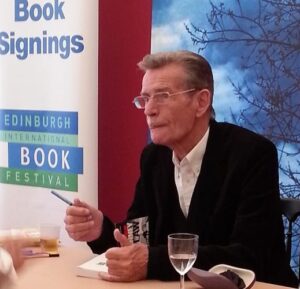
It’s exactly a decade since the Scottish writer, poet and columnist William McIlvanney passed away on December 5th, 2015.  Here’s something to mark this melancholy anniversary.


For myself and many book-lovers in Scotland in the 1980s, William McIlvanney was both a source of pride and exasperation.  Pride that modern Scottish literature was capable of producing someone as good as he was; but exasperation that the British literary establishment seemed to have little interest in him or his peers (like Alasdair Gray and James Kelman) north of the border.  On their radar, Scottish writers didn’t make much of a blip.


Back then, the clique of authors, critics and academics who, through Britain’s highbrow media outlets, decided what was fashionable were a privileged Oxford / Cambridge-educated bunch who lived in London and seemingly lived up their own arses too.  I always find it telling that in 1984, when things felt at their very worst, the Booker Prize – the flagship award for the UK literary establishment – managed to have on its short-list five books that had novelists, biographers, literary critics and literary lecturers as their main characters.  The only shortlisted book that was about people who didn’t make a living out of literature (you know, like 99.999% of the human population) was J.G. Ballard’s Empire of the Sun.  And it didn’t win, though it should have.


The novel that helped put McIlvanney on the map was 1975’s Docherty, which was about a tough west-of-Scotland miner and his family trying to cope with everything that the early decades of the 20th century threw at them.  Thus, McIlvanney was never going to ingratiate himself with the ‘in’ crowd by writing about writers, biographers, critics or lecturers either.


I’d read McIlvanney’s 1977 novel Laidlaw as a teenager – more about that in a minute – but it wasn’t until I was at college that one of my tutors (Isobel Murray) urged me to read a book of his that’d just been published, 1986’s The Big Man.  I’m glad I listened to her because The Big Man proved to be one of my favourite books of the 1980s.  It features another miner, called Dan Scoular.  He’s an ex-miner, actually, because this is the post-miners’-strike 1980s, Scoular has lost his job and he and his family are struggling to make ends meet.  The imposing Scoular happens to be good at fighting, though it’s a side of him that he’s suppressed for a long time.  Then he’s approached by a Glaswegian gangster who offers to pay him a small fortune if he takes part in an illegal bare-knuckle fight.  Thus, Scoular faces a dilemma – does he do something that he finds abhorrent if it saves him and his loved ones from penury?  Inevitably, after he ignores his better instincts and agrees to the proposal, he finds out that there are more complicated and even nastier things going on in the background.


© Hodder and Stoughton


The Big Man is the most cinematic of McIlvanney’s books and it was no surprise that it was filmed, in 1990, by David Leland.  The film gets some things right.  The villains, played by Ian Bannen and Maurice Roëves, are good.  However, it gets a lot wrong, including a Hollywood-esque, feel-good ending far removed from the bleak, ambiguous note with which McIlvanney closes the book.  Another problem is that, at the time, there wasn’t a bankable-enough Scottish star for the filmmakers to cast in the role of Scoular.  So they had to search around and the next best thing they could find was a Northern Irishman, Liam Neeson.


Now I like Neeson, but every time in The Big Man that he opens his mouth and those dulcet County Antrim tones of his emerge, the sense that you’re in a hard-pressed mining town in the West of Scotland goes out of the window.  It’s a pity that the film wasn’t made during the years since, when some bankable Scottish actors have come to prominence (though it might be difficult to find one with the necessary, hulking physicality that Neeson had).  Incidentally, The Big Man – a movie about Scottish ex-mining communities and ruthless Glasgow criminals – also has Hugh Grant in its cast.  I’ll give you all a minute to pick your jaws up off the floor.


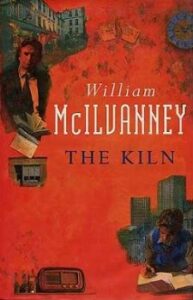
A later novel by McIlvanney, 1996’s The Kiln, received a lot of acclaim.  It even had a recommendation on its cover from Sean Connery.  I’ve just praised McIlvanney for not writing books about writers, but The Kiln actually has a writer as its central character, one in the throes of a mid-life crisis.  However, the novel is more a coming-of-age novel because its hero spends much of it looking back on his working-class youth, especially on a period he spent toiling in a local brickworks.


When The Kiln appeared, it seemed to cement – an appropriate verb for a book about bricks – McIlvanney’s status as a major figure in Scottish letters.  But it seemed the last time that he commanded such attention.  Recently, I was thinking about The Kiln and I remembered reading it while I was making a long-distance bus trip during the only occasion I was in Australia – which was in 1997, almost thirty years ago and almost twenty years before McIlvanney’s death.  What on earth happened to him after that?  I’d come across an occasional interview with him or article by him in the Scottish press, but that was about it.  In 2006 he published one more novel, Weekend, though it arrived with little fanfare – the antithesis of the reception The Kiln got a decade earlier.
 

© Hodder and Stoughton


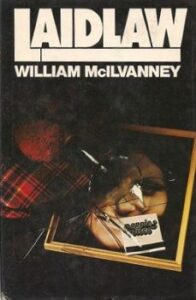
Though as far as mainstream literature was concerned McIlvanney seemed to disappear from view after The Kiln, he did in recent years win belated acknowledgement for his work as a crime writer – specifically, for his 1977 novel Laidlaw, which was republished in 2013, and its sequels The Papers of Tony Veitch (1983) and Strange Loyalties (1991).  (The latter book also serves as a grim semi-sequel to The Big Man.)  All are about a tough but intellectual and philosophical Glasgow detective called Jack Laidlaw.  Since then, crime novels set in Scotland have sold by the barrow-load and Scottish crime writers like Iain Rankin, Val McDiarmid, Denise Mina, Christopher Brookmyre and Stuart MacBride have enjoyed lucrative careers, so McIlvanney can be seen as the man who started it all.  His Jack Laidlaw was the prototype for Inspector Rebus and the rest.  In effect, McIlvanney created ‘Tartan Noir’.


Even when I read Laidlaw at a young age, I found it a bit uneven (as prototypes usually are), its prose shifting slightly uncomfortably between Glasgow-speak and Raymond Chandler-isms.  It wasn’t helped by the way it was marketed, either – “Turn down a Glaswegian when he offers you a drink,” intoned the blurb on the back, “And he’ll break your legs,” which wasn’t what the book was about.  Laidlaw focuses more on psychology than on violence, and I found it disconcerting that in its final pages the hero isn’t rushing to catch the murderer so much as he’s rushing to save the murderer from gangland-backed vigilante justice.  But all power to McIlvanney for inventing what would become Scotland’s biggest literary export.  Iain Rankin, in particular, has always admitted his debt to him.


McIlvanney was a political thinker too and during the 1990s – back in those long-ago days when Scotsman Publications produced material that was worth reading – he was a perceptive columnist in the Scotland on Sunday newspaper.  I also remember him delivering a speech in Edinburgh’s Meadows during the March for Scottish Democracy rally held on December 12th, 1992, demanding the creation of a Scottish parliament.  On stage, in front a crowd of 30,000 people, he performed far better than any of the politicians in attendance.  He memorably summed up the case for a parliament saying: “We gather here like refugees in the capital of our own country, wondering what we want to be when we grow up.  Scotland – the oldest teenager amongst nations.”


But at the same time he pleaded for racial tolerance.  “Scottishness,” he pointed out, “isn’t some pedigree lineage.  It’s a mongrel tradition.”  I suspect that with McIlvanney’s speech that day began the emphasis on ‘civic nationalism’ that Scottish nationalists – at least, the decent, mainstream ones, not the fringe, far-right heidbangers – have been at pains to cultivate ever since.


Finally, William McIlvanney played an indirect role in the start of my writing career.  My very first short story to see publication, a slice-of-life piece set on a Scottish farm with the self-explanatory title Lambing Time, appeared in a magazine called Scratchings, then produced annually by Aberdeen University’s Creative Writing Society.  Scratchings had been launched in the early 1980s with the help of a financial contribution from McIlvanney.  At the time he was Aberdeen University’s writer-in-residence and he was approached by two young students who “wanted to borrow 40 pounds to start a poetry magazine.  Would he be able to lend them the money?”  He did, Scratchings was born, and it provided a home for Lambing Time a few years later.


Incidentally, the two students who successfully tapped McIlvanney for 40 pounds were Dundonian Kenny Farquharson, now a columnist with the Times newspaper; and Invernessian Alison Smith, now better known as the novelist Ali Smith, who’s been shortlisted three times for the Booker Prize – yes, the award whose shortlist bugged me so much back in 1984.
 

© Hodder and Stoughton
Favourite Scots words I-L


From wikipedia.com / © Tim Evanson


Today is St Andrew’s Day, the national day of Scotland.  So, in keeping with tradition on this blog, here’s the latest instalment in my A-Z of the always-fascinating Scots language….


Once upon a time, the main detractors of the Scots tongue seemed to be those snobby, London-based, Oxbridge-educated fossils who ran Britain’s literary establishment.  I’m thinking of the furore that greeted James Kelman’s novel How Late It Was, How Late winning the Booker Prize in 1994.  How Late… was written uncompromisingly in the voice of a working-class Glaswegian and its success did not go down well in many posh quarters.  Simon Jenkins, for instance, described it getting the Booker as ‘literary vandalism’, Kelman as an ‘illiterate savage’, and the novel itself as “the rambling thoughts of a blind Glaswegian drunk.”


But compare that with the reaction of Britain’s literary establishment to last year’s Deep Wheel Orcadia, the science-fiction verse-novel by Harry Josephine Giles, which is told in Orcadian and which won 2022’s Arthur C. Clarke AwardDeep Wheel Orcadia has been greeted respectfully, for example, here and here, rather than with the horrified pearl-clutching or bemused mockery that used to be the norm.


No, looking at social media, it seems to me that nowadays the folk who bash the Scots language most, and who virulently denigrate people who use it, are Scottish ones – those of a Conservative and / or Unionist disposition.  The more extreme members of this faction profess to be loyal subjects of ‘the King’ (Charles presumably, not Elvis) and staunch supporters of a certain football team in Glasgow.  They also slather their Twitter profiles in Union Jacks and, without a shred of irony, declare that they ‘hate nationalism’.


In other words, Scots has become part of a culture war.  It’s been aligned with the Scottish independence movement and the independence-seeking Scottish government at one end of the battlefield; while at the battlefield’s other end, Unionists and British nationalists deny that Scots exists or deride it as ‘slang’ or ‘an accent’ or (at best) ‘a dialect of English’.  Likewise, they do down any sort of Scottish culture that suggests Scotland is slightly different from England and the inhabitants of Great Britain aren’t just a single, homogenous mass.  Hence, you get the likes of Ian Smart, self-styled ‘lefty lawyer’ and ‘Scottish Labour Party hack’, dismissing former Machar (Scotland’s Poet Laureate) and writer-in-Scots Jackie Kay as “a woman from Bishopbriggs, writing doggerel”, and slandering another Scots-using author, Emma Grae, as a ‘white nationalist’.


Scotland’s other language, Gaelic, gets it in the neck from these types all the time too.  Witness the celebrated episode where right-wing Scottish troll Effie Deans complained on social media about how road-signs in Gaelic caused her to get lost in the Fort William area.  This was despite the place-names being printed in English as well as in Gaelic on the signs.  “She’s like a post-imperial psychotic satnav gone wrong,” commented one wit on Twitter.


Anyway, here’s a further selection of my favourite words in Scots, this time those beginning with the letters ‘I’, ‘J’, ‘K’ and ‘L’.  And Scots is a language.  If you don’t like that assertion, you can stick it up your hole.


From google.com/maps


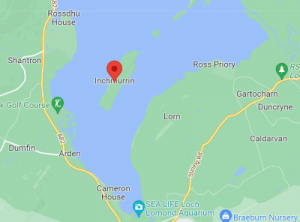
Inch (n) – not the unit of measurement but a geographical word with two meanings, both of which turn up in Scottish place-names.  It can be a small island (see Inchmurrin in Loch Lomond, which is actually the largest freshwater island in the British and Irish islands), or an expanse of flat ground next to a river (see Markinch in Fife).


Irn Bru (n/adj) – Scotland’s ‘other national drink’, the fizzy, luridly-coloured, non-alcoholic beverage that’s claimed to be both a hangover cure and the only soft drink in the world not to be outsold by Coca Cola in its native country.  I’m not sure if either of these claims stands up to scientific scrutiny, but who cares?  All right, Irn Bru is a trademark more than a vocabulary item, but I’ve seen it used as an adjective meaning ‘orange’, for instance, as in “the Irn Bru-coloured ex-American president, Donald Trump.”


Jakey (n) – a down-at-heels, worse-for-wear vagrant with an alcohol dependency.  The alcohol in question is usually either Buckfast Tonic Wine or Carlsberg Special Brew.  The Scottish-based bestselling author J.K. Rowling is sometimes referred to as ‘Jakey Rowling’ by Scottish-independence enthusiasts, irritated at her high-profile support for Scotland remaining part of the United Kingdom during the 2014 independence referendum.


Janny (n) – a janitor.  In Matthew Fitt’s  But n Ben A-Go-Go (2000), hailed (22 years before Deep Wheel Orcadia) as the first-ever science-fiction novel written in Scots, the main character works as a cyberjanny, ‘cleaning up social middens in cyberspace’.


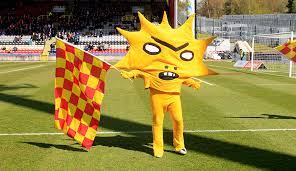
Jag (n/v) – variously, the painful pricking sensation you get when you touch a thistle-head; a needle-and-syringe injection; a serving of whisky, as in “Wid ye like a wee jag ay Grouse?”; or a supporter of Partick Thistle Football Club, the third football team in Glasgow whose mascot, Kingsley, is the most terrifying sporting mascot in the world.  The adjective derived from jag is jaggy.  Yes, Kingsley is the world’s jaggiest sporting mascot too.


© Partick Thistle Football Club


Jalouse (v) – to suspect.


Jaup (v) – ‘to splash or spatter’, according to my well-thumbed copy of the Collins Pocket Scots Dictionary.  Like a lot of Scots words, I heard this one, or a vowel-altered variation of it, before I even moved to Scotland.  While I was living in Northern Ireland as a wee boy, and whenever my mother was frying something in the kitchen, she’d bark at me: “Stay back or ye’ll be japped by the pan!”


Jiggered (adj) – exhausted.


Jingbang (n) – the lot or ‘every last one’, as in the phrase, “the whole jing-bang ay them”.


© D.C. Thomson


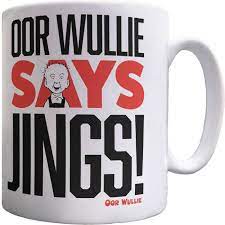
Jings! (exclamation) – a mild and very old-fashioned expression of surprise in Scotland.  Nowadays, in fact, I suspect there is just one person in Scotland who still says “Jings!”  That is Oor Wullie, the dungaree-clad, bristly-haired juvenile delinquent from the Sunday Post comic strip of the same name.


Jobby (n) – a turd.  A word much loved by Billy Connolly, as in his routine about the mechanism that expels faecal matter underneath airplane toilets, the jobbywheecher.  (Wheech means to remove something quickly and suddenly.)  Incidentally, another Scottish term for excrement found in this region of the alphabet is keech.


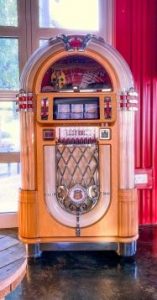
Jouk (v) – to duck or dodge.  A nice story I’ve heard is that this word found its way to the American south.  There, a juke joint became a roughhouse dancing venue where people had to keep jouking this way and that to avoid punches, bottles, etc., thrown on the dance floor.  In turn, this led to the machines that played records of the music you heard at such places being called jukeboxes.


From unspash.com / © Max Tcvetkov


Keek (v) – to peep or glance at something.  The derivative keeker refers not, as you might expect, to a peeping Tom, but to a black eye.


Ken (v) – to know.  Meanwhile, the adjective kenspeckle means ‘well-known’.


Kent yer faither! (idiom) – “(I) knew your father!”  In other words, “Don’t give yourself airs and graces because you’re from humble stock, same as the rest of us.”  I’ve never heard anyone use this as a putdown, but I’ve heard several folk over the years complain about kentyerfaither syndrome in Scotland.  They felt Scotland was a place where if you managed to improve yourself and be successful, you then had to deal with a bunch of jealous, moaning gits trying to cut you down to size.


Kirk (n) – with a capital ‘K’, the Kirk refers to the Church of Scotland, i.e., the institution representing the country’s once-dominant Presbyterian faith.  With a small ‘k’, a kirk refers to a church building.  In 2008, when George Takei, who played Mr Sulu in the original series of Star Trek (1966-69), married his long-term partner Brad Altman and invited all the surviving members of the Star Trek cast to his wedding, except for William Shatner, whom he famously disliked, a joke about this circulated in Scotland.  The punchline went: “The Kirk doesn’t approve of gay marriage anyway.”


From wikipedia.org / © NBC


Laldy (n) – ‘your all’.  The expression “Gie it laldy!” has been bellowed from the touchline of many a Scottish sports field.


Leid (n) – a language.  Thus, this entry is about the ‘gid Scots leid’.


Links (n) – defined in the Free Dictionary as ‘relatively flat or undulating sandy turf-covered ground usually along a seashore.’  A links can also refer to a golf course positioned on such terrain.  For example, eastern Edinburgh has Leith Links and Fife has Lundin Links.  In fact, Ruth Davidson, the tank-loving honorary colonel who used to lead the Scottish Conservative Party, was ennobled not so long ago and she chose for herself the title of ‘Baroness Davidson of Lundin Links’.  Although I prefer to call her: ‘Her Royal Highness Baroness Colonel Tank-Commander Ruth Davidson of Jar-Jar Binks’.


Loon (n) – a word common in North-East Scotland, equivalent to laddie, just as the North-Eastern quine is equivalent to lassie.  When I was out drinking as a young guy in Aberdeen, my Aberdonian pal George Boardman would cheerily cry at the end of the evening, “See ye later, loon!”


Loup (v) – to jump.


Lugs (n) – ears.  I’ve heard more than one person, after being subjected to someone else’s haranguing or moaning, retort: “Quit burnin ma lugs!”


Lum (n) – a chimney.  Some years ago, the Guardian reviewed a collection of short stories by the late Scottish author Alasdair Gray and the reviewer complained about the number of typos in the book.  He cited as an example ‘Edinburgh lums’, which he assumed was a misprint of ‘Edinburgh slums’.  But no, Gray was actually referring to the smoky chimneys of the Scottish capital.


From unsplash.com / © Uwe Conrad