Weird Penguin: Ancient Sorceries


© Penguin Books


In 2024 Penguin books inaugurated its Weird Fiction series, which to date has involved the republication of five venerable titles: Robert Chambers’ The King in Yellow (1895), William Hope Hodgson’s The House on the Borderland (1908), Gertrude Barrows Bennett’s Claimed! (1920), Algernon Blackwood’s Ancient Sorceries and a collection, Weird Fiction: An Anthology (2024).  Well, I assume Weird Fiction: An Anthology is a new collection, but it consists of some venerable short stories.


I’d already read those first two novels and most of the tales in the anthology, whose line-up includes such well-kent scribblers as Edgar Allan Poe, H.P. Lovecraft, W.W. Jacobs, May Sinclair, M.R. James and Sir Arthur Conan Doyle.  But I hadn’t read the Bennett and Blackwood books.  Recently, their striking covers – illustrated in pastel colours, especially pink – caught my eye while I was in the Singaporean bookshop I frequent, Kinokuniya Books in Orchard Road’s Takashimaya Shopping Centre, and I wasted no time in buying them.


Here are my thoughts on the volume by Algernon Blackwood.  I’ll write about the Gertrude Barrows Bennet one later.


Ancient Sorceries contains five stories, the title one plus A Psychical Invasion, The Nemesis of Fire, Secret Worship and A Victim of Higher Space.  All feature Dr John Silence, described in the book’s blurb as “Physician Extraordinary… the greatest occult detective of the age.”  Yes, Silence is what in modern parlance we’d call a ‘paranormal investigator’ – but when the paranormal manifests itself in malevolent forms, he also battles against it.


Series of stories about occult detectives have been common in horror fiction and I have to say I have a problem with them.  That problem is one of believability.  You can swallow the notion of the hero having one dramatic encounter with the supernatural in one story, maybe even of them having a second dramatic encounter with it in a second story.  But when that hero deals in story after story with supernatural jiggery-pokery, cropping up in all sorts of different forms – ghosts, werewolves, poltergeists, whatever – it becomes almost impossible to take seriously.  That’s especially so when you consider how most human beings go through their lives with no contact at all with what might be defined as ‘occult’ or ‘paranormal’.  (During my many years on the planet, I’ve had one strange experience, lasting all of half-a-minute, which I couldn’t explain and which, if I was so inclined, I could attribute to the supernatural.)  This means a writer of such tales has to show a great deal of skill in making them seem even halfway plausible.


Also implausible is the idea that the occult detective, a mortal human being, can constantly take on dark forces of immense, unnatural power and triumph over them.  The success rate for the heroes of these stories suggests that those dark forces are, in reality, pretty weak sauce.


The afore-mentioned William Hope Hodgson wrote stories about an occult detective called Carnacki the Ghost Finder, first published as a collection in 1913.  He managed, I feel, to just about get away with it.  Hope Hodgson helped make his tales a little more believable by interspersing the ones where the threat was genuinely supernatural with ones where, Scooby Doo-style, it turned out to be a hoax.  Also, his usual narrative device – he had each story told by Carnacki to a group of mates with whom he’s just had dinner – helped too, since it’s possible Carnacki could be exaggerating what happened or even just making it up.


On the other hand, I’ve read a few stories that the prolific pulp writer Seabury Quinn wrote about a French occult detective called Jules de Grandin and found them bloody awful.  (It doesn’t help that de Grandin’s patois – “Sang du diable…!  Behold what is there, my friend…  Parbleu, he was caduo – mad as a hatter, this one, or I am much mistaken!” – is closer to Inspector Clouseau than Hercule Poirot.)


Usually, the best I can hope for is to regard the stories as out-and-out fantasies – which is the case with Manley Wade Wellman’s stories of Silver John, set in the Appalachian Mountains.  Or as ‘silly but fun’ – the reaction I had to Alice and Claude Askew’s stories about Aylmer Vance (‘Ghost-seer’).  But in no way do I find them scary.


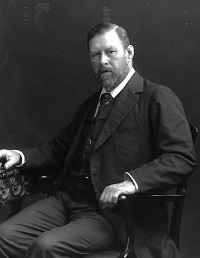
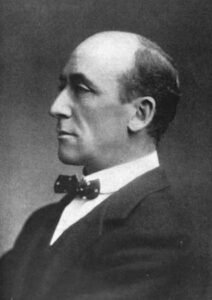
Blackwood, in his day a celebrated author, journalist, broadcaster and, generally, someone who ‘lived the life’ – his CV includes stints as a farmer, hotelier, barman, model, secretary, businessman and violin teacher and he was also a Theosophist and eager outdoorsman – has a big reputation as a writer of chilling stories.  The literary critic S.T. Joshi lauded his fiction as “more consistently meritorious than any weird writer’s except Dunsany’s”, and anything by him I’ve read before now I’ve found impressive.  I was thus looking forward to seeing how he would tackle this subgenre and its believability issue.
 

From wikipedia.org / © The Outlook


In fact, I’m afraid the trouble with a couple of the stories in Ancient Stories is that Blackwood is so keen to make them appear believable that he over-compensates.  They end up with more prose in them is necessary.  They would have been more digestible if they’d been a dozen pages shorter.


The title story, Ancient Sorceries, is a case in point. Dr John Silence doesn’t feature much in this one.  He just interviews its main character, Arthur Vezin, about some strange experiences and passes comment at the end.  Vezin was travelling by train across northern France when, impulsively, he decided to get off at a remote station, stay in the locality for the night and resume his journey the next day.  (A quiet sort, Vezin had been put off his train journey by the unwelcome presence of many noisy tourists, mainly ‘unredeemed holiday English’.)  Vezin ended up staying in a little town that seemed normal on the surface but, of course, had weird things going on underneath.  A mysterious mental torpor began to affect him.  Rather than get the next day’s train, he stayed in the town longer and longer and became increasingly listless:


“It was, I think on the fifth day – though in his detail his story sometimes varied – that he made a definite discovery, which increased his alarm and brought him up to a rather sharp climax…  At the best of times he was never very positive, always negative rather, compliant and acquiescent; yet, when necessity arose, he was capable of reasonably vigorous action and could take a strongish decision.  The discovery he now made that brought him up with such a sharp turn was that this power had positively dwindled to nothing.  He found it impossible to make up his mind…”


Alas, Blackwood’s description of Vezin’s gradual – very gradual – descent into this torpor goes on for too long.  He’s trying to make it sound realistic and credible, but as you read it over several pages, you feel a similar torpor taking possession of your senses.  Things admittedly liven up near the end, but the climax feels like it’s been a long time coming.


Also guilty of this is The Nemesis of Fire, whose action takes place on a remote English country estate, involves artefacts from ancient Egypt and features a fearsome fiery phenomenon that causes things, and people, to burst into flames.  This is narrated by one of Silence’s associates and immediately we’re reminded of a Sherlock Holmes story being told by Holmes’ loyal sidekick, Dr Watson.


This time, too much prose is spent describing, and adulating, Silence’s character.  For example: “His voice had that quiet mastery in it which leads men to face death with a sort of happiness and pride.  I would have followed him anywhere at that moment.  At the same time his words conveyed a sense of dread seriousness.  I caught the thrill of his confidence; but also, in this broad light of day, I felt the measure of alarm that lay behind.”  Yes, this helps us believe Silence is a remarkable man, capable of taking on and defeating the supernatural horrors that confront him.  But again, it goes on too long.  Sir Arthur Conan Doyle made it plain that Watson greatly admired Holmes, but did so economically and didn’t let it get in the way of the actual story.


That said, the other three tales in this volume are fine.  The Psychical Invasion is a sturdy haunted-house story that benefits from a novel idea: rather than bring a team of ghost-hunters with him into the house, Silence is accompanied by a cat and dog – working on the belief that animals are more sensitive to the paranormal than humans.


Secret Worship is about a man returning to a monastic school in the mountains of southern Germany where he studied as a child – again, this is a ‘Silence-lite’ entry where the detective remains in the background most of the time – and is increasingly disturbed by the hospitality he gets from the brothers / teachers there.  I thought it was the strongest story of the lot, a masterpiece of mounting unease.


The last tale, A Victim of Higher Space, is agreeably wonky and I wonder if a young Ian McEwan read it prior to writing his short story Solid Geometry, which featured in his early collection First Love, Last Rites (1975).


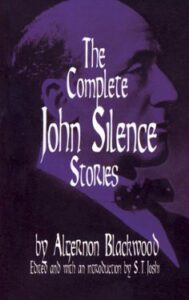
One thing that’s slightly annoying about this book is its incompleteness.  For some reason it omits a sixth Silence story, The Camp of God.  This is included in an earlier collection, The Complete John Silence Stories (2011), which comes with an introduction by S.T. Joshi.  I can’t understand how a publishing company as mighty as Penguin allowed that sixth instalment to slip through the net.
 

© Dover Publications
Horror before it got panned


© Pan Books


One more horror-themed reposting just before Halloween…


Michael Gove, well-known cokehead, Aberdonian nightclub boogie-king and England’s Education Minister from 2010 to 2014, would be disappointed in me.  When I was a lad, my usual reading material was not the likes of George Eliot’s Middlemarch, which in 2013 Gove famously said he wanted to see the nation’s youth reading.


Rather, when I was 11, 12 or 13, I commonly had my nose stuck in works by such authors as Sven Hassel, James Herbert and Guy N. Smith, meaning that I didn’t become conversant in the effects of the Great Reform Act of 1832 or in the gradual diminution of the ideals of Dorothea Brooke, which Eliot wrote about in her 1871-1872 masterpiece.  I did, however, end up learning a lot about German Panzer divisions wreaking bloody havoc on the Russian front during World War II, about chemical weapons leaking out of military laboratories in the form of thick swirling fogs and driving all who come in contact with them murderously insane, and about giant mutant crabs going on the rampage and eating people.  Knowing such things prepared me a lot for adult life.


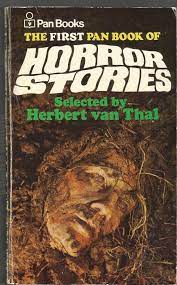
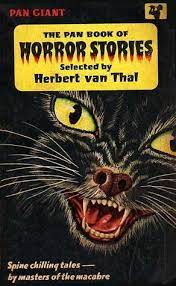
I also spent a lot of time reading, in the form of tatty paperbacks that in the school playground and on the school bus were constantly borrowed, read, returned, borrowed again and read again, a series called The Pan Book of Horror Stories.  The first of this series had been published in 1959, under the editorship of the strikingly named Herbert Van Thal, a literary agent, publisher and author whom the critic John Agate had once likened to ‘a sleek, well-groomed dormouse’.  The first few volumes of horror stories that Van Thal edited for Pan Books consisted largely of classical stories from well-known horror writers and more ‘mainstream’ (whatever that means) writers who’d dabbled in the genre; and their quality was generally held to be high.


By the late 1960s, however, Van Thal was filling each new compilation with more and more stories from new writers, many of whom were taking advantage of a more permissive era to see what they could get away with in terms of violence, gore and general unpleasantness.  Serious horror writers and fans became quite sniffy about the books.  Ramsey Campbell, Britain’s most acclaimed living horror writer, has said: “I did like the first one when I was 13 years old, but I thought the series became increasingly illiterate and disgusting and meritless.”


When my schoolmates and I started reading them in the 1970s, the latest editions of The Pan Book of Horror Stories were low in literary quality but high in disgusting-ness, which suited our jaded, beastly little minds fine.  I’m still psychologically scarred by Colin Graham’s The Best Teacher in the ninth collection, which was about a psychopath who decides to write a manual for aspiring horror writers, instructing them in what dismemberment, disembowelment and various acts of torture really look and sound like.  To this end, he kidnaps a horror writer and starts dismembering, disembowelling and torturing him whilst recording everything with a camera and tape recorder.  Anyone who thinks that the horror sub-genre of ‘torture-porn’ began with Eli Roth’s movie Hostel in 2005 ought to check out Graham’s grubby epic from a few decades earlier.


© Pan Books


To be fair, the later Pan collections did feature then-up-and-coming, now-well-regarded writers like Tanith Lee, Christopher Fowler and, ahem, Ian McEwan.  However, by the 1980s (and after Van Thal’s death), the series was clearly on its last legs.  It resorted to ransacking Stephen King’s famous anthology Nightshift (1978) and reprinting stories like The Graveyard Shift, The Mangler and The Lawnmower Man.  This was unwise, since anybody inclined to read the Pan horror series had probably read Nightshift already.  The final volume, the thirtieth, had a very limited print run and if you ever lay your hands on a copy, it’s probably worth a lot as a collector’s item.


A while ago in a second-hand bookshop I discovered a copy of The First Pan Book of Horror Stories.  This, alas, was unlikely to be sought by book collectors, since the copy looked like something had chewed, swallowed, partly-digested and regurgitated it.  At least it was still readable, so I got a chance to sample the original instalment in this famous, or infamous, series.  I was curious to know if it deserved the praise Ramsey Campbell had given it and also to see how different it was from the more disreputable stuff that came later.


My first impression was that the stories in this collection weren’t how I’d have organised them.  I’ve heard writers whose works were printed in the later Pan books grumble about Van Thal’s abilities as an editor, and it’s hard to see why stories as similar as Hester Holland’s The Library and Flavia Richardson’s Behind the Yellow Door (both about hapless young women who are hired as private secretaries by older, plainly-batty women and who meet gruesome fates), or Oscar Cook’s His Beautiful Hands and George Fielding Eliot’s The Copper Bowl (both about exotic, grotesque revenges and tortures inflicted by East Asian people – at least one of them struck me as racist) should end up in the same book.  In fact, Eliot’s story follows immediately after Cook’s, thanks to Van Thal’s strange policy of arranging the stories by the alphabetical order of their authors’ surnames.


I also noticed how stories I’d read elsewhere and greatly enjoyed in my youth now, sadly, seem a bit duff.  I loved Hazel Heald’s The Horror in the Museum when I read it as a 13-year-old.  Heald, incidentally, wrote it under the tutelage of H.P. Lovecraft, whose influence is obvious in the ornate prose-style.  However, a modern rereading suggests that Heald (and Lovecraft) could’ve cut the story’s length by about 20 pages without losing any of its plot points.


Meanwhile, Bram Stoker’s The Squaw, another tale I had fond memories of, seems much poorer now thanks to one of its characters being an American tourist called Elias P. Hutchinson.  If Hutchinson was what Stoker believed all Americans sounded like, spewing toe-curling things like ‘I du declare’ and ‘I say, ma’am’ and ‘this ole galloot’ and ‘durned critter’, I can only say that Stoker needed to go out and do some research.  Still, despite some glaringly obvious failings, both The Horror in the Museum and The Squaw benefit from having cracking denouements.


From wikipedia.org


The Horror in the Museum is one of the few stories in the collection that contains a monster.  (And what a monster it is: “globular torso… bubble-like suggestion of a head… three fishy eyes… foot-long proboscis… bulging gills… monstrous capillation of asp-like suckers… six sinuous limbs with their black paws and crab-like claws…”).  Apart from The Kill by Colonel Peter Fleming, a werewolf story penned by none other than Ian Fleming’s older brother, the rest of the stories are fairly monster-free, depending on psychological terrors for their impact.  Indeed, C.S. Forester’s The Physiology of Fear is a horror story in an unusually literal sense.  It deals with a particularly horrific episode in human history, the Nazi concentration camps.  It also features a German scientist engaged in research, with the Third Reich’s support and with prisoners from the camps as his guinea pigs, into the emotion of horror as it arises in the human psyche.  And the story’s ending isn’t conventionally horrific.  Instead, the scientist is ensnared in an ironic and satisfying twist worthy of Roald Dahl.


Also not a horror story in any conventional sense is Muriel Spark’s The Portobello Road.  It qualifies as a ghost story, but most of all it’s a mediation on the nature of friendship as it survives, or doesn’t survive, from childhood into adulthood.  This being Spark – whose most famous creation, Miss Jean Brodie, was simultaneously a prim middle-class Edinburgh schoolmistress and a fascist – the story has a bitter, vinegary flavour.  None of its characters are particularly pleasant and none seem to deserve long-term friendship.  In fact, the one character who tries to keep those friendships alive is the one who, ultimately, commits the story’s single, shocking act of violence.


Meanwhile, I reacted to the sight of Jack Finney’s Contents of the Dead Man’s Pocket as if an old friend had suddenly hoven into view.  Not that I’d encountered this particular story before, but it conjured up fond memories of American writers like Richard Matheson, Robert Bloch, Ray Russell and Charles Beaumont, who in the 1950s seemed to keep their rents paid by pumping out short stories for the likes of Playboy magazine and TV scripts for the likes of The Twilight Zone (1959-64) and Boris Karloff’s Thriller (1960-62).  In admirably direct and diamond-hard prose, their tales would detail the world turning suddenly and inexplicably weird for citizens of conformist post-war America, for both dutiful suburban wives in nipped-in-at-the-waist housedresses and office-bound men in grey-flannel suits.


From fictionunbound.com


Finney, most famous as the author of the sci-fi horror novel The Body Snatchers (1955), which has been filmed four times and shows conformity taken to a nightmarish extreme, starts his story thus: “At the little living room table Tom Benecke rolled two sheets of flimsy and a heavier top sheet, carbon paper sandwiched between them, into his portable.”  A half-dozen pages later, events have lured Benecke away from his portable typewriter and embroiled him in a vertiginous life-or-death struggle just outside his apartment window.  It calls to mind the Stephen King short story The Ledge, another one that appeared in his collection Nightshift.  I doubt if the similarity between the two stories is a coincidence, King being a big admirer of work from this era of American story-telling.


Also deserving mention are Oh Mirror, Mirror, a claustrophobic item penned by the great Nigel Kneale; Raspberry Jam, Angus Wilson’s poisonous take on the snobbery of old people who no longer have anything to be snobbish about; and Serenade for Baboons, a colonial horror by Noel Langley.


Inevitably, a couple of clunkers find their way into the book too.  Anthony Vercoe’s Flies wouldn’t be such a bad story if the writer hadn’t swamped his prose with exclamation marks.  I can’t remember encountering so many of the damned things in ten pages of prose before and the result is almost unreadable.  Meanwhile, The House of Horror is one of a series of short stories that American pulp writer Seabury Quinn wrote about a psychic investigator called Jules de Grandin.  De Grandin is French and seemingly meant to be a supernatural version of Hercule Poirot (who, I know, was actually Belgian).  Unfortunately, Quinn gives him a patois that is as cringe-inducing as Elias P. Hutchinson’s Americanisms in The Squaw: “Sang du diable…!  Behold what is there, my friend…  Parbleu, he was caduo – mad as a hatter, this one, or I am much mistaken!”


On the whole, though, I found The First Pan Book of Horror Stories a rewarding read.  I now look forward to tracking down the other, earlier instalments in the series – those ones that came out before Herbert Van Thal decided to crank up the levels of nasty, schlocky stuff, in order to satisfy the blood-crazed savages amongst his reading public.


Blood-crazed savages such as my twelve-year-old self…


© Pan Books