© Bauer Media Group / Q Magazine
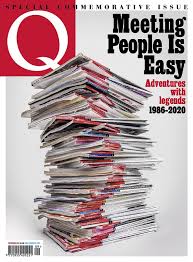
This week saw the publication of the final issue of Q, the British monthly music magazine that’d been on the go since 1986. You could argue that it’d been as much a victim of Covid-19 as, say, Terence McNally, John Prine or Tim Brooke-Taylor. In recent years Q had struggled financially and the lockdown in Britain caused by the virus and consequent lack of sales dealt the killer blow. Its editor since 2017, Ted Kessler, reflected in its last issue, “We’d been a lean operation for all of my tenure, employing a variety of ways to keep our head above water in an extremely challenging print market. Covid-19 wiped all that out.”
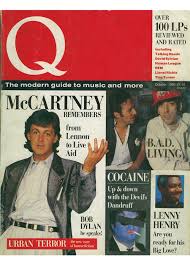
That’s a shame because for a decade-and-a-half, from the late 1980s to the early 2000s, Q was a fixture in my life. Buying it every month was both an ingrained habit and something I looked forward to.
It was launched in the mid-1980s by David Hepworth and Mark Ellen – the latter’s claims to fame include playing bass for a short time in the 1970s Oxford University band the Ugly Rumours, which had one Tony Blair as its singer. You mightn’t have expected Hepworth and Ellen to start up something like Q, aimed at older music fans, because previously they’d edited the shiny, teen-pop weekly Smash Hits. However, they’d also spent the 1980s hosting the BBC’s long-running highbrow rock-music show The Old Grey Whistle Test (1971-88) and on July 13th, 1985, helped to present the BBC’s coverage of the Live Aid concert at Wembley Stadium. Indeed, it was in response to something Hepworth said during the broadcast that Bob Geldof made his famous “F*ck the address!” outburst on live TV.
Hepworth and Ellen angled Q towards an older readership because they realised that pop and rock music were no longer just a young person’s game. By the mid-1980s, folk who’d spent their teen years listening to Elvis Presley, Chuck Berry, Little Richard and the like were well into their forties and those who’d been old enough to enjoy the soundtrack of the Summer of Love were pushing middle-age. Furthermore, a new innovation, the compact disc, was causing many older records to be reissued in a new format and older people were spending money on older music again – buying on CD what they already owned on vinyl, a technology that suddenly seemed obsolete. Unsurprisingly, the ‘reissues’ review section in Q was almost as long as its ‘new releases’ review one.
At the same time, the existing British music press seemingly offered nothing to anyone who was older than their mid-twenties. The teenybop magazines, pursuing an audience interested only in New Romantic bands like Duran Duran, Spandau Ballet and Wham – a movement I have to say I found unspeakable, as well as unlistenable – certainly didn’t, and the ‘serious’ music weeklies like the New Musical Express and the Melody Maker treated anything recorded before the advent of punk rock in the mid-1970s as the music of boring old farts.
No doubt reading Q in the late 1980s marked me out as a boring old fart too (I recall the NME once describing Q as a ‘living death of a magazine’), but I preferred its more measured, less partisan and less pretentious style and its willingness to cover with an open mind a range of musical genres from a range of eras to the attitude of the highbrow weeklies. The NME particularly got up my nose, its scribes broadcasting their musical preferences (and personal politics) in such an annoying, self-conscious, stuck-up and patronising way that I sometimes wondered if they were all clones that’d been grown from the cells of Rik Mayall’s character in the TV sitcom The Young Ones (1982-84). I actually enjoyed much of the music that the NME championed, like punk, new wave and indie, but my two favourite musical genres at the time were heavy metal and goth music, both of which the NME loathed and ridiculed, dismissing their fans as gormless morons. So yes, by 1986, I was ready for Q.
That’s not to say Q was toothless. Some of the most scathing pieces of musical journalism I’ve read appeared in its pages, though they were effective because the writer simply recorded was seen and heard and allowed the ‘stars’ in question to talk and string themselves up with their own words. I’m thinking of an article about an American tour attempted by late 1980s teen heartthrobs Bros, in which the brothers comprising the band, Matt and Luke Goss, came across as delusional and out-of-their-depth plonkers. Or a piece about Simply Red doing a concert in Cuba, in which the Q journalist had to deal with the mood-swings of a megalomaniacal, self-pitying and generally bloody awful Mick Hucknall. Or an encounter with the Smashing Pumpkins’ Billy Corgan, in which Corgan’s behaviour was such that the interview’s strapline was Marvel at the horribleness of Billy Corgan!
This ‘give-them-enough-rope’ approach, along with a strong dose of sarcasm, was evident in what for me was Q’s best regular feature, Who the hell does… think he / she is?, which ran until the late 1990s and was often but not always written by the late Tom Hibbert. This involved a unflattering interview with one of the ‘characters’ who were fixtures of British popular culture at the time – prominent in British TV, radio, comedy, sport, music, publishing, journalism or politics, but not showing much evidence of the talent that, in a rational world, would have secured them that prominence. The rogue’s gallery getting the Who the hell… treatment included Jeffrey Archer, Bananarama, Simon Bates, Jeremy Beadle, Gary Bushell, Barbara Cartland, Jeremy Clarkson, Edwina Currie, Jim Davidson, Eddie ‘the Eagle’ Edwards, Samantha Fox, Hale and Pace, Neil and Christine Hamilton, Benny Hill, David Icke, Bernard Manning, David Mellor, Michael Winner and not one, but two Starrs, Freddie and Ringo.
The interviews with those last two people were particularly memorable. An unhinged Freddie Starr ended up raving, “Jesus Christ tried to please everyone. And look what happened to him. Am I right? Am I right?” Whereas Ringo Starr, taking umbrage that in 1992 Hibbert still wanted to talk about the Beatles, raged: “That was 30 years ago, man. I’m still making records and you can hear that I’m a great musician on the new record, Time Takes Time, if you can ever be bothered to mention it. This is an actual bloody legend in front of you.”.
And it’s fascinating, if extremely disturbing, to note how many of the Who the hell… interviewees were later revealed as paedophiles and sexual abusers: Max Clifford, Gary Glitter, Rolf Harris and, worst of all, Jimmy Savile. Of Savile, Hibbert wrote: “People are loath to speak ill of Sir James. The man is a saint, millions raised for charity; he is the kiddies’ friend, ever on the telly placing a Jim’ll Fix It gong around the neck of some abashed youngster who’s just been a hovercraft pilot for a day. It is churlish, cynical beyond belief, to suggest there might be something untoward about the benevolent one. But isn’t there, perhaps, some oddness afoot. You hear tales, entirely uncorroborated, of course, whispered in sniggers at dinner parties…” To which Savile retorted that there were no skeletons in his closet because “I got knighted and that proves it, doesn’t it?” The wizened old monster then started bragging about his promiscuity with the ladies: “You can’t be in a disco with 600 birds in Aberdeen and stopping overnight and faithful to one f*ck in Leeds…”
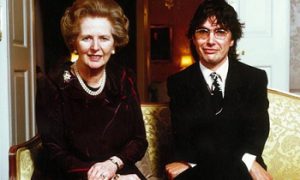
Incidentally, an interview Hibbert did with Savile’s good friend Margaret Thatcher also appeared in Who the hell… Asking her what her favourite sort of pop music was, she professed to liking How Much is that Doggie in the Window?
© Paul Rider
Q was lucky in its timing, for the anodyne, superficial music that dominated the charts during the early and mid-1980s was later, partly at least, dislodged by Madchester and grunge. And then the Britpop phenomenon hit the country in the mid-1990s. In other words, music got rockier again, and with bands around like the Stone Roses and Happy Mondays, Nirvana and Pearl Jam, Oasis and Blur, Q had proper rock stars, displaying proper rock star attitudes, as material for entertaining articles and interviews. During the 1990s, the magazine also established the yearly Q Awards Ceremony, which became famous for the raucousness and rudeness of certain invitees. For example, John Lydon heckled Phil Jupitus and Johnny Vegas as ‘Teletubbies’, and Liam Gallagher called Chris Martin of Coldplay a ‘plant-pot’ – quite right too.
I spent a good part of the 1990s living in the Japanese city of Sapporo, and between 1993 and 1998 I bought every issue of Q from my local branch of Tower Records. Just before I left Sapporo, I donated my collection of back issues to my mate, Steve Burrow. I hope he’s still got them, as they would be worth a fortune today. A little later, I went to Ethiopia and worked there for the Voluntary Service Overseas organisation, and my brother in Scotland was kind enough every month to post me the latest copy of Q after he’d finished reading it. I think those Q back issues, from 1999 to 2001, ended up sitting on the shelves of the volunteers’ library in the central VSO Office in Addis Ababa. Who knows? Maybe they’re still there now.
But I lost interest in Q in the early noughties, partly because every issue seemed to indulge in that most pointlessly bloke-ish of things, compiling lists: ‘The 100 best albums of all time’, ‘the 100 best gigs of all time’, ‘the 100 best drummers of all time’, and so on and so forth. I know I’m guilty of putting the occasional list on this blog, but at least I don’t charge people money to read them.
In truth, Q was running out of interesting things to write about. By now the popular music scene had become a lot duller, thanks in part to the rise of identikit pop stars spawned by TV reality shows like Pop Idol (2001-2003), The X-Factor (2004-present) and The Voice (2010-present). These non-entities were products of what I like to think of as ‘the Simon Cowell conveyor belt of karaoke’.
That’s not to say that there wasn’t good music still around, but people were accessing it on the Internet and making the discovery and enjoyment of that music a much more disparate and individual experience. The days when large numbers of people suddenly hooked onto the same musical craze, which the old-style music magazines would then cover and capitalise on by selling loads of copies, were dead and gone. The Internet too was where people were increasingly turning to for information about music. Indeed, it was ironic that Q, a magazine partly created by new technology, the CD, was scuppered by new technology too.
That’s said, I’ve heard good things about Q under the editorship of Ted Kessler during the past three years, and I wish I’d dipped into it again while it was still there. But it’s too late now.
That’s not to say, of course, that good writing about music doesn’t exist anymore. It does, but you’re more likely to find it online than on the (ever-thinning) magazine racks of your local newsagent. That’s why I recommend you click onto – and if you like it, donate to – the Quietus.
© Bauer Media Group / Q Magazine