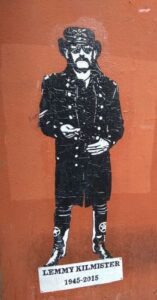
10 years ago, Lemmy was killed by death


From wikipedia.org / © Mark Marek


Following the recent death of singer and guitarist Chris Rea, whose 1986 song Driving Home for Christmas has become something of a festive-season classic, a mate of mine observed that this was yet another example of a ‘musician who’s associated with a perennial Christmas song’ expiring at Christmastime.


To support his thesis, he mentioned George Michael (responsible for 1984’s Last Christmas and died on Christmas Day 2015) and Shane MacGowan (co-singer and co-writer of 1987’s Fairy Tale of New York and died on November 30th, 2023 – okay, not quite in the festive season but I’m sure the Christmas lights were already up in Dublin at the time).  Referencing the singers of Merry Christmas Everybody (1973) and I Wish It Could Be Christmas Every Day (1973) and the perpetrator of Mistletoe and Wine (1988) and Saviour’s Day (1990), my mate concluded, “…Noddy, Roy and Cliff better take extra care in Decembers to come.”


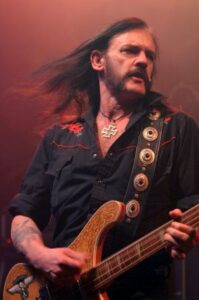
Well, today is the festive-season day of December 28th, 2025.  And it marks the tenth anniversary of the death of a titan of popular music: Lemmy, front-man with one of heavy metal’s most brilliant bands, Motörhead, and a general all-round role model for how to live your life (i.e. loudly, always disreputably and occasionally downright badly).


I was going to say that Lemmy’s passing at Christmastime disproves my mate’s theory that only the singers of Christmas songs die during this period.  But I’ve just checked and discovered that, though Motörhead never recorded a Christmas song, in 2008 Lemmy did get together with ZZ Top’s Billy Gibbons and the Foo Fighters’ Dave Grohl and made a cover version of Chuck Berry’s Run, Rudolph, Run (1958) for the same year’s album We Wish You a Metal Christmas and a Headbanging New Year.  (Google AI informs me the song’s vibe was ‘heavy, aggressive and sinister’.)   So maybe there’s something in it after all.


Anyway, Lemmy.  What an amazing career he had.  Legend has it that he managed the remarkable feat of being thrown out of Hawkwind for taking too many drugs – though more likely he was thrown out for taking the wrong sort of drugs, i.e., amphetamines, which the other, hallucinogenic-loving band-members looked down on.  He tried to teach Sid Vicious how to play bass (with a predictable lack of success).  He composed the greatest rock ‘n’ roll song ever, Ace of Spades (1980).  He also gave rise to the greatest joke ever – “If Lemmy had a fight with God, who would win?”  “It’s a trick question: Lemmy is God.” – which was funny because it was true.


Here, by way of a tribute to the great man, is a review of a Motörhead concert that I wrote back in 2008 for the University of East Anglia’s student newspaper, Concrete.  It’s an excitable and breathless piece of writing but, well, I had just been at a Motörhead concert.  Reading it now, I have a few regrets.  I should apologise to the late Ronnie James Dio – in the years since, I’ve come to realise I like ‘strutting spandex-clad idiots singing songs about elves and wizards’.  Plus, Ronnie was no idiot.


And obviously, I regret the fact that the prediction made in the final sentence didn’t come true.

*

MOTÖRHEAD

UEA, November 21st, 2008

If the Nobel Foundation in Stockholm ever creates a Nobel Prize for Heavy Metal, surely its first recipient will be Lemmy, singer, bassist and general driving force of Motörhead.


Founded in the 1970s, a decade when heavy metal consisted of strutting spandex-clad idiots singing songs about elves and wizards (e.g. Rainbow) or about their abilities in making vigorous love to the ladies (e.g. Whitesnake), Motörhead were a revelation.


Lemmy’s hoarse roar was stuck onto a racket of guitars played at the loudest possible volume and at the fastest possible speed, a sound that helped to spawn the speed and thrash metal sub-genres and supplied Metallica, Slayer, Anthrax and co. with at least 666 tons of inspiration.


Lemmy was also an early and crucial champion of Girlschool, the groundbreaking all-female metal band who helped the music to shed some of its reputation for sexism.  And in the segregated pre-grunge era, when heavy metal and punk fans weren’t supposed to associate with each another, Motörhead was the one metal band it was okay for punks to like.  Lemmy and the Sex Pistols’ Sid Vicious were good mates and he even tried to teach Sid how to play bass guitar – unsuccessfully, it must be said.


Taking the stage tonight after a short-but-well-received set from Toronto band Danko Jones and a ludicrous-but-loveable one from Saxon – ironically one of those hoary old-style metal bands that Motorhead helped to make obsolete – Lemmy, guitarist Phil Campbell and drummer Mikkey Dee went to work with their usual, blistering single-mindedness.  Old favourites like Bomber (1979) and Killed by Dead (1984) got blasted out alongside items from their new album Motörizer – though unsurprisingly the new stuff didn’t sound entirely different from the old stuff.


Apart from a blues pastiche where Lemmy displayed some unexpected harmonica-playing skills, this was business-as-usual in the best sense of the phrase.  Rounding off a perfect evening for the head-grinding crowd was an encore containing Ace of Spades, surely the most brain-batteringly brilliant song in heavy metal – and possibly in 7000 years of human civilisation as well.


The big heavy-metal news this week was that Guns n’ Roses had finally put out Chinese Democracy – an album so named because it’d taken so long to record that democracy could have feasibly come to China by the time of its release.   From tonight’s showing, however, Motörhead will be going strong long after China has taken over Wall Street, bought up Coca Cola and put a man on the moon.
 

From blabbermouth.net / © Pedro Alonso

21st century metal


© Nuclear Blast


Such has been the fanfare recently over the return of Swedish 1970s pop darlings Abba, with a new ten-song album and a supposed ‘virtual concert’ where ‘digital avatars’ will perform in the shoes of the band’s now somewhat long-in-the-tooth members, that I’ve wondered if I’m the only person in the world who doesn’t actually like Abba.


Okay, ‘doesn’t like’ is a bit strong.  A more accurate verb-phrase would be ‘is totally indifferent to’.


There are a couple of Abba songs that get me tapping my foot in a vague, mindless way, like Gimme! Gimme! Gimme! or Money, Money, Money (both 1979) or the song with which they won the 1974 Eurovision Song Contest, Waterloo – which, come to think of it, was an appropriation of the breezy, sax-laden sound of Roy Wood’s glam-rock band Wizzard.  But unlike, say, the entire population of Australia, a country that’s given us such Abba-obsessed cultural phenomena as the cover band Bjorn Again and the movies Priscilla, Queen of the Desert and Muriel’s Wedding (both 1994), I don’t worship the ground that the shiny, 1970s, high-heeled boots of Agnetha, Anni-Frid, Benny and Bjorn have walked on.


However, while the planet’s airwaves turn into the equivalent of the soundtrack of Mamma Mia! (2008), though thankfully without the pained, raspy sound of Pierce Brosnan attempting to sing, I will seek solace in the one type of music that truly matters… heavy metal.


Here’s a quick guide to the heavy metal bands, all of whom have become prominent since the beginning of the new millennium, that I’ve been listening to lately.


Al-Namrood

As this 2015 feature in the magazine Vice noted, “Al-Namrood have never played a live show, because it could result in the entire band being executed.”  That’s because the band Al-Namrood (a) play black metal and (b) are Saudi Arabian, two concepts that go together about as harmoniously as serpents and mongooses. According to their guitarist and bassist Mephisto, who, like all the band’s members, has never revealed his real name for his own safety, “Al-Namrood is the Arabic name of the Babylonian king Nimrood, who was a mighty tyrannical king who ruled Babylon with blood and defied the ruler of the universe.”  Yes, those sound like pretty black metal things to do.  It’s a shame that the band has had to operate so far off the grid because the music by them I’ve heard, its growling vocals and relentlessly thunderous guitars and drums laced with delicious Arabic folk stylings, I’ve found irresistible.


Behemoth

Polish black metal and death metal band Behemoth are similarly unloved by their country’s political and religious establishment.  And though the repercussions obviously won’t be as serious as those risked by Al-Namrood in Saudi Arabia, Behemoth’s frontman Adam ‘Nergal’ Darski has recently been convicted of blasphemy and could face imprisonment in the increasingly authoritarian Poland of Andrzej Duda. Actually, politically, Nergal has proved to be a bit of a knobhead in the past and once gained notoriety for wearing a ‘black metal against Antifa’ T-shirt, so it’s ironic he’s become a martyr in the struggle against the forces of extreme, right-wing knobhead-dom.


Behemoth first caught my attention when I listened to their 2018 album I Loved You at Your Darkest, which begins with a choir of creepy children chanting, “I shall not forgive… Jesus Christ… I forgive thee not…”  Thereafter, the album is a brilliantly Wagnerian parade of tunes with such titles as God = Dog, Ecclesia Diabolica Catholica and If Crucifixion Was Not Enough.  Can’t imagine why those pious Polish politicians don’t like them.


© Earache Records


Cult of Luna

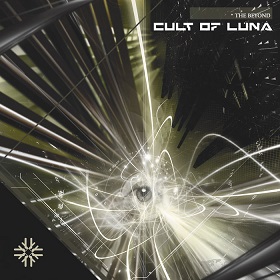
Proof that, musically, Sweden has considerably more to offer than just Abba, Swedish doom metal band Cult of Luna serve up tunes where big, booming slabs of guitar lumber ominously along, accompanied by hollering and shrieking vocals, creating a sound that suggests a world teetering on the brink of collapse while simultaneously being strangely exhilarating and even uplifting.  The earliest album of theirs I’ve heard is 2003’s The Beyond, the most recent one 2021’s The Raging River.  Though there’s evidence of development and exploration between the two, the basic template is reassuringly the same.


Electric Wizard

Hailing from County Dorset, England, the original members of Electric Wizard bonded in the 1990s over a shared love of horror films, the writings of H.P. Lovecraft and the music of legendary Brummie metal band Black Sabbath.  It was from the titles of two Sabbath songs, Electric Funeral and The Wizard (both 1970), that they devised their band’s name.  For me, they just seem to get better and better – from early albums like Dopethrone (2000) and Let Us Prey (2002) to their most recent opus, Wizard Bloody Wizard (2017), which contains the deliriously catchy track Necromania.


In fact, someone has stuck a fan video for Necromania on YouTube, its visuals stitched together from such lovable old horror-movie schlock-fests as The Dunwich Horror (1969), Le Frisson des Vampires (1971), Lizard in a Woman’s Skin (1971), All the Colours of the Dark (1972), Baron Blood (1972), Dracula AD 1972 (1972) and The Satanic Rites of Dracula (1973). It captures the essence of Electric Wizard perfectly.


© Roadrunner


Gojira

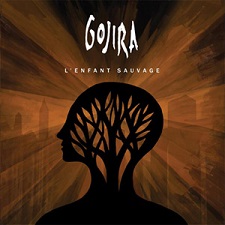
Several bands have named themselves after Godzilla, Japan’s favourite, radioactive-breathed, city-destroying kaiju, including Godzilla in the Kitchen and Bongzilla.  In my opinion, the best of the bunch is the one using the giant reptile’s original Japanese moniker, Gojira.  This French death / progressive metal outfit combines shrieking vocals, wailing guitars and thunderous drums – courtesy of drummer Mario Duplantier, whose sound suggests the footfall of the giant lizard itself – with a surprising degree of melody.  Well, the melodiousness is perhaps not so surprising, giving that the bandmembers cite Led Zeppelin as a key influence.  The 2012 album L’Enfant Sauvage made me fall in love with Gojira, although their most recent one, Fortitude (2021), is pretty good too.


Melechesh

I first heard of the band Melechesh through the artist John Coulthart, whose blog I read regularly and who’s designed the covers for their albums, including 2015’s album Enki.  Soon afterwards, I saw Enki on sale in a record shop and bought it out of curiosity.  It’s a great album, its storming metallic sound embroidered with such eastern-Mediterranean and Middle Eastern instruments as the sitar, bouzouki, saz and bendir.  Melechesh, it transpires, are the propagators of ‘Mesopotamian metal’ which, according to their Wikipedia entry, aims to “create a type of black metal incorporating extensive Middle Eastern influences mainly based on Assyrian and occult themes.”  They formed in Jerusalem in 1993 but later relocated to Europe.  In the mid-1990s, the city authorities in Jerusalem accused them of ‘dark cult activities’, which probably didn’t encourage them to hang around in Israel.


© Nuclear Blast


Orchid

One afternoon I was in the FOPP record shop on Edinburgh’s Rose Street and the guy behind the counter decided to play a heavy metal album over the store’s PA system.  “What’s this?” I demanded, intoxicated by the album’s old-school sound – although as this was Rose Street, I may have been slightly intoxicated already. “It’s The Mouths of Madness,” he replied, “by Orchid!”  Then he produced another copy of the album, recorded in 2013, which I bought on the spot.  I would have remarked: “ORCHID – obviously stands for OZZY Osbourne / RAINBOW / the CULT / Rob HALFORD / IRON Maiden / Ronnie James DIO!”  But I wasn’t able to think that fast.


As I’ve suggested, San Francisco metallers Orchid wear their influences on their sleeves, but especially the influence of Black Sabbath.  Now while Black Sabbath, with their doomy sound and the occult preoccupations of their song-titles and lyrics, have been a huge influence on heavy metal generally, later bands have taken that sound and those preoccupations and made them more extreme and exaggerated. But Orchid are reminiscent of Black Sabbath as they were, in a purer, simpler form. I don’t mean that they copy the original band’s songs. Orchid sound like Black Sabbath in their early 1970s prime, if they ‘d existed in a parallel universe where they’d been able to churn out a few extra albums. Similar riffs, but not the same riffs.


© Sinister Figure


Reverend Bizarre

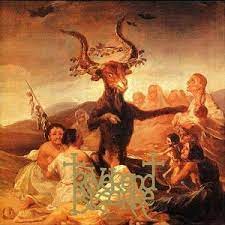
As far as I can tell, quaintly-named doom-metal outfit Reverend Bizarre are the only band on this list who no longer exist. They disbanded in 2007, having produced three albums during the noughties.  I own two of those, the excellent In the Rectory of the Reverend Bizarre (2002) and II: Crush the Insects (2005).  Sounding like  a sludgier, more primordial version of Electric Wizard, this Finnish band was notable for, among other things, its vocalist, the also quaintly-named Albert Witchfinder.  He eschewed modish doom-metal growling and shrieking and mainly just crooned forebodingly.


Wolves in the Throne Room

Their name may conjure up images of Game of Thrones, but Wolves in the Throne Room come from the relatively un-sword-and-sorcerous environs of Washington State in the northwestern USA.  One of their objectives (to quote Wikipedia again) is “channeling the ‘energies of the Pacific Northwest’s landscape’ into musical form.”  Thus, their song titles contain such words as ‘fields’, ‘fog’, ‘lightning’, ‘rain’, ‘rainbow’, ‘stars’, ‘storm’ and ‘woodland’ and their sound has been described as ‘atmospheric black metal’ or ‘ambient black metal’.  But there’s still enough ‘black metal’ present in Wolves in the Throne Room’s formula to prevent them sounding serene and bucolic.  I have three of their albums – 2006’s Diadem of 12 Stars, 2009’s Black Cascade and 2011’s Celestial Lineage – and think they’re all blisteringly brilliant.


Having finished writing this blog-entry, I now feel an urge to listen to the above nine bands’ albums again, at maximum volume.  I’ll probably be deaf afterwards, but at least then there’s no danger of me hearing the new Abba album.


© Southern Lord