The big Mc


From wikipedia.org / © Nonsenseferret


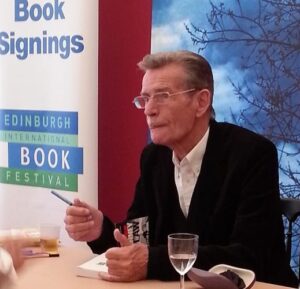
It’s exactly a decade since the Scottish writer, poet and columnist William McIlvanney passed away on December 5th, 2015.  Here’s something to mark this melancholy anniversary.


For myself and many book-lovers in Scotland in the 1980s, William McIlvanney was both a source of pride and exasperation.  Pride that modern Scottish literature was capable of producing someone as good as he was; but exasperation that the British literary establishment seemed to have little interest in him or his peers (like Alasdair Gray and James Kelman) north of the border.  On their radar, Scottish writers didn’t make much of a blip.


Back then, the clique of authors, critics and academics who, through Britain’s highbrow media outlets, decided what was fashionable were a privileged Oxford / Cambridge-educated bunch who lived in London and seemingly lived up their own arses too.  I always find it telling that in 1984, when things felt at their very worst, the Booker Prize – the flagship award for the UK literary establishment – managed to have on its short-list five books that had novelists, biographers, literary critics and literary lecturers as their main characters.  The only shortlisted book that was about people who didn’t make a living out of literature (you know, like 99.999% of the human population) was J.G. Ballard’s Empire of the Sun.  And it didn’t win, though it should have.


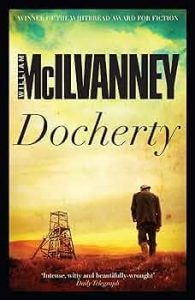
The novel that helped put McIlvanney on the map was 1975’s Docherty, which was about a tough west-of-Scotland miner and his family trying to cope with everything that the early decades of the 20th century threw at them.  Thus, McIlvanney was never going to ingratiate himself with the ‘in’ crowd by writing about writers, biographers, critics or lecturers either.


I’d read McIlvanney’s 1977 novel Laidlaw as a teenager – more about that in a minute – but it wasn’t until I was at college that one of my tutors (Isobel Murray) urged me to read a book of his that’d just been published, 1986’s The Big Man.  I’m glad I listened to her because The Big Man proved to be one of my favourite books of the 1980s.  It features another miner, called Dan Scoular.  He’s an ex-miner, actually, because this is the post-miners’-strike 1980s, Scoular has lost his job and he and his family are struggling to make ends meet.  The imposing Scoular happens to be good at fighting, though it’s a side of him that he’s suppressed for a long time.  Then he’s approached by a Glaswegian gangster who offers to pay him a small fortune if he takes part in an illegal bare-knuckle fight.  Thus, Scoular faces a dilemma – does he do something that he finds abhorrent if it saves him and his loved ones from penury?  Inevitably, after he ignores his better instincts and agrees to the proposal, he finds out that there are more complicated and even nastier things going on in the background.


© Hodder and Stoughton


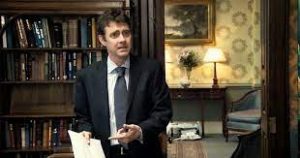
The Big Man is the most cinematic of McIlvanney’s books and it was no surprise that it was filmed, in 1990, by David Leland.  The film gets some things right.  The villains, played by Ian Bannen and Maurice Roëves, are good.  However, it gets a lot wrong, including a Hollywood-esque, feel-good ending far removed from the bleak, ambiguous note with which McIlvanney closes the book.  Another problem is that, at the time, there wasn’t a bankable-enough Scottish star for the filmmakers to cast in the role of Scoular.  So they had to search around and the next best thing they could find was a Northern Irishman, Liam Neeson.


Now I like Neeson, but every time in The Big Man that he opens his mouth and those dulcet County Antrim tones of his emerge, the sense that you’re in a hard-pressed mining town in the West of Scotland goes out of the window.  It’s a pity that the film wasn’t made during the years since, when some bankable Scottish actors have come to prominence (though it might be difficult to find one with the necessary, hulking physicality that Neeson had).  Incidentally, The Big Man – a movie about Scottish ex-mining communities and ruthless Glasgow criminals – also has Hugh Grant in its cast.  I’ll give you all a minute to pick your jaws up off the floor.


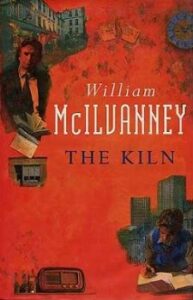
A later novel by McIlvanney, 1996’s The Kiln, received a lot of acclaim.  It even had a recommendation on its cover from Sean Connery.  I’ve just praised McIlvanney for not writing books about writers, but The Kiln actually has a writer as its central character, one in the throes of a mid-life crisis.  However, the novel is more a coming-of-age novel because its hero spends much of it looking back on his working-class youth, especially on a period he spent toiling in a local brickworks.


When The Kiln appeared, it seemed to cement – an appropriate verb for a book about bricks – McIlvanney’s status as a major figure in Scottish letters.  But it seemed the last time that he commanded such attention.  Recently, I was thinking about The Kiln and I remembered reading it while I was making a long-distance bus trip during the only occasion I was in Australia – which was in 1997, almost thirty years ago and almost twenty years before McIlvanney’s death.  What on earth happened to him after that?  I’d come across an occasional interview with him or article by him in the Scottish press, but that was about it.  In 2006 he published one more novel, Weekend, though it arrived with little fanfare – the antithesis of the reception The Kiln got a decade earlier.
 

© Hodder and Stoughton


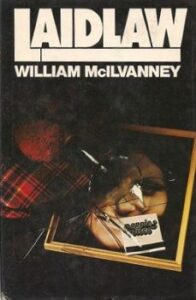
Though as far as mainstream literature was concerned McIlvanney seemed to disappear from view after The Kiln, he did in recent years win belated acknowledgement for his work as a crime writer – specifically, for his 1977 novel Laidlaw, which was republished in 2013, and its sequels The Papers of Tony Veitch (1983) and Strange Loyalties (1991).  (The latter book also serves as a grim semi-sequel to The Big Man.)  All are about a tough but intellectual and philosophical Glasgow detective called Jack Laidlaw.  Since then, crime novels set in Scotland have sold by the barrow-load and Scottish crime writers like Iain Rankin, Val McDiarmid, Denise Mina, Christopher Brookmyre and Stuart MacBride have enjoyed lucrative careers, so McIlvanney can be seen as the man who started it all.  His Jack Laidlaw was the prototype for Inspector Rebus and the rest.  In effect, McIlvanney created ‘Tartan Noir’.


Even when I read Laidlaw at a young age, I found it a bit uneven (as prototypes usually are), its prose shifting slightly uncomfortably between Glasgow-speak and Raymond Chandler-isms.  It wasn’t helped by the way it was marketed, either – “Turn down a Glaswegian when he offers you a drink,” intoned the blurb on the back, “And he’ll break your legs,” which wasn’t what the book was about.  Laidlaw focuses more on psychology than on violence, and I found it disconcerting that in its final pages the hero isn’t rushing to catch the murderer so much as he’s rushing to save the murderer from gangland-backed vigilante justice.  But all power to McIlvanney for inventing what would become Scotland’s biggest literary export.  Iain Rankin, in particular, has always admitted his debt to him.


McIlvanney was a political thinker too and during the 1990s – back in those long-ago days when Scotsman Publications produced material that was worth reading – he was a perceptive columnist in the Scotland on Sunday newspaper.  I also remember him delivering a speech in Edinburgh’s Meadows during the March for Scottish Democracy rally held on December 12th, 1992, demanding the creation of a Scottish parliament.  On stage, in front a crowd of 30,000 people, he performed far better than any of the politicians in attendance.  He memorably summed up the case for a parliament saying: “We gather here like refugees in the capital of our own country, wondering what we want to be when we grow up.  Scotland – the oldest teenager amongst nations.”


But at the same time he pleaded for racial tolerance.  “Scottishness,” he pointed out, “isn’t some pedigree lineage.  It’s a mongrel tradition.”  I suspect that with McIlvanney’s speech that day began the emphasis on ‘civic nationalism’ that Scottish nationalists – at least, the decent, mainstream ones, not the fringe, far-right heidbangers – have been at pains to cultivate ever since.


Finally, William McIlvanney played an indirect role in the start of my writing career.  My very first short story to see publication, a slice-of-life piece set on a Scottish farm with the self-explanatory title Lambing Time, appeared in a magazine called Scratchings, then produced annually by Aberdeen University’s Creative Writing Society.  Scratchings had been launched in the early 1980s with the help of a financial contribution from McIlvanney.  At the time he was Aberdeen University’s writer-in-residence and he was approached by two young students who “wanted to borrow 40 pounds to start a poetry magazine.  Would he be able to lend them the money?”  He did, Scratchings was born, and it provided a home for Lambing Time a few years later.


Incidentally, the two students who successfully tapped McIlvanney for 40 pounds were Dundonian Kenny Farquharson, now a columnist with the Times newspaper; and Invernessian Alison Smith, now better known as the novelist Ali Smith, who’s been shortlisted three times for the Booker Prize – yes, the award whose shortlist bugged me so much back in 1984.
 

© Hodder and Stoughton
Favourite Scots words, S – part 1


© Channel 4 Films / PolyGram Filmed Entertainment


Hot on the heels of my post about Robert Burns, here’s the latest in my series about favourite words in Scots, the language Burns wrote in.  Many Scots words begin with the letter ‘S’, so in this instalment I’m only going to list the first half of them.


Scaffy (n) – not, as you might expect, a scaffolder, but a streetcleaner or binman.


Scheme / Schemie (n) – a scheme is the Scottish word for a housing estate and schemie is the derogatory word for someone who lives on one.  One long-ago Saturday evening, while I was wandering around central Edinburgh, I went past a nightclub and was suddenly accosted by an upset young woman who demanded, “Dae I look like a schemie?”  Her supposed resemblance to a schemie was why the bouncer at the nightclub door had just turned her away.


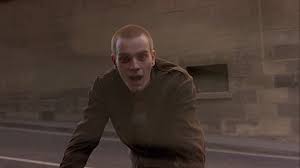
Meanwhile, a much-quoted line from Irvine Welsh’s Trainspotting (1993) comes from Mark Renton when he turns up for a job interview: “They’d rather gie a merchant school old boy with severe brain damage a job in nuclear engineering than gie a schemie wi a Ph. D. a post as a cleaner in an abattoir.”


Scooby (n), as in ‘I havenae a Scooby’ – rhyming slang for ‘clue’.  Scooby refers to Scooby Doo, the famous American TV cartoon dog who first appeared in 1969, accompanying some ‘meddling kids’, without whose investigations many, many, many criminals “would have gotten away with it.”  I’ve seen arguments online about whether this started as Scottish rhyming slang and then spread to England, or started as Cockney rhyming slang and spread to Scotland.  But I’m sure I heard it in Scotland back in the 1980s, and it was appearing in Scottish newspapers in the 1990s, so its Caledonian pedigree is pretty venerable.


Scrieve (v) – to write.  Accordingly, a scriever is a writer.  “Just been doin’ a wee bit scrievin’ you know,” says Matt Craig, the main character and aspiring scriever in Archie Hind’s Glasgow-set novel The Dear Green Place (1966), which is as good an account of the trials and tribulations facing a working-class person trying to make a name as a writer, and a living from it, as Jack London’s better-known Martin Eden (1909).


© Corgi Books


Scunnered (adj) – sickened or disgusted.  During the 1980s and 1990s, this word was commonly used in Scotland on the mornings following general elections, when it became clear that a majority of people in Scotland had voted for the Labour Party and a majority of people in the south of England had voted for Maggie Thatcher’s Conservatives.  Guess who ended up ruling Scotland each time?  For a 21st-century variation on this, see the Brexit vote.


Sharn (n) – dung.  Yes, Dungeons & Dragons enthusiasts may know Sharn as a city that ‘towers atop a cliff above the mouth of the Dagger River in southern Breland’ in the fictional world of Eberron, but in Scots sharn refers to cow-shite.  That’s a warning to fantasy creators.  When you dream up names for your fantasy characters, creatures and places, be sure to check they don’t also mean something embarrassing in Scots.  Now please excuse me while I get back to writing my latest sword-and-sorcery epic wherein Glaikit the Barbarian rescues Princess Jobbie from the clutches of the Dark Lord Pishy-Breeks in the Kingdom of Boak.


Shauckle (v) – to shuffle along, barely raising your feet off the ground.


Sheuch (n) – a channel for removing wastewater, i.e., a gutter at the side of a street or a ditch at the side of a field. In William McIlvanney’s 1975 novel Docherty, the young hero Conn gets battered by his school’s headmaster for saying to him, “Ah fell an bumped ma heid in the sheuch.”  The fact that he doesn’t use the ‘correct’ word, gutter, is seen as ‘insolence’.  Early in the 20th century, when the events of Docherty take place, Scottish schoolkids would be punished for using Scots rather than the King’s English.  The only day in the year when Scots was acceptable in schools was January 25th, Robert Buns’ birthday, when they were made to recite the poetry of their national bard.


© Canongate Books Ltd


Incidentally, in Northern Ireland, where I spent my childhood, a sheuch seemed to be only a ditch.  My dad was a farmer and once or twice I heard him cry, “There’s a cow got stuck in the sheuch!”  And the North Channel – the strip of water above the Irish Sea that separates Scotland and Northern Ireland – was called ‘the Sheuch’ and the land-masses east and west of it termed ‘baith sides o’ the Sheuch.’


Shieling (n) – a hut or shelter for animals, usually out in the wilds and / or up in the hills.


Shilpit (adj) – thin, pale and weak-looking.


Shoogly (adj) – wobbly.  To hang on a shoogly peg means to be in dodgy, precarious or dire circumstances.  Since the arrival of the ineffectual and accident-prone Humza Yousaf as First Minister of Scotland, it’s fair to say the peg the electoral fortunes of the Scottish National Party hang on has been pretty shoogly.


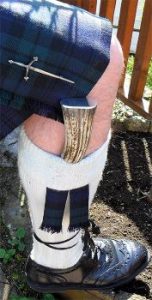
Skeandhu (n) – the Anglicised (or Scotticised) version of the Gaelic term sgian-duhb, meaning the ceremonial dagger that’s tucked behind the top of the hose in male Highland dress.  Considering the popularity of Highland dress at Scottish weddings, and the amount of alcohol consumed at them, it’s always surprised me that the country has avoided having a sky-high death-toll of wedding guests stabbed with skean-dhus in drunken altercations.


From wikipedia.org / © Stubborn Stag


Skelf (n) – a splinter.


Skelp (n / v) – to slap or a slap.  Skelps were often administered by parents and teachers to wayward kids back in the days, fondly remembered by the Daily Mail and Daily Express, when it was believed that assaulting children was good for them.


Skite (n / v) – also to strike someone or the blow thereof.  However, a skite is more likely to come from a sharp, stinging cane or stick than the open hand that delivers by a skelp.  Both are nicely onomatopoeic words, in their different ways.


Skoosh (n / v) – a squirt or spray of liquid.  A commonly heard exchange in Scottish pubs: “Dae ye want water in yer whisky?”  “Aye, but just a wee skoosh.”


Sleekit (adj) – according to the Merriam Webster dictionary, either ‘sleek’ and ‘smooth’ or ‘crafty’ and ‘deceitful’.  Presumably it was with the first meaning that this word got immortalised in a line of Robert Burns’ 1785 poem To a Mouse: “Wee, sleekit, cow’rin, tim’rous beastie…”  Nowadays, it’s used mainly with the ‘crafty’ and ‘deceitful’ application.  I can think of many politicians I’d describe as sleekit, but I won’t mention any names.


From members.parliament.uk


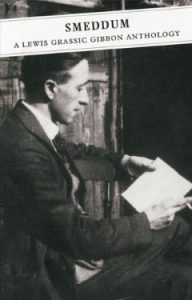
Smeddum (n) – in physical terms, a powder.  However, smeddum has also come to mean the kernel or essence of something, and presumably from that to mean its vigour, spirit, determination or grit too.  Robert Burns – him again – had the first meaning in mind when he wrote about ‘fell, red smeddum’, possibly referring to red precipitate of mercury, in his 1785 poem To a Louse.  Whereas Lewis Grassic Gibbon was thinking of smeddum’s spiritual denotation when he made it the title of his most famous short story, about a hard-working Scottish matriarch called Meg Menzies who takes no shit from anyone.  As Meg herself says: “It all depends if you’ve smeddum or not.”


Smirr (n) – a drizzly rain falling in small droplets.  This sad, ghostly word perfectly describes the sad, ghostly semi-rain that sometimes seems to envelop Scotland’s landscapes 365 days of the year.


Snaw (n) – snow.  Like snaw aff a dyke is a simile commonly used to describe something that disappears, or is disappearing, super-fast: for example, jobs for life, polar icecaps, cashiers in supermarkets, CD and DVD drives in laptops, Twitter’s credibility after Elon Musk took it over, and Liz Truss premierships.


© Canongate Books Ltd

Favourite Scots words, M-O


From wikipedia.org / Scottish National Portrait Gallery


Burns Night falls this evening, with – by my calculations – 264 years having now passed since the birth of Scotland’s greatest poet, Robert Burns.  For many decades, January 25th witnessed one of the greatest ironies in Scottish culture.  All over the country, schoolchildren would be made to memorise, then get up and recite Burns’ poems in front of their classmates and teachers.  Those poems, of course, were written in the Scots language and thus were loaded with Scots vocabulary and grammar.  However, any other day of the year, if a schoolkid had dared to speak Scots in the classroom, they’d have received a teacherly reprimand: “No, don’t speak like that.  Speak proper English…”


Actually, a famous scene in William McIlvanney’s 1975 novel Docherty, where the hero’s son gets battered by a teacher at school for daring to utter the Scots word sheuch (meaning ‘gutter’ or ‘ditch’), seems sadly credible.  At one time, speaking the language of Burns on a day that wasn’t Burns’ birthday was probably enough to get you belted in certain Scottish schools.


Anyway, here’s another slew of Scots words that I like – this time, starting with the letters ‘M’, ‘N’ and ‘O’.


Makar (n) – a poet or bard.  In 2004, the Scottish Parliament established the post of ‘Scots Makar’, i.e., a national bard or poet laureate.  Since then, the post has been occupied by Edwin Morgan, Liz Lochhead, Jackie Kay and, currently, Kathleen Jamie.


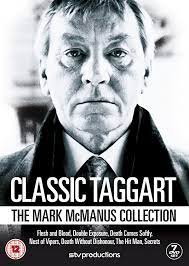
Malky (n/v) – a Glaswegian term meaning ‘a murder’ or ‘to murder’.  Research tells me that malky was originally a nickname for a razor used as a weapon, and to malky someone was to slash them with such a razor.  That said, the catchphrase of popular culture’s most famous depiction of Glaswegian crime and crime-fighting, “There’s been a murrr-der!” in the TV cop show Taggart (1983-2010), wouldn’t had the same impact if it’d been, “There’s been a malky!”


© STV Studios


Manse (n) – a manse is the house provided for a Church of Scotland minister, so basically it’s similar to a ‘rectory’ or ‘parsonage’.  Someone who grew up in a manse, because their father (or mother) was a Church of Scotland minister, is known as a son or daughter of the manse.  The Scottish Labour Party has, for some reason, given us several children of the manse, including former Prime Minister Gordon Brown, former Scottish Labour Party leader Wendy Alexander, and Wendy’s wee brother Douglas, a former cabinet minister.  Political children of the manse inevitably cite their backgrounds as evidence of their strong ‘moral compasses’, though I have to say in my time I’ve met a few inhabitants of the manse (children and parents) whose moral compasses have gone a bit wonky, usually after a few glasses of whisky.


Mawkit (adj) – extremely dirty.


Merle (n) – a blackbird.  I understand that merle is also the French word for ‘blackbird’, so presumably it’s another example of the linguistic legacy of the Auld Alliance that once existed between Scotland and France.


Messages (n) – shopping of the everyday variety, i.e., buying a few groceries rather than buying in bulk at Tesco or Sainsbury.  Hence the common expression: “I’m daein’ ma messages!”


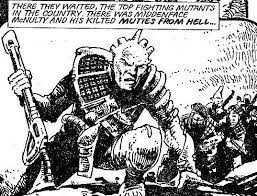
Midden (n) – a dunghill.  A word often employed by Scottish parents while they complain about the condition of their teenage kids’ bedrooms.  Also, at one point, the celebrated British sci-fi comic 2000 AD featured a character who was a Scottish bounty hunter with a gruesomely mutated visage.  His name was Middenface MacNulty.


© Rebellion Developments


Mince (n) – nonsense. Hence such exclamations as “Och, ye’re talkin’ mince!” or “Yer heid’s fu ay mince!” or “See thon new Avatar movie? It’s mince!


Ming (v) – to smell badly, with the present participle mingin’ used as adjective to mean ‘stinking’.  As a result, when I was a kid and watched the old Flash Gordon serials (1936-40) on TV, I could help wondering if the villainous Ming the Merciless was so named because of his fearsome body odour.  For a while, ming passed into popular usage all over Britain with a tweak in meaning, so that the word ‘minger’ became a common slang-term for describing someone who was ‘severely deficient in the looks department’.  But I don’t hear it used much nowadays.


Mowdie (n) – a mole.


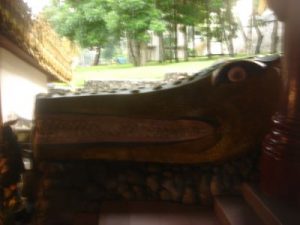
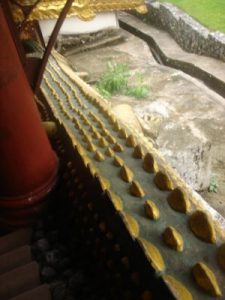
Muckle (adj) – very big.  This adjective was immortalised in the much-loved children’s poem Crocodile by J.K. Annand, which begins: “When doukin’ in the River Nile / I met a muckle crocodile. / He flicked his tail, he blinked his ee, / Syne bared his ugsome teeth at me.”


Incidentally, here’s some pictures of a muckle crocodile I once met, at the side of the stairs going up to Shwedagon Pagoda in Yangon, Myanmar.


Neb (n) – a nose, beak or projecting point.  Once upon a time, ladies of a certain age had to put up with uncomplimentary remarks about nebs whenever they played their Barry Manilow records on the household stereo.


Ned (n) – a young hooligan.  Depending on which story you believe, the word ned was derived from the term ‘never-do-well’ or was an acronym for ‘Non-Educated Delinquent’.  For a time in the early 2000s, it was ubiquitous in Scottish conversation, used as a label for any undesirable-looking youth with a penchant for wearing shell-suits, bling and Burberry-patterned caps and for swigging from bottles of Buckfast Tonic Wine.  Its popularity was no doubt increased by the neds’ sketches in the famous Scottish TV comedy show of the era, Chewin’ the Fat (1999-2005).  Indeed, ned became the north-of-the-border equivalent of the word ‘chav’, used in England to describe ‘an anti-social lower-class youth dressed in sportswear’.  Just as with ‘chav’, there were fears that ned was being used to demonise all young, working-class people. If I remember correctly, the Scottish Socialist Party MSP Rosie Kane tried to have the word banned from the Scottish parliament in 2003.


But before the controversy, I remember hearing the word ned as long ago as the early 1980s.  Folk from Glasgow I knew would use it to describe anyone who was small, mouthy and annoying.  In that way, it wasn’t much different from the abusive Scots term nyaff, which urbandictionary.com defines as “a very irritating person.  When they come into the room, you want to leave.”


© Southern Television


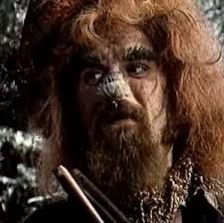
Neep (n) – a turnip.  That’s why in the 1970s kids’ TV show Wurzel Gummidge (1979-81), Billy Connolly played a turnip-headed Scottish scarecrow called ‘Bogle MacNeep’.  Turnips and potatoes together on a plate are, of course, known as neeps an’ tatties.  Meanwhile, my American partner assures me that whenever I talk about neeps an’ tatties, it sounds to her like I’m describing something extremely lewd and filthy.  Goodness!  (Or better still, jings!)


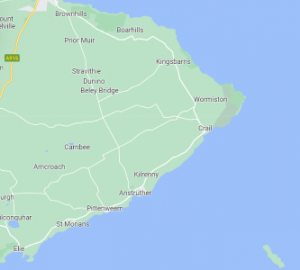
Neuk (n) – a corner, including one – i.e., a bend – in the coastline.  The most famous geographical example is East Neuk in Fife.


From maps.google.com


Nip (n) – a short, sharp measure of alcoholic spirits, often whisky, though I’ve heard people talk about ‘nips ay gin.’  I’d always assumed that, when describing a measure of whisky and the spiky, tingling effect it had when you downed it, nip was synonymous with jag.  But looking online, I’ve seen claims that it comes from the word ‘nibble’, as if a nip is just a nibble at the cake that is the full whisky bottle.  Also, I’ve seen it attributed to the archaic word ‘nipperkin’, which was ‘a unit of measurement of volume, equal to one-half of a quarter-gill, one-eighth of a gill, or one thirty-second of an English pint’.


Nippie sweetie (n) – an irritable, sharp-tongued person.  This is usually applied to the female of the species.  Disgruntled Scottish Conservatives, Liberal Democrats and Labourites frequently fling the term nippie sweetie at Scotland’s First Minister and leader of the Scottish National Party, Nicola Sturgeon.


Numpty (n) – a stupid person.  To me, though, a numpty is more than that – it’s a preposterous, pompous person who is also stupid.  In In the Loop (2009), the movie spin-off from the satirical TV show The Thick of It (2005-12), the preposterous, pompous politician played by Tom Hollander becomes a laughing stock when the wall of his constituency office endangers public safety by toppling over.  Jamie MacDonald, the ferocious Motherwell-born spin doctor played by Paul Higgins, taunts him about ‘Wallgate’ by calling him ‘Humpty Numpty’.  (To quote MacDonald in full: “If it isn’t Humpty Numpty, sitting on top of a collapsing wall like some clueless egg c*nt.”)


© BBC Films / UK Film Council / Optimum Releasing


Offski (adj) – ‘away’, ‘leaving’, ‘going’, as in the common Glaswegian phrase, “I’m offski!”


Orraman (n) – in agricultural communities, an orraman was an odd-jobbing farmhand who’d muck out sheds, dig holes, put up fences, mend drystane dykes, lug bales of hay around, drive tractors and basically do whatever needed doing at the time. Now, with farming heavily mechanised, and with one farmer on a tractor (towing the appropriate machine) capable of doing what it took half-a-dozen people to do a few decades ago, the days of the orraman are probably past.


Oxster (n) – an armpit.  Dundonian poet Matthew Fitt deployed this word when he wrote the Scots-language translation of the 2013 Asterix-the-Gaul book, Asterix and the Picts.  In the original French text, Asterix’s hulking sidekick Obelisk made a joke about ‘oysters’.  Fitt converted it into a joke about oxsters / armpits to make it more Scottish-friendly.  As you do.