From wikipedia.org / © Scottish Government
I’ve always had an unhealthy obsession with politics. Lately, however, I’ve written less about the subject on this blog because my obsession was becoming literally unhealthy – ruminating on politics and politicians in 2026 was filling my head with dark and depressing thoughts. Nonetheless, I’ll now make some comments about the election for the Scottish Parliament, which happened on May 7th. That day also saw elections for the Welsh Senedd and for various local authorities in England, but I’ll only mention those in passing.
If you’re not a political anorak, you might want to skip this.
So: the results were 58 seats for the Scottish National Party (down six from the previous election in 2021); 17 for Scottish Labour (down five); 17 for Reform UK (up 17); 15 for the Scottish Greens (up seven); 12 for the Scottish Conservative and Unionist Party (down 19); and ten for the Scottish Liberal Democrats (up six).
Despite securing six seats less than their 2021 total, and seven seats short of a parliamentary majority, the result was impressive for the SNP in that this is the fifth election in a row where they’ve ended up as the biggest, government-forming party. Keir Starmer’s Labour government at Westminster, which hasn’t been in power for two years yet and is already as popular as a fart in a spacesuit, would kill for such longevity and durability.
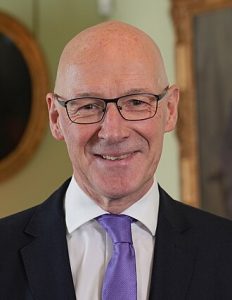
It’s also quite a comeback for SNP leader John Swinney. Originally Swinney served as SNP leader from 2000 to 2004, when his party was in opposition in the Scottish Parliament. It wasn’t a happy experience for him. In the 2003 Scottish election his party dropped from 35 to 28 seats and the following year he resigned. He later described being opposition leader as “the worst, most awful, most sapping, most soul-destroying job in politics…”
Having enjoyed spells as a cabinet minister and Deputy First Minister, Swinney was planning to retire at this year’s election. However, in May 2024, after the affable but hapless Humza Yousaf resigned as First Minister, Swinney surprised everyone by standing unopposed for – with his famous negotiating skills, he managed to sweet-talk the formidable likes of Kate Forbes into not running against him – and winning the leadership again, 20 years after losing it. And this time, he became First Minister of Scotland too. Many assumed he would act as a ‘caretaker’ FM, until someone younger and with more chutzpah came along, but thanks to this election result he’s likely to be around for a while.
While I’d never describe Swinney as someone who sets the heather alight, and if he got a fiver every time someone likened his demeanour to that of a bank manager he’d probably be a billionaire by now, I have to say I think he’s a decent guy and I’d rather have him in charge of Scotland than most other Scottish politicians. I’m biased in this regard. As I wrote on this blog before, I encountered him a couple of times during my youth, via my old schoolmate Roger Small, who was best friends with him at university, and I liked him. But it’s not just me. Most people, political friends and foes alike, seem to like Swinney.
Even the world’s most horrible man, Donald Trump, has a soft spot for him. In 2025, Trump declared, “John Swinney is a terrific guy — and loves golf and loves the people of this country, and we really appreciate it.” Yes, I know that Trump thinks Vladimir Putin, Xi Jinping and Kim Jong Un are the bees’ knees, so being liked by him isn’t necessarily a ringing endorsement of your character.
More recently, when Trump announced the removal of US tariffs on Scotch whisky, Swinney claimed this was due in part to a meeting he had with the US president last September. He was criticised for saying this by the UK government’s Secretary of State for Scotland Douglas Alexander, who argued that trade agreements weren’t in the remit of a leader of a devolved administration. But after the election result, Trump messaged, “Congratulations to John Swinney on winning his Re-Election for First Minister of Scotland. He is a good man, who worked very hard along with the King and Queen of the United Kingdom, with respect to Tariff Relief for Great Scottish Whiskey – and deserves this Big Electoral Victory!” So now, Dougie Alexander looks a bit of a chump.
Trump, being a low IQ individual, misspelt ‘Scottish whisky’ as ‘Scottish whiskey’. The stuff spelt with an ‘e’ is actually made in Ireland.
From wikipedia.org / © Scottish Parliament / youtube.com
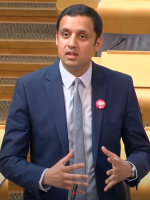
Elsewhere, Scottish Labour and the Scottish Conservatives had their worst ever performances in a Scottish parliamentary election. Labour leader Anas Sawar hit the headlines back in February when he demanded that Keir Starmer resign as British Prime Minister: “The situation in Downing Street is not good enough. There have been too many mistakes.” Sarwar’s resignation-call distanced him and his branch of the Labour party from the wildly unpopular Starmer and it generated a lot of publicity at the time. But when Starmer said no, he wouldn’t be resigning, it looked less like a political earthquake and more like a mild political bowel-movement. It highlighted Sarwar’s place as Scottish party leader in the great scheme of things – not high. It also meant Starmer was embarrassingly conspicuous by his absence in Scotland when Labour started campaigning for the election there.
The Scottish Tories have been reduced to a rump, their number of Members of the Scottish Parliament (MSPs) barely in double figures. Their leader Russell Findlay has tried to talk them up in the Tory-friendly pages of the Scottish Daily Mail, describing them as the ‘Dynamic Dozen’. I wouldn’t describe any dozen that includes such numpties as Murdo Fraser, the man who once asked Donald Trump if he’d consider buying Glasgow Rangers Football Club, as ‘dynamic’. Maybe ‘dysfunctional’ or ‘dystopian’.
Following a near-extinction event caused by their coalition with the Conservatives in Westminster in the early 2010s, the Liberal Democrats have enjoyed something of a revival. The passing of time has clearly detoxified their reputation a little in folk’s memories. That said, I don’t know how anyone can stomach their Scottish leader Alexander Cole-Hamilton, who to me comes across as being insufferably arrogant.
And the Scottish Greens have almost doubled their representation in the parliament. Without wishing to downplay this achievement, I suspect they enjoyed the best of both worlds in relation to the English and Welsh Greens – a separate party – south of the border. They benefited from the wave of enthusiasm, and publicity, that their southern counterparts experienced earlier this year. Simultaneously, as a separate party, they were distant enough from them to escape the more recent backlash against the English / Welsh party’s leader Zack Polanski, who stupidly retweeted something about the attack on two Jewish men in Golders Green and then suffered an all-out assault from the right-wing media determined to portray him as an antisemite. (This despite Polanski being Jewish himself and despite some of the media’s caricatures of him being… hideously antisemitic.)
The Scottish Greens are co-led by Gillian Mackay and the chirpy Ross Greer. I know Greer is a ‘Marmite’ politician for many, but I like how he puts the wind up gammons like Piers Morgan.
From youtube.com / © ITV
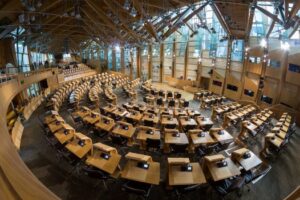
With the SNP on 58 MSPs, and the pro-Scottish-independence Greens on 15, 73 MSPs now support Scotland leaving the United Kingdom, as opposed to 56 unionist MSPs who don’t. It’s the parliament’s biggest ever pro-independence majority. Of course, you won’t have heard much about that fact from Scotland’s (unionist-owned) mainstream media, who instead have obsessed on a different fact – that the parliament suddenly has 17 far-right Reform MPs. Nigel Farage’s extremist party had representation there before, thanks to one MSP defecting to them from the Conservatives. But today, with Labour, they’re the joint-second biggest party.
This has prompted journalists like the Times’s Kenny Farquharson to declare ‘the death of Scottish exceptionalism’ – Scottish exceptionalism being the idea that Scottish voters are more community-orientated, more considerate of their fellow citizens, more leftwing and, generally, nicer than voters than those elsewhere in the UK, especially in England. Reform’s showing proves that, no, the Scots are just as right-wing and awful as everyone else.
Well, I find it nauseating that the parliament contains 17 MSPs who, if their party ever came to power, would enact Trump-style authoritarian and racist policies. One of them, Senga Beresford, representing the South Scotland region, has already caused controversy by expressing admiration for fascist lout Stephen Yaxley-Lennon on social media. But I derive some comfort from the fact that none of those MSPs were elected through the parliament’s first-past-the-post, constituency-based voting system, responsible for deciding 73 of the 129 MSPs. Reform’s 17 sneaked in afterwards, via the additional, regional-based ‘list’ system. Also, the Conservatives won 31 seats at the previous election, but have been culled to 12, and that number plus Reform’s 17 puts the total number of right-wingers at 29 – two less than before.
I certainly don’t see Scotland as being exceptional, i.e., better than anywhere else. I’ve met plenty of Scots who’ve been arseholes as much as arsehole-y people from other places. But Scotland is still different from other parts of the UK. If it wasn’t different, it wouldn’t have its own languages, literature, music, sports teams, legal system, educational system, etc. It wouldn’t have been scunnered by Margaret Thatcher in the 1980s while people elsewhere were proclaiming her the new, handbag-wielding messiah. It wouldn’t have voted heavily against Brexit when people in England and Wales voted for it. It wouldn’t have its own independence movement with, now, a 57% majority in the Scottish parliament. I know that sticks in the craws of unionist politicians and journalists who’d have you believe that Scotland is absolutely indistinguishable from the rest of the UK, that a punter from Elgin is identical to a punter from Ely.
Talking of journalists, the coverage of the election in the Scottish mainstream media was woeful. The unionist newspapers (i.e., nearly all of them) spent half the time wailing “Everything in Scotland is shite!” and the other half wailing, “How dare anyone suggest doing anything even vaguely radical to improve things!” Swinney’s proposal that, in an emergency, the Scottish government should put a cap on the price of essential food products so that poor people could still buy them, was met with hoots of derision – and the sneering observation that the UK government would never allow it. (A Labour government – “For the many, not the few” – denying someone the right to keep essential foodstuffs affordable for the nation’s poorest people? Not a great look.)
I thought the recent opinion-piece by Scottish journalist Stephen Daisley in the Spectator, calling on the Labour and Conservative parties to get rid of the UK’s devolved parliaments (“Dr. Frankenstein would understand that it was his duty to put down the hideous creature his foolishness and vanity unleashed on the world”), was bad enough. But the articles that his fellow Scottish journo Chris Deerin penned about Scottish Reform leader Malcolm Offord, for the supposedly left-wing New Statesman, went to arse-licking extremes where no article has gone before.
And now, with Plaid Cymru’s Rhun ap Iorwerth the First Minister in Cardiff, and Sinn Fein’s Michelle O’Neill the First Minister in Belfast, all three devolved governments in the United Kingdom are helmed by people who see their nations’ futures as being outside that supposedly united kingdom. Interesting times indeed…
But you won’t ever read about that in the newspapers.
From wikipedia.org / © User Colin