Happy World Goth Day 2026


From youtube.com© South Park Studios


I know time seems to speed up as you grow older, but it still feels weird to me that we’re not only into another year, 2026, but we’re already nearing its halfway point.  In fact, today, we’ve reached May 22nd.  And rolling around again – again? – is World Goth Day.


According to its Wikipedia entry, May 22nd became the annual day of celebration for the world’s darkest-clad, whitest-eyelinered, most sunlight-shunning musical sub-culture when “UK-based goth DJ Lee Meadows, aka DJ Cruel Britannia (currently known as BatBoy Slim), wrote a MySpace blog suggesting the idea of initiating a ‘Goth Day’ to a very positive reception.  In 2010, he and London-based DJ Martin Oldgoth decided to make the concept global, both ‘as a bit of fun’ and to create an environment of positivity and unity within the goth community.”
 

From worldgothday.com / © BatBoy Slim


As is customary on this blog, I’ll mark the occasion by providing links to a dozen of my favourite Goth songs on YouTube.  As ever, I apologise if you first have to endure some annoying corporate and insipid YouTube advertisements, packed with AI-generated visual crap, which are the antithesis of the mystical, elegiac and tenebrous aesthetic of Goth culture.


To get the ball rolling, here’s Wytches Chant ’98 by English Goth band Inkubus Sukkubus, whom noted punk / Goth journalist Mick Mercer described as ‘a zombie version of Fleetwood Mac.’  (Many would argue that the real Fleetwood Mac have been fairly zombified for the past few decades anyway.)  So, let’s raise our voices and sing along to that Wytches Chant ‘98: “Isis, Astarte, Diana, Hecate, Demeter, Kali, Inanna…”


A while ago I was looking at an online list of ‘underrated Goth bands’ and discovered Container 47 and their song Razor End Falling.  The band don’t have a Wikipedia page and all I know about them is that they’re from Italy and have been on the go since the early 2000s.  This song, to me at least, is agreeably heavy.


On the same ‘underrated Goth bands’ list, I noticed the name the Rose of Avalanche.  Wow, I thought – I hadn’t heard of them since they supported the Mission at a gig in Aberdeen in the mid-1980s.  They originally broke up in 1993 but, following a 26-year hiatus, reformed in 2019.  I found their 1985 single LA Rain enjoyably audacious – it takes the sound, ambience and languid pace of a typical Lou Reed / Velvet Underground song and drenches it in a shimmery, Gothy 1980s guitar-sound.  Though some people may not feel the same way about it.
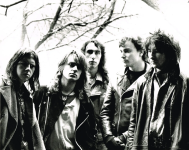
 

From roseofavalanche.com / © The Rose of Avalanche


Here’s some more rain, served up by the Swedish Goth band Miazma (which, from soon after its inception in the late 1990s, has apparently consisted of just one musician, Kristian Olofsson).  It’s called Black Rain.  Including this song on the list saves me having to include anything by the seminal Goth outfit the Sisters of Mercy because, frankly, Miazma sounds uncannily like the Sisters of Mercy, down to Olofsson’s vocals, which reproduce the nonchalant gruffness of the Sisters’ frontman, Andrew Eldritch.  On the other hand, a band whom this Miazma shouldn’t be confused with is another band called Miazma, which is actually a death metal one from Australia’s Alice Springs.


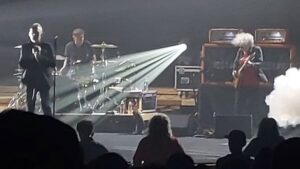
And yet more rain…  If Scottish alternative-rock brothers Jim and William Reid, aka the mighty Jesus and Mary Chain, knew I’d included one of their songs in a list of Goth tunes, I suspect they’d come round to my house and murder me – using hammers.  Well, tough luck, guys – I am including you.  I saw the Jesus and Mary Chain perform in Singapore last month and the gig, at the city-state’s Esplanade Theatre, attracted a fair number of Singaporean Goths.  And I think their song Nine Million Rainy Days, from the aptly titled 1987 album Darklands, is dripping with Gothic doom, gloom and darkness, as evidenced by the lyrics, “As far as I can tell / I’m being dragged from here to hell / All my time in hell was spent with you…”


Halfway through, however, Nine Million Rainy Days veers off in an unexpected direction when it borrows the famous ‘woo-woo’ backing vocals that grace the Rolling Stones’ Sympathy for the Devil (1969), though here they mutate into ‘woo-woo, woo-woo, woo!’


Talking of the Rolling Stones, eyebrows were recently raised when Mick, Keef and Ronnie announced that Robert Smith of the legendary Goth band the Cure would be contributing to their next album.  The Stones’ straight-up, unpretentious, bluesy, rock ‘n’ roll swagger seems light-years removed from the Cure’s meticulous, brooding atmospherics, so I don’t know how that’ll work out.  Meanwhile, the Cure and possibly their greatest album, 1989’s Disintegration, have been on my mind lately because my lovely mother-in-law gave me a Cure / Disintegration T-shirt as a present for my last birthday.  So, from that album, here’s the song Lullaby.  The link takes you to the song’s memorable video, where Smith, in pyjamas, sings worriedly about “Mr Spider-man” having him “for dinner tonight.”
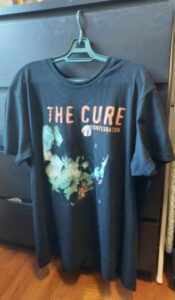


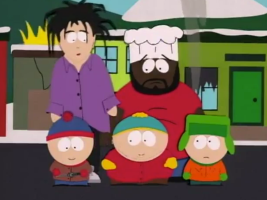
In fact, Disintegration is such a masterpiece I could have included any song off it: Fascination Street, Plainsong, Pictures of You, etc.  No wonder that in a 1998 episode of South Park, Kyle Broflovski shouts at Robert Smith, “Disintegration is the best album ever!”  (Admittedly, he was rather excitable by that point.  His town had been pulverised by Barbra Streisand, who’d transformed into a giant, robot-kaiju called Mecha-Streisand, and Robert Smith had saved the day by transforming into a giant moth and hurling her into outer space: “I have to try,” sighed the Cure’s front-man. “I can’t let Barbra Streisand do this to the entire world.”)


And now for a younger band.  Boy Harsher are a darkwave duo consisting of singer Jae Matthews and producer Augustus Muller, who hail from the American state of Georgia.  They cite among their influences the late, visionary filmmaker David Lynch, though with the next track on my list, a remastered version of Boy Harsher’s 2014 single Pain, I get more of a vibe of the synth tracks John Carpenter devised for the soundtracks of his 1970s and 1980s movies.  That’s initially at least, before Pain’s propulsive beat carries all before it.


Actually, Pain features in a movie itself.  It can be heard during a party scene in the 2022 horror film Terrifier 2.  I haven’t seen it, but I think that’s the one where the villain (Art the Clown) flays a victim and then rubs salt into the wound by, er, rubbing salt into the victim’s catastrophic wounds.  So, having a song called Pain in the film was appropriate.
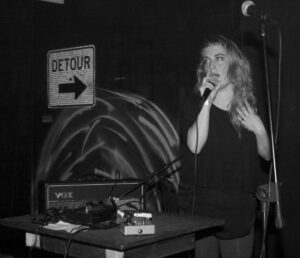
 

From wikipedia.org / © GRIT PHOTOZINE


In fact, Pain got a remix in 2018 courtesy of the American musician and producer Luis Vasquez who from 2009 was also the single, official member of the band the Soft Moon.  Fittingly, an influence on the Soft Moon’s sound was the celebrated industrial / electronic rock band Nine Inch Nails, itself a one-man-band for the musician and producer Trent Reznor.  (More on Nine Inch Nails later.)  The next item on the list is one of my favourite Soft Moon songs, Become the Lies, from the band’s final album, Exister (2022).  I have to write about Luis Vasquez and the Soft Moon in the past tense because, tragically, Vasquez died in 2024 aged just 44.


Another musician specialising in dark electronica who left us much too soon was Frank Tovey, who as Fad Gadget at the very end of the 1970s and in the early 1980s helped pioneer both the synth-pop and darker Goth sounds that became popular soon after.  Alas, a heart attack claimed Tovey / Gadget at the age of 45 in 2002.  Here’s his first and possibly most famous single, Back to Nature, from 1979.


Fad Gadget has been credited as a big influence on Depeche Mode, though beyond the use of newly affordable musical technology, like synthesisers, I personally can’t see much connection between the ruminative likes of Back to Nature and Depeche Mode’s early, chirpy (and for me, annoying) hits like New Life and Just Can’t Get Enough (both 1981).  Despite being irritated by the early ‘Mode’, I’ve gradually grown to love them as, in their later incarnations, they’ve shifted away from a poppy, kid-friendly synth sound and embraced a darker, harsher, more industrial and Gothic one.


Here’s the stomping Barrel of a Gun, the first single off Depeche Mode’s 1997 album Ultra.  The accompanying video shows how far they’d progressed by then from their early-1980s clean-cut-boys-with-synthesisers phase – this is grungy, decadent, Anton Corbijn-directed artiness.  At least, it is until Dave Gahan starts wandering around in a silly coat covered in Christmas-tree lights.
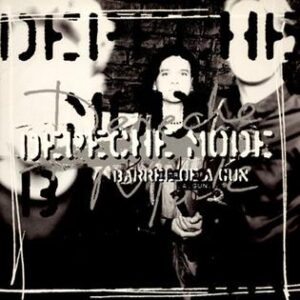
 

From wikipedia.org / © Mute Records


Here’s something else that’s silly, this time involving America’s awesomely dark and bleak industrial-rock juggernaut Nine Inch Nails (which is basically musician / vocalist / producer Trent Reznor and whoever happens to be in the studio with him at the time).  No, I’m not saying Nine Inch Nails are silly.  But some years ago, they were the subject of a celebrated musical / video ‘mashup’ whereby editor and content creator Garren Lazar married the band’s disturbing song Closer, from the 1994 album The Downward Spiral, onto clips taken from the beloved children’s TV programme The Muppet Show (1976-81).  Hence, the song’s opening drumbeat is performed in the video by Animal, the drummer in the Muppets’ house band, Dr Teeth and the Electric Mayhem.  (Thankfully, Animal doesn’t feature when Reznor sings Closer’s most notorious lyric, “I want to f**k you like an animal.”)


Watching Kermit, Gonzo, Miss Piggy and the rest cavort to this song is a reminder that, loveable though the Muppets are, if you first encountered them at a very young age you might have found them a bit sinister.  For example, the stuff in the video involving a frenetically speeded-up Dr Teeth is downright freaky.  Also featured are some of the human guests who appeared on The Muppet Show, such as Alice Cooper, Cloris Leachman, Rita Moreno, Harry Belafonte and Dudley Moore – Moore’s cameo is particularly worth waiting for.


However, should anyone be upset at me linking to a comical Nine Inch Nails / Muppets mashup, I’ll throw in a bonus link – to a more sombre and majestic mashup where Rory Gamble transposes Nine Inch Nails’ The Day the World Went Away (from 1999’s The Fragile) onto the trailer for Mad Max: Fury Road – Black & Chrome.  Both sonically and visually, it’s a work of genius.  You’ll punch the air when, one minute and ten seconds in, things get cranked up to 11.


Eat Your Makeup is the name of a short film made by American’s God-Emperor of Bad Taste, John Waters, back in 1968.  However, Eat Your Make Up – note the slight difference in the wording – is also the name of a French Goth band and here, to round things off, is their 2005 song I was the Murderer.  It’s a pleasant reminder that at least some of Goth’s musical roots lie in punk rock.
 

© Adipocere Records
Films I’d like to see remade (Part 1)


From imdb.com / © Rank Organisation


I still find it disconcerting when films I enjoyed in my youth are remade in the 21st century: for example, 1980’s The Fog (remade in 2005), 1981’s The Evil Dead (remade in 2013) and Clash of the Titans (remade in 2010), 1986’s The Hitcher (remade in 2007), 1987’s Robocop (remade in 2014) and 1988’s Hairspray (remade in 2007).  My immediate and automatic response to such remakes is, “What, they’re remaking that movie already?  Have you no shame, Hollywood?”


This is followed by a feeling of horror as I realise just how long ago it was when those original movies were released.  The first Evil Dead movie was 32 years old – 32 years! – when its remake surfaced, though in my mind it was only yesterday when Sam Raimi’s Deadites made their first-ever appearance and started making life difficult for Bruce Campbell.   And actually, three of the films I remember most fondly from my youth, Philip Kaufman’s Invasion of the Body Snatchers (1978), John Carpenter’s The Thing (1982) and Brian De Palma’s Scarface (1983) were remakes themselves.  Body Snatchers appeared just 22 years after the 1956 original and The Thing appeared 32 years after its 1950 one.  Scarface was an outlier, since the first Scarface came out in 1932, more than a half-century earlier.


Maybe I shouldn’t be so concerned about how soon after the original movie that a remake appears.  I should be concerned about the quality of it – for remakes tend to be shite.  I haven’t seen all those mentioned at the beginning of this entry, but the ones I have seen have been nowhere near as good as the originals.  (The Evil Dead remake probably comes closest, but I still much prefer the ramshackle and low-budget, but resourceful, charm of Raimi’s 1981 film.)  That said, remakes don’t have to be bad all the time – the aforementioned ones by Kaufman, Carpenter and De Palma testify to that.


So, without further ado, here are some films – and one series of films – I wouldn’t mind seeing remade in the 21st century, with bigger budgets and better special effects.  But remade decently.


From wikipedia.org / © Rank Organisation


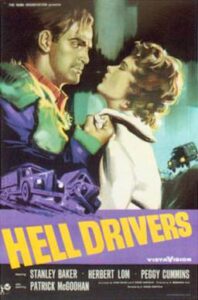
Hell Drivers (1957)

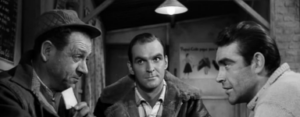
Blacklisted by the House Committee on Un-American Activities in 1951, American director Cy Endfield moved to Britain where, half-a-dozen years later, he made Hell Drivers.  Given the persecution Endfield had suffered, it unsurprisingly takes a dim view of American-style, cut-throat capitalism.  It has that underrated but magnificent actor Stanley Baker as an ex-con who finds a job as a truck driver with a dodgy haulage company, which threatens its drivers with the sack if they don’t deliver loads of gravel across treacherous roads at breakneck speeds.  The reason there aren’t more drivers employed to relieve the pressure, and reduce the danger, is because of a scam involving the local depot manager (William Hartnell) and its off-his-head Irish foreman (Patrick McGoohan, coming across like a brawnier version of Shane MacGowan).  The latter soon becomes Baker’s nemesis.


As well as a political message, Endfield injects Hell Drivers with an American-style grittiness rarely seen in British films of the period.  But what really makes the film a joy to watch nowadays is the cast.  As Kim Newman has written of it in Empire Magazine, “how many other movies have an ensemble which includes the original Dr Who (Hartnell), the first James Bond (Sean Connery), the Prisoner (McGoohan), a Man From UNCLE (David McCallum), a Professional (Gordon Jackson), Clouseau’s boss (Herbert Lom), plus Alfie Bass, the excellent Peggy Cummins (of the cult items Gun Crazy and Night of the Demon), the inimitably boozy Wilfrid Lawson, Jill Ireland and Sid James?”


In 2026, with capitalism more cut-throat than ever, a remake of Hell Drivers would be timely.  I don’t think, though, setting it in the wilds of Middlesex, West Sussex and Buckinghamshire, where the original was filmed, would work now, so it’d have to have its hard-pressed truck drivers pounding the roads of a less hospitable locale – the Alaskan tundra, say, or somewhere that retains some near-impenetrable tropical rainforest.


And to pay proper homage to the original, you’d definitely need a cast made up of actors who’ve played iconic roles in iconic TV shows or movie series.  You could have one of the grittier Bonds (Daniel Craig or Timothy Dalton), one of the grittier Doctors Who (Christopher Eccleston or Peter Capaldi), plus a Sherlock Holmes (Benedict Cumberbatch, maybe), a Harry Potter (Daniel Radcliffe), perhaps someone from the Breaking Bad universe (Bryan Cranston, say, or Bob Odenkirk)…  The possibilities are endless.


From wikipedia.org


The Margaret Rutherford Miss Marple movies (1961-64)

This is a little different.  I’d like to see the four movies made about Agatha Christie’s genteel sleuth of a certain age, Miss Marple, which had the delightful Margaret Rutherford in the leading role – Murder She Said (1961), Murder at the Gallop (1963), Murder Most Foul (1964) and Murder Ahoy! (1964) – rebooted as a TV show.  Not just another show about Miss Marple per se – there have been ones with Joan Hickson, Geraldine McEwan and Julia McKenzie – but one set in the universe of the four Rutherford movies.


Thus, its episodes would be set against the tableau of early-1960s England, with Miss Marple depicted as an obstinate, feisty old lady who refuses to know her place and keeps barging into and solving mysteries.  There’d be as much as humour as tension and the show would have the films’ supporting characters, like the timid librarian Mr Stringer (Rutherford’s real-life husband Stringer Davis), who reluctantly helps Miss Marple out, and the exasperated copper Inspector Craddock (Charles Tingwell), who begins each instalment telling her to mind her own business but ends it taking orders from her.  Meanwhile, Ron Goodwin’s jaunty Miss Marple Theme would burble in the background.


I suspect in a 2026 version Mark Gatiss would make a lovely Mr Stringer, while Daniel Mays would nicely fill the shoes of the long-suffering Inspector Craddock.  But who would play Miss Marple – or more precisely, play Margaret Rutherford playing Miss Marple?  Perhaps Dawn French, though she’d have to spend a long time in the make-up chair to recreate Rutherford’s famously jowly, hangdog features.


In the original movies, each murder that Rutherford / Marple investigated involved a British institution – a country manor, horse riding, the theatre and the Navy.  She’d duly rattle establishment cages by sticking her nose in where it wasn’t welcome.  So perhaps each episode of this hypothetical series would have her ruffling the feathers of other British institutions of the time – the Army, the House of Lords, Savile Row, Crufts, the country’s nascent rock ‘n’ roll industry…  Miss Marple meets the young Rolling Stones?  I’d pay good money to see that.


From wikipedia.org / © 20th Century Fox


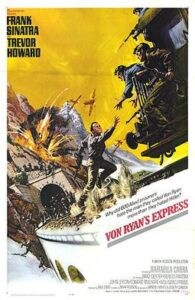
Von Ryan’s Express (1965)

I never had much time for Frank Sinatra, neither as an entertainer nor as a person, but he left an impression on my 10-year-old self the first time I saw the ripping World War II yarn Von Ryan’s Express.  It’s the story of an American airman, Ryan (Sinatra), downed in Italy, who joins forces with some Allied prisoners of war, led by Trevor Howard.  They attempt an audacious escape into neutral Switzerland by seizing control of a train and steering it up a railway line into the Alps.  Much derring-do is involved as German troops and aircraft go all-out to stop them reaching their destination.


It’s great, crowd-pleasing stuff until the ending – spoilers are coming! – which is depicted on the movie poster, painted by the great Frank McCarthy.  The train has almost made it to safety.  Having fought a rearguard action against the Germans, Sinatra is running after the train and has almost caught up with it.  But then….  What happened next put a dampener on things.  But it also lodged the film in my mind forever.


With 2009’s Inglourious Basterds, Quentin Tarantino showed his love for rip-roaring if cheesily improbable World War II adventures, so perhaps he could helm a remake of Von Ryan’s Express?  To stick to the innocent, uncomplicated spirit of the original, though, he’d have to forgo his use of the F-word and N-word, and his fetish for close-ups of ladies’ feet, and his nerdish references to ‘film-study criticism of the work of German director G.W. Pabst’.


© Hammer Film Productions / Seven Arts Productions


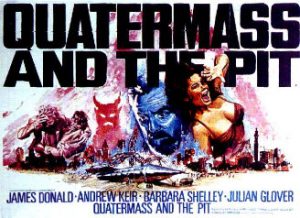
Quatermass and the Pit (1967)

Hammer Films’ sci-fi horror film Quatermass and the Pit was based on the 1958 BBC TV serial of the same name.  Both film and serial were written by Nigel Kneale.  It begins with workers on a London Underground extension project digging up an alien spacecraft full of dead, horned, insect-like creatures that are identified by scientist-hero Professor Bernard Quatermass (Andrew Keir) as inhabitants of the now-lifeless planet Mars.  It transpires that millions of years ago, these sneaky Martians arrived on earth and did some evolutionary tinkering on the apes who were the ancestors of modern humanity.  This tinkering included implanting in the apes an urge to conduct occasional culls whereby those with pure Martian programming exterminated those who’d developed mutations and lost that programming.


When some TV news crews descend on the scene, a power surge from their camera-cables reactivates the spacecraft and it triggers a new cull.  London becomes an apocalyptic hellscape where the human inhabitants who retain their Martian conditioning roam around, zombie-like, and use newly awoken telekinetic powers to kill everyone who’s lost it.


I still find Quatermass and the Pit impressive today, and scary, though inevitably there are special effects that reflect the limitations of Hammer’s budget.  I’d relish the prospect of a modern, big-budget retelling of the story.


One thing that makes the film effective, and affecting, is Kneale’s portrayal of the scientists.  Unlike usual movie-scientists, they aren’t cold-blooded, delusional, self-serving or plain weird.  Instead, Quatermass and his colleagues, Dr Roney (James Donald) and Barbara Judd (Barbara Shelley), are portrayed as decent human beings, working with an eager curiosity, a sense of duty and a sense of humour.  Keir and Donald were both Scots, so maybe a modern movie could cast Brian Cox as Quatermass and James McAvoy as Dr Roney.  Actually, I think a third Scottish actor, Karen Gillan, would be excellent as Barbara Judd.


To be continued…


© Metro-Goldwyn-Mayer

Back with the Chain gang


I once wrote on this blog that the Jesus and Mary Chain, the Scottish alternative rock band whose core members are brothers Jim and William Reid, was “on at least three days of the week… my favourite band of all time.”  Incidentally, I’d say on the other four days of the week my favourite all-time band is the Rolling Stones between 1969 and 1974, when Mick Taylor played with them.


However, when I heard that the Jesus and Mary Chain intended to perform in Singapore, my current abode, in the middle of this month, I felt a little apprehensive.  For one thing, though I often cite the first time I saw the band live – at London’s Brixton Academy in 1992, while they headlined the Rollercoaster tour and the support bands were American alternative rockers Dinosaur Jr, swirly shoegazers My Bloody Valentine, and a young, up-and-coming band called Blur (whatever happened to them?) – as one of the best gigs, if not the best gig I’ve ever attended, the last time I saw them was a different affair.   That was in Edinburgh in 1998, when relations between Jim and William had decayed so badly they spent the show telling each other to shut up.  It presaged a disastrous performance soon after at the Los Angeles venue House of Blues, where Jim turned up drunk and William stormed offstage.  To no one’s great surprise, the following year they announced the band had split up – though they reformed in 2007.


Would 2025’s Singapore gig be closer in spirit to the 1992 one or the 1998 one?


Also, last year, they released a new album called Glasgow Eyes whose sound was something of a departure.  Though simultaneously dreamy and scuzzy in the best Jesus and Mary Chain tradition, a strong dose of electronica infused it.  I assumed their 2025 set would contain a good number of songs from Glasgow Eyes, which was fine, but it’d mean a lot of the music wouldn’t be what I immediately associated with the Jesus and Mary Chain.


There was the age issue too. With Jim and William Reid now 64 and 67 years old respectively, I wondered how kind time had been to their performing abilities.  After all, I hadn’t seen these guys sing and play onstage for nearly 30 years.  30 years – wow!


And lastly, it just seemed weird that the Jesus and Mary Chain was playing in a famously sensible, serious and clean-living place like Singapore.  After all, this is a band that initially made its name with chaos and disreputability.  When the Reids first performed in 1983, they generated controversy with their habit of delivering gigs just 15 minutes long, with their backs to the audience and their sound cloaked in squalls of feedback, which went down so badly with the punters that – according to the British tabloid press – ‘riots’ ensued.  And their Singaporean show was scheduled for the Esplanade Concert Hall, a venue whose floorspace is entirely covered in seating.  I honestly couldn’t imagine a Jesus and Mary Chain gig where everyone had to sit.


Thus, as I entered the Esplanade Concert Hall on the evening of the show, I had plenty of concerns.  But I needn’t have worried.  This was a great concert.


Before things kicked off, I ordered a few beers at a bar just outside the auditorium’s entrance and sipped them whilst taking in the appearances of my fellow concert-goers.  It genuinely surprised me how many Singaporeans had come tonight.  They consisted mainly of young goths or middle-aged folk who looked like they’d been art-college students in an earlier era.  There was a lengthy queue, mainly of Singaporeans, to buy T-shirts.  An especially popular purchase was a T-shirt featuring the cover of the Jesus and Mary Chain’s 1985 debut album, Psychocandy, which depicted Jim and William in their svelte youth.


© Blanco y Negro


(Among the non-Jesus and Mary Chain T-shirts I observed folk wearing were, not unexpectedly, ones bearing the names of the Cure and the Cocteau Twins…  And, in one case, of Radio Clyde, which was unexpected.)


But there were Westerners around too. Whilst queuing for a beer, I got chatting to an English fellow who was wearing a T-shirt featuring the title of Blur’s 1993 album Modern Life is Rubbish.  “I actually saw Blur supporting the Jesus and Mary Chain,” I said, “back before they were famous.”


He replied, “That would have been the Rollercoaster tour.  I saw it in Birmingham.”  He added wistfully, “Don’t remember much about it, though.”


I should have come back with the obvious quip, “Yes, it was all a bit of a blur!”  But, alas, I wasn’t as quick-thinking as that.


Just before eight o’clock, the gig’s start-time, everyone made their way into the auditorium.  However, when the lights dimmed, it wasn’t for the Jesus and Mary Chain’s set but for that of a support act, the Singaporean singer-songwriter Shye.  Although Shye’s Wikipedia page describes the musical genres she works in as ‘folk-rock, neo-soul, electronic, R&B’, what she and her backing band served up tonight sounded pretty shoegazer-ish to me – not too far removed from the songs at the mellower end of the Jesus and Mary Chain’s repertoire.  Her performance went down well.


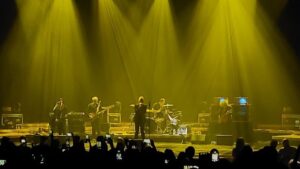
Then the main attraction appeared.  The moment the band – Jim, William, guitarist Scott Von Ryper, bassist Mark Crozer and drummer Justin Welch – came onstage and immediately tore into Jamcod, the most blistering track on Glasgow Eyes, the crowd rose to their feet as one and stayed on their feet for the entire 19-song set.  And I knew at once from the band’s poise and confidence, and the audience’s euphoric reaction to them, that everything about this show was going to be right.


Every phase in the Jesus and Mary Chain’s career was acknowledged tonight, with material played from all eight of the band’s studio albums – plus the 1986 Some Candy Talking EP, unsurprisingly represented by the song Some Candy Talking, whose ambiguous lyrics so upset the late disc jockey Mike Smith that he blacklisted it on the BBC’s Radio One.  As it turned out, four songs were performed from Glasgow Eyes: besides Jamcod, the lowkey Chemical Animal, the lumbering Poor Pure and the jaunty Venal Joy.  These actually fitted in seamlessly with the rest of the set.


I was delighted that the band played three songs from my favourite Jesus and Mary Chain album, 1989’s Automatic: Between Planets, Halfway to Crazy and Head On.  I always felt Automatic got a bad rap from the critics and was sorely underrated.  Also well-represented was 1987’s Darklands, whose brooding numbers added both melody and melancholy to proceedings and balanced the set’s more abrasive parts: the album’s title track, Happy When It Rains and, appropriately, April Skies.  (Well, the show was taking place under the April skies of Singapore.)  And for fans who’d been with the band from the very beginning, three numbers were aired from Psychocandy: In a Hole, Taste of Cindy and Just Like Honey.


On the original Just Like Honey, the female backing vocals were provided by Karen Parker, the then-girlfriend of then-Jesus and Mary Chain drummer Bobby Gillespie (who, of course, would go on to front Primal Scream).  So versatile was Ms. Parker that on one occasion she stepped in and played drums at one of their gigs after Gillespie had hurt his hand.  Also, Scarlett Johannson did those vocal duties when the band played Just Like Honey during their first performance after reforming in 2007.  Tonight, Jim Reid invited Shye, the support act, onstage again to sing it with him.  She also co-sang Sometimes Always from 1994’s Stoned & Dethroned – stepping into the shoes of Mazzy Star’s Hope Sandoval, who’d shared the vocals on the original recording.  Shye acquitted herself beautifully.


I doubt if many people would rate 1998’s Munki or 2017’s Damage and Joy as the best-ever Jesus and Mary Chain albums, but I had absolutely no problem with the songs played from them tonight: Cracking Up and I Hate Rock ‘n’ Roll off the former and All Things Pass off the latter.  Everything, in fact, was performed with great aplomb.  As frontman, Jim Reid kept the talk between songs to a minimum and just got on with delivering the goods, i.e., singing.  At the end of the main set, though, he did comment drily, “We have to go now… But if you make some noise, we might come back.”


My only regrets about the evening were a few songs I’d have liked them to play, but they didn’t.  These included Blues from a Gun and UV Ray from Automatic, and Nine Million Rainy Days from Darklands.  I would also have enjoyed hearing something off their two compilations of singles, B-sides and rarities, 1988’s Barbed Wire Kisses, (for example, Sidewalking) and 1993’s The Sound of Speed (for example, Heat and their cover of the 13th Floor Elevators’ Reverberation).  And I’d have loved to hear more from their excellent 1992 album Honey’s Dead, though the song they did play from it, Reverence, at the end of the encore brought proceedings to a stupendous close.  None of this, of course, was the band’s fault.  It’s a testimony to the greatness of their back catalogue that they could never cram everything you wanted to hear into a single set.


When I left the Esplanade Concert Hall and stepped out into the Singaporean night, I felt quite a buzz, to say the least.  In fact, I felt 30 years younger.


Temporarily, anyway.


Cinematically stoned (Part 2)


© Taplin-Perry-Scorsese Productions / Warner Bros


I ended my previous post by promising I’d give a list of my favourite movie scenes wherein songs by the Rolling Stones are employed to memorable effect.  Here it is.


Jumpin’ Jack Flash (1968) in Mean Streets (1973)

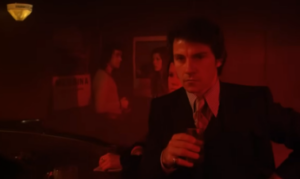
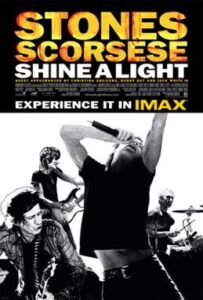
Wow.  Martin Scorsese really likes the Rolling Stones.  Not only has he made a concert movie about them, 2008’s Shine a Light, but he’s used their music in umpteen films: Goodfellas (1990), Casino (1995), The Departed (2006) and the one that first put him on the map, 1973’s Mean Streets.  Even today, more than 50 years later, the scene in Mean Streets where a young Robert De Niro comes swaggering through a bar, in slow motion, towards a pensive Harvey Keitel, while Mick Jagger hollers in the background about being “born in a cross-fire hurricane”, is a great synthesis of rock ‘n’ roll music and rock ‘n’ roll cinema.  Indeed, Jumpin’ Jack Flash is a fitting accompaniment for the arrival in popular consciousness of De Niro, who’d spend the rest of the 20th century showing Hollywood how to do proper acting.  The 21st century, featuring such efforts as The Adventures of Rocky and Bullwinkle (2000), Little Fockers (2010), New Year’s Eve (2011) and Dirty Grandpa (2016)…  Okay, not so much.


Satisfaction (1965) in Apocalypse Now (1979)

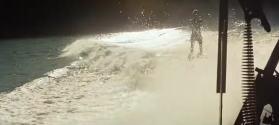
The Stones’ early, primordial and still potent stomper Satisfaction gets a brief but memorable airing in Francis Ford Coppola’s baroque Vietnam War masterpiece, playing on the radio while Captain Martin Sheen and his not-exactly-fighting-fit crew go cruising up the Nùng River in search of Marlon Brando.  Cue some funky on-deck dance moves by a frighteningly young-looking Laurence Fishburne and some funny / cringeworthy water-skiing moves by Sam Bottoms that knock various Vietnamese people out of their fishing boats.


© Omni Zoetrope / United Artists


Sympathy for the Devil (1968) in Alien Nation (1988) and in Interview with the Vampire (1994)

Graham Baker’s sci-fi / cop movie Alien Nation isn’t very good.  Its premise of an alien community getting stranded on earth and having to integrate as best as they can with the curmudgeonly human natives was handled much better in Neill Blomkamp’s District 9 (2009).  But I do like a woozy, hypnotic scene in it where alien-loathing cop James Caan enters a sleazy alien bar while a lady-alien performs an erotic dance to the strains of Sympathy for the Devil.  Not the original Stones song, but a correspondingly woozy, hypnotic cover-version of it by the great Jane’s Addiction.  I can’t find a film-clip of the scene, but here’s the Jane’s Addiction cover.


Meanwhile, Neil Jordan’s adaptation of Anne Rice’s Interview with the Vampire ends with Sympathy for the Devil on the soundtrack.  Again, this isn’t the Rolling Stones version but a cover, this time by Guns n’ Roses.  It’s every bit as ramshackle, shonky and (for me) enjoyable as the other covers Guns n’ Roses have done, for example, of Wings’ Live and Let Die (1973) and Bob Dylan’s Knockin’ on Heaven’s Door (1973).  Sympathy for the Devil kicks in when the vampire Lestat – Tom Cruise in one of his rare interesting roles – pops up to claim Christian Slater as his new vampirical companion for eternity.


Can’t You Hear Me Knocking? (1971) in Casino (1995)

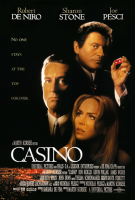
While Martin Scorsese serenades Robert De Niro and Harvey Keitel with Jumpin’ Jack Flash in Mean Streets, he employs the Stones song Can’t You Hear Me Knocking? for another of his regulars, Joe Pesci, in Casino.  Remarkably, Scorsese plays all seven minutes of the Santana-esque Can’t You… as an accompaniment to a lengthy sequence showing how Pesci’s Casino character Nicky Santoro gets established in Las Vegas.  Predictably, the sequence has Pesci doing what Pesci usually does in Scorsese movies: being a psychotic shit, barking orders at hoodlum sidekicks twice his size, eating in restaurants, ingratiating himself with fellow Mafiosi, being a psychotic shit, cursing and swearing, getting a blow-job, being a psychotic shit, talking about food, knocking off jewellery stores, acting the loving family man with his non-criminal relatives… and being a psychotic shit.


© Légende Entreprises / Universal Pictures


Ruby Tuesday (1967) in Children of Men (2006)

Wistful Stones ballad Ruby Tuesday features briefly on the soundtrack of Alfonso Cuarón’s gruellingly pessimistic science-fiction thriller Children of Men.  It’s another cover, sung by Franco Battiato.  We hear it during one of the movie’s calmer moments when Theo (Clive Owen) is visiting his old mate Jasper (Michael Caine), whose home provides a small pocket of sanity amid the unfolding dystopian grimness.  Amusingly, Caine, well known in real life for being a right-wing old grump with an aversion to paying tax, here plays an elderly anarcho-hippy with a fondness for smoking exceptionally strong pot.


Gimme Shelter (1969) in The Departed (2006)

Martin Scorsese loves the Rolling Stones and he loves their apocalyptic number Gimme Shelter in particular.  By my count he’s used it in three movies: Goodfellas, Casino and The Departed.  It’s best deployed at the beginning of The Departed, rumbling in the background while gangland thug Frank Costello (Jack Nicholson) expounds his philosophy.  “I don’t want to be a part of my environment,” he intones, imbuing his words with that leery, languid menace that only Nicholson is capable of.  “I want my environment to be a part of me.”  Strangely, in Scorsese’s Shine a Light two years later, Gimme Shelter was one of the songs the Stones didn’t perform on stage.  Marty missed a trick there.


© Plan B Entertainment / Warner Bros


Street Fighting Man (1968) in Fantastic Mr Fox (2009)

Director Wes Anderson also sticks Rolling Stones into his movies, but so far I haven’t mentioned him because I think most of his work is smug, pretentious and annoying.  For example, Play with Fire (1965) figures prominently in 2007’s The Darjeeling Limited, an Anderson movie so twee I find it the cinematic equivalent of being force-fed with chocolate-cake mix.  However, I like the scene in his stop-motion-animation adaptation of Roald Dahl’s Fantastic Mr Fox where, to the sound of the rabblerousing Stones anthem Street Fighting Man, Farmers Bean, Boggis and Bunce use three diggers to tear up the den of the titular Mr Fox; forcing the den’s inhabitants to frantically dig an escape-route.  Yes, they really ‘dig’ that song.  Sorry.


And finally…  Out of Time (1968) in Once Upon a Time in Hollywood (2019)

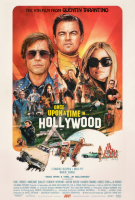
I’m not the biggest fan of the Stones song Out of Time – Jagger’s vocals get a bit too caterwauling for my liking – but it sees good satirical use in Once Upon a Time in Hollywood, Quentin Tarantino’s paean to the American movie-making capital in the late 1960s, a fascinating period when traditional notions about what made a good film were rapidly being undermined by an uppity younger generation.  Played when Rick Dalton (Leonardo DiCaprio), his new Italian spouse Francesca Capucci (Lorenza Izzo) and sidekick Cliff Booth (Brad Pitt) return from Italy, where Rick has been making spaghetti westerns and action thrillers with the likes of Sergio Corbucci and Antonio Margheriti, Out of Time gives an one-the-nose summation of DiCaprio’s sad-sack character – an actor a bit too old, un-hip and uncomprehending of the changing world around him to get the leading roles he once did, now doomed to playing villains in second-rate TV shows.


© Columbia Pictures / Sony Pictures Releasing 

Cinematically stoned (Part 1)


© Goodtimes Enterprises / Warner Bros.


Oh God.  I’ve just discovered that the soundtrack of Melania (2026), the vanity-documentary about Melania Trump, financed by Jeff Bezos and directed by Brett Ratner – a man accused of sexual assault by six women (allegations Ratner has always denied) – contains a song I just might identify as my favourite one of all time.   That is Gimme Shelter, the opening track on the Rolling Stones’ 1969 album Let It Bleed.  Yes, a tune that means so much to me features in a movie pithily described by Mikey Smith, deputy political editor at the Daily Mirror, as ‘a bad film made by bad people about bad people’, and about which Variety suggested if they showed it on an airplane ‘people would still walk out’.  I feel besmirched.


It’s quite possible, though, that the Trumps and Brett Ratner bunged Gimme Shelter onto the soundtrack without actually listening to the words.  Supposedly played as an accompaniment to Melania’s preparations for her husband’s inauguration as 47th President of the USA, which one year later would lead to masked, paramilitary-style thugs abducting young children from their homes and schools and executing peaceful protesters on the street, the song has such lyrics as “Rape, murder / It’s just a shot away” and “War, children / It’s just a shot away.”  Very apt, when you think about it.


Anyway, this has at least got me thinking about a different, and nicer, Rolling Stones-related topic – the band and movies.  After all, over the years, there have been plenty of Beatles films: A Hard Day’s Night (1964), Help! (1965), Yellow Submarine (1968), Let It Be (1970), I Wanna Hold Your Hand (1978), Sergeant Pepper’s Lonely Hearts Club Band (1978), The Birth of the Beatles (1979), Give my Regards to Broad Street (1984), The Hours and Times (1991), Backbeat (1994), Two of Us (2000), The Beatles: Get Back (2021) (which is actually a miniseries, but Peter Jackson made it, so it feels like a movie to me) and Sam Mendes’s forthcoming project, The Beatles – A Four-Film Cinematic Event (2027).  But what about the Rolling Stones?  What contribution to cinema has been made by the Liverpudlian mop-tops’ less wholesome London rivals?


© Shangri-La Entertainment / Paramount Classics


On the face of it, there isn’t a lot.  That is, if you don’t count the various documentaries made about them like Charlie is my Darling (1966), Jean Luc Godard’s oddball Sympathy for the Devil (1968) and Gimme Shelter (1970), a chronicle of their 1969 American tour that ended bloodily with Hells Angels-perpetrated carnage at the Altamont Speedway Free Festival.   And if you don’t count their many concert movies like The Stones in the Park (1969), Let’s Spend the Night Together (1982), Julien Temple’s The Stones at the Max (1991) (the first feature-length movie to be filmed in IMAX – because what you really want to see is a 100-feet-tall close-up of Keith Richards’ face, right?), The Rolling Stones Rock and Roll Circus (1996) (plug your ears for the bit with Yoko Ono) and the Martin Scorsese-directed Shine a Light (2008), which provided the gruesome spectacle of a leathery 60-something Jagger duetting with 20-something pop-moppet Christina Aguilera and prowling around her like a randy velociraptor.


There’s been little effort to film key events in the history of the Rolling Stones.  Off the top of my head, the only one I can think of is the little-known Stoned (2005), about the possible circumstances of Brian Jones’s death.  And as for movies featuring Stones-members as actors, well, there’s just a couple of items with Mick Jagger – epics such as Ned Kelly (1970) and Freejack (1992).  Ouch.


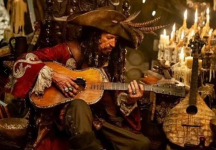
Actually, you could make a case for the Pirates of the Caribbean series being Rolling Stones films as their star Johnny Depp famously based the voice, mannerisms and swagger of his Captain Jack Sparrow character on Keith Richards.  I thought Depp-playing-Keith-playing-a-pirate was a rib-tickling gimmick that elevated the first Pirates of the Caribbean instalment, back in 2003, from being a middling film to being an entertaining one.  Alas, the sequels to it became ever-more convoluted, repetitious and tedious and, by the time of the third in the franchise, At World’s End (2007), when the filmmakers had the bright idea of bringing in the real Keith Richards to cameo as Captain Jack’s pirate dad, the idea had lost its novelty value.


© Buena Vista / Walt Disney Productions / Jerry Bruckheimer Films


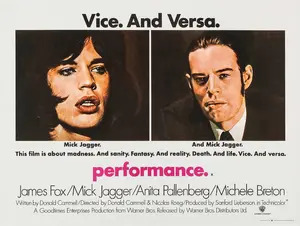
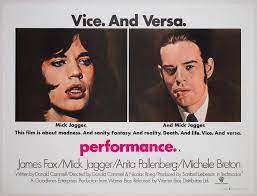
Arguably, the most Rolling Stones-esque film of all is Performance (1968), the psychedelically weird crime-rock movie co-directed by Donald Cammell and Nicholas Roeg.  Its cast includes Mick Jagger and Anita Pallenberg, then lover of Keith Richards.  The story of an on-the-run gangster (James Fox) who holes up in a mansion belonging to a burnt-out rock star (Jagger) and gets involved in some mind-bendingly druggy goings-on, the film neatly captures the dark, dangerous aura that was popularly associated with the Stones at the time.  Neither did it do the film’s scary reputation any harm that afterwards Fox underwent a ‘crisis’, dropped out of acting for the next decade-and-a-half and became an evangelical Christian.  As if the poor man hadn’t suffered enough, during the late 2010s, his son Laurence came out of the closet as a whinging, entitled, far-right-wing rentagob.


Keith Richards had and still has a deep-rooted aversion to Performance, thanks to the sexual shenanigans that Pallenberg supposedly got up to with Jagger during filming.  He believed these shenanigans were orchestrated by Donald Cammell, presumably as a way of getting Pallenberg and Jagger further ‘in character’.  In his autobiography Life (2020) – which was written with the help of a journalist also, confusingly, called James Fox – Richards describes Cammell as “the most destructive little turd I have ever met.”


Because of Richards’ loathing of Performance, one Jagger-Richards song that’s never been played at Rolling Stones gigs and is unlikely to ever be played at future ones is Memo from Turner (1968), which soundtracks a particularly strange sequence at the movie’s climax when everyone is out of their faces, the gangsters start stripping off and Jagger dances amid veering lights.  On the Performance recording of the song, Jagger is the only Stone involved, doing vocal duties, while Ry Cooder plays slide-guitar (wonderfully) and Randy Newman plays piano.  It’s a shame that we’ll never hear a live Stones version of it because it’s a belter.  I’m also partial to this cover of it by forgotten 1980s retro-rockers Diesel Park West.


Anyway, there’s one thing you can say about the Rolling Stones and celluloid.  In the right film, blasting over the soundtrack at the right moment, a Stones song can help create a splendid musical, visual and dramatic alchemy, turning a good cinematic scene into one that’s truly awesome.  In Part 2 of this post, I’ll list my favourite uses of Rolling Stones songs in the movies.  Stay tuned…


© Goodtimes Enterprises / Warner Bros.

Even bloodsuckers get the blues


© Warner Bros / Proximity Media


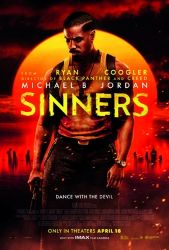
A few days ago my partner and I went to see Sinners, the new horror-cum-gangster film directed, written and co-produced by Ryan Coogler.  Here are my thoughts on it.  And before I go any further, a word of warning: there will be spoilers.


To be honest, I wasn’t expecting a great deal, as I’d heard something about its plot and it sounded horribly like 1996’s Robert Rodriguez-directed, Quentin Tarantino-scripted From Dusk till Dawn.  Although a few misguided souls nowadays look back on that film as a neglected and misunderstood classic, I have to say I f**king hated it.  In part, this was because From Dusk till Dawn began so well, as a nastily-effective little crime thriller wherein two fleeing bank-robbing brothers (Tarantino and George Clooney) kidnap a pastor (Harvey Keitel) and his family and force them to smuggle them over the US / Mexico border.  Disappointingly, things then go south in all senses of the phrase.  The group arrives at a mysterious Mexican bar called the Titty Twister where the staff and many of the patrons prove to be – surprise! – vampires.  The rest of the film is a ludicrous, tongue-in-cheek splatterfest where the humans battle against waves of bloodsucking undead.  While From Dusk Till Dawn’s sudden change of tone has been praised in some quarters for its audacity, I found it a vertiginous plunge into cheesy bollocks.


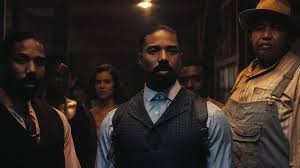
Anyway, the structure of Sinners is not dissimilar.  Its first half plays out as a period gangster story, then vampires show up and its latter half becomes an exercise in horror.  Set in the Mississippi Delta in 1932, it’s about the homecoming of black gangster twin brothers Stack and Smoke (both played by Michael B. Jordan) who’ve recently left Chicago where, it’s suggested, they worked for Al Capone.  On their home turf, they embark on a new project – purchasing a disused sawmill and turning it into a juke joint, i.e.. a place for live music, dancing, drinking and gambling whose customers are from the local African American community.


To ensure the juke joint’s opening night is a success, they staff it with trusted friends, family members and associates: Smoke’s ex-wife, the occult-dabbling Annie (Wunmi Mosaku), and Chinese shopkeepers Grace (Li Jun Li) and Bo (Yao) to handle the catering; hulking buddy Cornbread (Omar Miller) to man the door; and boozy old bluesman Delta Slim (Delroy Lindo), slinky singer Pearline (Jayme Lawson) and young, startlingly-talented guitarist Sammie (Miles Caton) to provide the music.


© Warner Bros / Proximity Media


Despite a few obstacles – two thieves who soon regret tangling with the take-no-prisoners Stack, the fact that the sawmill’s former owner is head of the local chapter of the Ku Klux Klan, and the disapproval of Sammie’s dad, a preacher who believes music is only virtuous if it’s used to further the word of the Lord – the juke joint opens, pulls in the crowds and is soon swinging.  And then the vampires arrive.


Yes, I was dreading this moment – because I had really enjoyed the non-fantastical part of the film.  Coogler did a great job depicting the minutiae of the 1932 Mississippi Delta.  This was a world where the black population was just a couple of generations removed from the official slavery of the Confederacy and most of them now toiled in the racket that was sharecropping, a form of unofficial slavery.  At the same time, they were crafting a musical culture, the blues, that would ultimately revolutionise American and global music through its influence on rock and roll.  One touch among many that I liked here was the portrayal of the Chinese shopkeepers, Grace and Bo, who thanks to their ethnicity are able to run stores in both districts of the Mississippi town of Clarksdale, the black one and the white one.


Anyway, when the vampires show up, does the film turn to shite as From Dusk till Dawn did?  Thankfully, no.  Coogler provides some foreshadowing to prepare us for the twist, so it doesn’t come as a credibility-straining bolt from the blue.  During the opening sequence, a voice-over talks about certain types of music being “so pure it can pierce the veil between life and death, past and future” and attract supernatural creatures – an idea that’s echoed later when the vampires admit Sammie’s miraculous guitar-playing has drawn them to the juke joint.  (Even before the vampires arrive, Coogler treats us to a phantasmagorical sequence where Sammie’s playing seems to conjure up among the dancing crowd the spectres of music past and future – West African shamans, Chinese Xiqu performers, hip-hop DJs and an electric guitarist who looks like he’s a member of George Clinton’s P-Funk collective.)


Also preparing viewers for the tonal switch is an earlier sequence where a white man, Remmick (Jack O’Connell), flees from a squad of Choctaw Native Americans and takes refuge in a cabin inhabited by a hard-up white couple.  The pursuing Native Americans politely warn the couple that they’re sheltering something evil.  But as KKK robes are visible inside the cabin, it’s no surprise that the couple believe the story of their white visitor rather than that of the ‘Injuns’.  Noticing the sun is setting, and with a shotgun pointed at them, the Choctaw decide discretion is the better part of valour and retreat.  Which leaves Remmick to reveal himself as a vampire and infect his two saviours.


Coogler leaves this bit of world-building unexplored – which makes it wonderfully intriguing.  Why are the Choctaw acting as vampire hunters?  It also reminds me of the start of John Carpenter’s The Thing (1982), where a dog – actually the titular thing in canine form – is chased by a pair of wrathful Norwegians in a helicopter.  Compared to the Norwegians, though, the Native Americans are more pragmatic and level-headed.


© Warner Bros / Proximity Media


Later, Remmick and the vampirised Klan couple appear on the threshold of Smoke and Stack’s new juke joint, bearing musical instruments and pleading to be let in (“We heard tell of a party”) so that they can have a jamming session with Sammie.  Sinners makes much of the belief that to get onto a premises, a vampire has to be invited – and Smoke and Stack, suspicious of white folks, are in no hurry to invite this trio inside.  So they bide their time outside, biting and vampirising anyone who goes home early or nips out of the building for a pee.  While they wait for their opportunity to get inside, their numbers grow…


In a smart move, Coogler makes Remmick Irish and gives him a taste for music as strong as his taste for blood.  So, lurking outside, the vampires knock out a few tunes themselves – a charming version of the Irish / Scottish folk number Wild Mountain Thyme, for instance, and when there’s enough of them to stage a full-scale vampire hooley, a raucous rendition of Rocky Road to Dublin, during which Remmick indulges in some step-dancing.  This makes being a vampire look like fun and Remmick, entreating the folks in the juke joint to surrender to him and his horde, makes a persuasive-sounding case for being vampirised.  Once you’re a vampire, it doesn’t matter what skin-tone you have.  Black vampires are treated no worse than white ones: “This world already left you for dead.  I can save you from your fate.  I am your way out.”


There’s a snag, of course.  Remmick, as the Count Dracula / Mr. Barlow-style lead vampire, calls the shots and his minions have to do his bidding.  Indeed, they seem parts of a giant hive-mind – evidenced by their chorused singing of Rocky Road to Dublin, which contrasts with the individuality Sammie expresses with his guitar.  And Remmick’s interest in Sammie and his music isn’t motivated by an impulse of sharing but by a desire to assimilate them.


It’s fun to speculate who or what Remmick symbolizes.  When he makes his first pitch at the juke joint’s door, begging to be let inside while Sammie, Delta Slim and Pearline perform, I was reminded of those white British rock-and-roll bands of the 1960s, like the Rolling Stones, the Animals and the Yardbirds.  Influenced by the likes of Robert Johnson and Muddy Waters, they started their careers desperate to play blues music and become known as bluesmen themselves.  Which prompted Sonny Boy Williamson II to quip caustically: “These English boys want to play the blues real bad… And they do, real bad.”


But maybe it makes more sense to compare Remmick to the white-owned American music industry.  His hunger for Sammie parallels how that industry gobbled up black artists, of blues, jazz, gospel, soul, funk, whatever, and made a fortune off their music whilst giving them as little credit, money and control over their work as possible.  Often, their songs ended up being sung by someone else, someone white – see Pat Boone singing a version of Little Richard’s Tutti Frutti just five months after its release in 1955 – with precious few royalties making it their way.


Incidentally, late on, Remmick comes out with a sob story about how he was persecuted and deprived of his land in Ireland – presumably at the hands of the British and presumably back in the days when he was still human.  That a victim of oppression has become a supernatural killing machine, one with a fascistic disregard for the lives of the people he feeds on, is Coogler’s way of reminding us that many poor white people, treated like dirt in their home countries, emigrated to other parts of the world where they treated indigenous people and black people like dirt too.  It’s a sad reflection on human nature that people near the bottom of the pile have a psychological need to believe there are people even further down the pile whom they can mistreat and regard as inferior.  Though this observation would no doubt delight Elon Musk, who recently grumbled that the “fundamental weakness of Western civilization is empathy”.


I’ve spent a lot of time analysing Sinners but I should also say it’s a supremely entertaining movie.  It’s exciting, scary, funny and atmospheric.  Furthermore, it proves a point that many filmmakers overlook – if you want a horror film to grip an audience, give them likeable and sympathetic characters to identify with.  That way, they have an investment in those characters and things feel much more tense when bad stuff starts happening.


© Cedric Burnside Project

© Silvertone Records


It goes without saying that the soundtrack is great too.  I’m particularly pleased to see that Cedric Burnside had a hand in performing some of the blues tunes – I attended a cool gig by Burnside at the Edinburgh Jazz and Blues Festival in 2015 and afterwards got his signature on a CD as a present for one of my mates.  Also, don’t rush off when the credits start rolling at the end.  There’s still a scene to come, one set in the early 1990s and featuring the venerable bluesman Buddy Guy.  (By a coincidence I saw Guy perform in the early 1990s, though obviously the early-1990s Guy in Sinners is a good bit older than the one I witnessed.)  It’s a coda that’s both sinister and affecting.


And the acting is excellent.  Michael B. Jordan is impressive in the twin roles of Smoke and Stack.  I soon forgot that both characters were being played by the same person.  It’s a pleasure seeing Delroy Lindo again, whom I fondly remember as the villain in the 1995 adaptation of Elmore Leonard’s Get Shorty and from numerous Spike Lee movies.  And as Sammie, Michael Caton is a revelation.  He’s young and naïve, as the script demands, but he’s blessed with a deep, prematurely-old voice that totally persuades you this lad can sing and play the blues.


One thing about the casting, though.  Jack O’Connell is perfectly fine as Remmick.  But since the character is a scary old monster who’s Irish and musical, I don’t know why they didn’t cast the obvious candidate for the role: Van Morrison.


© Warner Bros / Proximity Media

My favourite gigs


© Chrysalis


My previous blog-post was about seeing Deep Purple live in concert.  This was the most recent of many gigs I’ve been to.  Indeed, by my calculations, I’ve seen about 160 musical acts perform live, starting with veteran Scottish hard rock / heavy metal group Nazareth, whom I saw in Aberdeen in 1984.


Anyway, this has got me thinking about the best gigs I’ve ever been to.  Here are my favourite eight.


The Proclaimers – Aberdeen Ritzy, 1987

I didn’t know what to expect when some mates got me along to a concert by Craig and Charlie Reid, better known as Scottish folk-pop duo the Proclaimers.  I liked the Reids – their hit song that year, the politically charged Letter from America, was already becoming Scotland’s great anti-Maggie-Thatcher anthem – but I had no idea what they’d be like live.  Also, they were performing at Aberdeen Ritzy, a place I had an aversion to because I’d once worked there as a member of the floor-staff and it was the least enjoyable job I’d ever had.


I had no reason to be apprehensive.  The gig felt like a giant, joyous football match where the entire crowd supported the same team and that team was winning 10-0.  I suspect one reason why the Proclaimers went down so well that night was because the Aberdonian audience could relate to their song Throw the R Away, which is about the frustrations caused when standard English-speakers can’t understand your accent.  Which is a common hazard if you speak Aberdonian.


The Jesus and Mary Chain, Dinosaur Jr, My Bloody Valentine, Blur – the Rollercoaster Tour, London Brixton Academy, 1992

From Craig and Charlie Reid to two more Scottish siblings called Reid.  These were Jim and William Reid of the feedback-drenched East Kilbride noise-niks the Jesus and Mary Chain.  Their Rollercoaster Tour date at Brixton Academy in 1992 offered not only excellent support from American alternative rockers Dinosaur Jr and dreamy, swirly shoegazers My Bloody Valentine, but also a chance to sample a young, up-and-coming band called Blur.  Though my reaction when I saw Damon Albarn onstage wasn’t that he was destined to be an icon of the future Britpop movement but that he resembled a very young, musical version of Norman Wisdom.


© Blanco y Negro


Meanwhile, the headliners blew me away.  Promoting their recent album Honey’s Dead (1992), which was packed with behemoth tunes like Reverence and Sugar Ray, the Jesus and Mary Chain performed in silhouette against a giant blood-red backdrop.  This made them look like the imperious Masters of the Universe.


The Manic Street Preachers – Sapporo Penny Lane, 1993

Welsh rock band the Manic Street Preachers were promoting their album Gold Against the Soul when they turned up in the Japanese city of Sapporo, at whose Hokkai-Gakuen University I worked at the time as a lecturer.  Though in Britain they were seen as having a punk edge, the Japanese took their fondness for glam clothes and eyeliner as meaning they were another Guns n’ Roses.  Thus, their gig at Sapporo’s Penny Lane drew a lot of Japanese girls wearing silk scarves and floppy hats, who kept squealing “Rich-ee!” at the Manics’ guitarist, Richey Edwards.  The gig was both excellent and dramatic – the drama coming when the highly-strung Edwards freaked out about an illuminated fire-exit sign at the other end of the auditorium that he claimed was putting him off his performance.


Since then, that gig has haunted me in two ways.  Firstly, around the same time, I bought the Japanese edition of Gold Against the Soul.  Years later, long after Edwards’ tragic and never-explained disappearance in 1995, I listened to it again and discovered the CD case contained a second tray that I hadn’t noticed before.  In it was a bonus CD, a live one of them performing in Japan.  When I played it, I felt poignantly transported back in time – for there, in the crowd, were those Japanese girls shouting “Rich-ee!” again at poor, doomed Richey Edwards.


From wikipedia.org / © Masao Nakagami


Secondly, when I saw the Manic Street Preachers again last year, in Singapore, they played a new song called Still Snowing in Sapporo, which I learned was inspired by that long-ago gig in 1993.  How weird, I thought, to be in the audience listening to them playing a song about a concert 30 years earlier… knowing I was were probably the only person in the audience who was at that concert.


The Beastie Boys – Sapporo Jasmac Plaza, 1995

I almost didn’t attend this gig, which also took place while I worked at Sapporo’s Hokkai-Gakuen University.  The show was due to begin at 7.00 PM – concerts in Japan tended to start when the tickets said they would – and the same evening I had to give a late lecture until 7.20 PM.  Plus I calculated that by the time I got from the university campus to the venue, the Jasmac Plaza, the Beastie Boys would already be an hour into their gig.  It didn’t seem worth it.


However, a few weeks before the concert, it was announced that work had been completed on a new Sapporo subway line, which had a station called Gakuen-Mae directly below the campus where I was working.  I also discovered that the next station along the new line, Hosui-Suskino, had an exit that was only a block from the Jasmac Plaza.  And a subway train left for Hosui-Susukino from Gakuen-Mae every evening at 7.30.  I figured that if I caught the 7.30 train, and moved very fast, I could be at the concert hall in the Jasmac Plaza ten minutes later – hopefully not yet halfway through the Beastie Boys’ set.  Fate seemed to be urging me to buy a ticket, so I did.


That evening, I finished my lecture on the stroke of 7.20, ran like hell for the subway station and charged down what seemed like half-a-dozen escalators, descending deeper and deeper into the earth.  The train was already at the platform and I ran and jumped through its about-to-close carriage doors.  At Hosui-Susukino, I sprang out of the train, ran up more escalators, ran along a city block into the Jasmac Plaza and up several staircases to its fourth floor, where the concert hall was.  Live music blasted out of speakers above me.  I dashed into the hall, gasping for breath, my university lecturer’s suit, shirt and tie soaked in sweat…  And I discovered that the Beastie Boys weren’t on stage at all.  What I was hearing was a support act that hadn’t been mentioned on the bloody ticket.  The Beasties didn’t appear until forty minutes later.


After that, it needed to be a superb gig to justify all the hassle and indignity I’d suffered.  Which, thankfully, it was.


© Mute


Nick Cave – Edinburgh Princes Street Gardens, 1999

During the 1999 Edinburgh Festival, goth-rock troubadour Nick Cave – without his band the Bad Seeds – performed in Edinburgh’s Princess Street Gardens, which meant he had the craggy Edinburgh Castle rock, crowned by the battlements of the castle itself, as a spectacular backdrop.  But there was a problem.  Taking place in the castle was the Edinburgh Tattoo, that celebration of tartan-swathed, bagpipe-wailing Scottish military kitsch held every August; and the Tattoo organisers were not happy about having to compete against a concert below in the Gardens.  Indeed, a few evenings earlier, the Gardens had hosted the psychedelic / space-rock outfit Spiritualised and their percussive beats had caused the Lone Piper – the bagpiper who appears on the ramparts at the Tattoo’s finale to play the lament Sleep Dearie Sleep – to lose concentration and mess up the tune.  This evening, to placate the Tattoo, Cave wasn’t allowed to start playing until it had finished, meaning the audience turned up at the time specified on the tickets but then had to wait an hour.  To keep us entertained, some local performance-poets were brought onstage, including the late, lamented Paul Reekie.


One consequence of this was that when Cave finally did come on, the end-of-Tattoo firework display was erupting above the castle.  Talk about a spectacular entrance.  And the ensuing gig was worth the long wait.  The songs, mostly stripped-down versions of stuff from 1997’s The Boatman’s Call and 1996’s Murder Ballads, were wonderfully enhanced by the gothic surroundings – the rock, the castle and finally a gorgeous full moon ascending into the starry Edinburgh sky.


The Waterboys – Newcastle, Tyne Theatre and Opera House, 2003

In the mid-1980s, there was a considerable buzz about the Waterboys, who were expected to go stratospheric and join U2 and Simple Minds as one of the big Celtic rock bands of the era.  Instead, under the leadership of Edinburgh man Mike Scott, they decamped to Ireland, became a folk band for a while, and rock superstardom never arrived.  I actually preferred their folky stuff (like 1988’s When Ye Go Away) to their rather bloated rock stuff (like 1985’s The Whole of the Moon).


For this 2003 gig in Newcastle, the band did an hour of gentle, melodic music, kicking off with a version of the Rolling Stones’ Wild Horses, which Scott decided to play because he’d “had it in his head all day,”  There was an interval during which the Geordie crowd enjoyed a pint or four in the Opera House bar.  And then it was back into the auditorium for a second hour of up-tempo rock music.  The relaxed and nothing-more-to-prove Scott clearly wanted to have a good time and wanted to give his audience a good time too – which he did, in spades.


© Geffen Records


Alabama 3 – Newcastle, University of Northumbria, 2005

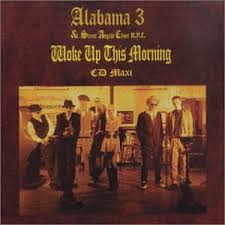
This was the best blues / country / techno / electronica / indie / trip-hop / acid-jazz gig I’ve seen, courtesy of the best (and possibly only) band in the world whose music ticks all those boxes, the Alabama 3.  They’re not from Alabama, but from South London.  Also, there’s eight or nine of them rather than three.  With so many band-members onstage, and such a stew of different sounds, this gig at the University of Northumbria was inevitably a bit of a shambles – but what a glorious shambles.  Their track Woke Up This Morning, which at the time served as the opening theme for The Sopranos (1999-2007), was particularly epic.


Primal Scream – Norwich UEA, 2009

I wasn’t expecting a great deal in 2009 when the Bobby Gillespie-fronted alternative rock band Primal Scream turned up at the University of East Anglia, where I was in the middle of doing a full-time MA.  Feeling creaky and long in the tooth by then, I assumed my best gig-going days were behind me.  I was too old for the mosh-pit, for jumping around and getting into the exuberant spirit of things.  Meanwhile, I’d seen Primal Scream a few times before and found them a bit hit-and-miss.


But I ended up really, really enjoying myself.  I managed to snag a position right at the edge of the stage, giving me a perfect view.  And Gillespie and the gang were in blistering form.  Primal Scream concerts can feel schizophrenic because their music veers between harsh, experimental electronica (like 2000’s Kill All Hippies) and loose-limbed, traditional Rolling Stones-style rock ‘n’ roll (like 1994’s Jailbird), but here it didn’t matter.  They just alternated.  They’d do one hardcore electronica number (accompanied by a brain-frying lightshow), followed by a Stonesy number, then another electronica one, then another Stonesy one, and so on.  Somehow, tonight, it worked brilliantly.


From wikipedia.org / © Phil Guest

A Dad story


From amazon.co.uk / © Smith, Smith & Swan


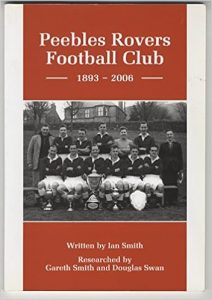
Back in 2006, I returned to my family’s home in the town of Peebles, in southeastern Scotland, for a fortnight’s vacation from a job I was doing in a particularly authoritarian, under-developed and hard-to-live-in country.  As that country offered little in the way of social life, I had plenty of free time on my hands when I wasn’t at my workplace.  And to fill in that free time, I’d spent the past year working on a project initiated by my brother Gareth and his mate Douglas Swan.  Basically, Gareth and Douglas wanted to publish a book about the history of a local football team, Peebles Rovers.  They conducted the research for it and sent the notes, newspaper cuttings, interview transcripts and so on to me.  I’d always fancied myself as a writer, so I took on the job of turning their research into prose.


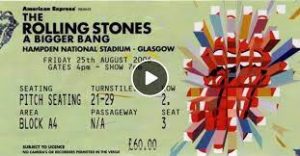
The research had all been written up and the book was soon to be published when I arrived home that August.  As a thank-you for the work I’d put into it, Gareth and Dougie bought me a present: a ticket for the Rolling Stones concert on Friday, August 25th, at Hampden Stadium in Glasgow, which coincided with my return to Scotland.


This was a little sudden and unexpected.  Also, my parents’ house, where I was staying, was offline and I didn’t have a phone – so dictatorial was the country I was working in that private citizens weren’t allowed to carry one.  Thus, I was somewhat unprepared that Friday morning when I set off, via bus from Peebles to Edinburgh, and then train from Edinburgh to Glasgow.  I hadn’t, for example, been able to search for accommodation that night in Glasgow, after the concert.  “Och,” I thought to myself in my haphazard way, “I’m sure something will turn up.”


However, before I left the house in Peebles, my Dad told me: “If you can’t find a place to stay, and have problems getting home, call me from a pay-phone.  I’ll come and collect you.”


“Sure,” I said.  But as I prided myself on being an independent, ‘low-maintenance’ sort of person, I had no intention of phoning him late at night, and probably getting him out of bed, to lament that I needed help getting home.


Anyway…  I got to Glasgow and first of all visited the Tourist Information Centre in George Square to ask if the city had any hotel rooms free that evening.  “Not really,” the lady at the desk replied. “There’s a big concert here today, you see…”  Well, I knew that, having come to attend it.  From what she said, it sounded like the nearest hotel that did have vacancies was halfway between Glasgow and John O’Groats.  Oh well, I thought.  I’ll just have to head back to Edinburgh afterwards and see if I can get to Peebles from there.  Because the Edinburgh Festival was in full swing at the time, all accommodation in the Scottish capital was already booked too.  It’d been snapped up months ago.
 

From mixcloud.com


I enjoyed the Rolling Stones and the Charlatans, their support band, at Hampden that evening.  Following the show, I hopped on a late train to Edinburgh.  Unfortunately, I arrived in Edinburgh sometime after the final bus of the day had left the city for Peebles.  What to do?  Well, from previous experience of the Edinburgh Festival, I knew it was virtually impossible to find a taxi at night-time.  But there was a very late bus, leaving at around three o’clock in the morning, for the town of Penicuik, which was halfway between Edinburgh and Peebles.  From Penicuik, home was another ten miles away.  First, you had to traverse the wilds of Leadburn Moor, then you had to make your way along the more sheltered and scenic Eddleston Valley.
 

Ten miles, I thought to myself in a gung-ho manner, having downed quite a few pints that day and being full of Dutch courage.  I could walk that in two-and-a-half hours.  And, just in case there are any cars using the road at that late hour – I can always try hitchhiking.  Maybe I’ll strike it lucky and get a lift, and get back to Peebles sooner.   
 

Because it was Festival time, many of the pubs in Edinburgh were open very late.  And because I felt I could do with just a wee bit more Dutch courage, I spent the run-up to three o’clock sinking more pints in the Scotsman Lounge on Cockburn Street.  Finally, it was time to go.  I got on the three o’clock bus and a half-hour later got off in the centre of Penicuik, which was utterly still and silent.


From there, I walked down a street towards the southern edge of the town.  I didn’t see another soul on the pavements.  Neither did a single vehicle pass on the road.  The outskirts of town neared and, beyond, the darkness of Leadburn Moor beckoned.  I steeled myself.  Okay, I thought.  This is going to be a hell of a walk.  But I can do it…


As I got to the town’s edge, and the beginning of the darkness, a pair of headlights went blazing past on the other side of the road – northwards, into Penicuik, the opposite direction from where I was going.  A pity, I thought.  But there’s at least one person on the road at this hour.  Maybe there’ll be others, heading my way…


And sure enough, a minute later, I heard a car engine approaching behind me – driving southwards, towards Peebles!  I turned just before the headlights reached me and stuck out my hitchhiking thumb.  The car passed, and slowed, and stopped a few yards ahead.  Fortune was smiling on me for sure.  I ran to the car, grabbed the passenger’s door, yanked it open, stuck my head in and blurted: “Are you going towards Peebles – ?”


My voice died.  For sitting in the driver’s seat was… my Dad.


I spluttered, “What are you doing here?”


“Och,” he said, “I woke up a while ago and thought to myself, that fellah hasn’t come home yet. So I wondered what you would do.  I figured you’d be daft enough to get the bus from Penicuik and try walking home from there.  So I thought I’d get in the car and take a wee scoot up the road and have a look for you.  I spotted you on the pavement there a minute ago, found a place to turn and came back.”


I didn’t know whether I should feel annoyed, insulted, pleased, amused or relieved.  I probably ended up feeling a mixture of all five, but the biggest feeling was one of relief.


That wasn’t the only occasion that my auld man, kind and shrewd, came to my rescue.  But it was perhaps the most memorable one.


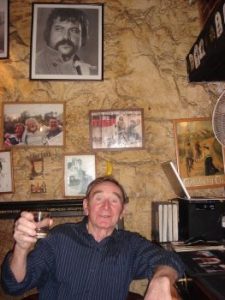
My Dad passed away at the end of last month, aged 88.  So I thought I would share this Dad story with you.


Four years after the event described above, I met up with my Dad for a week’s holiday in Malta.  Yes, we did end up one day in the pub in Valetta where thirsty movie star Oliver Reed breathed his last whilst filming Ridley Scott’s Gladiator there in 1999.

Happy World Goth Day 2023


From worldgothday.com / © BatBoy Slim


Today, May 22nd, is among other things International Day for Biological Diversity, Buy a Musical Instrument Day, National Vanilla Pudding Day and, due to it being Sir Arthur Conan Doyle’s birthday, Sherlock Holmes Day.  However, what piques my interest in May 22nd is the fact that it’s also World Goth Day. Yes, it’s that date in the calendar when we celebrate Goth, the world’s most black-clad, most kohl-eyeliner-rimmed, most sunlight-adverse musical sub-culture.  Today even has its own Goth-themed logo, designed by the fabulously-named BatBoy Slim.


To mark the occasion, here are links to a dozen of my favourite Goth tunes on YouTube.  My apologies if, first, you have to sit through a few of those annoying and asinine adverts that nowadays seem to clog the channel like fatbergs in a London sewer. .


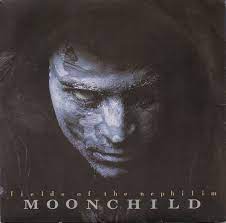
To start with, here’s one of the genre’s most old-school bands, Fields of the Nephilim, with their 1987 anthem Moonchild – I’m sure it’s no coincidence that Moonchild is also the name of a novel that occult icon and self-styled ‘wickedest man in the world’ Aleister Crowley had penned 70 years earlier.  With the sepulchral voice of singer Carl McCoy and the band’s peculiar look – moth-eaten Wild West gunslingers covered in flour – I thought Fields of the Nephilim were a bit of joke during their 1980s heyday, but I have to say they’ve grown on me since then and I find Moonchild and its lyrical refrain (“Moonchild, lower me down, lower me down / Moonchild…. Lower me down, down, down, down, down, dowww-wwwn!”) irresistible.


© Situation Two


Also defiantly old-school in sound, but of a more recent vintage – it was originally released in 2006 – is Tear You Apart by Californian band She Wants Revenge.  Like many people, I hadn’t heard the song before it was used in a 2015 episode of the TV show American Horror Story (apparently at the insistence of Lady Gaga, who featured among the cast).  When I did hear it, with its cheeky emulation of the dub-style guitar sound from Bauhaus’s 1982 epic Bela Lugosi’s Dead, and its titular homage to Love Will Tear Us Apart (1980) by Joy Division, I genuinely believed for a moment this was a 35-year-old Goth classic that’d somehow eluded me since the 1980s.


Another band hailing from California is London After Midnight, who no doubt took their name from the long-lost 1927 silent vampire film London After Midnight, which starred Lon Chaney Sr.  In a genre where too often songs lapse into pompous, overblown melodrama, their 1992 song Sacrifice manages the difficult trick of being stately and melodramatic – check out that thunder in the background – while being rather sweet and jaunty as well.


© Rotation


Now for a classic from the early 1980s and the nascent years of Goth music: 1982’s Torch by Soft Cell.  The Soft Cell duo of Marc Almond and Dave Ball would probably hate to see themselves categorised as ‘Goth’ and have one of their songs included in a playlist like this, but their sound – and especially the gorgeous trumpet-synth sound featured here – has always, for me, evoked the scene’s candlelit melancholia.  Incidentally, when the pair of them were interviewed in the Guardian earlier this month, Almond made a memorable observation about how old age suddenly sneaks up on you: “One day you’re smearing your naked body in cat food at art college, the next you’re choosing terracotta pots at the garden centre.”  Yes, Marc, I wholly agree.  Not that I ever smeared my naked body in cat food at art college, though.


And here’s another synth-orientated duo.  In 2011 Light Asylum consisted of Brooklyn singer Shannon Funchess and keyboardist Bruno Coviello – the latter departed shortly afterwards – and I found this clip of them on YouTube performing their song Dark Allies live at the time. Funchess’s barnstorming vocal performance is amazing.  It’s just a pity that the audience seem as animated and appreciative as an army of arthritic zombies.


Still keeping with synth-y musical outfits…  Despite the death of founding member Andy Fletcher in 2022, the veteran Basildon band Depeche Mode have a new album, Momento Mori, out this year and, like Jason Voorhees in the Friday the 13th movies, seem unkillable.  I’m partial to this remix – the ‘Headcleanr Rock Mix’ – of their song Nothing from the 1987 album Music for the Masses.  The Rock Mix takes out much of the original’s synth sound and replaces it with one that’s, well, rocky.  It also plays up the song’s ‘Woo-woo!’ backing vocals and the result is like an up-tempo version of the Rolling Stones’ Sympathy for the Devil (1968).


© Mute


Goth icon Nick Cave received some flak this month for being part of the Australian delegation that attended the coronation ceremony of King Charles III.  When challenged about this on his website The Red Hand Files, Nick declared an admiration for the House of Windsor, stating that the late Queen Elizabeth II “seemed almost extra-terrestrial and was the most charming woman I have ever met.”  This from someone who once duetted with P.J. Harvey?  Wow!  Nick must have found Queen Liz powerful stuff indeed.  He also answered the question, “What would the young Nick Cave have thought of that?” by saying: “…well, the young Nick Cave was, in all due respect to the young Nick Cave, young, and like many young people, mostly demented, so I’m a little cautious about using him as a benchmark for what I should or should not do.”


In fact, I wouldn’t have minded Cave attending the coronation if he’d brought his band the Bad Seeds along with him and they’d been allowed to perform my all-time favourite Nick Cave and the Bad Seeds number Stagger Lee, which is the next song on my list.  (In the Stagger Lee video, Nick looks scary even while wearing a pink T-shirt.)  Yes, the coronation would have been a much livelier affair if, instead of Handel’s Zadok the Priest, Westminster Abbey had resounded to Nick Cave hollering about slobbering on someone’s head and climbing over pussies to get to ‘one fat boy’s asshole’.  And having Blixa Bargeld shrieking animalistically at the moment that Charles got crowned would have worked perfectly.


There was never much chance of Robert Smith, frontman and mainstay of the Cure, getting invited to the coronation.  Not as he once said of the Royal Family, “I’m much better than them.  They’ve never done anything.  They’re f**king idiots.”  Anyway, here’s footage of the glorious Mr Smith performing, not with the Cure, but as a collaborator with the Canadian band Crystal Castles in 2010.  They’re doing a cover of the song Not in Love, originally recorded by another Canadian outfit, Platinum Blonde, in 1983.


From indy100.com


I don’t know why I like this cover of the 1968 Yardbirds number Heart Full of Soul by the Goth band Ghost Dance – who were formed in 1985 by Gary Marx (late of the Sisters of Mercy) and Anne-Marie Hurst (late of Skeletal Family), and who disbanded in 1989, but who have recently reformed again.  I just do.  It’s a joyous-sounding thing.


Not normally joyous is the sound of Goth / industrial-rock juggernaut Killing Joke, whose mission according to singer and keyboardist Jaz Coleman was to “define the exquisite beauty of the atomic age in terms of style, sound and form”.  Actually, the band’s crunching, thunderous urgency rarely sounded ‘exquisite’ or ‘beautiful’, but it was pretty impressive.  Here’s a track I like very much from their eponymous 2003 album.  It’s called Asteroid and features Coleman screeching the blunt but memorable refrain, “Asteroid…!  Coming in from the void!”  The hectic drums are courtesy of a guest artist, Nirvana and the Foo Fighters’ Dave Grohl.  Killing Joke had once accused Nirvana of plagiarism because of the similarity of the guitar riff in Nirvana’s Come as You Are (1991) to the one in their 1985 song Eighties, so clearly there were no hard feelings between them and Grohl.


© Zuma / Epic / Columbia


Idiosyncratic Birkenhead indie-rock troubadours Half Man Half Biscuit could in no way be described as ‘Goth’, but their 2000 song With Goth on our Side not only takes the mickey out of a certain Bob Dylan effort, but also pokes affectionate fun at music’s darkest subculture with its tale of Dai Young, who’s ‘the king of Welsh Goths’, and his girlfriend: “She sits and she crimps / Her mother’s convinced / She’s communing with imps.”  The girlfriend also has a kid brother called Wilf, who’s all right because ‘he’s into Placebo and Cradle of Filth’.


And to call the curtain on World Goth Day 2023, here’s Cities in Dust by Siouxsie and the Banshees, the stand-out track on their 1986 album Tinderbox – which, incidentally, was the first album by the band that I ever bought.  Needless to say, I hold Siouxsie Sioux in high regard.  Indeed, if Nick Cave believes Queen Elizabeth II is the most extra-terrestrial and most charismatic woman he’s ever met, well, I can only surmise that he’s never met Her Gothic Highness, the majestic and imperious Siouxsie.


© Polydor / Geffen

Jim Mountfield gets stoned


© Aphelion


Ask me to name my favourite band of all time and four days of the week I’ll say the Rolling Stones, at least during their 1969-1974 period when they had Mick Taylor playing guitar with them.  (If you ask me on the other three days of the week, I’ll say the Jesus and Mary Chain.)


Though nowadays the Rolling Stones are most likely to evoke an affectionate chuckle from all and sundry, usually due to the lovable antics and anecdotes of Mr Keith Richards – Keef falling out of a palm tree in Fiji and needing emergency surgery for the acute cerebral hematoma he incurred, Keef smoking some of his recently deceased and cremated dad’s ashes in a spliff, Keef spilling the beans about Mick Jagger’s ‘tiny todger’ – there was a time when some very dark stuff indeed seemed to swirl around the band.


This dark stuff included the mysterious (and conspiracy-theory-laden) death of the Stones’ original lead guitarist Brian Jones, who was found drowned in his swimming pool in July 1969…  The band’s headlining of the ill-fated Altamont Speedway Free Festival in December of the same year, which saw the Hells Angels who’d been hired to act as concert security stab someone to death in the crowd…  Jagger’s involvement with Performance (1970), Nicolas Roeg and Donald Cammell’s dark, sleazy, druggy and violent movie about decadent rock stars and Kray Brothers-style gangsters, which so affected Jagger’s co-star James Fox that afterwards he took a decade-long hiatus from acting and became an evangelical Christian (though, alas, more horror was in store for poor old James, because in 1978 he fathered the idiotic far-right-wing nincompoop Laurence Fox)…  The band’s fondness for referencing Auld Nick when titling albums, such as Their Satanic Majesties Request (1967) and Goat’s Head Soup (1973), and songs, such as Sympathy for the Devil (1968) and Dancing with Mr D (1973)…  And generally, the whole image the band cultivated during the late 1960s and early 1970s. of outrage, hysteria, decadence, heroin, cocaine, Jack Daniels, groupies, partying, dabbling in the occult and doing naughty things with Mars Bars.


© Goodtimes Enterprises / Warner Brothers


Since I write horror stories, under the nom de plume Jim Mountfield, I’d always wanted to pen a macabre tale about the Rolling Stones during their young, hedonistic and scary days.  Well, I’m pleased to announce that I’ve finally managed to do so and the result, a 12000-word story called The Lost Stones, has just been published in the long-fiction section of the May 2023 edition of the ezine Aphelion.


Okay, it’s not quite about the Stones themselves – it’s about a mysterious cover band called the Lost Stones, who bear an uncanny resemblance to the real Stones in their youth, when Brian Jones was still alive and part of their line-up.  And the Lost Stones’ post-gig parties are really not events you want to get invited to…


I had a lot of fun writing The Lost Stones, especially as I managed to set the story in Sapporo, the main city of Japan’s northernmost island and prefecture Hokkaido, where I spent five very happy years during the 1990s.


Furthermore, I was able to mix into the story some folklore from North Africa.  The Maghreb, i.e., Arab and Berber North Africa, is another place where I’ve lived, from 2009 to 2013.  The Stones have a connection with that region because of their hook-up in the late 1960s with the Sufi-music-playing group the Master Musicians of Joujouka, who are based in the Rif Mountains of Morocco.  Brian Jones was particularly enthusiastic about the Master Musicians and an album he produced of their music, Brian Jones Presents the Pipes of Pan at Joujouka, is fascinatingly trippy.


The main page of Aphelion is available here and, until early June, Jim Mountfield’s story The Lost Stones can be accessed here.


© Rolling Stones