My 2025 writing round-up


© Schlock! Webzine


All in all, 2025 was a horrible year: one in which an unholy alliance of authoritarians, kleptocrats, fascists, media tycoons, tech bros and oil barons worked hard at stripping freedoms from those of us living in societies that have, until now, retained some freedoms; at transferring another huge chunk of wealth from our dwindling coffers to their swelling coffers; and at burning and poisoning the planet we live on in their quest for profits whilst aggressively pushing the line that any science questioning this policy is a ‘hoax’.  But you’ve probably noticed that.  You don’t need me to tell you.


On a personal level, and regarding my writing career, 2025 for a time looked like it would be horrible too.  The previous year, 2024, had been my most successful one ever, with its twelve months seeing 17 of my short stories published.  However, in my writing round-up for 2024, I noted warily that “I will be hard-pressed to equal or better that record in 2025…  That’s because of the recent disappearances of certain magazines (like The Sirens Call) and publishers (like Midnight Street Press) who have published my stuff regularly in the past.”  Yes, those closures impacted on me this year.  But for a period of four of five months in the middle of 2025, I really felt that, submissions-wise, I couldn’t get myself arrested.  I sent story after story to publication after publication and, relentlessly, rejection after rejection came back.


For a while, my efforts at fiction seemed about as popular as a Cybertruck in a Tesla showroom in a district of Washington DC heavily populated by ex-government employees.


But…  “If at first you don’t succeed, Mr Kidd…”  “…Try, try again, Mr Wint.”


In keeping with the philosophy of Mr Kidd and Mr Wint, the two camp assassins in Diamonds are Forever (1971) who indefatigably persevere in in their efforts to dispose of Sean Connery, I tried and tried again.  And unexpectedly, I had a breakthrough near the end of the year.  Half-a-dozen of my stories got into print in November and December.  Also surprising – since I’ve never considered myself a particularly Christmassy person – was the fact that three of these stories appeared in anthologies or magazine issues dedicated to the festive season.


Anyway, here’s a summary of the fiction I’ve had published in 2025.  It includes details of where they were published, which pseudonym they were published under and how they can be accessed today.


As Jim Mountfield:

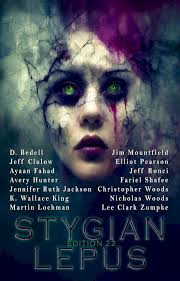
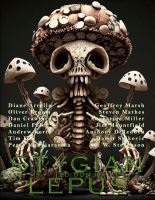
  • Jim Mountfield, the penname under which I write horror stories, had his first 2025 success with a story that appeared in Issue 22 of the Stygian Lepus magazine.  It was entitled Beach Bodies, was set in Bali, and was about an older man coming into conflict with an extreme manifestation of the foreign backpacker and influencer culture that overruns the island’s tourist spots.  Issue 22 of the Stygian Lepus can be purchased here.
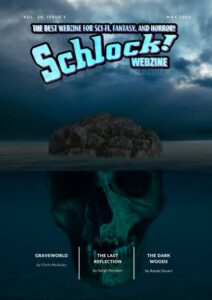
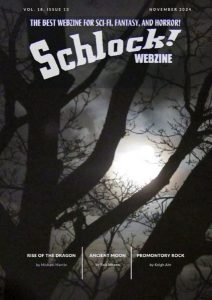
  • In July, a Mountfield story called Slot Boy was featured in Volume 19, Issue 6 of Schlock! Webzine.  At the time I described Slot Boy, which was set in Scotland and not wholly serious in tone, as having a “Scottish backdrop of parochial wee towns, middle-aged neds, cranky auld wifies, mobility scooters, and terrible football.”  You can buy that particular issue of Schlock! Webzine here.


© Spiral Tower Press


  • My next two Mountfield stories were also set in Scotland. Halloween 2025 saw the release of Issue 5 of Witch House Magazine, whose contents included The Bustle in the Hedgerow.  This story drew on a number of inspirations: a historian who once visited my family’s farm while hunting for the remains of a Roman fort; a hedge my father once planted on the farm after receiving an environmental grant; and the supposedly true story of two ancient Celtic stone heads, known as the Hexham Heads, which caused terrifying paranormal activity to assail anyone who came into ownership of them.  The Hexham Heads traumatized a generation of kids in the UK in the 1970s when the BBC current-affairs show Nationwide broadcast a report about them.  Issue 5 of Witch House can be downloaded here.
  • Early in December, a Mountfield story called The Dark Crooked One appeared in a seasonal anthology from Black Hare Press, Eerie Christmas 4. This combined a legend about Scottish bogeyman who supposedly appears during the shortest days of the year, including December 25th, with the real-life tensions that can arise at Christmas – namely, when you stick a not-particularly-happy family together in a room all day, make them eat and drink too much, and pressurise them into acting like they’re having a good time when, in fact, they’re not.  Go here to buy a copy of Eerie Christmas 4.
  • And later in December, Jim Mountfield was responsible for the first part of a science-fictional horror story, entitled Appopolis Now and set in an imaginary Asian country in the near-future, that turned up in Issue 30 of the Stygian LepusAppopolis Now is currently available to read here.  Its second and final part should appear in the 31st issue of the Stygian Lepus next month.


As Rab Foster:

  • Meanwhile, my fantasy-writing alter-ego Rab Foster had his first 2025 story published in April when one called The Cats and the Crimson was accepted for Issue 159 of the monthly webzine Swords and Sorcery Magazine. The first half of the title reflects the fact that the story contains cats – both domestic cats and some ghoulish, demonic variations on the feline species.  The second half of it indicates the presence in its cast of Cranna the Crimson, a fearless and rather incorrigible swordswoman who’s already been a character in two of my earlier published stories.  You can read the story in Swords and Sorcery Magazine’s archive, here.
  • The next month, a Foster story called The Shrine on the Moor appeared in Volume 19, Issue 4 of Schlock! Webzine. This featured another recurring character of mine, the mercenary Drayak Shathsprey, and was a sequel to a story called Pit of the Orybadak, which had been published in the magazine Savage Realms Monthly at the start of the previous year.  Volume 19, Issue 4 can be purchased here.


© Cloaked Press, LLC


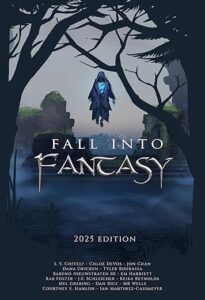
  • September saw the publication of another instalment in the yearly Fall into Fantasy anthology series published by Cloaked Press.  Fall into Fantasy 2025’s line-up of stories included a Rab Foster one called From Out the Boundless Deep.  Its main character, Kayra, had previously featured in a story called The Trap Master, published in the webzine Aphelion in 2018.  As I wrote on this blog: “The premise of both stories is that Kayra inhabits a world where all the creatures of myth and legend – griffins, hydras, harpies, kelpies, minotaurs, etc. – are real and she makes a living by hunting and trapping them.”  In From Out the Boundless Deep, Karya gets summoned to a remote beach where something large and mysterious has just been washed up.  Fall into Fantasy 2025 is on sale here.
  • The year ended with Rab Foster getting another story placed in Swords and Sorcery Magazine, this time one entitled The Palanquin. It’s an attempt to tell a fantasy story set within the confines of a very limited space – the interior of the conveyance of the title.  It features yet another recurring character in the Foster universe, the swordswoman and mercenary Keeshan, who appears sometimes as a partner to Drayak Shathsprey and sometimes as a lone agent.  Shathsprey has a role in The Palanquin too, but it’s a minor one.  Currently, the story can be read here.


As Steve Cashel:

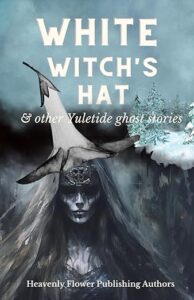
  • I usually write non-horror and non-fantasy fiction that’s set in Scotland under the pseudonym Steve Cashel. This year, atypically, he had a story turn up in another anthology of supernatural Christmas tales, White Witch’s Hat and Other Yuletide Ghost Stories from Heavenly Flower Publishing.  The reason for this was because the story in question, Southbound Traveller, was set in a Scottish household on Christmas Day in the early 1990s and for most of its length was realistic in tone.  Only near the end does something strange happen – and it’s more a ‘paranormal incident’ than a manifestation by a ghost or other supernatural entity.  (An inspiration for the story was actually Hans Christian Anderson’s 1845 fairy tale The Little Match Girl.)  It seemed more like a Steve Cashel story than a Jim Mountfield one, so Cashel got the credit.  To purchase a copy of White Witch’s Hat and Other Yuletide Ghost Stories, please click here.


© Heavenly Flower Publishing


As Paul McAllister

  • Finally, I managed to get two short stories published in December 2025 under the penname of Paul McAllister, which I use for non-scary, non-fantastical fiction set in Ireland.  This felt like scoring two goals in injury time at the end of a football match.  The first of the stories was called That Time and was based on a memory of a brief but harrowing incident that happened to me when I was about eight years old and living in Northern Ireland.  That Time was included in Issue 2 of the digital magazine Still Here, whose title and theme was Ghosts of our Pasts.  A pdf of Issue 2 can be downloaded here.
  • And the team behind Still Here also decided to put out a mini-issue to coincide with Christmas Day, entitled A Light in December.  I managed to get a Paul McAllister story selected for that as well.  Called The Recovery, it’s another one that takes place in Northern Ireland.  It involves a funeral, during the run-up to Christmas, and a case of mistaken identity.  Again, you can download a pdf of the mini-issue here.


In the end, despite my pessimistic predictions, I managed to get twelve short stories published during 2025.  Prior to the bumper year of 2024, a dozen published stories was my average total each year.  So, I didn’t fare so badly after all.  From this experience, I would give budding writers two pieces of advice: (1) never give up (which is the advice all writers give aspiring writers); and (2) have lots of Christmas stories ready in your arsenal for the next round of seasonal anthologies.  I’ve already started writing a couple for Christmas 2026.


Meanwhile… A Happy New Year to you all.


© Stygian Lepus

Jim Mountfield downloads the app


© The Stygian Lepus


The first part of my science-fictional horror story Appopolis Now has recently been published in Edition 30 of the Stygian Lepus, a magazine where, to quote the current blurb on its website, “the shadows don’t fall – they think, watching you from the edges of perception.”  As with all my stories that are dark and fantastical in tone, the story is attributed to the penname Jim Mountfield.


Appopolis Now is set in the future and imagines a society that’s slightly more high-tech than the one we will live in at the moment.  It’s also a society that’s…  Well, perhaps not dystopian, but definitely Cronenbergian.  (Wow, I have just typed ‘Cronenbergian’ and the Spelling & Grammar checker hasn’t put a red line under it.  That must mean it’s a recognised English adjective now, like ‘Orwellian’, ‘Kafkaesque’ and ‘Ballardian’.)  If you’re familiar with the works of Canadian filmmaker David Cronenberg, that should give you some idea about what to expect.


Edition 30 of the Stygian Lepus contains 14 pieces of macabre, disturbing and unorthodox short fiction and, for the next month, can be accessed here.

Christmas comes early for Jim Mountfield too


© Black Hare Press


I’ve never thought of myself as a Christmassy person, but the festive season of 2025 has allowed me to get a couple of Christmas-set short stories into print.  So maybe I’m less of a Scrooge or a Grinch than I’d believed.


A month ago, my story Southbound Traveller appeared in the collection White Witch’s Hat & Other Yuletide Ghost Stories from Belfast’s Heavenly Flower Publishing.  The story was set in 1990s Scotland and tried mostly for a realistic tone.  Rather than ghosts, it featured an example of what’s best described as a ‘paranormal incident’ near its end.  For that reason, Southbound Traveller appeared under the penname Steve Cashel, which I use for my less fantastical Scottish fiction.


Now, my story The Dark Crooked One has just been published in the book Eerie Christmas 4 from Melbourne’s Black Hare Press, which its blurb describes as a “collection of yuletide tales where the holly is sharp, the snow hides secrets, and something ancient stirs beneath the carols.”  It contains “haunted traditions that refuse to die, gifts that demand a terrible price, winter spirits hungry for warmth, and wishes that should never have been whispered at all.”  The Dark Crooked One is much more of a full-throttle horror tale, featuring a seasonal bogeyman – and indeed, Stephen King’s 1973 short story The Bogeyman gets namechecked in it – so it’s attributed to Jim Mountfield, the pseudonym I use for my scary fiction.


Though most of the horror in The Dark Crooked One is supernatural in character, there’s a little real-life horror present too.  This is the stress and pain that comes when family-members, who don’t necessarily get along very well, are cooped up together in a couple of rooms during December 25th, one of the shortest and wintriest days of the year, and are forced to eat too much and drink too much whilst making it look like they’re enjoying themselves.  And have to listen to the King’s Speech (or the Queen’s Speech, as it was at the time the story is set).


Black Hare Press have done an excellent job in packaging Eerie Christmas 4.  Not only have they been thorough in editing and proofing the text, but they’ve added decorative embellishments to its pages – marginalia, chapter ornamentations and dinkuses – which are both festive and spooky.  This anthology is strongly recommended.


Containing 40 tales of Yuletide terror, Eerie Christmas 4 can be ordered in different formats from different vendors via this webpage here.

We’ve lost the other Mr. Mountfield


From wikipedia.org / © Katherine Barton and Gaz Davidson


I was shocked and saddened to hear about the death on November 20th of Gary ‘Mani’ Mountfield, bass player with the Stone Roses from 1987 to 1996 and 2011 to 2017 and with Primal Scream for the 15 years between his spells in the Roses.


Shocked because Mani seemed such an exuberant figure (in keeping with his exuberant bass sound) that he was the very last rock-and-roll-related personage I’d expect to die at the relatively young age of 63.  I’ve seen plenty of other rock-and-roll figures on stage who did look ready to kick the bucket because of their frailty, ravaged-ness and general air of vulnerability.  But not Mani, who was always ebullient.   In fact, just days before his passing, he’d announced dates for a speaking tour of the United Kingdom planned for next year, which doesn’t sound like someone on their last legs.


Hailing – of course – from Manchester, Mani first played in two bands that were prototypes for the Stone Roses, the Fireside Chaps (with future Roses guitarist John Squire) and the Waterfront (with future Roses singer Ian Brown joining in 1983).  The Roses’ definite line-up finally coalesced in 1987 with him, Brown, Squire and drummer Alan ‘Reni’ Wren.  During the 1980s he also found time to play in a band called the Mill alongside Clint Boon, who’d later furnish humble but durable ‘Madchester’ band the Inspiral Carpets with their quirky keyboard sound.


Along with the Happy Mondays – and, okay, the Inspiral Carpets – the Stone Roses were the leading lights of the late 1980s / early 1990s Madchester movement, which irresistibly grafted the riffs of rock music onto the grooves of dance music and promoted a cheery, unpretentiously hedonistic vibe far removed from the posing and self-consciousness that’d plagued British popular music earlier in the 1980s.  It also paved away for the more internationally successful, but aesthetically less interesting, Britpop explosion of the mid-1990s.  Mani’s bass was an essential part of the formula.  For instance, it’s the first instrument you hear on I Want to be Adored, the opening track on the Stone Roses’ eponymous and massively acclaimed album of 1989.


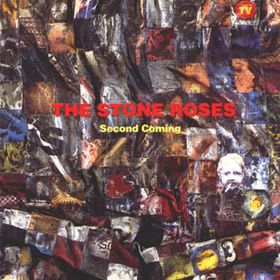
Sadly, legal wrangles and musical procrastination meant it was a long time before a second Stone Roses album appeared.  Second Coming finally saw the light of day in 1994, five-and-a-half years later.  Inevitably, after the wait and all the attendant anticipation, it was deemed a disappointment by the critics.  I have to say I think Second Coming is sorely underrated.  I fully understand why Simon Pegg, in Shaun of the Dead (2004), refuses to throw it along with the rest of his record collection at two advancing zombies.  “I like it,” he affirms.


I saw the Stone Roses for the first and last time during the tour they did on the back of Second Coming.  In 1995 they played a gig in the Japanese city of Sapporo, where I was living at the time.  It was not a happy experience.  Ian Brown was in a foul mood and gave the impression of wanting to be somewhere else – anywhere else.  To be fair, a trio of Australian bodybuilders had beaten Brown up in a club in Tokyo a few days earlier, which gave him a credible reason for his lack of enthusiasm.  Mani and the rest of the band played perfectly well.
 

© Geffen Records


Also slightly unhappy was the next occasion I saw Mani perform, which was after he’d joined Scottish band Primal Scream, another outfit intent on exploring the overlap between rock music and dance music.  The band were on the bill of a one-day event on Glasgow Green that I attended in 2000.  While they were limbering up to play the song Sick City from their new album XTRMNTR, Mani cheerfully barked into a microphone, “This is dedicated to Glasgow because it really is… a sick city!”  For a large portion of the Glaswegian crowd, this comment went down like a cup of – appropriately – cold sick.  (By the way, this was before ‘sick’ acquired its modern, slang meaning of ‘really good’.)   Later, Mani felt obliged to announce that he was only joking  and, really, “Glasgow isn’t a sick city at all!”  It’d been some banter that folk took the wrong way, but it impressed me that he was man enough to apologise for it.


I saw the Mani-era Primal Scream on two further occasions: at London’s Brixton Academy in 2003, when I thought they were pretty good; and at Norwich’s University of East Anglia in 2009, when they were on blistering form.  In fact, I’d include their 2009 Norwich show in my personal ‘Top Ten Gigs of All Time’.  With his jolly, everyman demeanour, Mani provided some balance to Primal Scream’s frontman Bobby Gillespie, whom I always found a bit too-cool-for-school when they played live.


Before joining the reformed Stone Roses in 2011, Mani found time to participate in another band, a ‘supergroup’ called Freebass whose gimmick was that it had three – three! – famous bass players, all from the Manchester area.  Its line-up also included Andy Rourke, former bassist with the Smiths, and Peter Hook, former bassist with Joy Division and New Order.  The project ended ignominiously, with Mani taking exception to what he saw as Hook unjustly exploiting the legacy of Joy Division and his late Joy Division bandmate Ian Curtis – Hook had also formed an outfit called Peter Hook and the Light that performed old Joy Division songs.  Hook’s wallet, Mani claimed on social media, was visible from space because it was ‘stuffed with Ian Curtis’s blood money.’  Needless to say, the two fell out, though later – again – Mani apologised and he and Hook made up.


Indeed, Hook has been one of the many musicians who’ve paid tribute to Mani since his death was announced a few days ago.  Other condolences have come from members of the Stone Roses, Primal Scream, the Happy Mondays, New Order, the Smiths, the Charlatans, the Verve, Echo and the Bunnymen, Elbow, the Courteneers, the Farm, Ocean Colour Scene, Kasabian, Shed Seven, Badly Drawn Boy…  I’m not a big fan of Oasis, but I thought it touching that, at their concert in Brazil the other night, Liam and Noel Gallagher projected Mani’s face onto the giant screen behind the stage whilst performing Live Forever (1994).  You get the impression you could go around everybody involved in the British music scene in the 1980s and 1990s and not find anyone with a bad word to say about the guy.


Finally, I owe Mani some gratitude.  Years ago – around 2010, I think – I was trying to think of a pseudonym to put on a horror short story I was about to submit to a magazine.  ‘Ian Smith’ seemed too dull a name to attach to a piece of short fiction that was meant to chill the blood.  At the time, I had a Primal Scream album playing in the background and I suddenly thought, “They’ve really had a second wind since Mani joined them.”  Then it occurred to me: Mani’s real name was Gary Mountfield.  ‘Mountfield’ sounded about right for a pseudonym – it wasn’t too exotic, but not too common either.  (Mountfield was also the name of a village in Country Tyrone, Northern Ireland, where I used to live, so it had a personal connection with me too.)  Thus, the penname Jim Mountfield was born.  It’s adorned nearly 70 published short stories since then.


So, thank you for the inspiration, Mani.

 

From wikipedia.org / © livepict.com

Jim Mountfield hedges his bets


© Spiral Tower Press


I’m pleased to say that at the end of last month – appropriately in time for Halloween – I had a new short story published in Issue 5 of Witch House MagazineWitch House is devoted to “the pulp fiction tradition of a modern gothic literature called ‘cosmic horror.’  Writers in this tradition include (but are not limited to) the following: Edgar Allan Poe, M.R. James, Arthur Machen, H.P. Lovecraft, Clark Ashton Smith, Robert Bloch, August Derleth, Shirley Jackson, Stephen King, and many more.  ‘Cosmic horror’ emphasizes helpless protagonists, unexplainable monstrous menaces, and fictional occult themes such as forbidden lore and evil conspiracy.”  My story is entitled The Bustle in the Hedgerow and, because it’s macabre in tone, it’s attributed to Jim Mountfield, the penname I use for such fiction.


Yes, the title was inspired by a lyric (“If there’s a bustle in your hedgerow, don’t be alarmed now”) in Led Zeppelin’s Stairway to Heaven (1971), a song that a very long time ago I thought was great but now, having heard it a million times, I’m heartily sick of.  Other songs that fall into this unfortunate category include the Beatles’ Hey Jude (1968), Derek and the Dominos’ Layla (1970) and the Eagles’ Hotel California (1977).  But that’s the only Zeppelin-esque influence on the story.  The Bustle in the Hedgerow owes its existence to three different ideas I had at three different times, which I duly recorded in my ideas notebook.  All published writers and aspiring writers of an elderly disposition, like me, carry a notebook into which they scribble the ideas that occur to them.  Though I suppose these days younger writers may record their ideas using a notes app on their smartphones.


The story’s main character was based on the historian, writer and poet Walter Elliot, who’s written extensively about the Scottish Borders, especially the lovely Ettrick and Yarrow part of it.  My family own a small farm near the Borders town of Peebles.  One day Walter showed up on our doorstep, asking if he could take a look around one of our fields in the cause of historical and archaeological research.  My dad happily told him to go ahead and, as a thank you, Walter presented him with free copies of couple of his books.  “A historian doing research in a remote farm field,” I thought.  “That’d make a good premise for a story.”  I wrote the idea down.


I should say that Walter Elliot is still on the go.  His work was acknowledged and lauded in the Scottish Parliament in 2021.  So please, don’t anyone tell him I’ve turned him into a character in a horror story.


© Deerpark Press


The second idea came when my dad got a grant from the European Union – oh, how long ago that seems now – to improve the natural environment of the farm and planted half-a-mile of hedgerow along the side of its biggest field.  One of the reasons why the hedge got approval was because it’d act as a ‘wildlife corridor’, allowing wild animals to move from habitat to habitat without having to cross roads or cultivated land.  Because the hedge started at a site where the local burn widened into a pool, and it ended at a shelterbelt of trees adjacent to our farmstead, I had a typically horror-writer-ish thought: “Hey, if something nasty lived in that pool, it could now use the hedge, the wildlife corridor, as a way of getting access to our house!”   And another idea was scribbled down.


Thirdly, I’d made notes about, and always wanted to write a story connected with, the Hexham Heads.  These were two little stone heads, alleged by some to be Celtic in origin, discovered in the northeast English town of Hexham in 1971.  They reputedly caused unwelcome and frightening paranormal activity in the homes of whoever had custody of them.  Infamously, Nationwide (1969-83) – a normally easy-going, family-friendly TV current-affairs programme that the BBC aired every weekday evening around six o’clock – featured a report on the story in 1976.  For some reason, the makers of the report saw fit to throw in images of severed human heads on tree-branches, screams and an unexpected jump-cut of Oliver Reed from 1961’s Curse of the Werewolf amid the creepy interviews, traumatising every young kid who happened to be watching.  It certainly scared the shit out of me.  (Long believed lost, footage of that legendary 1976 report has now been discovered and restored.  See here and here.)


From wikipedia.org / © Archaeology Data Service / Dr Anne Ross


I don’t normally dispense advice to other writers.  For me, personally, this has always felt a bit pompous.  But based on my experiences here, I’d recommend them to (1) make notes of their ideas before they forget them, and (2) avoid regarding each idea as having a linear correlation with a story.  Rather than thinking ‘one idea equals one story’, they should keep studying all their ideas, however random, and keep looking for ways that two, three or more ideas could be combined in a single work.  This cross-fertilisation allowed me to come up with The Bustle in the Hedgerow.


Containing eleven pieces of fiction and five poems, Issue 5 of Witch House Magazine can be downloaded here.

Jim Mountfield gets slotted in


© Schlock! Webzine


Jim Mountfield is the pseudonym I attach to fiction I write that’s dark and macabre in nature, and I’m delighted to report that a new Mountfield short story has just appeared in Volume 19 Issue 6, the July 2025 edition, of Schlock! Webzine.  It’s entitled Slot Boy and it takes place in Scotland, against an appropriately Scottish backdrop of parochial wee towns, middle-aged neds, cranky auld wifies, mobility scooters, and terrible football.


Despite its Scottish setting, Slot Boy – like many of my stories – owes a lot to the works of Stephen King.  Although the inspiration for this particular story comes from something I suspect King isn’t in a hurry to trumpet as one of his finest hours, the anthology movie Creepshow 2 (1987), which was a sequel to the rather better Creepshow (1982).  One of the three segments in Creepshow 2, The Raft, was based on a short story included in King’s 1985 collection Skeleton Crew, but the other two segments, Old Chief Wood’nhead and The Hitchhiker, were apparently stories he devised especially for the film.  He wrote an outline that was then polished into a script by legendary horror filmmaker director George A. Romero, though the final movie was directed by Michael Gornick.


Weirdly, it was Old Chief Wood’nhead that inspired Slot Boy.


The Raft and The Hitchhiker both have their moments, but Old Chief Wood’nhead is rightly regarded as the worst of Creepshow 2’s stories.  That’s despite it featuring the stalwart character actor George Kennedy (a man I always associated with crashing airplanes – he was in 1965’s Flight of the Phoenix and all four of the 1970s’ Airport movies) and Dorothy Lamour, star of the Bob Hope / Bing Crosby Road to… movies (1940-62).  Kennedy and Lamour play an elderly couple who own a shop with a hulking, timber cigar store Indian, the titular Old Chief Wood’nhead, standing outside it.  Predictably, bad things happen to them. Then, magically, seeking revenge, Old Chief Wood’nhead comes to… Well, you can guess the rest.


Native American culture is a rich source of stories and myths – see the works of Stephen Graham Jones – but Old Chief Wood’nhead operates at the level of a crass old Hollywood western, with a caricatured ‘injun’ shooting arrows, removing scalps and wielding a tomahawk.  Of course, the horror in the story, or in any horror story, is nothing compared to the real-life horrors that North America’s native American population had to endure during history.  Estimates suggest that population stood at about eight million in the whole continent in 1492; but in the USA, by 1890, it’d been reduced to a quarter of a million.  Though no doubt Trump will soon rewrite all that and have it taught in schools that life was peachy for Native Americans after European settlers arrived.


If Old Chief Wood’nhead was a bit asinine, why on earth did I think of it again after so many years, let alone get an idea for a story from it?  Well, for the first two years that I lived in Singapore, I regularly ate and drank in an establishment on Singapore’s Mountbatten Road that, bizarrely, had this standing on the edge of its premises:


I don’t think I ever saw a cigar store Indian during my time in Scotland, but shops there used to have other figurines standing outside their doors, usually for charity purposes.  One of those figurines features in Slot Boy and plays a role in the story similar to that played by Old Chief Wood’nhead in Creepshow 2.  I just hope the result is scarier – and funnier – than the movie segment.


During July 2025, you can read Slot Boy here, while the main page of Schlock! Webzine, Volume 19 Issue 6, can be accessed here.


© Laurel Entertainment / New World Pictures

Jim Mountfield gets beached


© Stygian Lepus 


Jim Mountfield, the penname I use when I write scary stories, has just had his first fiction published in 2025.  This is a short story entitled Beach Bodies, which appears in Issue 22 of the Stygian Lepus, a magazine where “readers explore the depths of imagination, where fear and fascination entwine.”


As its title suggests, Beach Bodies was inspired by a visit I made to a beach: Nyang Nyang Beach in the Uluwata area of Bali, Indonesia.  I’d walked a fair bit along the beach, away from its touristy part, to a stretch of it where there was hardly another human being in sight, when suddenly I came across a huge, long slab of rock embedded in the sand.  It was flat but its surface was covered in ruts and runnels that, each time a wave crashed against the shore and breakers came hissing up the beach, filled with white foam and formed strange, drizzling patterns.  There was something weird – something a bit, well, alien – about that rock formation.  And that’s how my story got its basic idea.


Meanwhile, most of the Western tourists I saw on the beach seemed to be busy filming themselves with their smartphones, recording clips of their hopefully-glamorous, hopefully-exotic holiday-adventures that would then be uploaded to their social media accounts.  I even noticed a Balinese guy on the shore, operating a film camera pointed at a group of surfers out amid the waves.  He’d been hired to film their surfing exploits, the footage of which would no doubt be posted online.  This influencer-style narcissism made me immensely grumpy…  That grumpiness also features in the story.


For the next few weeks, Beach Bodies can be read online here, while the contents page of the Stygian Lepus, Issue 22, is accessible here.  And go to this link if you’d like to sample the issue as an eBook.


My 2024 writing round-up


© The Sirens Call Publications


“Well, 2024 was an excellent year!”  No future historians will say, ever.  Come to think of it, because of events in 2024, there might not be any future historians.  Not any future, full-stop.


However, on a personal level, 2024 saw some improvements in my situation.  Firstly, in March, my partner and I, and our cat, moved apartments in our current city (and country) of abode, Singapore.  We’d been in an expensive condo, inhabited mostly by rich Western and Chinese expatriates, in a modern part of the city-state.  We moved into a cheaper and more modest condo in an older and more traditional district where our neighbours are nearly all Singaporean.  It’s so much nicer.  For one thing there are no spoilt, bratty kids running riot outside our front door because the unfortunate Filippino / Indonesian / Burmese girls hired by their expat parents as ‘maids’ or ‘helpers’ and made to look after them are afraid or unwilling to discipline them.  Also, our new neighbourhood is handier for getting to our work and has several notable Hawkers’ Centres and eateries offering a range of good but modestly-priced foods.  Singapore is generally expensive and its Hawkers’ Centres are one of its saving graces.


Secondly, I had a successful year with regard to my writing.  Indeed, in terms of short stories published, 2024 even topped 2023, when 15 of my stories made it into my print.  This has been my best writing year to date.


So, here’s a round-up of my stories published in 2024.  Details are provided about who published them, what pseudonym they were published under and, when possible, how they can be accessed today.


As Jim Mountfield:

  • Jim Mountfield, the pseudonym I stick on my horror fiction, was first published in 2024 at the end of January when the story Underneath the Arches was included in the quarterly fiction-and-poetry magazine The Sirens Call.  Heavily inspired by Edgar Allan Poe, Underneath the Arches was written by me at a young age – and I think it shows in the florid writing style.  However, I was grateful to The Sirens Call for giving the story (which’d languished on my computer hard-drive for decades) a home at last.  Alas, The Sirens Call ceased publication late in the year and I can no longer provide a link for downloading its past issues.
  • In April, Issue 11 of The Stygian Lepus featured my ‘cosmic-horror’ story The Followers, which was set in the English city I lived in from 2002 to 2005, Newcastle-upon-Tyne.  Specifically, it was set in two parts of it, Grainger Market and Chinatown on Stowell Street.  Issue 11 can be read here if you become a member of The Stygian Lepus’s Back Catalogue; or purchased here.


© The Stygian Lepus


  • April was also when my Northern-Ireland-set short story The Crawler, which involved a devious policeman and a collection of sinister dolls, appeared in 2024’s second issue of The Sirens Call.
  • And in July the next – and unfortunately, the last ever – issue of The Sirens Call contained my sci-fi / horror story The Colony.  This was set in East Anglia after manmade climate change has hoicked up temperatures and sea levels.  Its premise was that scientists had created, through genetic engineering, millions of giant jellyfish-like organisms and tethered them offshore in order to hold back storm surges and reduce coastal erosion.  Obviously, nothing could go wrong with this scheme.  Nothing at all…
  • The Hole in the Wall was a ‘folk-horror’ story about a member of an organisation modelled on Britain’s Campaign for Real Ale (CAMRA) who’s researching a couple of pubs.  First, he visits a horrible dump of a pub; then he stumbles across a pub that’s so classy it seems too good to be true.  And yes, the second one is too good to be true because it has a mysterious, malevolent something lurking in its walls.  The Hole in the Wall appeared in Volume 18, Issue 12 – the October 2024 edition – of Schlock! Webzine, which can be purchased here.
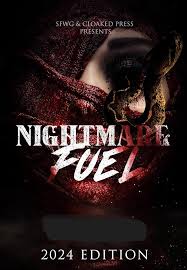
  • Also in October, my story The Activation was the opening number in the anthology Nightmare Fuel: Body Horror 2024, the annual volume of scary fiction published by Cloaked Press.  As the collection’s title suggests, its theme this year was body horror, described by Wikipedia as “a subgenre of horror fiction that intentionally showcases grotesque or psychologically disturbing violations of the human body or of another creature…” including “aberrant sex, mutations, mutilation, zombification, gratuitous violence, disease, or unnatural movements of the body.”  The Activation contained about five of those things, so I think it fitted the bill.  It was also a prequel to my story The Nuclei, which appeared in the 2020 collection Xenobiology – Stranger CreaturesNightmare Fuel: Body Horror 2024 can be purchased on Kindle here and as a paperback here.


© Cloaked Press


  • In November, a Jim Mountfield story appeared in the collection Monster: Underdog Anthology 2024 from Leg Iron Books.  A monster of a book indeed, this featured 39 spooky stories, including my Halloween-set effort Bag of Tricks.  The story was inspired by a memory I had of riding on Bangkok’s Skytrain one October 31st when some Thai kids entered the carriage wearing fancy dress, presumably on their way to a Halloween party; but most of Bag of Tricks actually takes place in Scotland.  Monster: Underdog Anthology 2024 can be bought on Kindle here and as a paperback here.
  • The Tears of the Pontianak, which appeared in the Samhain 2024 edition of the magazine The Hungur Chronicles, published in November too, was a first for me.  This was my first published story where the setting is my current home, Singapore.  As you can tell from the title, it’s mainly about a Pontianak, a blood-drinking demon of Malaysian, Singaporean and Indonesian folklore.  But the idea for the story actually came to me one afternoon when I was exploring Singapore’s Asian Civilisations Museum and encountered some beautiful pieces of local, antique furniture.  The Hungur Chronicles’ Samhain 2024 issue can be purchased directly from Hiraeth Publishing here or from Barnes & Noble here.
  • Coming from a farming background, quite a few of my stories are set on farms.  However, I only had one ‘farm-horror’ story published in 2024.  This was in Issue 19 – the December 2024 edition – of The Stygian Lepus and its title was Rack and Ruin.  It owed something to the legendary American horror writer H.P. Lovecraft, although the Lovecraftian elements were mixed with the mud, muck and rain of a hill farm in autumnal southern Scotland.  Again, Issue 19 can be read here if you’re a member of The Stygian Lepus’s Back Catalogue; or simply bought here.
  • The influence of H.P. Lovecraft could also be seen in The House of Glass, the final Jim Mountfield story I had published in 2024.  As its title implies, most of the action takes place inside a house made almost entirely of glass.  The house stands in the mountains of Sri Lanka, the country where I lived in real life from 2014 to 2022.  The House of Glass appears in the anthology Swan Song: The Final Anthology, which, sadly, is the last volume to come from Trevor Denyer’s Midnight Street Press – from now on, Midnight Street Press will exist only to sell what’s on its back catalogue, not to produce anything new.  It can be purchased from Amazon UK here and from Amazon US here.


© Swords and Sorcery Magazine


As Rab Foster:

  • Rab Foster, the pseudonym I use when writing fantasy fiction – usually the unruly sub-genre of fantasy called ‘sword and sorcery’ – hit the ground running in 2024.  On January 1st, the second and final part of my story The Boots of the Cat appeared in Volume 18 Issue 3 of Schlock! Webzine.  This was about a group of mercenaries who, while sequestered in an unwelcoming city, find themselves in a strange scenario inspired by a famous fairy tale.  And no, despite the title, that fairy tale isn’t Puss in Boots.  The issue can be purchased here.
  • Because of a publishing delay, the December 2023 edition of the fiction magazine Savage Realms Monthly didn’t appear until January 2024.  It contained my story Pit of the Orybadak, which combined fantasy elements – slimy flesh-eating monsters slithering around in a giant bog – with the pertinent real-life theme of how soldiers are treated (or mistreated) when they become prisoners of war.  This issue of Savage Realms Monthly can be bought here.
  • The Fleet of Lamvula, a heady story inspired by my love of ‘lost graveyards of ships’ stories, and the movies of Ray Harryhausen, and the trippiest song ever recorded, Black Sabbath’s Planet Caravan, appeared in late January in Issue 144 of Swords and Sorcery Magazine. The story can now be read in Swords and Sorcery Magazine’s archive, here.
  • In July, my Rab Foster story The Drakvur Challenge made it into the pages of Issue 3 of Crimson Quill Quarterly.  This was a milestone for me, being (by my calculations) the 100th short story I’ve had published.  The Drakvur Challenge was inspired by a visit I made to Tirta Gangga Royal Water Garden in Bali, Indonesia – a place I found fascinating because of its beautiful ponds, fish, fountains and networks of stepping stones… while, stowed away in a compound at the back, it also had some surprisingly monstrous-looking statues.  However, like much of my fantasy fiction, The Drakvur Challenge owed a big debt to the cinematic marvel that was Ray Harryhausen too.  Issue 3 of Crimson Quill Quarterly can be obtained as a paperback here and on Kindle here.


© Crimson Quill Quarterly


  • August saw the appearance of my story The Scarecrow of Terryk Head in Issue 151 of Swords and Sorcery Magazine.  In it, one of my recurring fantasy-fiction characters, Gudroon the Witch, had to deal with not only the evil scarecrow of the title but with three doltish farmers – and with three even-more-doltish farmers’ sons.  Again, The Scarecrow of Terryk Head is now available to read in the magazine’s archive, here.
  • In November, Rab Foster strayed into the controversial sub-genre of fantasy known as ‘grimdark’ and served up a tale of violence and gore, nihilism and despair, entitled The Mechanisms of Raphar.  (What, I wonder, inspired this?  What event in the real world in November 2024 could have induced nihilism and despair in me?)  Owing something to Edgar Allan Poe’s The Pit and the Pendulum (1842) and also something to the ’10 Courts of Hell’ display at Singapore’s most remarkable museum, Haw Par Villa, The Mechanisms of Raphar appeared in Volume 18, Issue 13 of Schlock! Webzine, now purchasable at Amazon here.


© Schlock! Webzine


As Steve Cashel:

  • Steve Cashel, the penname I put on non-horrific, non-fantastical and often crime-tinged stories set in Scotland, had one piece published in 2024.  In fact, it appeared only yesterday, on December 31st, the final day of the year.  It’s called Malkied and appears on the short-fiction page of the website for the crime-and-mystery publisher Close to the Bone.  It’s accessible here.


And finally…

  • This is cheating.  Self-publishing doesn’t count.  But on September 18th, 2024 – the tenth anniversary of Scotland’s referendum on independence – I took the opportunity to post on this blog a short story entitled Mither, which I’d written in 2014 soon after I’d heard the referendum’s result.  A mixture of Scottish politics and Alfred Hitchcock’s Psycho (1960), it was too weird to ever get properly published.  (Still, even if I say so myself, I think Norman Bates and his mom are a good metaphor for Scotland and the divisions between ‘yes’ and ‘no’ voters that supposedly materialised at the time.)  Anyway, if you’re interested, you can read it here.


So, I had 17 short stories published in 2024, which makes it my most successful year as a writer ever.  I suspect I will be hard-pressed to equal or better that record in 2025, however.  That’s because of the recent disappearances of certain magazines (like The Sirens Call) and publishers (like Midnight Street Press) who have published my stuff regularly in the past.


Meanwhile, 2025 looks like it’s going to be garbage, largely due to Donald Trump regaining the American presidency, which will embolden fascists, climate-change deniers, anti-vaxxers and conspiracy-fantasist nutjobs around the world.  I suspect even somewhere as famously stable as Singapore will be affected, negatively, by the USA turning into a mafia state / an oligarchy / the political equivalent of a meth lab.  And there’ll be extra, unwelcome input from Elon Musk…  Oh well.  My strategy for surviving 2025 with my sanity intact will be to keep my head down and keep writing.


© The Sirens Call Publications

Jim Mountfield joins the swan song


© Midnight Street Press


Jim Mountfield, the pseudonym under which I write horror stories, has just had another work published in an anthology.  This comes soon after two other Mountfield short stories were included in the anthologies Nightmare Fuel: Body Horror 2024 (in October) and Monster: Underdog Anthology 2024 (in November).  The new story appears in Swan Song: The Final Anthology, just published by Trevor Denyer’s Midnight Street Press.  Though I’m pleased about this, the experience is also bittersweet because Swan Song is the final book or magazine to come from Midnight Street Press and marks Trevor’s last work as a publisher, though I’m sure he’ll continue as a writer and poet.


Trevor started publishing in 1998 with Immediate Direction Publications, the original incarnation of Midnight Street Press, and the first thing he produced was the magazine Roadworks.  In summer 2001, my story Hound Dog Blues turned up in Issue 12 of Roadworks.  It was inspired by a 1995 court-case in my southern-Scottish hometown of Peebles involving a mate of mine, which ended up overturning the United Kingdom’s ‘Dangerous Dogs’ legislation of 1991, in Scotland at least.  A judge couldn’t determine whether or not my mate’s dog, a mongrel called ‘Slitz’, qualified as being a dangerous breed, as some had claimed, and declared the legislation not fit for purpose.  Anyway, the resulting Hound Dog Blues could best be described as ‘Irvine Welsh meets Stephen King’s Cujo (1981)’.


A year later, when Immediate Directions Publications also put out a fantasy magazine called Legend, I managed to place a story, Her Web, in it too.   Her Web was a milestone for me because it was my first-ever fantasy story to get into print.  In recent years, I’ve had quite a few fantasy stories published under the pseudonym Rab Foster, so the appearance in Legend set the ball rolling there.


© Midnight Street Press


I’m grateful to Trevor Denyer for publishing those two stories when he did because it gave me a break when my morale really needed it.  The early 2000s was a period when, as a writer, I often felt I couldn’t get myself arrested, let alone published.  I remember staring almost disbelievingly at his acceptance letters.  (At that time, it was still a thing to post physical manuscripts to publishers, making sure you’d included the all-important stamped, self-addressed envelope in which an editor would send a reply saying ‘yay’ or ‘nay’.)


That was also back when my nom de plume wasn’t Jim Mountfield or Rab Foster, but Eoin Henderson.  I’m superstitious, and when I was having little luck getting stuff published under that pseudonym, I changed to others.  Since then, I’ve had reasonable runs of luck with Jim Mountfield and Rab Foster, so I expect to remain being them for a while longer.


Later, after Immediate Direction Publications had changed into Midnight Street Press, further stories of mine saw print in Trevor’s yearly magazine Hellfire Crossroads and in his anthologies Strange Days (2020) and Railroad Tales (2021).   These include two stories that are among my favourites of what I’ve written.  The Next Bus appeared in Issue 4 of Hellfire Crossroads in 2014 and was about a tourist who finds himself stuck at a remote bus-stop with a homicidal maniac wanting to make a life-or-death wager on when the titular next bus will arrive.  I don’t drive and depend on public transport to get around, so the story expressed my frustration at spending much of my life waiting at bus stops, wondering when the bloody bus is going to come.


I also really liked The Groove, which appeared in the subsequent issue of Hellfire Crossroads, as it wasn’t only about horror but about another topic close to my heart, music.   It had a lover and connoisseur of music getting his revenge from beyond the grave on his widow – her musical tastes begin and end with Mariah Carey, Phil Collins, Whitney Houston, Bryan Adams, Robbie Williams and Celine Dion, so you know she’s evil – when she schemes to enrich herself by rewriting his will, getting her hands on his massive record collection and selling it off on eBay.  Not only that, but she befouls her husband’s memory by playing Robbie Williams’ Angels (1997) at his funeral.


Earlier this year, Trevor brought out a new magazine called Roads Less Travelled, but that didn’t do as well as expected and led to his decision to close Midnight Street Press as a publishing concern (though not as a retailer – its past publications can still be purchased from its website).  Swan Song: The Final Anthology contains the stories he’d planned to publish in future issues of Roads Less Travelled, had the magazine been a success.  These stories include a horror / science-fiction number by myself, as Jim Mountfield, entitled The House of Glass, which owes something to the work of H.P. Lovecraft.  However, it’s set among the non-Lovecraftian landscapes of Sri Lanka, the country where I lived from 2014 to 2022.


Containing 20 stories of horror, dark fantasy, science fiction and slipstream, Swan Song is available at Amazon UK here and Amazon US here.  And to browse Midnight Street Press’s voluminous back catalogue, visit its website here.


© Midnight Street Press

Jim Mountfield racks up another one


© Stygian Lepus


I grew up on a farm.  In fact, I grew up on two farms, one in Northern Ireland and the other in Scotland.  So when I write fiction, farms are a common setting for my stories.  That includes scary stories, which I write under the pseudonym Jim Mountfield.


A big inspiration for my ‘farm-horror’ stories was a 2005 Irish film called Isolation, written and directed by Billy O’Brien.  It’s about a lonely and financially-pressed farmer forced to take the filthy lucre of a bio-genetics company and let them experiment on his cattle.  Being a horror film, this doesn’t result in faster-growing livestock as the company hopes but some nightmarishly malformed, slimy organisms whose alien tissue is soon infecting all living things on the farm, bovine and human.  Though it’s not well-known, Infection has a great cast –  including two of my favourite Irish actors, John Lynch and Ruth Negga, plus Essie Davis and Sean Harris.


What really impressed me, though, was its bleak agricultural setting, one where soulless concrete animal-sheds and black-tarped silage pits loomed next to decaying barns and lakes of slurry, everything dark and driech in the continuously pissing rain.  This made me realise that, at least on a bad-weather day, much modern farming is so grim it’s a horror story even before any monsters show up.


© Film Four / Lions Gate Films / Irish Film Board


Last year, I had three farm-horror stories published – Wool in (the now sadly-defunct) The Sirens Call, The Turnip Thieves in Schlock! Webzine and The Shelter Belt in Witch House.  Feeling I’d rather overdone this sub-genre, I didn’t write any more for a while.  Until now – for I’ve just had a new, farm-set story published, one featuring the requisite soulless concrete sheds and decaying barns, rain and muck.  It’s called Rack and Ruin and appears in the newly-published Issue 19 of The Stygian Lepus.


The original idea for Rack and Ruin came from the roadkill I’d frequently see on the back-road beside my family’s farm in Scotland.  One very wet day, walking along that back-road, I encountered some roadkill that’d been so mashed by the wheels of passing cars, and partly-dispersed by the pounding rain, that I had no idea what animal it’d been.  I gave the gruesome thing a wide birth as I walked by it.  I would have given it an even wider berth if this had happened after I saw Isolation, for it resembled one of the squishy, hellish things in the film.


Rack and Ruin was also influenced slightly by the classic H.P. Lovecraft story, The Colour Out of Space (1927), in which a meteorite crashes in the hills of Massachusetts and releases a strange blight on the surrounding land – the property of a farmer called Nahum Gardner, who subsequently sees his crops and livestock mutate and become uneatable and unsellable and his family members die, disappear, go mad or grow horribly deformed.  This is accompanied by the appearance of an indescribable colour that exists outside the visible spectrum.


Lovecraft’s story is told through the eyes of a narrator, a surveyor, who gets the details of the story from one of the Gardners’ neighbours.  Thus, there’s little from the perspective of the farming family actually at the centre of the horror.  I thought I would try to address this in Rack and Ruin.  Farming is tough enough in the real world, being tethered to a piece of ground, toiling at it night and day in all weathers, trying to make a living from it whilst at the mercy of the natural climate and the economic one.  Imagine how much worse you’d feel if your precious land was threatened by something inexplicably cosmic in origin.


The Colour Out of Space has been filmed several times and at least one of them, a 2019 version directed and co-written by Richard Stanley, does tell the story from the viewpoint of the Gardners.  However, as Nathan Gardner – Stanley’s renamed Nahum Gardner – is played by Nicolas Cage, he hardly behaves like any farmer I’ve ever met.  The scene where Cage freaks out after discovering his beloved tomatoes have been spoiled by the pesky meteorite is funny, though.


© SpectreVision / RLJE Films


For roughly the next month, my story Rack and Ruin can be read here.  And for the contents page of The Stygian Lepus, Issue 19, and access to all its stories and articles, visit here.