Films I’d like to see remade (Part 2)


From wikipedia.org / © Metro-Goldwyn-Mayer


Here are some more films I remember fondly from my youth that, with sufficient love and skill, I think could be remade as wonderful new films.


Dark of the Sun (1968)

When, in my early teens, I saw this action / adventure / war movie on late-night TV, I believed it was the toughest movie ever.  At least, I believed that until I saw William Friedkin’s nail-biting Sorcerer (1977), itself a remake, of Henri-George Clouzot’s The Wages of Fear (1953), which promptly stole its crown as Most Badass Film I’d Ever Seen


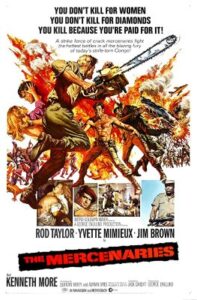
But no matter – Dark of the Sun, or The Mercenaries as it was also known, still seemed pretty hardcore to me.  Why, it even had a chainsaw fight in it!  Thanks to the Texas Chainsaw Massacre movies (1974 onwards) and the Evil Dead movies (1981 onwards), and to one-off entries like Motel Hell (1980) and Mandy (2018), chainsaw fights are ten a penny nowadays.  But back then, seeing someone lunge at someone else with a whirring, metal-toothed power tool was an intense experience.


Based on a 1965 Wilbur Smith novel and directed by Jack Cardiff, Dark of the Sun tells the story of some mercenaries being sent into action amidst the Simbas rebellion in early 1960s Congo. It stars Robert Taylor, Yvette Mimieux – Taylor and Mimieux reunited eight years after appearing in George Pal’s charming 1960 adaptation of H.G. Wells’s The Time Machine – Jim Brown, Kenneth More (subverting his usual, cuddly English-gentleman image by playing an alcoholic doctor) and Peter Carsten (playing a vile, child-murdering Nazi).  At the time, critics lambasted the film for what they saw as its extreme violence.  However, as Cardiff noted, the violence depicted didn’t come anywhere near the real atrocities that’d happened in the Congo then, or near the violence featured in movies in later decades.


I’d like to see a remake of Dark of the Sun that updates the intensity, grittiness and violence to fit with 2026 sensibilities and that places the action within the context of 2026 geopolitics.  And is more racially sensitive – any racism in the original movie went over my 13-year-old head but I’m sure that, viewing it today, I’d cringe at parts of it.   At the very least, and despite the presence of Jim Brown as one of the mercenaries, I suspect I’d find it infused with a ‘white saviour’ or ‘white man’s burden’ complex.


Quentin Tarantino is a huge fan of this film (as is Martin Scorsese) so, as I did with Von Ryan’s Express (1965), I recommend old Quent as the man to helm a remake of it.  I know he’s sworn that he’s only going to make ten films in his lifetime, and his next one will be his last, but I don’t believe that for an instant.


Come to think of it, Dark of the Sun has quite a few things in common with Von Ryan’s Express, including a cracking movie film poster designed by the splendid Frank McCarthy and the presence of Nazis.  And like the earlier film, Dark of the Sun prominently features a train.


As does my next candidate for a modern remake, which is….


© Granada Films


Horror Express (1972)

The much-loved British-Spanish movie Horror Express is set on a train hurtling across Siberia in the early 20th century.  The train is being stalked by a decomposing ape-man fossil that’s seemingly come back to life – in fact, it’s possessed by an alien lifeforce and has the power to suck people’s brains out through their eyeballs.  Trying to thwart it are British scientists Sir Alexander Saxon (Christopher Lee) and Dr Wells (Peter Cushing).  Things become even more complicated in the film’s final act when the train is invaded by a bunch of Cossack soldiers, led by Telly Savalas’s villainous Captain Kazan.


Directed by Eugenio Martin, Horror Express is basically The Thing (1982) set on board the train from Alfred Hitchcock’s 1938 classic The Lady Vanishes.  Saxon and Wells are variations on the characters of Charters and Caldicott, the stuffy but unflappable English cricket-lovers in Hitchcock’s movie who get caught up in the chaos.  That said, you never feel Christopher Lee and Peter Cushing are playing anyone other than themselves in Horror Express.  During their careers, the two actors made 22 movies together, were close friends offscreen and have an effortless chemistry here.


The decaying ape-man in the original movie is still icky, but it would be nice to see it in a modern remake with a decent special-effects budget where it could do properly mind-blowing, spectacularly gruesome Thing-like things.  To play Saxon and Wells, you’d need a pair of British actors who’ve worked together already and possess some of that Lee-Cushing chemistry – maybe Benedict Cumberbatch and Martin Freeman, from the BBC TV show Sherlock (2010-17)?


And to play Savalas’s murderous Captain Kazan, there can be only one man: Nicolas Cage.


Theatre of Blood (1973)

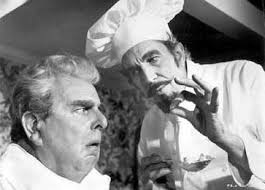
Until recently, I’d have been aghast at the thought of anyone remaking Douglas Hickox’s brilliant horror comedy Theatre of Blood, wherein Vincent Price plays an insane and hammily over-the-top Shakespearean actor called Edward Lionheart.  Enraged by the snobbish London theatre critics who’ve bad-mouthed his performances, Lionheart murders them one by one using methods borrowed from the Bard’s plays.  “They’re not going to start killing critics for giving bad notices, are they?” exclaims the campest critic, played by Robert Morley, who eventually meets a grisly fate modelled on events in Titus Andronicus.  A very distinguished cast of English character actors goes the same way as Morley: Michael Hordern, Dennis Price, Arthur Lowe, Harry Andrews, Robert Coote and Coral Browne.
 

© Harbour Productions Ltd / Cineman Productions / United Artists


There’s no shortage of famous modern-day British thespians who could play the supporting cast of doomed theatre critics in a remake – I’d enjoy seeing James Corden get the Titus Andronicus treatment – but surely, surely nobody could recreate the absolutely delicious performance that Vincent Price gives as Lionheart in the original movie?


Well, I thought that until I saw Ralph Fiennes in this year’s 28 Years Later: The Bone Temple.  Now I’m pretty sure he could be the Vincent Price of 2026.  And actually, Fiennes has played a character not dissimilar to Lionheart in 2022’s The Menu.


And if Fiennes wasn’t available, I suppose they could always call on Matt Berry.


The Beast Must Die (1974)

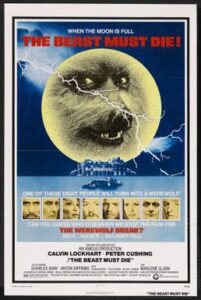
Paul Annett’s The Beast Must Die is a low-budget horror movie with an irresistible premise.  It’s about a millionaire big-game hunter, played by Calvin Lockhart, determined to bag a werewolf.  He rigs up his country estate with CCTV cameras and motion sensors, procures a helicopter and invites five unsavoury people to visit for a few days convinced that one of them  is a werewolf.  Among those playing Lockhart’s house-guests and staff are Peter Cushing, Charles Gray, Anton Diffring and a youthful Michael Gambon.  Needless to say, there is a werewolf present, but it gradually turns the tables on Lockhart and his hi-tech equipment, whilst also bumping off the supporting cast.


The ideas is irresistible, as I said, but watching The Beast Must Die on TV as a kid was a frustrating experience.  Due to the inevitable budgetary constraints, Lockhart’s mansion house and grounds aren’t that hi-tech and the werewolf, when it appears, just looks like a big dog.  You’d think the sequence where the werewolf takes out a helicopter would be thrilling, but it isn’t.  Let’s remake this one with a proper budget, so that it’s as awesome as it sounded on paper in 1974.
 

From wikipedia.org / © Amicus Productions / British Lion Films


Juggernaut (1974)

The most underrated but, in my mind, the greatest of 1970s disaster movies, Richard Lester’s Juggernaut is mostly set on a British ocean liner stuck out in the stormy north Atlantic.  An anonymous call to the company that owns the liner informs it that half-a-dozen bombs have been stashed on board and they’ll explode unless a ransom is paid.  With weather conditions too severe to allow the ship’s crew and passengers to be evacuated, and the authorities forbidding the company to pay the ransom – which would be surrendering to terrorism – a team of bomb-disposal experts led by Fallon (Richard Harris) and his sidekick Charlie (David Hemmings) are sent to try and make the bombs safe.


Back on dry land, a policeman (Anthony Hopkins), whose family are among those trapped on the ship, tries to discover the bomber’s identity.  I don’t want to give away any spoilers, but when a twitchy Freddie Jones appears onscreen, you know who it is.


Juggernaut has a wonderful cast all round – not just the three ‘H’s of Harris, Hemmings and Hopkins, but also Omar Sharif, Ian Holm, Shirley Knight, Clifton James, Julian Glover and many more.  But the show is quietly stolen by Roy Kinnear, playing the ship’s entertainment officer, who has the thankless task of keeping the passengers’ spirits up when at any moment they could be blown to smithereens.  When he organises a fancy-dress party, one passenger appears dressed as the Grim Reaper and carrying a round black object with BOMB written on it.


As well as being massively suspenseful, the film offers social commentary.  The ship is called the Britannic and it’s not difficult to see Juggernaut as a meditation on the sorry plight of Britain in the mid-1970s, its days as a world power well behind it, being battered by global events it had no power over, such as the Oil Crisis.  In 2026, a decade after Brexit and during the chaotic era of Trump, a remake of Juggernaut would be both more poignant and more cutting.


You could also cast, in a Juggernaut remake, the sons of three of its original stars, now well established as actors in their own right: Jared Harris, Toby Jones and Rory Kinnear.  But it’d be fun to see them in roles different from those their dads played.  Kinnear as the policeman, Jones as the entertainment officer, Harris as the bomber?
 

© Two Roads / United Artists
Films I’d like to see remade (Part 1)


From imdb.com / © Rank Organisation


I still find it disconcerting when films I enjoyed in my youth are remade in the 21st century: for example, 1980’s The Fog (remade in 2005), 1981’s The Evil Dead (remade in 2013) and Clash of the Titans (remade in 2010), 1986’s The Hitcher (remade in 2007), 1987’s Robocop (remade in 2014) and 1988’s Hairspray (remade in 2007).  My immediate and automatic response to such remakes is, “What, they’re remaking that movie already?  Have you no shame, Hollywood?”


This is followed by a feeling of horror as I realise just how long ago it was when those original movies were released.  The first Evil Dead movie was 32 years old – 32 years! – when its remake surfaced, though in my mind it was only yesterday when Sam Raimi’s Deadites made their first-ever appearance and started making life difficult for Bruce Campbell.   And actually, three of the films I remember most fondly from my youth, Philip Kaufman’s Invasion of the Body Snatchers (1978), John Carpenter’s The Thing (1982) and Brian De Palma’s Scarface (1983) were remakes themselves.  Body Snatchers appeared just 22 years after the 1956 original and The Thing appeared 32 years after its 1950 one.  Scarface was an outlier, since the first Scarface came out in 1932, more than a half-century earlier.


Maybe I shouldn’t be so concerned about how soon after the original movie that a remake appears.  I should be concerned about the quality of it – for remakes tend to be shite.  I haven’t seen all those mentioned at the beginning of this entry, but the ones I have seen have been nowhere near as good as the originals.  (The Evil Dead remake probably comes closest, but I still much prefer the ramshackle and low-budget, but resourceful, charm of Raimi’s 1981 film.)  That said, remakes don’t have to be bad all the time – the aforementioned ones by Kaufman, Carpenter and De Palma testify to that.


So, without further ado, here are some films – and one series of films – I wouldn’t mind seeing remade in the 21st century, with bigger budgets and better special effects.  But remade decently.


From wikipedia.org / © Rank Organisation


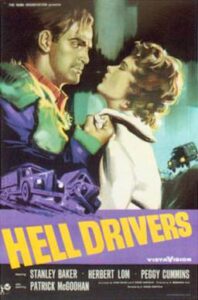
Hell Drivers (1957)

Blacklisted by the House Committee on Un-American Activities in 1951, American director Cy Endfield moved to Britain where, half-a-dozen years later, he made Hell Drivers.  Given the persecution Endfield had suffered, it unsurprisingly takes a dim view of American-style, cut-throat capitalism.  It has that underrated but magnificent actor Stanley Baker as an ex-con who finds a job as a truck driver with a dodgy haulage company, which threatens its drivers with the sack if they don’t deliver loads of gravel across treacherous roads at breakneck speeds.  The reason there aren’t more drivers employed to relieve the pressure, and reduce the danger, is because of a scam involving the local depot manager (William Hartnell) and its off-his-head Irish foreman (Patrick McGoohan, coming across like a brawnier version of Shane MacGowan).  The latter soon becomes Baker’s nemesis.


As well as a political message, Endfield injects Hell Drivers with an American-style grittiness rarely seen in British films of the period.  But what really makes the film a joy to watch nowadays is the cast.  As Kim Newman has written of it in Empire Magazine, “how many other movies have an ensemble which includes the original Dr Who (Hartnell), the first James Bond (Sean Connery), the Prisoner (McGoohan), a Man From UNCLE (David McCallum), a Professional (Gordon Jackson), Clouseau’s boss (Herbert Lom), plus Alfie Bass, the excellent Peggy Cummins (of the cult items Gun Crazy and Night of the Demon), the inimitably boozy Wilfrid Lawson, Jill Ireland and Sid James?”


In 2026, with capitalism more cut-throat than ever, a remake of Hell Drivers would be timely.  I don’t think, though, setting it in the wilds of Middlesex, West Sussex and Buckinghamshire, where the original was filmed, would work now, so it’d have to have its hard-pressed truck drivers pounding the roads of a less hospitable locale – the Alaskan tundra, say, or somewhere that retains some near-impenetrable tropical rainforest.


And to pay proper homage to the original, you’d definitely need a cast made up of actors who’ve played iconic roles in iconic TV shows or movie series.  You could have one of the grittier Bonds (Daniel Craig or Timothy Dalton), one of the grittier Doctors Who (Christopher Eccleston or Peter Capaldi), plus a Sherlock Holmes (Benedict Cumberbatch, maybe), a Harry Potter (Daniel Radcliffe), perhaps someone from the Breaking Bad universe (Bryan Cranston, say, or Bob Odenkirk)…  The possibilities are endless.


From wikipedia.org


The Margaret Rutherford Miss Marple movies (1961-64)

This is a little different.  I’d like to see the four movies made about Agatha Christie’s genteel sleuth of a certain age, Miss Marple, which had the delightful Margaret Rutherford in the leading role – Murder She Said (1961), Murder at the Gallop (1963), Murder Most Foul (1964) and Murder Ahoy! (1964) – rebooted as a TV show.  Not just another show about Miss Marple per se – there have been ones with Joan Hickson, Geraldine McEwan and Julia McKenzie – but one set in the universe of the four Rutherford movies.


Thus, its episodes would be set against the tableau of early-1960s England, with Miss Marple depicted as an obstinate, feisty old lady who refuses to know her place and keeps barging into and solving mysteries.  There’d be as much as humour as tension and the show would have the films’ supporting characters, like the timid librarian Mr Stringer (Rutherford’s real-life husband Stringer Davis), who reluctantly helps Miss Marple out, and the exasperated copper Inspector Craddock (Charles Tingwell), who begins each instalment telling her to mind her own business but ends it taking orders from her.  Meanwhile, Ron Goodwin’s jaunty Miss Marple Theme would burble in the background.


I suspect in a 2026 version Mark Gatiss would make a lovely Mr Stringer, while Daniel Mays would nicely fill the shoes of the long-suffering Inspector Craddock.  But who would play Miss Marple – or more precisely, play Margaret Rutherford playing Miss Marple?  Perhaps Dawn French, though she’d have to spend a long time in the make-up chair to recreate Rutherford’s famously jowly, hangdog features.


In the original movies, each murder that Rutherford / Marple investigated involved a British institution – a country manor, horse riding, the theatre and the Navy.  She’d duly rattle establishment cages by sticking her nose in where it wasn’t welcome.  So perhaps each episode of this hypothetical series would have her ruffling the feathers of other British institutions of the time – the Army, the House of Lords, Savile Row, Crufts, the country’s nascent rock ‘n’ roll industry…  Miss Marple meets the young Rolling Stones?  I’d pay good money to see that.


From wikipedia.org / © 20th Century Fox


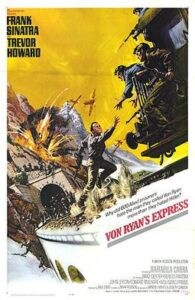
Von Ryan’s Express (1965)

I never had much time for Frank Sinatra, neither as an entertainer nor as a person, but he left an impression on my 10-year-old self the first time I saw the ripping World War II yarn Von Ryan’s Express.  It’s the story of an American airman, Ryan (Sinatra), downed in Italy, who joins forces with some Allied prisoners of war, led by Trevor Howard.  They attempt an audacious escape into neutral Switzerland by seizing control of a train and steering it up a railway line into the Alps.  Much derring-do is involved as German troops and aircraft go all-out to stop them reaching their destination.


It’s great, crowd-pleasing stuff until the ending – spoilers are coming! – which is depicted on the movie poster, painted by the great Frank McCarthy.  The train has almost made it to safety.  Having fought a rearguard action against the Germans, Sinatra is running after the train and has almost caught up with it.  But then….  What happened next put a dampener on things.  But it also lodged the film in my mind forever.


With 2009’s Inglourious Basterds, Quentin Tarantino showed his love for rip-roaring if cheesily improbable World War II adventures, so perhaps he could helm a remake of Von Ryan’s Express?  To stick to the innocent, uncomplicated spirit of the original, though, he’d have to forgo his use of the F-word and N-word, and his fetish for close-ups of ladies’ feet, and his nerdish references to ‘film-study criticism of the work of German director G.W. Pabst’.


© Hammer Film Productions / Seven Arts Productions


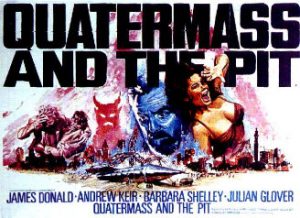
Quatermass and the Pit (1967)

Hammer Films’ sci-fi horror film Quatermass and the Pit was based on the 1958 BBC TV serial of the same name.  Both film and serial were written by Nigel Kneale.  It begins with workers on a London Underground extension project digging up an alien spacecraft full of dead, horned, insect-like creatures that are identified by scientist-hero Professor Bernard Quatermass (Andrew Keir) as inhabitants of the now-lifeless planet Mars.  It transpires that millions of years ago, these sneaky Martians arrived on earth and did some evolutionary tinkering on the apes who were the ancestors of modern humanity.  This tinkering included implanting in the apes an urge to conduct occasional culls whereby those with pure Martian programming exterminated those who’d developed mutations and lost that programming.


When some TV news crews descend on the scene, a power surge from their camera-cables reactivates the spacecraft and it triggers a new cull.  London becomes an apocalyptic hellscape where the human inhabitants who retain their Martian conditioning roam around, zombie-like, and use newly awoken telekinetic powers to kill everyone who’s lost it.


I still find Quatermass and the Pit impressive today, and scary, though inevitably there are special effects that reflect the limitations of Hammer’s budget.  I’d relish the prospect of a modern, big-budget retelling of the story.


One thing that makes the film effective, and affecting, is Kneale’s portrayal of the scientists.  Unlike usual movie-scientists, they aren’t cold-blooded, delusional, self-serving or plain weird.  Instead, Quatermass and his colleagues, Dr Roney (James Donald) and Barbara Judd (Barbara Shelley), are portrayed as decent human beings, working with an eager curiosity, a sense of duty and a sense of humour.  Keir and Donald were both Scots, so maybe a modern movie could cast Brian Cox as Quatermass and James McAvoy as Dr Roney.  Actually, I think a third Scottish actor, Karen Gillan, would be excellent as Barbara Judd.


To be continued…


© Metro-Goldwyn-Mayer

Cinematically stoned (Part 2)


© Taplin-Perry-Scorsese Productions / Warner Bros


I ended my previous post by promising I’d give a list of my favourite movie scenes wherein songs by the Rolling Stones are employed to memorable effect.  Here it is.


Jumpin’ Jack Flash (1968) in Mean Streets (1973)

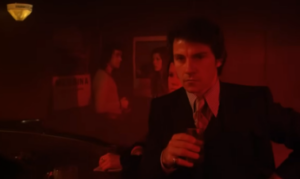
Wow.  Martin Scorsese really likes the Rolling Stones.  Not only has he made a concert movie about them, 2008’s Shine a Light, but he’s used their music in umpteen films: Goodfellas (1990), Casino (1995), The Departed (2006) and the one that first put him on the map, 1973’s Mean Streets.  Even today, more than 50 years later, the scene in Mean Streets where a young Robert De Niro comes swaggering through a bar, in slow motion, towards a pensive Harvey Keitel, while Mick Jagger hollers in the background about being “born in a cross-fire hurricane”, is a great synthesis of rock ‘n’ roll music and rock ‘n’ roll cinema.  Indeed, Jumpin’ Jack Flash is a fitting accompaniment for the arrival in popular consciousness of De Niro, who’d spend the rest of the 20th century showing Hollywood how to do proper acting.  The 21st century, featuring such efforts as The Adventures of Rocky and Bullwinkle (2000), Little Fockers (2010), New Year’s Eve (2011) and Dirty Grandpa (2016)…  Okay, not so much.


Satisfaction (1965) in Apocalypse Now (1979)

The Stones’ early, primordial and still potent stomper Satisfaction gets a brief but memorable airing in Francis Ford Coppola’s baroque Vietnam War masterpiece, playing on the radio while Captain Martin Sheen and his not-exactly-fighting-fit crew go cruising up the Nùng River in search of Marlon Brando.  Cue some funky on-deck dance moves by a frighteningly young-looking Laurence Fishburne and some funny / cringeworthy water-skiing moves by Sam Bottoms that knock various Vietnamese people out of their fishing boats.


© Omni Zoetrope / United Artists


Sympathy for the Devil (1968) in Alien Nation (1988) and in Interview with the Vampire (1994)

Graham Baker’s sci-fi / cop movie Alien Nation isn’t very good.  Its premise of an alien community getting stranded on earth and having to integrate as best as they can with the curmudgeonly human natives was handled much better in Neill Blomkamp’s District 9 (2009).  But I do like a woozy, hypnotic scene in it where alien-loathing cop James Caan enters a sleazy alien bar while a lady-alien performs an erotic dance to the strains of Sympathy for the Devil.  Not the original Stones song, but a correspondingly woozy, hypnotic cover-version of it by the great Jane’s Addiction.  I can’t find a film-clip of the scene, but here’s the Jane’s Addiction cover.


Meanwhile, Neil Jordan’s adaptation of Anne Rice’s Interview with the Vampire ends with Sympathy for the Devil on the soundtrack.  Again, this isn’t the Rolling Stones version but a cover, this time by Guns n’ Roses.  It’s every bit as ramshackle, shonky and (for me) enjoyable as the other covers Guns n’ Roses have done, for example, of Wings’ Live and Let Die (1973) and Bob Dylan’s Knockin’ on Heaven’s Door (1973).  Sympathy for the Devil kicks in when the vampire Lestat – Tom Cruise in one of his rare interesting roles – pops up to claim Christian Slater as his new vampirical companion for eternity.


Can’t You Hear Me Knocking? (1971) in Casino (1995)

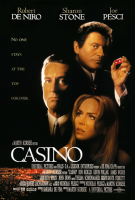
While Martin Scorsese serenades Robert De Niro and Harvey Keitel with Jumpin’ Jack Flash in Mean Streets, he employs the Stones song Can’t You Hear Me Knocking? for another of his regulars, Joe Pesci, in Casino.  Remarkably, Scorsese plays all seven minutes of the Santana-esque Can’t You… as an accompaniment to a lengthy sequence showing how Pesci’s Casino character Nicky Santoro gets established in Las Vegas.  Predictably, the sequence has Pesci doing what Pesci usually does in Scorsese movies: being a psychotic shit, barking orders at hoodlum sidekicks twice his size, eating in restaurants, ingratiating himself with fellow Mafiosi, being a psychotic shit, cursing and swearing, getting a blow-job, being a psychotic shit, talking about food, knocking off jewellery stores, acting the loving family man with his non-criminal relatives… and being a psychotic shit.


© Légende Entreprises / Universal Pictures


Ruby Tuesday (1967) in Children of Men (2006)

Wistful Stones ballad Ruby Tuesday features briefly on the soundtrack of Alfonso Cuarón’s gruellingly pessimistic science-fiction thriller Children of Men.  It’s another cover, sung by Franco Battiato.  We hear it during one of the movie’s calmer moments when Theo (Clive Owen) is visiting his old mate Jasper (Michael Caine), whose home provides a small pocket of sanity amid the unfolding dystopian grimness.  Amusingly, Caine, well known in real life for being a right-wing old grump with an aversion to paying tax, here plays an elderly anarcho-hippy with a fondness for smoking exceptionally strong pot.


Gimme Shelter (1969) in The Departed (2006)

Martin Scorsese loves the Rolling Stones and he loves their apocalyptic number Gimme Shelter in particular.  By my count he’s used it in three movies: Goodfellas, Casino and The Departed.  It’s best deployed at the beginning of The Departed, rumbling in the background while gangland thug Frank Costello (Jack Nicholson) expounds his philosophy.  “I don’t want to be a part of my environment,” he intones, imbuing his words with that leery, languid menace that only Nicholson is capable of.  “I want my environment to be a part of me.”  Strangely, in Scorsese’s Shine a Light two years later, Gimme Shelter was one of the songs the Stones didn’t perform on stage.  Marty missed a trick there.


© Plan B Entertainment / Warner Bros


Street Fighting Man (1968) in Fantastic Mr Fox (2009)

Director Wes Anderson also sticks Rolling Stones into his movies, but so far I haven’t mentioned him because I think most of his work is smug, pretentious and annoying.  For example, Play with Fire (1965) figures prominently in 2007’s The Darjeeling Limited, an Anderson movie so twee I find it the cinematic equivalent of being force-fed with chocolate-cake mix.  However, I like the scene in his stop-motion-animation adaptation of Roald Dahl’s Fantastic Mr Fox where, to the sound of the rabblerousing Stones anthem Street Fighting Man, Farmers Bean, Boggis and Bunce use three diggers to tear up the den of the titular Mr Fox; forcing the den’s inhabitants to frantically dig an escape-route.  Yes, they really ‘dig’ that song.  Sorry.


And finally…  Out of Time (1968) in Once Upon a Time in Hollywood (2019)

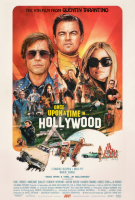
I’m not the biggest fan of the Stones song Out of Time – Jagger’s vocals get a bit too caterwauling for my liking – but it sees good satirical use in Once Upon a Time in Hollywood, Quentin Tarantino’s paean to the American movie-making capital in the late 1960s, a fascinating period when traditional notions about what made a good film were rapidly being undermined by an uppity younger generation.  Played when Rick Dalton (Leonardo DiCaprio), his new Italian spouse Francesca Capucci (Lorenza Izzo) and sidekick Cliff Booth (Brad Pitt) return from Italy, where Rick has been making spaghetti westerns and action thrillers with the likes of Sergio Corbucci and Antonio Margheriti, Out of Time gives an one-the-nose summation of DiCaprio’s sad-sack character – an actor a bit too old, un-hip and uncomprehending of the changing world around him to get the leading roles he once did, now doomed to playing villains in second-rate TV shows.


© Columbia Pictures / Sony Pictures Releasing 

Paul Thomas Anderson wins this battle


© Warner Bros. Pictures / Ghoulardi Film Company


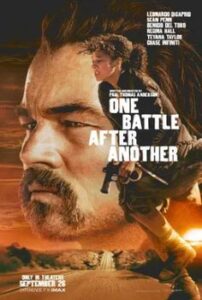
The critics have, almost universally, lavished praise on One Battle after Another (2025), the new movie written and directed by Paul Thomas Anderson.  (Though he didn’t try to adapt it directly, Anderson’s script took some inspiration from Thomas Pynchon’s 1990 novel Vineland.)  The praise is richly deserved.  I went to see it in my local cinema a few days ago and, afterwards, I hadn’t felt so exhilarated by a film since watching Mad Max: Fury Road (2015) on a big screen a decade earlier.


Heading the movie’s cast is Leonard DiCaprio, who plays Pat, a bomb-maker involved in a revolutionary American group called the French 75.  The ’75 stick it to The Man by freeing recent Latin-American immigrants from detention centres and blowing up banks and the offices of right-wing politicians.  Surprisingly, the plodding, unshowy Pat has a relationship, then sires a child, with fellow-revolutionary Perfidia Beverley Hills.  Essayed by Teyana Taylor in a short but devastating performance, Perfidia is the opposite of DiCaprio’s character.  She’s a force of nature: loud, fearless and given to flamboyant gestures, like humiliating the sleazy commander of a detention centre by forcing him to jerk off in front of her.  It’s entirely in keeping with her character when she’s shown firing a machine gun whilst massively pregnant.


To put an end to the French 75, the authorities appoint the ruthless and immoral Captain Steven Lockjaw (Sean Penn), coincidentally the detention-centre commander who was made to have that embarrassing, public wank.  Lockjaw captures Perfidia and compels her to rat on her colleagues, and thereafter it becomes open season on the ’75, with most of them being arrested or – more often – summarily executed.  Pat and his now-infant daughter manage to escape with new identities (‘Bob and Willa Ferguson’) and end up living a low-key, mostly off-grid existence in a Californian town called Baktan Cross.  Pat / Bob decays into a booze and dope-raddled paranoid, terrified the past will catch up with them.  Wilma (Chase Infiniti) grows up with no idea of her real origins and becomes a teenager bemused by, and frequently having to nursemaid, her eccentric old dad.


15 years later, Captain Lockjaw is invited to join an Illuminati-like organization called the Christmas Adventurers Club, whose members belong to the white American elite and are wealthy, powerful… and extremely racist.  Lockjaw’s relationship with Pefidia in the days of the French 75 was more than one of pursuer and quarry.  He came to fetishise her, his obsession triggered by that first, masturbatory encounter, and they were briefly intimate prior to her capture – which highlights what a wild, try-anything-once character Perfidia was.  Now Lockjaw fears that he might be Wilma’s father, not Pat / Bob, and having a mixed-race daughter would obviously torpedo his chances of joining the Christmas Adventurers.  So he launches a military crackdown on Baktan Cross, ostensibly to round up illegal immigrants, but really so he can find Pat / Bob and the inconvenient Wilma and erase them.


© Warner Bros. Pictures / Ghoulardi Film Company


That’s the set-up established during One Battle After Another’s first quarter and it’s all you need to know.  What follows is a cinematic rollercoaster ride as Pat / Bob and Wilma, in separate locations when Lockjaw and his uniformed, heavily-armed goons crash into Baktan Cross, flee, hide, fight back and try to find each other and escape.  Along the way, they  encounter Sensei Sergio St. Carlos (Benicio del Toro), Willa’s local karate teacher who’s much more than he seems; a bounty hunter with a conscience (Eric Schweig); an assassin sent by the Christmas Adventurers to clean up Lockjaw’s mess (John Hoogenakker); some skateboarding radicals; a nasty far-right militia who dispose of people for money; and a secret enclave of nuns with guns


As you’ll gather from the synopsis, One Battle After Another is a politically charged movie.  It regularly focuses on how how the USA reacts to immigrants,  often impoverished, frightened and vulnerable people, both mistreating them and unscrupulously using them as pawns in power games and culture wars.  This is timely considering what Trump and his minions are doing at the moment.  It has to be said, though, that Lockjaw and the police and troops under his command go about their business with much more precision, organization and efficiency than the masked, clumping thugs in Trump’s Immigration and Customs Enforcement (ICE) agency have managed so far.  Predictably, you don’t have to look far on the Internet before you find negative reviews of the movie posted by far-right frothers, incensed by what they see as its Marxist / communist / socialist / radical-leftist leanings.


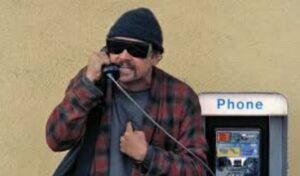
But as well as being political, One Battle After Another is very funny.  DeCaprio’s Pat / Bob may have been a revolutionary once, but for most of the movie he’s an amusingly grumpy and befuddled middle-aged dad, showing zero patience, say, for his daughter’s insistence that he respects her schoolfriends’ preferred pronouns.  Particularly funny are the scenes where, on the run from Lockjaw, he tries to phone what’s left of the French 75 to beg them for help.  He’s far from impressed when they demand he reels off an array of code-phrases to prove he’s who he says he is – codes he’s mostly forgotten during the past 15 years.  DeCaprio’s subsequent meltdowns are hilarious, though these scenes will strike a chord with anyone who, in the days before voice-recognition, tried to phone their bank but failed to cite the right security numbers.


The film makes interesting parallels between the French 75 and the Christmas Adventurers Club.  Though they’re positioned at different ends of society, at the bottom and at the top, both are shrouded in secrecy and pompous security protocols and both believe they are doing great works and bending history to their wills.  Seen from outside, though, they seem like two groups of overgrown kids who’ve set up gangs with stroppy rules about who gets to be ‘in’ and who doesn’t.


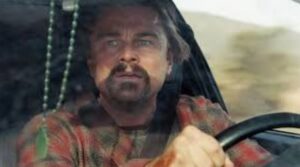
One Battle After Another features, perhaps, Leonardo DeCaprio’s best-ever performance.  His Pat / Bob character is an extension of Rick Dalton, the frustrated over-the-hill movie star he played in Quentin Tarantino’s Once Upon a Time in Hollywood (2019).  But while Dalton had his loyal buddy and stunt double Cliff Booth (Brad Pitt) to keep him from going off the rails, Pat / Bob has no one when the shit hits the fan.  His daughter Willa is elsewhere and he has to overcome his many insecurities and get his act together alone.  At the same time, DeCaprio convinces us that Pat / Bob, despite his chaotic nature, is a loving father.  It’s his desire to save her that keeps him going, no matter what fate throws at him.  And in this film, it throws a lot.


© Warner Bros. Pictures / Ghoulardi Film Company


He’s excellently partnered by Chase Infiniti as Willa.  Though in reality the actress is 25 years old, she convincingly plays a teenager – one who has her head well-screwed-on at the start of proceedings, but who still has to deal with a very steep learning curve.


Meanwhile, Sean Penn is splendidly villainous as Lockjaw.  He’s memorable both because of his grotesque physicality – with his contorted face, weird musculature and lurching gait, he looks like Popeye the Sailor Man rendered in human flesh – and because of his deeply screwed-up personality, which is simultaneously psychotic and pathetic and driven by a juvenile sense of entitlement.


Great though DeCaprio, Infiniti and Penn are, Benicio del Toro comes close to quietly stealing the show.  When he first appears, you see him as a character who’s popped up in DeCaprio’s movie.  But later, having learnt more about him – his character runs an extensive and meticulously-organised sanctuary and support-network for undocumented immigrants in the town – you begin to feel DeCaprio has strayed into his movie.


There’s also a lovely score courtesy of Radiohead’s Johnny Greenwood and, late on, a car chase that could become as legendary as the one in the Steve McQueen classic Bullit (1968).  And Paul Thomas Anderson handles things at all times with aplomb.


One Battle After Another should win a slew of Oscars at next year’s Academy Awards.  By then, though, Donald Trump may have banned all opposition parties in the USA and put the country under martial law, enforced by real-life Steven Lockjaws in ICE, the National Guard and various far-right militias.  So it might not.


If that proves to be the case, I can only say, “Viva la revolution!”


© Warner Bros. Pictures / Ghoulardi Film Company

Even bloodsuckers get the blues


© Warner Bros / Proximity Media


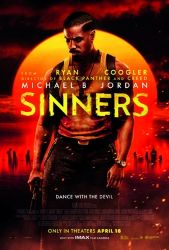
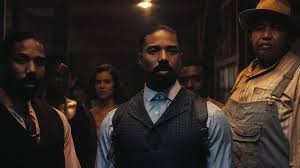
A few days ago my partner and I went to see Sinners, the new horror-cum-gangster film directed, written and co-produced by Ryan Coogler.  Here are my thoughts on it.  And before I go any further, a word of warning: there will be spoilers.


To be honest, I wasn’t expecting a great deal, as I’d heard something about its plot and it sounded horribly like 1996’s Robert Rodriguez-directed, Quentin Tarantino-scripted From Dusk till Dawn.  Although a few misguided souls nowadays look back on that film as a neglected and misunderstood classic, I have to say I f**king hated it.  In part, this was because From Dusk till Dawn began so well, as a nastily-effective little crime thriller wherein two fleeing bank-robbing brothers (Tarantino and George Clooney) kidnap a pastor (Harvey Keitel) and his family and force them to smuggle them over the US / Mexico border.  Disappointingly, things then go south in all senses of the phrase.  The group arrives at a mysterious Mexican bar called the Titty Twister where the staff and many of the patrons prove to be – surprise! – vampires.  The rest of the film is a ludicrous, tongue-in-cheek splatterfest where the humans battle against waves of bloodsucking undead.  While From Dusk Till Dawn’s sudden change of tone has been praised in some quarters for its audacity, I found it a vertiginous plunge into cheesy bollocks.


Anyway, the structure of Sinners is not dissimilar.  Its first half plays out as a period gangster story, then vampires show up and its latter half becomes an exercise in horror.  Set in the Mississippi Delta in 1932, it’s about the homecoming of black gangster twin brothers Stack and Smoke (both played by Michael B. Jordan) who’ve recently left Chicago where, it’s suggested, they worked for Al Capone.  On their home turf, they embark on a new project – purchasing a disused sawmill and turning it into a juke joint, i.e.. a place for live music, dancing, drinking and gambling whose customers are from the local African American community.


To ensure the juke joint’s opening night is a success, they staff it with trusted friends, family members and associates: Smoke’s ex-wife, the occult-dabbling Annie (Wunmi Mosaku), and Chinese shopkeepers Grace (Li Jun Li) and Bo (Yao) to handle the catering; hulking buddy Cornbread (Omar Miller) to man the door; and boozy old bluesman Delta Slim (Delroy Lindo), slinky singer Pearline (Jayme Lawson) and young, startlingly-talented guitarist Sammie (Miles Caton) to provide the music.


© Warner Bros / Proximity Media


Despite a few obstacles – two thieves who soon regret tangling with the take-no-prisoners Stack, the fact that the sawmill’s former owner is head of the local chapter of the Ku Klux Klan, and the disapproval of Sammie’s dad, a preacher who believes music is only virtuous if it’s used to further the word of the Lord – the juke joint opens, pulls in the crowds and is soon swinging.  And then the vampires arrive.


Yes, I was dreading this moment – because I had really enjoyed the non-fantastical part of the film.  Coogler did a great job depicting the minutiae of the 1932 Mississippi Delta.  This was a world where the black population was just a couple of generations removed from the official slavery of the Confederacy and most of them now toiled in the racket that was sharecropping, a form of unofficial slavery.  At the same time, they were crafting a musical culture, the blues, that would ultimately revolutionise American and global music through its influence on rock and roll.  One touch among many that I liked here was the portrayal of the Chinese shopkeepers, Grace and Bo, who thanks to their ethnicity are able to run stores in both districts of the Mississippi town of Clarksdale, the black one and the white one.


Anyway, when the vampires show up, does the film turn to shite as From Dusk till Dawn did?  Thankfully, no.  Coogler provides some foreshadowing to prepare us for the twist, so it doesn’t come as a credibility-straining bolt from the blue.  During the opening sequence, a voice-over talks about certain types of music being “so pure it can pierce the veil between life and death, past and future” and attract supernatural creatures – an idea that’s echoed later when the vampires admit Sammie’s miraculous guitar-playing has drawn them to the juke joint.  (Even before the vampires arrive, Coogler treats us to a phantasmagorical sequence where Sammie’s playing seems to conjure up among the dancing crowd the spectres of music past and future – West African shamans, Chinese Xiqu performers, hip-hop DJs and an electric guitarist who looks like he’s a member of George Clinton’s P-Funk collective.)


Also preparing viewers for the tonal switch is an earlier sequence where a white man, Remmick (Jack O’Connell), flees from a squad of Choctaw Native Americans and takes refuge in a cabin inhabited by a hard-up white couple.  The pursuing Native Americans politely warn the couple that they’re sheltering something evil.  But as KKK robes are visible inside the cabin, it’s no surprise that the couple believe the story of their white visitor rather than that of the ‘Injuns’.  Noticing the sun is setting, and with a shotgun pointed at them, the Choctaw decide discretion is the better part of valour and retreat.  Which leaves Remmick to reveal himself as a vampire and infect his two saviours.


Coogler leaves this bit of world-building unexplored – which makes it wonderfully intriguing.  Why are the Choctaw acting as vampire hunters?  It also reminds me of the start of John Carpenter’s The Thing (1982), where a dog – actually the titular thing in canine form – is chased by a pair of wrathful Norwegians in a helicopter.  Compared to the Norwegians, though, the Native Americans are more pragmatic and level-headed.


© Warner Bros / Proximity Media


Later, Remmick and the vampirised Klan couple appear on the threshold of Smoke and Stack’s new juke joint, bearing musical instruments and pleading to be let in (“We heard tell of a party”) so that they can have a jamming session with Sammie.  Sinners makes much of the belief that to get onto a premises, a vampire has to be invited – and Smoke and Stack, suspicious of white folks, are in no hurry to invite this trio inside.  So they bide their time outside, biting and vampirising anyone who goes home early or nips out of the building for a pee.  While they wait for their opportunity to get inside, their numbers grow…


In a smart move, Coogler makes Remmick Irish and gives him a taste for music as strong as his taste for blood.  So, lurking outside, the vampires knock out a few tunes themselves – a charming version of the Irish / Scottish folk number Wild Mountain Thyme, for instance, and when there’s enough of them to stage a full-scale vampire hooley, a raucous rendition of Rocky Road to Dublin, during which Remmick indulges in some step-dancing.  This makes being a vampire look like fun and Remmick, entreating the folks in the juke joint to surrender to him and his horde, makes a persuasive-sounding case for being vampirised.  Once you’re a vampire, it doesn’t matter what skin-tone you have.  Black vampires are treated no worse than white ones: “This world already left you for dead.  I can save you from your fate.  I am your way out.”


There’s a snag, of course.  Remmick, as the Count Dracula / Mr. Barlow-style lead vampire, calls the shots and his minions have to do his bidding.  Indeed, they seem parts of a giant hive-mind – evidenced by their chorused singing of Rocky Road to Dublin, which contrasts with the individuality Sammie expresses with his guitar.  And Remmick’s interest in Sammie and his music isn’t motivated by an impulse of sharing but by a desire to assimilate them.


It’s fun to speculate who or what Remmick symbolizes.  When he makes his first pitch at the juke joint’s door, begging to be let inside while Sammie, Delta Slim and Pearline perform, I was reminded of those white British rock-and-roll bands of the 1960s, like the Rolling Stones, the Animals and the Yardbirds.  Influenced by the likes of Robert Johnson and Muddy Waters, they started their careers desperate to play blues music and become known as bluesmen themselves.  Which prompted Sonny Boy Williamson II to quip caustically: “These English boys want to play the blues real bad… And they do, real bad.”


But maybe it makes more sense to compare Remmick to the white-owned American music industry.  His hunger for Sammie parallels how that industry gobbled up black artists, of blues, jazz, gospel, soul, funk, whatever, and made a fortune off their music whilst giving them as little credit, money and control over their work as possible.  Often, their songs ended up being sung by someone else, someone white – see Pat Boone singing a version of Little Richard’s Tutti Frutti just five months after its release in 1955 – with precious few royalties making it their way.


Incidentally, late on, Remmick comes out with a sob story about how he was persecuted and deprived of his land in Ireland – presumably at the hands of the British and presumably back in the days when he was still human.  That a victim of oppression has become a supernatural killing machine, one with a fascistic disregard for the lives of the people he feeds on, is Coogler’s way of reminding us that many poor white people, treated like dirt in their home countries, emigrated to other parts of the world where they treated indigenous people and black people like dirt too.  It’s a sad reflection on human nature that people near the bottom of the pile have a psychological need to believe there are people even further down the pile whom they can mistreat and regard as inferior.  Though this observation would no doubt delight Elon Musk, who recently grumbled that the “fundamental weakness of Western civilization is empathy”.


I’ve spent a lot of time analysing Sinners but I should also say it’s a supremely entertaining movie.  It’s exciting, scary, funny and atmospheric.  Furthermore, it proves a point that many filmmakers overlook – if you want a horror film to grip an audience, give them likeable and sympathetic characters to identify with.  That way, they have an investment in those characters and things feel much more tense when bad stuff starts happening.


© Cedric Burnside Project

© Silvertone Records


It goes without saying that the soundtrack is great too.  I’m particularly pleased to see that Cedric Burnside had a hand in performing some of the blues tunes – I attended a cool gig by Burnside at the Edinburgh Jazz and Blues Festival in 2015 and afterwards got his signature on a CD as a present for one of my mates.  Also, don’t rush off when the credits start rolling at the end.  There’s still a scene to come, one set in the early 1990s and featuring the venerable bluesman Buddy Guy.  (By a coincidence I saw Guy perform in the early 1990s, though obviously the early-1990s Guy in Sinners is a good bit older than the one I witnessed.)  It’s a coda that’s both sinister and affecting.


And the acting is excellent.  Michael B. Jordan is impressive in the twin roles of Smoke and Stack.  I soon forgot that both characters were being played by the same person.  It’s a pleasure seeing Delroy Lindo again, whom I fondly remember as the villain in the 1995 adaptation of Elmore Leonard’s Get Shorty and from numerous Spike Lee movies.  And as Sammie, Michael Caton is a revelation.  He’s young and naïve, as the script demands, but he’s blessed with a deep, prematurely-old voice that totally persuades you this lad can sing and play the blues.


One thing about the casting, though.  Jack O’Connell is perfectly fine as Remmick.  But since the character is a scary old monster who’s Irish and musical, I don’t know why they didn’t cast the obvious candidate for the role: Van Morrison.


© Warner Bros / Proximity Media

The jolly films of Roger (Part 2)


© American International Pictures


Following on from my last blog-post, in which I paid tribute to the prolific, indefatigable and – it has to be said – thrifty filmmaker Roger Corman who died on May 9th, here’s a round-up of my favourite films that Corman directed.


A Bucket of Blood (1959)

Character actor Dick Miller worked regularly with Roger Corman.  His biggest role for him was in a movie that’s also Corman’s best work of the 1950s, the horror-comedy A Bucket of Blood.  Miller plays a would-be avant-garde sculptor called Walter Paisley who’s increasingly frustrated at his lack of talent.  This isn’t helped by the fact that, to make ends meet, he has to work as a busboy at the local Beatnik café, which is full of pretentious tossers going on about what creative geniuses they are.  “Be a nose!  Be a nose!” the hapless Paisley cries as he tries and fails to fashion a recognisable human visage out of a lump of clay.  After accidentally killing his landlady’s cat and then killing an undercover cop who’s trying to implicate him in some drug-dealing at the café (Paisley memorably cleaves his head with a skillet), he hits on a way of producing perfectly proportioned statues: committing murder and coating the bodies in clay.  Frankly, the resulting corpse-statues look hideous, but that doesn’t stop the Beatniks at the café proclaiming Paisley an artistic genius.


Their lack of taste in sculpture mirrors their lack of taste in poetry.  At the beginning we hear Beatnik bard Maxwell Brock (Julian Burton) delivering an epic, and epicly bad, poem called Life is a Bum, which goes: “Life is an obscure hobo bumming a ride on the omnibus of art…  The Artist is, all others are not…  Where are John, Joe, Jake, Jim, Jerk?  Dead, dead, dead!  They were not born before they were born, they were not born…  Where are Leonardo, Rembrandt, Ludwig?  Alive, alive, alive!  They were born…!


© Alta Vista Productions / American International Pictures


The Raven (1963)

As a kid, I loved this movie, the fifth of Corman’s Edgar Allan Poe adaptations for American International Pictures.  The tale of a trio of feuding magicians played by Vincent Price, Boris Karloff and Peter Lorre, it’s more fantasy than horror – but spiced with delightfully ghoulish moments, such as when a torturer checks the temperature of a red-hot poker by pressing it into his own arm, or when Price opens a little casket and is discombobulated to find it full of human eyeballs.  (“I’d rather not say,” he croaks when Lorre asks him what’s inside.)  It’s like a version of Walt Disney’s Bedknobs and Broomsticks (1971) for morbid children.


Needless to say, the film’s connection with Edgar Allan Poe is extremely loose.  In fact, it’s only Karloff turning Lorre into a raven twice during the film that allows Corman to tack the title of Poe’s most famous poem onto it and have Price recite the poem mellifluously during its opening scene.  Meanwhile, in the role of Lorre’s son, we get a 26-year-old and amusingly wooden Jack Nicholson.


© Alta Vista Productions / American International Pictures


X: The Man with the X-Ray Eyes (1963)

A non-gothic movie Corman made whilst in the middle of his Edgar Allan Poe cycle, the sci-fi chiller X: The Man with the X-Ray Eyes (1963) is about a scientist, played by Ray Milland, who experiments on his own eyes and ends up seeing beyond the usual visual spectrum perceptible to humans.


I wrote about this movie last year in a post about its scriptwriter, Ray Russell.  “Milland’s increasingly penetrative vision goes from letting him see though clothing – hence a party scene where, to his bemusement, the dancing revellers appear to be cavorting in the nude – to letting him see the distance edges of the universe, where horrible things lurk.  How one reacts to the film today depends on how one reacts to the special effects that Corman, a famously thrifty filmmaker, deploys to represent Milland’s visions.  They vary from psychedelic patterns and filters to (when he’s peering into human bodies) flashes of what are obviously photos and diagrams taken from human-anatomy manuals.  The effects are either desperately ingenious or just plain desperate, depending on your attitude.  Still, the film cultivates an effective mood of cosmic horror and the ending is nightmarish in its logic.”


The Masque of the Red Death (1964)

Corman’s majestic adaptation of Edgar Allan Poe’s The Masque of the Red Death, scripted by Charles Beaumont and R. Wright Campbell (with a second Poe story, Hop Frog, stitched into the plot for good measure) and beautifully shot by the great Nicolas Roeg, showcases Vincent Price at his sumptuously evil best.  He’s Prince Prospero, who’s holed up in his castle with an entourage of loathsome aristocrats while a plague, the Red Death, decimates the countryside outside.  Price and friends happily live a life of decadence, fuelled by drink, drugs, sex and diabolism – rather like Boris Johnson and his lackeys and minions partying at No 10, Downing Street, during Covid-19 and breaking all their own lockdown restrictions – while refusing to help the neighbourhood’s terrified peasants.  However, when they decide to enliven their social calendar with a fancy-dress masque, the masque is gate-crashed by a mysterious, Ingmar Bergman-esque figure swathed in a red robe.  Guess who that is.


© Alta Vista Productions / Anglo-Amalgamated / Warner Pathé  


Tomb of Ligeia (1964)

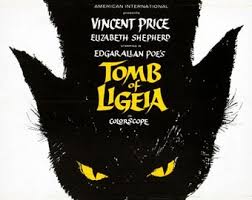
Made the same year as Masque, Corman’s Ligeia has Price in a more sympathetic role, playing a haunted and reclusive man who tries to put his troubles behind him and find happiness with a new wife (Elizabeth Shepherd).  Unfortunately, his former wife, though dead, is still around in spirit form and won’t leave him in peace.  Tomb of Ligeia has a slightly over-the-top ending, but the build-up to it, involving black cats, flag-stoned passageways, cobwebs, candlelight, hypnosis, Egyptology and some spectacular monasterial ruins filmed at Castle Acre Priory near Swaffham in England’s County Suffolk, is spookily wonderful.


The Wild Angels (1966)

Just what is it that you want to do…?”  “Well, we wanna be free, we wanna to be free to do what we wanna do.  And we wanna get loaded and we wanna have a good time.  And that’s what we’re gonna do….  We’re gonna have a good time, we’re gonna have a party!


Scottish alternative rock / dance band Primal Scream immortalised this exchange from Corman’s The Wild Angels, between Frank Maxwell’s preacher and Peter Fonda’s Hells Angel, by sampling it on their 1990 dancefloor hit Loaded.  Though to be fair, the American grunge band Mudhoney got there first when they sampled it on their song In and Out of Grace two years earlier.  It’s also recited at the climax of The World’s End, Edgar Wright’s underrated sci-fi / horror satire from 2013, during the face-off between Simon Pegg and a supercilious alien intelligence voiced by Bill Nighy.


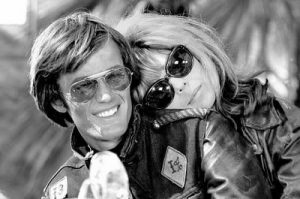
In addition to Fonda, The Wild Angels features Nancy Sinatra, Bruce Dern, Diane Ladd – supposedly Dern and Ladd’s daughter Laura was conceived during filming, so Laura Dern is something else we have Roger Corman to thank for – and the baby-faced Michael J. Pollard shortly before he played W.C. Moss in Bonnie and Clyde (1967).  The script, officially written by long-term Corman associate Charles B. Griffith and unofficially rewritten by Peter Bogdanovich, is minimalist. While there’s stuff about Fonda’s Hells Angels chapter pursuing a stolen bike, and about Dern’s character being shot by the cops and having to be rescued from a hospital, it’s mainly a frame for scenes in which the Angels offend Middle America.  Corman did his research by throwing parties with free beer and marijuana for real Hells Angels.  He had Griffith attend them and make notes while those Angels recounted their wild (and no doubt exaggerated) tales of life on the road.


© American International Pictures


At least Griffith and Bogdanovich don’t pull their punches.  In the script, the Angels come across as pretty assholey, particularly with their love for Nazi symbols and memorabilia.  This causes a confrontation between them and a World-War-II veteran (Dick Miller again) early in the movie.  When Dern’s character dies and they organise a funeral for him – predictably, the church service degenerates into an orgy – the coffin is draped in a Nazi flag.  The real Hells Angels, some of whom had appeared in the film, were so annoyed by Corman’s portrayal of them that they threatened to both kill him and sue him (presumably not in that order).  If that wasn’t enough, Corman had Frank ‘Dodgy Connections’ Sinatra breathing down his neck, concerned about daughter Nancy’s safety among the Angels on the set.  Actually, the story of an exploitation director making a biker movie who unwittingly antagonises the Hells Angels and the Mafia sounds like it would make a good exploitation movie.


The Trip (1967)

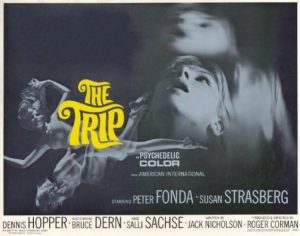
Corman, Fonda and Dern were united for this movie, scripted by one Jack Nicholson.  Yes, it’s about a trip, a hallucinogenic one, experienced by a TV commercial director played by Fonda, wearing a sensible red V-necked sweater.  He takes LSD as a reaction to the break-up of his marriage and the trip initially happens at the home of, and under the watchful eye of, a friend played by Dern, wearing a sensible eggshell-blue polo-neck and fawn jacket.  These scenes were filmed in the house of Albert Lee, leader of the rock band Love.  The cost-conscious Corman was surely pleased to discover that Lee’s house had so much psychedelic décor already it hardly needed to be dressed up for the film.  However, when Fonda hallucinates that he’s killed Dern – he hasn’t – he panics and flees down to Sunset Strip.  Then things really get groovy.


Seen today, The Trip is inevitably something of a museum piece and the low budget means some of its fantasy scenes are ropey.  Bits where Fonda, now wearing a baggy white shirt like a romantic poet, is pursued by medieval, cloaked-and-cowled figures on horseback through what is obviously modern-day California are particularly cringey.  But there are enough genuinely weird things – Fonda having a question-and-answer session with Dennis Hopper on a carousel, Fonda making love to a lady under some heavily patterned lighting that makes them look like psychedelically-coloured chameleons, Fonda having a panic attack inside Dern’s wardrobe – to make it memorable.  And if you enjoy a good 1960s-movie psych-out sequence, the one where the heavily-tripping Fonda blunders into a night club during a live rock performance is awesome.


© American International Pictures


Bloody Mama (1970)

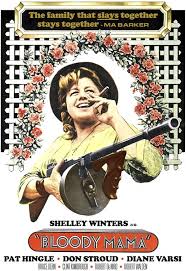
Like The Wild Angels, this Corman movie isn’t so much a story as a series of outrages, with reprobates lurching from one confrontation to another.  Unlike The Wild Angels, the characters in Bloody Mama are based, very loosely, on historical figures – Depression-era America’s notorious Barker-Karpis Gang, supposedly led by matriarch Kate ‘Ma’ Barker.  Many have argued that Ma Barker’s reputation as a criminal mastermind was invented by the media and by J. Edgar Hoover, keen to justify the FBI killing an old woman when they finally caught up with her and shot her.  As the fictionalised Ma Barker, lording it over her four gormless gangster sons, Shelley Winters gives a scenery-chomping performance that dominates the film and blinds you to its various budgetary and exploitative shortcomings. God-fearing, gun-toting, racist, incestuous and psychotic, she seems a monstrous metaphor for America itself.  This is underlined when she herds her sons around the piano to sing Battle Hymn of the Republic.


Among the sons, Don Stroud gets most to do as Ma’s eldest, Herman. He’s a hulking thug to begin with but, in some unexpected character development, gradually forms a mind of his own.  Film buffs, though, will be more excited by the presence of a young Robert De Niro, playing well-medicated son Lloyd.  At one point he gets high on glue, causing an uncomprehending Winters to exclaim, “When you’re working on those model airplanes, you get to acting awful silly!”


Incidentally, Bloody Mama was such a money spinner for American International Pictures that they demanded another Depression-era gangster movie.  Corman, though, was willing only to produce the follow-up, Boxcar Bertha (1972), and a young lad called Martin Scorsese got the directing gig.


When I first started writing this tribute to Roger Corman, I was going to title it THE MAN WHO ROGERED HOLLYWOOD, though I soon decided that sounded disrespectful.  But Corman literally did roger Hollywood.  Without his opportunities and tutelage, Coppola, Scorsese, Cameron, Nicholson, etc., might never have got to where they did, and many landmark movies during the last half-century of Hollywood’s history – from the Godfather movies to the Scorsese-De Niro collaborations, from the Terminator and Avatar series to a host of classic films including Monte Hellman’s Two-Lane Blacktop (1971), Joe Dante’s Gremlins (1984), Jonathan Demme’s Silence of the Lambs (1989), Carl Franklin’s One False Move (1993) and Curtis Hanson’s LA Confidential (1997) – might  not have seen the light of day.  And many of his own movies, cheap though they were, were a great deal of fun.  No wonder Quentin Tarantino loved him.


Not bad for the guy who directed It Conquered the World (1956) and produced Dinocroc vs Supergator (2010).


© Alta Vista Productions / American International Pictures

People who stunted my development


© The Mirisch Company / United Artists


I read recently that the Academy of Motion Picture Arts and Sciences – better and less grandiosely known as the folk who dole out the Oscars every year – are currently considering creating a new Oscar that will honour the work of the movie industry’s stunt performers.  A yearly award for the film featuring the best stunt-work looks a real possibility thanks to the efforts of Chad Stahelski, director of the John Wick series (2014-23).  He commented last month, “We’ve been meeting with members of the Academy and actually having these conversations…  Everybody on both sides wants this to happen. They want stunts at the Oscars.  It’s going to happen.”


Also creating a buzz lately about stunt-work – proper, practical stunts carried out by real people, as opposed to artificial action-sequences created with cartoony, shit-looking Computer-Generated Imagery – has been the trailer for the new Mission Impossible movie.  This is framed by a stunt involving the world’s most famous scientologist in which he deliberately barrels off a very high cliff.  The last person to do this so spectacularly was Roger Moore – or more accurately, stuntman Rick Sylvester – in the pre-credits sequence of The Spy Who Loved Me (1978).


Anyway, now seems an opportune time to dust down and repost this piece about my favourite practitioners of the art of stunt-work, which originally saw the light of day in 2018.


In my boyhood, there were no personal computers, video games or Internet to keep me inside the house.  For amusement, I had to go outside and play in a variety of locations that, thinking about it now, were a wee bit dangerous – at roadsides and riversides, in derelict buildings and old sheds, and on any roof or in any treetop I managed to climb up to.  I suppose many kids in the 1970s played in places like those, but I had an advantage.  I lived on a farm, which was full of machinery sheds, hay-sheds, grain stores, slurry pits, silage pits, workshops and outhouses. It was also right next to a river and a busy road.  Perhaps it was this potential for injury and death in my play-area that prompted me, like most pre-pubescent males in the 1970s, to resolve that when I grew up I was going to be a film stuntman.


Accordingly, when I went fishing one day at the age of nine and fell off the riverbank, into the river, the way I recounted the mishap to my school-mates later made it sound like how Paul Newman and Robert Redford had famously jumped off the cliff and into the river in Butch Cassidy and the Sundance Kid (1969).  This feat of derring-do had actually been performed by the stuntmen Howard Curtis and Micky Gilbert.  To be honest, the bank I fell off was only two feet above the water, and the water itself was only three feet deep, but in situations like these you’re allowed to use your imagination.


In fact, I became much less enamoured with action-movie stars when it occurred to me that, most of the time, they didn’t perform the breath-taking stunts featured in their films.  Those were done by unsung stuntmen and stuntwomen, who therefore were the people I should admire.  If I’d been on the set of Raiders of the Lost Ark in 1981, with my autograph book, I think I would have ignored Harrison Ford and made a beeline instead for stuntmen Vic Armstrong and the late Terry Richards.  And that’s a big reason why I despise the 2002 James Bond film Die Another Day, which made heavy use of CGI during its action scenes.  It seemed a betrayal of all the stunt-work that’d distinguished the Bond movies during their previous 40-year history and an insult to all the people who’d contributed to that stunt-work.  (By my count, Armstrong and Richards both worked on six official Bond movies, and each had one ‘rogue’ 007 production to their names too – Armstrong with 1983’s Never Say Never Again, Richards with 1967’s Casino Royale.)


Anyway, here’s a list of some of my favourite stunt performers throughout history….


© Walter Wanger Productions / United Artists


Born to a US ranching family in 1895, Yakima Canutt became a world-champion rodeo rider and by 1923 was involved in the fledgling motion-picture industry, inevitably playing cowboys in westerns.  However, he’d had his voice ravaged by flu during a two-year stint with the US Navy and he realised he couldn’t continue as an actor when silent films gave way to the talkies, and so he started to specialise in stunt-work.  Canutt ended up as stunt double for John Wayne, who claimed to have got many of his famous cowboy mannerisms – the strut, the drawl – from him.  As a cowboy, after all, Canutt was the real deal.


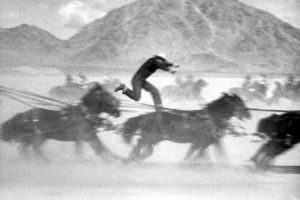
His most famous stunt is one he performed in 1939’s Stagecoach, in which he leaps onto a team of horses pulling the titular stagecoach, falls between them, gets dragged along and then disappears under the stagecoach itself.  This inspired the sequence in Raiders of the Lost Ark where Indiana Jones is dragged beneath a German truck.  Canutt later became a second-unit director and staged the chariot race in 1959’s Ben Hur.  And despite sustaining injuries that required plastic surgery on at least two occasions, he lived to the ripe old age of 90.


Bud Ekins was a champion motorcyclist as well as a stuntman.  It was he – not Steve McQueen, as was believed for a long time – who rode the Triumph TR6 Trophy motorbike near the end of 1963’s The Great Escape, when McQueen’s character, pursued by half the German army, attempts to leap the giant fence that separates him from Switzerland.  (The famously petrol-headed McQueen did ride the motorbike during the preceding chase and was keen to perform the jump himself, but the filmmakers talked him out of it.)  That alone earns Ekins a place in my Stuntmen Hall of Fame, but he went on to do lots of other cool stuff.  He worked with McQueen again in Bullitt (1968), driving that film’s iconic Ford Mustang 390 GT, and he was also involved in Diamonds are Forever (1970), Race with the Devil (1975), Sorcerer (1977) and The Blues Brothers (1980).


Every time I’m on board a cable car and spot another cable car approaching from the opposite direction, I wonder if I’ll see Alf Joint perform a suicidal leap from the roof of one car onto the roof of the other – for Joint was the stuntman who doubled for Richard Burton in 1967’s Where Eagles Dare when Burton’s character had to hop cable cars close to the fearsome Schloss Adler, the mountaintop stronghold of the SS.  Like many a great British stuntman, Joint’s CV is a roll-call of Bond movies (he made two), Star Wars movies (one) and Superman movies (three).  He doubled for Eric Porter, playing Professor Moriarty in the acclaimed 1980s TV series The Adventures of Sherlock Holmes, when the character plunged to his doom at the Reichenbach Falls; and for Lee Remick in The Omen (1976), presumably during the sequence when Remick is pushed out of a hospital window and crashes through the roof of an ambulance passing below.


© Winkast Film Productions / Metro-Goldwyn-Mayer


I also remember Joint performing a memorable stunt during the adverts for Cadbury’s Milk Tray chocolates, which ran on TV from 1968 to 2003 (though I hear they were revived a few years ago).  These featured the Milk Tray man, a Bondian character who kept risking life and limb in order to deliver boxes of the chocolates to a beautiful lady, with the tagline being: “And all because… the lady loves Milk Tray.”  I can’t recall if it was the same lady receiving all the chocolates in all the adverts – if it was, the poor woman must have developed type 2 diabetes by 2003.  Anyway, Joint did the Milk Tray man’s dive off a vertiginous cliff, into a shark-infested sea, in perhaps the most famous of these adverts in 1972.


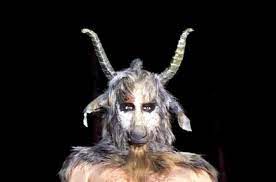
Also involved in Where Eagles Dare was Eddie Powell, a stuntman who seemed to divide his time between James Bond movies – he made ten official ones, plus Never Say Never Again – and Hammer Films, where he was a stunt double for Christopher Lee in movies like The Mummy (1959), Dracula, Prince of Darkness (1966) and To the Devil a Daughter (1976).  For that last film, he also did a ‘full body burn’ stunt during a scene where satanic forces cause Anthony Valentine to spontaneously combust inside a church.  In addition, Hammer gave him a few acting credits, predictably eccentric ones, such as the lumbering, bandaged monster in The Mummy’s Shroud (1967) and the half-man, half-beast Goat of Mendes conjured up at a witches’ sabbat in The Devil Rides Out (1968).


© Hammer Films / Seven Arts Productions


Later in his career, Powell performed stunts as the titular, drooling, acid-blooded, multi-mouthed beastie in Alien (1979) and Aliens (1986).  For instance, he took part in the first film’s engine-room scene where the alien swoops down on the hapless Harry Dean Stanton.


Strictly speaking, I shouldn’t mention William Hobbs here as he wasn’t exactly a stuntman.  He was a fight choreographer, more precisely a sword-fight choreographer, and his work enlivened many a swashbuckler over the years.  He directed the swordplay in The Three Musketeers (1973) and Four Musketeers (1974) and presumably had the difficult task of restraining Oliver Reed, who from all accounts threw himself into the movies’ fight scenes with the enthusiasm of a blade-wielding Whirling Dervish.  He also worked on Roman Polanski’s Macbeth (1971), Ridley Scott’s The Duellists (1977) and Terry Gilliam’s Brazil (1985), for which he devised the samurai fights.  I generally can’t stand the 1980 Dino De Laurentiis production of Flash Gordon, but the sequence where Sam Jones fights Timothy Dalton on a platform while spikes erupt at random points and at random moments through its floor, again overseen by Hobbs, is one of the film’s few good parts.  Near the end of his life he was still working, on TV, arranging fights for Game of Thrones (2011-19).
 

Actually, you can see Hobbs in action in this instalment of the long-running TV show This is Your Life (1955-2007), rehearsing a gruelling-looking swordfight with Christopher Lee just before Eamonn Andrews surprises Lee and shepherds him off to a TV studio for a star-studded retrospective of his career.  (I usually found This is Your Life tacky and maudlin, but I thought this one was fascinating because, besides Lee and Hobbs, it corrals such movie legends as Peter Cushing, Vincent Price and the afore-mentioned Oliver Reed together under one roof.)


© Troublemaker Studios / Dimension Films


And now for a lady, the New Zealand stuntwoman Zoe Bell, who doubled for Lucy Lawless in the Xena: Warrior Princess TV show and for Uma Thurman in Quentin Tarantino’s Kill Bill movies.  Kill Bill: Volume 2 (2004) involved a stunt where a shotgun blast hurled Bell backwards – this did so much damage to her ribs and wrist that she spent months recovering from it.  But there were clearly no hard feelings between Bell and Tarantino because for his next movie, 2007’s Death Proof, he cast her as herself.  She plays a movie stuntwoman – called Zoe Bell – who turns the tables on Kurt Russell’s car-driving serial killer.  Tarantino shares my disdain for CGI and insisted that all the vehicular action seen in Death Proof was the real deal, including a ‘ship’s mast’ stunt where Bell straddles the hood of a speeding Dodge Challenger R/T with only a couple of straps to hang onto.  Since then, she’s done more gigs for Tarantino, as a stuntwoman in Inglourious Basterds (2009), as an actress in Django Unchained (2012) and The Hateful Eight (2016), and as both in Once Upon a Time in Hollywood (2019).


Finally, no roundup of my favourite stuntmen would be complete without mention of Vic Armstrong, who’s in the Guinness Book of Records as the world’s busiest stunt double.  His brother Andy, his wife Wendy, and a half-dozen members of the younger generation of his family all work in the stunt / special-effects business too, which must make the Armstrongs the Corleones of the stunt-world.


As well as seven official and unofficial Bonds, his filmography includes three Indiana Joneses and three Supermen, plus a Rambo, Terminator, Omen, Conan and Mission Impossible.  He served not only as Harrison Ford’s stunt double while he played Indiana Jones, but also in Blade Runner (1982), Return of the Jedi (1983), The Mosquito Coast (1986), Frantic (1988) and Patriot Games (1992).  Indeed, back in his youth, his resemblance to the star was so striking that Ford once quipped to him, “If you learn to talk, I’m in deep trouble.”


© Titan Books

When Raquel ruled


© 20th Century Fox


From the mid-1960s to mid-1970s, Raquel Welch was probably the cinematic sex symbol as far as unreconstructed blokes in the Anglosphere were concerned – blokes who were a bit intimidated by the exoticness and general foreignness of, say, Brigitte Bardot or Ursula Andress.  Welch, who sadly died last week at the age of 82, was Chicago born but raised in San Diego.  Her time in the latter location seemed to imbue her with a healthy, clean-cut Californian glow that was an obvious physical advantage to her in her film roles.  Cerebrally, though, she didn’t win a lot of respect from her (mostly male) peers.  This sorry state-of-affairs was epitomised by some advice that Don Chaffey, director of One Million Years BC (1966), offered her early on in that movie’s filming.  Her function, he explained, was not to think, but merely to run from one rock to another.


I should say that when Raquel Welch was at the height of her popularity, I was too young to actually fancy her.  Instead, I just remember her as a talismanic presence in a number of movies that I found incredibly enjoyable at the time and that have stayed in my memory during the decades since.  Here are my half-dozen favourites that showcase the late, great Ms Welch.


Fantastic Voyage (1966)

In this science fiction epic, Welch plays Cora Peterson, technical assistant to a brain surgeon (Arthur Kennedy) and member of a medical team who are miniatured in a submarine and injected into the bloodstream of a seriously injured scientist.  Why?  Well, there’s a blood clot lodged deep in his brain that can’t be reached on an operating table, and the only option is to have miniature people inside him zapping the pesky clot to buggery with a laser beam.  Which makes sense.


© 20th Century Fox


As the scientist is a leading expert in the field of miniaturisation, which apparently is being developed on both sides of the Iron Curtain, it’s no surprise when it transpires that the Soviets have put a secret agent on board the submarine to sabotage the mission.  Neither is it a surprise when this secret agent turns out to be a character played by the reliably-twitchy Donald Pleasence.  Actually, Pleasence’s death-scene, in which he falls victim to a hungry white blood-cell, is worth the price of admission alone.


Yes, it’s all very silly.  In fact, when he wrote the film’s novelisation, the respected sci-fi author and professor of biochemistry Isaac Asimov tied himself in knots trying to make its plot seem more scientifically feasible.  But with imaginative sets representing the inside of the human body, and decent special effects depicting the movements of the cast and their submarine within this strange micro-verse, and capable direction by underrated filmmaker Richard Fleischer, it’s a piece of hokum that’s both entertaining and memorable.


One Million Years BC (1966)

To be fair to director Don Chaffey, running from rock to rock was pretty much all that Welch, as the cavewoman Loana, and John Richardson as her caveman beau Tumak, needed to do for the duration of One Million Years BC, whilst trying to escape the claws and fangs of legendary special-effects man Ray Harryhausen’s stop-motion-animation dinosaurs.  The film, made by Hammer Films, is even sillier than Fantastic Voyage.  Not scripted with much attention to paleontological science, it depicts Welch, Richardson and the rest of the human cast existing alongside monster-lizards in the Calabrian Stage of the Pleistocene Epoch.  Nonetheless, Harryhausen’s splendid work transforms it into pulp-art and its poster, with Welch standing imposingly in a fur bikini, became one of the great cinematic images of the 1960s.  It’s the last poster, for instance, on the wall of Tim Robbins’ cell in The Shawshank Redemption (1994), sneakily concealing the tunnel that he’s digging out of the place.


© Hammer Films / Seven Arts


In the late 1990s, while I was living in Edinburgh, Ray Harryhausen appeared one day at the (now sadly defunct) Lumiere Cinema to give a talk about his movie-making career.  I attended, and I recall the queue that formed afterwards at Harryhausen’s table as people got him to autograph items related to his films.  Many of these were posters and video cassettes of One Million Years BC and I remember him demanding, “Did you buy these because of my dinosaurs or because Raquel Welch is on the cover in a fur bikini?”


Bedazzled (1967)

This being the late 1960s, it was inevitable that Welch would appear in a number of self-consciously groovy, achingly unfunny swinging-sixties comedy-movies, such as Leslie H. Martinson’s Fathom (1967) and Joseph McGrath’s The Magic Christian (1969).  However, I do like Stanley Donen’s Bedazzled, a comic retelling of the Faust story with Peter Cook and Dudley Moore.  Cook is the devil, trying to ensnare the soul of the hapless Moore, and he enlists the Seven Deadly Sins to help him.  Welch, as Lust, is definitely the most fetching of the sins – not that she has much competition, considering that, for instance, Barry Humphries plays Envy.


By the way – a shout-out for Bedazzled’s lovely opening credits, orchestrated by Maurice Binder and accompanied by Moore’s brassy but also subtly-melancholic theme music.


© 20th Century Fox


Bandolero (1968)

God, when I was a western-daft 10-year-old, I loved Bandolero.  Directed by seemingly inexhaustible western-movie director Andrew V. McLaglen, it contained everything I could have hoped for – action, humour, bank robberies, ghost towns, a gang of outlaws, a rival gang (consisting of bloodthirsty Mexican desperadoes, the bandoleros of the title), a tenacious sheriff and his posse, and a climactic shoot-out where (nearly) everyone gets killed.  The cast is excellent too.  In addition to Welch, there’s Dean Martin and James Stewart as the brothers leading the outlaws, the ever-reliable George Kennedy as the sheriff, and a supporting cast of familiar faces like Andrew Prine, Will Greer and Denver Pyle.  You even get a glimpse of former Tarzan actor Jock Mahoney, playing Welch’s quickly-killed-off husband.


All right, even at the age of 10, I knew Bandolero was pushing it a bit to have us believe that Dean Martin and James Stewart could be siblings.  Still, it seemed more credible than another western I saw at the same time, The Sons of Katie Elder (1965), which posited Dean Martin and John Wayne as siblings.


Hannie Caulder (1971)

Another western and a rare beast indeed, a British-made western.  It’s immeasurably better than other British efforts in the genre, such as Michael Winner’s dreadful Chatto’s Land (1972) or, gulp, Carry On Cowboy (1965).  And unlike Bandolero, which had Welch as a damsel in distress, Hannie Caulder has her playing a proactive, implacable female Clint Eastwood-type, seeking revenge on the three outlaw scumbags who raped her and murdered her husband.


© Tigon Films / Paramount Pictures


Admittedly, the tone of Hannie Caulder is badly fractured.  The villains who behave so heinously towards Welch in the movie’s early stages are otherwise portrayed as a trio of comic bumblers in the tradition of the Three Stooges, and the humour feels jarring.  But if you can get past that, you’ll enjoy a cast that’s even better than the cast of Bandolero.  Essaying the villains are legendary character actors Ernest Borgnine, Strother Martin and Jack Elam, Robert Culp turns up as a bounty hunter trying to help Welch out, and Northern Irish actor Stephen Boyd, one of Welch’s Fantastic Voyage co-stars, makes a cameo as a mysterious preacher.  The fact that Hannie Caulder was made by Tigon Films, a company more famous for its horror movies like Witchfinder General (1968) and Blood on Satan’s Claw (1970), perhaps accounts for producer Tony Tenser casting Christopher Lee as the gunsmith who provides Welch with the customised weapon necessary for taking down her antagonists.  There’s even room for Diana Dors, a sex symbol from an earlier era, playing the mistress of a bordello adept at battering obnoxious customers with her frilly umbrella.


Almost inevitably, Hannie Caulder is much-loved by Quentin Tarantino, who cites it as an influence on his Kill Bill movies (2003-4).


The Three / Four Musketeers (1973-74)

This double-movie adaptation of Alexandre Dumas’ 1844 novel was directed by Richard Lester, the man who helmed the two comedic Beatles movies in the 1960s.  He’d even, at one point, considered making a film where the Fab Four played the musketeers.  The Three and Four Musketeers are laced with many of Lester’s comic touches, often involving his regular collaborator Roy Kinnear, and Spike Milligan, who appears in the first film as Welch’s husband – surely the unlikeliest husband she was ever paired with onscreen.  Welch herself shows good comic talent, for example, at the end of The Three Musketeers where she gets knocked over by a jousting dummy.  At the same time, the films’ action sequences, orchestrated by the great sword-fight choreographer William Hobbs, look unnervingly realistic.  They come across as haphazard, exhausting and, yes, dangerous.  With Lester’s humour and Hobbs’ authenticity, then, the films shouldn’t work…  But somehow, they do.


In my mind, however, what makes these the best cinematic version of Dumas’ book is the fact that they’re packed with 1970s cinematic icons – Welch as heroine Constance Bonacieux, Michael York as hero d’Artagnan, Faye Dunaway as the villainous Milady, Christopher Lee as the equally villainous Rochefort, Charlton Heston as the equally, equally villainous Cardinal Richelieu, Oliver Reed as the brooding and frankly Oliver Reed-like Athos…  And so on.  Welch appeared in a few more films afterwards, but none were especially memorable and her time as English-language cinema’s number-one female pin-up had evidently passed.  But she could have done much worse than step out of the limelight with the Musketeers movies.


© 20th Century Fox

Norm!


From wikipedia.org / © Gerald Lucas


I’m aware that some of the writers, artists, musicians and filmmakers whose work I admire were total arseholes in their personal lives.  Possessing ‘artistic genius’, or just having an ‘artistic temperament’, was for them an excuse to commit all manner of heinous sins.  Yet all I can do, I feel, is separate the art from the inadequate and disappointing personality that created it – and focus on and enjoy the former.  As the writer Poppy Z. Brite (who sometimes goes by the name of Billy Martin) wrote recently about the author V.S. Naipaul: “Past a point, you can’t help what you love.  Naipaul is my own problematic favourite, a sexist, racist, often unkind man, but I love his writing and he fascinates me as a person.”


To some extent, that sums up my feelings about that famous post-war American man of letters Norman Mailer, who would have been 100 years old today if he’d still been on the go.  To say Mailer was problematic as a person is an understatement.  From all the accounts the guy was a belligerent, egotistical, self-promoting, homophobic and misogynistic dickwad who lamented about ‘the womanisation of America’ and was preoccupied with the sort of toxic masculinity that, in the 21st century and as embodied by the likes of Putin and Trump, seems capable of threatening the continued existence of humanity.


Most notoriously, in 1960, he stuck a knife into his second wife, Adele Morales, enraged when she told him he wasn’t as good a writer as Dostoyevsky.  Morales survived and divorced him two years later.  For that reason, my partner never refers to Norman Mailer as ‘Norman Mailer’, but as ‘Stabby’.


Among other things on Mailer’s charge-sheet, in 1981 he was instrumental in securing parole for murderer, bank robber and forger Jack Abbott.  Abbott was also a writer, which for Mailer apparently righted all his other wrongs.  Six weeks after his parole, Abbott stabbed to death a waiter following an argument about whether or not he could use a café’s toilet.


And yet…  I’ve always enjoyed Mailer’s books when I’ve come across them, to greater or lesser degrees.  This is despite – or if I’m in the right mood, because of – the rampant egotism of their author often finding its way onto their pages.


© Rhinehart & Company


Mailer’s first novel The Naked and the Dead (1948) is to my mind one of the great novels written about World War II.  Mailer wrote about it from experience, as he’d been posted to the Philippines with the 112th Cavalry.  It made an impact on me with its pessimism, which isn’t just about human nature when it’s put under hideous pressure in a theatre of war.  The pessimism also concerns the current, and likely future, condition of the USA, which is symbolised by the platoon at the centre of the plot.  They represent an assortment of different ethnic and regional groups that make up American society – Jewish, Italian, Irish, Mexican, Southern – and they generally don’t like or trust each other.  In charge of them are a psychotic sergeant, an educated and liberal-minded lieutenant and, at the top of the chain of command, a fascistic general who believes the war against Japan is soon going to morph into a war against the Soviet Union.  The enlightened lieutenant offers the novel its one sliver of hope, but that hope is abruptly snuffed out in a plot-twist some way before the end.


However, even if you find the political allegory in The Naked and the Dead clunky, there’s no denying that it conveys the numbing physical exhaustion of warfare – especially a war fought in a jungle on a tropical Pacific island.  If George Orwell’s Homage to Catalonia (1938) gets across the idea that more than anything else war will leave you bored witless, The Naked and the Dead persuades you that it’ll leave you utterly knackered too.


One unfortunate feature of the novel, and something that modern-day readers will no doubt find hilarious, is that Mailer had to pepper his prose with the word ‘fug’, an invented substitute for the F-word.  Warned by his publishers that the dialogue of his soldier-characters couldn’t be too realistic, even though in a real combat zone hard-pressed soldiers would be spewing the F-word endlessly,  Mailer ended up having them say things like ‘Fug you!’ and ‘Fugging hell!’  It must have stuck in Mailer’s craw – and Mailer had a big craw for things to get stuck in – when, later, he was introduced to the celebrated writer and wit Dorothy Parker and she exclaimed, “So you’re the young man who can’t spell f*ck!”


A decade after its publication, The Naked and the Dead was turned into a movie. It’s a prime example of Hollywood taking something with an uncompromising message and watering it down to make it more palatable to mainstream cinema audiences – and losing what made the original effective in the process.  Not only does the lieutenant (Cliff Robertson) survive at the end but, if I remember correctly, he gets to make an inspirational speech about the value of everyone pulling together.  However, Mailer was already aware of the rottenness of Hollywood and in 1955 had written a novel on the topic, The Deer Park.  This was the era when the House of Representatives’ Committee on Un-American Activities was at its most powerful and the notorious Hollywood Blacklist was ending filmmakers’ careers, events that are referred to in his book.


© G.P. Putnam’s Sons


I don’t remember much about the plot or characters of The Deer Park, but I recall the vividness of its setting, Desert D’Or, a desert town that’s become a fashionable resort and refuge for Hollywood bigwigs.  Its existence as a pocket of lavish make-believe amid the desert’s harshness is matched by the artificiality of its inhabitants, who are an immoral, scheming, backstabbing, bullying lot.  Wikipedia informs me that the novel’s title “refers to the Parc-aux-Serfs (‘Deer Park’), a resort Louis XV of France kept stocked with young women for his personal pleasure”, which seems appropriate.


Unsurprisingly, when the 1960s began to swing with sex, drugs and rock ‘n’ roll, and the Vietnam War, Mailer took to the decade like a duck to water.  At a young and impressionable age – 17 years old – I read Mailer’s Armies of the Night, in which he recounts how he marched on the Pentagon in October 1967 and told the US government to stop the war in Vietnam.  To be honest, Mailer did have a bit of help here.  About 100,000 people marched with him, including Allen Ginsburg, Abbie Hoffman and Jerry Rubin, who tried to use concentrated, psychic hippie-power to levitate the Pentagon building and ‘exorcise the evil within’.


© Penguin Books


A ’fictionalised work of non-fiction’, Armies of the Night was the first such book I’d encountered and it took me a while to get used to its central conceit, wherein Mailer describes what happened at the march not as some omnipotent narrator, or in the first person, but in the third person, so that he becomes a character in the action itself.  Yes, it’s a memorable device but, inevitably with Mailer, it’s self-aggrandising too.  At one point, possibly inspired by Armies of the Night, I wrote entries in my journal for a few months in the third person.  Years later, when I re-read what I’d written, my main thought was: “What a big-headed wanker I must have been back then.”


Mailer was in the first person for the next book by him I’ve read, also a work of non-fiction, 1975’s The Fight.  This is about the ‘Rumble in the Jungle’, the famous boxing match between Muhammad Ali and George Foreman (who, to a younger generation, is primarily known as the inventor of the George Foreman Lean Mean Fat-Reducing Grilling Machine).  With Ali at his peak, and Foreman at his meanest and most lethal, this was, for boxing fans, an epic event.  It was also a grotesque one, because one of the 20th century’s most opulently corrupt dictators, Zaire’s Mobutu Sese Seko, hosted the fight in his country.  Sparing no expense, Mobutu also flew in some of the world’s greatest musicians, like James Brown and B.B. King, for a musical gala to accompany it.  And it was no surprise that the world’s biggest literary ego, Mailer, rocked in too to write a book about it.


While I prefer the 1996 documentary When We were Kings (to which Mailer contributes) as the definite account of the Rumble in the Jungle, I think The Fight is pretty good.  Mind you, with so much going on in Zaire at the time, Mailer could hardly fail to write an entertaining book about it all.  And it does provide a fascinating insight into the mind of the man who called himself the greatest…  The book mentions Muhammad Ali a few times as well.


Random House USA Inc


Having read one Mailer book from the 1940s, the 1950s, the 1960s and the 1970s, it’s fitting that the last of his works I’ve encountered is from the 1980s, 1984’s Tough Guys Don’t Dance.  Mailer didn’t take the writing of this novel terribly seriously.  It was something he dashed off in two months, to fulfil a contract, and is very obviously a pastiche / piss-take of the crime-thriller noir genre, vaguely in the tradition of Mickey Spillane and Raymond Chandler.  Its plot twists all over the place before, unconvincingly, the hero’s dad – a no-nonsense hard man, but with a heart of gold, no doubt representing Mailer’s own image of himself – pops up out of nowhere to sort everything out.


I thought it was basically rubbish, then, but it was enjoyable rubbish.  Maybe I liked it because, as with Tough Guys Don’t Dance’s hero Tim Madden, I was going through a hard-drinking phase at the time, waking up occasionally with a raging hangover but no firm idea of what I’d ended up doing the previous night.  Thus, I could relate to what Madden goes through in the book.  Though unlike Madden, I never woke up to find (1) an inexplicable tattoo on my body that hadn’t been there before, and (2) an inexplicable severed head in my possession that hadn’t been there before, either – the events that set the story in motion.


One thing that’s genuinely good about Tough Guys Don’t Dance is its setting, which is Provincetown in Cape Cod, Massachusetts – in real life Mailer had a house there, in Commercial Street.  He nicely captures the eeriness of the place when the summer weather has receded and the tourist season has ended, when ‘one chill morose November sky went into another’ and, seemingly, the town’s ‘true number of inhabitants must be thirty men and women, all hiding’.


© Penguin Random House


Three years later, Mailer got the chance to turn Tough Guys Don’t Dance into a movie, which he directed, and co-scripted with the distinguished screenwriter Robert Towne, and with Francis Ford Coppola’s Zoetrope Studios as one of the production companies.  Sounds good, yes?  Well, no.  The producers were Menahem Golan and Yoram Globus of the notorious Cannon Group, whose previous meisterwerks included Breakin’ 2: Electric Boogaloo (1984), Bolero (1984), Invasion USA (1985), Cobra (1986) and Death Wish 4: The Crackdown (1987).  And despite the talent involved, Tough Guys Don’t Dance definitely bears the Cannon imprint most strongly in terms of quality.  It’s a delirious slice of so-bad-it’s-good campness.


Thus, you get a party sequence, which appears to be Mailer’s idea of what a decadent 1980s shindig would be like – yuppies with feather-cut hairdos cavorting like arthritic elephants to some god-awful 1980s soft-rock music while nose-hoovering cocaine off the tabletops and brazenly opening the front door stark-naked because they think it’s their ‘boyfriend’.  (No, it’s actually the local police chief, played by Wings Hauser, come to ask them to turn the noise down.)  Still, I’m told that Mailer filmed much of the movie at his own house in Provincetown, so maybe he did hold parties like this.  Then there’s the scene where Madden (Ryan O’Neal) finds out about his wife’s infidelity and reacts with a jaw-dropping display of bad acting – “Oh man!   Oh God!  Oh man!  Oh God!” – which, over the years, has become so infamous it’s now an Internet meme.


To be fair to O’Neal, almost everyone in the film is having a bad-acting day.  This ranges from the way-over-the-top ‘southern’ accents sported by Debra Sandlund and John Bedford Lloyd – “Madden, take it in the mouth or you’ll die.  Will you take my pride and joy into your mouth?” – to the stilted awkwardness of just about everyone else (Hauser, Isabella Rossellini, Frances Fisher) as they try to get their tongues, and their minds, around Mailer’s dialogue, which is largely fixated on performing the sex-deed with adequate levels of manliness.  At one point Rossellini tells O’Neal that she and her husband, Hauser, “make out five times a night.  That’s why I call him Mr Five.”  Though this is contradicted when Rossellini and Hauser have an argument.  “I made you come 16 times – in a night.”  “And none of them was any good!”


On the plus side, Lawrence Tierney gives a solid performance as Madden’s dad.  I’ve read somewhere that after seeing him in this, a young Quentin Tarantino decided to hire him for Reservoir Dogs (1993).  Also, Mailer adds some supernatural elements that I don’t recall being in the book, and ramps up the general weirdness, so that the film becomes an oddly prescient mixture: a superficially sleepy little town, dark secrets, murder, drugs, violence, corruption, the uncanny, the strange…  There’s even a creepy forest where O’Neal has hidden his marijuana stash.  Yes, three years before the real event, did Mailer accidentally create the prototype for David Lynch’s Twin Peaks (1990-91, 2017)?


© Zoetrope Studios / Golan-Globus


Like Captain Ahab and his whale, Mailer spent his literary life pursuing that elusive beast, the writing of the Great American Novel.  Though the critical consensus is that he never managed it, he did produce some very big books along the way, like Ancient Evenings (1983) and Harlot’s Ghost (1992), neither of which I’ve read – and with them weighing in at 709 and 1168 pages respectively, I doubt if I ever will read them.  Nonetheless, I suspect I’ll find myself perusing Mailer’s other, more digestible books in future, because basically I enjoy his stuff.  My partner may not approve, but there are still works by old ‘Stabby’ that I’d like to have a stab at.


And the only possible reaction to that distasteful pun is: “Oh man!  Oh God!  Oh man!  Oh God!”

The full Fulci


From amiddleagedwitch.wordpress.com


Today, March 13th, 2021, marks the 25th anniversary of the passing of Italian director Lucio Fulci.  Here’s a reposting of a lengthy treatise I wrote about the mighty Fulci back in 2014.


Nowadays, satellite television can beam any subject matter, however adult, into our living rooms.  Thanks to this, the whole family, from grandma and grandpa down to the pre-school infants, can now sit together in front of the TV and enjoy, communally, such splendid sights as the bit in season three of The Walking Dead (2012-13) where Danai Gurira grabs a big jaggy chunk of glass and rams it in extreme close-up into David Morrissey’s eyeball.  Even better, a few minutes later, they can enjoy the sight of David Morrissey, again in extreme close-up, pulling the jaggy glass out of his eyeball.


This wasn’t always the case.  Audiences didn’t always have easy access to images of extreme eyeball abuse.  Indeed, three decades ago, a scene where a person got a humongous wooden splint stuck in her eye while being dragged through a hole in a door by a mouldering zombie was enough to cause outrage amongst the powers who decided what British film-fans could and couldn’t watch.  The scene belonged to the 1979 Italian horror movie Zombie Flesh Eaters, directed by the inimitable Italian filmmaker Lucio Fulci.  And it was the gory content of this and movies like it that led to Britain’s Video Nasties scare of the early 1980s.


By 1983, the Department of Public Prosecutions, cheered on by the likes of public-morality campaigner Mary Whitehouse and the right-wing British tabloid press, had drawn up a list of 72 films deemed liable to ‘deprave and corrupt’ and thus open to prosecution under the Obscene Publications Act.  39 of the 72 were successfully prosecuted.  The remaining 33 weren’t prosecuted or were subject to unsuccessful prosecutions, but at the time you had little chance of seeing them through legitimate means.


Now that the hysteria has long passed, the majority of these films are available in uncut versions in Britain.  A couple of them, like Don’t Go into the Woods (1981) and Contamination (1980), have even suffered the ultimate humiliation.  They’ve been awarded wussy ‘15’ certificates.


Among the movies Lucio Fulci directed, two, Zombie Flesh Eaters and 1981’s The House by the Cemetery ended up on the list of 39 prosecuted titles; while a third, 1981’s The Beyond, was on the list of 33 that escaped successful prosecution.  A fourth, 1980’s City of the Living Dead, didn’t make the Nasties list, but British police seized videos of it nonetheless.  A fifth, 1982’s The New York Ripper, wasn’t classified as a Nasty either but still got banned from British cinemas.  For this achievement alone, I think Lucio Fulci deserves respect.


I have a complicated relationship with Fulci.  I doubt if I’ve ever seen more than one or two things he’s directed that I’d classify as good films, but I have to admit that when I encounter a new Fulci title in a DVD store or see one scheduled for broadcast on the Horror Channel, my pulse speeds up.  I get a prickly, sweaty sense of excitement.  I tell myself, I have to see this.  Although the end result is usually the same.  After the damned thing has finished, I sit back and feel a strange combination of bemusement, queasiness and disappointment, while a voice nags at me: “What the hell was that about?”  Although to be fair to Fulci, there’s usually been at least one sequence in the film that’s made me think: “Wow!”


Lucio Fulci didn’t find fame, or infamy, in the English-speaking world until the late 1970s, but he’d been a staple of Italian cinema for a long time before.  He started as a scriptwriter, first of all working on the 1954 comedy Un Giorna in Pretura.  In 1959, a dozen film-scripts later, he began directing.  One of his earliest directorial efforts was Ragazzi del Juke-Box, a musical starring the soon-to-be 1960s pin-up Elke Sommer.  During the 1960s and 1970s, Lucio beavered away making comedies and spaghetti westerns.  He also tried his hand at directing giallo movies, those twisted, kinky, violent and macabre Italian variations on the thriller genre: 1969’s Unna Sull’atra, 1971’s A Woman in a Lizard’s Skin and 1972’s Don’t Torture a Duckling.


© Medusa Distribuzione


Of Fulci’s giallo films, I’ve only seen Don’t Torture a Duckling and it’s surely one of the best things he did.  It has none of the excess and goofiness of his later horror films and it benefits from its distinctly un-giallo-like setting.  While most examples of this sub-genre take place in an affluent urban world inhabited by high-fliers in the creative industries (photographers and fashion models are common), Duckling is set in a rural and backward south Italian village, its separation from modernity symbolised by the nearby highway where traffic rumbles past oblivious to its existence.  While the setting allows Fulci to take pot-shots at the institutions of conservative, traditional Italy, his cameras film the countryside there sumptuously.


That said, viewers today will be troubled by some early scenes, seemingly played for humour, which show heroine Barbara Bouchet teasing the village’s young boys by brazenly exposing herself to them.  Imagine if the film had had hero Tomas Milian exposing himself to the village’s young girls.  It’s a clumsy foreshadowing of the film’s themes, which are the threat posed to childhood innocence by an immoral world, and a serial killer’s determination to preserve that innocence by any means necessary.


Some commentators have noted that Fulci’s sudden interest in giallo movies, and hence in darker, bloodier material, coincided with the death of his wife Maria, who in 1969 committed suicide after discovering she had cancer.  But the director himself never mentioned a connection between this personal tragedy and the darkening tone of his films.


The release of Zombie Flesh Eaters in 1979 saw Fulci plant his flag both in horror-movie territory and in the consciousness of impressionable, sensation-hungry teenagers, as I was then.  The film was a success despite critics slamming it as an inferior cash-in on George A. Romeo’s seminal zombie movie from the previous year, Dawn of the Dead. 


© Variety Film  


Well, Zombie Flesh Eaters isn’t as good as Dawn of the Dead, but it has an undeniable something about it.  The story kicks off with an un-crewed boat drifting towards New York Harbour while a ravenous zombie lurks in its hold.  Then it shifts to the Caribbean island from which the boat originated, where a full-scale zombie epidemic, possibly scientifically induced, possibly supernatural, is underway.  And at the very end it returns to New York, which has now succumbed to a zombie onslaught too.  The stuff in New York is ropey but the scenes on the Caribbean island, depicted as a cursed, pestilent and windswept hellhole, are wonderfully atmospheric.  A sequence where the protagonists stumble into a ‘conquistadors’ cemetery’ and the graves start disgorging some ancient cadavers is especially hard to forget.


But even that scene is surpassed by an earlier one where a female scuba diver flees from the predations of a large shark and hides behind a coral reef; only to discover that on the other side of the reef there lurks – eek! – a soggy underwater zombie.  The shark and the zombie then proceed to fight, in a slow, balletic way.  It’s typical of Fulci’s best sequences in that it manages to be simultaneously bizarre, haunting and totally bonkers.


The film is helped by the presence of two British performers, Ian McCulloch and Richard Johnson, who just ignore the absurdities of the situations and dialogue and get on with some proper acting.  I read an interview with McCulloch a while back and he professed himself bemused by Fulci’s filming techniques in New York. These involved the cast and crew turning up at a spot, filming without any licence, and then clearing off as soon as the police appeared.  This might explain the film’s curiously disjointed final image, which shows an army of zombies shuffling along an elevated bridge whilst below the New York rush-hour traffic trundles back and forth as if it’s just a normal evening.


The female lead, played by Tisa Farrow, is bloody awful, though.  Tisa is the younger sister of Mia Farrow, and I’ve often wondered what the pair of them talked about when they met up during this period.  “Oh hi, Tisa.  I’m busy making A Wedding with Robert Altman and Death on the Nile with Peter Ustinov.  What are you up to?”  “Well, I’m fighting off a horde of flesh-eating zombies in a conquistadors’ cemetery with Lucio Fulci.”  Mind you, considering what Mia had to endure with Frank Sinatra and Woody Allen, maybe she thought her kid sister had the better deal.


Zombie Flesh Eaters is one of my favourite Lucio Fulci movies because it has a story, one where things move from A to B and then to C.  Unfortunately, for his next horror movies, Fulci decided that there’d be a common theme.  Each would take place in a locality that, unknown to the inhabitants, rests on top of a portal to hell.  And if you’re on top of a portal to hell, the laws of physics, of cause and effect, of A leading to B and to C, will be suspended.  All sorts of crazy things will happen.  The dead will rise, furniture will levitate, dogs will go mad, eyeballs will bleed, the sky will rain maggots, demonic winds will blow in your windows and satanic spiders will chew your face off.  But there won’t be anything like a logically sequenced plot.


Many film fans have applauded Fulci for doing away with such outdated, bourgeoisie concepts as ‘plots’ in his films, but I have to say I find it a cop-out.  This ‘portal to hell’ stuff was just an excuse for him to make things up as he went along.


© Medusa Distribuzione


First in this series was 1980’s City of the Living Dead, which centres on strange goings-on in a remote American town that, by bad luck, is built on one of those afore-mentioned portals to hell.  The townspeople are soon falling victim to various forms of supernatural mayhem, which are orchestrated by a ghostly priest and a clutch of zombies who apparently have the power to teleport from one place to another.  City is a shambolic film.  Well, what else can you expect when there’s teleporting zombies in it?  But as usual with Fulci there are scenes that really stick in the memory.  I particularly like one where the protagonists explore some catacombs under the local graveyard, unaware that the cobwebby old cadavers there are stirring into life the moment they pass by.


A sequence that all viewers of City remember is one where a girl sits paralysed in a car while the ghostly priest leers in at her and, under his malevolent influence, she starts to vomit up her own entrails.  Lovingly captured on Fulci’s camera, those entrails ooze from her mouth in a slow, slimy mass.  The actress who had the honour of playing this scene was starlet Daniella Doria.  She had to sit before the camera with her mouth crammed full of sheep’s offal, which she then slobbered down her front.  People go on about the pain that Christian Bale inflicts upon himself in his quest for cinematic perfection, starving himself to a skeletal husk for The Machinist (2004) or making his weight balloon to play the slobby hero of American Hustle (2013); but I bet even Bale would draw the line at spewing mouthfuls of cold sheep-guts over himself in a Lucio Fulci movie.


Daniella Doria made three subsequent films with Fulci and she died horribly in all of them, via asphyxiation, stabbing and slashing.  “She was one of my favourite actresses,” Fulci reminisced later.  “I killed her so many times.”


Many rate the following year’s The Beyond as Fulci’s masterpiece and, indeed, its champions include Quentin Tarantino.  But I have the same problems with it that I have with City of the Living Dead.  There’s no rhyme or reason to it, because the action takes place on top of another of those pesky portals to hell.  Again, though, there are some striking scenes, notably, one where heroine Catriona McColl encounters a spectral figure standing in the middle of a straight, seemingly endless causeway.  The figure is that of a blind woman, played by Cinzia Monreale, who turns out to be a ghost.  Later, though, the blind woman dies when her throat is torn out.  Predictably, Fulci never explains how a ghost, someone who’s already dead, can be killed.


© Medusa Distribuzione


The Beyond also contains the barmy ‘spiders from hell’ scene, during which a lightning bolt knocks a character off a ladder.  He breaks his back and then lies helplessly while giant spiders emerge from the ether around him, converge and start munching on his face.  The spiders – real tarantulas – look creepy enough as they approach during the long shots; but for the face-nibbling close-ups they become phoney bundles of pipe cleaners that Fulci’s special-effects team probably threw together during the mid-morning tea-break.


Another problem is the ending.  It seems that Fulci had intended The Beyond, which takes place in a dilapidated Louisiana hotel, to be a haunted-house movie.  However, his financial backers expected him to make them another money-spinning zombie movie.  I can imagine Fulci’s producer grabbing him one day on the set, after looking at what was already in the can, and waving his arms and ranting in a stereotypical Italian way: “Lucio!  Hey Lucio!  Where-za hell-za zombies?!”  So, although he didn’t want to, poor old Fulci had to insert an incongruous climax into the film where McColl and hero David Warbeck have a shoot-out with a sudden and unexpected bunch of zombies.


The final instalment in Fulci’s ‘portals to hell’ series was 1982’s The House by the Cemetery, which has a young family moving into the titular house by the titular cemetery and discovering that they’re sharing it with, down in the basement, something horrible.  But sadly, the film lacks those moments of demented flamboyance that distinguished its two predecessors.


Meanwhile, between City of the Living Dead and The Beyond, Fulci tried to do something different.  This was filming a contemporary update of the Edgar Allan Poe story The Black Cat and setting it in England.  I’d hoped that the subject matter would reign in the director’s excesses and impose a little discipline on him.  The focus, after all, isn’t on a portal to hell that makes all things possible, but on a cat.  A pretty evil cat, right enough, but at the end of the day just a cat.


Unfortunately, like Fulci’s other films of the period, The Black Cat (1981) suffers from having everything thrown into it bar the kitchen sink.  The cat has somehow picked up subconscious psychic emanations from its owner, who’s a paranormal investigator obsessed with contacting the dead and who’s played by the distinguished Irish actor Patrick Magee.  Imbued with the hatred Magee feels deep down for the untrustworthy yokels who live around him in a rural English village, the cat starts acting out Magee’s suppressed fantasies and starts killing the villagers.


© Silenia Cinematografica / Italian International Film


But the cat seems to have picked up some other things, including super-intelligence and super-strength, for it can hypnotise its victims, sabotage ventilation systems, set furniture on fire, come back from the dead and even, like those silly zombies in City of the Living Dead, teleport.  You wonder why with all these talents the cat ever bothers to scratch anyone, but it does that too.  Still, the film has a few impressively eerie sequences, such as when Magee totters down to the village graveyard after dark and tests out his new contacting-the-dead wireless equipment.


Fulci is remembered for one more ‘major’ horror film, 1982’s The New York Ripper.  A serial killer / slasher effort with a self-explanatory title, this was controversial to say the least and led to him being accused of misogyny.  Even if Britain hadn’t been so jittery at the time about Video Nasties, the fact that it appeared soon after the real-life Yorkshire Ripper killings in northern England probably meant it was never going to get a British cinematic release.  The New York Ripper is a gruelling film and, frankly, a pretty bad one.  The killer’s quirk of performing Donald Duck impersonations during the murders isn’t so much deeply disturbing as deeply stupid.  If nothing else, the film serves as a record of the sleaze and dodginess associated with New York in the 1970s and 1980s.  This, of course, was before the city was cleaned up in the 1990s by its mayor, the totally non-sleazy, non-dodgy Rudy Giuliani


Thereafter, Fulci’s output tailed off in both prominence and quality due to a series of misfortunes that included a fall-out with his long-term scriptwriting collaborator Dardano Sacchetti and some serious health problems like hepatitis, cirrhosis and diabetes.  Although ‘quality’ is a subjective concept when you’re discussing his movies anyway.  He soldiered on into the early 1990s, his last directorial effort being the poorly received psychological thriller Door to Silence in 1991.  I’ve watched a single movie from his later years, a 1987 teen-orientated horror film called Aenigma that was apparently filmed in the then-Yugoslavia and is a weak rip-off of Brian De Palma’s Carrie (1976) and Richard Franklin’s telekinesis thriller Patrick (1978).  One thing I’ll say about Aenigma is that its death-by-snails sequence has to be seen to be believed.


Lucio Fulci died impoverished, sick and alone in Rome in 1996.  At least he had the satisfaction of attending, two months prior to his death, a convention in New York organised by the American horror-movie magazine Fangoria.  Much to his astonishment, since he didn’t appreciate his popularity beyond the shores of Italy, he was mobbed at the convention by thousands of American fans.


Funnily enough, Fulci’s films make me think of Gerry Anderson’s sci-fi-puppet TV show from 1964, Stingray.  Each episode of Stingray would open with a voice intoning, “Anything can happen in the next half-hour!”  That line would make a suitable opening for a typical Lucio Fulci movie too: “Anything can happen in the next hour-and-a-half!”  Especially if the film takes place on top of a portal to hell.


© Medusa Distribuzione