You can’t say those things nowadays… unless you’re a politician


From wikipedia.org / © House of Lords / Roger Harris


In this post I’m not going to repeat the three most depraved and revolting jokes I’ve ever heard.  But I’ll say when and where I heard them, and from whom.


The first joke concerned a medical tragedy and a hideous crime, both involving children, which’d made headlines in the UK during the 1980s.  One night in a pub in Aberdeen, where I was a college student, a friend told a 13-word joke that combined the two cases.  The friend was a decent guy who was drunk at the time and he uttered the joke during a moment of reckless bravado.  Immediately afterwards, he looked disgusted with himself and spent the rest of the evening in a state of depression.  I don’t think I heard him tell an even vaguely risqué joke after that.


I wasn’t as shocked as I might have been because I’d already encountered the joke in written form.  Some degenerate had scribbled it on the back of a toilet-door in Aberdeen University’s Queen Mother Library and I’d noticed it whilst ‘on the john’.


The second joke was two words longer – 15 – and I heard it in the context of a supposedly real-life anecdote.  Another guy I’d known as a student had, following graduation, gone on a trip to the USA where, one day, he’d ended up at an outdoor music festival.  He too was somewhat inebriated.  The festival’s compere decided, at one point, to leave the stage and wander among the crowd, sticking his microphone into people’s faces and asking them how they were getting on.  He stopped by my old acquaintance and, discovering he was from ‘Scaaat-land’, asked him to tell a ‘Scaaat-tish’ joke.  So my acquaintance spewed those 15 words into the microphone, which boomed across the field from the festival’s speakers and left the entire crowd in mortified, disbelieving silence.  I’m not sure if I really believe that story happened – but if it did happen, it was quite something.


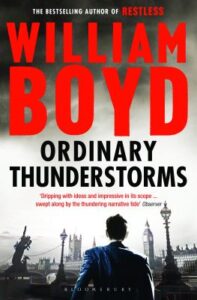
Incidentally, the same joke appears in William Boyd’s 2009 novel Ordinary Thunderstorms.  An unsavoury character tells it to the book’s hero, who responds by tipping him over a bridge and dropping him into the River Thames, where he drowns.  To be fair, the character had antagonized him a lot before that, so he wasn’t just reacting to the joke’s depravity.
 

© Bloomsbury


The third joke I heard in the early 1990s.  I was sitting at the counter of an Edinburgh pub when a drunken guy beside me told it.  It was a longer and more elaborate joke and featured Freddie Mercury, singer of the rock band Queen, who was famously gay and had died of AIDS a while earlier, and another famous showbusiness personage, also gay, who’s still with us in 2026.


Ooph, I thought, that’s really horrible. I hope I never hear a joke like that again.  


Well, I have just encountered a joke like that again.  In fact, it’s the same joke, though updated from the 1990s and now about the gay singer George Michael, who passed away in 2016, and his former partner Fadi Fawaz.  According to the Daily Record newspaper last week, it was told by Malcolm Offord, leader of the far-right-wing Reform party’s branch in Scotland.  In 2018, he included it in a speech he delivered at a Burns Supper held by a rugby club he was a director of.  In the kerfuffle following the Daily Record’s report, Offord admitted telling the joke was ‘a mistake’ and denied being homophobic.  “I don’t have any issue with homophobia,” he said.  “I’ve got a lot of gay friends.”


Nigel Farage, Reform’s Britain-wide leader, has defended Offord, saying, “If we’re going to drum people out of public life for telling a joke at a boozy rugby club dinner that’s amongst friends, we’ll finish up with the dullest group of individuals, looking a bit like, sounding a bit like Keir Starmer.”  Less forgiving was John Swinney, leader of the Scottish National Party and currently First Minister of Scotland – the post Offord aspires to take over following the Scottish parliamentary election this May.  Swinney said of Offord, “He’s unfit to be leader of any political party, unfit to be a member of the Scottish Parliament with views and attitudes like that…  I think we’ve got to be really careful as a country about where we are heading, and Reform have got no part to play in it if they represent views of intolerance, prejudice and hatred of that type.”


What are we to make of this?  Should we regard Offord’s faux pas as regrettable, alcohol-fuelled ‘banter’, accept his apology and move on?  And are we, as Farage suggests, in danger of becoming too puritanical, of scaring all the interesting people away from public office, of ending up with humourless dullards in power over us?  Is society getting – oh God, here we go again – too woke?


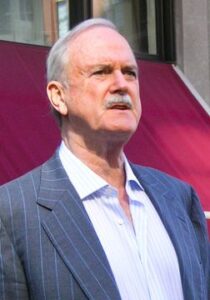
It calls to mind the lamentations of Monty Python (1969-74) and Fawlty Towers (1975-79) star John Clleese, who’s spent a good part of the last few years complaining that you can’t tell a good, impactful, close-to-the-bone joke anymore because folk get too offended: “I don’t think we should organize a society around the sensibilities of most easily upset people because then you have a very neurotic society.”  Incidentally, the 86-year-old Cleese appears to have thrown in his lot with Rupert Lowe’s party Restore UK, an outfit even further to the right than Farage’s Reform.
 

From wikipedia.org / © Paul Boxley


Well, in my view, we’re never going to stop hearing sick, horrible and downright racist / misogynist / homophobic / transphobic / etc. jokes.  For as long as the urge to be ‘edgy’ persists in the human psyche, such jokes will continue to be told in pubs and clubs, on sports terraces, in Internet forums, on WhatsApp and other messaging platforms, in countless situations where people interact.  But anyone who thinks it’s a good idea to spout a joke of that sort in public – supposedly 200 people attended Offord’s Burns Supper – shouldn’t be presenting themselves as a politician qualified to take over the highest political office in Scotland.  Especially when as holder of that office you’ll be representing, and making decisions that affect, the group of people your joke cruelly mocked.


Call me old-fashioned, but I prefer my political leaders to be dull – and serious, and sensible.  I remember British Prime Ministers like Labour’s Jim Callaghan and the Conservatives’ John Major, both rather grey and uninteresting, but whom I felt a lot safer having in Number 10, Downing Street than, say, an alleged laugh-a-minute ‘personality’ like Boris Johnson.  Between Callaghan and Major, of course, Britain was subjected to the 11-year reign of Margaret Thatcher, who had many qualities – mainly negative qualities, in my opinion – but being a barrel of laughs who told good jokes wasn’t one of them.


Offord must have thought he was on safe ground with his joke because he was at a well-lubricated rugby club event, not what you’d expect to be the most politically correct of gatherings.  But according to the Daily Record, even his rugby-loving audience was unimpressed.  One witness said, “I was sitting next to a gay man and it was clearly an extremely uncomfortable and unpleasant experience for him…  At the time I thought it pretty awful and indeed that was the feeling in the room.  Even for a rugby club it was a crude, bad taste and insulting spectacle…  I don’t know who in their right mind would say something like that.”


Even some of the usual suspects in Scotland’s mostly right-wing, Unionist media have turned on Offord because of this.  Scottish Times columnist Alex Massie penned a piece entitled Reform may already regret its choice of leader in Scotland, whilst Scottish journalist Stephen Daisley, who frequently writes for the very right-wing Spectator, messaged, “Malcolm Offord is single-handedly wrecking Reform’s chances in the Scottish parliament.  Can the Holyrood campaign be salvaged?”


I haven’t heard any reaction yet from Chris Deerin, who’s somehow the Scotland editor at the supposedly left-leaning New Statesman.  When Offord became Scottish Reform leader, Deerin tweeted, “Malcolm Offord is a seriously great get for Reform.  Very smart, ambitious for Scotland, excellent communicator, properly Scottish, experience of government, hugely successful in business – working class boy made good.  Ooft.”  (‘Ooft’, of course, was my first thought when I heard that joke.)  And in a couple of New Statesman articles Deerin penned about Offord, he talked breathlessly about the wealthy politician’s ‘gilded life’ and particularly admired his “vintage, open-top Jaguar sports car, Bond-esque in its sleek lines and growling power,” in which Offord “roared off into the countryside.”


Alas, despite everything, I don’t think Offord will be roaring off into the countryside, never to be seen or heard of again.  There are too many people who’ll rally to his cause rather than reject it after this furore.  That’s because they believe the line, fed to them endlessly by Britain’s right-wing media and pundits, that everything is too puritanically woke now, that you can’t crack a joke about gays or women or religious or ethnic minorities without the roof falling on your head, that you “can’t say those things nowadays”.  The irony is that you can say those things nowadays, and totally get away with them, at least if you’re a British politician.


Nigel Farage has recently courted controversy over the personalized messages he’s sent as Cameo videos – one of several lucrative side-projects he has in addition to being Reform party leader and a Member of Parliament.  A Guardian investigation found that the messages included ones “supporting a convicted rioter, repeating extremist slogans, and endorsing a neo-Nazi event” and where he “referenced antisemitic conspiracy theories, and made misogynistic remarks about leftwing politicians, including a comment about the US congresswoman Alexandria Ocasio-Cortez’s breasts.”


Previously, Farage was in hot water because of allegations made by over 30 people who’d known him during his schooldays.  According to their accounts, the teenaged Farage was quite the dedicated follower of fascism – among other things, singing Hitler Youth songs and growling “Hitler was right” and “Gas them” at Jewish pupils. He’s variously responded to these allegations by calling them ‘fantasies’, saying he can’t remember saying such stuff or dismissing it as – there’s that word again – ‘banter’.


Not that this has dented Farage’s popularity much.  His party is still leading in British opinion polls.

 

From wikipedia.org / © Roger Harris

From wikipedia.org / © Roger Harris


Elsewhere, Robert Jenrick, formerly the Conservatives’ Shadow Justice Secretary and now a defector to Reform, caused outrage last year when he said a 90-minute visit to the Handsworth part of Birmingham was “as close as I’ve come to a slum in this country” and one where he didn’t encounter “another white face“.  And earlier this month, the Conservatives’ Nick Timothy, who’s inherited Jenrick’s role as Shadow Justice Secretary, described an open Iftar event in Trafalgar Square as “an act of domination…  not welcome in our public places and shared institutions…  straight from the Islamist playbook.”  In previous years open Iftar events had been held in the square without anyone objecting, as had other religions’ celebrations such as Chanukah, Vaisakhi and Diwali.  And it had also hosted Christian events like mass prayers and Good Friday passion plays.


Rather than discipline them, Conservative party leader Kemi Badenoch backed both Jenrick and Timothy.  The latter case inspired the double-barreled, hard-right-wing rabble-rouser Stephen Yaxley-Lennon to crow on social media about how, just two years ago, a Conservative Member of Parliament making Timothy’s anti-Islamic comments would have been expelled from the party.  But not in 2026.


Yes, call me old-fashioned…  But I prefer the good old days when not only were British mainstream politicians grey and dull, but if they’d spouted anything blatantly racist, misogynistic, homophobic, or Islamophobic, they’d immediately have been out on their ear.

Spying economy class


© Gardner VI Books AMS006


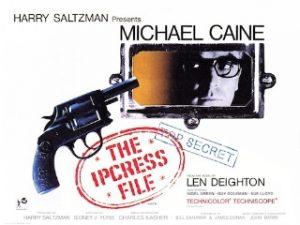
So it’s farewell to Len Deighton, the author, military historian, screenwriter, illustrator and gastronomist who passed away on March 15th at the venerable age of 97.  As a tribute, here’s something I wrote a few years ago after I’d finally got around to reading The IPCRESS File (1962), the spy thriller that made Deighton’s name and supposedly provided an antidote to the more romanticised spy novels popular at the time featuring a certain James Bond.


Regular readers of this blog will know that I’m a James Bond buff.  Because of this, I’d wanted for a long time was get my hands on a copy of Len Deighton’s 1962 spy novel The IPCRESS File – my interest in it being that it’s often touted as the anti-Bond.


Whereas 007 is a posh ex-public schoolboy with oodles of money and charm at his disposal, Harry Palmer, spy hero of The IPCRESS File, is an unprivileged and ordinary-seeming bloke with only his working-class wits to help him negotiate the hazardous, occasionally dangerous world of espionage.  Whereas Bond swans around in glamorous international locations enjoying the finest in cuisine, liquor and cars, Palmer trudges the lugubrious streets of London peering at the rain and pigeons through an oversized pair of glasses.  Whereas Bond wins ladies’ hearts with his unflappable insouciance, Palmer gets dumped on by his superiors for his insolence, which to them signifies that he’s a troublesome oik who doesn’t know his place.


But hold on.  That’s the impression I always had of Deighton’s character thanks to seeing in my youth the 1965 film version of The IPCRESS File, which featured in its lead role that impeccably deadpan man of the people Michael Caine.  (At least, he was a man of the people until the 1970s, when he started moaning about having to pay tax.)  It was a surprise, then, to finally open the original novel recently and discover that it wasn’t what the film version had led me to believe.  It wasn’t quite as different from the Bond novels as I’d expected.


I should qualify that by saying I’m talking in terms of characterisation, not in terms of plot.  For unlike the straightforward, action-adventure plot dynamics of the average Bond novel, the narrative of The IPCRESS File is a twisty, at times head-scratching thing that produces plenty of surprises about who’s working for, and spying on, whom.


© Lowndes Productions / Rank Organisation


Anyway, firstly, forget about Harry Palmer.  The hero of Deighton’s novel goes through its 250-odd pages without ever revealing his name.  Early on, somebody calls him ‘Harry’, but he immediately muses: “Now my name isn’t Harry, but in this business it’s hard to remember whether it ever has been.”  All we have is an anonymous narrator recounting events with a laconic turn of phrase whilst giving few clues about his personality and background.  In other words, the main character in The IPCRESS File is a cypher, an empty space into which readers can project their own personalities and so imagine themselves at the centre of the intrigue.


A cypher was pretty much what James Bond was too – not so much a properly-rounded character as a device for drawing in the reader.  His creator Ian Fleming was careful not to give him too much individuality.  This policy extended from his bland name (famously borrowed from the ornithologist who wrote the book Birds of the West Indies) to his lack of a life-history – it was only in You Only Live Twice (1964), the last novel published in Fleming’s lifetime, that we learn much about it and even then it turns out that Bond was orphaned at an early age, i.e. denied anything as character-forming as a family background.


Being a blank canvas isn’t the only thing that Deighton’s protagonist has in common with Bond.  Both their jobs involve some globe-trotting.  Now this came as a shock to me after seeing the film The Ipcress File – unlike the book, ‘Ipcress’ isn’t capitalised in its title – which determinedly confines its action to the British capital.  However, the book sees him pursue a kidnapped scientist to Lebanon – resulting in a deadly blunder that the film has happening in a London car-park – and later being posted to a Pacific atoll that the American military have commandeered in order to observe and measure the explosion of a neutron bomb.  The Pacific episode, set in a remote and inhospitable fragment of the tropics that the Americans have converted into a base containing “two athletic fields, two movie theatres, a chapel, a clothing store, beach clubs for officers and enlisted men, a library, hobby shops, vast quarters for the Commanding General, a maintenance hangar, personnel landing pier, mess hall, dispensary, a PX, post office, a wonderful modern laundry and a power plant”, is at times so odd and surreal it doesn’t so much resemble a spy story as something by J.G. Ballard.


And like Bond, the hero of the literary IPCRESS File has refined taste buds.  We variously see him tucking into ‘Russian tea and apple strudel’, ‘Dgaj Muhshy (chicken stuffed with nutmeg, thyme, pine nuts, lamb and rice and cooked with celery)’, ‘totem poles of lamb, aubergine, onion and green pepper’, ‘iced Israeli melon’ and ‘fine lobster salad and carefully-made mayonnaise’.  Even his sandwiches seem classy by 1962 standards, consisting of ‘cream cheese with pineapple, and ham with mango chutney… with rye bread’.  Admittedly, this theme appears too in the film, which has a scene where Caine’s Harry Palmer bumps into a superior in a shop and is chided for paying “ten pence more for a fancy French label” of button mushrooms.  The disdainful superior adds: “You’re quite a gourmet, aren’t you, Palmer?”


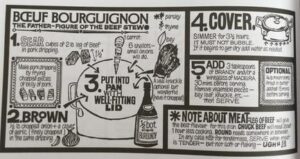
The character’s enthusiasm for a quality meal reflects a similar enthusiasm on his creator’s part.  Indeed, when he was still working an illustrator, Deighton spent four years producing Cookstrips for the Observer newspaper.  These were what nowadays we’d call ‘infographics’.  Each presented a recipe for a particular dish, with pictures, arrows and a minimum of text making the preparation process as simple and clear as possible.


From Wikipedia / © Harper Collins


Where Deighton’s hero and Fleming’s hero part ways is in their relationships with their employers.  While Bond seems at ease in the secret service, Deighton’s character lacks the wealthy and privileged background that most of his colleagues and superiors have.  And he isn’t impressed by what that background has produced.  He begins the novel working for Military Intelligence under a man called Ross, “a regular officer, that is to say he didn’t drink gin after 7.30 P.M. or hit ladies without first removing his hat.”  Ross, we hear, has given him plenty of ‘toffee-nosed dressing downs’ and at one point he rambles at inordinate length about his huge and lavish garden.  “Ross,” the perplexed narrator breaks in, “Mrs Laing and Dorothy Perkins are roses, aren’t they?”


Early in The IPCRESS File, though, he’s transferred from Ross’s unit to a civilian intelligence department of the Home Office called the WOOC(P).  Not that he’s much happier with the person in charge there, a character called Dalby who’s “an elegant languid public-school Englishman of a type that can usually reconcile his duty with comfort and luxury.”  When Dalby asks him if he “can handle a tricky little special assignment,” he retorts, “If it doesn’t demand a classical education I might be able to grope around it.”


Having to work with people from moneyed backgrounds presents him with another problem.  His superiors don’t seem to appreciate the fact that he needs a steady income and regular payment of expenses to survive.  When he switches from Ross’s outfit to Dalby’s, he wonders how long he “would have to make the remnants of this month’s pay last before the new scale began.”  Later, he complains that he’s “still two months behind with pay and three with allowances” and that “a claim for £35 in overseas special pay” was “overdue by ten and a half months.”


This also surfaces in the film, with Ross and Dalby (played by Guy Doleman and Nigel Green) depicted as a pair of condescending bowler-hatted toffs who view Palmer as an irritant with ideas above his station.  But the unflattering commentary about Britain’s class system is diluted slightly by the addition of a military theme.  Ross and Dalby are both of upright army-officer stock while Palmer, we hear, had an inglorious time in uniform.  (I assume that as an ordinary soldier he was caught up in illegal black-market activities in Germany, though I could be wrong.)  Anyway, he’s spent time in a military prison and might be thrown into one again if he gets on the wrong side of his employers.


Thus, Palmer’s insolence isn’t just the result of a general social resentment – it comes too from a particular resentment against an institution, the army, that’s blighted his past and could potentially blight his future.  Meanwhile, the film plays down his financial frustrations and shows him protesting instead against the needless bureaucracy of his work.  Dalby, for instance, insists on a lengthy report being written after every excursion he makes ‘into the field’.


Incidentally, James Bond gets the best of both worlds.  He’s well-bred enough to know his way around a flashy casino or expensive golf club, and is choosy about what he eats, drinks and drives, but he knows how to avoid coming across as an arse when mingling with ordinary working folk.  Note how easily he gets into conversation with a pub landlord in Moonraker (1955), say, or with Tiffy, the bargirl at the bordello in The Man with the Golden Gun (1965).  As Henry Chancellor puts it, he’s a ‘snob about things’ but not ‘about people’.


To sum up then, I found the hero of Len Deighton’s The IPCRESS File rather more Bondian than I’d anticipated.  But what distinguishes him from Ian Fleming’s super-spy is class.  One has an ample supply of it.  For the other, it’s the bane of his bloody life.


From Wikipedia / © David Rose / The Daily Telegraph

Steve Cashel has the last laugh


© Close to the Bone Publishing


Steve Cashel, the pseudonym I use when I write fiction set in Scotland and without any elements of the fantastic, has had a new story published in Close to the Bone Magazine.  The magazine describes itself as “publishing weekly hard-hitting crime fiction since 2012”.


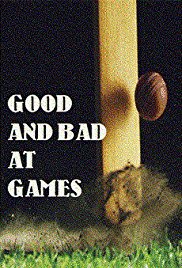
My story, entitled Last Laugh, doesn’t contain any crime that necessitates the involvement of the police force, detectives and / or private investigators.  But it does concern behaviour that’s criminal in nature.  It tells the tale of a man who suddenly finds himself reflecting on a boy he bullied in his schooldays, the bullying becoming more and more extreme until it got entirely out of hand.  The story owes something to Good and Bad at Games, the 1983 British TV drama written by William Boyd and directed by Jack Gold, which was published with another of Boyd’s TV plays in a volume called School Ties in 1985.


Good and Bad at Games was based on Boyd’s experiences at the posh private school Gordonstoun, to which he was packed at the age of nine.  Gordonstoun is famous for having helped to educate Prince Philip, the late Duke of Edinburgh, and his sons King Charles III, Prince Edward and Andrew Mountbatten-Windsor, the arsehole formerly known as ‘Prince’.


However, in Boyd’s introduction to School Ties, the author wrote that in his day the school was ”comparatively unknown and inexpensive, distinguished only by its remoteness (in the far north of Scotland), a reputation for its somewhat Spartan lifestyle (boys wore shorts throughout their school career) and the idiosyncrasies of the educational ethos of its founder, who thought a school could be run along principles laid down in Plato’s Republic.”  Boyd also described being a small boy there, at the mercy of bigger boys, as being ”like a medieval peasant during the Hundred Years War.  One never knew when another marauding army might march by, randomly distributing death and destruction.”


In a nod to Boyd, I made the imaginary posh school in Last Laugh a Scottish one, though in Edinburgh rather than the remote north.  It takes both day-pupils, who are mostly Scottish, and boarders, who are mostly English, which doesn’t exactly enhance its social cohesion.


For now, Last Laugh can be read here, while you can access the home page of Close to the Bone Magazine here.


© Channel 4

The Darkness descends on Singapore


Andy Warhol’s prediction that one day everyone would be famous for 15 minutes seems cruelly appropriate when I think about English glam rock / metal band the Darkness.  In 2003 they released their debut album Permission to Land and for the next year they were huge. The album went platinum and the band racked up three awards – Best British Group, Best British Rock Act and Best British Album – at 2004’s BRIT Awards.


But then…  Suddenly, they weren’t huge.  Their second album One Way Ticket to Hell… and Back (2005) being a flop and their singer and lead guitarist Justin Hawkins quitting the band after struggling with drug and alcohol addiction didn’t help, though overall they gave the impression their popularity would be brief.  With the over-the-top theatricality of their music – crowned by Hawkins’ falsetto vocals – and the cartoonish-ness of their videos and general image, the band obviously didn’t take themselves seriously, which was admirable.  Alas, there’s a problem with presenting yourself as something of a joke, i.e., even the funniest joke in the world stops being funny when you’ve heard it a number of times.


For the record, I should say I liked One Way Ticket to Hell… and Back, if only for its title track, which contained the immortal lyrics: “The first line hit me like a kick in the face / Thought I better have another one just in case…”  I also liked them because they came from Lowestoft, the rather rough-and-ready seaside resort in County Suffolk.  I was spending much of my time in Suffolk when, temporarily, they hit the big time.  Indeed, at the height of their celebrity, they threatened to buy big, fancy houses in Southwold, the more upmarket, snootier seaside resort a few miles along the coast from Lowestoft – a threat some Southwolders took seriously.  I seem to recall a newspaper article where the journalist visited Southwold and interviewed some locals about the prospect of having Justin Hawkins and co. as residents.  One old lady expressed her disapproval of them because they ‘had tattoos’.


However, as evidenced by John Travolta – who went from the highs of Saturday Night Fever (1977) and Grease (1978) to the lows of the Look Who’s Talking movies (1989-93), but then enjoyed a comeback with Pulp Fiction (1994) – or Robert Downey Jr – who, after Air America (1990) and Chaplin (1992), seemingly destroyed his career with cocaine and heroin abuse, but then made a half-billion dollars playing Iron Man in the Marvel Cinematic Universe – or even Sir Michael Caine – whose route from Zulu (1964) and Alfie (1966) to having roles in eight Christopher Nolan movies and becoming a British national treasure had to go through a mid-career trough containing the likes of The Swarm (1978), Beyond the Poseidon Adventure (1979), The Island (1980), The Hand (1981) and Jaws: the Revenge (1987) – just because you were once fashionable, but then went out of fashion, doesn’t mean you won’t ever come back into fashion.   So it is with the Darkness.  After being off the radar for a long time, they’ve lately acquired some retro-coolness.


Their eighth and most recent album, 2025’s Dreams on Toast, got to Number 2 in the British charts.  They’re due to support Iron Maiden at their 50th anniversary show at Knebworth Park in July this year.  And in December 2026 they’ve lined up no fewer than seven UK arenas to perform in for their Band of Brothers tour.  They even generated some headline-making controversy when Justin Hawkins, who reunited with the Darkness in 2011, and younger brother Dan, who plays lead guitar in the band too, criticized Yungblud’s performance at the late Ozzy Osbourne’s farewell concert last summer.  The elder Hawkins commented: “…if the future of rock comes from musical theatre and Disney, if this is Ozzy’s heir, we’re in trouble.”  Finally, it hasn’t done the band’s renewed popularity any harm that, since 2021, Justin Hawkins has had a YouTube channel where he reviews and analyses songs.  It currently has 600,000 subscribers.


Last week, the Darkness made their first-ever appearance in Singapore, my current abode, with a gig at the Capitol Theatre.  In terms of musicality, it wasn’t the best concert I’ve attended in the city-state.  That accolade probably belongs to Jack White, whom I saw at the same venue three-and-a-half years ago.  But in terms of showmanship… This gig was pretty awesome.


Yes, the band-members are two decades older than they were in their mid-noughties heyday – bassist Frankie Poullain, who once resembled a moustached villain from a spaghetti western, appears to have transformed into Kurt Vonnegut – but the encroachment of middle age hasn’t slowed, calmed or subdued them.  Justin Hawkins, for example, in an impressive display of spriteliness, performed a handstand at one point.  Also, admirably un-self-conscious, he stripped off to the waist early in the gig and flaunted a torso slathered in tattoos.  No wonder that old lady in Southwold objected to him.


When you list the bands that had an influence on the Darkness, the one topping the list is surely Queen.  Accordingly, there were moments tonight when I felt I was listening to the rockier end of Queen’s musical repertoire – without the detours into opera, funk, disco, music hall, electronica and so on that the older band were so fond of – with Justin Hawkins providing plenty of Freddie Mercury-style flamboyance.  But I mean that in a good way.  Those Queen-esque moments smacked of loving homage rather than slavish imitation.  And on the subject of Queen, I should mention that since 2015 the Darkness’s drummer has been Rufus Tiger Taylor, whose dad is none other than the legendary Queen tub-thumper Roger Taylor.  Justin Hawkins cracked a joke about this at one point, quipping that Rufus’s father used to ‘play the drums in Status Quo’.  I laughed, though nobody else in the crowd seemed to.  Maybe because I was the only audience-member old enough to know who Status Quo were.


The setlist balanced half-a-dozen songs from their first and still most famous album Permission to Land, including such crowd-pleasing items as I Believe in a Thing Called Love and Get Your Hands Off My Woman Motherf*cker, with half-a-dozen from their recent comeback Dreams on Toast.  Of the latter songs, Rock and Roll Party Cowboy, which served as the opening number and set the tone for what was to follow, was a particularly glorious slab of glam-metal genius / stupidity (“Leather jacket, no sleeves / Harley-Davidson? Yes, please!“).  Some of their in-between albums were represented by a song each and they also did a cover, a guitar-heavy rendition of Jennifer Rush’s The Power of Love (1984), which Hawkins’ voice was highly suited to.  The cover was fun, though one ironic take on a power ballad was enough.  They thankfully didn’t follow it up with versions of, say, Bonnie Tyler’s Total Eclipse of the Heart (1983) or Celine Dion’s It’s All Coming Back to Me Now (1996).


The band played epically with instruments cranked up to 11 at all times, Justin Hawkins antics’ as frontman achieved the right alchemy of melodrama and hilarity, and consequently the evening was high in entertainment value and the crowd had an excellent time. What helped, I felt, was that the Darkness came across as being a bunch of genuinely decent lads.  For instance, Justin Hawkins showed his appreciation of the guitar-tech guy who sporadically had to run on and off-stage.  The band also made sure their touring member, the keyboardist and guitarist Ian Norfolk – who, with his bald head, trimmed beard and sensible clothes looked as unlike the other performers as was possible – got a minute in the limelight.  By the way, I appreciate a guy called Norfolk playing with a band from Suffolk.


Moreover, the one moment that could have soured things – the band stopped a half-minute into I Believe in a Thing Called Love to ask certain members of the audience at the front of the stalls to stop filming on their phones – was well-handled by Hawkins.  Speaking like the nice, popular teacher at school who, once in a blue moon, has to discipline an unreasonably rowdy class, he pointed out in an I’m-not-angry-just-a-bit-disappointed voice, “Imagine if I sang the song while filming you on my phone…  It’d be really boring!”  He was more restrained than Brett Anderson of Suede, who in a 2023 gig at Singapore’s Star Theatre reacted to phone-filming spectators by tussling with them and knocking the infernal devices out of their hands.


Incidentally, when I arrived before the show, I noticed that one of the counters selling drinks at the back of the stalls belonged to the Flying V, Singapore’s premiere – well, probably only – heavy-metal bar.  And when I approached that counter to buy a beverage, I discovered they were selling Aspall Cyder.  The cidery producing this particular brew is located in the Suffolk village of Aspall, about 30 miles southwest of Lowestoft.  Wow, I thought, is this on sale because the Darkness are performing tonight?  Are they supporting the Suffolk economy whilst playing in Asia?  Momentarily, I had a vision of the Darkness’s tour-jet being accompanied by a cargo plane loaded with bottles of East Anglian scrumpy.  However, I visited the Flying V after the gig and learnt that they sell Aspall Cyder there all the time.  So it was just a coincidence.


Paul McAllister sends some sunlight through the cracks


© Still Here Magazine


If you’ve read my recent posts about the state of the world – a world hostage to the crazed and destructive whims of the current occupant of the White House – you’ll be surprised to hear that I’ve just had a short story published in a magazine-issue whose theme is ‘hope’.


Issue 3 of the digital literary magazine Still Here features 19 poems and 18 pieces of fiction, each of which – in the words of editor Alauna Lester – “is a reminder that there is always light, even when it filters in quietly through the cracks.”  For that reason, the issue is titled Sunlight through the Cracks.  My contribution is a story called Learning to Leave and, as it’s set in Northern Ireland and doesn’t contain any elements of fantasy or horror, it’s attributed to Paul McAllister, the penname I usually put on stories of that sort.


The story, and its title, were inspired by an academic paper, Learning to Leave: The Irony of Schooling in a Coastal Community, which was written by Michael John Corbett and published by the University of British Columbia in 2000.  I read it in 2008, when I was beginning to study for an MA in Education and Development at the University of East Anglia (UEA).  One of the MA’s tutors, Professor Bryan Maddox, sent a copy of the paper to his students.  At the time, I suppose my course-mates and I had a missionary-like zeal about the transformative powers of education – we believed the world would be a much better place if all its inhabitants got to go to school, full-stop.  Corbett’s paper, though, advised caution, noting how one Canadian coastal community had suffered, not benefitted, from the educational system its young people had gone through.


By making us to read the paper, Bryan was playing devil’s advocate.  He wanted us to stop and think about the medicine we were so keen to prescribe.  Education, at least not in a one-size-fits-all form, isn’t necessarily the solution to everyone’s problems.  (Bryan, incidentally, was a great teacher.  I spent much of that year at the UEA tearing my hair out in frustration at lecturers who believed it was acceptable to subject their students to multi-slide PowerPoint presentations, overloaded with text, with zero time to process anything.  Bryan, though, kept the number of slides he used to single figures and encouraged discussion and reflection, and you walked out of his lectures feeling you’d actually learned something.)


Learning to Leave: The Irony of Schooling in a Coastal Community struck a chord with me because its message corresponded to something I’d noticed a few months earlier.  I’d accompanied my dad on a trip to Northern Ireland and, for the first time in decades, visited the little village in rural Country Tyrone where I’d spent my childhood.  And, years afterwards, the memory of that visit, plus the message of Corbett’s paper, compelled me to put pen to paper (or fingers to keyboard) and write the story Learning to Leave.  However, because it appears in Sunlight through the Cracks, it isn’t wholly bleak.  Some hope appears late on in the narrative, from an unexpected source.


As usual, Alauna and her team have put much care and effort into producing Issue 3 of Still Here and it’s a visual as well as a literary treat.  You can download a copy of its third edition, Sunlight through the Cracks, here.

The missiles are flying… Hallelujah! Hallelujah!


© Paramount Pictures / Dino De Laurentiis Company


With Donald Trump enacting his latest insanity – joining forces with Israel and bombing the bejeezus out of Iran, which has prompted the latter country to retaliate by firing ordinance in all directions and lighting up the Middle East like a Christmas tree – I find myself thinking of Greg Stillson, a character featuring prominently in Stephen King’s novel The Dead Zone (1979).  In the David Cronenberg-directed movie version of The Dead Zone (1983), Stillson is played by Martin Sheen.  It’s Sheen, as Stillson, who utters the quote that’s this blog-entry’s title.


Stillson is a psychotic bully who begins as a salesman, becomes a businessman and then a politician, and finally leads a populist movement that sweeps him into the White House.  Well, he does in one timeline.  Before winning the presidency, while he’s on the campaign trail, he shakes hands with The Dead Zone’s hero, Johnny Smith, who’s been blessed – or cursed – with the power to see into people’s futures just by touching them.  He has a vision of Stillson’s future wherein, as a despotic and unhinged US president, he presses the buttons that trigger an apocalyptic nuclear war.  Thereafter, Smith has to decide how he’s going to stop him.  (Spoiler – he does, but with tragic consequences for himself.)


I don’t know if anyone with clairvoyant visions touched one of Trump’s little hands a couple of decades ago and witnessed him pressing buttons and wiping out humanity in 2026, the 250th anniversary of American independence.  But it wouldn’t surprise me if someone had.


Anyway, it doesn’t need saying, but Trump’s actions – which began on February 27th, when in conjunction with the Israelis and under the moniker ‘Operation Epic Fury’, he had his military bombard Iran with missiles and drones; one source estimating on March 4th that nearly 900 people had been killed so far, including Iran’s Supreme Leader Ayatollah Ali Khamenei – are a vastly bad idea for many reasons.  Here are some of those reasons.


From wikipedia.org / farsi.khamenei.ir


One.  The attack is illegal under international law.  In the Conversation, Shannon Brincat and Juan Zahir Naranjo Caceres have written that “Israel said the strikes were ‘preventative’, meaning they were to prevent Iran from developing a capacity to be a threat.”  However, they point out that “preventative war has no legal basis under international law. The UN Security Council did not authorize any military action, meaning the sole lawful pathway for the use of force for self-defence was never pursued.”


Two.  The attack went against the American constitution.  The American historian Heather Cox Richardson has noted on her Substack: “In his letter to Congress notifying them of his attack, Trump said he had acted under the 1973 War Powers Act, which permits a president to attack another country if there is an urgent threat.  But the letter itself doesn’t identify any such urgent threat.  It simply said Iran is one of the world’s largest sponsors of state terrorism and that it ‘continues to seek the means to possess and employ nuclear weapons’…  The Framers of the Constitution placed the power to declare war in the hands of Congress and not in the president above all because they did not trust that much power in the hands of one man…”


Three.  It’s likely Benjamin Netanyahu bounced the USA into the attack.  Going back to Reason One, the supposedly ‘preventative’ nature of the USA and Israel’s assault on Iran is torturous to say the least.  A few days ago, US Secretary of State Marco Rubio said, “It was abundantly clear that if Iran came under attack by anyone – the United States or Israel or anyone – they were going to respond, and respond against the United States…  We knew that there was going to be an Israeli action. We knew that that would precipitate an attack against American forces, and we knew that if we didn’t pre-emptively go after them before they launched those attacks, we would suffer higher casualties.”


In other words..  We had to attack them before they attacked us, which they would surely do because Israel intended to attack them first.  This means the USA’s vast military firepower isn’t actually under the control of the American commander-in-chief, but under that of Israeli Prime Minister Benjamin Netanyahu.  The wily Netanyahu says ‘Jump’, the Americans say ‘How high?’


Four.  Dodgy Middle Eastern deals are possibly involved.  Who else, besides Netanyahu, has a finger in the pie here?  In 2025 Trump did investment deals with Saudi Arabia, Qatar and the United Arab Emirates, which he claimed were worth over two trillion dollars.  Qatar saw fit to gift – some would use the verb ‘bribe’ – Trump with a 400-million-dollar Boeing jumbo jet that he plans to turn into a new Air Force One, making one wonder how much of these investments will be enriching Trump and his clan rather than the USA itself.  Also, Trump’s son-in-law Jared Kushner and Steve Witkoff – the real-estate developer whom, laughably, Trump sent into negotiations with Russia about the Ukraine War even though he had zero diplomatic experience – have been in the Middle East lately as ‘envoys’, hawking the idea that the decimated Gaza should be reinvented as a luxury resort with ‘180 skyscrapers’ (and any remaining Palestinians, presumably, doing jobs like cleaning the toilets).


In the future, if a saner administration ever comes to power in Washington DC and launches an investigation into this debacle, it’d be wise to ‘follow the money’.  I’ll bet at least some of the encouragement for this war came from business interests and wealthy leaders in the Middle East who regarded the Iranian regime as an undesirable neighbour, lowering the tone and property value of the area, and wanted it removed.


Five.  It’s actually Operation Forget Epstein.  Trump likes to distract.  When the headlines look bad for him, he does something outrageous that generates different headlines – not necessarily favourable ones, but enough to banish the previous, bad headlines from people’s memories.  This works especially well in our screen-obsessed, social-media-fixated era where attention-spans are short.


On February 25th, the New York Times published a report under the headline EPSTEIN FILES ARE MISSING RECORDS ABOUT WOMAN WHO MADE CLAIMS AGAINST TRUMP.  This mentioned documents “released by the Justice Department” that “briefly mention a woman’s unverified accusation that Donald J. Trump assaulted her in the 1980s, when she was a minor.”  Yet other documents relating to these allegations have been withheld or removed from the public database about Trump’s paedophilic, sex-trafficking old buddy Jeffrey Epstein.


And two days later, the assault began on Iran.  Funny, that.


From wikipedia.org / © Jesse Monford


Six.  There’s no plan and no objectives.  The George Bush Jr-led invasion of Iraq in 2003, which toppled Saddam Hussein but created massive instability and led to huge numbers of fatalities – estimates of which range “from 151,000 violent deaths as of June 2006 (per the Iraq Family Health Survey) to 1,033,000 excess deaths (per the 2007 Opinion Research Business [ORB] Survey)” – was a ruinous fiasco. It was also built on the lie that Saddam possessed ‘Weapons of Mass Destruction’.  But compared to Trump’s Iran incursion, it looks like a masterpiece of planning.


For one thing, to have a plan, you actually need to have objectives, i.e., things to plan towards. Trump and his cabinet apparently have no idea what the goal of all this is.  Rubio, as we’ve seen, has said they’re waging war simply because that’s what the Israelis are doing.  Meanwhile, Trump has suggested at one point it’s to achieve regime-change in Iran and replace Khamenei with someone more compliant to US interests, as was allegedly done in Venezuela after the abduction of its former president, Nicolas Maduro.  Though the other day Trump admitted there was a problem with this because his airstrikes had killed all the possible candidates to take over: “…none of the people we had in mind are going to come to power, because they are all dead.”  No, so far, that doesn’t sound like a brilliantly executed plan.


Trump has also claimed the war is to prevent Iran developing nuclear weapons, even though after the USA carried out a bombing raid on Iran in June last year he was adamant that “Iran’s key nuclear enrichment facilities have been completely and totally obliterated.” Trump has tried to justify this new war by saying Iran was – here plucking a figure out of his arse – ‘two weeks’ away from acquiring a nuclear weapon.


Elsewhere, it’s been suggested the war is to encourage the Iranian people to rise up and overthrow the regime that’s oppressed and abused them for 47 years; to stop Iran sponsoring terrorism; and to destroy Iran’s navy.  But most likely it’s because Trump woke up the other morning, looked out of the window and thought, “Gee, this would be a good day to bomb Iran back to the Stone Age.”


Seven.  This sort of thing has been tried before.  Vietnam…  Afghanistan…  Iraq…  Libya.


Eight.  Possible destabilization of the Middle East.  Even if by some fluke Iran ends up with a Trump-and-Netanyahu-approved government, it’s difficult to see how it can impose order on a country so diverse and, after all this devastation and upheaval, febrile.  Iran’s population is 61 percent Persian, 16 percent Azerbaijani and 10 percent Kurdish, and the rest of it includes people like Lurs, Arabs, Baloch, Arabs and Turkish groups.  While it’s overwhelmingly Shia Muslim, 9 percent of the population are Sunni and other sects of Muslim and there are also Baha’i, Christians, Zoroastrians, Jews and Sabean Mandeans.  That’s before we get to political differences.  Has anyone in Washington DC considered this?  I doubt it.


Civil war in Iran could have devastating consequences for the Middle East.  We’ve already seen the current conflict’s knock-on effects on the world’s oil supply, especially the disruption of tanker-traffic in the Strait of Hormuz, and on air travel, with more than 20,000 flights grounded and a million people stranded around the world since late February.  The Middle East going J.G. Ballard is not good news for anyone.  Well, apart from Vladimir Putin, who’ll see an increase in demand for Russian oil.


Nine.  China may be thinking, “Hold my beer!”  Trump’s rhetoric about attacking Iran sounds uncomfortably like Putin’s excuse for invading Ukraine in 2022 – his goal was to ‘demilitarise’ and ‘denazify’ the country.  I also suspect China is watching keenly and wondering how it could cook up a similar motive for taking over Taiwan in the future.


Incidentally, Taiwan is the world’s foremost producer of Artificial Intelligence chips and according to the New York Times, without those chips, “the tech industry and the US economy would be crippled.”  Haven’t thought that one through either, have you, Donald?


From pixabay.com / © clecaux