Jim Mountfield joins the swan song


© Midnight Street Press


Jim Mountfield, the pseudonym under which I write horror stories, has just had another work published in an anthology.  This comes soon after two other Mountfield short stories were included in the anthologies Nightmare Fuel: Body Horror 2024 (in October) and Monster: Underdog Anthology 2024 (in November).  The new story appears in Swan Song: The Final Anthology, just published by Trevor Denyer’s Midnight Street Press.  Though I’m pleased about this, the experience is also bittersweet because Swan Song is the final book or magazine to come from Midnight Street Press and marks Trevor’s last work as a publisher, though I’m sure he’ll continue as a writer and poet.


Trevor started publishing in 1998 with Immediate Direction Publications, the original incarnation of Midnight Street Press, and the first thing he produced was the magazine Roadworks.  In summer 2001, my story Hound Dog Blues turned up in Issue 12 of Roadworks.  It was inspired by a 1995 court-case in my southern-Scottish hometown of Peebles involving a mate of mine, which ended up overturning the United Kingdom’s ‘Dangerous Dogs’ legislation of 1991, in Scotland at least.  A judge couldn’t determine whether or not my mate’s dog, a mongrel called ‘Slitz’, qualified as being a dangerous breed, as some had claimed, and declared the legislation not fit for purpose.  Anyway, the resulting Hound Dog Blues could best be described as ‘Irvine Welsh meets Stephen King’s Cujo (1981)’.


A year later, when Immediate Directions Publications also put out a fantasy magazine called Legend, I managed to place a story, Her Web, in it too.   Her Web was a milestone for me because it was my first-ever fantasy story to get into print.  In recent years, I’ve had quite a few fantasy stories published under the pseudonym Rab Foster, so the appearance in Legend set the ball rolling there.


© Midnight Street Press


I’m grateful to Trevor Denyer for publishing those two stories when he did because it gave me a break when my morale really needed it.  The early 2000s was a period when, as a writer, I often felt I couldn’t get myself arrested, let alone published.  I remember staring almost disbelievingly at his acceptance letters.  (At that time, it was still a thing to post physical manuscripts to publishers, making sure you’d included the all-important stamped, self-addressed envelope in which an editor would send a reply saying ‘yay’ or ‘nay’.)


That was also back when my nom de plume wasn’t Jim Mountfield or Rab Foster, but Eoin Henderson.  I’m superstitious, and when I was having little luck getting stuff published under that pseudonym, I changed to others.  Since then, I’ve had reasonable runs of luck with Jim Mountfield and Rab Foster, so I expect to remain being them for a while longer.


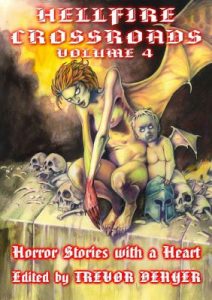
Later, after Immediate Direction Publications had changed into Midnight Street Press, further stories of mine saw print in Trevor’s yearly magazine Hellfire Crossroads and in his anthologies Strange Days (2020) and Railroad Tales (2021).   These include two stories that are among my favourites of what I’ve written.  The Next Bus appeared in Issue 4 of Hellfire Crossroads in 2014 and was about a tourist who finds himself stuck at a remote bus-stop with a homicidal maniac wanting to make a life-or-death wager on when the titular next bus will arrive.  I don’t drive and depend on public transport to get around, so the story expressed my frustration at spending much of my life waiting at bus stops, wondering when the bloody bus is going to come.


I also really liked The Groove, which appeared in the subsequent issue of Hellfire Crossroads, as it wasn’t only about horror but about another topic close to my heart, music.   It had a lover and connoisseur of music getting his revenge from beyond the grave on his widow – her musical tastes begin and end with Mariah Carey, Phil Collins, Whitney Houston, Bryan Adams, Robbie Williams and Celine Dion, so you know she’s evil – when she schemes to enrich herself by rewriting his will, getting her hands on his massive record collection and selling it off on eBay.  Not only that, but she befouls her husband’s memory by playing Robbie Williams’ Angels (1997) at his funeral.


Earlier this year, Trevor brought out a new magazine called Roads Less Travelled, but that didn’t do as well as expected and led to his decision to close Midnight Street Press as a publishing concern (though not as a retailer – its past publications can still be purchased from its website).  Swan Song: The Final Anthology contains the stories he’d planned to publish in future issues of Roads Less Travelled, had the magazine been a success.  These stories include a horror / science-fiction number by myself, as Jim Mountfield, entitled The House of Glass, which owes something to the work of H.P. Lovecraft.  However, it’s set among the non-Lovecraftian landscapes of Sri Lanka, the country where I lived from 2014 to 2022.


Containing 20 stories of horror, dark fantasy, science fiction and slipstream, Swan Song is available at Amazon UK here and Amazon US here.  And to browse Midnight Street Press’s voluminous back catalogue, visit its website here.
 

© Midnight Street Press

Jim Mountfield racks up another one


© Stygian Lepus


I grew up on a farm.  In fact, I grew up on two farms, one in Northern Ireland and the other in Scotland.  So when I write fiction, farms are a common setting for my stories.  That includes scary stories, which I write under the pseudonym Jim Mountfield.


A big inspiration for my ‘farm-horror’ stories was a 2005 Irish film called Isolation, written and directed by Billy O’Brien.  It’s about a lonely and financially-pressed farmer forced to take the filthy lucre of a bio-genetics company and let them experiment on his cattle.  Being a horror film, this doesn’t result in faster-growing livestock as the company hopes but some nightmarishly malformed, slimy organisms whose alien tissue is soon infecting all living things on the farm, bovine and human.  Though it’s not well-known, Infection has a great cast –  including two of my favourite Irish actors, John Lynch and Ruth Negga, plus Essie Davis and Sean Harris.


What really impressed me, though, was its bleak agricultural setting, one where soulless concrete animal-sheds and black-tarped silage pits loomed next to decaying barns and lakes of slurry, everything dark and driech in the continuously pissing rain.  This made me realise that, at least on a bad-weather day, much modern farming is so grim it’s a horror story even before any monsters show up.


© Film Four / Lions Gate Films / Irish Film Board


Last year, I had three farm-horror stories published – Wool in (the now sadly-defunct) The Sirens Call, The Turnip Thieves in Schlock! Webzine and The Shelter Belt in Witch House.  Feeling I’d rather overdone this sub-genre, I didn’t write any more for a while.  Until now – for I’ve just had a new, farm-set story published, one featuring the requisite soulless concrete sheds and decaying barns, rain and muck.  It’s called Rack and Ruin and appears in the newly-published Issue 19 of The Stygian Lepus.


The original idea for Rack and Ruin came from the roadkill I’d frequently see on the back-road beside my family’s farm in Scotland.  One very wet day, walking along that back-road, I encountered some roadkill that’d been so mashed by the wheels of passing cars, and partly-dispersed by the pounding rain, that I had no idea what animal it’d been.  I gave the gruesome thing a wide birth as I walked by it.  I would have given it an even wider berth if this had happened after I saw Isolation, for it resembled one of the squishy, hellish things in the film.


Rack and Ruin was also influenced slightly by the classic H.P. Lovecraft story, The Colour Out of Space (1927), in which a meteorite crashes in the hills of Massachusetts and releases a strange blight on the surrounding land – the property of a farmer called Nahum Gardner, who subsequently sees his crops and livestock mutate and become uneatable and unsellable and his family members die, disappear, go mad or grow horribly deformed.  This is accompanied by the appearance of an indescribable colour that exists outside the visible spectrum.


Lovecraft’s story is told through the eyes of a narrator, a surveyor, who gets the details of the story from one of the Gardners’ neighbours.  Thus, there’s little from the perspective of the farming family actually at the centre of the horror.  I thought I would try to address this in Rack and Ruin.  Farming is tough enough in the real world, being tethered to a piece of ground, toiling at it night and day in all weathers, trying to make a living from it whilst at the mercy of the natural climate and the economic one.  Imagine how much worse you’d feel if your precious land was threatened by something inexplicably cosmic in origin.


The Colour Out of Space has been filmed several times and at least one of them, a 2019 version directed and co-written by Richard Stanley, does tell the story from the viewpoint of the Gardners.  However, as Nathan Gardner – Stanley’s renamed Nahum Gardner – is played by Nicolas Cage, he hardly behaves like any farmer I’ve ever met.  The scene where Cage freaks out after discovering his beloved tomatoes have been spoiled by the pesky meteorite is funny, though.


© SpectreVision / RLJE Films


For roughly the next month, my story Rack and Ruin can be read here.  And for the contents page of The Stygian Lepus, Issue 19, and access to all its stories and articles, visit here.

Jim Mountfield sheds some tears


© Hiraeth Publishing


Late last month saw the publication of the Samhain 2024 edition of the fiction, non-fiction and poetry magazine The Hungur Chronicles.  I’m pleased to say it includes an 8000-word short story of mine called The Tears of the Pontianak.  The story is a horror one so, as with all my horror fiction, it’s attributed to the pseudonym Jim Mountfield.


I had the original idea for the story one day while I was exploring Singapore’s impressive Asian Civilisations Museum.  A couple of items of antique furniture – beautifully ornate and lacquered and each containing a dozen drawers – caught my eye and got me thinking.  I imagined a chest of drawers like these being acquired by a rich man with a lot of guilty secrets in his past, secrets his conscience could only deal with by compartmentalising them and totally shutting them away from his existence now.  Not only would the drawers be symbolic of how he’d compartmentalised his life, but they’d somehow have a supernatural power to revive his guilty secrets and force him to confront them.


The Hungur Chronicles is a rebooted version of Hungur, a magazine I wrote stories for back in 2010 and 2011.  The reason I hadn’t written for Hungur / The Hungur Chronicles since then is because the publication features “short stories, poems, articles, and illustrations related in some way to vampires.”  And until recently I’d found it difficult to come up with a fresh and interesting vampire story.  Like zombies, vampires are a staple of horror stories that have been used a zillion times before.  It seemed impossible to write about them in a way that wasn’t clichéd.


So, yes, The Tears of the Pontianak isn’t only about a strange chest of drawers.  It’s about a vampire.  However, the ‘vampire’ in question is something a little out-of-the-ordinary, at least for Western readers.  It’s a Pontianak, a malevolent female creature that appears in the folklore of Indonesia, Malaysia and Singapore.  Though Pontianaks have different attributes in different places, I went with the Malaysian version of them, which, according to Wikipedia, “depicts them as “vampiric” blood-suckers that dissect through the internal organs of men.”  But to link the Pontianak with the other elements in my story, like the haunted chest of drawers and the rich man with a guilty past, I had it feed on something other than blood.  I also needed to set the story in Southeast Asia.  Thus, The Tears of the Pontianak is a minor milestone for me because it’s my first published story that takes place in Singapore.


Finally, I’m fond of basing fictional characters on gnarly old cinematic character-actors whom I like.  For example, ones inspired by James Robertson Justice and James Cosmo have turned up in stories of mine that’ve seen print during the past year.  The Tears of the Pontianak contains a character modelled on Michael Smiley, the grizzled Northern Irish character actor whose CV includes roles in several weird, disturbing and violent Ben Wheatley films: Down Terrace (2009), Kill List (2011), A Field in England (2013) and Free Fire (2016).  As I’m also grizzled and Northern Irish, and people tell me I’m weird enough to be a character in a Ben Wheatley film, I identify a lot with Smiley.  And in The Tears of the Pontianak I pay tribute to him.


© Film4 Productions / BFI / Rook Films / StudioCanal


Containing four additional stories, some poetry and a non-fiction article, and with a striking cover by painter Sandy DeLuca, the Samhain 2024 edition of The Hungur Chronicles can be purchased here.

Jim Mountfield goes guising again


© Legiron Books


Two years ago, under my horror-fiction nom de plume Jim Mountfield, I had a short story called Guising published in an issue of the magazine The Sirens Call.  As its title indicates, this story centred on the Scottish Halloween custom of guising, which in the opening paragraphs I described thus:


Scottish people will tell you that guising isn’t the same as trick-or-treating, though it involves children dressed as ghosts, witches and monsters going to front doors and receiving confectionary or small sums of cash from householders.  The Scottish custom is transactional.  The children have to earn their rewards.  This means putting on a show for whoever they’re visiting.  A brief show, admittedly, like telling a story or singing a song.  Guising has its roots in the activities long ago of mummers who’d turn up at houses and taverns on special days such as Christmas, Easter, Plough Monday and All Souls’ Day, stage short plays, and afterwards collect money from their audiences…


Unfortunately, Sirens Call Publications recently ceased business, so I can no longer provide a link to the issue in question.


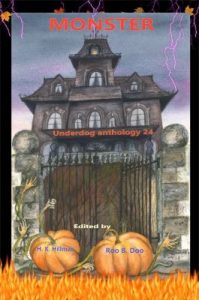
Well, I’ve just had another Halloween-themed short story published, again as Jim Mountfield and again (mostly) set in Scotland.  And there’s more guising in it.  This one is called Bag of Tricks and it appears in the collection Monster: Underdog Anthology 24 from Legiron Books.  All the stories in Monster involve Halloween and the anthology should have gone on sale a fortnight ago to coincide with October 31st.  However, a last-minute glitch with Amazon meant its appearance was delayed into November.


While the guising in Guising took place in the working-class streets of a small mill-town during the 1970s, the guising in Bag of Tricks is more suburban and up-to-date.  It happens in 2023, smartphones are present, and the brattiest kid is dressed as a character from the Saw (2005-23) franchise.  The setting is a smart, edge-of-town estate and the guising party is accompanied by adults – in the feral 1970s, kids were allowed to roam free at night, but in the more child-safety-conscious 21st century, they’re supervised.  Those adults have “decided that, because some houses belonged to older folk who remembered how Halloween had been in Scotland before it got Americanised, the children wouldn’t just chant, ‘Trick or treat!’ and expect to receive sweeties. No, they had to be traditional Scottish guisers and perform – delivering a joke, a story, a song – so that they earned the confectionary.”


Obviously, this being a horror story, those guisers get more than they bargained for as the evening progresses.


A bumper beast of a book containing 416 pages and 39 stories from 37 authors, Monster: Underdog Anthology 24 can be purchased as a paperback here, and in its Kindle edition here.

Jim Mountfield gets activated


© Cloaked Press, LLC


Back in September 2020, I had a story called The Nuclei included in an anthology called Xenobiology: Stranger CreaturesAll its stories, in the words of one of the editors, Michele Dutcher, shared a theme of “biology that has been artificially produced, or biological creatures that have been produced by genetic material being acted upon by outside sources to produce something new.”  Being about artificially-created biological creatures, The Nuclei was classifiable as science fiction, but it definitely lurked at the horror end of the sci-fi spectrum.  In fact, the creatures featured in The Nuclei were the result of me attempting to imagine the most revolting monsters possible.  For that reason, the story was credited to Jim Mountfield, the pseudonym I use for my macabre fiction.


The Nuclei was also a post-apocalyptic story, set in the ruins of Edinburgh – we definitely need more post-apocalyptic stories set in the capital of Scotland – after my revolting, artificially-created creatures had decimated humanity and brought human civilisation to an end.  The human characters, some ragged, malnourished survivors who belonged either to a loony religious cult or to an equally loony militia, referred to an event called ‘the Activation’ shortly before civilisation fell, when the artificially-created horrors were first unleashed on mankind.  That gave me the idea of writing a prequel to the story, detailing what happened at the Activation, i.e., on Day One of the nightmare.


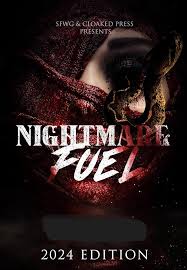
I have now written that story, called The Activation, and have just had it published under the penname of Jim Mountfield too.  It features in Nightmare Fuel: Body Horror 2024, the latest instalment in the annual Nightmare Fuel collections of scary fiction put out by Cloaked Press, LLC.  As its title indicates, the theme for this year’s collection was body horror, which Wikipedia defines as “a subgenre of horror fiction that intentionally showcases grotesque or psychologically disturbing violations of the human body or of another creature.”  Well, the modus operandi of the creatures in The Nuclei involved a lot of body horror, so this seemed a natural home for its prequel.


The setting and main character of The Activation were inspired by something that happened to me once and by somebody I used to know.  Firstly, the happening was a misadventure I had while travelling on the London Tube back in 2016, somewhere between King’s Cross and Liverpool Street Stations – I must have been on either the Circle, Metropolitan or Hammersmith and City lines.  A young woman had what is euphemistically described as an ‘episode’ and started screaming hysterically at her fellow passengers.  Unfortunately, among the things she screamed was the claim that she was carrying a bomb.  The train promptly stopped at the next station and remained there with its doors sealed for 20 or 25 minutes.  Nobody could get in or out.  Meanwhile, the woman kept shrieking gibberish at everyone.


At one point, a pair of British Transport Police officers walked down the train, but didn’t actually stop to deal with the unhinged woman when they reached her.  No, they just walked past her, to the train’s far end, and then walked back – again doing nothing when they passed her a second time.  Later, when I researched the protocol for occurrences like this, I found out that the Transport Police officers had done an ‘assessment of the incident scene’.  Satisfied that they knew where the problem was, and that it wasn’t a case of terrorism, and that there weren’t any other problems elsewhere, they then informed the local police and told them where to find the problem.  When those police arrived on the platform, the nearest set of doors were opened so that they could board the train and remove said problem.


Obviously, this took time.  And with those doors sealed until the local police came, it made me wonder what would have happened to the folk stuck on the train if there’d been a real terrorist present.  I guess we were considered ‘expendable’.


By the time the Transport Police did their assessment, it’d become clear to everybody that the young woman causing the trouble wasn’t a terrorist.  She was just some poor, mixed-up soul who’d probably forgotten to take her medication that day.  I realised this when, at one point during her ravings, she started listing ‘all the great prophets in history’.  These were Buddha, Jesus, Mohammed and… Zippy, the gimpy zip-mouthed puppet from the British kids’ TV show Rainbow (1972-92).


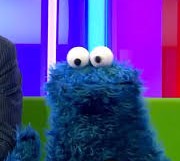
I had to put that detail into my story The Activation.  Although, because Nightmare Fuel: Body Horrors is an American publication, I changed Zippy from Rainbow to the better-known Cookie Monster from Sesame Street (1969-present).  Sorry about that, Zippy, but you just aren’t internationally famous enough.


© Teddington Studios / Thames Television

© Sesame Workshop / BBC / From X


Secondly, the main character in The Activation was inspired by a former colleague, a PE teacher, who was employed by an English private school I worked at in 2002.  He was an ex-soldier.  One evening, the two of us were having a pint in the neighbourhood pub when he told me – with a preliminary request not to say anything about it to the school’s headmistress – that when he went to the school to be interviewed for the PE-teacher position, he’d been homeless.  At the time he was sleeping inside some giant concrete pipes at the side of a road that were soon to be popped in the ground for a sewage or drainage project.  Homelessness among former members of the Armed Forces is something that’s tragically common.


Anyway, for The Activation, I thought the hero would be somebody with experiences similar to my old colleague – a former soldier, homeless, desperately trying to turn his life around.  And then he gets caught up in the hideous events of the story and is put through hell.  Yes, I know.  I’m a sadist.


Containing 14 tales of grisly, gruelling terror, Nightmare Fuel: Body Horror 2024 can now be purchased on Kindle here and as a paperback here.

Jim Mountfield goes to the pub


© Schlock! Webzine


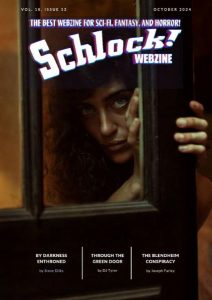
Jim Mountfield, the nom de plume I use when writing fiction of a scary nature, has a new short story featured in the October 2024 edition of the online publication Schlock! Webzine.  It’s entitled The Hole in the Wall and it chronicles the spooky events that befall a real-ale enthusiast while he’s researching a pair of English pubs.  Writing The Hole in the Wall allowed me to poke a little gentle fun at the organisation the Campaign for Real Ale (CAMRA) and its members, though here the main character belongs to an outfit called ABRA, “the association for Action on Bars and Real Ale”.


Now I whole-heartedly believe CAMRA does sterling work in Britain promoting decent-tasting beer and fighting for the preservation of pubs, and I have absolutely nothing against its members.  Indeed, in my youth, I was in CAMRA myself.  But a few CAMRA-ites I knew could be somewhat intense and zealous.  I recall doing a work-experience stint as a trainee journalist with the magazine Camping and Caravanning in 1992.  To keep me busy, the editor suggested I write a feature about cider – the next issue was to focus on camping and caravanning in Somerset and Devon, a region famously home to much of England’s cider.  A mate in CAMRA put me in touch with the organisation’s cider authority, whom I interviewed for the feature over the phone.  More than an hour later, I could not get the interview to end.  The guy would not stop talking about cider.  At  one point he started singing wassailing songs down the phone-line at me.  Such enthusiasm for his favourite beverage was impressive, if frightening.


Of the pubs featured in The Hole in the Wall, one is a dive and is called the Year and a Day Tavern, which was based on a now-closed hostelry on Norwich’s Magdalen Street, the Cat and Fiddle.  I visited it once or twice when I lived in the city in 2008-9 and I have to agree with an acerbic reviewer of the bar who advised online: “…don’t go to the toilet in any circumstances unless you’re wearing a full nuclear biological and chemical protection suit and gas mask.”  The other pub in the story, a smart one called the Cache, was based on a couple of places I used to imbibe in, including the Bodega on Newcastle-upon-Tyne’s Westgate Road and the Fat Cat on Norwich’s West End Street, though the hanging ‘artefacts’ on view inside it were inspired by the décor in the Nutshell in Bury St Edmunds, which claims to be the smallest pub in Britain.


For the next month, The Hole in the Wall is available to read for free here, while the contents page of Schlock! Webzine’s October 2024 issue can be accessed here.  So, please pull up a stool, pour yourself a pint and enjoy.

Jim Mountfield visits the colonies


© The Sirens Call


The Colony, a short horror story I wrote under the pseudonym of Jim Mountfield, has just been published in Issue 66, the summer 2024 edition, of the fiction and poetry magazine The Sirens Call.


For Issue 66, the Sirens Call’s editors suggested that contributors write something on the theme of ‘heat’.  I thought I would write a sci-fi / horror story set in the globally-warmed future.  Come to think of it, you can no longer describe global warming as ‘science fiction’.  We’re living in a globally-warmed world now.  This year, for example, my current place of residence Singapore has been stricken with extreme temperatures.  It was headline news here in March when thermometers recorded highs of 36 degrees.  And the local taxi drivers’ main – only? – topic of conversation in recent months is how they can’t remember the city-state being as swelteringly hot as this before.


Major inspiration for The Colony came from an article I read last year in the web magazine Atlas Obscura about the O.H. Hinsdale Wave Research Lab in Oregon where, among other things, scientists have been experimenting with an item called a ‘chungus’.  This combats coastal erosion by “dampening the waves, robbing them of some of their energy before they crash onto the… shore.”  A chungus is a ‘five-foot-wide, lumpy brown blob floating in the water, encased in webbing and studded with… floaties.  Long plastic tentacles trail from its underside like vinyl seaweed.”  The lab’s researchers suggest that “future versions… would be connected in a vast network, their plump bodies seeded with marsh grasses and seaweed.  Eventually, they would form floating gardens surrounding coastal cities like fluffy green tutus, potentially saving them from disaster… a network of them could dampen a real-world storm surge.”


Of course, my warped mind quickly got wondering…  What if these floating blobs of tentacles and vegetation weren’t inanimate objects but sentient creatures designed, then cloned, in genetic research laboratories, and tethered offshore in their millions to stop coastal erosion and storm surges caused by global warming and rising sea-levels?  And what if, in the tradition of sci-fi horror stories, The Science Goes Wrong?


Meanwhile, it was a no-brainer where to set the story.  I spent a couple of years living in East Anglia, one of England’s most scenic areas but also its flattest and lowest.  It’s severely prone to coastal erosion – something whose effects are in plain view if you visit places along the East Anglian coast like Dunwich, Happisburgh and Orford.


As ever, Issue 66 of The Sirens Call is an absolute bargain, being free and having some 280 pages stuffed with stories and poems.   It can be downloaded here.

Jim Mountfield does some crawling


© Sirens Call Publications


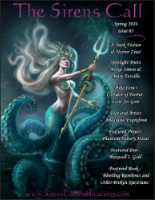
The Crawler, a short story I wrote under the penname Jim Mountfield, is now available to read in the latest edition, Issue 65, of the magazine The Sirens Call.


As usual with the stuff I write as Jim Mountfield, The Crawler is a dark, scary tale.  It’s set in Northern Ireland and part of the inspiration for it came from my memory of how, when I was a kid, there seemed to be lots of old women living alone in my neighbourhood.  Occasionally, they stayed in big houses – but often their homes were small and impoverished.  I recall one elderly lady, Rachel, who lived up the road from us in a little cottage that didn’t even have running water.  Each day she had to collect buckets of water from a spring in the nearby fields.  Those memories date back to the early 1970s, and those women were at least in their seventies, so I wonder if their lives had been impacted by World War I.  They were deemed to be of ‘marriageable age’ during a period when many young men were being slaughtered on the battlefields of Belgium and France.  Afterwards, there weren’t enough young men left to go round, which doomed them to a lifetime’s spinsterhood.  Anyway, The Crawler’s setting came from that melancholy memory.


I also had a blunter reason for setting the story in Northern Ireland.  For plot reasons, the main character needed to have access to a gun.  Thanks to strict gun-ownership laws, most people in the British and Irish islands don’t have access to guns – which, incidentally, is something I strongly approve of – but that wouldn’t be problem in Northern Ireland if your main character was a policeman during or just after the Troubles that blighted the province from the 1960s to the 1990s.


Issue 65, the spring 2024 edition, of The Sirens Call can be downloaded here for free.  As always, it’s an absolute bargain, being 283 pages long and home to some 200 stories and poems.

Jim Mountfield gets some followers


© Stygian Lepus


Issue 11 of the webzine The Stygian Lepus has just appeared online and its contents include a short story by Jim Mountfield, the pseudonym under which I write horror fiction.  Entitled The Followers, it’s the tale of some creative-writing-course students being sent out onto the streets to do a research assignment – never suspecting that, gradually, they’re being drawn into a scenario best described as one of cosmic horror.


Like the previous story I had published by The Stygian Lepus, A Man about a Dog, which appeared in their eighth issue last November, The Followers is set in a northern-English city inspired by Newcastle-upon-Tyne, where I lived from 2002 to 2005.  In fact, its two settings are based on Stowell Street, home to Newcastle’s tiny Chinatown, where I used to work; and on its majestic covered market-hall, Grainger Market, where I used to do much of my shopping.


For the next while, The Followers can be directly accessed here, while the main page of The Stygian Lepus, Issue 11, can be reached here.

Some archery with Jim Mountfield


© The Sirens Call


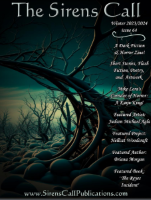
Underneath the Arches, a short horror story I wrote a long time ago, is among the 167 pieces of fiction and poetry that appear in the newly-published Winter 2023 / 2024 edition of the magazine The Sirens Call.  The story was inspired by the arched cavities along the western side of the graveyard behind the Church of St John the Evangelist, which stands at the junction of Princes Street and Lothian Road in central Edinburgh.  In August each year – Edinburgh Festival time – the church’s grounds become the home of an art, crafts and design fair.  Stalls set up shop in the area between the church and its graves of illustrious, well-heeled Edinburgh citizens of times past.  According to its Facebook account, this is now known as the West End Fair.


What caught my fancy when I first encountered the St John’s craft fair in the late 20th century was how those western arches, underneath Lothian Road, had been drafted into use too.  During August, they became mini-shops, out of which vendors sold their wares to the market’s customers.  Thus inspired, I wrote a macabre story about a young man who buys something from one of the arches and, inevitably, lives to regret it.  (Hint: the market is sited in a graveyard…  A place of the dead!)


When I was looking for something to submit to the latest edition of The Sirens Call, I stumbled across Underneath the Arches on my computer’s hard drive.  Talk about a blast from the past.  It’d obviously been written by a much younger version of myself, angsty, pretentious, and in thrall to Edgar Allan Poe (and, indeed, Franz Kafka).  Predictably, the story itself was pompous and overwrought, ridden with adjectives, adverbs, metaphors and similes.  I ended up cutting about 2000 words – 45 percent of its original length – out of it before I submitted it.


Reading it now, I have to say I wish I’d been even more stringent in my editing of it.  There’s a sentence at the end where the word ‘ridge’ is used twice, and I manage to use ‘seemed to’ three times in the opening paragraphs.  (Coincidentally, the editor of a different publication recently told me: “Mark Twain famously said; ‘Anytime you have the urge to write the word ‘just’, use ‘damn’ instead, that way your editor will remove it for you.’ The same is true of the phrase ‘seemed to’.”)


Anyway, no matter.  As usual with my horror stories, Underneath the Arches appears under the pseudonym Jim Mountfield.  And available for free, with all sorts of ghoulish goodies loaded into its 253 pages, the new issue of The Sirens Call is a rare bargain these days.  You can download it here.