Uncle Sam (Part 1)


From wikipedia.org / © Sean Koo


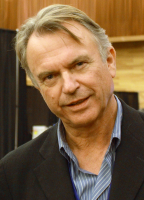
Having just paid tribute to the centenarian Mel Brooks, I hadn’t intended to post another film-related entry so soon on this blog.  Sadly, however, Sam Neill, whom I admired both as an actor and as a person, passed away three days ago and I thought I should pen some words in honour of him too.


Neill’s passing was made even sadder by the fact he’d recently been declared cancer-free after a five-year battle against the disease.  Seemingly, his immune system was so weakened by the treatment he’d received that he fell prey to pneumonia.  Rima Te Wiata, Neill’s co-star in Hunt for the Wilderpeople (2016) told the New Zealand Herald: “It really sucks, actually… I think he would be like: ‘For goodness sake, I got over my cancer. And now look, now I get pneumonia. What next?'”


Though officially a New Zealander, Neill could also be called a Northern Irishman because in 1947 he was born in Omagh, county-town of County Tyrone (17 miles away from where I spent my childhood), to New Zealand and English parents.  He moved from there to Christchurch in 1954 and presumably, if he’d ever acquired a Northern Irish accent, he soon lost it.  Decades later, when he played the psychotic Belfast policeman Chester Campbell in the first two seasons of the TV show Peaky Blinders (2013-14), he asked two mates – Northern Irish actors Liam Neeson and James Nesbitt – for coaching so that he could produce a convincing ‘Norn Irn’ accent.


He also began life as ‘Nigel’, but by the age of 11 had taken to calling himself ‘Sam’.  When he started acting, he was glad he’d chosen the blokey ‘Sam’ over the slightly effete ‘Nigel’.  In an interview published recently in the Guardian, he commented, “If I’d stayed with Nigel Neill, I don’t think I would have had a film career.”  He’d obviously never encountered the great screenwriter Nigel Kneale, whose creations included the Quatermass films and TV dramas.


Though he’d done film and TV work throughout the 1970s, including Roger Donaldson’s thriller Sleeping Dogs (1977), described on its Wikipedia page as “the first feature-length 35 mm film produced entirely in New Zealand”, Neill first came to my attention in 1981, when I was a horror-film-obsessed teenager and when he appeared in two fairly high-profile horror films, Graham Baker’s Omen III: The Final Conflict and Andrzej Żuławski’s Possession.  I read about them in film magazines like Starburst and Fangoria, though I was too young to see them in a cinema because in the UK they were given ‘X’ certificates, meaning only people aged 18 and over could see them.  In the case of Possession, I didn’t even have a chance to see it later on video for it ended up on the Britain’s infamous (and idiotic) ‘video nasties’ list, deemed likely to ‘deprave or corrupt’ its viewers and thus banned from home viewing.
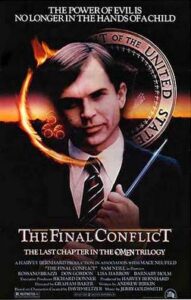
 

© Mace Neufeld Productions / 20th Century Fox


Omen III: The Final Conflict was the third in the trilogy that’d started with Richard Donner’s The Omen (1976) and continued with Don Taylor’s DamienOmen II (1978) and that told the tale of Damien Thorn, the son of Satan and the Antichrist who, according to Biblical prophecies, will rise to power in end times.  Unlike the earlier two movies, where Damien is depicted as a kid (first played by Harvey Spender Stephens, then Jonathan Scott-Taylor), he’s now an adult.  Portrayed by Neill, he’s the powerful CEO of Thorn Industries and soon into the film also becomes US ambassador to Britain, a position from which he hopes to launch his biggest project yet – the thwarting of the Second Coming of Christ.


As Damien, Neill is suave enough to be convincing as a powerful operator in purely human affairs, one who can rub shoulders with top people in top places and get what he wants; whilst also having a sinisterness and darkness that makes you accept him as the same, infernal creature he was in the earlier films (especially the disturbingly baleful Spender Stephens in the first Omen).  Alas, Neill is the only thing of value in the film.  Coming after the original, which was very enjoyable hokum, and the second film, which at least had its moments, The Final Countdown is a damp squib.  Unlike his predecessors Donner and Taylor, Graham Baker doesn’t have the directing chops to properly mount the Omen films’ main attractions – the set-piece ‘accidents’, elaborate, supernaturally-engineered and inevitably fatal, that bump off anyone who gets in Damien’s way.  That said, the scene early on where the previous American ambassador commits ‘suicide’ and conveniently creates a job opening for him, is agreeably splattery.


A far less conventional horror film, and a far better one, is the same year’s Possession.  Though it defies all description, you could say it was a particularly traumatic and traumatising break-up movie…  Or a brooding parable about the Cold War (it was filmed in West Berlin)…  Or a psychological thriller involving doppelgangers…  Or a body-horror film wherein a woman makes repeated love to a vilely tentacled, half-human, half-squid creature…  Or an espionage thriller leading to an apocalyptic World War III finale.


Director Andrzej Żuławski – himself suffering from depression after recently being expelled from his native Poland – put Neill and his co-star Isabelle Adjani through the wringer during the film’s making.  Neill remarked in 2021 that he ‘escaped’ from the movie with his ‘sanity barely intact’.  Adjani suffered even more, though, and supposedly needed a couple of years to get over the experience.  That’s understandable when, for instance, you see the berserk intensity of the now-legendary sequence where she suffers a miscarriage in a subway corridor.  Actually, a young Gaspar Noé must have been highly impressed by that sequence because he basically got Sofia Boutella to recreate it in his 2018 movie Climax.
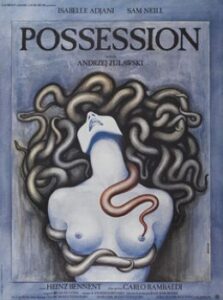
 

© Gaumont Distribution


Things were looking up for Neill’s career in 1983, when he played the title role in Reilly, Ace of Spies, a 12-part TV series dramatizing the life of real-life superspy Sidney Reilly during the first quarter of the 20th century.  Reilly was scripted by Troy Kennedy Martin and directed by Jim Goddard and Martin Campbell and Campbell, a fellow Kiwi, would later direct two James Bond movies, Goldeneye (1995) and Casino Royale (2006).  In fact, for a time in the mid-1980s it looked like Neill was in with a shout of becoming the next James Bond.  (It makes sense – there have been Scottish, Australian, Welsh and Irish Bonds, so why not a New Zealand one?)


In the Guardian interview I mentioned earlier, he was asked about the Bond role.  He said he would have accepted it if it’d been offered to him, but added: “I’m also aware that I wouldn’t have enjoyed my life so much if I was an ex-Bond. That’s what people would say when I went for my morning coffee. ‘Look – it’s what’s-his-name, who used to be James Bond?’ ‘Yeah, he was the one I never really liked.’”


In 1989 he had a good role in Philip Noyce’s Dead Calm, a maritime thriller / horror movie that conveys both the claustrophobia of being at sea – you’re stuck in the confined space of a boat – and the agoraphobia of it – you’re out on a vast, empty mass of water, far from civilisation and help.  Neil and Nicole Kidman (in her seventh, and breakout, film role) play a couple who, while yachting, discover a sinking schooner.  They pick up one survivor (Billy Zane) who – surprise! – turns out to be a crazed killer.


Still, I had the impression that during the late 1980s Neil’s moment had passed and he was destined to spend his remaining career in movies’ supporting casts as a reliable character actor.  This was suggested, for example, by his role in 1990’s The Hunt for Red October, where he gets fourth-place billing after Sean Connery, Alec Baldwin and Scott Glenn.  He plays the second-in-command to Connery’s Captain Marko Ramius, and a participant in a plot whereby the only submarine-commander in the Soviet fleet with a Scottish accent, and his officers, commandeer a super-submarine called Red October and attempt to defect with it to the West.  When Neill’s character starts waxing lyrically to Connery about the rabbit farm he plans to start up after they reach America, you know he’s going to get killed before the end.
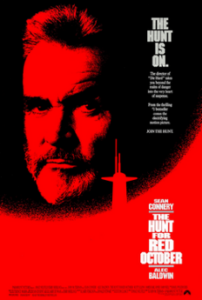
 

© Mace Neufeld Productions / Paramount Productions


However, then, Neill’s fortunes took an upswing – because Steven Spielberg and blockbuster-dom came knocking.


To be continued…
The big Mc


From wikipedia.org / © Nonsenseferret


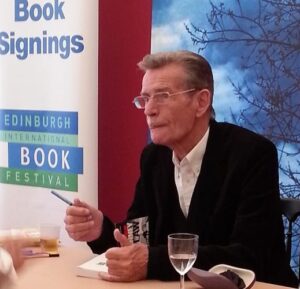
It’s exactly a decade since the Scottish writer, poet and columnist William McIlvanney passed away on December 5th, 2015.  Here’s something to mark this melancholy anniversary.


For myself and many book-lovers in Scotland in the 1980s, William McIlvanney was both a source of pride and exasperation.  Pride that modern Scottish literature was capable of producing someone as good as he was; but exasperation that the British literary establishment seemed to have little interest in him or his peers (like Alasdair Gray and James Kelman) north of the border.  On their radar, Scottish writers didn’t make much of a blip.


Back then, the clique of authors, critics and academics who, through Britain’s highbrow media outlets, decided what was fashionable were a privileged Oxford / Cambridge-educated bunch who lived in London and seemingly lived up their own arses too.  I always find it telling that in 1984, when things felt at their very worst, the Booker Prize – the flagship award for the UK literary establishment – managed to have on its short-list five books that had novelists, biographers, literary critics and literary lecturers as their main characters.  The only shortlisted book that was about people who didn’t make a living out of literature (you know, like 99.999% of the human population) was J.G. Ballard’s Empire of the Sun.  And it didn’t win, though it should have.


The novel that helped put McIlvanney on the map was 1975’s Docherty, which was about a tough west-of-Scotland miner and his family trying to cope with everything that the early decades of the 20th century threw at them.  Thus, McIlvanney was never going to ingratiate himself with the ‘in’ crowd by writing about writers, biographers, critics or lecturers either.


I’d read McIlvanney’s 1977 novel Laidlaw as a teenager – more about that in a minute – but it wasn’t until I was at college that one of my tutors (Isobel Murray) urged me to read a book of his that’d just been published, 1986’s The Big Man.  I’m glad I listened to her because The Big Man proved to be one of my favourite books of the 1980s.  It features another miner, called Dan Scoular.  He’s an ex-miner, actually, because this is the post-miners’-strike 1980s, Scoular has lost his job and he and his family are struggling to make ends meet.  The imposing Scoular happens to be good at fighting, though it’s a side of him that he’s suppressed for a long time.  Then he’s approached by a Glaswegian gangster who offers to pay him a small fortune if he takes part in an illegal bare-knuckle fight.  Thus, Scoular faces a dilemma – does he do something that he finds abhorrent if it saves him and his loved ones from penury?  Inevitably, after he ignores his better instincts and agrees to the proposal, he finds out that there are more complicated and even nastier things going on in the background.


© Hodder and Stoughton


The Big Man is the most cinematic of McIlvanney’s books and it was no surprise that it was filmed, in 1990, by David Leland.  The film gets some things right.  The villains, played by Ian Bannen and Maurice Roëves, are good.  However, it gets a lot wrong, including a Hollywood-esque, feel-good ending far removed from the bleak, ambiguous note with which McIlvanney closes the book.  Another problem is that, at the time, there wasn’t a bankable-enough Scottish star for the filmmakers to cast in the role of Scoular.  So they had to search around and the next best thing they could find was a Northern Irishman, Liam Neeson.


Now I like Neeson, but every time in The Big Man that he opens his mouth and those dulcet County Antrim tones of his emerge, the sense that you’re in a hard-pressed mining town in the West of Scotland goes out of the window.  It’s a pity that the film wasn’t made during the years since, when some bankable Scottish actors have come to prominence (though it might be difficult to find one with the necessary, hulking physicality that Neeson had).  Incidentally, The Big Man – a movie about Scottish ex-mining communities and ruthless Glasgow criminals – also has Hugh Grant in its cast.  I’ll give you all a minute to pick your jaws up off the floor.


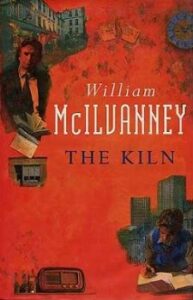
A later novel by McIlvanney, 1996’s The Kiln, received a lot of acclaim.  It even had a recommendation on its cover from Sean Connery.  I’ve just praised McIlvanney for not writing books about writers, but The Kiln actually has a writer as its central character, one in the throes of a mid-life crisis.  However, the novel is more a coming-of-age novel because its hero spends much of it looking back on his working-class youth, especially on a period he spent toiling in a local brickworks.


When The Kiln appeared, it seemed to cement – an appropriate verb for a book about bricks – McIlvanney’s status as a major figure in Scottish letters.  But it seemed the last time that he commanded such attention.  Recently, I was thinking about The Kiln and I remembered reading it while I was making a long-distance bus trip during the only occasion I was in Australia – which was in 1997, almost thirty years ago and almost twenty years before McIlvanney’s death.  What on earth happened to him after that?  I’d come across an occasional interview with him or article by him in the Scottish press, but that was about it.  In 2006 he published one more novel, Weekend, though it arrived with little fanfare – the antithesis of the reception The Kiln got a decade earlier.


© Hodder and Stoughton


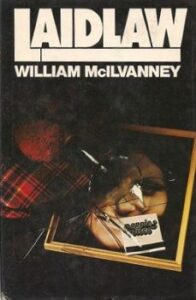
Though as far as mainstream literature was concerned McIlvanney seemed to disappear from view after The Kiln, he did in recent years win belated acknowledgement for his work as a crime writer – specifically, for his 1977 novel Laidlaw, which was republished in 2013, and its sequels The Papers of Tony Veitch (1983) and Strange Loyalties (1991).  (The latter book also serves as a grim semi-sequel to The Big Man.)  All are about a tough but intellectual and philosophical Glasgow detective called Jack Laidlaw.  Since then, crime novels set in Scotland have sold by the barrow-load and Scottish crime writers like Iain Rankin, Val McDiarmid, Denise Mina, Christopher Brookmyre and Stuart MacBride have enjoyed lucrative careers, so McIlvanney can be seen as the man who started it all.  His Jack Laidlaw was the prototype for Inspector Rebus and the rest.  In effect, McIlvanney created ‘Tartan Noir’.


Even when I read Laidlaw at a young age, I found it a bit uneven (as prototypes usually are), its prose shifting slightly uncomfortably between Glasgow-speak and Raymond Chandler-isms.  It wasn’t helped by the way it was marketed, either – “Turn down a Glaswegian when he offers you a drink,” intoned the blurb on the back, “And he’ll break your legs,” which wasn’t what the book was about.  Laidlaw focuses more on psychology than on violence, and I found it disconcerting that in its final pages the hero isn’t rushing to catch the murderer so much as he’s rushing to save the murderer from gangland-backed vigilante justice.  But all power to McIlvanney for inventing what would become Scotland’s biggest literary export.  Iain Rankin, in particular, has always admitted his debt to him.


McIlvanney was a political thinker too and during the 1990s – back in those long-ago days when Scotsman Publications produced material that was worth reading – he was a perceptive columnist in the Scotland on Sunday newspaper.  I also remember him delivering a speech in Edinburgh’s Meadows during the March for Scottish Democracy rally held on December 12th, 1992, demanding the creation of a Scottish parliament.  On stage, in front a crowd of 30,000 people, he performed far better than any of the politicians in attendance.  He memorably summed up the case for a parliament saying: “We gather here like refugees in the capital of our own country, wondering what we want to be when we grow up.  Scotland – the oldest teenager amongst nations.”


But at the same time he pleaded for racial tolerance.  “Scottishness,” he pointed out, “isn’t some pedigree lineage.  It’s a mongrel tradition.”  I suspect that with McIlvanney’s speech that day began the emphasis on ‘civic nationalism’ that Scottish nationalists – at least, the decent, mainstream ones, not the fringe, far-right heidbangers – have been at pains to cultivate ever since.


Finally, William McIlvanney played an indirect role in the start of my writing career.  My very first short story to see publication, a slice-of-life piece set on a Scottish farm with the self-explanatory title Lambing Time, appeared in a magazine called Scratchings, then produced annually by Aberdeen University’s Creative Writing Society.  Scratchings had been launched in the early 1980s with the help of a financial contribution from McIlvanney.  At the time he was Aberdeen University’s writer-in-residence and he was approached by two young students who “wanted to borrow 40 pounds to start a poetry magazine.  Would he be able to lend them the money?”  He did, Scratchings was born, and it provided a home for Lambing Time a few years later.


Incidentally, the two students who successfully tapped McIlvanney for 40 pounds were Dundonian Kenny Farquharson, now a columnist with the Times newspaper; and Invernessian Alison Smith, now better known as the novelist Ali Smith, who’s been shortlisted three times for the Booker Prize – yes, the award whose shortlist bugged me so much back in 1984.


© Hodder and Stoughton

Hungry like the Alpha Wolf


I remember sometime in the 1990s reading an interview with the late, legendary radio DJ John Peel, who was an enthusiastic proponent of extreme heavy metal.  Peel talked about the oddness of going to see a band like the aptly-titled Extreme Noise Terror and realising that he was three times the average age of the punters in the auditorium.


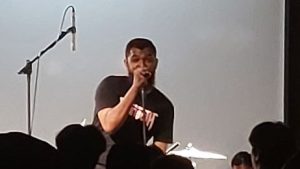
That was exactly how I felt a week-and-a-half ago when I went to Singapore’s Aliwal Arts Centre to attend a gig by the Australian metalcore band Alpha Wolf.  Such was the youthfulness of those around me, and such was my own feeling of decrepitude, that I wondered if I should just send myself up, impersonate Steve Buscemi in the popular Internet meme (taken from a 2012 episode of the TV show 30 Rock) and declare, “How do you do, fellow kids?


Metalcore, Wikipedia informs me, “is a fusion genre combining elements of extreme metal and hardcore punk… noted for its use of breakdowns, which are slow, intense passages conducive to moshing.”  A list of metalcore bands I’ve found on the Internet contains such names as Killswitch Engage and the Dillinger Escape Plan, bands whose albums have resided in my record collection for many years.  Wow, I thought, I’ve owned metalcore music without even knowing it was metalcore! 


Meanwhile, when I looked at Alpha Wolf’s Wikipedia entry, I discovered that they’d taken their name from the 2011 Liam Neeson thriller The Grey, which is about the survivors of a plane crash in an uninhabited part of Alaska being picked off one-by-one by a pack of hungry wolves.  At one point, Neeson’s character, a wolf expert, explains that the beasts are led by a fearsome ‘alpha wolf, which is apparently the Alien Queen of the lupine world.  However, as the band come from Tasmania, I wonder if their name was also partly inspired by their island’s most famous extinct animal, the Tasmanian wolf.


One nice thing about the Alpha Wolf gig was that support was provided by not one, nor two, but three local bands.  It fascinates me that a place as famously orderly and respectable as Singapore can produce so many bands specialising in the supposedly disorderly and disreputable genre of heavy metal.  Those support bands were Tariot, Tell Lie Vision and the self-described ‘progressive metalcore’ Aggressive Raisin Cat, whom John Peel would probably have awarded a session on his BBC Radio 1 show on the strength of their name alone.  All three gave their sets their best shot and won the crowd’s appreciation.  My only quibble was that Aggressive Raisin Cat didn’t have an image of a raisin, or indeed, a cat, projected onto the backdrop behind them while they played.  Instead, there was a weird-looking spinning crisp.


The venue proved a rather austere place.  It was just a space with a stage at the front, and a mixing console and a merchandising stall in the back corners.  There wasn’t a bar, which meant that liquid refreshment had to be procured from the nearest branch of 7-11, which took a while to find, and led me to unfortunately miss some of Tariot’s set.  In between performances, most of the crowd would seep out onto the street outside to chat, smoke and imbibe a little – despite Singapore’s reputation for strictness, drinking in public is permitted until 10.30 pm.  Then, as soon as they heard the next band’s musicians striking their first chords, they’d hurry back inside again.


I’ve seen some videos by Alpha Wolf on YouTube, where they performed belters of songs like Black Mamba and Akudama, though thanks to the limited acoustics in the box-like, concrete-y confines of the arts centre auditorium, some of the shape and structure of those songs got lost a bit.  Still, the intensity of the headliners’ show couldn’t be faulted.  From the amount of moshing and crowd-surfing going on, and the fact that by the end of the set there seemed to be more folk on the stage than on the floor below, it was clear that Alpha Wolf had given the punters their money’s worth.


Just before the proceedings finished, a cake-and-candles were brought onstage for the celebration of someone’s birthday – I couldn’t see very clearly from my vantage point at the back of the venue, but the birthday-boy might have been the singer with Aggressive Raisin Cat – which struck me as a sweet, final touch.  What a nice bunch of lads, I thought.  To put it another way, despite the aural bombast, Liam Neeson should have nothing to fear if this Alpha Wolf was at his door.


© Open Road Films