Films I’d like to see remade (Part 1)


From imdb.com / © Rank Organisation


I still find it disconcerting when films I enjoyed in my youth are remade in the 21st century: for example, 1980’s The Fog (remade in 2005), 1981’s The Evil Dead (remade in 2013) and Clash of the Titans (remade in 2010), 1986’s The Hitcher (remade in 2007), 1987’s Robocop (remade in 2014) and 1988’s Hairspray (remade in 2007).  My immediate and automatic response to such remakes is, “What, they’re remaking that movie already?  Have you no shame, Hollywood?”


This is followed by a feeling of horror as I realise just how long ago it was when those original movies were released.  The first Evil Dead movie was 32 years old – 32 years! – when its remake surfaced, though in my mind it was only yesterday when Sam Raimi’s Deadites made their first-ever appearance and started making life difficult for Bruce Campbell.   And actually, three of the films I remember most fondly from my youth, Philip Kaufman’s Invasion of the Body Snatchers (1978), John Carpenter’s The Thing (1982) and Brian De Palma’s Scarface (1983) were remakes themselves.  Body Snatchers appeared just 22 years after the 1956 original and The Thing appeared 32 years after its 1950 one.  Scarface was an outlier, since the first Scarface came out in 1932, more than a half-century earlier.


Maybe I shouldn’t be so concerned about how soon after the original movie that a remake appears.  I should be concerned about the quality of it – for remakes tend to be shite.  I haven’t seen all those mentioned at the beginning of this entry, but the ones I have seen have been nowhere near as good as the originals.  (The Evil Dead remake probably comes closest, but I still much prefer the ramshackle and low-budget, but resourceful, charm of Raimi’s 1981 film.)  That said, remakes don’t have to be bad all the time – the aforementioned ones by Kaufman, Carpenter and De Palma testify to that.


So, without further ado, here are some films – and one series of films – I wouldn’t mind seeing remade in the 21st century, with bigger budgets and better special effects.  But remade decently.
 

From wikipedia.org / © Rank Organisation


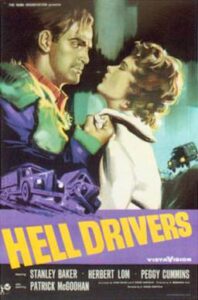
Hell Drivers (1957)

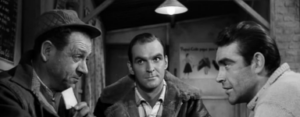
Blacklisted by the House Committee on Un-American Activities in 1951, American director Cy Endfield moved to Britain where, half-a-dozen years later, he made Hell Drivers.  Given the persecution Endfield had suffered, it unsurprisingly takes a dim view of American-style, cut-throat capitalism.  It has that underrated but magnificent actor Stanley Baker as an ex-con who finds a job as a truck driver with a dodgy haulage company, which threatens its drivers with the sack if they don’t deliver loads of gravel across treacherous roads at breakneck speeds.  The reason there aren’t more drivers employed to relieve the pressure, and reduce the danger, is because of a scam involving the local depot manager and its off-his-head Irish foreman (played by Patrick McGoohan like a brawnier version of Shane MacGowan).  The latter soon becomes Baker’s nemesis.


As well as a political message, Endfield injects Hell Drivers with an American-style grittiness rarely seen in British films of the period.  But what really makes the film a joy to watch nowadays is the cast.  As Kim Newman has written of it in Empire Magazine, “how many other movies have an ensemble which includes the original Dr Who (Hartnell), the first James Bond (Sean Connery), the Prisoner (McGoohan), a Man From UNCLE (David McCallum), a Professional (Gordon Jackson), Clouseau’s boss (Herbert Lom), plus Alfie Bass, the excellent Peggy Cummins (of the cult items Gun Crazy and Night of the Demon), the inimitably boozy Wilfrid Lawson, Jill Ireland and Sid James?”


In 2026, with capitalism more cut-throat than ever, a remake of Hell Drivers would be timely.  I don’t think, though, setting it in the wilds of Middlesex, West Sussex and Buckinghamshire, where the original was filmed, would work now, so it’d have to have its hard-pressed truck drivers pounding the roads of a less hospitable locale – the Alaskan tundra, say, or somewhere that retains some near-impenetrable tropical rainforest.


And to pay proper homage to the original, you’d definitely need a cast made up of actors who’ve played iconic roles in iconic TV shows or movie series.  You could have one of the grittier Bonds (Daniel Craig or Timothy Dalton), one of the grittier Doctors Who (Christopher Eccleston or Peter Capaldi), plus a Sherlock Holmes (Benedict Cumberbatch, maybe), a Harry Potter (Daniel Radcliffe), perhaps someone from the Breaking Bad universe (Bryan Cranston, say, or Bob Odenkirk)…  The possibilities are endless.


From wikipedia.org


The Margaret Rutherford Miss Marple movies (1961-64)

This is a little different.  I’d like to see the four movies made about Agatha Christie’s genteel sleuth of a certain age, Miss Marple, which had the delightful Margaret Rutherford in the leading role – Murder She Said (1961), Murder at the Gallop (1963), Murder Most Foul (1964) and Murder Ahoy! (1964) – rebooted as a TV show.  Not just another show about Miss Marple per se – there have been ones with Joan Hickson, Geraldine McEwan and Julia McKenzie – but one set in the universe of the four Rutherford movies.


Thus, its episodes would be set against the tableau of early-1960s England, with Miss Marple depicted as an obstinate, feisty old lady who refuses to know her place and keeps barging into and solving mysteries.  There’d be as much as humour as tension and the show would have the films’ supporting characters, like the timid librarian Mr Stringer (Rutherford’s real-life husband Stringer Davis), who reluctantly helps Miss Marple out, and the exasperated copper Inspector Craddock (Charles Tingwell), who begins each instalment telling her to mind her own business but ends it taking orders from her.  Meanwhile, Ron Goodwin’s jaunty Miss Marple Theme would burble in the background.


I suspect in a 2026 version Mark Gatiss would make a lovely Mr Stringer, while Daniel Mays would nicely fill the shoes of the long-suffering Inspector Craddock.  But who would play Miss Marple – or more precisely, play Margaret Rutherford playing Miss Marple?  Perhaps Dawn French, though she’d have to spend a long time in the make-up chair to recreate Rutherford’s famously jowly, hangdog features.


In the original movies, each murder that Rutherford / Marple investigated involved a British institution – a country manor, horse riding, the theatre and the Navy.  She’d duly rattle establishment cages by sticking her nose in where it wasn’t welcome.  So perhaps each episode of this hypothetical series would have her ruffling the feathers of other British institutions of the time – the Army, the House of Lords, Savile Row, Crufts, the country’s nascent rock ‘n’ roll industry…  Miss Marple meets the young Rolling Stones?  I’d pay good money to see that.
 

From wikipedia.org / © 20th Century Fox


Von Ryan’s Express (1965)

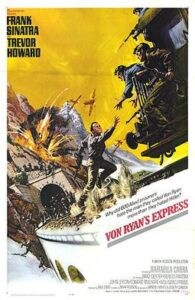
I never had much time for Frank Sinatra, neither as an entertainer nor as a person, but he left an impression on my 10-year-old self the first time I saw the ripping World War II yarn Von Ryan’s Express.  It’s the story of an American airman, Ryan (Sinatra), downed in Italy, who joins forces with some Allied prisoners of war, led by Trevor Howard.  They attempt an audacious escape into neutral Switzerland by seizing control of a train and steering it up a railway line into the Alps.  Much derring-do is involved as German troops and aircraft go all-out to stop them reaching their destination.


It’s great, crowd-pleasing stuff until the ending – spoilers are coming! – which is depicted on the movie poster, painted by the great Frank McCarthy.  The train has almost made it to safety.  Having fought a rearguard action against the Germans, Sinatra is running after the train and has almost caught up with it.  But then….  What happened next put a dampener on things.  But it also lodged the film in my mind forever.


With 2009’s Inglourious Basterds, Quentin Tarantino showed his love for rip-roaring if cheesily improbable World War II adventures, so perhaps he could helm a remake of Von Ryan’s Express?  To stick to the innocent, uncomplicated spirit of the original, though, he’d have to forgo his use of the F-word and N-word, and his fetish for close-ups of ladies’ feet, and his nerdish references to ‘film-study criticism of the work of German director G.W. Pabst’.
 

© Hammer Film Productions / Seven Arts Productions


Quatermass and the Pit (1967)

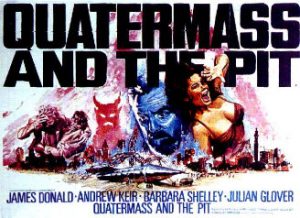
Hammer Films’ sci-fi horror film Quatermass and the Pit was based on the 1958 BBC TV serial of the same name.  Both film and serial were written by Nigel Kneale.  It begins with workers on a London Underground extension project digging up an alien spacecraft full of dead, horned, insect-like creatures that are identified by scientist-hero Professor Bernard Quatermass (Andrew Keir) as inhabitants of the now-lifeless planet Mars.  It transpired that millions of years ago, these sneaky Martians arrived on earth and did some evolutionary tinkering on the apes who were the ancestors of modern humanity.  This tinkering included implanting in the apes an urge to conduct occasional culls whereby those with pure Martian programming exterminated those who’d developed mutations and lost that programming.


When some TV news crews descend on the scene, a power surge from their camera-cables reactivates the spacecraft and it triggers a new cull.  London becomes an apocalyptic hellscape where the human inhabitants who retain their Martian conditioning roam around, zombie-like, and use newly awoken telekinetic powers to kill everyone who’s lost it.


I still find Quatermass and the Pit impressive today, and scary, though inevitably there are special effects that reflect the limitations of Hammer’s budget.  I’d relish the prospect of a modern, big-budget retelling of the story.


One thing that makes the film effective, and affecting, is Kneale’s portrayal of the scientists.  Unlike usual movie-scientists, they aren’t cold-blooded, delusional, self-serving or plain weird.  Instead, Quatermass and his colleagues, Dr Roney (James Donald) and Barbara Judd (Barbara Shelley), are portrayed as decent human beings, working with an eager curiosity, a sense of duty and a sense of humour.  Keir and Donald were both Scots, so maybe a modern movie could cast Brian Cox as Quatermass and James McAvoy as Dr Roney.  Actually, I think a third Scottish actor, Karen Gillan, would be excellent as Barbara Judd.


To be continued…


© Metro-Goldwyn-Mayer

Back with the Chain gang


I once wrote on this blog that the Jesus and Mary Chain, the Scottish alternative rock band whose core members are brothers Jim and William Reid, was “on at least three days of the week… my favourite band of all time.”  Incidentally, I’d say on the other four days of the week my favourite all-time band is the Rolling Stones between 1969 and 1974, when Mick Taylor played with them.


However, when I heard that the Jesus and Mary Chain intended to perform in Singapore, my current abode, in the middle of this month, I felt a little apprehensive.  For one thing, though I often cite the first time I saw the band live – at London’s Brixton Academy in 1992, while they headlined the Rollercoaster tour and the support bands were American alternative rockers Dinosaur Jr, swirly shoegazers My Bloody Valentine, and a young, up-and-coming band called Blur (whatever happened to them?) – as one of the best gigs, if not the best gig I’ve ever attended, the last time I saw them was a different affair.   That was in Edinburgh in 1998, when relations between Jim and William had decayed so badly they spent the show telling each other to shut up.  It presaged a disastrous performance soon after at the Los Angeles venue House of Blues, where Jim turned up drunk and William stormed offstage.  To no one’s great surprise, the following year they announced the band had split up – though they reformed in 2007.


Would 2025’s Singapore gig be closer in spirit to the 1992 one or the 1998 one?


Also, last year, they released a new album called Glasgow Eyes whose sound was something of a departure.  Though simultaneously dreamy and scuzzy in the best Jesus and Mary Chain tradition, a strong dose of electronica infused it.  I assumed their 2025 set would contain a good number of songs from Glasgow Eyes, which was fine, but it’d mean a lot of the music wouldn’t be what I immediately associated with the Jesus and Mary Chain.


There was the age issue too. With Jim and William Reid now 64 and 67 years old respectively, I wondered how kind time had been to their performing abilities.  After all, I hadn’t seen these guys sing and play onstage for nearly 30 years.  30 years – wow!


And lastly, it just seemed weird that the Jesus and Mary Chain was playing in a famously sensible, serious and clean-living place like Singapore.  After all, this is a band that initially made its name with chaos and disreputability.  When the Reids first performed in 1983, they generated controversy with their habit of delivering gigs just 15 minutes long, with their backs to the audience and their sound cloaked in squalls of feedback, which went down so badly with the punters that – according to the British tabloid press – ‘riots’ ensued.  And their Singaporean show was scheduled for the Esplanade Concert Hall, a venue whose floorspace is entirely covered in seating.  I honestly couldn’t imagine a Jesus and Mary Chain gig where everyone had to sit.


Thus, as I entered the Esplanade Concert Hall on the evening of the show, I had plenty of concerns.  But I needn’t have worried.  This was a great concert.


Before things kicked off, I ordered a few beers at a bar just outside the auditorium’s entrance and sipped them whilst taking in the appearances of my fellow concert-goers.  It genuinely surprised me how many Singaporeans had come tonight.  They consisted mainly of young goths or middle-aged folk who looked like they’d been art-college students in an earlier era.  There was a lengthy queue, mainly of Singaporeans, to buy T-shirts.  An especially popular purchase was a T-shirt featuring the cover of the Jesus and Mary Chain’s 1985 debut album, Psychocandy, which depicted Jim and William in their svelte youth.


© Blanco y Negro


(Among the non-Jesus and Mary Chain T-shirts I observed folk wearing were, not unexpectedly, ones bearing the names of the Cure and the Cocteau Twins…  And, in one case, of Radio Clyde, which was unexpected.)


But there were Westerners around too. Whilst queuing for a beer, I got chatting to an English fellow who was wearing a T-shirt featuring the title of Blur’s 1993 album Modern Life is Rubbish.  “I actually saw Blur supporting the Jesus and Mary Chain,” I said, “back before they were famous.”


He replied, “That would have been the Rollercoaster tour.  I saw it in Birmingham.”  He added wistfully, “Don’t remember much about it, though.”


I should have come back with the obvious quip, “Yes, it was all a bit of a blur!”  But, alas, I wasn’t as quick-thinking as that.


Just before eight o’clock, the gig’s start-time, everyone made their way into the auditorium.  However, when the lights dimmed, it wasn’t for the Jesus and Mary Chain’s set but for that of a support act, the Singaporean singer-songwriter Shye.  Although Shye’s Wikipedia page describes the musical genres she works in as ‘folk-rock, neo-soul, electronic, R&B’, what she and her backing band served up tonight sounded pretty shoegazer-ish to me – not too far removed from the songs at the mellower end of the Jesus and Mary Chain’s repertoire.  Her performance went down well.


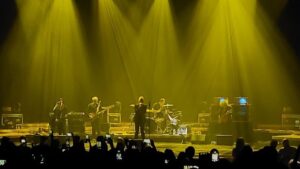
Then the main attraction appeared.  The moment the band – Jim, William, guitarist Scott Von Ryper, bassist Mark Crozer and drummer Justin Welch – came onstage and immediately tore into Jamcod, the most blistering track on Glasgow Eyes, the crowd rose to their feet as one and stayed on their feet for the entire 19-song set.  And I knew at once from the band’s poise and confidence, and the audience’s euphoric reaction to them, that everything about this show was going to be right.


Every phase in the Jesus and Mary Chain’s career was acknowledged tonight, with material played from all eight of the band’s studio albums – plus the 1986 Some Candy Talking EP, unsurprisingly represented by the song Some Candy Talking, whose ambiguous lyrics so upset the late disc jockey Mike Smith that he blacklisted it on the BBC’s Radio One.  As it turned out, four songs were performed from Glasgow Eyes: besides Jamcod, the lowkey Chemical Animal, the lumbering Poor Pure and the jaunty Venal Joy.  These actually fitted in seamlessly with the rest of the set.


I was delighted that the band played three songs from my favourite Jesus and Mary Chain album, 1989’s Automatic: Between Planets, Halfway to Crazy and Head On.  I always felt Automatic got a bad rap from the critics and was sorely underrated.  Also well-represented was 1987’s Darklands, whose brooding numbers added both melody and melancholy to proceedings and balanced the set’s more abrasive parts: the album’s title track, Happy When It Rains and, appropriately, April Skies.  (Well, the show was taking place under the April skies of Singapore.)  And for fans who’d been with the band from the very beginning, three numbers were aired from Psychocandy: In a Hole, Taste of Cindy and Just Like Honey.


On the original Just Like Honey, the female backing vocals were provided by Karen Parker, the then-girlfriend of then-Jesus and Mary Chain drummer Bobby Gillespie (who, of course, would go on to front Primal Scream).  So versatile was Ms. Parker that on one occasion she stepped in and played drums at one of their gigs after Gillespie had hurt his hand.  Also, Scarlett Johannson did those vocal duties when the band played Just Like Honey during their first performance after reforming in 2007.  Tonight, Jim Reid invited Shye, the support act, onstage again to sing it with him.  She also co-sang Sometimes Always from 1994’s Stoned & Dethroned – stepping into the shoes of Mazzy Star’s Hope Sandoval, who’d shared the vocals on the original recording.  Shye acquitted herself beautifully.


I doubt if many people would rate 1998’s Munki or 2017’s Damage and Joy as the best-ever Jesus and Mary Chain albums, but I had absolutely no problem with the songs played from them tonight: Cracking Up and I Hate Rock ‘n’ Roll off the former and All Things Pass off the latter.  Everything, in fact, was performed with great aplomb.  As frontman, Jim Reid kept the talk between songs to a minimum and just got on with delivering the goods, i.e., singing.  At the end of the main set, though, he did comment drily, “We have to go now… But if you make some noise, we might come back.”


My only regrets about the evening were a few songs I’d have liked them to play, but they didn’t.  These included Blues from a Gun and UV Ray from Automatic, and Nine Million Rainy Days from Darklands.  I would also have enjoyed hearing something off their two compilations of singles, B-sides and rarities, 1988’s Barbed Wire Kisses, (for example, Sidewalking) and 1993’s The Sound of Speed (for example, Heat and their cover of the 13th Floor Elevators’ Reverberation).  And I’d have loved to hear more from their excellent 1992 album Honey’s Dead, though the song they did play from it, Reverence, at the end of the encore brought proceedings to a stupendous close.  None of this, of course, was the band’s fault.  It’s a testimony to the greatness of their back catalogue that they could never cram everything you wanted to hear into a single set.


When I left the Esplanade Concert Hall and stepped out into the Singaporean night, I felt quite a buzz, to say the least.  In fact, I felt 30 years younger.


Temporarily, anyway.


Nostalgic wallows 6: 1970s visions of the future


From wikipedia.org / © NASA / Josh Valcarcel


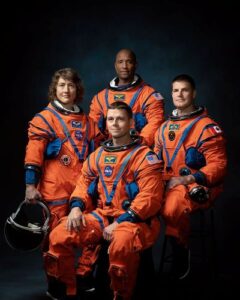
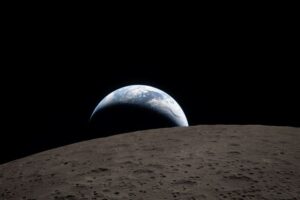
Three days ago, the crew of Artemis II returned to earth.  They had taken part in a lunar flyby mission launched by the United States’ National Aeronautics and Space Administration (NASA) that saw human beings leave low earth orbit and travel around the moon for the first time in over 50 years.  I would have posted something on this blog about Artemis II before now, but didn’t want to tempt fate.  “Let’s wait until they get back safely,” I thought.  The fact that the current US government, which gives NASA its orders, seemingly doesn’t give a f*ck about matters such as health and safety or, indeed, science generally made me worry the mission had been insufficiently prepped and might end in disaster.


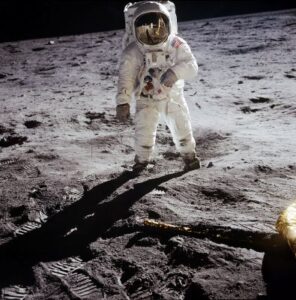
Happily, though, the Artemis II mission has been a resounding success.  It’s also made me think back to when I was a little kid, in the early 1970s, the last time that humans went to the moon.  In fact, it was in 1969, when I was three years old and NASA’s Apollo programme was underway, that the late Neil Armstrong became the first human to set foot on an alien world.  All right, it was only the moon, which is hardly in the same league as Krypton or Tatooine, but for a wee species that evolved out of the Homo genus just 200,000 years ago, Armstrong’s ‘small step’ 57 years ago was pretty impressive.


However, it has also made me wonder.  After all the excited expectations raised by the Apollo programme about space travel, how come the half-century between it and Artemis II has turned out to be so rubbish?


I’m too young to remember seeing Armstrong plant his spacesuit-encased foot on the lunar turf in 1969, but I can just about recall live TV pictures of a subsequent Apollo mission to the moon in the early 1970s.  Admittedly, I wasn’t altogether sure what I was watching.  At the time my family and I were huddled around a tiny black-and-white television in Northern Ireland, which only picked up one channel, the BBC.  (It showed a second channel, RTE, from the Republic of Ireland, if my Dad poked a screwdriver into a hole at the set’s side and did some awkward and potentially dangerous fiddling with the wiring.)  All I could make out on the screen were some fuzzy pale blobs floating against a fuzzy grey background.  However, my Dad assured me these were men walking about on the moon, high above us, at that very moment, so I took his word for it.


From wikipedia.org / © NASA


It must have been in 1973 that my imagination took a leap that was almost as giant as the ‘leap for mankind’ that Armstrong spoke of when he descended from the lunar landing module.  The cause of this were two sets of newly-published encyclopaedias that my parents had seen advertised somewhere and ordered – a 15-volume set with lemony-coloured covers called the Childcraft books that, accordingly, were for children; and a 24-volume set called the World Book series that were for adults and came in sombre, mossy-green covers.  That was 39 encyclopaedias in all and, amazingly, they fitted perfectly into the big display shelf that ran along the top of the sideboard in our living room.


I immediately set about reading these encyclopaedias, both the juvenile and adult ones, and my horizons were swiftly widened.  Not all the consequences of this were positive.  My parents had neglected to read the small print in the advertisement.  If they had, they would have discovered that the encyclopaedias had been printed in America, by Americans, for Americans, and their contents were duly biased towards America.  As a result, I wasted a lot of time searching in the fields of our farm for evidence that woodchucks, porcupines, prairie dogs and Gila monsters had been foraging there.  Also, some quaint words started to appear in my vocabulary – diaper, candy store, soda fountain, rest room – which inevitably had my classmates at primary school tearing the piss out of me.


One feature of these encyclopaedias that really rubbed off on me was that, because they were American and because they’d been published just after the moon landings, they were dripping with optimism.  And this was a scientific as well as an American optimism.  Yes, it’s hard to believe today, now that one of the two main American political parties is infested with far-right-wing religious fruitcakes who maintain that the universe was created in six days a few thousand years ago (and vaccines are bad, and manmade climate change is a hoax), but there was a time not long ago when America took science seriously and saw it as one of the key tools in converting the rest of the world to the glories of the American way.  At the age of eight or nine, I lapped all this up – even those assertions in the encyclopaedias that, with the benefit of hindsight, were a bit over-optimistic.


For example, the encyclopaedias predicted that, having reached the moon, it would only be a short time – the 1980s, at the latest – before human beings were tramping around the surface of Mars too.  The ‘S’ volume of the World Book encyclopaedias had a lengthy entry about ‘space travel’ and on one page I found a multi-pictured diagram showing how astronauts were going to get to Mars.  Admittedly, the Mars spaceship in that diagram, as well as having a long, sleek fuselage and a beak-like nose, had wings, which seemed a bit suspicious because by then I knew that in outer space there wasn’t any air and wings were thus superfluous.  (I suspect the artist behind those pictures had been unconsciously influenced by a non-space vehicle that was making a stir at the time, Concorde.)  Elsewhere, there were pictures of what a moonbase – only a few decades away in the future, I was told – would look like, although it was an unprepossessing cylindrical structure that resembled a giant tin can.


Anyway, I assumed this was what I could expect by the time I’d reached my thirties.  I’d be living on a moonbase, watching Concorde-like spaceships streak past on their way to Mars.


My expectations were buoyed further when in the mid-1970s my parents finally got round to buying a new TV set that got three channels, the BBC, RTE and ITV – Independent Television.  Although ITV had (and still has) a reputation for cheap and lowbrow programming in comparison with that made by the BBC, it did broadcast at the time various action / adventure series made by a subsidiary called ITC entertainment, run by the cigar-smoking impresario Lord Lew Grade.  Aimed at international markets and at the American market in particular, ITC’s shows commanded higher-than-average budgets and looked quite glossy by the standards of 1960s and 1970s British TV.  They included The Prisoner (1967-68), Department S (1969-70) and The Persuaders (1971) and a host of science-fiction shows made by the remarkable Gerry Anderson.  I was able to watch these for the first time.


From gerryanderson.com / © ITV Studios


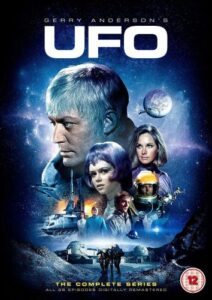
It was watching repeats of Anderson’s live-action sci-fi show, UFO, made in 1970 and starring Ed Bishop, George Sewell, Michael Billington, Peter Gordeno, Wanda Ventham (Benedict Cumberbatch’s mum) and Gabrielle Drake (Nick Drake’s sister), that convinced me that the future was going to be absolutely brilliant.  For UFO, Anderson’s production team envisioned the shape of things to come through a prism of gaudy late-1960s design and fashion, with a smidgeon of then-fashionable psychedelia.  It didn’t just feature spaceships and moonbases, but also sleek super-cars, talking computers with hallucinogenic panels of flashing lights, giant submarines with detachable nose-modules that turned into aircraft when they reached the ocean surface, guys in groovy-looking suits that didn’t have lapels, and ladies wearing silver miniskirts and sporting purple hairdos.


So, I thought, I’d be living on a moonbase, watching spaceships streak past towards Mars, and Gabrielle Drake would be shimmying around me looking fetching in silver and purple.  The future seemed better than ever.


Needless to say, as the 1970s wore on, I began to get uneasy about the fact that very little futuristic stuff was happening any more.  As far as manned spaceflight was concerned, not much occurred after the Skylab project – yes, there was the space shuttle, but that didn’t venture beyond earth’s orbit and, frankly, seemed a bit shit.  Meanwhile, the Viking 1 probe landed on Mars but, alas, found nothing interesting.  There were no aliens, Martian canals or H.G. Wells-style three-legged war machines shooting death-rays – just some boring geological formations that had once been river valleys.  And what had happened to that you-can-do-anything-if-you-put-your-mind-to-it American optimism?  It seemed to fizzle out as the 1970s became one long litany of American trauma: the Vietnam War, the 1973 oil crisis, Watergate and the Iran hostage saga.


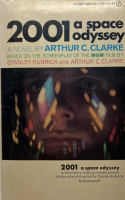
I still had hope, though.  In the mobile library that came to our village every week, I picked up a copy of Arthur C. Clarke’s novelisation of 2001: A Space Odyssey, the classic 1968 sci-fi movie he’d co-written with director Stanley Kubrick.  It was reassuring to read Clarke’s sober, matter-of-fact account of a journey from the earth to the moon and then on to Saturn.  (In Kubrick’s film, the final destination was changed to Jupiter because of the job of convincingly depicting Saturn’s rings was too much for his special effects team.)  By then I was well-versed in astronomy and space travel and the book seemed to reinforce everything I knew already about the subjects.  It also seemed to make the idea that humanity would be out exploring more of space in the early 21st century feasible and, indeed, logical.


© Signet Books


When I finally saw 2001 the movie, however, it was in 1982 and even I had to concede it’d become a bit of a museum piece.  In some ways it possessed an admirable, almost documentary-like realism – for instance, I was impressed by the fact that, unlike the spaceships in every other science fiction movie I’d seen, Kubrick’s spaceships didn’t make any noise (because sound doesn’t travel in the vacuum of space) – but it struck me as a historical artefact nonetheless because it was clearly rooted in a past time and in past conceptions of what lay ahead.  It offered a late-1960s view of the future, one that just wasn’t plausible any longer in the early 1980s.


By then, the Mad Max movies (1979, 81 & 85) had started to do the rounds and, after the oil shortages of the 1970s, they presented an unfortunately more credible vision of what the 21st century might be like.  It was also telling that a couple of years earlier, in 1978, Lord Grade’s ITC Entertainment, which had once stimulated my space-age fantasies with Gerry Anderson’s UFO, had produced the movie Capricorn One – a cynical sci-fi thriller about a NASA expedition to Mars that is actually a hoax, with the supposed landing on the Martian surface being filmed in a TV studio in the American desert.


And now in 2026 I find myself inhabiting a world far removed from the visions that Neil Armstrong, Gerry Anderson and Arthur C. Clarke inspired in me during my childhood.  The Artemis programme promises that human beings will once again set foot on the moon but I’m sceptical that people will get to Mars in my lifetime and I’m beginning to wonder if they’ll ever get there at all.  I know Elon Musk keeps vowing to do it but, given the logistics involved and given our current levels of technology, I think that’s bollocks.  (Talking bollocks comes as naturally to Musk as breathing.)


It doesn’t help that the orange narcissist currently residing in the White House is trying to cut 23 percent of NASA’s funding – though he’ll no doubt attempt to grab the credit for Artemis II’s success and make it all about himself.


Still, thank you, Artemis II crew. You’ve kindled some fond nostalgia in me and given me a sliver of hope, at least, that humanity’s future might extend beyond the gravitational pull of its home world.


From wikipedia.org / © NASA

Favourite temples 1: the silver temple in Chiang Mai


I’ve been thinking a lot about temples recently – maybe because, with the dire condition of the world these past few weeks (mainly due to US President Greg Stillson, sorry, Donald Trump), I’ve felt like I need a sacred place to retreat to and meditate in, away from the trials and tribulations of modern life.  Or just to pray in, for salvation.


Anyway, it’s occurred to me that I’ve visited loads of temples over the years, in loads of countries. So, this is the first post in a series where I describe my favourite ones.


The northern Thai city of Chiang Mai has larger and grander temples than Wat Sri Suphan.  However, this particular one, located some way south of the city centre, down a lane off Wualai Road and in the district containing Chiang Mai’s silversmith trade, is my favourite temple there.  That’s because of its key building, the ubosot (the ordination hall).  Since 2008, the neighbourhood’s silversmiths have worked on decorating its exterior and interior, and fashioned adornments in silver, aluminium and nickel, so that today it stands as a spectacular, shining showcase for their skills.


The building resembles a gothic armadillo, encased in concave slabs of silvery-tiled roofing that bristle with serpentine blades (bai raka) and pointed sculptures.  Its outside walls are covered in a fascinating array of engravings.  There are emblematic images for Asian nations with large Buddhist populations like Cambodia, Indonesia, Laos, Malaysia, Myanmar, the Philippines, Vietnam, Thailand itself, and my current place of abode, Singapore.  However, when I visited the temple in 2018, I was living in Sri Lanka and I was slightly perturbed to find no representation of that country (which is mostly Buddhist).  I hope they’ve rectified that omission since then.


Also adorning those outside walls are pictures of iconic historical landmarks from around the world like the Great Wall of China, the Leaning Tower of Pisa and the Roman Colosseum; pictures of the Seven Wonders of the Ancient World; the animals of the Chinese Zodiac; and, weirdly and unexpectedly, the Hulk, Spiderman, Captain America, Iron Man and various other characters from the Marvel superhero universe.  Actually, this was a pre-taste of the surprises that awaited me when I entered the building.


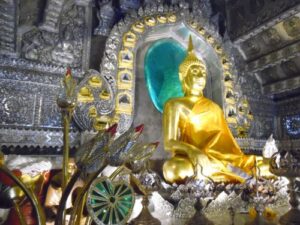
As a place of ordination, the inside of the hall is off-limits to women.  So, armed with my better half’s camera, I ventured in and snapped as many pictures as I could for her.  The gleaming Buddha at the far end of the room gives the interior a feeling of levity and serenity, but if you turn around to the walls and study some of their details, the effect is rather different.  It’s gloriously, at times crazily baroque and over-the-top.


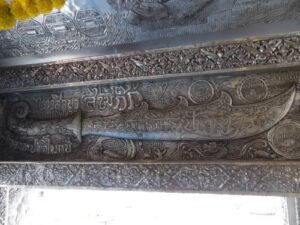
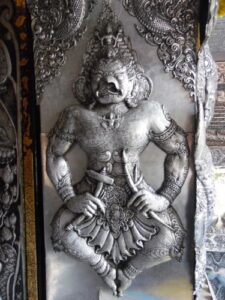
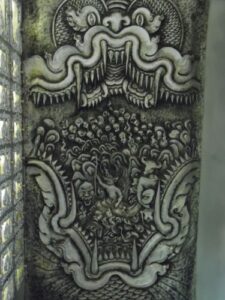
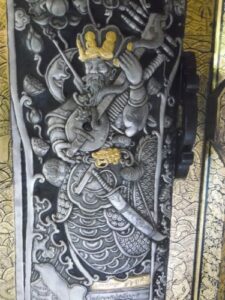
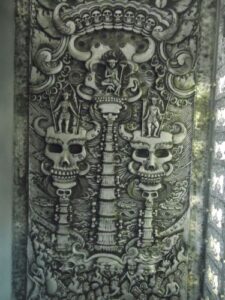
Among the silvery adornments are a huge, barbed and intricately inscribed sword; a creepy-looking garuda (a part-human, part-human creature of Buddhist mythology, much featured in Thai religious architecture); a huge gaping maw rimmed with needle-like fangs and containing a whole crowd of ghouls and demons; and a couple of crowned and bearded Thai mermen.  Indeed, the amount of blades, shields, skulls, devils and monsters on display made me feel that I wasn’t so much inside a temple as inside a silver reproduction of a heavy metal fan’s bedroom.


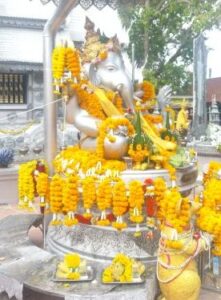
Finally, outside again, you’ll see seated under a big shiny parasol a statue of the elephant-headed Hindu god Ganesha, looking resplendent amid copious yellow garlands.  In Thailand, Ganesha is known as Phra Phikanet and among the qualities he’s associated with are creativity and success.  No wonder they have him decorating the insignia for the country’s Department of Fine Arts.