The literary Bond revisited: The Spy Who Loved Me


© Vintage Books


First published in 1962, The Spy Who Loved Me is the ninth of Ian Fleming’s James Bond novels and holds several records in the Bond literary canon.  It clocks in at 198 pages, making it the shortest Bond book.  It was also the last book to appear in a world that knew Bond as a literary and not a cinematic character, because its publication came just six months before the release of Dr No, the first Bond movie produced by Cubby Broccoli and Harry Saltzman.  And it was the worst-received of the books.  The Daily Telegraph reacted to it with a despairing “Oh Dear Oh Dear Oh Dear!”, the Listener dismissed it as ‘unremittingly’ and ‘grindingly boring’ and the Observer demanded, “why can’t this cunning author write up a bit instead of down?”


Once the critics had stuck in their knives, Fleming himself disowned the book.  He asked his publisher not to print a paperback edition of it, a request honoured until two years after his death.  He also stipulated that any movie version of The Spy Who Loved Me could never use the book’s plot, only its title.


I’m sure that 15 years later when Cubby Broccoli got around to filming The Spy Who Loved Me, he was distraught about this.  “You mean,” lamented the cigar-puffing mogul, “I can’t follow what happens in the book?  I have to put other stuff in my movie instead?  Like cars that travel underwater?  Giant oil-tankers that swallow nuclear submarines?  Roger Moore skiing over a clifftop and saving himself with a Union Jack parachute?  No!  NO!”


© Eon Productions


Well, I’ve finally read the original, much-maligned The Spy Who Loved Me.  My initial reaction was Ian Fleming at least deserved credit for venturing off the beaten track.  Fans of his previous eight books were surely surprised when they started reading it in 1962 and discovered they were hearing a first-person narrative voice rather than Fleming’s usual, authoritative, third-person one.  “I was running away,” it begins.  “I was running away from England, from my childhood, from the winter, from a sequence of untidy, unattractive love-affairs, from the few sticks of furniture and jumble of overworn clothes that my London life had collected around me; and I was running away from the drabness, fustiness, snobbery and claustrophobia of close horizons and from my inability, though I am quite an attractive rat, to make headway in the rat-race.  In fact, I was running away from almost everything except the law.”


The first-person voice is that of Viv Michel, a young French-Canadian woman who’s been left in charge of a closed-for-the-winter motel called The Dreamy Pines Motor Court in the mountains of northern New York State.  After a first chapter where Viv doesn’t cope well with a thunderstorm raging above the motel’s empty cabins, playground, swimming pool and golf range – she stupidly pulls an electrical switch at the same moment that a bolt of lightning lets rip, and the resultant electrical shock knocks her unconscious – she spends the next eighty pages explaining how she’s ended up in this situation.


She describes her early life in Canada; being sent to a finishing school in England where she “was made to suffer agonies” for her accent, for her table manners “which were considered uncouth”, for her “total lack of savoir-faire and, in general, for being a Canadian”; and finding work in London while suffering the afore-mentioned “sequence of untidy, unattractive love affairs”.  After the last affair results in her having an abortion in Switzerland, she returns to North America, where she resolves to search for adventure and self-discovery and shake off the memories of the men who’ve used and abused her.  So she purchases a Vespa 150cc Gran Sport and sets off on a road trip.  It’s on the road that she comes across the Dreamy Pines Motor Court, where she gets offered employment; first as an end-of-season receptionist and then, when it closes for the winter, as a caretaker minding the premises until its owner, one Mr Sanguinetti, arrives to take possession of the keys.


Viv’s position at the Dreamy Pines feels slightly like that of Jack Torrance at the Overlook Hotel in Stephen King’s The Shining (1977) and things soon go as badly for her as they did for the ill-fated Jack.  Two hoodlums with the nicknames Sluggsy and Horror show up at the motel in the middle of the night and take her prisoner.  It transpires that Sanguinetti is a gangster and the pair are henchmen tasked with burning the place to the ground as part of an insurance scam.  Viv, the only witness, looks likely to be torched along with the motel.


It’s here that we encounter the single detail of the book that makes it into the 1977 film ‘adaptation’ with Roger Moore.  Looking at Horror’s face, she notices “a glint of grey silvery metal from his front teeth,” indicating that “they had been cheaply capped with steel.”  Sound familiar?


© Eon Productions


By now we’re more than halfway into the book.  Back in 1962 at this point, readers must have been panicking: where the hell is Bond?  Well, he appears at The Dreamy Pines later that same night – Viv’s first impression of him is that he’s “good-looking in a dark, rather cruel way” with a scar that “showed whitely down his left cheek” – and he explains that his car has suffered a flat tyre on the road nearby and he’d like to get a room.  He soon wises up to the situation and joins forces with Viv.  The next seventy pages play more like a Mickey Spillane novel than a Fleming / Bond one, with considerable running, hiding and shooting before Sanguinetti’s scheme is thwarted and Sluggsy and Horror end up dead at the bottom of the local lake.  Then Viv and Bond indulge in some love-making and then, as abruptly and enigmatically as he arrived, Bond slips off again.  In the final pages, Viv muses: “He was just a man who had turned up at the right time and then gone on his way.”


Though The Spy Who Loved Me wins kudos for bravely departing from the usual Bond formula, there are moments when seemingly Fleming remembers it’s still a Bond novel and is forced to compromise, with awkward results.   He wants Viv to be more believable than the average Bond girl, which is why we see her depicted as a working Londoner.  But on the other hand, as a Bond girl, she can’t be too ordinary so she also gets a French-Canadian back-story to make her appear more exotic – the overall effect of which feels contrived.  Also, while Fleming wants her to be feisty and independent, he needs her to have a vulnerable side too – to be a credible damsel-in-distress, for whom Bond rides to the rescue as a knight in shining armour.  That may explain the opening chapter where she panics during the storm and, frankly, comes across as a dolt.


And to make up for Bond’s late entrance into the plot, Fleming feels obliged to bring his readers up to speed on what Bond’s been doing in the meantime; so we get the telling of a previous Bond adventure.  In a twelve-page chapter entitled Bedtime Story, Bond explains to Viv in detail how he ended up on the road that night.  He was driving south after an operation in Toronto wherein he and the Canadian Mounties prevented the assassination of a Russian defector by the KGB and SPECTRE.  By this point, Bond and Viv know the extreme danger posed by Sluggsy and Horror, so you’d think they’d have other things to focus on besides telling stories.


One thing I found surprisingly impressive about The Spy Who Loved Me is Viv’s account of her love-life in London.  It’s as far removed as possible from the fantasy romance / sex scenes associated with the Bond novels.  Just out of school, she gets involved with a youth called Derek Mallaby, whose posh, confident veneer hides, temporarily, the fact that (a) he’s desperate for sex and (b) he’s clueless about how to have sex.  What follows is a painful tale set in the England of “drabness, fustiness, snobbery and claustrophobia” that existed before the 1960s started swinging and the permissive era arrived.  The only privacy Viv and Derek can find for making love is in a small balcony-box at a cinema, “a meagre-looking place, showing two westerns, a cartoon and so-called ‘News’ that consisted of what the Queen had been doing a month ago.”  Their attempted lovemaking, on the floor with Derek on top “in a dreadful clumsy embrace”, is anything but sensual and ends abruptly when a furious cinema manager bursts in on them: “Filthy little brats…!  I’ve a damned good mind to call the police.  Indecent exposure.  Disturbing the peace.”


Barely articulate about what they’re trying to do, relying on strained expressions like ‘doing it’ and ‘being a sport’, and not even knowing what a condom is called and having to describe it to a shop assistant as “one of those things for not having babies”, Viv and Derek are products of a repressed, joyless, monochrome Britain that the Bond novels, with their exotic glamour and glitzy hedonism, were supposed to give readers of the era an escape from.  No wonder The Spy Who Loved Me pissed so many of those readers off.


Once Viv and Derek have properly ‘done it’ a few times, Derek proves to be a cad and dumps her.  She then gets into a second relationship with a German man called Kurt, which culminates in her getting pregnant, having an abortion and being dumped a second time.  Kurt “had inherited strong views about mixed blood… and when he married, it would be into the Teutonic strain.”  Fleming’s well-known dislike of Germans is on full display here.


This part of the book is so interesting because it suggests Fleming, a writer not noted for his empathy with women, is trying for once to think outside his normal male-chauvinist box and identify with a female character having a hard time in a world populated with predatory, shitty men.


Alas, this is rendered null and void later when Bond, hardly un-predatory and un-shitty himself, turns up and Viv promptly goes doe-eyed and weak-kneed at the sight of him; implying that Viv’s problem wasn’t men, it was just the absence of a fully-fledged alpha male like Bond to satisfy / tame her.


And, late on, Fleming truly sabotages his cause when Viv comes out with this jaw-dropping assertion: “All women love semi-rape.  They love to be taken.”  These ten words have rightly earned Fleming and The Spy Who Loved Me much opprobrium and they undo whatever good work he did with his depiction of Viv earlier in the book.  I’d like to say they show an attitude towards women that’s wildly and rightly out-of-date nowadays – but of course in these Trumpian times, the era of Andrew Tate and Conor McGregor, there’s probably loads of male influencer-wankers out there in the so-called ‘manosphere’ who’d agree with Fleming’s sentiment.


In the end, I have no reason to disagree with the many people who label The Spy Who Loves Me the weakest of the Bond novels.  The contradiction at its heart, that it’s a Bond story and yet wants to be something other than a Bond story, makes it uneven and inconsistent.  And it’s all over the place in its sexual politics and, at worst, those politics are unspeakable.


But it deserves a little respect for attempting to do something out-of-the-ordinary, and thanks to Fleming’s always-amenable prose it’s an easy-enough read.  And, in parts, hints of a better book glimmer through.  It’s The Spy Who Tried Something Different.


© Penguin Books

Jim Mountfield racks up another one


© Stygian Lepus


I grew up on a farm.  In fact, I grew up on two farms, one in Northern Ireland and the other in Scotland.  So when I write fiction, farms are a common setting for my stories.  That includes scary stories, which I write under the pseudonym Jim Mountfield.


A big inspiration for my ‘farm-horror’ stories was a 2005 Irish film called Isolation, written and directed by Billy O’Brien.  It’s about a lonely and financially-pressed farmer forced to take the filthy lucre of a bio-genetics company and let them experiment on his cattle.  Being a horror film, this doesn’t result in faster-growing livestock as the company hopes but some nightmarishly malformed, slimy organisms whose alien tissue is soon infecting all living things on the farm, bovine and human.  Though it’s not well-known, Infection has a great cast –  including two of my favourite Irish actors, John Lynch and Ruth Negga, plus Essie Davis and Sean Harris.


What really impressed me, though, was its bleak agricultural setting, one where soulless concrete animal-sheds and black-tarped silage pits loomed next to decaying barns and lakes of slurry, everything dark and driech in the continuously pissing rain.  This made me realise that, at least on a bad-weather day, much modern farming is so grim it’s a horror story even before any monsters show up.


© Film Four / Lions Gate Films / Irish Film Board


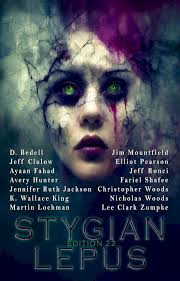
Last year, I had three farm-horror stories published – Wool in (the now sadly-defunct) The Sirens Call, The Turnip Thieves in Schlock! Webzine and The Shelter Belt in Witch House.  Feeling I’d rather overdone this sub-genre, I didn’t write any more for a while.  Until now – for I’ve just had a new, farm-set story published, one featuring the requisite soulless concrete sheds and decaying barns, rain and muck.  It’s called Rack and Ruin and appears in the newly-published Issue 19 of The Stygian Lepus.


The original idea for Rack and Ruin came from the roadkill I’d frequently see on the back-road beside my family’s farm in Scotland.  One very wet day, walking along that back-road, I encountered some roadkill that’d been so mashed by the wheels of passing cars, and partly-dispersed by the pounding rain, that I had no idea what animal it’d been.  I gave the gruesome thing a wide birth as I walked by it.  I would have given it an even wider berth if this had happened after I saw Isolation, for it resembled one of the squishy, hellish things in the film.


Rack and Ruin was also influenced slightly by the classic H.P. Lovecraft story, The Colour Out of Space (1927), in which a meteorite crashes in the hills of Massachusetts and releases a strange blight on the surrounding land – the property of a farmer called Nahum Gardner, who subsequently sees his crops and livestock mutate and become uneatable and unsellable and his family members die, disappear, go mad or grow horribly deformed.  This is accompanied by the appearance of an indescribable colour that exists outside the visible spectrum.


Lovecraft’s story is told through the eyes of a narrator, a surveyor, who gets the details of the story from one of the Gardners’ neighbours.  Thus, there’s little from the perspective of the farming family actually at the centre of the horror.  I thought I would try to address this in Rack and Ruin.  Farming is tough enough in the real world, being tethered to a piece of ground, toiling at it night and day in all weathers, trying to make a living from it whilst at the mercy of the natural climate and the economic one.  Imagine how much worse you’d feel if your precious land was threatened by something inexplicably cosmic in origin.


The Colour Out of Space has been filmed several times and at least one of them, a 2019 version directed and co-written by Richard Stanley, does tell the story from the viewpoint of the Gardners.  However, as Nathan Gardner – Stanley’s renamed Nahum Gardner – is played by Nicolas Cage, he hardly behaves like any farmer I’ve ever met.  The scene where Cage freaks out after discovering his beloved tomatoes have been spoiled by the pesky meteorite is funny, though.


© SpectreVision / RLJE Films


For roughly the next month, my story Rack and Ruin can be read here.  And for the contents page of The Stygian Lepus, Issue 19, and access to all its stories and articles, visit here.

Jim Mountfield sheds some tears


© Hiraeth Publishing


Late last month saw the publication of the Samhain 2024 edition of the fiction, non-fiction and poetry magazine The Hungur Chronicles.  I’m pleased to say it includes an 8000-word short story of mine called The Tears of the Pontianak.  The story is a horror one so, as with all my horror fiction, it’s attributed to the pseudonym Jim Mountfield.


I had the original idea for the story one day while I was exploring Singapore’s impressive Asian Civilisations Museum.  A couple of items of antique furniture – beautifully ornate and lacquered and each containing a dozen drawers – caught my eye and got me thinking.  I imagined a chest of drawers like these being acquired by a rich man with a lot of guilty secrets in his past, secrets his conscience could only deal with by compartmentalising them and totally shutting them away from his existence now.  Not only would the drawers be symbolic of how he’d compartmentalised his life, but they’d somehow have a supernatural power to revive his guilty secrets and force him to confront them.


The Hungur Chronicles is a rebooted version of Hungur, a magazine I wrote stories for back in 2010 and 2011.  The reason I hadn’t written for Hungur / The Hungur Chronicles since then is because the publication features “short stories, poems, articles, and illustrations related in some way to vampires.”  And until recently I’d found it difficult to come up with a fresh and interesting vampire story.  Like zombies, vampires are a staple of horror stories that have been used a zillion times before.  It seemed impossible to write about them in a way that wasn’t clichéd.


So, yes, The Tears of the Pontianak isn’t only about a strange chest of drawers.  It’s about a vampire.  However, the ‘vampire’ in question is something a little out-of-the-ordinary, at least for Western readers.  It’s a Pontianak, a malevolent female creature that appears in the folklore of Indonesia, Malaysia and Singapore.  Though Pontianaks have different attributes in different places, I went with the Malaysian version of them, which, according to Wikipedia, “depicts them as “vampiric” blood-suckers that dissect through the internal organs of men.”  But to link the Pontianak with the other elements in my story, like the haunted chest of drawers and the rich man with a guilty past, I had it feed on something other than blood.  I also needed to set the story in Southeast Asia.  Thus, The Tears of the Pontianak is a minor milestone for me because it’s my first published story that takes place in Singapore.


Finally, I’m fond of basing fictional characters on gnarly old cinematic character-actors whom I like.  For example, ones inspired by James Robertson Justice and James Cosmo have turned up in stories of mine that’ve seen print during the past year.  The Tears of the Pontianak contains a character modelled on Michael Smiley, the grizzled Northern Irish character actor whose CV includes roles in several weird, disturbing and violent Ben Wheatley films: Down Terrace (2009), Kill List (2011), A Field in England (2013) and Free Fire (2016).  As I’m also grizzled and Northern Irish, and people tell me I’m weird enough to be a character in a Ben Wheatley film, I identify a lot with Smiley.  And in The Tears of the Pontianak I pay tribute to him.


© Film4 Productions / BFI / Rook Films / StudioCanal


Containing four additional stories, some poetry and a non-fiction article, and with a striking cover by painter Sandy DeLuca, the Samhain 2024 edition of The Hungur Chronicles can be purchased here.

Favourite Scots words, S – part 2


© Channel Four Films / PolyGram Filmed Entertainment


Today is November 30th, the feast-day of Andrew the Apostle, now better known as St Andrew, the national saint of Scotland.  And seeing as it’s St Andrew’s Day, I will post another instalment of my guide to my favourite words in Scots, the dialect of Middle English still spoken in modern-day Scotland.  Like Singlish, the unofficial fifth language of Singapore, there’s a good case for Scots to be considered a language of its own.  Indeed, it’s been recognised as such by the Council of Europe’s Charter on Regional and Minority Languages.


In my previous entry, the words I covered began with ‘S’ and I only got as far as ‘snaw’.  So here are the rest of the ‘S’-words.


Sneck (n) – the latch or catch used for fastening a gate.  Actually, my trusty and much-thumbed copy of the Collins Pocket Scots Dictionary tells me that snib, the mechanism for securing the bolt on a door, is a Scots word too, though I’d always thought it came from standard English.  Both sneck and snib can be used as verbs.


Soap dodger (n) – an unhygienic and un-fragrant person who has a deep aversion to soap, baths and showers.  I looked up ‘soap dodger’ online and was told it was a general ‘British’ slang-word that appeared around 1990.  But I’m sure I’d heard it in Scotland long before that – mainly by fans of arch-enemy Scottish football clubs Glasgow Rangers and Glasgow Celtic, who used it as a term of abuse for each other.


Sodger (n) – a soldier.


Sonsie (adj) – plump, rosy and healthy.  This adjective appears in the opening lines of Robert Burns’ poem about Scotland’s premier foodstuff, Address to a Haggis (1786).  Saluting the bulging-with-sheep’s-offal haggis, he writes: “Fair fa’ your honest, sonsie face / Great chieftain o’ the puddin-race!


Sook (n) – nothing to do with an Arabic marketplace or commercial district, a sook is a person who sucks up to, those in authority.  The term is commonly used for school pupils who grovel shamelessly before their teachers.  However, the whole obsequious, cap-doffing, belly-crawling, brown-nosing British establishment could be described as ‘sooks’ because of their behaviour towards the Royal Family.


© Mainstream Publishing


Meanwhile, in his book Scots – The Mither Tongue (1986), Billy Kay identifies the first great sook in history as being James Boswell, the companion, biographer and toady of Dr Samuel Johnson, who was perfectly happy to pander to the Doctor’s anti-Scottish prejudices even though he was Scottish himself.  (“I do indeed come from Scotland,” he whined when he first met Johnson.  “But I cannot help it.”  To which the Doctor snorted contemptuously, “That, Sir, I find, is what a very great many of your countrymen cannot help.”)


Souch (v) – a verb denoting the activity of the wind when it blows in a noisy fashion.


Souter (n) – a shoemaker or cobbler.  Famously, Burns used the word as a nickname for a character – a cobbler by trade – in his magnum opus Tam O’Shanter (1791).  Souter Johnnie is a drinking buddy of the poem’s titular, dissolute hero.  Early in the poem, we see Tam in the pub with “…at his elbow, Souter Johnnie / His ancient, trusty, drouthy cronie / Tam lo’ed him like a very brither / They had been fou for weeks thegither.”


Also, at school, I had a teacher called Mr Souter.  But I won’t crack the obvious joke about him talking ‘a lot of cobblers’.


Spaewife (n) – a woman who tells fortunes.  The Spaewife is the name of an 1885 poem by Robert Louis Stevenson, in which the narrator plies a spaewife with all manner of philosophical questions (“Hoo a’ things come to be whaur we find them when we try…”, “Why lads are a’ to sell an’ lasses a’ to buy…”, “The reason o’ the cause an’ the wherefore o’ the why…”).  However, he keeps getting brushed off with the glib answer, “It’s gey an’ easy spierin’.” (“It’s very easy asking.”)


Spaver (n) – a trouser zip or fly.  The now-defunct online Doric Dictionary showed how the word was used with this eye-watering example-sentence: “Help, mither, av nipped ma tadger in ma spaver!


Speir (v) – as the quote from Stevenson’s The Spaewife indicates above, this means to ask.


Spurtle (n) – a long wooden utensil once used in Scottish cooking, sometimes a spatula for turning over oatcakes, sometimes a stick for stirring porridge.  I can’t recall the name of the story it was in, but I vividly remember reading a description of a sheep’s carcass lying on a Scottish hillside with its four stiff legs “sticking up like spurtles”.


Square go (n) – a face-to-face brawl where neither opponent carries a weapon nor has any advantage over the other.  Inevitably, this term is used by the psychotic Frank Begbie in Irvine Welsh’s Trainspotting (1993), during his account of a fight he got into in a poolroom:  “…this hard c*nt comes in.  Obviously f*ckin’ fancied himself, like.  Starts staring at me.  Lookin’ at me, right f*ckin’ at me, as if to say, ‘Come ahead, square go.’  You ken me, I’m not the type of c*nt that goes looking for f*ckin’ bother, like, but…”


From wikipedia.org / © Moncrief


Stairheid (n) – the top of a flight of stairs.  Long ago in urban Scotland, when much of the working-class population lived in close proximity in one or two-bedroom flats in tenement buildings, accessed by steep, stone stairs, a stairhead rammy was what you got when two neighbours – often female – had a falling-out and came to blows.


Stave (v) – to incur an injury by spraining or twisting a limb or digit.


Steamin’ (adj) – one of the many adjectives in Scots for describing a drunk person.  (Others include arsed, bevied, bleezin’, blootered, buckled, fou’, gubbered, hingin’, minced, mingin’, miraculous, miracked, mortal, reekin’, reelin’, stocious and wellied.)  Steamin’ also spawned the word steamboats: “By the end o’ the night I wis absolutely steamboats!”


Stoater (n) – a person or thing that is especially wonderful, beautiful or excellent.  “Donald Trump’s a stoater!” cried nobody in Scotland, ever.


Stob (n) – a wooden post, like one you’d find in a fence.


Stookie (n) – a plaster-of-Paris cast put around a broken limb.


Stour (n) – a black, grimy dust.  I’ve seen ‘stour’ used to describe smoke, but it would have be foul, tarry smoke that leaves deposits of dirt over everything.  Stourie is the adjective derived from stour.


In my Scottish hometown of Peebles, a stourie-fit – a ‘dusty-foot’ – was someone who wasn’t a native of the town but an incomer.  Presumably, their wandering feet had collected much stour before they arrived in pristine, stour-free Peebles.  And as the town is a wee bit clannish, your family might have to be settled there for a few generations before your feet were considered less stourie.


Stowed oot (adj) – packed with people. Many times in my youth, I tried to enter a social venue, only to be pushed back by a bouncer who snarled, “Ye cannae come in!  We’re stowed oot awreidy!”


Stramash (n) – a disorderly commotion or argument.  A word popularised by the late Scottish TV commentator Arthur Montford, famous for his extravagantly checked jackets, who would rarely let a football match go by without referring to some sort of stramash breaking out in the penalty box.


© One Little Indian


Stushie (n) –  a disagreement or row, perhaps not quite of the violent character of a rammy or a stramash.  Years ago, In 1992, I remember somebody Scottish remarking on how there’d been “a stushie aboot thon song Ebenezer Goode by the Shamen” (whose chorus was the dodgy-when-heard-out-of-context ‘Ez-er Goode!  Ez-er Goode!’).  So maybe it approximates to a rumpus or uproar.  Sadly, I have never heard people arguing bitterly over the bill for a platter of sushi, so I haven’t had the chance to cry poetically, “There’s a stushie about the sushi!”


Swallie (n) – a drink of alcohol, derived from the word ‘swallow’.  A Scottish person offering you a tipple might ask, “Dae ye fancy a wee swallie?”  Needless to say, a ‘wee swallie’ is usually anything but wee.


Sweetie wife (n) – not a female spouse who sells confectionery but a person who’s a gossip.  Interestingly, the term sweetie wife is normally applied to a man, not a woman.


Swither (v) – to oscillate indecisively between various options or courses of action.  During the Covid-19 pandemic, Boris Johnson swithered about whether or not he should impose lockdown on England, with disastrous and tragic results.  Of course, Johnson is such a reptile he does something that rhymes with swither too.


From ontheterracing.blogstspot.com

Jim Mountfield goes guising again


© Legiron Books


Two years ago, under my horror-fiction nom de plume Jim Mountfield, I had a short story called Guising published in an issue of the magazine The Sirens Call.  As its title indicates, this story centred on the Scottish Halloween custom of guising, which in the opening paragraphs I described thus:


Scottish people will tell you that guising isn’t the same as trick-or-treating, though it involves children dressed as ghosts, witches and monsters going to front doors and receiving confectionary or small sums of cash from householders.  The Scottish custom is transactional.  The children have to earn their rewards.  This means putting on a show for whoever they’re visiting.  A brief show, admittedly, like telling a story or singing a song.  Guising has its roots in the activities long ago of mummers who’d turn up at houses and taverns on special days such as Christmas, Easter, Plough Monday and All Souls’ Day, stage short plays, and afterwards collect money from their audiences…


Unfortunately, Sirens Call Publications recently ceased business, so I can no longer provide a link to the issue in question.


Well, I’ve just had another Halloween-themed short story published, again as Jim Mountfield and again (mostly) set in Scotland.  And there’s more guising in it.  This one is called Bag of Tricks and it appears in the collection Monster: Underdog Anthology 24 from Legiron Books.  All the stories in Monster involve Halloween and the anthology should have gone on sale a fortnight ago to coincide with October 31st.  However, a last-minute glitch with Amazon meant its appearance was delayed into November.


While the guising in Guising took place in the working-class streets of a small mill-town during the 1970s, the guising in Bag of Tricks is more suburban and up-to-date.  It happens in 2023, smartphones are present, and the brattiest kid is dressed as a character from the Saw (2005-23) franchise.  The setting is a smart, edge-of-town estate and the guising party is accompanied by adults – in the feral 1970s, kids were allowed to roam free at night, but in the more child-safety-conscious 21st century, they’re supervised.  Those adults have “decided that, because some houses belonged to older folk who remembered how Halloween had been in Scotland before it got Americanised, the children wouldn’t just chant, ‘Trick or treat!’ and expect to receive sweeties. No, they had to be traditional Scottish guisers and perform – delivering a joke, a story, a song – so that they earned the confectionary.”


Obviously, this being a horror story, those guisers get more than they bargained for as the evening progresses.


A bumper beast of a book containing 416 pages and 39 stories from 37 authors, Monster: Underdog Anthology 24 can be purchased as a paperback here, and in its Kindle edition here.

Thom is da bomb


I don’t know when I became a fan of the band Radiohead.  They seemed to creep up on me by stealth.  I’d been aware of them for years before suddenly, one day, I realised: “Hey! I really like them!”


Appropriately for a band who crept up on me, the first song by them I heard was Creep from their debut album Pablo Honey (1993).  Though a massive hit, I didn’t actually like Creep, finding it dull and plodding.  My disdain for it was shared by Radiohead themselves, with guitarist Ed O’Brien saying of their performances of the song during the early 1990s: “We seemed to be living out the same four and a half minutes of our lives over and over again.  It was incredibly stultifying.”


At this time I worked as a university lecturer in the northern Japanese city of Sapporo.  One day  in 1995 I received a gift from a cool indie-kid in one of my classes, Yoko Koyama, who’d discovered that despite my outward veneer of grumpiness and grouchiness I was, underneath, a sensitive soul who was heavily into music.  The gift was a cassette recording of Radiohead’s newly-released second album, The Bends.  I diplomatically accepted it, not expecting to like it much on the basis that I hadn’t been impressed by Creep.  But when I listened to it, I thought, “This is actually pretty good.”  Not brilliantly good, but definitely good.


Around then, Radiohead visited Sapporo and played a gig, but the night of their concert was one when I had to teach a couple of evening classes at the university.  So I missed the chance to see them.  The next day, I went into one of my regular Sapporo drinking hangouts, the Beifu-tei Bar, and got talking to a mate of mine, a Scotsman from St Andrews called Stevie Malcolm.  Stevie informed me, “Aye, thon English rock band were in here last night after their gig.  What dae ye call them?  Thingmie-heid.”


“You mean, Radiohead?”


“Aye, Radio-heid!”


I got the impression Stevie had chatted away to Radiohead barely knowing who they were.  Though from the band’s unconventional approach to the music industry and their discomfort with the trappings of superstardom, they probably liked chatting to strangers in bars with barely any idea of who they were.


In 1997 Radiohead released their third album OK Computer, which even my snobbiest, most purist music-loving friends, who’d dismissed Pablo Honey and The Bends with a contemptuous flick of the hand, had to admit was an awesome record.  It still figures prominently when music publications list the best rock albums of all time and retrospective reviews frequently award it a full five stars.  And though subsequent albums – Kid A (2000), Amnesiac (2001), Hail to the Thief (2003), In Rainbows (2007), The King of Limbs (2011) and A Moon Shaped Pool (2016) – never created quite the same stir, and often made demands on the listener by veering off into the avantgarde, experimental and left-field, I’ve found all of them laudable.


It helped that, unlike other bands who at various times were massively loved by audiences and hailed by critics as world-straddling musical colossi, Radiohead never seemed in your face that much.  So you didn’t grow sick of them.  Whereas for a few years U2 or Oasis, or even REM, seemed to be everywhere in the media, with the result that their ubiquity led to a backlash – the public losing interest, the critics getting disenchanted, familiarity generally breeding contempt – Radiohead were more subtle, less intrusive and lower profile.  Perhaps their credibility endured because of that.


Even their appearances in popular culture tended to be wry and quirky and happened in unexpected, and cool, places.  For example, I remember the very last episode of Father Ted (1995-98) when the suicidal priest Father Kevin (Tommy Tiernan) gets cured of his depression by Ted playing to him Isaac Hayes’ joyous Theme from Shaft (1971) – only to lapse back into suicidal depression when he hears Radiohead’s Exit Music (For a Film) (1997) playing on the radio in a bus.  Or when they turned up in a 2001 episode of South Park called Scott Tenorman Must Die and added a final layer of torment to the unfortunate Scott Tenorman of the title.  Scott is a kid who’s been tricked by Eric Cartman into eating the minced bodies of his dead parents.  When he discovers what he’s done, he understandably bursts into tears.  Just then, his favourite band, Radiohead, happen to stroll past, see him and cruelly mock him for being a ‘cry-baby’.


From x.com / © Hat Trick Productions

© South Park Studios


Anyway, last week on November 5th, Radiohead’s vocalist and main songwriter Thom Yorke rolled up here in Singapore to play a solo concert as part of his Everything tour.  Yorke has a long history of making music on his own, from his 2006 album The Eraser, through 2014’s Tomorrow’s Modern Boxes, to 2019’s ANIMA, and he’s also been involved in a couple of side-bands like Atoms for Peace and The Smile, so it’s not a surprise to find him performing without the rest of Radiohead.  I attended the gig accompanied by my better half, Mrs Blood and Porridge, who wouldn’t have missed this occasion for the world.  She’s such a dyed-in-the-wool Radiohead fan that the other day she even made our cat watch the video for 2016’s Burn the Witch on YouTube.


Yorke played at the Star Theatre, which I’ve visited a couple of times in the past.  At previous gigs there, I was not greatly impressed by the crowd, many of whom seemed more interested in filming the event on their phones than getting into the excitement and vibe of the music itself.  As I wrote a while ago about a Deep Purple concert: “Why remove yourself from the occasion and gaze zombie-like at tiny figures moving about a tiny stage on a tiny screen…?  It’s also, needless to say, disrespectful of the performers onstage…  Honestly, there were times when the auditorium was so densely flecked with glowing phone-screens you felt you were flying over Las Vegas at night.”  But tonight’s audience, Singaporeans and foreigners alike, seemed to be genuine Radiohead fans and Thom Yorke-lovers who knew the great man wasn’t going to appreciate having a thousand phones pointed at him by a thousand glaikit dimwits.  So, thankfully, phone-usage was at a minimum.


It wasn’t the most physical of performances.  Yorke spent most of his time on a patch of stage encircled by musical equipment, including several keyboards, and looked like a cross between Rick Wakeman of Yes and Captain Nemo tinkling out Sebastian Bach’s Toccata and Fugue in D Minor on his organ.  He did, occasionally, venture towards the audience to play guitar or indulge in some shuffling dancing.  The latter drew affectionate cheers.  I have to say seeing Thom make his funky moves brought a smile to my face, as it seemed to prove there was at least one person on the planet whose dancing is even worse than mine is.


But what of the music?  I’d read a worrying review of a gig from earlier in the tour, in Sydney, where the writer observed, “Each Radiohead song that’s played – they make up just under half the setlist – is met with a hushed reverence, while loud chatter is heard every time something else gets an airing.”  Maybe that means modern-day Sydney concertgoers are disrespectful bozos, for that certainly wasn’t my impression of the Singapore crowd.  Yes, the ten Radiohead numbers he played during the set – coming from a range of the band’s albums, though nothing featured from Pablo Honey, Hail to the Thief or The King of Limbs – were enthusiastically received.  But the audience showed their appreciation of the non-Radiohead stuff as well.  This included material from all three of Yorke’s solo albums, two new songs (Back in the Game and Hearing Damage), and two he’d composed for the 2018 soundtrack for Luca Guadagnino’s remake of the Dario Argento 1977 horror classic Suspiria.


It all meshed together nicely.  The solo material evoked at different times the sounds of the Aphex Twin, Depeche Mode and Nine Inch Nails and I even wondered if Yorke was getting a bit disco-y at one or two points.  Naturally, electronica-rooted Radiohead numbers like Idioteque, Everything in its Right Place or Packt Like Sardines in a Crushd Tin Box (off Kid A) slotted in seamlessly among that lot.  Surprisingly, though, the band’s more conventional – dare I say more tuneful – songs, like How to Disappear Completely (Kid A again) Fake Plastic Trees (off The Bends), and All I Need (off In Rainbows) fitted in smoothly too, making it an impressively cohesive set.  Maybe it was because Yorke’s falsetto – often mocked, but inimitable, haunting and gorgeous – provided the aural thread that stitched together all these disparate pieces of musical cloth.


Praise is due too for the accompanying light show, with several tall screens treating the audience to dazzling and dizzying displays that, during the evening, seemed to range from daubs of luminous green graffiti to blizzards of multicoloured confetti, from drizzles of Matrix-style code to what looked like, frankly, masses of glowing spaghetti.  Occasionally, these gave way to stark white light, and darkness, where, at his consoles, Yorke looked like a torturer operating his torture-machines in a gothic dungeon.  Occasionally too, the chaotic patterns coalesced into the ghostly features of the man himself.  Thus, the show was an impressively visual as well as aural experience.  I have to say it was easier on the eyes than the screens at the previous gig I’d been to at the Star Theatre, which’d subjected me to regular, unflinching close-ups of the 78-year-old visage of Deep Purple’s Ian Gillan.


By the concert’s end it seemed the many diehard fans in the crowd had got their money’s worth.  Their frequent cries of “I love you, Thom!” had never lessened in enthusiasm while the 22-song set wound on.  And presumably the guy who shouted, before the gig and behind us on the escalator while we rode up to the theatre’s entrance, “Please, Thom, don’t play Creep tonight!”, went home happy too.


A good evening, then.  It certainly took our minds off the horror that was happening elsewhere on November 5th.


The controls are set for the heart of the sun


© Val Guest Productions / Pax Films / British Lion Films


In my previous blog-post, I cited the ending of the apocalyptic 1961 sci-fi film The Day the Earth Caught Fire, where we’re inside a newspaper office and see that two versions of the next day’s front page have been prepared.  One page’s headline announces WORLD SAVED.  The other announces WORLD DOOMED.  Which headline, I wondered, would be appropriate after the US presidential election on November 5th?


Well, the results are in.  And it’s…


© Val Guest Productions / Pax Films / British Lion Films


I think I’ll stay away from the news for the next week or so, as it’s going to be full of the sights and sounds of the very worst people on the planet popping open the champagne and jeering and crowing about Trump’s win – from despots and corrupt authoritarians like Vladimir Putin, Benjamin Netanyahu, Kim Jong Un, Victor Orban and Aleksandr Lukashenko to billionaires who believe (probably rightly, given the evidence now) that democracy is something that can be bought and sold in the quest for profits, like Elon Musk, Jeff Bezos, Charles Koch, Rupert Murdoch, Paul Marshall and all the other media tycoons, hedge-fund moguls, oligarchs, oil barons and would-be tech overlords.
 

Despite a majority of British people hating Trump’s guts, Britain’s press and social media will be particularly infested with sycophants drooling and slobbering over the orange turd’s victory.  These range from online grifters who make their money whipping gullible people into frenzies of paranoia and hatred, such as Andrew Tate, Russell Brand, Neil Oliver, Tommy Robinson and failed nepo-baby thespian Laurence Fox; to the preening hacks who pen vitriol for the country’s right and far-right-wing publications, like Brendan O’Neill, Alison Pearson, Douglas Murray, Piers Morgan and Isabel Oakeshott; and to its most discredited, unsavoury and opportunistic politicians, such as Boris Johnson, Liz Truss, Nigel Farage, Lee Anderson and Jacob Rees-Mogg.  So, I’ll avoid that lot too for a while.  I don’t want to be put off my food.

 

Many hideous people are no doubt licking their lips at the prospect of the dystopian years ahead, thinking about what they can do as part of the Trump bandwagon and how they can line their pockets from it.  I’m sure that includes all those I’ve mentioned above.


Finally, I now find myself thinking of the ending of another 1960s sci-fi film, that of Franklin J. Schaffner’s Planet of the Apes (1968).


© APJAC Productions / 20th Century Fox


Not only does this conclude with Charlton Heston discovering the Statue of Liberty buried up to her chest in sand – indicating that the USA, plus the rest of human civilisation, are now extinct and lie hidden under millions of tons of sediment – but it shows Heston having a meltdown in front of this haunting and pitiful spectacle.  “You maniacs!” he rages.  “You blew it up!  Damn you!  Goddamn you all to hell!”


He could have been referring to those millions of Americans who thought it was a good idea to vote Donald Trump back into office the other day.


© APJAC Productions / 20th Century Fox

Set the controls for the heart of the sun


© Val Guest Productions / Pax Films / British Lion Films


One my favourite British science-fiction movies is The Day the Earth Caught Fire (1961), starring Edward Judd, Janet Munro and Leo McKern, directed by Val Guest and scripted by Guest and Wolf Mankowitz.  (The underrated Guest made three other movies, 1955’s The Quatermass Experiment, 1957’s Quatermass II and 1960’s Hell is a City, that I also like a lot.)


The Day the Earth Caught Fire is an apocalyptic tale wherein the USA and the Soviet Union carry out simultaneous nuclear-bomb tests at the earth’s poles and, subsequently, the planet experiences weird meteorological events.  Rivers dry up in some places and rain falls in unexpected torrents in others.  The general trend, though, is that temperatures rise.  The film’s heroes – a pair of London-based journalists – discover that those nuclear tests have disrupted the earth’s nutation, its axis of rotation.  Our planet is now spiralling closer and closer to the sun and in a few months’ time will plunge into it.


Yes, the film’s science is wonky.  A full-force hurricane has a heat-release every 20 minutes that’s similar to one 10-megaton nuclear bomb going off, so a few such nuclear explosions are nowhere near enough to knock the earth out of its orbit.  Also, what’s amusing about the film from a 2024 viewpoint is that its journalist heroes work for the Daily Express – a newspaper now so moon-howlingly rubbish it makes the Daily Mail look comparatively sane and reasonable.  Today, while the Thames evaporated, the Express would be denouncing the earth-knocked-out-of-orbit / crashing-into-the-sun scenario as a woke hoax and politically-correct fearmongering.


However, as a dystopian sci-fi movie showing a gradually-unfolding catastrophe through the eyes of some ordinary people who are powerless to do anything about it, The Day the Earth Caught Fire is both affecting and chilling.


The film ends ambiguously.  The world’s governments make a last-ditch attempt to reverse the damage, exploding more nuclear bombs in the desperate hope they’ll nudge the earth back into its proper orbit.  Meanwhile, in the Daily Express’s offices in now-utterly-sweltering London, we see that two versions of the next day’s front page have been prepared.  One bears the headline WORLD SAVED, the other the headline WORLD DOOMED.  And we leave the film’s characters there, not knowing their fate.


I’ve been thinking about the ending of The Day the Earth Caught Fire a lot today.  November 5th, 2024, is when Americans go to the polls to elect a new president.  That will either be Kamala Harris or Donald Trump.  The latter was once memorably and accurately described by the New Yorker writer Mark Singer as someone whose existence is ‘unmolested by the rumbling of a soul’.  A few years ago, less eloquently, I called him ‘that rancid man-slug of evil.’


Trump has been open about what he’ll do to the USA if he’s re-elected president.  He’ll transform the world’s most powerful country from a democracy into an authoritarian state, with him as despot-in-chief.  Even if the American public are stricken with buyers’ remorse after voting him in, he’ll change the election laws and fiddle the constitution so that they can’t ever get rid of him and his far-right Republican successors (who’ll no doubt be led by the repulsive J.D. Vance).  The Trump Reich will be here to stay.


Along the way, he’ll also embolden other fascists in other countries around the world, hand over Ukraine to his buddy, hero and idol Vladimir Putin and allow Putin’s malignant influence to extend right into Europe, make American women second-class citizens with zero control over their bodies, persecute LGBT people and probably erase trans ones, put the lunatic anti-vaxxer Robert F. Kennedy in charge of American health policy and appoint Elon Musk as his Joseph Goebbels-style head of propaganda who’ll pump out misinformation and hate on Twitter (or ‘X’ as Musk calls his debased platform these days).  Science will be derided, suppressed and defunded.  Pig-ignorance will be lauded, promoted and revelled in.


Worst of all, Trump, a climate-change denialist, will add billions of tonnes of US carbon emissions to the earth’s atmosphere, probably thwarting any last chances of humanity doing anything to mitigate the effects of the climate catastrophe.  Yes, the earth really will be catching fire, if slightly more slowly than it did in Guest’s movie.


So, world saved or world doomed?  We’ll find out a little later this week.


© Val Guest Productions / Pax Films / British Lion Films

Rab Foster gets grim


 © Schlock! Webzine


Rab Foster, my penname when I write fantasy fiction, has just had a new story published.  It’s called The Mechanisms of Raphar and it appears in the November 2024 – Volume 18, Issue 13 – edition of Schlock! Webzine.


Once upon a time, I believed fantasy fiction came in two varieties only.  One type consisted of 1000-page-long, telephone-directory-sized epics whose narratives involved quests, wizards, kings and queens, elves, hobbits and orcs and the first thing you saw when you opened the books was a lavishly detailed map of the fantasy-land in question.  This J.R.R. Tolkien-esque variety was known as ‘high fantasy’.  Alternatively, there were short stories where Conan the Barbarian, armed with only a broadsword and a leather jockstrap, cut a bloody swathe through enemy warriors, slew the occasional giant snake and earned himself the adoration of the occasional busty maiden.  These were examples of the more down-and-dirty ‘sword and sorcery’ variety, of which Robert E. Howard was the leading practitioner.


But not anymore.  Nowadays, if I type the question, “What are the different types of fantasy fiction?” into Google, it gives me 24 sub-genres.  These include all sorts of nice, cheery-sounding things such as ‘hopepunk’ (“about characters fighting for positive change, radical kindness, and communal responses to challenges”), ‘romantasy’ (which are “typically set in fantastical worlds, with fairies, dragons, magic, but also feature classic romance plotlines – enemies-to-lovers, soulmates, love triangles”) and ‘cosy fantasy’ (“works that contain or portray a comforting healing ambience to the story… centre on slice of life moments… and are often gentle in their narratives”).  A well-known example of that last sub-genre is Travis Baldree’s 2023 novel Legends & Lattes, in which an orc and a succubus join forces to… open a coffee shop.  Now I’m not going to slag off Legends & Lattes because it’s wrong to diss a book I haven’t read.  Let me merely say it doesn’t sound like my cup of tea.  Or indeed, cup of coffee.


Meanwhile, at the opposite end of the niceness spectrum from hopepunk, romantasy and cosy fantasy is… grimdark.  This is the nihilistic, blood-soaked, everyone’s-a-bastard variety of fantasy most famously essayed in George R.R. Martin’s Game of Thrones books (1996-2011) and TV series (2011-19).  The science-fiction author Adam Roberts has described grimdark as fantasy stories where “nobody is honourable and might is right”, and which “turn their backs on the more uplifting Pre-Raphaelite visions of idealised medievaliana, and instead stress how nasty, brutish, short and, er, dark life back then really was.”


I’m not that big a fan of grimdark.  I sometimes find its ‘everything sucks’ attitude rather adolescent.  But The Mechanisms of Raphar is pretty grim, and pretty dark, so I guess it qualifies as a story of this type.  I’ve experienced a few lows recently, especially in my professional life, and I can hardly say I’m enchanted with the state of the world in 2024, so perhaps the story is a manifestation of my current discontent.


The Mechanisms of Raphar was vaguely inspired by the Edgar Allan Poe story The Pit and the Pendulum.  Unlike the famous 1961 movie version directed by Roger Corman, which was about Vincent Price mourning his dead wife in a castle that coincidentally happened to have a few torture instruments stowed in its cellar, Poe’s original tale is about a prisoner of the Spanish Inquisition who tries to withstand the various devices of torture they use against him.  In The Mechanisms of Raphar, the villains are an insane, sado-masochistic religious cult who worship a god of pain, have a giant temple that’s packed full of torture-machines, and make their services available – for a fee – to people who want other people to suffer horribly, such as despots and their prisoners or other religions and their heretics.  I’m from Northern Ireland, so I don’t have a high opinion of organised religion.  I think this shows in the story.


Incidentally, the name ‘Raphar’ is nearly an anagram of ‘Haw Par’, which is my tribute to Haw Par Villa, the most extraordinary museum in Singapore.  Haw Par Villa’s most famous – or notorious – attraction is a graphic representation of the Ten Courts of Hell where you can see the souls of sinners being horrifically tortured and punished for the crimes they committed while they were alive.  Indeed, the ‘Tree of Blades’ that features in the story is inspired by the ‘Tree of Knives’, festooned with bloodied bodies, on display in Haw Par Villa’s depiction of hell.


Until the end of November, The Mechanisms of Raphar can be read here, while you can access the contents page of Volume 18, Issue 13 of Schlock! Webzine here.


And now that I’ve hopefully worked that bloodlust out of my system, maybe I will write a cosy fantasy next…  Maybe my next Rab Foster story will be one where a kelpie and a balrog join forces to open a tea-room in Goblin-land.

10 scary pictures for Halloween 2024


From pixabay.com / © Benjamin Balazs


It’s that time of year again – October 31st, Samhain, All Hallow’s Eve, Halloween.


As is customary on this blog, I’ll mark the occasion by displaying ten items of creepy, frightening or unsettling artwork that, during the past year, I’ve stumbled across in my Internet wanderings and taken a shine to.  And this time, I’ll feature a few pictures that aren’t just dark in tone but actually relate to Halloween.


So, to set the mood, here’s a picture called Halloween by the Ohio artist Maggie Vandewalle who, her website explains, “has used watercolour or graphite to convey her love of the organic world and that of a really good story.”  This has led to her producing many images of animals linked to the occult: cats, bats, crows, hares.  She also does a good job of drawing trees, and I find this landscape particularly gorgeous.  Few things are more evocative than looking at the colours of an evening sky through a mesh of darkening tree-branches.


© Maggie Vandewalle


Earlier this month – October 7th – was the 175th anniversary of the death of America’s premier writer of macabre fiction, Edgar Allan Poe.  Here’s something Poe-esque, an illustration for his story The Fall of the House of Usher (1839) by the New York-born, New Jersy-raised and Connecticut-dwelling writer and illustrator Robert Lawson.  Lawson’s speciality was children’s books – his work adorns such classics as Mark Twain’s The Prince and the Pauper (1881) and T.H. White’s The Sword in the Stone (1938) – and as this gallery page for the Goldstein Lawson Collection shows, he had a flair for drawing fairy tale and mythological creatures.  However, in 1931, he won an award for creating an etching for Poe’s famous tale of familial decline, madness and destruction.  As my digital copy of the etching is murky and wouldn’t look good in the cramped confines of this blog, here’s the clearer, preliminary pencil-drawing Lawson made for it.  As the late Roger Corman, director of the famous 1960 film version House of Usher, once commented, “The house is the monster.”  It certainly looks it in this.


From feuilleton / © Estate of Robert Lawson


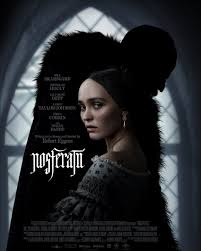
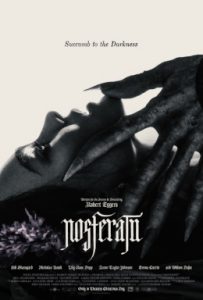
From Edgar Allan Poe to Bram Stoker.  With yet another Dracula film adaptation, Roger Eggers’ Nosferatu, scheduled for release at the end of this year, I thought it timely to include this illustration featuring Stoker’s legendary vampire count by Spanish painter and illustrator Fernando Vicente.  It depicts the scene where Dracula crawls down his castle wall, “face down with his cloak spreading out around him like great wings”, fingers and toes grasping “the corners of the stones”, descending “with considerable speed, just as a lizard moves along a wall.”  In keeping with Stoker’s 1897 novel, Dracula is still an old man at this point – but Vicente’s version is an old man who looks like he can take care of himself and whom you wouldn’t want to mess with.  Indeed, he makes me think of the late silver-haired American character-actor Dennis Farina, who specialised in playing tough mobsters and cops (and who’d been a Chicago police detective before taking up acting).  Though it’s Dennis Farina with red eyes and fangs.


From bookpatrol.net / © Fernando Vicente


And from Bram Stoker to H.P. Lovecraft.  Just over a year ago, the Scottish actor David McCallum – best known for his TV roles in The Man from UNCLE (1964-68), The Invisible Man (1975), Sapphire and Steel (1979-82) and NCIS (2003-23) – passed away.  In the tributes that followed, there wasn’t much mention of the fact that McCallum was also a musician and writer.  And nothing was said about his prolific career as an audiobook narrator, a career that extended to the weird, baroque and morbid world of legendary horror writer H.P. Lovecraft.  Among the Lovecraft stories he narrated was The Rats in the Walls (which can be heard here on YouTube).  I like this cover illustration from the original LP of the recording, designed by Brooklyn artists Leo and Diane Dillon, with its giant skull (composed of normal-sized skulls and other bones) and an insane green face, seemingly spewing yellow bile, emerging from the bottom of the wall behind.  More on the Dillons can be found here and here – the latter site featuring some cracking cover art they did for the 1972 Ray Bradbury novel The Halloween Tree.


From pinterest.com / © Leo and Diane Dillon


Old bones are also on view in this image, which I’ve seen called The Boy in the Skeleton on social media.  It’s by the Dutch engraver and woodcutter Christoffel van Sichem the Younger, who lived from the late 16th to the mid-17th century.  I presume the panic-stricken lad, inside the larger and rather insouciant-looking skeleton, serves as a metaphor for how the human soul is imprisoned within a cage of flesh and bone, despite that cage being a fragile and ultimately perishable one.


From x.com


Right, back to the theme of Halloween.  I love this picture by the Paris-based illustrator Nico Delort.  Entitled It’s the Great Pumpkin, Charlie Brown, it’s obviously inspired by the much-loved, animated TV Halloween special of the same name, which was based on the cartoon-strip creations of Charles M. Schultz and first broadcast in 1966.  It shows the thumb-sucking, security-blanket-clutching Linus Van Pelt venturing into his local pumpkin patch to await the coming of the alternative Santa Claus, the Great Pumpkin.  Linus can be discerned in the middle distance of Delort’s composition, while the Great Pumpkin – possibly – can be glimpsed on the end of a faraway cloud.  But it’s the satanically-grinning pumpkins in the foreground that command your attention.


© Nico Delort


Also satanic is this picture by British artist Dave Kendall, who’s worked in collaboration with talents as diverse as Pat Mills (founder of the world’s greatest sci-fi comic, 2000AD), heavy metal titans Metallica and the late Lovecraftian author Brian Lumley.  Among Kendall’s dark, brooding and frequently twisted creations, I find this one of the most disturbing.  Its image of a bloody-faced nun, with grotesquely elongated fingers, is inspired by a short story called The Hands.  This was penned in 1986 by the esteemed Liverpudlian horror writer Ramsey Campbell and can be read here.


© Dave Kendall


More female monstrosities are displayed in this picture.  All I can determine about these bat-ladies is that they’re the work of an Austrian artist called Robert Loewe and appeared in the February 11th, 1913 edition of the weekly satirical magazine Die Muskete.


From thefugitivesaint.tumblir.com


Meanwhile, it’s a female doing the screaming – in impeccable, wide-mouthed and wide-eyed Japanese manga style – on this cover illustration for the appropriately named Halloween Comics.  The artist is Kazuo Umezo, known in Japan as ‘the god of horror manga’.  For inspiration, Umezo has often drawn on traditional Japanese folklore and legends and he’s made this argument against the many people – parents, editors, educators – who’ve urged him to ‘think of the children’ and tone down the horror content of his work: “Old Japanese folk stories and fairy tales could be unflinchingly brutal.  They come from a time when tragedy and carnage was an everyday part of life.  Now we have people calling to water them down, which essentially whitewashes history.  It’s insulting to the memory of those who suffered to bring us these stories.”  More of Umezo’s work, definitely not toned down, can be viewed on this entry dedicated to him on the website Monster Brains.


From monsterbrains.blogspot.com / © Kazuo Umezu


Finally, to end things on a gentler note, here’s a picture I appreciate both as a cat-lover and as someone who finds graveyards fascinating – one of a cat (black, of course) exploring a graveyard at night.  It’s from the cover of a ‘cozy mystery’ novel entitled Witch Way to Murder (2005) by Shirley Damsgaard and it’s by the New York artist Tristan Elwell.  A more recent and better-known cover illustration by Elwell, which also involves a cat, is the one adorning John Scalzi’s bestselling and award-winning satirical novel Starter Villain (2023).


From unquietthings.com / © Tristan Elwell


Enjoy Halloween!