Cinematically stoned (Part 2)


© Taplin-Perry-Scorsese Productions / Warner Bros


I ended my previous post by promising I’d give a list of my favourite movie scenes wherein songs by the Rolling Stones are employed to memorable effect.  Here it is.


Jumpin’ Jack Flash (1968) in Mean Streets (1973)

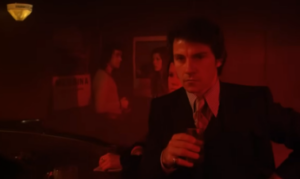
Wow.  Martin Scorsese really likes the Rolling Stones.  Not only has he made a concert movie about them, 2008’s Shine a Light, but he’s used their music in umpteen films: Goodfellas (1990), Casino (1995), The Departed (2006) and the one that first put him on the map, 1973’s Mean Streets.  Even today, more than 50 years later, the scene in Mean Streets where a young Robert De Niro comes swaggering through a bar, in slow motion, towards a pensive Harvey Keitel, while Mick Jagger hollers in the background about being “born in a cross-fire hurricane”, is a great synthesis of rock ‘n’ roll music and rock ‘n’ roll cinema.  Indeed, Jumpin’ Jack Flash is a fitting accompaniment for the arrival in popular consciousness of De Niro, who’d spend the rest of the 20th century showing Hollywood how to do proper acting.  The 21st century, featuring such efforts as The Adventures of Rocky and Bullwinkle (2000), Little Fockers (2010), New Year’s Eve (2011) and Dirty Grandpa (2016)…  Okay, not so much.


Satisfaction (1965) in Apocalypse Now (1979)

The Stones’ early, primordial and still potent stomper Satisfaction gets a brief but memorable airing in Francis Ford Coppola’s baroque Vietnam War masterpiece, playing on the radio while Captain Martin Sheen and his not-exactly-fighting-fit crew go cruising up the Nùng River in search of Marlon Brando.  Cue some funky on-deck dance moves by a frighteningly young-looking Laurence Fishburne and some funny / cringeworthy water-skiing moves by Sam Bottoms that knock various Vietnamese people out of their fishing boats.

 

© Omni Zoetrope / United Artists


Sympathy for the Devil (1968) in Alien Nation (1988) and in Interview with the Vampire (1994)

Graham Baker’s sci-fi / cop movie Alien Nation isn’t very good.  Its premise of an alien community getting stranded on earth and having to integrate as best as they can with the curmudgeonly human natives was handled much better in Neill Blomkamp’s District 9 (2009).  But I do like a woozy, hypnotic scene in it where alien-loathing cop James Caan enters a sleazy alien bar while a lady-alien performs an erotic dance to the strains of Sympathy for the Devil.  Not the original Stones song, but a correspondingly woozy, hypnotic cover-version of it by the great Jane’s Addiction.  I can’t find a film-clip of the scene, but here’s the Jane’s Addiction cover.


Meanwhile, Neil Jordan’s adaptation of Anne Rice’s Interview with the Vampire ends with Sympathy for the Devil on the soundtrack.  Again, this isn’t the Rolling Stones version but a cover, this time by Guns n’ Roses.  It’s every bit as ramshackle, shonky and (for me) enjoyable as the other covers Guns n’ Roses have done, for example, of Wings’ Live and Let Die (1973) and Bob Dylan’s Knockin’ on Heaven’s Door (1973).  Sympathy for the Devil kicks in when the vampire Lestat – Tom Cruise in one of his rare interesting roles – pops up to claim Christian Slater as his new vampirical companion for eternity.


Can’t You Hear Me Knocking? (1971) in Casino (1995)

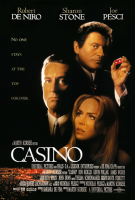
While Martin Scorsese serenades Robert De Niro and Harvey Keitel with Jumpin’ Jack Flash in Mean Streets, he employs the Stones song Can’t You Hear Me Knocking? for another of his regulars, Joe Pesci, in Casino.  Remarkably, Scorsese plays all seven minutes of the Santana-esque Can’t You… as an accompaniment to a lengthy sequence showing how Pesci’s Casino character Nicky Santoro gets established in Las Vegas.  Predictably, the sequence has Pesci doing what Pesci usually does in Scorsese movies: being a psychotic shit, barking orders at hoodlum sidekicks twice his size, eating in restaurants, ingratiating himself with fellow Mafiosi, being a psychotic shit, cursing and swearing, getting a blow-job, being a psychotic shit, talking about food, knocking off jewellery stores, acting the loving family man with his non-criminal relatives… and being a psychotic shit.
 

© Légende Entreprises / Universal Pictures


Ruby Tuesday (1967) in Children of Men (2006)

Wistful Stones ballad Ruby Tuesday features briefly on the soundtrack of Alfonso Cuarón’s gruellingly pessimistic science-fiction thriller Children of Men.  It’s another cover, sung by Franco Battiato.  We hear it during one of the movie’s calmer moments when Theo (Clive Owen) is visiting his old mate Jasper (Michael Caine), whose home provides a small pocket of sanity amid the unfolding dystopian grimness.  Amusingly, Caine, well known in real life for being a right-wing old grump with an aversion to paying tax, here plays an elderly anarcho-hippy with a fondness for smoking exceptionally strong pot.


Gimme Shelter (1969) in The Departed (2006)

Martin Scorsese loves the Rolling Stones and he loves their apocalyptic number Gimme Shelter in particular.  By my count he’s used it in three movies: Goodfellas, Casino and The Departed.  It’s best deployed at the beginning of The Departed, rumbling in the background while gangland thug Frank Costello (Jack Nicholson) expounds his philosophy.  “I don’t want to be a part of my environment,” he intones, imbuing his words with that leery, languid menace that only Nicholson is capable of.  “I want my environment to be a part of me.”  Strangely, in Scorsese’s Shine a Light two years later, Gimme Shelter was one of the songs the Stones didn’t perform on stage.  Marty missed a trick there.
 

© Plan B Entertainment / Warner Bros


Street Fighting Man (1968) in Fantastic Mr Fox (2009)

Director Wes Anderson also sticks Rolling Stones into his movies, but so far I haven’t mentioned him because I think most of his work is smug, pretentious and annoying.  For example, Play with Fire (1965) figures prominently in 2007’s The Darjeeling Limited, an Anderson movie so twee I find it the cinematic equivalent of being force-fed with chocolate-cake mix.  However, I like the scene in his stop-motion-animation adaptation of Roald Dahl’s Fantastic Mr Fox where, to the sound of the rabblerousing Stones anthem Street Fighting Man, Farmers Bean, Boggis and Bunce use three diggers to tear up the den of the titular Mr Fox; forcing the den’s inhabitants to frantically dig an escape-route.  Yes, they really ‘dig’ that song.  Sorry.


And finally…  Out of Time (1968) in Once Upon a Time in Hollywood (2019)

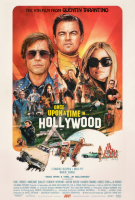
I’m not the biggest fan of the Stones song Out of Time – Jagger’s vocals get a bit too caterwauling for my liking – but it sees good satirical use in Once Upon a Time in Hollywood, Quentin Tarantino’s paean to the American movie-making capital in the late 1960s, a fascinating period when traditional notions about what made a good film were rapidly being undermined by an uppity younger generation.  Played when Rick Dalton (Leonardo DiCaprio), his new Italian spouse Francesca Capucci (Lorenza Izzo) and sidekick Cliff Booth (Brad Pitt) return from Italy, where Rick has been making spaghetti westerns and action thrillers with the likes of Sergio Corbucci and Antonio Margheriti, Out of Time gives an one-the-nose summation of DiCaprio’s sad-sack character – an actor a bit too old, un-hip and uncomprehending of the changing world around him to get the leading roles he once did, now doomed to playing villains in second-rate TV shows.
 

© Columbia Pictures / Sony Pictures Releasing 
Bungle in the jungle


© Legendary Pictures / Warner Bros.


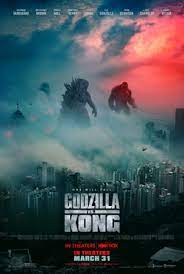
Godzilla versus Kong.  The King of the Monsters versus the Eighth Wonder of the World.  The supreme clash of the titans, the ultimate showdown between the royalty of kaiju cinema.  In the left corner, we have King Kong, the giant simian star of Merian C. Cooper and Ernest B. Schoedsack’s 1933 classic that created the template for movies wherein prehistoric monsters rampage through human metropolises.  And in the right corner, we have Godzilla, the massive radioactive-breathed lizard who first surfaced in 1954, courtesy of Toho Studios, to flatten Tokyo as a thinly-disguised metaphor for the atomic bombs that’d flattened real Japanese cities a decade earlier – although, while he appeared in dozens of subsequent movies battling against similarly-sized monstrous adversaries, he gradually morphed from being the destroyer of Japan to being the unofficial champion of it.


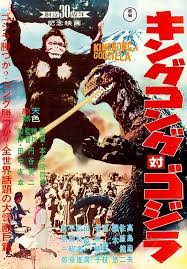
Having this pair square up to one another – an event that’s only happened once before, in the ultra-ropey but endearingly goofy 1962 Toho movie King Kong vs Godzilla – should be an epic cinematic experience, the kaiju equivalent of Muhammed Ali versus Joe Frazer or Ali versus George Foreman, of the Thrilla in Manilla or the Rumble in the Jungle.


Alas, the recently released Godzilla vs Kong, the fourth entry in Legendary Pictures’ MonsterVerse franchise, isn’t so much the Rumble in the Jungle as a Bungle in the Jungle.


Of its three predecessors, the first instalment, 2014’s Godzilla, directed by talented Welshman Gareth Edwards, is the one that stands as a quality film.  It had some truly cinematic sequences and a memorably sombre tone, embodied in the apocalyptic clouds of ash and dust that swirled around Godzilla while he went about his city-demolishing business.  However, it wasn’t the big, enjoyably dumb monster-on-the-loose movie that many people expected and in some quarters it was met with disappointment.  And I have to say that while I admired Godzilla, I didn’t massively enjoy it.


Edwards’ downbeat film was the antithesis of the second film in the franchise, Jordan Vogt-Roberts’ Kong: Skull Island, which arrived three years later.  Set in the early 1970s, this was a brash, colourful rollercoaster of a movie that managed to balance crowd-pleasing action with enough smart touches to engage the more cerebral members of the audience – smart touches ranging from jokes about Richard Nixon to an outrageous sequence where Kong takes on what is basically the fleet of helicopters from Francis Ford Coppola’s Apocalypse Now (1979), though to the accompaniment of Black Sabbath’s Paranoid rather than Richard Wagner’s Ride of the ValkyriesKong: Skull Island also benefitted from having a cast of veteran character actors like John C. Reilly, Samuel L. Jackson and John Goodman chew up any scenery that Kong wasn’t stomping on.


By the third movie, though, Michael Dougherty’s Godzilla: King of the Monsters (2019), the rot had set in.  The kaiju remained magnificent, but too much screen-time was devoted to the human characters, most of whom barely qualified as two-dimensional let alone three-dimensional.  Also, between the film’s set-pieces were sections where screenwriters Dougherty and Zach Shields couldn’t be bothered plotting in any credible or meaningful way.  You got ridiculous sequences like, for example, the bit where 12-year-old kid Madison Russell (Milly Bobby Brown) strolls out of the heavily fortified, heavily guarded lair of master-terrorist Jonah (Charles Dance) carrying a vital piece of technology that can communicate with and summon the monsters.  She then manages to set up the device and operate it in Kenway Park, home-ground of the Boston Red Sox.  Wow.   When I was 12 years old, I was still having problems tying a knot correctly in my school tie.


© Toho Studios


Brown’s Madison Russell character is, unfortunately, back in Adam Wingard’s Godzilla vs Kong and the chasms in plot logic are as gaping as they were before.  Here, she and a couple of conspiracy-theory-obsessed associates infiltrate, no, wander into the premises of a secretive corporation called Apex, which they suspect is up to no good.  With almost no visible effort, this motley collection of teenagers / conspiracy nuts discovers and breaks into a series of secret subterranean levels that are full of futuristic technology.  Apex might be the bees’ knees when it comes to developing high-tech gizmos, but they are evidently shit at hiring competent security staff.


The human characters involved in the film’s other main storyline, played by Alexander Skarsgård and Rebecca Hall (who, by accident or design in this movie, looks a bit like New Zealand premier Jacinda Ahern), fare no better.  They’re saddled with a don’t-even-try-to-think-about-it subplot where they join an expedition, sponsored by that shifty Apex corporation, to travel to the fabled ‘hollow earth’ alluded to by previous movies in the franchise.  To get there, they need to use King Kong to lead them, like a giant homing pigeon or upstream-swimming salmon, through the labyrinthine tunnels that connect it with the earth’s surface.  The hollow earth, which looks like the planet in James Cameron’s Avatar (2009) with some gravity-defying upside-down bits, is not only the home of Kong’s ancestors but also the location of a new energy source that Apex are keen to procure.  Once they find the energy source, they promptly download it to a computer in Hong Kong.  Yes, download it.  Don’t ask me how.


But I’ll try to be positive.  What did I like about Godzilla vs Kong?  Well, the first battle between the kaiju is a cracker.  Godzilla erupts out of the waves to confront Kong, who’s chained to the deck of one of a fleet of battleships and aircraft carriers, and the two beasties then slug it out while hopping from one beleaguered ship’s deck to another.  The sequence put in mind slightly of the 1974 Bond film Live and Let Die, in which Roger Moore escapes to safety by using some bobbing alligators as stepping stones.


Also, I liked the character of the little girl who learns to communicate secretly with Kong via sign language.  Played with a charming simplicity and straightforwardness by Kaylee Hottle, who in real life is a member of the deaf community, she wins more of the audience’s sympathy than all the synthetic, going-through-the-motions adult characters put together.


And I liked Milly Bobby Brown’s nerdy friend Josh, who gets unwillingly roped into her scheme to infiltrate Apex.  This is partly because he’s played by Julian Dennison from Taika Waititi’s Hunt for the Wilderpeople (2016) and partly because when we first meet him he’s listening to Breaking the Law by Judas Priest.


And I liked how, two-thirds of the way through, a third classic kaiju, one who made his debut in 1974’s Godzilla vs. Mechagodzilla, suddenly shows up to give Kong and Godzilla a common foe.  It’s just a pity that the ensuing stramash, which takes place in Hong Kong, feels a bit second-hand.  Guillermo del Toro’s Pacific Rim (2013) has already featured giant organic monsters and giant robotic ones beating the crap out of each other in Hong Kong.  Also, the final denouement, involving a heavily foreshadowed flask of whisky, is stupid even by the recent standards of this franchise.


At the end of the day, I can’t say I liked Godzilla vs Kong any more than Godzilla: King of the Monsters.  The earlier film at least treated us to spectacular re-imaginings of some of Toho Studio’s kaiju heavyweights, including the vicious three-headed dragon King Ghidorah, the scaly giant Pteranodon Rodan and the vast gorgeous lepidopteran Mothra.  The new film doesn’t have that level of interest, seeing as we’ve already met Godzilla and Kong in previous films.


At least I managed to see Godzilla vs Kong on a big screen, for this was my first outing to a cinema during the Covid-19 pandemic since I saw Christopher Nolan’s Tenet (2020) in one last summer.  That no doubt made the film appear more spectacular than if I’d seen it, streamed, on a domestic-sized screen.  And I have to say that in this large-sized format the film certainly held the attentions of the Sri Lankan kids and teenagers whom I watched it alongside.


I’m not, however, in any rush to see a fifth instalment in the MonsterVerse franchise.  Unless they figure out a way of getting Gamera into Movie Number Five.


© Daiei Film / Kadokawa Daiei Studio