Films I’d like to see remade (Part 2)


From wikipedia.org / © Metro-Goldwyn-Mayer


Here are some more films I remember fondly from my youth that, with sufficient love and skill, I think could be remade as wonderful new films.


Dark of the Sun (1968)

When, in my early teens, I saw this action / adventure / war movie on late-night TV, I believed it was the toughest movie ever.  At least, I believed that until I saw William Friedkin’s nail-biting Sorcerer (1977), itself a remake, of Henri-George Clouzot’s The Wages of Fear (1953), which promptly stole its crown as Most Badass Film I’d Ever Seen


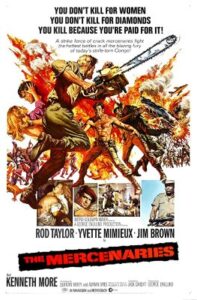
But no matter – Dark of the Sun, or The Mercenaries as it was also known, still seemed pretty hardcore to me.  Why, it even had a chainsaw fight in it!  Thanks to the Texas Chainsaw Massacre movies (1974 onwards) and the Evil Dead movies (1981 onwards), and to one-off entries like Motel Hell (1980) and Mandy (2018), chainsaw fights are ten a penny nowadays.  But back then, seeing someone lunge at someone else with a whirring, metal-toothed power tool was an intense experience.


Based on a 1965 Wilbur Smith novel and directed by Jack Cardiff, Dark of the Sun tells the story of some mercenaries being sent into action amidst the Simbas rebellion in early 1960s Congo. It stars Robert Taylor, Yvette Mimieux – Taylor and Mimieux reunited eight years after appearing in George Pal’s charming 1960 adaptation of H.G. Wells’s The Time Machine – Jim Brown, Kenneth More (subverting his usual, cuddly English-gentleman image by playing an alcoholic doctor) and Peter Carsten (playing a vile, child-murdering Nazi).  At the time, critics lambasted the film for what they saw as its extreme violence.  However, as Cardiff noted, the violence depicted didn’t come anywhere near the real atrocities that’d happened in the Congo then, or near the violence featured in movies in later decades.


I’d like to see a remake of Dark of the Sun that updates the intensity, grittiness and violence to fit with 2026 sensibilities and that places the action within the context of 2026 geopolitics.  And is more racially sensitive – any racism in the original movie went over my 13-year-old head but I’m sure that, viewing it today, I’d cringe at parts of it.   At the very least, and despite the presence of Jim Brown as one of the mercenaries, I suspect I’d find it infused with a ‘white saviour’ or ‘white man’s burden’ complex.


Quentin Tarantino is a huge fan of this film (as is Martin Scorsese) so, as I did with Von Ryan’s Express (1965), I recommend old Quent as the man to helm a remake of it.  I know he’s sworn that he’s only going to make ten films in his lifetime, and his next one will be his last, but I don’t believe that for an instant.


Come to think of it, Dark of the Sun has quite a few things in common with Von Ryan’s Express, including a cracking movie film poster designed by the splendid Frank McCarthy and the presence of Nazis.  And like the earlier film, Dark of the Sun prominently features a train.


As does my next candidate for a modern remake, which is….


© Granada Films


Horror Express (1972)

The much-loved British-Spanish movie Horror Express is set on a train hurtling across Siberia in the early 20th century.  The train is being stalked by a decomposing ape-man fossil that’s seemingly come back to life – in fact, it’s possessed by an alien lifeforce and has the power to suck people’s brains out through their eyeballs.  Trying to thwart it are British scientists Sir Alexander Saxon (Christopher Lee) and Dr Wells (Peter Cushing).  Things become even more complicated in the film’s final act when the train is invaded by a bunch of Cossack soldiers, led by Telly Savalas’s villainous Captain Kazan.


Directed by Eugenio Martin, Horror Express is basically The Thing (1982) set on board the train from Alfred Hitchcock’s 1938 classic The Lady Vanishes.  Saxon and Wells are variations on the characters of Charters and Caldicott, the stuffy but unflappable English cricket-lovers in Hitchcock’s movie who get caught up in the chaos.  That said, you never feel Christopher Lee and Peter Cushing are playing anyone other than themselves in Horror Express.  During their careers, the two actors made 22 movies together, were close friends offscreen and have an effortless chemistry here.


The decaying ape-man in the original movie is still icky, but it would be nice to see it in a modern remake with a decent special-effects budget where it could do properly mind-blowing, spectacularly gruesome Thing-like things.  To play Saxon and Wells, you’d need a pair of British actors who’ve worked together already and possess some of that Lee-Cushing chemistry – maybe Benedict Cumberbatch and Martin Freeman, from the BBC TV show Sherlock (2010-17)?


And to play Savalas’s murderous Captain Kazan, there can be only one man: Nicolas Cage.


Theatre of Blood (1973)

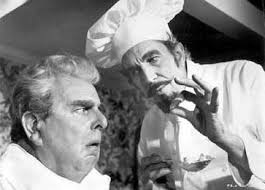
Until recently, I’d have been aghast at the thought of anyone remaking Douglas Hickox’s brilliant horror comedy Theatre of Blood, wherein Vincent Price plays an insane and hammily over-the-top Shakespearean actor called Edward Lionheart.  Enraged by the snobbish London theatre critics who’ve bad-mouthed his performances, Lionheart murders them one by one using methods borrowed from the Bard’s plays.  “They’re not going to start killing critics for giving bad notices, are they?” exclaims the campest critic, played by Robert Morley, who eventually meets a grisly fate modelled on events in Titus Andronicus.  A very distinguished cast of English character actors goes the same way as Morley: Michael Hordern, Dennis Price, Arthur Lowe, Harry Andrews, Robert Coote and Coral Browne.
 

© Harbour Productions Ltd / Cineman Productions / United Artists


There’s no shortage of famous modern-day British thespians who could play the supporting cast of doomed theatre critics in a remake – I’d enjoy seeing James Corden get the Titus Andronicus treatment – but surely, surely nobody could recreate the absolutely delicious performance that Vincent Price gives as Lionheart in the original movie?


Well, I thought that until I saw Ralph Fiennes in this year’s 28 Years Later: The Bone Temple.  Now I’m pretty sure he could be the Vincent Price of 2026.  And actually, Fiennes has played a character not dissimilar to Lionheart in 2022’s The Menu.


And if Fiennes wasn’t available, I suppose they could always call on Matt Berry.


The Beast Must Die (1974)

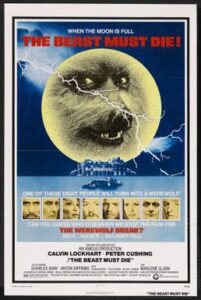
Paul Annett’s The Beast Must Die is a low-budget horror movie with an irresistible premise.  It’s about a millionaire big-game hunter, played by Calvin Lockhart, determined to bag a werewolf.  He rigs up his country estate with CCTV cameras and motion sensors, procures a helicopter and invites five unsavoury people to visit for a few days convinced that one of them  is a werewolf.  Among those playing Lockhart’s house-guests and staff are Peter Cushing, Charles Gray, Anton Diffring and a youthful Michael Gambon.  Needless to say, there is a werewolf present, but it gradually turns the tables on Lockhart and his hi-tech equipment, whilst also bumping off the supporting cast.


The ideas is irresistible, as I said, but watching The Beast Must Die on TV as a kid was a frustrating experience.  Due to the inevitable budgetary constraints, Lockhart’s mansion house and grounds aren’t that hi-tech and the werewolf, when it appears, just looks like a big dog.  You’d think the sequence where the werewolf takes out a helicopter would be thrilling, but it isn’t.  Let’s remake this one with a proper budget, so that it’s as awesome as it sounded on paper in 1974.
 

From wikipedia.org / © Amicus Productions / British Lion Films


Juggernaut (1974)

The most underrated but, in my mind, the greatest of 1970s disaster movies, Richard Lester’s Juggernaut is mostly set on a British ocean liner stuck out in the stormy north Atlantic.  An anonymous call to the company that owns the liner informs it that half-a-dozen bombs have been stashed on board and they’ll explode unless a ransom is paid.  With weather conditions too severe to allow the ship’s crew and passengers to be evacuated, and the authorities forbidding the company to pay the ransom – which would be surrendering to terrorism – a team of bomb-disposal experts led by Fallon (Richard Harris) and his sidekick Charlie (David Hemmings) are sent to try and make the bombs safe.


Back on dry land, a policeman (Anthony Hopkins), whose family are among those trapped on the ship, tries to discover the bomber’s identity.  I don’t want to give away any spoilers, but when a twitchy Freddie Jones appears onscreen, you know who it is.


Juggernaut has a wonderful cast all round – not just the three ‘H’s of Harris, Hemmings and Hopkins, but also Omar Sharif, Ian Holm, Shirley Knight, Clifton James, Julian Glover and many more.  But the show is quietly stolen by Roy Kinnear, playing the ship’s entertainment officer, who has the thankless task of keeping the passengers’ spirits up when at any moment they could be blown to smithereens.  When he organises a fancy-dress party, one passenger appears dressed as the Grim Reaper and carrying a round black object with BOMB written on it.


As well as being massively suspenseful, the film offers social commentary. This ship is called the Britannic and it’s not difficult to see Juggernaut as a meditation on the sorry plight of Britain in the mid-1970s, its days as a world power well behind it, being battered by global events it had no power over, such as the Oil Crisis.  In 2026, a decade after Brexit and during the chaotic era of Trump, a remake of Juggernaut would be both more poignant and more cutting.


You could also cast, in a Juggernaut remake, the sons of three of its original stars, now well established as actors in their own right: Jared Harris, Toby Jones and Rory Kinnear.  But it’d be fun to see them in roles different from those their dads played.  Kinnear as the policeman, Jones as the entertainment officer, Harris as the bomber?
 

© Two Roads / United Artists
Films I’d like to see remade (Part 1)


From imdb.com / © Rank Organisation


I still find it disconcerting when films I enjoyed in my youth are remade in the 21st century: for example, 1980’s The Fog (remade in 2005), 1981’s The Evil Dead (remade in 2013) and Clash of the Titans (remade in 2010), 1986’s The Hitcher (remade in 2007), 1987’s Robocop (remade in 2014) and 1988’s Hairspray (remade in 2007).  My immediate and automatic response to such remakes is, “What, they’re remaking that movie already?  Have you no shame, Hollywood?”


This is followed by a feeling of horror as I realise just how long ago it was when those original movies were released.  The first Evil Dead movie was 32 years old – 32 years! – when its remake surfaced, though in my mind it was only yesterday when Sam Raimi’s Deadites made their first-ever appearance and started making life difficult for Bruce Campbell.   And actually, three of the films I remember most fondly from my youth, Philip Kaufman’s Invasion of the Body Snatchers (1978), John Carpenter’s The Thing (1982) and Brian De Palma’s Scarface (1983) were remakes themselves.  Body Snatchers appeared just 22 years after the 1956 original and The Thing appeared 32 years after its 1950 one.  Scarface was an outlier, since the first Scarface came out in 1932, more than a half-century earlier.


Maybe I shouldn’t be so concerned about how soon after the original movie that a remake appears.  I should be concerned about the quality of it – for remakes tend to be shite.  I haven’t seen all those mentioned at the beginning of this entry, but the ones I have seen have been nowhere near as good as the originals.  (The Evil Dead remake probably comes closest, but I still much prefer the ramshackle and low-budget, but resourceful, charm of Raimi’s 1981 film.)  That said, remakes don’t have to be bad all the time – the aforementioned ones by Kaufman, Carpenter and De Palma testify to that.


So, without further ado, here are some films – and one series of films – I wouldn’t mind seeing remade in the 21st century, with bigger budgets and better special effects.  But remade decently.


From wikipedia.org / © Rank Organisation


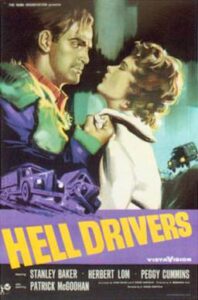
Hell Drivers (1957)

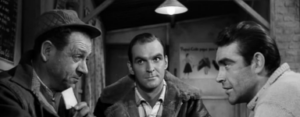
Blacklisted by the House Committee on Un-American Activities in 1951, American director Cy Endfield moved to Britain where, half-a-dozen years later, he made Hell Drivers.  Given the persecution Endfield had suffered, it unsurprisingly takes a dim view of American-style, cut-throat capitalism.  It has that underrated but magnificent actor Stanley Baker as an ex-con who finds a job as a truck driver with a dodgy haulage company, which threatens its drivers with the sack if they don’t deliver loads of gravel across treacherous roads at breakneck speeds.  The reason there aren’t more drivers employed to relieve the pressure, and reduce the danger, is because of a scam involving the local depot manager (William Hartnell) and its off-his-head Irish foreman (Patrick McGoohan, coming across like a brawnier version of Shane MacGowan).  The latter soon becomes Baker’s nemesis.


As well as a political message, Endfield injects Hell Drivers with an American-style grittiness rarely seen in British films of the period.  But what really makes the film a joy to watch nowadays is the cast.  As Kim Newman has written of it in Empire Magazine, “how many other movies have an ensemble which includes the original Dr Who (Hartnell), the first James Bond (Sean Connery), the Prisoner (McGoohan), a Man From UNCLE (David McCallum), a Professional (Gordon Jackson), Clouseau’s boss (Herbert Lom), plus Alfie Bass, the excellent Peggy Cummins (of the cult items Gun Crazy and Night of the Demon), the inimitably boozy Wilfrid Lawson, Jill Ireland and Sid James?”


In 2026, with capitalism more cut-throat than ever, a remake of Hell Drivers would be timely.  I don’t think, though, setting it in the wilds of Middlesex, West Sussex and Buckinghamshire, where the original was filmed, would work now, so it’d have to have its hard-pressed truck drivers pounding the roads of a less hospitable locale – the Alaskan tundra, say, or somewhere that retains some near-impenetrable tropical rainforest.


And to pay proper homage to the original, you’d definitely need a cast made up of actors who’ve played iconic roles in iconic TV shows or movie series.  You could have one of the grittier Bonds (Daniel Craig or Timothy Dalton), one of the grittier Doctors Who (Christopher Eccleston or Peter Capaldi), plus a Sherlock Holmes (Benedict Cumberbatch, maybe), a Harry Potter (Daniel Radcliffe), perhaps someone from the Breaking Bad universe (Bryan Cranston, say, or Bob Odenkirk)…  The possibilities are endless.


From wikipedia.org


The Margaret Rutherford Miss Marple movies (1961-64)

This is a little different.  I’d like to see the four movies made about Agatha Christie’s genteel sleuth of a certain age, Miss Marple, which had the delightful Margaret Rutherford in the leading role – Murder She Said (1961), Murder at the Gallop (1963), Murder Most Foul (1964) and Murder Ahoy! (1964) – rebooted as a TV show.  Not just another show about Miss Marple per se – there have been ones with Joan Hickson, Geraldine McEwan and Julia McKenzie – but one set in the universe of the four Rutherford movies.


Thus, its episodes would be set against the tableau of early-1960s England, with Miss Marple depicted as an obstinate, feisty old lady who refuses to know her place and keeps barging into and solving mysteries.  There’d be as much as humour as tension and the show would have the films’ supporting characters, like the timid librarian Mr Stringer (Rutherford’s real-life husband Stringer Davis), who reluctantly helps Miss Marple out, and the exasperated copper Inspector Craddock (Charles Tingwell), who begins each instalment telling her to mind her own business but ends it taking orders from her.  Meanwhile, Ron Goodwin’s jaunty Miss Marple Theme would burble in the background.


I suspect in a 2026 version Mark Gatiss would make a lovely Mr Stringer, while Daniel Mays would nicely fill the shoes of the long-suffering Inspector Craddock.  But who would play Miss Marple – or more precisely, play Margaret Rutherford playing Miss Marple?  Perhaps Dawn French, though she’d have to spend a long time in the make-up chair to recreate Rutherford’s famously jowly, hangdog features.


In the original movies, each murder that Rutherford / Marple investigated involved a British institution – a country manor, horse riding, the theatre and the Navy.  She’d duly rattle establishment cages by sticking her nose in where it wasn’t welcome.  So perhaps each episode of this hypothetical series would have her ruffling the feathers of other British institutions of the time – the Army, the House of Lords, Savile Row, Crufts, the country’s nascent rock ‘n’ roll industry…  Miss Marple meets the young Rolling Stones?  I’d pay good money to see that.


From wikipedia.org / © 20th Century Fox


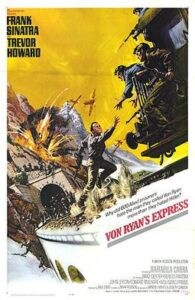
Von Ryan’s Express (1965)

I never had much time for Frank Sinatra, neither as an entertainer nor as a person, but he left an impression on my 10-year-old self the first time I saw the ripping World War II yarn Von Ryan’s Express.  It’s the story of an American airman, Ryan (Sinatra), downed in Italy, who joins forces with some Allied prisoners of war, led by Trevor Howard.  They attempt an audacious escape into neutral Switzerland by seizing control of a train and steering it up a railway line into the Alps.  Much derring-do is involved as German troops and aircraft go all-out to stop them reaching their destination.


It’s great, crowd-pleasing stuff until the ending – spoilers are coming! – which is depicted on the movie poster, painted by the great Frank McCarthy.  The train has almost made it to safety.  Having fought a rearguard action against the Germans, Sinatra is running after the train and has almost caught up with it.  But then….  What happened next put a dampener on things.  But it also lodged the film in my mind forever.


With 2009’s Inglourious Basterds, Quentin Tarantino showed his love for rip-roaring if cheesily improbable World War II adventures, so perhaps he could helm a remake of Von Ryan’s Express?  To stick to the innocent, uncomplicated spirit of the original, though, he’d have to forgo his use of the F-word and N-word, and his fetish for close-ups of ladies’ feet, and his nerdish references to ‘film-study criticism of the work of German director G.W. Pabst’.


© Hammer Film Productions / Seven Arts Productions


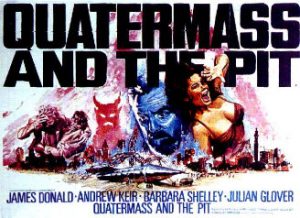
Quatermass and the Pit (1967)

Hammer Films’ sci-fi horror film Quatermass and the Pit was based on the 1958 BBC TV serial of the same name.  Both film and serial were written by Nigel Kneale.  It begins with workers on a London Underground extension project digging up an alien spacecraft full of dead, horned, insect-like creatures that are identified by scientist-hero Professor Bernard Quatermass (Andrew Keir) as inhabitants of the now-lifeless planet Mars.  It transpired that millions of years ago, these sneaky Martians arrived on earth and did some evolutionary tinkering on the apes who were the ancestors of modern humanity.  This tinkering included implanting in the apes an urge to conduct occasional culls whereby those with pure Martian programming exterminated those who’d developed mutations and lost that programming.


When some TV news crews descend on the scene, a power surge from their camera-cables reactivates the spacecraft and it triggers a new cull.  London becomes an apocalyptic hellscape where the human inhabitants who retain their Martian conditioning roam around, zombie-like, and use newly awoken telekinetic powers to kill everyone who’s lost it.


I still find Quatermass and the Pit impressive today, and scary, though inevitably there are special effects that reflect the limitations of Hammer’s budget.  I’d relish the prospect of a modern, big-budget retelling of the story.


One thing that makes the film effective, and affecting, is Kneale’s portrayal of the scientists.  Unlike usual movie-scientists, they aren’t cold-blooded, delusional, self-serving or plain weird.  Instead, Quatermass and his colleagues, Dr Roney (James Donald) and Barbara Judd (Barbara Shelley), are portrayed as decent human beings, working with an eager curiosity, a sense of duty and a sense of humour.  Keir and Donald were both Scots, so maybe a modern movie could cast Brian Cox as Quatermass and James McAvoy as Dr Roney.  Actually, I think a third Scottish actor, Karen Gillan, would be excellent as Barbara Judd.


To be continued…


© Metro-Goldwyn-Mayer

In the multiverse of Sam-ness


© Marvel Studios / Walt Disney Motion Pictures


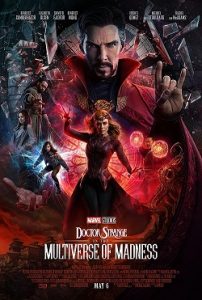
Though I’ve enjoyed some of the films produced by the Marvel Cinematic Universe (MCU) in recent years, and though I was a big fan in my youth of the Marvel comics that inspired those films, until now I’ve not been tempted into a cinema to watch one of them.  Usually, I’ve caught up with them courtesy of DVDs, streaming services or some airline’s in-flight entertainment system and seen them on a smaller screen.  However, the other day, for the first time, I actually got off my backside, left the comfort of my apartment, made my way to the nearest cinema and bought a ticket to see the latest MCU offering, Doctor Strange in the Multiverse of Madness (2022).


There were two reasons for this.  First, it’s Doctor Strange.  And secondly, the film’s directed by Sam Raimi.


In the 1970s, when I was a kid and read any Marvel comic I could lay my hands on, I loved Spiderman, the Hulk, the Fantastic Four, the Avengers, the X-Men and the rest, but Doctor Strange seemed something else.  The artwork by artists like Frank Brunner and Gene Colan was fascinatingly weird and psychedelic.  The fact that the LSD-fuelled Summer of Love loomed large in recent memory might have had something to do with this.  Also, the strip’s premise, whereby Doctor Steven Strange spent his time battling not science-fictional superpowered villains or alien beings but demons, sorcerers and other supernatural agents, gave the comic a special thrill.  At the time I was living in Northern Ireland, which was heavily populated with hard-line, Bible-thumping, Christian nutjobs.  To them even something as anodyne as the musical Jesus Christ Superstar (1971) was an unspeakable act of blasphemy and a portent of the coming End of Days.  Thus, reading a comic strip choc-a-bloc with demons, black magic and occult imagery felt, in that environment, to a nine-year-old kid, like forbidden fruit indeed.


Meanwhile, I’ve been a big fan of Sam Raimi’s work since seeing his horror-comedy movie Evil Dead II in an Aberdeen cinema in 1987.  I found Evil Dead II a brilliant mixture of crude, lowbrow slapstick – evidenced by the moment where a female character swallows an eyeball flying from an exploding head – and knowing, highbrow humour – evidenced by the scene where the hero, the ever-beleaguered Ash (played by Raimi’s long-time acting collaborator Bruce Campbell), chainsaws off his own demonically-possessed hand, then traps the severed appendage under a bucket and weighs the bucket down with a hardbacked edition of Ernest Hemmingway’s A Farewell to Arms.


© Renaissance Pictures / Rosebud Releasing Corporation


Raimi’s kinetic directing style and love of violent chaos seemed to owe as much to comic books as to anything in the cinema that’d come before him (though he was a big fan of the Columbia Pictures comedy team the Three Stooges).  So, it wasn’t altogether a surprise when he directed the first big cinematic comic-book adaptation of the 21st century, the Spiderman trilogy (2002-07) with Tobey Maguire.  Mind you, Raimi had already made a superhero movie, the overlooked but fascinatingly scuzzy Darkman (1990) with Liam Neeson.


Supposedly, Raimi was disappointed by the critical reaction to his third Spiderman film and decided not to make another superhero one, but couldn’t resist the invitation to direct this, the second outing for Doctor Strange – the first was released in 2016.  And when Raimi lets his imagination loose on such comic-book material, which had already been pretty out-there, the results are wonderful.


The basic plotline helps too.  Doctor Strange, played by the impeccably caped and goatee-ed Benedict Cumberbatch, encounters a young girl (Xochiti Gomez) with the power to travel from one universe to another.  Some universes are similar to ours but with a few discombobulating alterations, while others are bizarrely and surreally different.  There’s a malevolent force in pursuit of the girl, wanting to drain her of this power, and before long she and Strange are barrelling from one universe to the next with a super-villain hot on their heels.  Raimi has a field-day orchestrating the backdrops to their adventures, presenting us with universes that range from one resembling Salvador Dali in a hypothetical gothic phase to one resembling a topsy-turvy Jurassic Park to one where everything comes apart like a collapsing Rubik’s cube. There’s even a gloopy universe where everything is made of paint.


Equally, Raimi is allowed to let his horror sensibilities off the leash, which makes this easily the most macabre movie to come out of the MCU.  That said, with Ray Harryhausen-style lumbering trolls and flying ghouls, a partly decayed but nice zombie, and several deaths that are gruesome in a determinedly bloodless way, I doubt if this will induce nightmares in anyone over the age of ten.  Actually, as I watched Doctor Strange and his new young friend rush through portals in the fabric of reality, from one universe to another, I was reminded of the climax of Evil Dead II when Bruce Campbell’s Ash gets sucked through a portal, conjured up by black magic, and is thrown back in time to medieval Europe.  This sets things up for the third and final film in the series, Army of Darkness (1992), which was also full of Ray Harryhausen-style creations.  (I saw Army of Darkness in a cinema too, this time when I was living in the Japanese city of Sapporo.  The Japanese, picking up on the fact that Ash, when he wasn’t fighting demonically-possessed zombies, worked in a rather shit-sounding hardware store – “Shop Smart.  Shop S-Mart!  Got that?” – retitled the movie Captain Supermarket.)


©  Dino De Laurentiis Communications / Universal Pictures


Thus, I liked the parts of the movie that show Raimi’s creative stamp, and I liked the parts that share DNA with the original Doctor Strange comic strip…  But I could have done without the references to the rest of the MCU.  And you get a lot of those.  There are call-backs to the last two Avengers films, to the last Spiderman one, and to the Marvel TV series WandaVision (2021).  Also, the cast features not only Doctor Strange regulars like Chiwitel Ejiofor’s Mordo and Benedict Wong’s splendidly imperturbable Wong, but also, later, a bunch of characters from the wider Marvel gestalt.


This didn’t mean there was an unnecessarily complicated MCU backstory that made it hard to follow what was going on – I had a working knowledge of the characters from the old comics, rather than the more recent movies, and I managed fine.  It’s just that I prefer Doctor Strange, inhabiting his own little world where magic, the supernatural, the occult, demons, ghosts, etc., are realities, to be separate from the more conventional, sci-fi-style super-heroism of the rest of the Marvel canon.  That was something that spoiled the first Doctor Strange movie for me too.  You can imagine how peeved I was when Chris Hemsworth’s Thor turned up in its end-credits scene.


© Marvel / From previewsworld.com


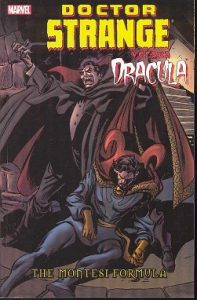
And I don’t recall the original Doctor Strange comics having much to do with the other Marvel superheroes, though perhaps I just missed reading the ones that did.  I do remember, though, Strange having a crossover adventure in which he encounters Dracula, who was also a Marvel character at the time, courtesy of the comics Tomb of Dracula (1972-79) in the USA and Dracula Lives (1974-76) in the UK.


Admittedly, in this new Doctor Strange movie, I enjoyed the presence of Elizabeth Olsen’s Wanda Maximoff / Scarlet Witch character, who in the MCU has chiefly been seen in the Avengers movies and the WandaVision TV show.  I knew the Scarlet Witch from the comics of my childhood too and had always found her an enigma, never sure if she was a good ‘un or a bad ’un.  One moment she’d be a henchwoman of the villainous Magneto, nemesis of Doctor Xavier in the X-Men; but the next moment, she’d appear as a member of the Avengers and suddenly be a good guy.  In Doctor Strange in the Multiverse of Madness, this moral ambiguity is also evident – though you can probably predict which side, the dark one or light one, she ends up succumbing to.  But even at the character’s worst, Olsen makes her a believable and even beguiling character.  As she tells Strange, “You break the rules and become a hero.  I do it and become the enemy.  That doesn’t seem fair.”


To sum up: Doctor Strange in the Multiverse of Madness is at its best when it’s being Sam Raimi-esque and Doctor Strange-esque.  it’s not so marvellous when it’s being Marvel-esque.  Incidentally, my happiest moment came when Bruce Campbell appears in a cameo as a belligerent git.  Subjected to a spell cast by Strange, and in the great tradition of Evil Dead II, he starts inflicting slapstick violence against his own face.  Well, what more can you want from a film?


© Marvel Studios / Walt Disney Motion Pictures

Dragged through a hedge backwards


© BBC


I’m currently halfway through William Boyd’s 2009 London-set thriller Ordinary Thunderstorms which, after a rather unengaging start, I’m happy to say is now shaping up to be a gripping read.  It’s interesting how quickly Boyd’s plot, of an innocent man being accused of a murder he didn’t commit and having to go to ground – literally so, hiding in a neglected patch of waste ground by the Embankment – to avoid both the police and the real killers, reminded me of several other books, namely, John Buchan’s The 39 Steps (1915), Geoffrey Household’s Rogue Male (1939) and, in a rather more skewed way, J.G. Ballard’s Concrete Island (1974).


It’s been a good while since I read The 39 Steps and Concrete Island, but I read Rogue Male just a couple of years ago and was impressed enough to post something about it on this blog.  Here’s the entry again, slightly updated to incorporate some Benedict Cumberbatch-related news.


For a novel whose plot hinges around an attempt to kill Adolf Hitler, there’s remarkably little about Hitler in Geoffrey Household’s Rogue Male.  In fact, the genocidal German dictator isn’t mentioned once.  Presumably this is because although Rogue Male first appeared in print in late 1939, after war had broken out between Britain and Germany, it was written before the outbreak of war when Household felt it would be diplomatic not to name names.


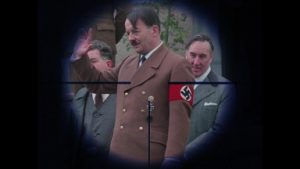
Thus, the book’s hero goes boar-hunting in Poland, crosses the border into a neighbouring country that isn’t identified, and one day ends up with the brutish leader of that country, also not identified, in the sights of his hunting rifle.  Is he actually in Germany and on the point of bagging Hitler?  Or could he be somewhere else, Russia say, where he’s targeting Joseph Stalin?  But although Household keeps it ambiguous, given historical events soon after the story’s late-1930s setting, it’s impossible to read Rogue Male now and not visualise in those sights a bloke with a square-shaped scrap of a moustache, an oily side-parting and a swastika armband.


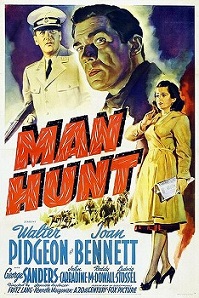
Incidentally, when Rogue Male was brought to the screen, the filmmakers didn’t follow Household’s ambiguity.  A 1941 Hollywood adaptation called Manhunt, directed by Fritz Lang – who’d bailed out of Germany in 1933 after Joseph Goebbels started taking an interest in him – readily depicted the target as Hitler and, viewed today, the film feels like an unabashed wartime propaganda piece.  Meanwhile, a 1976 adaptation by the BBC, directed by Clive Donner, was also unequivocal that its hero was going after Hitler.  The actor playing Hitler was none other than Michael Sheard, fondly remembered by kids of my generation for playing Mr Bronson, the hard-nut deputy headmaster on the BBC’s children’s drama / soap opera Grange Hill (1978-2008).


Just as the book’s target is anonymous, so is its hero, even though he tells the story in the first person.  Again, the film versions differ from the book in giving him an identity.  In 1941’s Manhunt, he’s called Captain Thorndyke and is played by Walter Pidgeon.  In 1976’s Rogue Male, he’s called Sir Robert Hunter and is played by the marvellous Peter O’Toole.


© Penguin Books


Whoever he is, he’s apprehended before he can fire the rifle and subjected to a brutal interrogation.  Then his captors decide that the easiest way to deal with him is to bump him off and make his death look like an unfortunate hunting accident.  The ensuing story can be divided into two parts, with each part having a similar, contracting, funnelling structure where the action begins in an expansive setting but ends in a cramped, claustrophobic one.  First, Rogue Male’s hero manages to escape from his captors and is pursued by them across the countryside of whatever foreign nation he’s in.  Okay, for the sake of simplicity, let’s just say his captors are the Gestapo and the nation is Germany.  His pursuers close in but he manages to elude them by stowing away on a London-bound ship, hiding on board inside an empty water tank.


Then begins the second, longer part of the narrative.  Back in Blighty, he discovers that Hitler’s agents are still on his trail.  They don’t just want to eliminate him but also want to make him sign a document saying that he carried out his attempted assassination with the blessing of the British government.  Again, the pursuit begins against a broad vista, this time the streets of London and landscapes of southern England.  But again, his options narrow and eventually he digs and hides himself in a little cubbyhole under an unruly and remote hedgerow marking the boundary between two farms in Dorset.


One thing that surely inspired Rogue Male was Richard Connell’s short story The Hounds of Zaroff (1924) about a big-game hunter who gets hunted as game by another, even bigger-game hunter.   However, while Household borrows this ironic scenario of a hunter becoming the hunted, he explores it with surprising depth.  His hero obviously grew up in a rural aristocratic culture of shooting and hunting but he’s remarkably empathetic with the creatures on the receiving end of the bullets and hounds.  He mentions once or twice that he got sick of hunting rabbits because of their harmlessness and defencelessness.  And, holed up in his Dorset burrow, he becomes rabbit-like himself.


He also bonds with a cat living wild in the hedge above him, whom he names ‘Asmodeus’, presumably after the ‘worst of demons’ described in the Catholic and Orthodox Book of Tobit.  At one point he speculates of Asmodeus, “there is, I believe, some slight thought transference between us…  back and forth between us go thoughts of fear and disconnected dreams of action.  I should call these dreams madness, did I not know they came from him and that his mind is, by our human standards, mad.”


Later, he comments, “I had begun to think as an animal; I was afraid but a little proud of it.  Instinct, saving instinct, had preserved me time and again…  Gone was my disgust with my burrow; gone my determination to take to open country whatever the difficulties of food and shelter.  I didn’t think, didn’t reason.  I was no longer the man who had challenged and nearly beaten all the cunning and loyalty of a first-class power.  Living as a beast, I had become a beast, unable to question emotional stress, unable to distinguish danger in general from a particular source of danger.”


While Rogue Male’s central character becomes unhealthily animal-like, his main adversary is a hunter extraordinaire.  A German agent masquerading as an English country gent called Major Quive-Smith appears on the scene, displaying impeccable upper-class charm towards the civilians he encounters, whist ruthlessly pursuing his quarry.  Quive-Smith books a room in one of the farms adjacent to the hedge and burrow, pretending that he wants to spend a few weeks in the area doing some shooting.  Spying on him from afar, Household’s narrator notes uneasily that “the major carried one of those awkward German weapons with a rifled barrel below the two gun barrels… the three barrels were admirably adapted to his purpose of ostensibly shooting rabbits while actually expecting bigger game.”


© 20th Century Fox


In addition to The Hounds of Zaroff, Household was probably influenced by John Buchan’s The 39 Steps (1915).  But while there’s more to Buchan’s novel than its conventional action-adventure reputation would suggest, due to its recurrent theme of disguise and imposture, I think Rogue Male is superior in terms of characterisation and psychological tension.  Buchan’s Richard Hannay is an outsider in that he’s a veteran of the African colonies who finds life back in the ‘Old Country’ stuffy, pretentious and tedious; but the hero of Rogue Male is an outsider in more complex ways.  He comes from a world of wealth and entitlement but treats that world with indifference and it’s noticeable that when he’s back in London he has a lack of friends in high places to call upon for help.  Indeed, he’s such a loner that at times you wonder if he wants to resign from the human race itself.  This is even without the mental and physical stress of being hunted making him less like a man and more like an animal.  Household provides a few clues about a past tragedy that may explain his disenchantment but wisely he doesn’t get bogged down in too much backstory.


And though Hannay is no shrinking violet, it’s doubtful if he could put with living for long in the burrow that the narrator digs for himself in Dorset and where he spends a good part of 90 pages, first hiding in it from Quive-Smith and his men, and then besieged in it by them.  Household manages the tricky task of not overly describing the dirt, muck and claustrophobic darkness of this hideaway whilst implying its squalor.  His hero is accustomed to it while he’s inside it but realises how horrible it is when he’s out of it and then comes back: “The stench was appalling.  I had been out only half an hour, but that was enough for me to notice, as if it had been created by another person, the atmosphere in which I had been living.”  Then again, like many men of his generation, he’s already undergone something traumatic that puts this experience in perspective: “…my God, I remembered that there were men at Ypres in 1915 whose dugouts were smaller and damper than mine!”


I’ve known the story of Rogue Male for a long time thanks to seeing the two film adaptations.  I didn’t like the 1941 Hollywood version, which downplays the rawness of the novel and turns it into a conventional espionage thriller, reducing the amount of time Walter Pidgeon spends in the burrow and padding things out with extra characters and plot twists.  The film’s low-point comes when Pidgeon gets off the ship and is greeted by a parade of Cockney Pearly Kings and Queens waltzing and singing down a foggy street. I guess that was the filmmakers’ way of assuring American audiences that, yes, he is back in London.


But I enjoyed the 1976 BBC version.  Its scriptwriter, Frederick Raphael, streamlines parts of Household’s narrative and embellishes others – most notably, adding a new character, a pompous and unhelpful representative of the British government sublimely played by Alastair Sim – but it’s gritty and, for the time, brutal, even if Peter O’Toole never quite becomes the desperate, filthy, animalistic figure that his counterpart in the book becomes.  In addition, it has a great cast (John Standing, Harold Pinter, Michael Byrne and Mark McManus as well as O’Toole and Sim) and it even slips in a cheeky visual reference to Michael Powell and Emeric Pressburger’s wartime classic, The Life and Times of Colonel Blimp (1943).


And coincidentally, it looks like Rogue Male could be back in vogue.  For the past few years, it’s been known that Benedict Cumberbatch wants to produce (and presumably star in) a new version of it.  Let’s hope the Cumberbatch version, if it appears, is closer to the sombre tone of the 1976 adaptation than the anodyne, crowd-pleasing tone of the 1941 one.  Or, better still, it makes a real effort to capture the fascinatingly introspective, misanthropic and grimy mood of the novel that inspired those versions in the first place.


© BBC