From wikipedia.org / © House of Lords / Roger Harris
In this post I’m not going to repeat the three most depraved and revolting jokes I’ve ever heard. But I’ll say when and where I heard them, and from whom.
The first joke concerned a medical tragedy and a hideous crime, both involving children, which’d made headlines in the UK during the 1980s. One night in a pub in Aberdeen, where I was a college student, a friend told a 13-word joke that combined the two cases. The friend was a decent guy who was drunk at the time and he uttered the joke during a moment of reckless bravado. Immediately afterwards, he looked disgusted with himself and spent the rest of the evening in a state of depression. I don’t think I heard him tell an even vaguely risqué joke after that.
I wasn’t as shocked as I might have been because I’d already encountered the joke in written form. Some degenerate had scribbled it on the back of a toilet-door in Aberdeen University’s Queen Mother Library and I’d noticed it whilst ‘on the john’.
The second joke was two words longer – 15 – and I heard it in the context of a supposedly real-life anecdote. Another guy I’d known as a student had, following graduation, gone on a trip to the USA where, one day, he’d ended up at an outdoor music festival. He too was somewhat inebriated. The festival’s compere decided, at one point, to leave the stage and wander among the crowd, sticking his microphone into people’s faces and asking them how they were getting on. He stopped by my old acquaintance and, discovering he was from ‘Scaaat-land’, asked him to tell a ‘Scaaat-tish’ joke. So my acquaintance spewed those 15 words into the microphone, which boomed across the field from the festival’s speakers and left the entire crowd in mortified, disbelieving silence. I’m not sure if I really believe that story happened – but if it did happen, it was quite something.
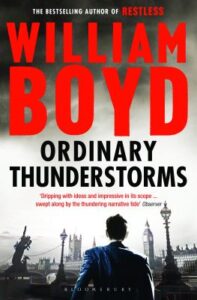
Incidentally, the same joke appears in William Boyd’s 2009 novel Ordinary Thunderstorms. An unsavoury character tells it to the book’s hero, who responds by tipping him over a bridge and dropping him into the River Thames, where he drowns. To be fair, the character had antagonized him a lot before that, so he wasn’t just reacting to the joke’s depravity.
© Bloomsbury
The third joke I heard in the early 1990s. I was sitting at the counter of an Edinburgh pub when a drunken guy beside me told it. It was a longer and more elaborate joke and featured Freddie Mercury, singer of the rock band Queen, who was famously gay and had died of AIDS a while earlier, and another famous showbusiness personage, also gay, who’s still with us in 2026.
Ooph, I thought, that’s really horrible. I hope I never hear a joke like that again.
Well, I have just encountered a joke like that again. In fact, it’s the same joke, though updated from the 1990s and now about the gay singer George Michael, who passed away in 2016, and his former partner Fadi Fawaz. According to the Daily Record newspaper last week, it was told by Malcolm Offord, leader of the far-right-wing Reform party’s branch in Scotland. In 2018, he included it in a speech he delivered at a Burns Supper held by a rugby club he was a director of. In the kerfuffle following the Daily Record’s report, Offord admitted telling the joke was ‘a mistake’ and denied being homophobic. “I don’t have any issue with homophobia,” he said. “I’ve got a lot of gay friends.”
Nigel Farage, Reform’s Britain-wide leader, has defended Offord, saying, “If we’re going to drum people out of public life for telling a joke at a boozy rugby club dinner that’s amongst friends, we’ll finish up with the dullest group of individuals, looking a bit like, sounding a bit like Keir Starmer.” Less forgiving was John Swinney, leader of the Scottish National Party and currently First Minister of Scotland – the post Offord aspires to take over following the Scottish parliamentary election this May. Swinney said of Offord, “He’s unfit to be leader of any political party, unfit to be a member of the Scottish Parliament with views and attitudes like that… I think we’ve got to be really careful as a country about where we are heading, and Reform have got no part to play in it if they represent views of intolerance, prejudice and hatred of that type.”
What are we to make of this? Should we regard Offord’s faux pas as regrettable, alcohol-fuelled ‘banter’, accept his apology and move on? And are we, as Farage suggests, in danger of becoming too puritanical, of scaring all the interesting people away from public office, of ending up with humourless dullards in power over us? Is society getting – oh God, here we go again – too woke?
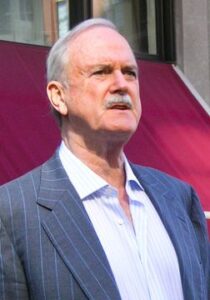
It calls to mind the lamentations of Monty Python (1969-74) and Fawlty Towers (1975-79) star John Clleese, who’s spent a good part of the last few years complaining that you can’t tell a good, impactful, close-to-the-bone joke anymore because folk get too offended: “I don’t think we should organize a society around the sensibilities of most easily upset people because then you have a very neurotic society.” Incidentally, the 86-year-old Cleese appears to have thrown in his lot with Rupert Lowe’s party Restore UK, an outfit even further to the right than Farage’s Reform.
From wikipedia.org / © Paul Boxley
Well, in my view, we’re never going to stop hearing sick, horrible and downright racist / misogynist / homophobic / transphobic / etc. jokes. For as long as the urge to be ‘edgy’ persists in the human psyche, such jokes will continue to be told in pubs and clubs, on sports terraces, in Internet forums, on WhatsApp and other messaging platforms, in countless situations where people interact. But anyone who thinks it’s a good idea to spout a joke of that sort in public – supposedly 200 people attended Offord’s Burns Supper – shouldn’t be presenting themselves as a politician qualified to take over the highest political office in Scotland. Especially when as holder of that office you’ll be representing, and making decisions that affect, the group of people your joke cruelly mocked.
Call me old-fashioned, but I prefer my political leaders to be dull – and serious, and sensible. I remember British Prime Ministers like Labour’s Jim Callaghan and the Conservatives’ John Major, both rather grey and uninteresting, but whom I felt a lot safer having in Number 10, Downing Street than, say, an alleged laugh-a-minute ‘personality’ like Boris Johnson. Between Callaghan and Major, of course, Britain was subjected to the 11-year reign of Margaret Thatcher, who had many qualities – mainly negative qualities, in my opinion – but being a barrel of laughs who told good jokes wasn’t one of them.
Offord must have thought he was on safe ground with his joke because he was at a well-lubricated rugby club event, not what you’d expect to be the most politically correct of gatherings. But according to the Daily Record, even his rugby-loving audience was unimpressed. One witness said, “I was sitting next to a gay man and it was clearly an extremely uncomfortable and unpleasant experience for him… At the time I thought it pretty awful and indeed that was the feeling in the room. Even for a rugby club it was a crude, bad taste and insulting spectacle… I don’t know who in their right mind would say something like that.”
Even some of the usual suspects in Scotland’s mostly right-wing, Unionist media have turned on Offord because of this. Scottish Times columnist Alex Massie penned a piece entitled Reform may already regret its choice of leader in Scotland, whilst Scottish journalist Stephen Daisley, who frequently writes for the very right-wing Spectator, messaged, “Malcolm Offord is single-handedly wrecking Reform’s chances in the Scottish parliament. Can the Holyrood campaign be salvaged?”
I haven’t heard any reaction yet from Chris Deerin, who’s somehow the Scotland editor at the supposedly left-leaning New Statesman. When Offord became Scottish Reform leader, Deerin tweeted, “Malcolm Offord is a seriously great get for Reform. Very smart, ambitious for Scotland, excellent communicator, properly Scottish, experience of government, hugely successful in business – working class boy made good. Ooft.” (‘Ooft’, of course, was my first thought when I heard that joke.) And in a couple of New Statesman articles Deerin penned about Offord, he talked breathlessly about the wealthy politician’s ‘gilded life’ and particularly admired his “vintage, open-top Jaguar sports car, Bond-esque in its sleek lines and growling power,” in which Offord “roared off into the countryside.”
Alas, despite everything, I don’t think Offord will be roaring off into the countryside, never to be seen or heard of again. There are too many people who’ll rally to his cause rather than reject it after this furore. That’s because they believe the line, fed to them endlessly by Britain’s right-wing media and pundits, that everything is too puritanically woke now, that you can’t crack a joke about gays or women or religious or ethnic minorities without the roof falling on your head, that you “can’t say those things nowadays”. The irony is that you can say those things nowadays, and totally get away with them, at least if you’re a British politician.
Nigel Farage has recently courted controversy over the personalized messages he’s sent as Cameo videos – one of several lucrative side-projects he has in addition to being Reform party leader and a Member of Parliament. A Guardian investigation found that the messages included ones “supporting a convicted rioter, repeating extremist slogans, and endorsing a neo-Nazi event” and where he “referenced antisemitic conspiracy theories, and made misogynistic remarks about leftwing politicians, including a comment about the US congresswoman Alexandria Ocasio-Cortez’s breasts.”
Previously, Farage was in hot water because of allegations made by over 30 people who’d known him during his schooldays. According to their accounts, the teenaged Farage was quite the dedicated follower of fascism – among other things, singing Hitler Youth songs and growling “Hitler was right” and “Gas them” at Jewish pupils. He’s variously responded to these allegations by calling them ‘fantasies’, saying he can’t remember saying such stuff or dismissing it as – there’s that word again – ‘banter’.
Not that this has dented Farage’s popularity much. His party is still leading in British opinion polls.

From wikipedia.org / © Roger Harris

From wikipedia.org / © Roger Harris
Elsewhere, Robert Jenrick, formerly the Conservatives’ Shadow Justice Secretary and now a defector to Reform, caused outrage last year when he said a 90-minute visit to the Handsworth part of Birmingham was “as close as I’ve come to a slum in this country” and one where he didn’t encounter “another white face“. And earlier this month, the Conservatives’ Nick Timothy, who’s inherited Jenrick’s role as Shadow Justice Secretary, described an open Iftar event in Trafalgar Square as “an act of domination… not welcome in our public places and shared institutions… straight from the Islamist playbook.” In previous years open Iftar events had been held in the square without anyone objecting, as had other religions’ celebrations such as Chanukah, Vaisakhi and Diwali. And it had also hosted Christian events like mass prayers and Good Friday passion plays.
Rather than discipline them, Conservative party leader Kemi Badenoch backed both Jenrick and Timothy. The latter case inspired the double-barreled, hard-right-wing rabble-rouser Stephen Yaxley-Lennon to crow on social media about how, just two years ago, a Conservative Member of Parliament making Timothy’s anti-Islamic comments would have been expelled from the party. But not in 2026.
Yes, call me old-fashioned… But I prefer the good old days when not only were British mainstream politicians grey and dull, but if they’d spouted anything blatantly racist, misogynistic, homophobic, or Islamophobic, they’d immediately have been out on their ear.