Films I’d like to see remade (Part 1)


From imdb.com / © Rank Organisation


I still find it disconcerting when films I enjoyed in my youth are remade in the 21st century: for example, 1980’s The Fog (remade in 2005), 1981’s The Evil Dead (remade in 2013) and Clash of the Titans (remade in 2010), 1986’s The Hitcher (remade in 2007), 1987’s Robocop (remade in 2014) and 1988’s Hairspray (remade in 2007).  My immediate and automatic response to such remakes is, “What, they’re remaking that movie already?  Have you no shame, Hollywood?”


This is followed by a feeling of horror as I realise just how long ago it was when those original movies were released.  The first Evil Dead movie was 32 years old – 32 years! – when its remake surfaced, though in my mind it was only yesterday when Sam Raimi’s Deadites made their first-ever appearance and started making life difficult for Bruce Campbell.   And actually, three of the films I remember most fondly from my youth, Philip Kaufman’s Invasion of the Body Snatchers (1978), John Carpenter’s The Thing (1982) and Brian De Palma’s Scarface (1983) were remakes themselves.  Body Snatchers appeared just 22 years after the 1956 original and The Thing appeared 32 years after its 1950 one.  Scarface was an outlier, since the first Scarface came out in 1932, more than a half-century earlier.


Maybe I shouldn’t be so concerned about how soon after the original movie that a remake appears.  I should be concerned about the quality of it – for remakes tend to be shite.  I haven’t seen all those mentioned at the beginning of this entry, but the ones I have seen have been nowhere near as good as the originals.  (The Evil Dead remake probably comes closest, but I still much prefer the ramshackle and low-budget, but resourceful, charm of Raimi’s 1981 film.)  That said, remakes don’t have to be bad all the time – the aforementioned ones by Kaufman, Carpenter and De Palma testify to that.


So, without further ado, here are some films – and one series of films – I wouldn’t mind seeing remade in the 21st century, with bigger budgets and better special effects.  But remade decently.
 

From wikipedia.org / © Rank Organisation


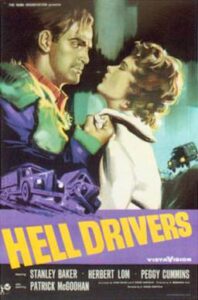
Hell Drivers (1957)

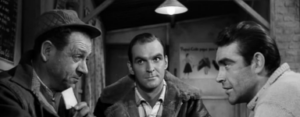
Blacklisted by the House Committee on Un-American Activities in 1951, American director Cy Endfield moved to Britain where, half-a-dozen years later, he made Hell Drivers.  Given the persecution Endfield had suffered, it unsurprisingly takes a dim view of American-style, cut-throat capitalism.  It has that underrated but magnificent actor Stanley Baker as an ex-con who finds a job as a truck driver with a dodgy haulage company, which threatens its drivers with the sack if they don’t deliver loads of gravel across treacherous roads at breakneck speeds.  The reason there aren’t more drivers employed to relieve the pressure, and reduce the danger, is because of a scam involving the local depot manager and its off-his-head Irish foreman (played by Patrick McGoohan like a brawnier version of Shane MacGowan).  The latter soon becomes Baker’s nemesis.


As well as a political message, Endfield injects Hell Drivers with an American-style grittiness rarely seen in British films of the period.  But what really makes the film a joy to watch nowadays is the cast.  As Kim Newman has written of it in Empire Magazine, “how many other movies have an ensemble which includes the original Dr Who (Hartnell), the first James Bond (Sean Connery), the Prisoner (McGoohan), a Man From UNCLE (David McCallum), a Professional (Gordon Jackson), Clouseau’s boss (Herbert Lom), plus Alfie Bass, the excellent Peggy Cummins (of the cult items Gun Crazy and Night of the Demon), the inimitably boozy Wilfrid Lawson, Jill Ireland and Sid James?”


In 2026, with capitalism more cut-throat than ever, a remake of Hell Drivers would be timely.  I don’t think, though, setting it in the wilds of Middlesex, West Sussex and Buckinghamshire, where the original was filmed, would work now, so it’d have to have its hard-pressed truck drivers pounding the roads of a less hospitable locale – the Alaskan tundra, say, or somewhere that retains some near-impenetrable tropical rainforest.


And to pay proper homage to the original, you’d definitely need a cast made up of actors who’ve played iconic roles in iconic TV shows or movie series.  You could have one of the grittier Bonds (Daniel Craig or Timothy Dalton), one of the grittier Doctors Who (Christopher Eccleston or Peter Capaldi), plus a Sherlock Holmes (Benedict Cumberbatch, maybe), a Harry Potter (Daniel Radcliffe), perhaps someone from the Breaking Bad universe (Bryan Cranston, say, or Bob Odenkirk)…  The possibilities are endless.


From wikipedia.org


The Margaret Rutherford Miss Marple movies (1961-64)

This is a little different.  I’d like to see the four movies made about Agatha Christie’s genteel sleuth of a certain age, Miss Marple, which had the delightful Margaret Rutherford in the leading role – Murder She Said (1961), Murder at the Gallop (1963), Murder Most Foul (1964) and Murder Ahoy! (1964) – rebooted as a TV show.  Not just another show about Miss Marple per se – there have been ones with Joan Hickson, Geraldine McEwan and Julia McKenzie – but one set in the universe of the four Rutherford movies.


Thus, its episodes would be set against the tableau of early-1960s England, with Miss Marple depicted as an obstinate, feisty old lady who refuses to know her place and keeps barging into and solving mysteries.  There’d be as much as humour as tension and the show would have the films’ supporting characters, like the timid librarian Mr Stringer (Rutherford’s real-life husband Stringer Davis), who reluctantly helps Miss Marple out, and the exasperated copper Inspector Craddock (Charles Tingwell), who begins each instalment telling her to mind her own business but ends it taking orders from her.  Meanwhile, Ron Goodwin’s jaunty Miss Marple Theme would burble in the background.


I suspect in a 2026 version Mark Gatiss would make a lovely Mr Stringer, while Daniel Mays would nicely fill the shoes of the long-suffering Inspector Craddock.  But who would play Miss Marple – or more precisely, play Margaret Rutherford playing Miss Marple?  Perhaps Dawn French, though she’d have to spend a long time in the make-up chair to recreate Rutherford’s famously jowly, hangdog features.


In the original movies, each murder that Rutherford / Marple investigated involved a British institution – a country manor, horse riding, the theatre and the Navy.  She’d duly rattle establishment cages by sticking her nose in where it wasn’t welcome.  So perhaps each episode of this hypothetical series would have her ruffling the feathers of other British institutions of the time – the Army, the House of Lords, Savile Row, Crufts, the country’s nascent rock ‘n’ roll industry…  Miss Marple meets the young Rolling Stones?  I’d pay good money to see that.
 

From wikipedia.org / © 20th Century Fox


Von Ryan’s Express (1965)

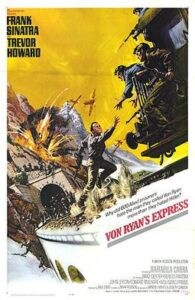
I never had much time for Frank Sinatra, neither as an entertainer nor as a person, but he left an impression on my 10-year-old self the first time I saw the ripping World War II yarn Von Ryan’s Express.  It’s the story of an American airman, Ryan (Sinatra), downed in Italy, who joins forces with some Allied prisoners of war, led by Trevor Howard.  They attempt an audacious escape into neutral Switzerland by seizing control of a train and steering it up a railway line into the Alps.  Much derring-do is involved as German troops and aircraft go all-out to stop them reaching their destination.


It’s great, crowd-pleasing stuff until the ending – spoilers are coming! – which is depicted on the movie poster, painted by the great Frank McCarthy.  The train has almost made it to safety.  Having fought a rearguard action against the Germans, Sinatra is running after the train and has almost caught up with it.  But then….  What happened next put a dampener on things.  But it also lodged the film in my mind forever.


With 2009’s Inglourious Basterds, Quentin Tarantino showed his love for rip-roaring if cheesily improbable World War II adventures, so perhaps he could helm a remake of Von Ryan’s Express?  To stick to the innocent, uncomplicated spirit of the original, though, he’d have to forgo his use of the F-word and N-word, and his fetish for close-ups of ladies’ feet, and his nerdish references to ‘film-study criticism of the work of German director G.W. Pabst’.
 

© Hammer Film Productions / Seven Arts Productions


Quatermass and the Pit (1967)

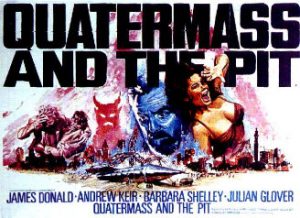
Hammer Films’ sci-fi horror film Quatermass and the Pit was based on the 1958 BBC TV serial of the same name.  Both film and serial were written by Nigel Kneale.  It begins with workers on a London Underground extension project digging up an alien spacecraft full of dead, horned, insect-like creatures that are identified by scientist-hero Professor Bernard Quatermass (Andrew Keir) as inhabitants of the now-lifeless planet Mars.  It transpired that millions of years ago, these sneaky Martians arrived on earth and did some evolutionary tinkering on the apes who were the ancestors of modern humanity.  This tinkering included implanting in the apes an urge to conduct occasional culls whereby those with pure Martian programming exterminated those who’d developed mutations and lost that programming.


When some TV news crews descend on the scene, a power surge from their camera-cables reactivates the spacecraft and it triggers a new cull.  London becomes an apocalyptic hellscape where the human inhabitants who retain their Martian conditioning roam around, zombie-like, and use newly awoken telekinetic powers to kill everyone who’s lost it.


I still find Quatermass and the Pit impressive today, and scary, though inevitably there are special effects that reflect the limitations of Hammer’s budget.  I’d relish the prospect of a modern, big-budget retelling of the story.


One thing that makes the film effective, and affecting, is Kneale’s portrayal of the scientists.  Unlike usual movie-scientists, they aren’t cold-blooded, delusional, self-serving or plain weird.  Instead, Quatermass and his colleagues, Dr Roney (James Donald) and Barbara Judd (Barbara Shelley), are portrayed as decent human beings, working with an eager curiosity, a sense of duty and a sense of humour.  Keir and Donald were both Scots, so maybe a modern movie could cast Brian Cox as Quatermass and James McAvoy as Dr Roney.  Actually, I think a third Scottish actor, Karen Gillan, would be excellent as Barbara Judd.


To be continued…


© Metro-Goldwyn-Mayer

The real Princess Diana


© ITV / ABC / Thames


2020 has been a rotten year and I suspect it still has more rottenness in store.  One of the many reasons why I’ve found it so godawful has been because it’s seen the deaths of two actresses who meant a lot to me, firstly because they both had leading roles in James Bond movies and I’m a big James Bond fan, and secondly because they both starred in one of my favourite TV shows, The Avengers (1961-69).  I’m talking, of course, about Honor Blackman, who died in April, and now Diana Rigg, who died last week.


I never got to see Diana Rigg perform on stage, where she appeared in plays by Edward Albee, Bertolt Brecht, Anton Chekov, Noel Coward, Henrik Ibsen, Molière, Jean Racine, George Bernard Shaw, Tom Stoppard, Tennessee Williams and, obviously, William Shakespeare.  Nor did I catch her when, after becoming a Dame in the mid-1990s and being recognised as a national treasure, she appeared in prestigious TV productions like Rebecca (1997) or Victoria & Albert (2001), both of which resulted in her winning or being nominated for Emmy Awards.  I was living abroad and didn’t have access to English-language TV at the time.


I didn’t even watch her much-praised performance as Olenna Tyrell in the TV show Game of Thrones from 2013 to 2017, since I thought I should first read the George R.R. Martin books on which the show was based – something I’ve yet to get around to doing.


Despite what I’ve missed, however, I offer here a collection of Diana Rigg performances that I have seen and remember fondly.


Playing Tracy di Vincenzo in On Her Majesty’s Secret Service (1969)

On Her Majesty’s Secret Service is ostensibly about James Bond (George Lazenby in his one-and-only shot at the role) tangling with his arch-enemy Ernst Stavros Blofeld (Telly Savalas).  However, it also explores Bond’s emotional side and highlights his vulnerability.  Key to this is OHMSS’s sub-plot about the romance between Bond and Contessa Theresa ‘Tracy’ di Vicenzo (Rigg), daughter of the boss of the crime syndicate the Unione Corse of Corsica.  At the film’s end, Blofeld is seemingly vanquished and Bond and Tracy get married.  Then Blofeld makes a sudden reappearance in the final scene, sprays their honeymoon car with bullets, kills Tracy and leaves Bond as a babbling wreck.


Fascinatingly, for a film franchise that’s often accused of de-humanising the Ian Fleming novels that inspired it and emphasising big, dumb spectacle at the expense of characterisation, Tracy is a more fleshed-out character in OHMSS-the film than in OHMSS-the-novel.  She’s given more to do and, played by Rigg, has a sparkle that’s missing in the rather aloof, ambiguous character that Fleming sketches.


© Eon Productions


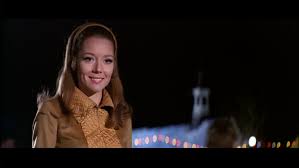
Particularly memorable is her appearance after Bond escapes from Blofeld’s Alpine headquarters.  Hunted by Blofeld’s henchmen, exhausted, frightened even – something that Lazenby, despite or perhaps because of his acting inexperience, conveys well – he takes refuge in a crowded Christmas market / ice rink in the local town.  Just as he thinks he not going to make it, Rigg comes to his rescue, unexpectedly skating into view in front of him like some heaven-sent angel of mercy.


Playing Sonya Winter in The Assassination Bureau (1969)

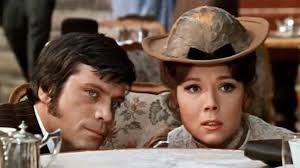
On Her Majesty’s Secret Service wasn’t the only instance in 1969 of Diana Rigg rubbing shoulders with Telly Savalas.  In Basil Deardon’s black comedy The Assassination Bureau (based on an unfinished Jack London novel), she plays an aspiring female journalist in Edwardian London sent by Savalas’s unscrupulous newspaper proprietor to investigate a secret criminal organisation offering assassins for hire.  Armed with a bagful of money that Savalas has provided, Rigg brazenly hires this Assassination Bureau to assassinate its own chairman, Ivan Dragomiloff, who’s played by Oliver Reed.  Admiring Rigg’s audacity, Reed accepts the commission and, with her in tow, spends the movie zigzagging around Europe dodging the efforts of his own board of directors to kill him.


It’s a pleasantly silly film and, admirably, doesn’t waste any time in setting up its convoluted premise and getting into the action.  Rigg is delightful as the uppity Sonya Winter, determinedly doing her job and flying the flag for women’s rights amid a world of starchy, patronising male chauvinists.  Meanwhile, Reed had only just played the brutish Bill Sikes in Oliver! (1968) and at the time was in contention to play James Bond, although his reputation for drunken offscreen hi-jinks put 007 producers Cubby Broccoli and Harry Saltzman off the idea.  His pairing with Rigg in The Assassination Bureau is no beauty-and-the-beast affair, however.  He dials down the roughness and dials up the charm so that their chemistry together is actually very pleasing.


© Paramount Pictures


Playing Edwina Lionheart in Theatre of Blood (1973)

Douglas Hickox’s brilliant comedy-horror movie Theatre of Blood has Vincent Price as an insane and hammily over-the-top Shakespearean actor who starts killing the snobbish London theatre critics who’ve bad-mouthed his performances, using murders methods borrowed from the Bard’s plays.  “They’re not going to start killing critics for giving bad notices, are they?” exclaims the campest critic Meredith Merridew, played by Robert Morley, who eventually meets a grisly fate modelled on events in Titus Andronicus.  As the corpses pile up, murdered in ways suggested by Julius Caesar, Troilus and Cressida, Cymbeline, Richard III, Henry VI: Part One and even The Merchant of Venice (Price rewrites it so that he can extract a pound of flesh from Harry Andrews), the youngest and least obnoxious critic, played by Ian Hendry, and the investigating police officers, played by Milo O’Shea and Eric Sykes, turn to Lionheart’s supposedly normal daughter, Edwina (Rigg), for help.


Distraught about what her father is doing, yet repulsed by the critics who destroyed his career, Edwina is initially a troubled and conflicted character.  Yet as the film progresses, it transpires that Rigg is having as much fun in her role as the Bard-quoting, soliloquizing Price is in his.


Taking the mickey out of herself in The Morecambe and Wise Show (1975), The Great Muppet Caper (1981) and Extras (2006)

Rigg never took herself too seriously.  She teamed up with Britain’s most famous comic double-act Morecambe and Wise for their 1975 Christmas TV special, where she appeared in the inevitable Ernie Wise-penned play.  This featured Rigg as Nell Gwynne, Eric Morecambe as Charles II and Wise as Samuel Pepys.  (“Have you read Ernie’s play?” demands Morecambe.  “Yes, I have,” replies Rigg.  “And you’re still here?”)  Better still is her appearance in The Great Muppet Caper, the second movie starring Jim Henson’s much-loved puppets, in which she plays the snooty fashion designer Lady Holiday, who’s robbed of her jewellery by a gang led by her devious brother (Charles Grodin).  Predictably, Miss Piggy approaches Rigg in the hope of securing a job as a fashion model and insists on showing Rigg her portfolio: “This is me reeking grandeur!”


And then there’s a 2006 episode of Ricky Gervais and Stephen Merchant’s comedy show Extras, which is about a struggling actor (Gervais) trying to make ends meet with bit-parts and uncredited roles in films and on television.  This scenario enables the show’s gimmick of having real, famous actors and actresses play versions of themselves – usually twisted, unpleasant versions.  In this particular episode, Gervais gets a three-day job in a new fantasy film starring the then-17-year-old Daniel Radcliffe and Dame Diana Rigg.  The joke is that Radcliffe is a randy, boorish and clueless teenager.  Whilst eating with him in the studio canteen, Radcliffe tries to convince Gervais that he’s a man of the world by whipping a condom out of his pocket – he’s unravelled it but seems to think he can still put it on – and then accidentally pings it through the air to a nearby table, where it lands on the unamused Rigg’s head.  Radcliffe asks her for his ‘johnny back’ and gets a schoolmistress-ly reply: “May I have my prophylactic back, please?”


Later, Radcliffe sidles up to her and inquires, “You still got that catsuit from The Avengers?”  Rigg retorts: “Go away, Daniel.”


© BBC / HBO


And that brings me nicely to…


Playing Emma Peel in The Avengers (1965-67)

By the time Rigg joined The Avengers in the mid-1960s, the show, under the guidance of creator Brian Clemens, had gradually mutated from being a conventional action / thriller show with Patrick Macnee’s John Steed and Ian Hendry’s Dr David Keel as a pair of crime-fighters to being a television phenomenon that did everything on its own terms, both determinedly non-realistic and restlessly inventive.


Rigg’s tenure on The Avengers was surely its golden era.  With her Emma Peel character partnering Macnee’s now surreally debonair Steed, and the show being broadcast in colour for the first time, it was a self-confident cocktail of the funny, the silly, the fantastical, the baroque and, occasionally, the gothic and the kinky.  (The kinkiness factor came to the fore in an episode called A Touch of Brimstone, wherein Rigg dons a costume comprising a spiked collar, whalebone corset, black leather boots and a snake.  Funnily enough, this attracted the highest viewing figures of any episode in The Avengers’ eight-year history.)


Rigg brought to the show a bemused, unruffled quirkiness that was the equal of Macnee’s majestic imperturbability.  She was also his equal in being proactive, having no qualms about wading into fights to show off her martial arts prowess or hurtling around in a Lotus Elan.  As a villain in one episode remarked, “She’s well and truly emancipated, is that one.”


Rigg wasn’t comfortable about the fact, but Emma Peel also became a sex symbol.  She couldn’t well avoid it, being ephemerally gorgeous and clad in a succession of leather catsuits, mini-skirts and mod-inspired outfits that, inevitably, ended up being sold in the ladies’ fashion shops of the real Britain.  Wisely, though, sex was off the agenda in her character’s onscreen relationship with Macnee’s Steed.  The two indulged in a relaxed, platonic flirtatiousness and left it at that.  Macnee did get a kiss from her at the end of her final episode on the show, when she left him with the parting advice: “Always keep your bowler on in times of stress, and watch out for diabolical masterminds.”


Appearing at the height of the swinging 1960s, but tongue-in-cheek and light-hearted rather than smug, which is how I find many productions from the time, The Avengers, and especially the Emma Peel-era Avengers, projects a charming and not-taking-itself-seriously notion of Britishness that seems light-years removed from the discredited, embittered, clapped-out Britain of 2020.  The death of Diana Rigg, who’d been one of the last links with the show, just seems to emphasise that it’s now all in the past.


© ITV / ABC / Thames