The missiles are flying… Hallelujah! Hallelujah!


© Paramount Pictures / Dino De Laurentiis Company


With Donald Trump enacting his latest insanity – joining forces with Israel and bombing the bejeezus out of Iran, which has prompted the latter country to retaliate by firing ordinance in all directions and lighting up the Middle East like a Christmas tree – I find myself thinking of Greg Stillson, a character featuring prominently in Stephen King’s novel The Dead Zone (1979).  In the David Cronenberg-directed movie version of The Dead Zone (1983), Stillson is played by Martin Sheen.  It’s Sheen, as Stillson, who utters the quote that’s this blog-entry’s title.


Stillson is a psychotic bully who begins as a salesman, becomes a businessman and then a politician, and finally leads a populist movement that sweeps him into the White House.  Well, he does in one timeline.  Before winning the presidency, while he’s on the campaign trail, he shakes hands with The Dead Zone’s hero, Johnny Smith, who’s been blessed – or cursed – with the power to see into people’s futures just by touching them.  He has a vision of Stillson’s future wherein, as a despotic and unhinged US president, he presses the buttons that trigger an apocalyptic nuclear war.  Thereafter, Smith has to decide how he’s going to stop him.  (Spoiler – he does, but with tragic consequences for himself.)


I don’t know if anyone with clairvoyant visions touched one of Trump’s little hands a couple of decades ago and witnessed him pressing buttons and wiping out humanity in 2026, the 250th anniversary of American independence.  But it wouldn’t surprise me if someone had.


Anyway, it doesn’t need saying, but Trump’s actions – which began on February 27th, when in conjunction with the Israelis and under the moniker ‘Operation Epic Fury’, he had his military bombard Iran with missiles and drones; one source estimating on March 4th that nearly 900 people had been killed so far, including Iran’s Supreme Leader Ayatollah Ali Khamenei – are a vastly bad idea for many reasons.  Here are some of those reasons.


From wikipedia.org / farsi.khamenei.ir


One.  The attack is illegal under international law.  In the Conversation, Shannon Brincat and Juan Zahir Naranjo Caceres have written that “Israel said the strikes were ‘preventative’, meaning they were to prevent Iran from developing a capacity to be a threat.”  However, they point out that “preventative war has no legal basis under international law. The UN Security Council did not authorize any military action, meaning the sole lawful pathway for the use of force for self-defence was never pursued.”


Two.  The attack went against the American constitution.  The American historian Heather Cox Richardson has noted on her Substack: “In his letter to Congress notifying them of his attack, Trump said he had acted under the 1973 War Powers Act, which permits a president to attack another country if there is an urgent threat.  But the letter itself doesn’t identify any such urgent threat.  It simply said Iran is one of the world’s largest sponsors of state terrorism and that it ‘continues to seek the means to possess and employ nuclear weapons’…  The Framers of the Constitution placed the power to declare war in the hands of Congress and not in the president above all because they did not trust that much power in the hands of one man…”


Three.  It’s likely Benjamin Netanyahu bounced the USA into the attack.  Going back to Reason One, the supposedly ‘preventative’ nature of the USA and Israel’s assault on Iran is torturous to say the least.  A few days ago, US Secretary of State Marco Rubio said, “It was abundantly clear that if Iran came under attack by anyone – the United States or Israel or anyone – they were going to respond, and respond against the United States…  We knew that there was going to be an Israeli action. We knew that that would precipitate an attack against American forces, and we knew that if we didn’t pre-emptively go after them before they launched those attacks, we would suffer higher casualties.”


In other words..  We had to attack them before they attacked us, which they would surely do because Israel intended to attack them first.  This means the USA’s vast military firepower isn’t actually under the control of the American commander-in-chief, but under that of Israeli Prime Minister Benjamin Netanyahu.  The wily Netanyahu says ‘Jump’, the Americans say ‘How high?’


Four.  Dodgy Middle Eastern deals are possibly involved.  Who else, besides Netanyahu, has a finger in the pie here?  In 2025 Trump did investment deals with Saudi Arabia, Qatar and the United Arab Emirates, which he claimed were worth over two trillion dollars.  Qatar saw fit to gift – some would use the verb ‘bribe’ – Trump with a 400-million-dollar Boeing jumbo jet that he plans to turn into a new Air Force One, making one wonder how much of these investments will be enriching Trump and his clan rather than the USA itself.  Also, Trump’s son-in-law Jared Kushner and Steve Witkoff – the real-estate developer whom, laughably, Trump sent into negotiations with Russia about the Ukraine War even though he had zero diplomatic experience – have been in the Middle East lately as ‘envoys’, hawking the idea that the decimated Gaza should be reinvented as a luxury resort with ‘180 skyscrapers’ (and any remaining Palestinians, presumably, doing jobs like cleaning the toilets).


In the future, if a saner administration ever comes to power in Washington DC and launches an investigation into this debacle, it’d be wise to ‘follow the money’.  I’ll bet at least some of the encouragement for this war came from business interests and wealthy leaders in the Middle East who regarded the Iranian regime as an undesirable neighbour, lowering the tone and property value of the area, and wanted it removed.


Five.  It’s actually Operation Forget Epstein.  Trump likes to distract.  When the headlines look bad for him, he does something outrageous that generates different headlines – not necessarily favourable ones, but enough to banish the previous, bad headlines from people’s memories.  This works especially well in our screen-obsessed, social-media-fixated era where attention-spans are short.


On February 25th, the New York Times published a report under the headline EPSTEIN FILES ARE MISSING RECORDS ABOUT WOMAN WHO MADE CLAIMS AGAINST TRUMP.  This mentioned documents “released by the Justice Department” that “briefly mention a woman’s unverified accusation that Donald J. Trump assaulted her in the 1980s, when she was a minor.”  Yet other documents relating to these allegations have been withheld or removed from the public database about Trump’s paedophilic, sex-trafficking old buddy Jeffrey Epstein.


And two days later, the assault began on Iran.  Funny, that.


From wikipedia.org / © Jesse Monford


Six.  There’s no plan and no objectives.  The George Bush Jr-led invasion of Iraq in 2003, which toppled Saddam Hussein but created massive instability and led to huge numbers of fatalities – estimates of which range “from 151,000 violent deaths as of June 2006 (per the Iraq Family Health Survey) to 1,033,000 excess deaths (per the 2007 Opinion Research Business [ORB] Survey)” – was a ruinous fiasco. It was also built on the lie that Saddam possessed ‘Weapons of Mass Destruction’.  But compared to Trump’s Iran incursion, it looks like a masterpiece of planning.


For one thing, to have a plan, you actually need to have objectives, i.e., things to plan towards. Trump and his cabinet apparently have no idea what the goal of all this is.  Rubio, as we’ve seen, has said they’re waging war simply because that’s what the Israelis are doing.  Meanwhile, Trump has suggested at one point it’s to achieve regime-change in Iran and replace Khamenei with someone more compliant to US interests, as was allegedly done in Venezuela after the abduction of its former president, Nicolas Maduro.  Though the other day Trump admitted there was a problem with this because his airstrikes had killed all the possible candidates to take over: “…none of the people we had in mind are going to come to power, because they are all dead.”  No, so far, that doesn’t sound like a brilliantly executed plan.


Trump has also claimed the war is to prevent Iran developing nuclear weapons, even though after the USA carried out a bombing raid on Iran in June last year he was adamant that “Iran’s key nuclear enrichment facilities have been completely and totally obliterated.” Trump has tried to justify this new war by saying Iran was – here plucking a figure out of his arse – ‘two weeks’ away from acquiring a nuclear weapon.


Elsewhere, it’s been suggested the war is to encourage the Iranian people to rise up and overthrow the regime that’s oppressed and abused them for 47 years; to stop Iran sponsoring terrorism; and to destroy Iran’s navy.  But most likely it’s because Trump woke up the other morning, looked out of the window and thought, “Gee, this would be a good day to bomb Iran back to the Stone Age.”


Seven.  This sort of thing has been tried before.  Vietnam…  Afghanistan…  Iraq…  Libya.


Eight.  Possible destabilization of the Middle East.  Even if by some fluke Iran ends up with a Trump-and-Netanyahu-approved government, it’s difficult to see how it can impose order on a country so diverse and, after all this devastation and upheaval, febrile.  Iran’s population is 61 percent Persian, 16 percent Azerbaijani and 10 percent Kurdish, and the rest of it includes people like Lurs, Arabs, Baloch, Arabs and Turkish groups.  While it’s overwhelmingly Shia Muslim, 9 percent of the population are Sunni and other sects of Muslim and there are also Baha’i, Christians, Zoroastrians, Jews and Sabean Mandeans.  That’s before we get to political differences.  Has anyone in Washington DC considered this?  I doubt it.


Civil war in Iran could have devastating consequences for the Middle East.  We’ve already seen the current conflict’s knock-on effects on the world’s oil supply, especially the disruption of tanker-traffic in the Strait of Hormuz, and on air travel, with more than 20,000 flights grounded and a million people stranded around the world since late February.  The Middle East going J.G. Ballard is not good news for anyone.  Well, apart from Vladimir Putin, who’ll see an increase in demand for Russian oil.


Nine.  China may be thinking, “Hold my beer!”  Trump’s rhetoric about attacking Iran sounds uncomfortably like Putin’s excuse for invading Ukraine in 2022 – his goal was to ‘demilitarise’ and ‘denazify’ the country.  I also suspect China is watching keenly and wondering how it could cook up a similar motive for taking over Taiwan in the future.


Incidentally, Taiwan is the world’s foremost producer of Artificial Intelligence chips and according to the New York Times, without those chips, “the tech industry and the US economy would be crippled.”  Haven’t thought that one through either, have you, Donald?


From pixabay.com / © clecaux

Jim Mountfield downloads the app


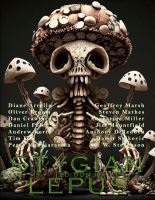
© The Stygian Lepus


The first part of my science-fictional horror story Appopolis Now has recently been published in Edition 30 of the Stygian Lepus, a magazine where, to quote the current blurb on its website, “the shadows don’t fall – they think, watching you from the edges of perception.”  As with all my stories that are dark and fantastical in tone, the story is attributed to the penname Jim Mountfield.


Appopolis Now is set in the future and imagines a society that’s slightly more high-tech than the one we will live in at the moment.  It’s also a society that’s…  Well, perhaps not dystopian, but definitely Cronenbergian.  (Wow, I have just typed ‘Cronenbergian’ and the Spelling & Grammar checker hasn’t put a red line under it.  That must mean it’s a recognised English adjective now, like ‘Orwellian’, ‘Kafkaesque’ and ‘Ballardian’.)  If you’re familiar with the works of Canadian filmmaker David Cronenberg, that should give you some idea about what to expect.


Edition 30 of the Stygian Lepus contains 14 pieces of macabre, disturbing and unorthodox short fiction and, for the next month, can be accessed here.

The alternative Christmas movie list


© Pan-Canadian Film Distributors


The cinema at Singapore’s ArtScience Museum is currently showing a season of Christmas-themed films so a few days ago my partner and I visited it to catch a showing of John McTiernan’s action classic Die Hard (1987).  My partner hadn’t seen it before and I’d only seen it on a small screen back in the prehistoric days of Betamax video cassettes.


I know every festive season an argument erupts on social media about whether Die Hard is or isn’t a Christmas movie, but seeing it again in 2022 I have to say it seems very Christmassy, much more than I remembered.  It’s got Christmas trees, Christmas decorations, Christmas presents, Christmas carols and Christmas Santa hats – one gets planted cheekily on the corpse of a dead terrorist which Bruce Willis’s John McClane sends down in a lift to taunt the remaining bad guys.  There’s also a limousine stereo playing Run DMC’s Christmas in Hollis (1987) – ”Don’t you have any Christmas music?” McClane grumbles from the back seat.  And Die Hard has Alan Rickman as the villainous and sublimely withering Hans Gruber, who’s a sort of anti-Santa Claus.  Gruber’s intonation is priceless as he reads the message McClane has written in blood on the dead terrorist’s chest: “Now I have a machine gun.  Ho… ho… ho.”


From amazon.com / © 20th Century Fox


However, I tend not to be aficionado of Christmas movies, for two reasons.  Firstly, the way that Christmas is presented in these movies has never corresponded to Christmas as I know it.  For example, as a kid, when I heard Bing Crosby crooning White Christmas in the 1954 film of the same name and then looked out of my window in Scotland at the late-December weather, what I saw wasn’t Bing’s white, fluffy snow-scape.   What I saw was usually a charcoal-grey sky, leaking charcoal-grey rain down onto a charcoal-grey terrain.


Secondly, Christmas movies are, nearly without exception, rubbish.  Most of them eschew anything resembling quality and dial the schmaltz and saccharine up to 11 and assume that’ll satisfy audiences instead – which unfortunately, in many cases, it does.  The biggest offender in my opinion is Richard Curtis’s Love, Actually (2003), which I prefer to think of as Shite, Actually.  That thing wouldn’t have got anywhere near being a good film even if they’d rewritten the Alan Rickman character and allowed him to start killing people.


Still, there’s a small handful of what are officially deemed ‘Christmas movies’ that I like.  Die Hard is one and others include The Snowman (1982), Gremlins (1986), The Nightmare Before Christmas (1993), Rare Exports (2010) and The Muppet Christmas Carol (1992) – any film that has Gonzo the Great playing Charles Dickens is fine by me.


There’s also a number of movies that aren’t officially counted as Christmas movies, even though they take place during the festive season, that I like too.  No doubt they aren’t included in the accepted Christmas canon because they’re dark in tone and don’t conform to the Richard Curtis Law of Christmas-Movie Pap and Sentimentality.  Anyway, it’s in honour of those non-conforming films that I offer the following – my list of favourite alternative Christmas movies.


© Embassy International Pictures / Universal Pictures


Brazil (1985)

Terry Gilliam’s take on George Orwell’s 1984 (1949) has so much going on thematically and visually that it’s easy to forget it’s set at Christmas-time.  But while we try to get our heads around the workings of the dystopian society depicted in Brazil – where labyrinthine bureaucratic systems and labyrinthine plumbing systems go wrong with equal regularity, one with deadly results and the other with disgustingly gloopy ones – we’re assailed by Yuletide trappings: Christmas parties, presents, trees, music.  There’s a family reading Dickens’ A Christmas Carol (1843) – just before a terrifying squad of secret-police goons come crashing into their home, wrongly sent by a bureaucratic mistake involving a fly getting stuck inside a typewriter.  There are Christmas-decorated department stores that become hellholes – even more hellish than normal at this time of year – when terrorist bombs explode.


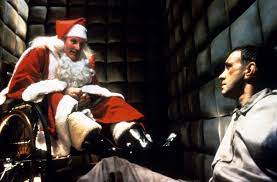
On a more symbolic level, the fate that befalls Robert DeNiro’s Harry Tuttle character – surreally engulfed in a mass of paper – suggests the horror of frantic, last-minute Christmas present-wrapping, when you begin to fear the unruly, recalcitrant paper is going to swallow you up.  And, late on, when Brazil’s everyman hero Sam (Jonathan Pryce) is imprisoned and facing torture, he gets a visit from Helpmann (Peter Vaughan), a senior official in the Ministry of Information, who ironically shows up wearing a Santa Claus outfit.  This underlines the fact that, like many an authoritarian, Helpmann believes he’s being benevolent towards his subjects, though in reality he’s anything but.


© Cinema Entertainment Enterprises


Rabid (1977)

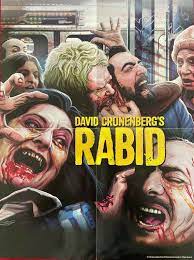
As you might expect, Christmas with Canadian director David Cronenberg is not exactly cosy.  Set during the festive season in and around Montreal, Cronenberg’s Rabid tells the tale of a woman (Marilyn Chambers) developing a weird, parasitic skin-puncturing / blood-draining orifice under her armpit following some experimental surgery.  She soon becomes a plague-spreader – her new body part infecting people who turn into ravening, blood-craving monsters.  One negative thing I always felt about Christmas was the sense of confinement – being stuck indoors because the weather was foul and because there was nothing to do outside anyway due to everything being closed.  Rabid conveys a similar feeling by showing Montreal under martial law, its wintry streets silent save for the trucks prowling around removing corpses from the sidewalks.  Though a more obvious Christmassy moment is when carnage erupts in a shopping mall and the cops unwittingly gun down the store Santa Claus.


The Silent Partner (1978)

You have to hand it to those Canadians – back in the 1970s, at least, they knew how to stage a dark Christmas movie.  Daryl Duke’s The Silent Partner (1978) is an excellent thriller, often amusing but with a few moments of nasty violence to keep the audience on edge.  Its villain is the psychotic but intelligent criminal Harry Reikle (Christopher Plummer).  Reikle becomes a formidable opponent for – and, as the film progresses, the title’s sinister ‘silent partner’ to – the film’s hero, Miles Cullen (Elliot Gould), a mild-mannered teller working in the Toronto bank that Reikle decides to rob.  As it’s Christmas time, and the shopping mall where the bank’s located is overflowing with festive cheer, Reikle carries out the crime disguised as a mall Santa Claus.  However, he meets his match in Miles.  After Reikle botches the robbery, Miles uses it as an opportunity to fill his own pockets with the supposedly ‘stolen’ money.  Reikle is predictably disgruntled by this and a game of cat-and-mouse ensues between them.


The Silent Partner later moves its action to a different time of year, but not before we see Miles at that traditional festive fixture, the staff Christmas party, where he has to listen to his weary, cynical workmates speculating longingly about what they’d do with the stolen money if they had it.  His colleagues include a very young John Candy, sporting an alarming 1970s side-parted hairdo.


© Hammer Films / British Lion Films


Cash on Demand (1961)

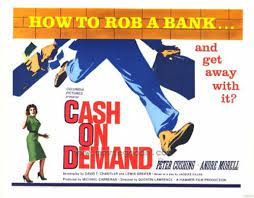
While we’re on the subject of movies about bank workers finding themselves in unhappy alliances with bank robbers, let’s mention the superlative Hammer Films B-movie Cash on Demand, directed by Quentin Lawrence, with Peter Cushing – better known for appearing in the studio’s horror films – as a snotty, uptight bank manager called Fordyce, who’s forced to help a criminal, Hepburn (Andre Morell), intent on robbing his bank.  Unlike The Silent Partner, Cash on Demand doesn’t show any violence but a lot of nastiness is implied, with Hepburn matter-of-factly informing Fordyce that he’s kidnapped his family and is going to start torturing them with electrical shocks if he doesn’t cooperate.


And, like The Silent Partner, the attempted robbery in Cash on Demand takes place during Christmas, with a Salvation Army band playing carols outside Fordyce’s bank.  Indeed, there’s a Scrooge / Christmas Carol subtext to the plot.  Fordyce begins the film as an insufferable prick, contemptuous of his workers, who are more interested in their upcoming Christmas do than the day’s toil at their desks.  However, by the ordeal’s end – and after his staff have come to his rescue – Fordyce is a much more appreciative soul, not just of his family but of the people who work for him.


© Amicus Productions / Metromedia Producers Corporation


Tales from the Crypt (1972)

Cushing also appears in the cast of the British horror anthology movie Tales from the Crypt, along with such notables as Sir Ralph Richardson, Ian Hendry and Patrick Magee.  Its first episode, All through the House, has the future Alexis Colby and all-round super-diva Joan Collins murdering her wealthy husband on Christmas Eve.  Just before she can make the murder – bashing his head in with a poker while he was reading a newspaper, smoking a cigar and wearing a Santa hat – look like an accident – falling down the cellar stairs – fate intervenes in the form of an escaped homicidal maniac who’s prowling outside and is dressed as Santa Claus.  We spend the story waiting to hear why he’s dressed as Santa Claus, but we never do – he just is.  In the climactic scene, Ms Collins gets her just desserts by being strangled by the maniac.  Actually, it looks like he’s just giving her a shoulder massage, but it’s still good, grisly, Yuletide fun.


© Rizzoli Film / Seda Spettacoll / Cineriz


Deep Red (1976)

Dario Argento’s ultra-stylish giallo movie Deep Red (Italian title Profondo Rosso) has David Hemmings investigating a string of gruesome murders around Turin.  It’s only tenuously a Christmas movie – the opening scene involves a child witnessing a murder next to a Christmas tree – but generally, in its dark way, the film feels Christmasy.  It’s due in part to the richness of Argento’s visuals and in part to the Christmas-like music by Argento’s frequent collaborators, German progressive-rock band Goblin, which alternates between a baroque organ-driven theme and a plaintive child’s refrain.  Meanwhile, the cackling clockwork puppet that makes a brief but unforgettable appearance is the sort of Christmas present you’d give to a child you really don’t like.


The Proposition (2005)

What does this Nick Cave-scripted, John Hillcoat-directed Australian western have to do with Christmas?  Well, the movie’s finale is a masterpiece of festive-season irony.  It has a beleaguered police captain and his wife, played by Ray Winstone and Emily Watson, prepare for their Christmas dinner – turkey, sprouts, pudding et al – with civilised English decorum in the midst of the festering, dusty, fly-ridden hellhole that was the 1880s Australian Outback.  There’s also a gang of vengeful, blood-crazed bushrangers on their way intending to kill Winstone and rape Watson, even while Winstone and Watson arrange the Christmas cutlery and crackers on their dining table.


Australians I know have described the weirdness of trying to celebrate a European-style Christmas against the backdrop of Australia’s sweltering December climate, and Cave’s script taps into that weirdness.  The Proposition is, incidentally, one of the mankiest films I’ve seen, with the grime-encrusted, matted-haired characters on view paying absolutely no attention to their personal hygiene.  The best thing Santa Claus could do for this lot is leave a few bottles of shampoo and conditioner in their stockings.


© UK Film Council / Sony Pictures Releasing


The Proposition would make a great Australian double-bill with my favourite Christmas movie of all time, which is…  Drum-roll…


Wake in Fright (1973)

One of the films that helped kick-start what is now known as Australia’s cinematic New Wave, Ted Kotcheff’s Wake in Fright is a reworking of William Golding’s Lord of the Flies (1954) – with a schoolteacher called John Grant (Gary Bond), not some schoolchildren, stranded in an isolated, primitive environment where the onion-skins of civilisation are gradually peeled off him and he descends into savagery.  The twist is that Grant isn’t stuck on a desert island but in a hellish Australian Outback town called Bundanyabba, where he’s foolishly gambled away the money he was using to travel home to Sydney.  And the brutish behaviour of Bundanyabba’s locals that infects him and drags him down isn’t, it’s implied, any different from that in any other Australian Outback town.


Famous for its scenes of squalor, drunkenness, brawling, vandalism, vomit, sweat-stains, flies, animal-slaughter and Donald Pleasence going bananas, Wake in Fright still qualifies as a Christmas movie.  Grant is trying to get back to Sydney for the Christmas vacation and events in Bundanyabba take place against a festive background of Christmas trees, decorations and carols.  Meanwhile, a scene near the end where a stained and begrimed Grant wakes up on a floor, haunted by memories from the night before of drinking about a hundred pints, gunning down about two dozen kangaroos, wrecking a pub, and shagging Donald Pleasance, will strike a chord with anyone who’s woken up in a similar state, with similarly traumatic memories, the morning after the work Christmas party.


© NLT Productions / Group W Films / United Artists


Merry Christmas!