Cinematically stoned (Part 2)


© Taplin-Perry-Scorsese Productions / Warner Bros


I ended my previous post by promising I’d give a list of my favourite movie scenes wherein songs by the Rolling Stones are employed to memorable effect.  Here it is.


Jumpin’ Jack Flash (1968) in Mean Streets (1973)

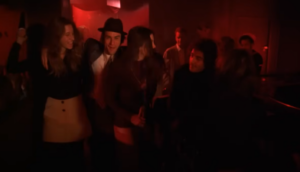
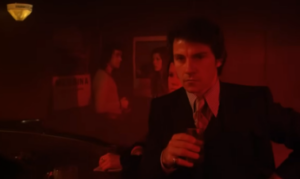
Wow.  Martin Scorsese really likes the Rolling Stones.  Not only has he made a concert movie about them, 2008’s Shine a Light, but he’s used their music in umpteen films: Goodfellas (1990), Casino (1995), The Departed (2006) and the one that first put him on the map, 1973’s Mean Streets.  Even today, more than 50 years later, the scene in Mean Streets where a young Robert De Niro comes swaggering through a bar, in slow motion, towards a pensive Harvey Keitel, while Mick Jagger hollers in the background about being “born in a cross-fire hurricane”, is a great synthesis of rock ‘n’ roll music and rock ‘n’ roll cinema.  Indeed, Jumpin’ Jack Flash is a fitting accompaniment for the arrival in popular consciousness of De Niro, who’d spend the rest of the 20th century showing Hollywood how to do proper acting.  The 21st century, featuring such efforts as The Adventures of Rocky and Bullwinkle (2000), Little Fockers (2010), New Year’s Eve (2011) and Dirty Grandpa (2016)…  Okay, not so much.


Satisfaction (1965) in Apocalypse Now (1979)

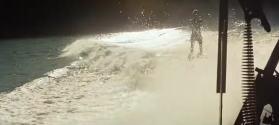
The Stones’ early, primordial and still potent stomper Satisfaction gets a brief but memorable airing in Francis Ford Coppola’s baroque Vietnam War masterpiece, playing on the radio while Captain Martin Sheen and his not-exactly-fighting-fit crew go cruising up the Nùng River in search of Marlon Brando.  Cue some funky on-deck dance moves by a frighteningly young-looking Laurence Fishburne and some funny / cringeworthy water-skiing moves by Sam Bottoms that knock various Vietnamese people out of their fishing boats.
 

© Omni Zoetrope / United Artists


Sympathy for the Devil (1968) in Alien Nation (1988) and in Interview with the Vampire (1994)

Graham Baker’s sci-fi / cop movie Alien Nation isn’t very good.  Its premise of an alien community getting stranded on earth and having to integrate as best as they can with the curmudgeonly human natives was handled much better in Neill Blomkamp’s District 9 (2009).  But I do like a woozy, hypnotic scene in it where alien-loathing cop James Caan enters a sleazy alien bar while a lady-alien performs an erotic dance to the strains of Sympathy for the Devil.  Not the original Stones song, but a correspondingly woozy, hypnotic cover-version of it by the great Jane’s Addiction.  I can’t find a film-clip of the scene, but here’s the Jane’s Addiction cover.


Meanwhile, Neil Jordan’s adaptation of Anne Rice’s Interview with the Vampire ends with Sympathy for the Devil on the soundtrack.  Again, this isn’t the Rolling Stones version but a cover, this time by Guns n’ Roses.  It’s every bit as ramshackle, shonky and (for me) enjoyable as the other covers Guns n’ Roses have done, for example, of Wings’ Live and Let Die (1973) and Bob Dylan’s Knockin’ on Heaven’s Door (1973).  Sympathy for the Devil kicks in when the vampire Lestat – Tom Cruise in one of his rare interesting roles – pops up to claim Christian Slater as his new vampirical companion for eternity.


Can’t You Hear Me Knocking? (1971) in Casino (1995)

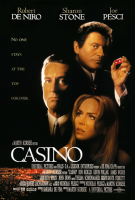
While Martin Scorsese serenades Robert De Niro and Harvey Keitel with Jumpin’ Jack Flash in Mean Streets, he employs the Stones song Can’t You Hear Me Knocking? for another of his regulars, Joe Pesci, in Casino.  Remarkably, Scorsese plays all seven minutes of the Santana-esque Can’t You… as an accompaniment to a lengthy sequence showing how Pesci’s Casino character Nicky Santoro gets established in Las Vegas.  Predictably, the sequence has Pesci doing what Pesci usually does in Scorsese movies: being a psychotic shit, barking orders at hoodlum sidekicks twice his size, eating in restaurants, ingratiating himself with fellow Mafiosi, being a psychotic shit, cursing and swearing, getting a blow-job, being a psychotic shit, talking about food, knocking off jewellery stores, acting the loving family man with his non-criminal relatives… and being a psychotic shit.
 

© Légende Entreprises / Universal Pictures


Ruby Tuesday (1967) in Children of Men (2006)

Wistful Stones ballad Ruby Tuesday features briefly on the soundtrack of Alfonso Cuarón’s gruellingly pessimistic science-fiction thriller Children of Men.  It’s another cover, sung by Franco Battiato.  We hear it during one of the movie’s calmer moments when Theo (Clive Owen) is visiting his old mate Jasper (Michael Caine), whose home provides a small pocket of sanity amid the unfolding dystopian grimness.  Amusingly, Caine, well known in real life for being a right-wing old grump with an aversion to paying tax, here plays an elderly anarcho-hippy with a fondness for smoking exceptionally strong pot.


Gimme Shelter (1969) in The Departed (2006)

Martin Scorsese loves the Rolling Stones and he loves their apocalyptic number Gimme Shelter in particular.  By my count he’s used it in three movies: Goodfellas, Casino and The Departed.  It’s best deployed at the beginning of The Departed, rumbling in the background while gangland thug Frank Costello (Jack Nicholson) expounds his philosophy.  “I don’t want to be a part of my environment,” he intones, imbuing his words with that leery, languid menace that only Nicholson is capable of.  “I want my environment to be a part of me.”  Strangely, in Scorsese’s Shine a Light two years later, Gimme Shelter was one of the songs the Stones didn’t perform on stage.  Marty missed a trick there.
 

© Plan B Entertainment / Warner Bros


Street Fighting Man (1968) in Fantastic Mr Fox (2009)

Director Wes Anderson also sticks Rolling Stones into his movies, but so far I haven’t mentioned him because I think most of his work is smug, pretentious and annoying.  For example, Play with Fire (1965) figures prominently in 2007’s The Darjeeling Limited, an Anderson movie so twee I find it the cinematic equivalent of being force-fed with chocolate-cake mix.  However, I like the scene in his stop-motion-animation adaptation of Roald Dahl’s Fantastic Mr Fox where, to the sound of the rabblerousing Stones anthem Street Fighting Man, Farmers Bean, Boggis and Bunce use three diggers to tear up the den of the titular Mr Fox; forcing the den’s inhabitants to frantically dig an escape-route.  Yes, they really ‘dig’ that song.  Sorry.


And finally…  Out of Time (1968) in Once Upon a Time in Hollywood (2019)

I’m not the biggest fan of the Stones song Out of Time – Jagger’s vocals get a bit too caterwauling for my liking – but it sees good satirical use in Once Upon a Time in Hollywood, Quentin Tarantino’s paean to the American movie-making capital in the late 1960s, a fascinating period when traditional notions about what made a good film were rapidly being undermined by an uppity younger generation.  Played when Rick Dalton (Leonardo DiCaprio), his new Italian spouse Francesca Capucci (Lorenza Izzo) and sidekick Cliff Booth (Brad Pitt) return from Italy, where Rick has been making spaghetti westerns and action thrillers with the likes of Sergio Corbucci and Antonio Margheriti, Out of Time gives an one-the-nose summation of DiCaprio’s sad-sack character – an actor a bit too old, un-hip and uncomprehending of the changing world around him to get the leading roles he once did, now doomed to playing villains in second-rate TV shows.

 

© Columbia Pictures / Sony Pictures Releasing 

Favourite Scots words, T-V


From unsplash.com / © Edward Howell


Yesterday was January 25th and yesterday evening saw a multitude of whisky-and-haggis-fuelled suppers held across the world to honour the 266th birthday of Robert Burns, Scotland’s national poet and one of its most distinguished writers in the Scots language.  This is an appropriate time, then, to publish the latest instalment of my list of favourite words and phrases from Scots.  I’m getting near the end of the alphabet now – the items in this post begin with letters ‘T’, ‘U’ and ‘V’.


Tablet (n) – a sweet foodstuff peculiar to Scotland, described by one culinary website as ‘crumbly, buttery fudge’.  Actually, I remember tablet being hard rather than crumbly.  At the end of its cooking process, it’d be a big solid slab in a tin, which you then cut up into little blocks.  It was also unhealthily laden with sugar, so obviously it became a popular Scottish treat.  In fact, in a short story I wrote a couple of years ago, I referred to tablet as ‘that tooth-rotting, Scottish confection of butter, sugar and condensed milk.’


Tackety boots (n) – hobnailed boots, the tackety bits being the hobnails.


Tappit hen (n) – originally a hen with a crest, although more recently it’s become the term for a type of pewter tankard or jug, with a lid, and a little knob on the lid.  I remember from my youth how the Tappit Hen was also the name of a pub in Aberdeen and, if my memory serves me correctly, it had a little nightclub called ‘Roosters’ upstairs.  Ha-ha, Roosters… On top of the Tappit Hen.  Get it?


Tapsalteerie (adj) – upside down.


Tattie (n) – a potato.  Potatoes are a staple of the Scottish diet – see the ubiquity of the dish mince an’ tatties.  If you get work on a farm picking potatoes, you are said to go tattie howkin’.  And there’s a savoury snack in Scotland, a wedge of potato flatbread that goes very nicely with a fried breakfast, called a tattie scone.


© Grove Atlantic


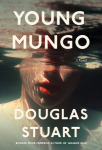
Tattiebogle (n) – a scarecrow.  In Douglas Stuart’s novel Young Mungo (2022), set in Glasgow in the early 1990s, Tattiebogle is the nickname that the title character, 15-year-old Mungo Hamilton, and his sister Jodie give their mother whenever she’s on one of her (frequent) alcoholic benders.  That’s when she seemingly transforms into a deranged, subhuman horror.


Tawse (n) – also known as ‘the belt’, a tawse was a strip of leather that had a sadistically forked tail and was an instrument of corporal punishment in Scottish schools.  Misbehaving pupils would be brought to the front of the classroom, made to stand with one hand outstretched and the other hand supporting it under the wrist, and given ‘six of the belt’, i.e., half-a-dozen whacks from the tawse across the palm.  Thanks to a judgement against its use by the European Court of Human Rights, the tawse disappeared from Scottish schools in the early-to-mid-1980s – making folk my age the last schoolkids to have been terrorised by it.


Teem (v) – to pour (with rain).  I’ve seen this included in lists of Scots words but I’ve only ever heard it used in Northern Ireland, where a lot of those words ended up.  “Ach, it’s teemin’!” my mum, who hailed from near Enniskillen, would exclaim when the heavens opened and rain started pounding us.


Teuchter (n) – a derogatory word used by Lowland Scots towards a person from the Highlands and Islands (often one who speaks the Scottish Gaelic language).  In Robin Jenkins’ 1979 novel Fergus Lamont, the title character describes the word as “the most contemptuous name a Lowlander can call a Highlander: it implies, among other things, heathery ears and sheep-like wits.”  I’ve also heard Aberdonians use teuchter in reference to anybody from the surrounding countryside of North East Scotland.


From ebay.co.uk / © B. Feldman & Co


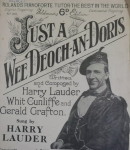
The day / the morra / the nicht (adv) – today, tomorrow and tonight.  The nicht is immortalised in the saying It’s a braw moonlicht nicht the nicht (‘It’s a beautiful moonlit night tonight’), which comes from a song called Wee Deoch and Doris by the popular Scottish music-hall performer Sir Harry Lauder.  The song includes the lines: “There’s a wee wifie waitin’ in a wee but an’ ben / If you can say,It’s a braw bricht moonlicht nicht’ / Then ye’re a’richt, ye ken.”


Thirled (adj) – being bound to something, by law, by contract, by loyalty or by habit.  John Buchan’s novel Witch Wood (1927), whose action takes place in the 17th-century Scottish Borders, contains the questioning line: “Or were they so thirled to their evil-doing that his appeals were no more than an idle wind?


Thrapple (n) – the throat or windpipe.


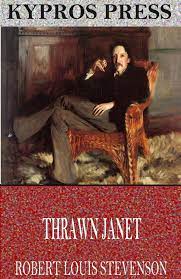
Thrawn (adj) – stubborn, obstinate and bloody-minded, inclined to do the opposite of what everyone urges you to do.  However, there’s a macabre short story called Thrawn Janet (1881) by Robert Louis Stevenson, in which the word has a different meaning – ‘twisted’ or ‘deformed’.  The title character is described as having “her neck thrawn, and her heid on ae side, like a body that has been hangit


© Charles River Editors


Tod (n) – a fox.  The Scottish author James Robertson once translated Roald Dahl’s children’s book Fantastic Mr Fox into Scots, where it sported the more Caledonian-friendly title Sleekit Mr Tod.


Trauchle (v) – to walk slowly and wearily.


Trews (n) – tartan trousers, once worn by Scotland’s southern regiments and regarded as a traditional garment of the country’s Lowlands (although in reality, like kilts, trews originated in the Highlands).  I’ve heard it said that trews were the prototype for the tartan plus-fours that golfers used to wear.


At modern Scottish gatherings, kilts tend to vastly outnumber trews, although I can think of a couple of famous people who had a liking for this form of Scottish legwear: the late Alex Salmond, First Minister of Scotland from 2007 to 2014, who once got involved in a stushie when he went on an official visit to China, forgot to pack his trews and then bought an emergency pair at the cost of 250 pounds to the Scottish taxpayer; the late and much-loved rugby player, Doddie Weir who, off the rugby field, was rarely photographed not in his trews; RuPaul, host of RuPaul’s Drag Race (2009-present), who wore them the day he got a star on Hollywood Boulevard; and, if yellow trews count, the British children’s cartoon character Rupert Bear.


Tup (n) – a ram.  Supposedly this term is used in the north of England too, but I’ve only ever heard it used in Scotland.


From unsplash.com / © Wolfgang Hasselmann


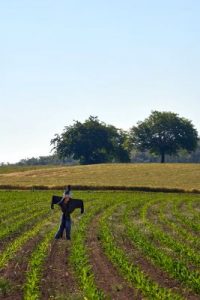
Turnshie (n) – a turnip.  Somewhat less common than neep, the other Scots word for turnip, turnshie has nonetheless spawned a couple of memorable compound nouns.  A turnshie-gowk is another Scots word for a scarecrow, while turnshie-heid is a term of abuse meaning ‘turnip-head’, i.e., a glaikit Liz Truss-style idiot.


Unco (adv) – very.  Robert Burns used this word in the following lines from his epic poem Tam O’Shanter (1791) to show the extreme happiness felt by Scotsmen whilst drinking alcohol: “While we sit bousin, at the nappy / And gettin fou and unco happy…”


Uisge beatha (n) – the Scottish Gaelic word for ‘whisky’, this has been commandeered by Scotland’s non-Gaelic speakers as an admiring term for their nation’s famous firewater.   Uisge beatha is sometimes spelt in Anglicised form as usquebaugh and it gets its poetic force from the fact that it means ‘water of life’.


Vennel (n) – an alleyway or narrow lane, the word being derived from the French one ‘venelle’.  Scottish terms with similar meanings include wynd and close.  Probably the most famous vennel in Scotland is one simply called ‘The Vennel’, which threads upwards from the southwestern end of the Grassmarket in Edinburgh and, at its highest point, provides a good vantage point for viewing and photographing Edinburgh Castle.


From unsplash.com / © Ross Findlay

Rab Foster makes a straw man argument


© Swords & Sorcery Magazine


The Scarecrow of Terryk Head is the name of a short story I’ve just had published using the pseudonym Rab Foster.  I always attribute any fantasy fiction I write to Rab Foster and, accordingly, this story is about an elderly witch who tries to enjoy a peaceful retirement in a remote farming valley, only to have her solitude disturbed by the local farmers, who beg her to use her magical powers to combat a fearsome and malignant totem that’s suddenly appeared at the top of the valley – the titular scarecrow at the titular Terryk Head.  The story appears in Issue 151 of the online Swords & Sorcery Magazine.


It wasn’t so long ago that I commented on this blog that I felt scarecrows had been overdone in fantasy fiction.  Well, I still believe that, but I thought the idea behind The Scarecrow of Terryk Head was good enough to justify the presence of a tattie-bogle (as we call the things in Scotland).  I have to admit the story was influenced, slightly, by scarecrows that appeared in the Thomas Ligotti tale The Shadow at the Bottom of the World, which was published in his 1991 collection Grimscribe: His Lives and Works; and in a story featured in the 2010 collection The Mirror of Paradise by the Sri Lankan writer Asgar Hussein.  Unfortunately, I can’t remember what Hussein’s scarecrow story was called, and I haven’t been able to find its title online.  But I enjoyed it a lot.


Other influences on The Scarecrow of Terryk Head include, curiously enough, Roald Dahl’s Fantastic Mr. Fox (1970) and, yes, the Bronte sisters.  And, writing it, I had fun paying homage to a scene from the 1961 film Murder, She Said.  This was a cinematic adaptation of Agatha Christie’s Miss Marple novel 4.50 from Paddington (1957) and starred two of my all-time favourite performers, Margaret Rutherford and James Robertson Justice.  What, you may wonder, does a fantasy story about witches and scarecrows have to do with an old black-and-white Miss Marple movie?  Well, read the darned thing and find out.


For the next month, The Scarecrow of Terryk Head can be accessed here; while the main-page of the 151st edition of Swords & Sorcery Magazine, which contains two other stories and an essay, can be reached here.