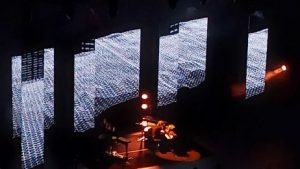
The Darkness descends on Singapore


Andy Warhol’s prediction that one day everyone would be famous for 15 minutes seems cruelly appropriate when I think about English glam rock / metal band the Darkness.  In 2003 they released their debut album Permission to Land and for the next year they were huge. The album went platinum and the band racked up three awards – Best British Group, Best British Rock Act and Best British Album – at 2004’s BRIT Awards.


But then…  Suddenly, they weren’t huge.  Their second album One Way Ticket to Hell… and Back (2005) being a flop and their singer and lead guitarist Justin Hawkins quitting the band after struggling with drug and alcohol addiction didn’t help, though overall they gave the impression their popularity would be brief.  With the over-the-top theatricality of their music – crowned by Hawkins’ falsetto vocals – and the cartoonish-ness of their videos and general image, the band obviously didn’t take themselves seriously, which was admirable.  Alas, there’s a problem with presenting yourself as something of a joke, i.e., even the funniest joke in the world stops being funny when you’ve heard it a number of times.


For the record, I should say I liked One Way Ticket to Hell… and Back, if only for its title track, which contained the immortal lyrics: “The first line hit me like a kick in the face / Thought I better have another one just in case…”  I also liked them because they came from Lowestoft, the rather rough-and-ready seaside resort in County Suffolk.  I was spending much of my time in Suffolk when, temporarily, they hit the big time.  Indeed, at the height of their celebrity, they threatened to buy big, fancy houses in Southwold, the more upmarket, snootier seaside resort a few miles along the coast from Lowestoft – a threat some Southwolders took seriously.  I seem to recall a newspaper article where the journalist visited Southwold and interviewed some locals about the prospect of having Justin Hawkins and co. as residents.  One old lady expressed her disapproval of them because they ‘had tattoos’.


However, as evidenced by John Travolta – who went from the highs of Saturday Night Fever (1977) and Grease (1978) to the lows of the Look Who’s Talking movies (1989-93), but then enjoyed a comeback with Pulp Fiction (1994) – or Robert Downey Jr – who, after Air America (1990) and Chaplin (1992), seemingly destroyed his career with cocaine and heroin abuse, but then made a half-billion dollars playing Iron Man in the Marvel Cinematic Universe – or even Sir Michael Caine – whose route from Zulu (1964) and Alfie (1966) to having roles in eight Christopher Nolan movies and becoming a British national treasure had to go through a mid-career trough containing the likes of The Swarm (1978), Beyond the Poseidon Adventure (1979), The Island (1980), The Hand (1981) and Jaws: the Revenge (1987) – just because you were once fashionable, but then went out of fashion, doesn’t mean you won’t ever come back into fashion.   So it is with the Darkness.  After being off the radar for a long time, they’ve lately acquired some retro-coolness.


Their eighth and most recent album, 2025’s Dreams on Toast, got to Number 2 in the British charts.  They’re due to support Iron Maiden at their 50th anniversary show at Knebworth Park in July this year.  And in December 2026 they’ve lined up no fewer than seven UK arenas to perform in for their Band of Brothers tour.  They even generated some headline-making controversy when Justin Hawkins, who reunited with the Darkness in 2011, and younger brother Dan, who plays lead guitar in the band too, criticized Yungblud’s performance at the late Ozzy Osbourne’s farewell concert last summer.  The elder Hawkins commented: “…if the future of rock comes from musical theatre and Disney, if this is Ozzy’s heir, we’re in trouble.”  Finally, it hasn’t done the band’s renewed popularity any harm that, since 2021, Justin Hawkins has had a YouTube channel where he reviews and analyses songs.  It currently has 600,000 subscribers.


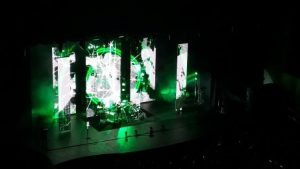
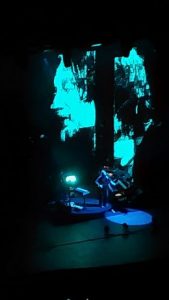
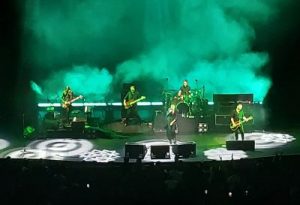
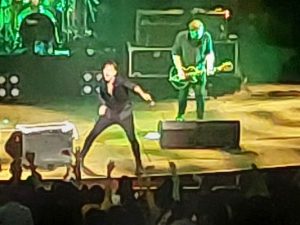
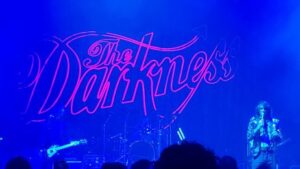
Last week, the Darkness made their first-ever appearance in Singapore, my current abode, with a gig at the Capitol Theatre.  In terms of musicality, it wasn’t the best concert I’ve attended in the city-state.  That accolade probably belongs to Jack White, whom I saw at the same venue three-and-a-half years ago.  But in terms of showmanship… This gig was pretty awesome.


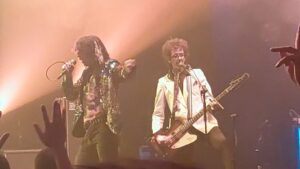
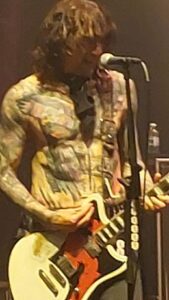
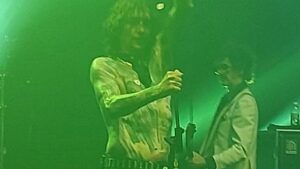
Yes, the band-members are two decades older than they were in their mid-noughties heyday – bassist Frankie Poullain, who once resembled a moustached villain from a spaghetti western, appears to have transformed into Kurt Vonnegut – but the encroachment of middle age hasn’t slowed, calmed or subdued them.  Justin Hawkins, for example, in an impressive display of spriteliness, performed a handstand at one point.  Also, admirably un-self-conscious, he stripped off to the waist early in the gig and flaunted a torso slathered in tattoos.  No wonder that old lady in Southwold objected to him.


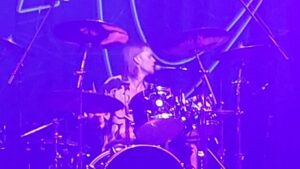
When you list the bands that had an influence on the Darkness, the one topping the list is surely Queen.  Accordingly, there were moments tonight when I felt I was listening to the rockier end of Queen’s musical repertoire – without the detours into opera, funk, disco, music hall, electronica and so on that the older band were so fond of – with Justin Hawkins providing plenty of Freddie Mercury-style flamboyance.  But I mean that in a good way.  Those Queen-esque moments smacked of loving homage rather than slavish imitation.  And on the subject of Queen, I should mention that since 2015 the Darkness’s drummer has been Rufus Tiger Taylor, whose dad is none other than the legendary Queen tub-thumper Roger Taylor.  Justin Hawkins cracked a joke about this at one point, quipping that Rufus’s father used to ‘play the drums in Status Quo’.  I laughed, though nobody else in the crowd seemed to.  Maybe because I was the only audience-member old enough to know who Status Quo were.


The setlist balanced half-a-dozen songs from their first and still most famous album Permission to Land, including such crowd-pleasing items as I Believe in a Thing Called Love and Get Your Hands Off My Woman Motherf*cker, with half-a-dozen from their recent comeback Dreams on Toast.  Of the latter songs, Rock and Roll Party Cowboy, which served as the opening number and set the tone for what was to follow, was a particularly glorious slab of glam-metal genius / stupidity (“Leather jacket, no sleeves / Harley-Davidson? Yes, please!“).  Some of their in-between albums were represented by a song each and they also did a cover, a guitar-heavy rendition of Jennifer Rush’s The Power of Love (1984), which Hawkins’ voice was highly suited to.  The cover was fun, though one ironic take on a power ballad was enough.  They thankfully didn’t follow it up with versions of, say, Bonnie Tyler’s Total Eclipse of the Heart (1983) or Celine Dion’s It’s All Coming Back to Me Now (1996).
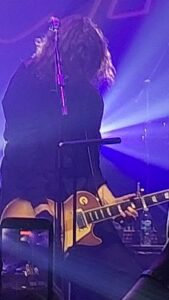
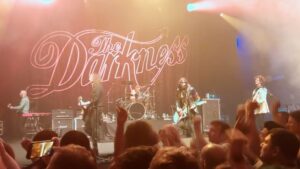


The band played epically with instruments cranked up to 11 at all times, Justin Hawkins antics’ as frontman achieved the right alchemy of melodrama and hilarity, and consequently the evening was high in entertainment value and the crowd had an excellent time. What helped, I felt, was that the Darkness came across as being a bunch of genuinely decent lads.  For instance, Justin Hawkins showed his appreciation of the guitar-tech guy who sporadically had to run on and off-stage.  The band also made sure their touring member, the keyboardist and guitarist Ian Norfolk – who, with his bald head, trimmed beard and sensible clothes looked as unlike the other performers as was possible – got a minute in the limelight.  By the way, I appreciate a guy called Norfolk playing with a band from Suffolk.


Moreover, the one moment that could have soured things – the band stopped a half-minute into I Believe in a Thing Called Love to ask certain members of the audience at the front of the stalls to stop filming on their phones – was well-handled by Hawkins.  Speaking like the nice, popular teacher at school who, once in a blue moon, has to discipline an unreasonably rowdy class, he pointed out in an I’m-not-angry-just-a-bit-disappointed voice, “Imagine if I sang the song while filming you on my phone…  It’d be really boring!”  He was more restrained than Brett Anderson of Suede, who in a 2023 gig at Singapore’s Star Theatre reacted to phone-filming spectators by tussling with them and knocking the infernal devices out of their hands.


Incidentally, when I arrived before the show, I noticed that one of the counters selling drinks at the back of the stalls belonged to the Flying V, Singapore’s premiere – well, probably only – heavy-metal bar.  And when I approached that counter to buy a beverage, I discovered they were selling Aspall Cyder.  The cidery producing this particular brew is located in the Suffolk village of Aspall, about 30 miles southwest of Lowestoft.  Wow, I thought, is this on sale because the Darkness are performing tonight?  Are they supporting the Suffolk economy whilst playing in Asia?  Momentarily, I had a vision of the Darkness’s tour-jet being accompanied by a cargo plane loaded with bottles of East Anglian scrumpy.  However, I visited the Flying V after the gig and learnt that they sell Aspall Cyder there all the time.  So it was just a coincidence.
 

Thom is da bomb


I don’t know when I became a fan of the band Radiohead.  They seemed to creep up on me by stealth.  I’d been aware of them for years before suddenly, one day, I realised: “Hey! I really like them!”


Appropriately for a band who crept up on me, the first song by them I heard was Creep from their debut album Pablo Honey (1993).  Though a massive hit, I didn’t actually like Creep, finding it dull and plodding.  My disdain for it was shared by Radiohead themselves, with guitarist Ed O’Brien saying of their performances of the song during the early 1990s: “We seemed to be living out the same four and a half minutes of our lives over and over again.  It was incredibly stultifying.”


At this time I worked as a university lecturer in the northern Japanese city of Sapporo.  One day  in 1995 I received a gift from a cool indie-kid in one of my classes, Yoko Koyama, who’d discovered that despite my outward veneer of grumpiness and grouchiness I was, underneath, a sensitive soul who was heavily into music.  The gift was a cassette recording of Radiohead’s newly-released second album, The Bends.  I diplomatically accepted it, not expecting to like it much on the basis that I hadn’t been impressed by Creep.  But when I listened to it, I thought, “This is actually pretty good.”  Not brilliantly good, but definitely good.


Around then, Radiohead visited Sapporo and played a gig, but the night of their concert was one when I had to teach a couple of evening classes at the university.  So I missed the chance to see them.  The next day, I went into one of my regular Sapporo drinking hangouts, the Beifu-tei Bar, and got talking to a mate of mine, a Scotsman from St Andrews called Stevie Malcolm.  Stevie informed me, “Aye, thon English rock band were in here last night after their gig.  What dae ye call them?  Thingmie-heid.”


“You mean, Radiohead?”


“Aye, Radio-heid!”


I got the impression Stevie had chatted away to Radiohead barely knowing who they were.  Though from the band’s unconventional approach to the music industry and their discomfort with the trappings of superstardom, they probably liked chatting to strangers in bars with barely any idea of who they were.


In 1997 Radiohead released their third album OK Computer, which even my snobbiest, most purist music-loving friends, who’d dismissed Pablo Honey and The Bends with a contemptuous flick of the hand, had to admit was an awesome record.  It still figures prominently when music publications list the best rock albums of all time and retrospective reviews frequently award it a full five stars.  And though subsequent albums – Kid A (2000), Amnesiac (2001), Hail to the Thief (2003), In Rainbows (2007), The King of Limbs (2011) and A Moon Shaped Pool (2016) – never created quite the same stir, and often made demands on the listener by veering off into the avantgarde, experimental and left-field, I’ve found all of them laudable.


It helped that, unlike other bands who at various times were massively loved by audiences and hailed by critics as world-straddling musical colossi, Radiohead never seemed in your face that much.  So you didn’t grow sick of them.  Whereas for a few years U2 or Oasis, or even REM, seemed to be everywhere in the media, with the result that their ubiquity led to a backlash – the public losing interest, the critics getting disenchanted, familiarity generally breeding contempt – Radiohead were more subtle, less intrusive and lower profile.  Perhaps their credibility endured because of that.


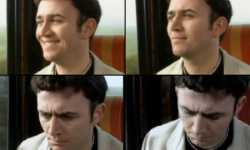
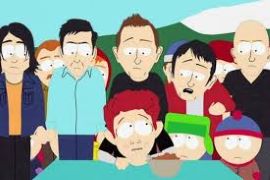
Even their appearances in popular culture tended to be wry and quirky and happened in unexpected, and cool, places.  For example, I remember the very last episode of Father Ted (1995-98) when the suicidal priest Father Kevin (Tommy Tiernan) gets cured of his depression by Ted playing to him Isaac Hayes’ joyous Theme from Shaft (1971) – only to lapse back into suicidal depression when he hears Radiohead’s Exit Music (For a Film) (1997) playing on the radio in a bus.  Or when they turned up in a 2001 episode of South Park called Scott Tenorman Must Die and added a final layer of torment to the unfortunate Scott Tenorman of the title.  Scott is a kid who’s been tricked by Eric Cartman into eating the minced bodies of his dead parents.  When he discovers what he’s done, he understandably bursts into tears.  Just then, his favourite band, Radiohead, happen to stroll past, see him and cruelly mock him for being a ‘cry-baby’.


From x.com / © Hat Trick Productions

© South Park Studios


Anyway, last week on November 5th, Radiohead’s vocalist and main songwriter Thom Yorke rolled up here in Singapore to play a solo concert as part of his Everything tour.  Yorke has a long history of making music on his own, from his 2006 album The Eraser, through 2014’s Tomorrow’s Modern Boxes, to 2019’s ANIMA, and he’s also been involved in a couple of side-bands like Atoms for Peace and The Smile, so it’s not a surprise to find him performing without the rest of Radiohead.  I attended the gig accompanied by my better half, Mrs Blood and Porridge, who wouldn’t have missed this occasion for the world.  She’s such a dyed-in-the-wool Radiohead fan that the other day she even made our cat watch the video for 2016’s Burn the Witch on YouTube.


Yorke played at the Star Theatre, which I’ve visited a couple of times in the past.  At previous gigs there, I was not greatly impressed by the crowd, many of whom seemed more interested in filming the event on their phones than getting into the excitement and vibe of the music itself.  As I wrote a while ago about a Deep Purple concert: “Why remove yourself from the occasion and gaze zombie-like at tiny figures moving about a tiny stage on a tiny screen…?  It’s also, needless to say, disrespectful of the performers onstage…  Honestly, there were times when the auditorium was so densely flecked with glowing phone-screens you felt you were flying over Las Vegas at night.”  But tonight’s audience, Singaporeans and foreigners alike, seemed to be genuine Radiohead fans and Thom Yorke-lovers who knew the great man wasn’t going to appreciate having a thousand phones pointed at him by a thousand glaikit dimwits.  So, thankfully, phone-usage was at a minimum.


It wasn’t the most physical of performances.  Yorke spent most of his time on a patch of stage encircled by musical equipment, including several keyboards, and looked like a cross between Rick Wakeman of Yes and Captain Nemo tinkling out Sebastian Bach’s Toccata and Fugue in D Minor on his organ.  He did, occasionally, venture towards the audience to play guitar or indulge in some shuffling dancing.  The latter drew affectionate cheers.  I have to say seeing Thom make his funky moves brought a smile to my face, as it seemed to prove there was at least one person on the planet whose dancing is even worse than mine is.


But what of the music?  I’d read a worrying review of a gig from earlier in the tour, in Sydney, where the writer observed, “Each Radiohead song that’s played – they make up just under half the setlist – is met with a hushed reverence, while loud chatter is heard every time something else gets an airing.”  Maybe that means modern-day Sydney concertgoers are disrespectful bozos, for that certainly wasn’t my impression of the Singapore crowd.  Yes, the ten Radiohead numbers he played during the set – coming from a range of the band’s albums, though nothing featured from Pablo Honey, Hail to the Thief or The King of Limbs – were enthusiastically received.  But the audience showed their appreciation of the non-Radiohead stuff as well.  This included material from all three of Yorke’s solo albums, two new songs (Back in the Game and Hearing Damage), and two he’d composed for the 2018 soundtrack for Luca Guadagnino’s remake of the Dario Argento 1977 horror classic Suspiria.


It all meshed together nicely.  The solo material evoked at different times the sounds of the Aphex Twin, Depeche Mode and Nine Inch Nails and I even wondered if Yorke was getting a bit disco-y at one or two points.  Naturally, electronica-rooted Radiohead numbers like Idioteque, Everything in its Right Place or Packt Like Sardines in a Crushd Tin Box (off Kid A) slotted in seamlessly among that lot.  Surprisingly, though, the band’s more conventional – dare I say more tuneful – songs, like How to Disappear Completely (Kid A again) Fake Plastic Trees (off The Bends), and All I Need (off In Rainbows) fitted in smoothly too, making it an impressively cohesive set.  Maybe it was because Yorke’s falsetto – often mocked, but inimitable, haunting and gorgeous – provided the aural thread that stitched together all these disparate pieces of musical cloth.


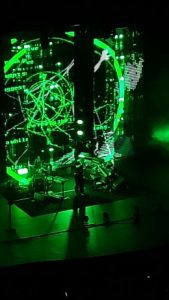
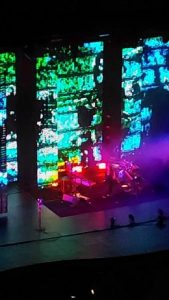
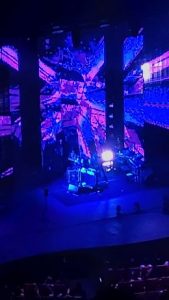
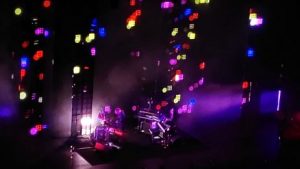
Praise is due too for the accompanying light show, with several tall screens treating the audience to dazzling and dizzying displays that, during the evening, seemed to range from daubs of luminous green graffiti to blizzards of multicoloured confetti, from drizzles of Matrix-style code to what looked like, frankly, masses of glowing spaghetti.  Occasionally, these gave way to stark white light, and darkness, where, at his consoles, Yorke looked like a torturer operating his torture-machines in a gothic dungeon.  Occasionally too, the chaotic patterns coalesced into the ghostly features of the man himself.  Thus, the show was an impressively visual as well as aural experience.  I have to say it was easier on the eyes than the screens at the previous gig I’d been to at the Star Theatre, which’d subjected me to regular, unflinching close-ups of the 78-year-old visage of Deep Purple’s Ian Gillan.


By the concert’s end it seemed the many diehard fans in the crowd had got their money’s worth.  Their frequent cries of “I love you, Thom!” had never lessened in enthusiasm while the 22-song set wound on.  And presumably the guy who shouted, before the gig and behind us on the escalator while we rode up to the theatre’s entrance, “Please, Thom, don’t play Creep tonight!”, went home happy too.


A good evening, then.  It certainly took our minds off the horror that was happening elsewhere on November 5th.


The per-Suede-er


At first glance, the pairing of the Manic Street Preachers and Suede at the concert I attended at Singapore’s Star Theatre on November 22nd seemed the musical equivalent of Neil Simon’s play The Odd Couple (1965).  Famous for their left-wing politics, the Manics got together as a band while they were at a comprehensive school in south Wales and they’ve forged a sound described by their Wikipedia page as variously ‘alternative’, ‘hard’, ‘punk’ and ‘glam’ rock.  The founders of Suede, on the other hand, put their band together while they were at University College London.  They were influenced by David Bowie and Roxy Music and their Wikipedia page describes their music with, among other things, the dreaded term ‘arthouse rock’.


Yes, as a former London university-student, Brett Anderson, Suede’s singer, lyricist and general lynchpin, seemed to me far removed from James Dean Bradfield and the other working-class Welsh lads in the Manic Street Preachers.  Which is unfair of me, as Anderson is actually the son of a taxi-driver.  (Maybe the name ‘Brett’ makes me biased.  The only other Brett I can think of is Lord Brett Sinclair, the posh playboy aristocrat played by Roger Moore in that dreadful / brilliant old TV show from 1972, The Persuaders.)


Still, in certain ways, the two bands are similar.  Both achieved success in the early 1990s, shortly before the advent of the Britpop movement that briefly set the world – or, at least, set those excitable hacks in the English media – on fire.  And instead of worshipping 1960s outfits like the Beatles and the Kinks, like the Britpop musicians did, the Manics and Suede were inspired by other things, such as the aforementioned punk rock and David Bowie.


Anyway, having experienced the Manics on the evening of the 22nd, I then sat through an hour-and-a-half of Suede.  And I was surprised.  I’d never seen the band before and I’d assumed that Brett Anderson was a cerebral, aesthetic type, not given to extroversion.  At least, that was the impression I’d got from interviews with him I’d read.  (I also seem to remember reading an interview that he’d conducted once, with one of his heroes, Brian Eno.)  So, I didn’t expect him to be the showman that he was tonight.  He strutted around, dropped dramatically onto his knees, perched himself on top of the front stage lights, and a couple of times descended into the stalls, where he prowled between the stage and the barrier holding back the audience.  He even went behind the barrier and into the audience.  He was a pretty belligerent in his showmanship too, constantly getting the crowd going, goading them to sing along and clap their hands.  This was Freddie Mercury with attitude.


The set-list was weighted with songs from their eponymous first album, released in 1993, and their most recent album, 2022’s Autofiction, which between them accounted for more than half the numbers played.  Autofiction has been described as a ‘back-to-basics triumph’ and its songs slotted in seamlessly with the jagged, urgent sound of early 1990s classics like Animal Nitrate, Metal Mickey and So Young.  Since Anderson is now in his fifties, with So Young he must be starting to feel like the Who’s Roger Daltrey every time he sings the ‘Hope I die before I get old’ line from 1965’s My Generation.


I was slightly disappointed that almost nothing was featured from 1994’s Dog Man Star, Suede’s second album, which is my favourite thing among their output.  Mind you, the one item from Dog Man Star that was played, The Wild Ones, was certainly memorable.  Anderson performed it by himself, on acoustic guitar, and made it even more memorable by preceding it with a rant at certain members of the audience who were filming the show on their phones.  He pleaded: “It’s so much better if you could possibly put your phones down…  Put your f**king phones down.  If you want to film, go to the back.  Don’t take up space out here.  These people want to have fun.  If you want to stare at you f**king phone, go to the f**king back.  Am I right…?  It just kills the gig.”


Being at the rear end, and at the very top, of the auditorium – from where the theatre’s lower level had looked so densely flecked with dots of phone-light that I sometimes felt I was flying over a city at night-time – I hadn’t been able to see precisely what Anderson was doing during his forays into the stalls.  However, according to the following day’s report in the Straits Times newspaper, he’d “tussled with a front-row male audience member, demanding that he put down his device” and “leapt over the barricade… confronted those in the front section of the venue who were busy filming him… started pushing fans’ hands down, grabbing phones off them, and putting them on the floor.”


Well, good on Brett Anderson, I say.  These days at concerts there seems to exist a great divide.  On one side of it are folk who simply want to experience and lose themselves in the live-music performance.  On the other side are numpties with one arm permanently hoicked up in the air, with a hand clutching the latest slab of technology from Motorola, Sony, Apple or Nokia, with eyes fastened on a tiny screen where tinier figures move around on a stage, with a mind focused only on getting the clips despatched to social-media platforms as swiftly as possible to show off to their ‘followers’.  I know which side of that gulf I’m on.  The other side can just f**k off into the sea.


Anyway, that piece of drama merely added to the emotionality and intensity of the Suede experience.  The band produced a glorious clangour of noise that,  thanks to the Star Theatre’s excellent acoustics, reached me and rattled me even at the very back of the venue.  I still had ghostly reverberations from Animal Nitrate in my ears while I travelled home on the Singapore MRT.


This being my first-ever Suede concert, and not having heard their music for many years, I hadn’t known what to expect during the second leg of tonight’s show.  But yes, I ended up per-Suede-ed.