You can’t say those things nowadays… unless you’re a politician


From wikipedia.org / © House of Lords / Roger Harris


In this post I’m not going to repeat the three most depraved and revolting jokes I’ve ever heard.  But I’ll say when and where I heard them, and from whom.


The first joke concerned a medical tragedy and a hideous crime, both involving children, which’d made headlines in the UK during the 1980s.  One night in a pub in Aberdeen, where I was a college student, a friend told a 13-word joke that combined the two cases.  The friend was a decent guy who was drunk at the time and he uttered the joke during a moment of reckless bravado.  Immediately afterwards, he looked disgusted with himself and spent the rest of the evening in a state of depression.  I don’t think I heard him tell an even vaguely risqué joke after that.


I wasn’t as shocked as I might have been because I’d already encountered the joke in written form.  Some degenerate had scribbled it on the back of a toilet-door in Aberdeen University’s Queen Mother Library and I’d noticed it whilst ‘on the john’.


The second joke was two words longer – 15 – and I heard it in the context of a supposedly real-life anecdote.  Another guy I’d known as a student had, following graduation, gone on a trip to the USA where, one day, he’d ended up at an outdoor music festival.  He too was somewhat inebriated.  The festival’s compere decided, at one point, to leave the stage and wander among the crowd, sticking his microphone into people’s faces and asking them how they were getting on.  He stopped by my old acquaintance and, discovering he was from ‘Scaaat-land’, asked him to tell a ‘Scaaat-tish’ joke.  So my acquaintance spewed those 15 words into the microphone, which boomed across the field from the festival’s speakers and left the entire crowd in mortified, disbelieving silence.  I’m not sure if I really believe that story happened – but if it did happen, it was quite something.


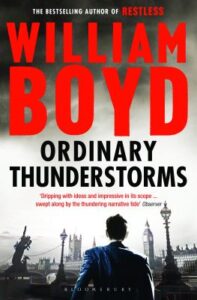
Incidentally, the same joke appears in William Boyd’s 2009 novel Ordinary Thunderstorms.  An unsavoury character tells it to the book’s hero, who responds by tipping him over a bridge and dropping him into the River Thames, where he drowns.  To be fair, the character had antagonized him a lot before that, so he wasn’t just reacting to the joke’s depravity.
 

© Bloomsbury


The third joke I heard in the early 1990s.  I was sitting at the counter of an Edinburgh pub when a drunken guy beside me told it.  It was a longer and more elaborate joke and featured Freddie Mercury, singer of the rock band Queen, who was famously gay and had died of AIDS a while earlier, and another famous showbusiness personage, also gay, who’s still with us in 2026.


Ooph, I thought, that’s really horrible. I hope I never hear a joke like that again.  


Well, I have just encountered a joke like that again.  In fact, it’s the same joke, though updated from the 1990s and now about the gay singer George Michael, who passed away in 2016, and his former partner Fadi Fawaz.  According to the Daily Record newspaper last week, it was told by Malcolm Offord, leader of the far-right-wing Reform party’s branch in Scotland.  In 2018, he included it in a speech he delivered at a Burns Supper held by a rugby club he was a director of.  In the kerfuffle following the Daily Record’s report, Offord admitted telling the joke was ‘a mistake’ and denied being homophobic.  “I don’t have any issue with homophobia,” he said.  “I’ve got a lot of gay friends.”


Nigel Farage, Reform’s Britain-wide leader, has defended Offord, saying, “If we’re going to drum people out of public life for telling a joke at a boozy rugby club dinner that’s amongst friends, we’ll finish up with the dullest group of individuals, looking a bit like, sounding a bit like Keir Starmer.”  Less forgiving was John Swinney, leader of the Scottish National Party and currently First Minister of Scotland – the post Offord aspires to take over following the Scottish parliamentary election this May.  Swinney said of Offord, “He’s unfit to be leader of any political party, unfit to be a member of the Scottish Parliament with views and attitudes like that…  I think we’ve got to be really careful as a country about where we are heading, and Reform have got no part to play in it if they represent views of intolerance, prejudice and hatred of that type.”


What are we to make of this?  Should we regard Offord’s faux pas as regrettable, alcohol-fuelled ‘banter’, accept his apology and move on?  And are we, as Farage suggests, in danger of becoming too puritanical, of scaring all the interesting people away from public office, of ending up with humourless dullards in power over us?  Is society getting – oh God, here we go again – too woke?


It calls to mind the lamentations of Monty Python (1969-74) and Fawlty Towers (1975-79) star John Clleese, who’s spent a good part of the last few years complaining that you can’t tell a good, impactful, close-to-the-bone joke anymore because folk get too offended: “I don’t think we should organize a society around the sensibilities of most easily upset people because then you have a very neurotic society.”  Incidentally, the 86-year-old Cleese appears to have thrown in his lot with Rupert Lowe’s party Restore UK, an outfit even further to the right than Farage’s Reform.

 

From wikipedia.org / © Paul Boxley


Well, in my view, we’re never going to stop hearing sick, horrible and downright racist / misogynist / homophobic / transphobic / etc. jokes.  For as long as the urge to be ‘edgy’ persists in the human psyche, such jokes will continue to be told in pubs and clubs, on sports terraces, in Internet forums, on WhatsApp and other messaging platforms, in countless situations where people interact.  But anyone who thinks it’s a good idea to spout a joke of that sort in public – supposedly 200 people attended Offord’s Burns Supper – shouldn’t be presenting themselves as a politician qualified to take over the highest political office in Scotland.  Especially when as holder of that office you’ll be representing, and making decisions that affect, the group of people your joke cruelly mocked.


Call me old-fashioned, but I prefer my political leaders to be dull – and serious, and sensible.  I remember British Prime Ministers like Labour’s Jim Callaghan and the Conservatives’ John Major, both rather grey and uninteresting, but whom I felt a lot safer having in Number 10, Downing Street than, say, an alleged laugh-a-minute ‘personality’ like Boris Johnson.  Between Callaghan and Major, of course, Britain was subjected to the 11-year reign of Margaret Thatcher, who had many qualities – mainly negative qualities, in my opinion – but being a barrel of laughs who told good jokes wasn’t one of them.


Offord must have thought he was on safe ground with his joke because he was at a well-lubricated rugby club event, not what you’d expect to be the most politically correct of gatherings.  But according to the Daily Record, even his rugby-loving audience was unimpressed.  One witness said, “I was sitting next to a gay man and it was clearly an extremely uncomfortable and unpleasant experience for him…  At the time I thought it pretty awful and indeed that was the feeling in the room.  Even for a rugby club it was a crude, bad taste and insulting spectacle…  I don’t know who in their right mind would say something like that.”


Even some of the usual suspects in Scotland’s mostly right-wing, Unionist media have turned on Offord because of this.  Scottish Times columnist Alex Massie penned a piece entitled Reform may already regret its choice of leader in Scotland, whilst Scottish journalist Stephen Daisley, who frequently writes for the very right-wing Spectator, messaged, “Malcolm Offord is single-handedly wrecking Reform’s chances in the Scottish parliament.  Can the Holyrood campaign be salvaged?”


I haven’t heard any reaction yet from Chris Deerin, who’s somehow the Scotland editor at the supposedly left-leaning New Statesman.  When Offord became Scottish Reform leader, Deerin tweeted, “Malcolm Offord is a seriously great get for Reform.  Very smart, ambitious for Scotland, excellent communicator, properly Scottish, experience of government, hugely successful in business – working class boy made good.  Ooft.”  (‘Ooft’, of course, was my first thought when I heard that joke.)  And in a couple of New Statesman articles Deerin penned about Offord, he talked breathlessly about the wealthy politician’s ‘gilded life’ and particularly admired his “vintage, open-top Jaguar sports car, Bond-esque in its sleek lines and growling power,” in which Offord “roared off into the countryside.”


Alas, despite everything, I don’t think Offord will be roaring off into the countryside, never to be seen or heard of again.  There are too many people who’ll rally to his cause rather than reject it after this furore.  That’s because they believe the line, fed to them endlessly by Britain’s right-wing media and pundits, that everything is too puritanically woke now, that you can’t crack a joke about gays or women or religious or ethnic minorities without the roof falling on your head, that you “can’t say those things nowadays”.  The irony is that you can say those things nowadays, and totally get away with them, at least if you’re a British politician.


Nigel Farage has recently courted controversy over the personalized messages he’s sent as Cameo videos – one of several lucrative side-projects he has in addition to being Reform party leader and a Member of Parliament.  A Guardian investigation found that the messages included ones “supporting a convicted rioter, repeating extremist slogans, and endorsing a neo-Nazi event” and where he “referenced antisemitic conspiracy theories, and made misogynistic remarks about leftwing politicians, including a comment about the US congresswoman Alexandria Ocasio-Cortez’s breasts.”


Previously, Farage was in hot water because of allegations made by over 30 people who’d known him during his schooldays.  According to their accounts, the teenaged Farage was quite the dedicated follower of fascism – among other things, singing Hitler Youth songs and growling “Hitler was right” and “Gas them” at Jewish pupils. He’s variously responded to these allegations by calling them ‘fantasies’, saying he can’t remember saying such stuff or dismissing it as – there’s that word again – ‘banter’.


Not that this has dented Farage’s popularity much.  His party is still leading in British opinion polls.

 

From wikipedia.org / © Roger Harris

From wikipedia.org / © Roger Harris


Elsewhere, Robert Jenrick, formerly the Conservatives’ Shadow Justice Secretary and now a defector to Reform, caused outrage last year when he said a 90-minute visit to the Handsworth part of Birmingham was “as close as I’ve come to a slum in this country” and one where he didn’t encounter “another white face“.  And earlier this month, the Conservatives’ Nick Timothy, who’s inherited Jenrick’s role as Shadow Justice Secretary, described an open Iftar event in Trafalgar Square as “an act of domination…  not welcome in our public places and shared institutions…  straight from the Islamist playbook.”  In previous years open Iftar events had been held in the square without anyone objecting, as had other religions’ celebrations such as Chanukah, Vaisakhi and Diwali.  And it had also hosted Christian events like mass prayers and Good Friday passion plays.


Rather than discipline them, Conservative party leader Kemi Badenoch backed both Jenrick and Timothy.  The latter case inspired the double-barreled, hard-right-wing rabble-rouser Stephen Yaxley-Lennon to crow on social media about how, just two years ago, a Conservative Member of Parliament making Timothy’s anti-Islamic comments would have been expelled from the party.  But not in 2026.


Yes, call me old-fashioned…  But I prefer the good old days when not only were British mainstream politicians grey and dull, but if they’d spouted anything blatantly racist, misogynistic, homophobic, or Islamophobic, they’d immediately have been out on their ear.
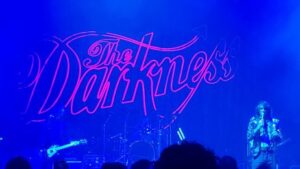

The Darkness descends on Singapore


Andy Warhol’s prediction that one day everyone would be famous for 15 minutes seems cruelly appropriate when I think about English glam rock / metal band the Darkness.  In 2003 they released their debut album Permission to Land and for the next year they were huge. The album went platinum and the band racked up three awards – Best British Group, Best British Rock Act and Best British Album – at 2004’s BRIT Awards.


But then…  Suddenly, they weren’t huge.  Their second album One Way Ticket to Hell… and Back (2005) being a flop and their singer and lead guitarist Justin Hawkins quitting the band after struggling with drug and alcohol addiction didn’t help, though overall they gave the impression their popularity would be brief.  With the over-the-top theatricality of their music – crowned by Hawkins’ falsetto vocals – and the cartoonish-ness of their videos and general image, the band obviously didn’t take themselves seriously, which was admirable.  Alas, there’s a problem with presenting yourself as something of a joke, i.e., even the funniest joke in the world stops being funny when you’ve heard it a number of times.


For the record, I should say I liked One Way Ticket to Hell… and Back, if only for its title track, which contained the immortal lyrics: “The first line hit me like a kick in the face / Thought I better have another one just in case…”  I also liked them because they came from Lowestoft, the rather rough-and-ready seaside resort in County Suffolk.  I was spending much of my time in Suffolk when, temporarily, they hit the big time.  Indeed, at the height of their celebrity, they threatened to buy big, fancy houses in Southwold, the more upmarket, snootier seaside resort a few miles along the coast from Lowestoft – a threat some Southwolders took seriously.  I seem to recall a newspaper article where the journalist visited Southwold and interviewed some locals about the prospect of having Justin Hawkins and co. as residents.  One old lady expressed her disapproval of them because they ‘had tattoos’.


However, as evidenced by John Travolta – who went from the highs of Saturday Night Fever (1977) and Grease (1978) to the lows of the Look Who’s Talking movies (1989-93), but then enjoyed a comeback with Pulp Fiction (1994) – or Robert Downey Jr – who, after Air America (1990) and Chaplin (1992), seemingly destroyed his career with cocaine and heroin abuse, but then made a half-billion dollars playing Iron Man in the Marvel Cinematic Universe – or even Sir Michael Caine – whose route from Zulu (1964) and Alfie (1966) to having roles in eight Christopher Nolan movies and becoming a British national treasure had to go through a mid-career trough containing the likes of The Swarm (1978), Beyond the Poseidon Adventure (1979), The Island (1980), The Hand (1981) and Jaws: the Revenge (1987) – just because you were once fashionable, but then went out of fashion, doesn’t mean you won’t ever come back into fashion.   So it is with the Darkness.  After being off the radar for a long time, they’ve lately acquired some retro-coolness.


Their eighth and most recent album, 2025’s Dreams on Toast, got to Number 2 in the British charts.  They’re due to support Iron Maiden at their 50th anniversary show at Knebworth Park in July this year.  And in December 2026 they’ve lined up no fewer than seven UK arenas to perform in for their Band of Brothers tour.  They even generated some headline-making controversy when Justin Hawkins, who reunited with the Darkness in 2011, and younger brother Dan, who plays lead guitar in the band too, criticized Yungblud’s performance at the late Ozzy Osbourne’s farewell concert last summer.  The elder Hawkins commented: “…if the future of rock comes from musical theatre and Disney, if this is Ozzy’s heir, we’re in trouble.”  Finally, it hasn’t done the band’s renewed popularity any harm that, since 2021, Justin Hawkins has had a YouTube channel where he reviews and analyses songs.  It currently has 600,000 subscribers.


Last week, the Darkness made their first-ever appearance in Singapore, my current abode, with a gig at the Capitol Theatre.  In terms of musicality, it wasn’t the best concert I’ve attended in the city-state.  That accolade probably belongs to Jack White, whom I saw at the same venue three-and-a-half years ago.  But in terms of showmanship… This gig was pretty awesome.


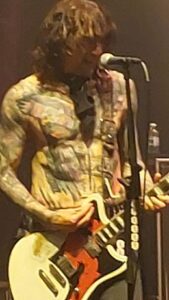
Yes, the band-members are two decades older than they were in their mid-noughties heyday – bassist Frankie Poullain, who once resembled a moustached villain from a spaghetti western, appears to have transformed into Kurt Vonnegut – but the encroachment of middle age hasn’t slowed, calmed or subdued them.  Justin Hawkins, for example, in an impressive display of spriteliness, performed a handstand at one point.  Also, admirably un-self-conscious, he stripped off to the waist early in the gig and flaunted a torso slathered in tattoos.  No wonder that old lady in Southwold objected to him.


When you list the bands that had an influence on the Darkness, the one topping the list is surely Queen.  Accordingly, there were moments tonight when I felt I was listening to the rockier end of Queen’s musical repertoire – without the detours into opera, funk, disco, music hall, electronica and so on that the older band were so fond of – with Justin Hawkins providing plenty of Freddie Mercury-style flamboyance.  But I mean that in a good way.  Those Queen-esque moments smacked of loving homage rather than slavish imitation.  And on the subject of Queen, I should mention that since 2015 the Darkness’s drummer has been Rufus Tiger Taylor, whose dad is none other than the legendary Queen tub-thumper Roger Taylor.  Justin Hawkins cracked a joke about this at one point, quipping that Rufus’s father used to ‘play the drums in Status Quo’.  I laughed, though nobody else in the crowd seemed to.  Maybe because I was the only audience-member old enough to know who Status Quo were.


The setlist balanced half-a-dozen songs from their first and still most famous album Permission to Land, including such crowd-pleasing items as I Believe in a Thing Called Love and Get Your Hands Off My Woman Motherf*cker, with half-a-dozen from their recent comeback Dreams on Toast.  Of the latter songs, Rock and Roll Party Cowboy, which served as the opening number and set the tone for what was to follow, was a particularly glorious slab of glam-metal genius / stupidity (“Leather jacket, no sleeves / Harley-Davidson? Yes, please!“).  Some of their in-between albums were represented by a song each and they also did a cover, a guitar-heavy rendition of Jennifer Rush’s The Power of Love (1984), which Hawkins’ voice was highly suited to.  The cover was fun, though one ironic take on a power ballad was enough.  They thankfully didn’t follow it up with versions of, say, Bonnie Tyler’s Total Eclipse of the Heart (1983) or Celine Dion’s It’s All Coming Back to Me Now (1996).


The band played epically with instruments cranked up to 11 at all times, Justin Hawkins antics’ as frontman achieved the right alchemy of melodrama and hilarity, and consequently the evening was high in entertainment value and the crowd had an excellent time. What helped, I felt, was that the Darkness came across as being a bunch of genuinely decent lads.  For instance, Justin Hawkins showed his appreciation of the guitar-tech guy who sporadically had to run on and off-stage.  The band also made sure their touring member, the keyboardist and guitarist Ian Norfolk – who, with his bald head, trimmed beard and sensible clothes looked as unlike the other performers as was possible – got a minute in the limelight.  By the way, I appreciate a guy called Norfolk playing with a band from Suffolk.


Moreover, the one moment that could have soured things – the band stopped a half-minute into I Believe in a Thing Called Love to ask certain members of the audience at the front of the stalls to stop filming on their phones – was well-handled by Hawkins.  Speaking like the nice, popular teacher at school who, once in a blue moon, has to discipline an unreasonably rowdy class, he pointed out in an I’m-not-angry-just-a-bit-disappointed voice, “Imagine if I sang the song while filming you on my phone…  It’d be really boring!”  He was more restrained than Brett Anderson of Suede, who in a 2023 gig at Singapore’s Star Theatre reacted to phone-filming spectators by tussling with them and knocking the infernal devices out of their hands.


Incidentally, when I arrived before the show, I noticed that one of the counters selling drinks at the back of the stalls belonged to the Flying V, Singapore’s premiere – well, probably only – heavy-metal bar.  And when I approached that counter to buy a beverage, I discovered they were selling Aspall Cyder.  The cidery producing this particular brew is located in the Suffolk village of Aspall, about 30 miles southwest of Lowestoft.  Wow, I thought, is this on sale because the Darkness are performing tonight?  Are they supporting the Suffolk economy whilst playing in Asia?  Momentarily, I had a vision of the Darkness’s tour-jet being accompanied by a cargo plane loaded with bottles of East Anglian scrumpy.  However, I visited the Flying V after the gig and learnt that they sell Aspall Cyder there all the time.  So it was just a coincidence.


The magnificent Seven Moons


© Sort Of Books


I’ve just realised that over the past year or so I’ve coincidentally read five novels that were winners of Britain’s most prestigious literary award, the Booker Prize.  The first four I read are as follows, ranked in descending order of greatness:


  • Very good: Shuggie Bain by Douglas Stuart, which won the Booker in 2020.  Inevitably, being about alcoholism, betrayal and homophobia in economically-ravaged, 1980s Glasgow, it’s a tough read.  One thing I found oddly depressing about it is how it reminded me of a time, not so long ago, when everyone from 15 years upwards seemed to have dentures.


  • Good: The Testaments by Margaret Atwood, joint-winner in 2019. Atwood is always decent value, but this follow-up to 1985’s The Handmaid’s Tale doesn’t quite have the same punch.  Partly this is because, as a sequel, it’s less ideas-driven than the original.  Partly it’s because The Testaments dares to have a happy ending.  But it’s certainly interesting to see Aunt Lydia get a redemptive arc.


  • Okay: The Luminaries by Eleanor Catton, winner in 2013.  Parts of this 19th-century, New Zealand-set murder mystery were engrossing, but with 832 pages and what felt like a cast of thousands – well, dozens – my interest was inevitably going to flag in places.  Still, kudos to Catton for constructing a novel that’s positively Dickensian in its size and ambition.


  • Tedious bollocks: The Old Devils by Kingsley Amis, winner in 1986.  Geriatric, right-wing Welsh windbags make fools of themselves in a gentrified version of 1980s Wales that I suspect only ever existed in Kingsley Amis’s imagination.


But for me the best of the lot was The Seven Moons of Maali Almeida by Sri Lankan writer Shehan Karunatilaka, which netted the Booker in 2022 and which I finished reading the other day.  No doubt I’m biased and have an advantage when it comes to this novel.  It’s set in Colombo and I lived in that city for eight years myself, which makes me familiar with much of the book’s geography, cultural references and historical context, to say nothing of the cynical and self-deprecating Sri Lankan humour that pervades its pages.  That sense of humour, by the way, is one of the  things I now miss most about the place.


But even if you’re not acquainted with Sri Lanka when you open the book, I suspect you’ll be impressed by Seven Moons – at least, if you give it a chance to draw you in.  Karunatilaka’s work veers from the exuberantly fantastical to the grimly realistic, from the hilarious to the horrific, from the vauntingly highbrow to the cheerfully lowbrow, from the sublime to the ridiculous, sometimes within the space of one page.


The novel takes place in the late 1980s and begins with titular character Maali Almeida experiencing the end of his physical existence, as a human, and the start of his ephemeral existence, as a ghost.  He finds himself in a weird, netherworld version of Colombo, where he can see, but not interact with, the living, but where ghosts and other supernatural beings mill about too – the more adept of them have mastered the neat trick of travelling around on the winds.  The spectral bureaucracy that processes the newly deceased urges him to continue onto the proper afterlife, which is only open to him for the next seven nights, or seven moons, of his passing.


But Maali is more concerned with hanging around and finding out the details of his death. Suffering from a sort of Post-Death Stress Disorder, he can’t remember how it happened.  As he was a war photographer when he was alive – 1980s Sri Lanka being in the throes of civil war – it’s likely he was murdered.  And the reason for his murder was likely some sensitive photographs he took that could have serious consequences for one of the country’s top politicians.


Half-murder-mystery, half-phantasmagorical-adventure, the story rattles along with Maali trying to overcome his limitations as a ghost and find a way of communicating with the two people he was closest to when he was alive, his ‘official’ girlfriend Jaki and his ‘unofficial’ boyfriend DD – Maali was a gay man in a time and place where it was probably safer to stay closeted – with the ultimate aim of solving the mystery of his death and securing the important photographs.


Along the way, he encounters all manner of eccentrics, misfits and miscreants.  In the living world, there are crooked politicians, crooked policemen, dodgy NGO workers, dodgy journalists, arms dealers, torturers, ‘garbage collectors’ (the goons who dispose of the bodies of those eliminated during the government’s dirty war against real and imagined dissent) and an unhelpful clairvoyant called the Crow Man.  In the ethereal world, there are ghosts, ghouls and yakas (demons from Sri Lankan mythology), including one embittered spirit, a murdered Marxist called Sena, who’s assembling an army of the dead whilst trying to figure out a way, intangible though he is, of violently striking back at his still-living tormentors and executioners.


From wikipedia.org / © Deshan Tennekoon


Seven Moons‘s allegory about the victim of a senseless war trying to make sense of it on the other side, as a ghost, could come across as heavy-handed.  But Karunatilaka invests the fantastical elements of his narrative with the exactly the right amounts of absurdity and bemusement.  It’s no surprise that he lists Douglas Adams and Kurt Vonnegut in the book’s acknowledgements.  Again, the humour has a distinctly local flavour.  For example, the celestial sorting office where Maali, deceased, finds himself at the beginning is conceptually like something from Michael Powell and Emric Pressburger’s classic movie A Matter of Life and Death (1945), but its chaotic nature feels pretty Sri Lankan.  Anyone who’s ever tried to get their EPF (Employees’ Provident Fund) from the Department of Labour off Kirula Road will understand.


Meanwhile, a famous quote by legendary science-fiction author and long-term Sri Lankan resident Arthur C. Clarke could be the blueprint for Karunatilaka’s vision of Colombo, overrun with the souls of the dead: “Behind every man now alive stand thirty ghosts, for that is the ratio by which the dead outnumber the living.”  In the midst of the spectral mayhem, Maali refers to Clarke’s quote and adds, “You look around you and fear the great man’s estimate might have been conservative.”


At the same time, the fantasy in no way diminishes the book’s accounts of the horrors perpetrated during the Sri Lankan Civil War.  This was when the government wasn’t locked in a struggle just with the LTTE, the Liberation Tigers of Tamil Eelam, who wanted a separate Tamil state but were “prepared to slaughter Tamil civilians and moderates to achieve this”, but also with the JVP, the Janatha Vimukthi Peramuna, who wanted “to overthrow the capitalist state” but were “willing to murder the working class while they liberate them.”  These organisations and others – including the STF, the Special Task Force, the government’s abduction, torture and execution squad – are listed and described in a passage near the beginning, for the benefit of readers unfamiliar with the country back then.  It comes with the advice: “Don’t try and look for the good guys ‘cause there ain’t none.”


In one interview, Karunatilaka observed that bleak though things have been in Sri Lanka during its recent economic crisis, brought about by the corrupt and idiotic mismanagement of the Rajapaksa regime, the situation doesn’t come close to how it was in the war-torn 1980s.  “I’ve no doubt many novels will be penned against Sri Lanka’s protests, petrol queues and fleeing Presidents.  But even though there have been scattered incidents of violence, today’s economic hardship cannot be compared to the terror of 1989 or the horror of the 1983 anti-Tamil pogroms.  We all pray it stays that way.”


One other thing I enjoyed about Seven Moons is how it captures the odd, hybrid culture that young people in 1980s Colombo must have inhabited – at least, the more affluent, English-speaking ones, of whom Maali is an example.  Mixed in with the Sri Lankan cultural references are the expected ones from America – Elvis Presley is prominent and Maali seems to have a hankering for Ridley Scott’s Blade Runner (1982).  Of course, looming over the whole novel is the shadow of that most 1980s-feeling of Hollywood movies, the Demi Moore / Patrick Swayze schmaltz-a-thon Ghost.  (Though I’ve just checked and discovered it wasn’t a 1980s movie.  It came out in 1990.)


British culture – due no doubt to the colonial connection – gets a look-in too, with mentions of Yorkshire Television’s durable lunchtime legal-drama show Crown Court (1972-84), the BBC’s rickety but impressively downbeat space opera Blake’s Seven (1977-81) and cheesy but popular Welsh retro-rocker Shakin’ Stevens.


But most amusing is Maali’s love of bombastic British rock-pop band Queen and their flamboyant singer, the late Freddie Mercury.  I found it hilarious that – watch out, spoilers approaching! – one of the plot’s main MacGuffins turns out to have been concealed inside the sleeve of Queen’s universally derided 1982 album Hot Space.  It’s the perfect hiding place.  Because no one in their right mind would ever dream of opening the sleeve of Hot Space.


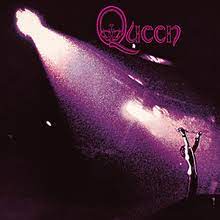
© EMI / Elektra

Still ruled by the Queen


© EMI / Elektra Records


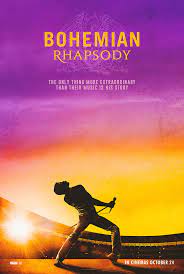
Back in 2018, I found myself in a Colombo pub one evening having a blether with Suresh De Silva, the vocalist and co-founder of the Sri Lankan heavy metal band Stigmata.  Within seconds of the start of our conversation De Silva had asked me if I’d seen Bohemian Rhapsody, the movie biopic of the 1970s / 1980s rock band Queen, which’d been released in Colombo cinemas a few weeks earlier.  The unexpectedness of the question threw me a little.  It also reminded me of the hugeness of the phenomenon that is Queen.


It’s a phenomenon that transcends place.  National boundaries seem not to matter when it comes to liking Queen.  Meeting a Sri Lankan heavy metaller in 2018 who wanted to talk about the band wasn’t my first experience of this.  I remember working long ago at a language school in the UK that had weekend discos for its kids.  At one point there were a lot of self-consciously trendy and streetwise teenagers from Milan at the school and the DJ who oversaw that weekend’s disco thought he’d please his audience by playing then-modish big beat, drums and bass, UK garage and hard trance tunes.  But he ended up nearly causing a riot.  What did those trendy Italian teens want him to play? I Want to Break Free by Queen.  All bloody evening.


Their popularity also transcends time.  They remain fabulously popular today even though they’ve been creatively inert since 1991, when their singer Freddie Mercury passed away from AIDS.


I find this interesting because back in the days when they were a properly functioning band, friends of mine who considered themselves serious and knowledgeable connoisseurs of music would tell me that though they tried to be broad-minded, they just couldn’t stomach bloody Queen, whom they saw as purveyors of bloated, corny, stomp-along, guitar-twiddling shite.  Meanwhile, other folk, who bought at most three CDs a year and barely knew the difference between Elvis Costello, Elvis Presley and Reg Presley – the majority of the British population in other words – believed Queen were the absolute bees’ knees.


Incidentally, it seemed ironic to me how popular Queen were in the 1970s and 1980s among guys who were unreconstructed, macho and laddish and who, in all likelihood, were pretty homophobic too.  They were liable to punch you in the face if you suggested they were into anything that might be classified as ‘gay’ culture.  But after a few moments of hearing the unashamedly camp Freddie Mercury crooning, “Oooh, you make me live… / Oooh, you’re my best friend!”, they’d be hugging each other, shedding sentimental tears and singing along in emotion-cracked voices.


© 20th Century Fox / Regency Enterprises / GK Films


I wasn’t greatly impressed by Bohemian Rhapsody when I caught up with it, sometime after speaking to Suresh De Silva.  It takes many liberties with the truth.  For example, the band weren’t on the wane before their barnstorming appearance at the 1985 Live Aid concert at Wembley Stadium, which the film claims pulled them back from the brink.  On the contrary, during the previous year and following the release of their 1984 album The Works, I remember them being as popular and prominent as ever.  And there was no big emotional moment before they took the Wembley stage when Freddie told his bandmates he was HIV positive.  In reality, he didn’t know this until 1987.


Meanwhile the film airbrushes away the band’s real-life moral warts and carbuncles. We get nothing about, for instance, their misguided and money-fuelled decision to play at the Sun City Super Bowl in Bophuthatswana, South Africa, at the height of the apartheid era.  This act of unprincipled greed earned them a ban by the British Musicians’ Union.  Also doused in a tankerload of whitewash is the issue of Freddie’s promiscuity.  In 1984, the real Freddie bragged to the DJ Paul Gambaccini with hedonistic and, considering the times, reckless abandon: “Darling, my attitude is ‘f**k it’.  I’m doing everything with everybody.”  But in Bohemian Rhapsody he’s presented as a victim, insecure about his sexuality and led astray by his personal manager Paul Prenter, who introduces him to a world of partying, orgy-ing and general dissolution.


Still, the sequence in the film with Mike Myers as a (fictional) record executive called Ray Foster, who’s aghast at the idea that Bohemian Rhapsody-the-song should be released as a single, is funny.  “It goes on forever.  Six bloody minutes!”  To which Freddie retorts: “I pity your wife if you think six minutes is forever.”


Personally, I thought 1970s Queen were great.  They produced albums like Sheer Heart Attack (1974), A Night at the Opera (1975), A Day at the Races (1976) and News of the World (1977) that were studded with classic songs and, though they sometimes felt all over the place stylistically, were admirable for trying to explore a wide range of musical genres, everything from music-hall singalongs and salsa-y Spanish guitar workouts to blues and jazz and even, with 1974’s Stone Cold Crazy, nascent speed metal.  The rip-roaring Death on Two Legs, which kicks off A Night at the Opera, is one of my favourite songs ever.


But for me they seemed to lose their creative mojo at the beginning of the 1980s.  The last song by them that I liked was probably their 1981 duet with David Bowie, Under Pressure.  Actually, I didn’t think much of Under Pressure at the time, but it’s grown on me since then.  It’s certainly a zillion times better than Vanilla Ice’s dire 1990 single Ice Ice Baby, which appropriated Under Pressure’s memorably nagging bassline.  (I remember being at a Saturday-night disco in my hometown in Scotland – the clubhouse of Peebles Rugby Club to be precise – when the DJ put on Ice Ice Baby.  The bassline started and everyone cheered and hurried onto the dance floor, thinking it was Queen and David Bowie.  Then the lyrics started: “Yo!  Let’s kick it!  Ice, ice baby…”  Everyone threw up their hands in horror and shouted, “Och, shite!  It’s Vanilla Ice!”  The dance floor immediately cleared again.)


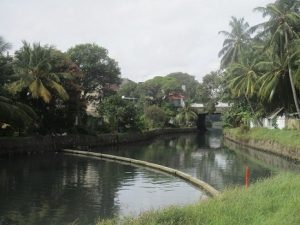
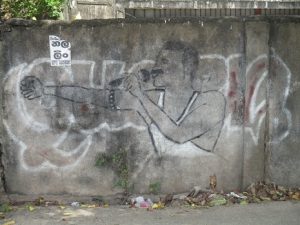
Anyway, a few days ago, taking advantage of the fact that Sri Lanka’s most recent Covid-19 lockdown has been lifted, I went for a walk and ended up at the area where Colombo’s Dehiwala Canal meets with the Indian Ocean. It’s a pleasantly grassy and leafy neighbourhood although, thanks to the condition of the water in the canal, it’s a bit smelly too.  And lo and behold, on a wall standing at the canal’s southern bank, I saw further evidence of the global love for Queen.


Yes, it was a mural of Freddie Mercury in his moustached, short-haired, white-vested Live Aid incarnation, which presumably someone had painted after seeing Bohemian Rhapsody in 2018.


As I’ve suggested in this post, I have mixed feelings about Queen overall.  But the fact that in the 21st century a Sri Lankan graffiti artist was inspired to paint their iconic vocalist and master showman on an out-of-the-way, canal-side wall makes me feel strangely happy.