I’ve been thinking a lot about temples recently – maybe because, with the dire condition of the world these past few weeks (mainly due to US President Greg Stillson, sorry, Donald Trump), I’ve felt like I need a sacred place to retreat to and meditate in, away from the trials and tribulations of modern life. Or just to pray in, for salvation.
Anyway, it’s occurred to me that I’ve visited loads of temples over the years, in loads of countries. So, this is the first post in a series where I describe my favourite ones.
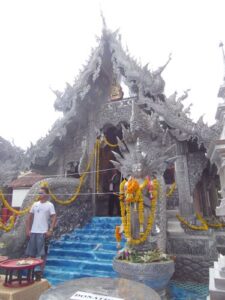
The northern Thai city of Chiang Mai has larger and grander temples than Wat Sri Suphan. However, this particular one, located some way south of the city centre, down a lane off Wualai Road and in the district containing Chiang Mai’s silversmith trade, is my favourite temple there. That’s because of its key building, the ubosot (the ordination hall). Since 2008, the neighbourhood’s silversmiths have worked on decorating its exterior and interior, and fashioned adornments in silver, aluminium and nickel, so that today it stands as a spectacular, shining showcase for their skills.
The building resembles a gothic armadillo, encased in concave slabs of silvery-tiled roofing that bristle with serpentine blades (bai raka) and pointed sculptures. Its outside walls are covered in a fascinating array of engravings. There are emblematic images for Asian nations with large Buddhist populations like Cambodia, Indonesia, Laos, Malaysia, Myanmar, the Philippines, Vietnam, Thailand itself, and my current place of abode, Singapore. However, when I visited the temple in 2018, I was living in Sri Lanka and I was slightly perturbed to find no representation of that country (which is mostly Buddhist). I hope they’ve rectified that omission since then.
Also adorning those outside walls are pictures of iconic historical landmarks from around the world like the Great Wall of China, the Leaning Tower of Pisa and the Roman Colosseum; pictures of the Seven Wonders of the Ancient World; the animals of the Chinese Zodiac; and, weirdly and unexpectedly, the Hulk, Spiderman, Captain America, Iron Man and various other characters from the Marvel superhero universe. Actually, this was a pre-taste of the surprises that awaited me when I entered the building.
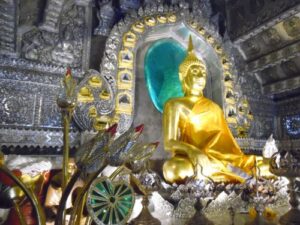
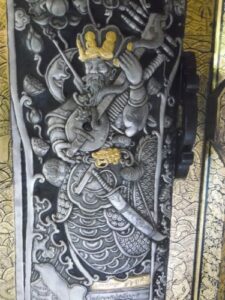
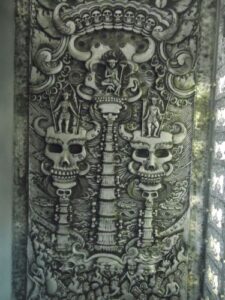
As a place of ordination, the inside of the hall is off-limits to women. So, armed with my better half’s camera, I ventured in and snapped as many pictures as I could for her. The gleaming Buddha at the far end of the room gives the interior a feeling of levity and serenity, but if you turn around to the walls and study some of their details, the effect is rather different. It’s gloriously, at times crazily baroque and over-the-top.
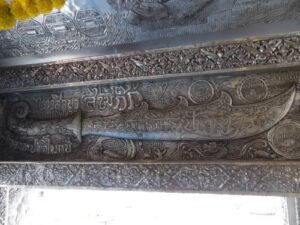
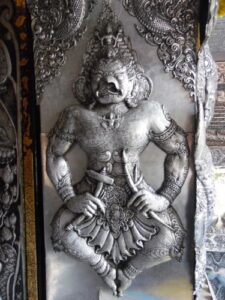
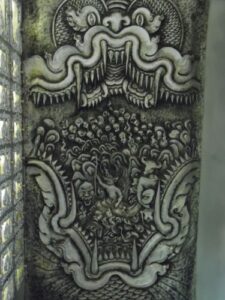
Among the silvery adornments are a huge, barbed and intricately inscribed sword; a creepy-looking garuda (a part-human, part-human creature of Buddhist mythology, much featured in Thai religious architecture); a huge gaping maw rimmed with needle-like fangs and containing a whole crowd of ghouls and demons; and a couple of crowned and bearded Thai mermen. Indeed, the amount of blades, shields, skulls, devils and monsters on display made me feel that I wasn’t so much inside a temple as inside a silver reproduction of a heavy metal fan’s bedroom.
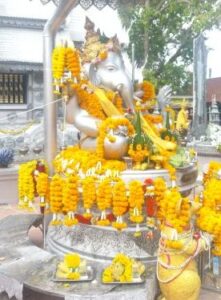
Finally, outside again, you’ll see seated under a big shiny parasol a statue of the elephant-headed Hindu god Ganesha, looking resplendent amid copious yellow garlands. In Thailand, Ganesha is known as Phra Phikanet and among the qualities he’s associated with are creativity and success. No wonder they have him decorating the insignia for the country’s Department of Fine Arts.