Weird Penguin: Claimed!


© Penguin Books


In 2024, Penguin Books launched its Weird Fiction series.  So far, this series has consisted of five classic titles: Robert Chambers’ The King in Yellow (1895); William Hope Hodgeson’s The House on the Borderland (1908); Gertrude Barrows Bennett’s Claimed! (1920); Algernon Blackwood’s Ancient Sorceries; and a collection of well-known stories of the weird by the likes of Edgar Allan Poe, H.P. Lovecraft, W.W. Jacobs, May Sinclair, M.R. James and Sir Arthur Conan Doyle called Weird Fiction: An Anthology (2024).  When I saw these books on sale in my local bookstore, I bought the two by Gertrude Barrows Bennett and Algernon Blackwood, which I hadn’t read before.


A while back, I posted my thoughts on Blackwood’s Ancient Sorceries.  Here’s what I made of Bennett’s Claimed!


While the content of Ancient Sorceries could be described as horror with a strong dose of the weird, Claimed! is a banquet of weirdness with the occasional plate of horror placed here and there.  It’s a short novel whose plot hinges around a strange box – “an oblong, bluish-green box, about a dozen inches long by half as many wide, highly polished, but severely simple of workmanship.  Its sole decoration was a single short line of characters belonging to some foreign language, which had apparently been incised across the top with an engineer’s tool and the lines filled in with scarlet enamel.”  The box won’t open and the inscription has a disconcerting habit of disappearing from its top surface and reappearing on its bottom surface, making those who possess it wonder if they’d turned the thing upside down without remembering doing so.


Ownership of the box passes from a mad sailor to a shopkeeper, who soon becomes mad, and then to a wealthy and irascible old industrialist called J.J. Robinson.  The latter doesn’t quite tip over into madness, but he certainly develops an unhealthy obsession with the box and with deciphering its secrets.  After an assault by a mysterious nighttime intruder, Robinson is left ailing and bedridden, though he insists on keeping the box by his side: “…he sank back, clasping the thing right to his breast…  ‘I got it!’ he croaked.  ‘What I want I get, and – what I get I keep! They can’t take it away from – old Jesse Robinson!  Nobody – can take it!  You – hear me?’”


At this point, Robinson’s niece Leilah and a young doctor called John Vanaman get involved in the strangeness while they try to care for the stricken but uncooperative old man.  Vanaman realises something odd is afoot when he sits by the slumbering Robinson’s bed one night and has a vision whereby a sea-tide seems to sluice in under the door and across the floor, even though he’s “sitting in the bedroom on the second floor of a house in Tremont, over fifty miles from the Atlantic shore.”


Even worse, something unspeakable enters the room with that impossible tide: “That which was in the room beneath the tide, and which had pushed the tide hither – before it, now gathered, took form, and rose up, sudden and monstrous…  Exactly what shape it had, Vanaman could not later clearly remember.  He could recall only his own fear and intuitive sense of it as a thing of awful force and of a potential destructiveness terrific beyond finite comprehension.”


Bennett sets up this scenario in the first 20 pages of the novel and it’s great, phantasmagorical stuff.  Alas, the mid-section of the book is less gripping.  There are a few incidents that set the pulse racing, such as a mysterious suicide and a bit where a hapless spiritualist tries to help, only to get her come-uppance.  But mainly it’s about the romance that inevitably brews between Leilah and Vanaman while they look after Robinson and try to work out what’s wrong with him.  As the straightforward, clean-cut hero and heroine of the story, they aren’t terribly interesting – and neither is their romance.


However, after the plot has become bogged down in Robinson’s mansion, page 65 sees a dramatic and welcome shift of gears.  Restored, the old man informs Vanaman: “We’re going to sea, my son.”  The action then shifts to a ship Robinson has chartered in order “to meet the party that wants my property, fair and square.”  He’s referring to the people, or beings, who created the box and who belonged to an ancient land that long ago sank below the ocean during a natural cataclysm.  In due course, we’re introduced to the Jack-London-esque character of the ship’s master, Captain Tom Porter – “well known and liked among the blunt, outspoken fraternity of his own kind” – and his hardy crew.  Happily, these new characters and the new locale give the novel a second wind.


There follows an unexpected abduction, a stirring nautical chase, and an impressively psychedelic finale wherein the protagonists cross a portal in time and space.  And this ties up all the mysteries surrounding the box…  Well, at least, I think it does.  For a 127-page novel, there’s been an awful lot going on.


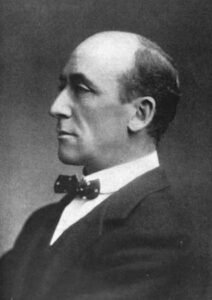
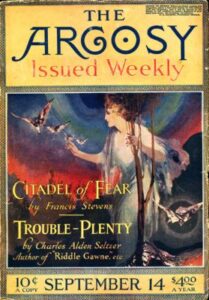
One nice thing about Claimed! was that it introduced me to its remarkable author, whom I hadn’t heard of before.  The Minneapolis-born Gertrude Barrows Bennett spent her adult life working as a stenographer, but for three years from 1917 to 1920 – a fraught period when she had to support both a daughter and an invalid mother – she also earned money as a writer.  She had short stories and novellas published in magazines like Argosy and All-Story Weekly and produced four novels: The Citadel of Fear (1918), The Heads of Cerberus (1919), Avalon (1919) and finally Claimed!  According to her Wikipedia entry, her writing ceased when her mother passed away and she was suddenly under less financial pressure.


Brief though her writing career was, Bennett did enough for the noted science-fiction critic and historian Sam Moskowitz to hail her as “the great woman writer of science fiction in the period between Mary Wollstonecraft Shelley and C.L. Moore.”  And though there’s debate about whether or not the legendary H.P. Lovecraft – who started his writing career around the same time she did – was aware of and influenced by Gertrude Barrows Bennett, there’s so much mind-boggling weirdness present in Claimed! that it wouldn’t surprise me if he was.
 

From philsp.com

Weird Penguin: Ancient Sorceries


© Penguin Books


In 2024 Penguin books inaugurated its Weird Fiction series, which to date has seen the republication of five venerable titles: Robert Chambers’ The King in Yellow (1895), William Hope Hodgson’s The House on the Borderland (1908), Gertrude Barrows Bennett’s Claimed! (1920), Algernon Blackwood’s Ancient Sorceries and a collection, Weird Fiction: An Anthology (2024).  Well, I assume Weird Fiction: An Anthology is a new collection, but it consists of some venerable short stories.


I’d already read those first two novels and most of the tales in the anthology, whose line-up includes such well-kent scribblers as Edgar Allan Poe, H.P. Lovecraft, W.W. Jacobs, May Sinclair, M.R. James and Sir Arthur Conan Doyle.  But I hadn’t read the Bennett and Blackwood books.  Recently, their striking covers – illustrated in pastel colours, especially pink – caught my eye while I was in a Singaporean bookshop I frequent, Kinokuniya Books in Orchard Road’s Takashimaya Shopping Centre, and I wasted no time in buying them.


Here are my thoughts on the volume by Algernon Blackwood.  I’ll write about the Gertrude Barrows Bennet one later.


Ancient Sorceries contains five stories, the title one plus A Psychical Invasion, The Nemesis of Fire, Secret Worship and A Victim of Higher Space.  All feature Dr John Silence, described in the book’s blurb as “Physician Extraordinary… the greatest occult detective of the age.”  Yes, Silence is what in modern parlance we’d call a ‘paranormal investigator’ – but when the paranormal manifests itself in malevolent forms, he also battles against it.


Series of stories about occult detectives have been common in horror fiction… and I have to say I have a problem with them.  That problem is one of believability.  You can swallow the notion of the hero having one dramatic encounter with the supernatural in one story, maybe even of them having a second dramatic encounter with it in a second story.  But when that hero deals in story after story with supernatural jiggery-pokery, cropping up in different forms – ghosts, werewolves, poltergeists, whatever – it becomes almost impossible to take seriously.  That’s especially so when you consider how most human beings go through their lives with no contact at all with what might be defined as ‘occult’ or ‘paranormal’.  (During my many years on the planet, I’ve had one strange experience, lasting all of half-a-minute, which I couldn’t explain and which, if I was so inclined, I could attribute to the supernatural.)  This means a writer of such tales has to show a great deal of skill in making them seem plausible.


Also implausible is the idea that the occult detective, a mortal human being, can constantly take on dark forces of immense, unnatural power and triumph over them.  The success rate for the heroes of these stories suggests that the forces of darkness are, in reality, pretty weak sauce.


The afore-mentioned William Hope Hodgson wrote stories about an occult detective called Carnacki the Ghost Finder, first published as a collection in 1913.  He managed, I feel, to get away with it.  Hope Hodgson helped make his tales more believable by interspersing the ones where the threat was genuinely supernatural with ones where, Scooby Doo-style, it turned out to be a hoax.  Also, his usual narrative device – Carnacki told each story to a group of mates with whom he’d just had dinner – helped too, since it’s possible Carnacki could be exaggerating what happened or even just making it up.


On the other hand, I’ve read a few stories that the prolific pulp writer Seabury Quinn wrote about a French occult detective called Jules de Grandin and found them bloody awful.  (It doesn’t help that de Grandin’s patois – “Sang du diable…!  Behold what is there, my friend…  Parbleu, he was caduo – mad as a hatter, this one, or I am much mistaken!” – is closer to Inspector Clouseau than Hercule Poirot.)


Usually, the best I can hope for is to regard the stories as out-and-out fantasies – which is the case with Manley Wade Wellman’s stories of Silver John, set in the Appalachian Mountains.  Or as ‘silly but fun’ – the reaction I had to Alice and Claude Askew’s stories about Aylmer Vance (‘Ghost-seer’).  But in no way do I find them scary.


Blackwood, in his day a celebrated author, journalist, broadcaster and, generally, someone who ‘lived the life’ – his CV includes stints as a farmer, hotelier, barman, model, secretary, businessman and violin teacher and he was also a Theosophist and eager outdoorsman – has a big reputation as a writer of chilling stories.  The literary critic S.T. Joshi lauded his fiction as “more consistently meritorious than any weird writer’s except Dunsany’s”, and anything by him I’ve read before now I’ve found impressive.  I was thus looking forward to seeing how he would tackle this subgenre and its believability issue.


From wikipedia.org / © The Outlook


In fact, I’m afraid the trouble with a couple of the stories in Ancient Stories is that Blackwood is so keen to make them appear believable that he over-compensates.  They end up with more prose in them is necessary.  They would have been more digestible if they’d been a dozen pages shorter.


The title story, Ancient Sorceries, is a case in point. Dr John Silence doesn’t feature much in this one.  He just interviews its main character, Arthur Vezin, about some strange experiences and passes comment at the end.  Vezin was travelling by train across northern France when, impulsively, he decided to get off at a remote station, stay in the locality for the night and resume his journey the next day.  (A quiet sort, Vezin had been put off his train journey by the unwelcome presence of many noisy tourists, mainly ‘unredeemed holiday English’.)  Vezin ended up staying in a little town that seemed normal on the surface but, of course, had weird things going on underneath.  A mysterious mental torpor began to affect him.  Rather than get the next day’s train, he remained in the town longer and longer and became increasingly listless:


“It was, I think on the fifth day – though in his detail his story sometimes varied – that he made a definite discovery, which increased his alarm and brought him up to a rather sharp climax…  At the best of times he was never very positive, always negative rather, compliant and acquiescent; yet, when necessity arose, he was capable of reasonably vigorous action and could take a strongish decision.  The discovery he now made that brought him up with such a sharp turn was that this power had positively dwindled to nothing.  He found it impossible to make up his mind…”


Alas, Blackwood’s description of Vezin’s gradual – very gradual – descent into this torpor goes on for too long.  He’s trying to make it sound realistic and credible, but as you read it over several pages, you feel a similar torpor taking possession of your senses.  Things admittedly liven up near the end, but the climax feels like it’s been a long time coming.


Also guilty of this is The Nemesis of Fire, whose action takes place on a remote English country estate, involves artefacts from ancient Egypt and features a fearsome fiery phenomenon that causes things, and people, to burst into flames.  This is narrated by one of Silence’s associates and immediately we’re reminded of a Sherlock Holmes story being told by Holmes’ loyal sidekick, Dr Watson.


This time, too much prose is spent describing, and adulating, Silence’s character.  For example: “His voice had that quiet mastery in it which leads men to face death with a sort of happiness and pride.  I would have followed him anywhere at that moment.  At the same time his words conveyed a sense of dread seriousness.  I caught the thrill of his confidence; but also, in this broad light of day, I felt the measure of alarm that lay behind.”  Yes, this helps us believe Silence is a remarkable man, capable of taking on and defeating supernatural horrors.  But again, it goes on too long.  Sir Arthur Conan Doyle made it plain that Watson greatly admired Holmes, but did so economically and didn’t let it get in the way of the actual story.


That said, the other three tales in this volume are fine.  The Psychical Invasion is a sturdy haunted-house story that benefits from a novel idea.  Rather than bring a team of ghost-hunters with him into the house, Silence comes accompanied by a cat and dog – working on the belief that animals are more sensitive to the paranormal than humans.


Secret Worship is about a man returning to a monastic school in the mountains of southern Germany where he studied as a child – again, this is a ‘Silence-lite’ entry where the detective remains in the background most of the time – and is increasingly disturbed by the hospitality he gets from the brothers / teachers there.  I thought it was the strongest story of the lot, a masterpiece of mounting unease.


The last tale, A Victim of Higher Space, is agreeably wonky and I wonder if a young Ian McEwan read it prior to writing his short story Solid Geometry, which featured in his early collection First Love, Last Rites (1975).


One thing that’s slightly annoying about this book is its incompleteness.  For some reason it omits a sixth Silence story, The Camp of God.  This is included in an earlier collection, The Complete John Silence Stories (2011), which comes with an introduction by S.T. Joshi.  I can’t understand how a publishing company as mighty as Penguin allowed that sixth instalment to slip through the net.


© Dover Publications