Films I’d like to see remade (Part 1)


From imdb.com / © Rank Organisation


I still find it disconcerting when films I enjoyed in my youth are remade in the 21st century: for example, 1980’s The Fog (remade in 2005), 1981’s The Evil Dead (remade in 2013) and Clash of the Titans (remade in 2010), 1986’s The Hitcher (remade in 2007), 1987’s Robocop (remade in 2014) and 1988’s Hairspray (remade in 2007).  My immediate and automatic response to such remakes is, “What, they’re remaking that movie already?  Have you no shame, Hollywood?”


This is followed by a feeling of horror as I realise just how long ago it was when those original movies were released.  The first Evil Dead movie was 32 years old – 32 years! – when its remake surfaced, though in my mind it was only yesterday when Sam Raimi’s Deadites made their first-ever appearance and started making life difficult for Bruce Campbell.   And actually, three of the films I remember most fondly from my youth, Philip Kaufman’s Invasion of the Body Snatchers (1978), John Carpenter’s The Thing (1982) and Brian De Palma’s Scarface (1983) were remakes themselves.  Body Snatchers appeared just 22 years after the 1956 original and The Thing appeared 32 years after its 1950 one.  Scarface was an outlier, since the first Scarface came out in 1932, more than a half-century earlier.


Maybe I shouldn’t be so concerned about how soon after the original movie that a remake appears.  I should be concerned about the quality of it – for remakes tend to be shite.  I haven’t seen all those mentioned at the beginning of this entry, but the ones I have seen have been nowhere near as good as the originals.  (The Evil Dead remake probably comes closest, but I still much prefer the ramshackle and low-budget, but resourceful, charm of Raimi’s 1981 film.)  That said, remakes don’t have to be bad all the time – the aforementioned ones by Kaufman, Carpenter and De Palma testify to that.


So, without further ado, here are some films – and one series of films – I wouldn’t mind seeing remade in the 21st century, with bigger budgets and better special effects.  But remade decently.
 

From wikipedia.org / © Rank Organisation


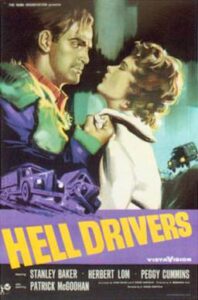
Hell Drivers (1957)

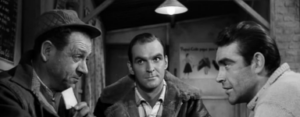
Blacklisted by the House Committee on Un-American Activities in 1951, American director Cy Endfield moved to Britain where, half-a-dozen years later, he made Hell Drivers.  Given the persecution Endfield had suffered, it unsurprisingly takes a dim view of American-style, cut-throat capitalism.  It has that underrated but magnificent actor Stanley Baker as an ex-con who finds a job as a truck driver with a dodgy haulage company, which threatens its drivers with the sack if they don’t deliver loads of gravel across treacherous roads at breakneck speeds.  The reason there aren’t more drivers employed to relieve the pressure, and reduce the danger, is because of a scam involving the local depot manager (William Hartnell) and its off-his-head Irish foreman (Patrick McGoohan, coming across like a brawnier version of Shane MacGowan).  The latter soon becomes Baker’s nemesis.


As well as a political message, Endfield injects Hell Drivers with an American-style grittiness rarely seen in British films of the period.  But what really makes the film a joy to watch nowadays is the cast.  As Kim Newman has written of it in Empire Magazine, “how many other movies have an ensemble which includes the original Dr Who (Hartnell), the first James Bond (Sean Connery), the Prisoner (McGoohan), a Man From UNCLE (David McCallum), a Professional (Gordon Jackson), Clouseau’s boss (Herbert Lom), plus Alfie Bass, the excellent Peggy Cummins (of the cult items Gun Crazy and Night of the Demon), the inimitably boozy Wilfrid Lawson, Jill Ireland and Sid James?”


In 2026, with capitalism more cut-throat than ever, a remake of Hell Drivers would be timely.  I don’t think, though, setting it in the wilds of Middlesex, West Sussex and Buckinghamshire, where the original was filmed, would work now, so it’d have to have its hard-pressed truck drivers pounding the roads of a less hospitable locale – the Alaskan tundra, say, or somewhere that retains some near-impenetrable tropical rainforest.


And to pay proper homage to the original, you’d definitely need a cast made up of actors who’ve played iconic roles in iconic TV shows or movie series.  You could have one of the grittier Bonds (Daniel Craig or Timothy Dalton), one of the grittier Doctors Who (Christopher Eccleston or Peter Capaldi), plus a Sherlock Holmes (Benedict Cumberbatch, maybe), a Harry Potter (Daniel Radcliffe), perhaps someone from the Breaking Bad universe (Bryan Cranston, say, or Bob Odenkirk)…  The possibilities are endless.


From wikipedia.org


The Margaret Rutherford Miss Marple movies (1961-64)

This is a little different.  I’d like to see the four movies made about Agatha Christie’s genteel sleuth of a certain age, Miss Marple, which had the delightful Margaret Rutherford in the leading role – Murder She Said (1961), Murder at the Gallop (1963), Murder Most Foul (1964) and Murder Ahoy! (1964) – rebooted as a TV show.  Not just another show about Miss Marple per se – there have been ones with Joan Hickson, Geraldine McEwan and Julia McKenzie – but one set in the universe of the four Rutherford movies.


Thus, its episodes would be set against the tableau of early-1960s England, with Miss Marple depicted as an obstinate, feisty old lady who refuses to know her place and keeps barging into and solving mysteries.  There’d be as much as humour as tension and the show would have the films’ supporting characters, like the timid librarian Mr Stringer (Rutherford’s real-life husband Stringer Davis), who reluctantly helps Miss Marple out, and the exasperated copper Inspector Craddock (Charles Tingwell), who begins each instalment telling her to mind her own business but ends it taking orders from her.  Meanwhile, Ron Goodwin’s jaunty Miss Marple Theme would burble in the background.


I suspect in a 2026 version Mark Gatiss would make a lovely Mr Stringer, while Daniel Mays would nicely fill the shoes of the long-suffering Inspector Craddock.  But who would play Miss Marple – or more precisely, play Margaret Rutherford playing Miss Marple?  Perhaps Dawn French, though she’d have to spend a long time in the make-up chair to recreate Rutherford’s famously jowly, hangdog features.


In the original movies, each murder that Rutherford / Marple investigated involved a British institution – a country manor, horse riding, the theatre and the Navy.  She’d duly rattle establishment cages by sticking her nose in where it wasn’t welcome.  So perhaps each episode of this hypothetical series would have her ruffling the feathers of other British institutions of the time – the Army, the House of Lords, Savile Row, Crufts, the country’s nascent rock ‘n’ roll industry…  Miss Marple meets the young Rolling Stones?  I’d pay good money to see that.
 

From wikipedia.org / © 20th Century Fox


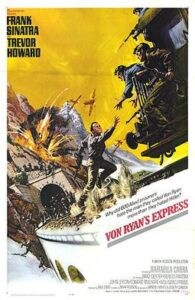
Von Ryan’s Express (1965)

I never had much time for Frank Sinatra, neither as an entertainer nor as a person, but he left an impression on my 10-year-old self the first time I saw the ripping World War II yarn Von Ryan’s Express.  It’s the story of an American airman, Ryan (Sinatra), downed in Italy, who joins forces with some Allied prisoners of war, led by Trevor Howard.  They attempt an audacious escape into neutral Switzerland by seizing control of a train and steering it up a railway line into the Alps.  Much derring-do is involved as German troops and aircraft go all-out to stop them reaching their destination.


It’s great, crowd-pleasing stuff until the ending – spoilers are coming! – which is depicted on the movie poster, painted by the great Frank McCarthy.  The train has almost made it to safety.  Having fought a rearguard action against the Germans, Sinatra is running after the train and has almost caught up with it.  But then….  What happened next put a dampener on things.  But it also lodged the film in my mind forever.


With 2009’s Inglourious Basterds, Quentin Tarantino showed his love for rip-roaring if cheesily improbable World War II adventures, so perhaps he could helm a remake of Von Ryan’s Express?  To stick to the innocent, uncomplicated spirit of the original, though, he’d have to forgo his use of the F-word and N-word, and his fetish for close-ups of ladies’ feet, and his nerdish references to ‘film-study criticism of the work of German director G.W. Pabst’.
 

© Hammer Film Productions / Seven Arts Productions


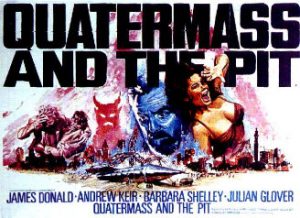
Quatermass and the Pit (1967)

Hammer Films’ sci-fi horror film Quatermass and the Pit was based on the 1958 BBC TV serial of the same name.  Both film and serial were written by Nigel Kneale.  It begins with workers on a London Underground extension project digging up an alien spacecraft full of dead, horned, insect-like creatures that are identified by scientist-hero Professor Bernard Quatermass (Andrew Keir) as inhabitants of the now-lifeless planet Mars.  It transpires that millions of years ago, these sneaky Martians arrived on earth and did some evolutionary tinkering on the apes who were the ancestors of modern humanity.  This tinkering included implanting in the apes an urge to conduct occasional culls whereby those with pure Martian programming exterminated those who’d developed mutations and lost that programming.


When some TV news crews descend on the scene, a power surge from their camera-cables reactivates the spacecraft and it triggers a new cull.  London becomes an apocalyptic hellscape where the human inhabitants who retain their Martian conditioning roam around, zombie-like, and use newly awoken telekinetic powers to kill everyone who’s lost it.


I still find Quatermass and the Pit impressive today, and scary, though inevitably there are special effects that reflect the limitations of Hammer’s budget.  I’d relish the prospect of a modern, big-budget retelling of the story.


One thing that makes the film effective, and affecting, is Kneale’s portrayal of the scientists.  Unlike usual movie-scientists, they aren’t cold-blooded, delusional, self-serving or plain weird.  Instead, Quatermass and his colleagues, Dr Roney (James Donald) and Barbara Judd (Barbara Shelley), are portrayed as decent human beings, working with an eager curiosity, a sense of duty and a sense of humour.  Keir and Donald were both Scots, so maybe a modern movie could cast Brian Cox as Quatermass and James McAvoy as Dr Roney.  Actually, I think a third Scottish actor, Karen Gillan, would be excellent as Barbara Judd.


To be continued…


© Metro-Goldwyn-Mayer

When Stan was the man


From YouTube / © BBC


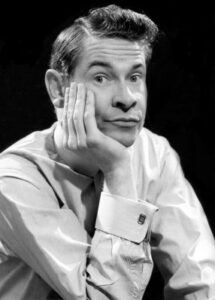
The great Scottish comic performer Stanley Baxter passed away earlier this month at the venerable age of 99.  Newspaper obituaries for him noted that, though he was a bright star indeed in 1970s British television, by the late 1980s his star had seemingly vanished from the firmament.  He’d gone.  It was almost as if he hadn’t been there in the first place.


As a result, one obituarist wrote, it was unlikely that anybody under the age of 40 in modern Britain had heard of him.  That does seem strange.  I can remember his TV shows being, in their day, very big events.  Over two decades, he only made six series – four of the Stanley Baxter Show between 1963 and 1971, one of the Stanley Baxter Picture Show in 1972 and one of the Stanley Baxter Series in 1981.  But during the intervening years, he staged several lavish, one-off specials that kept his face in the public consciousness, especially in the 1970s.  And his viewing figures were huge.


The reason Baxter himself gave for his abrupt disappearance during the 1980s was that his shows, full of song-and-dance extravaganzas and loving reproductions of old movie classics, became too expensive to make.  In particular, the television executive John Birt – once described memorably by playwright Dennis Potter as a ‘croak-voiced Dalek’ – had a hand in pulling the plug on him.  “It’s not that we don’t like your work,” he told Baxter. “It just all costs so much.”


It probably didn’t help that the type of entertainment Baxter was obviously smitten with, and slavishly reproduced and fondly parodied in his shows, had started to seem old-school by the 1980s.  Much of his material was drawn from the black-and-white days of Hollywood and he clearly took pleasure of impersonating the likes of Marlene Dietrich or Shirley Temple.  He also commonly referenced a former era of British cinema and theatre when accents were cut-glass and upper lips were stiff and he poked gentle fun at people like Sir John Gielgud and Noel Coward.  But by the time of his later shows, the audience familiar with those reference points was surely ageing.  A younger generation had arrived, more attuned to the 1970s New Hollywood movies of Martin Scorsese and Francis Ford Coppola and the blockbusters of George Lucas and Steven Spielberg.  Maybe Stanley Baxter’s TV career simply reached the end of its natural lifespan.


Incidentally, offscreen, Baxter was a quiet man who avoided publicity.  This was partly due to the fact he was gay and for a long time he worried about the world finding out – sadly, he worried about this well after the point when most British people no longer gave a damn whether someone was gay or not.  Anyway, by the 1980s, he was entering his sixties and probably welcomed retirement and being out of the public’s gaze.


I have to say, watching some of his sketches now, I find myself agreeing with a comment posted below one of the recent obituaries.  The comment-writer said he thought much of Baxter’s TV work was ‘clever’ rather than ‘funny’.  In fact, technically, those sketches are sometimes astonishing.  Baxter played all the parts in them.  However, because the digital compositing technology didn’t exist at the time to layer several images of him together in the same shot (and older techniques like multiple exposure and split-screen effect weren’t very convincing), the sketches were filmed from multiple camera angles with Baxter in different roles at different times.  Copious use was made of filmed-from-behind body doubles and much editing was done afterwards.  They must have been meticulously planned and taken ages to put together.  No wonder, most years, we only saw him in a one-off special.  Also, their writing was smart and Baxter’s impersonations were impeccable.  But as far as comic value is concerned – well, I find myself smiling, perhaps chuckling, at them at best.


An example is his spoof of Upstairs Downstairs, the masters-and-servants-in-a-big-house costume drama that aired on British TV from 1971 to 1975 and was the Downton Abbey (2010-15) of its day.  Baxter’s take on it is surprisingly meta.  The servants downstairs are discussing how many of the toffs upstairs have been written out of the scripts recently and replaced by new characters played by bigger-name stars.  Surely, they think, that can’t happen to them, since they’re all played by sturdy, salt-of-the-earth character actors?  But it does – the punchline comes when housekeeper Mrs. Bridges is informed that she’s about to be replaced by Glenda Jackson.  As usual, Baxter plays everyone during the eight-minute sketch and his impersonation of the starchy butler Mr. Hudson (in the real Upstairs Downstairs played by Baxter’s fellow Scot Gordon Jackson) is absolutely spot-on.  But while I might be full of admiration by the end of it, I haven’t done much laughing during it.


From wiki.scotlandonaire.com


In his sketches, Baxter plays women as well as men and his female impersonations are frequently great.  British comedy has a long tradition of men dressing up as women: the Carry On movies (1958-92), Monty Python (1969-74), The League of Gentlemen (1999-2002, 2017), Little Britain (2003-6), Dick Emery, Benny Hill, Les Dawson and practically every pantomime ever.  But those drag acts were invariably grotesque, their grotesqueness designed to provoke laughter.  Baxter, though, delights in making his female characters as believable and, well, feminine, as possible.  The novelist and critic Anne Billson responded to Baxter’s death the other day by observing how she now can’t watch Barbra Streisand singing Don’t Rain on My Parade in Funny Girl (1968) without thinking of Baxter impersonating Streisand and singing that song on one of his shows.  I have no doubt that Baxter as Streisand was awesome.


For me, Stanley Baxter’s work was funnier when it left the showbiz world behind and focused on other things – especially things inspired by his Scottish roots.  I fondly remember a sketch from one of his last specials, in the mid-1980s, wherein a strict Free Presbyterian clergyman (played by mighty character actor Andrew Keir) in the Scottish islands is enraged to hear sounds of partying coming from a house.  It’s Sunday – the Sabbath.  When he confronts the little old lady (Baxter) living in the house, she pertly informs him, “Oh, but we’re not dancing.  We’re having an orgy.”  She then describes a game being played inside.  “The men-folk take all their clothes off and stand in a long line…  The women are blindfolded and they have to identify the men by touch.”  She invites the clergyman in, saying, “As a matter of fact, your name has come up twice.”


Also Scottish were perhaps his greatest achievements, the Parliamo Glasgow sketches, filmed in the manner of TV language-learning programmes of the time.  The characters perform a skit in the target language, then change to English and inform the viewers about some of the useful words and phrases they’ve just heard.  This being a Stanley Baxter piss-take, however, the target language is Glaswegian and the skits involve such expressions as “Thatzum bahookey yu-voan-yu” or, fabulously, “Zarra marra oanra barra, Clarra?”  When the instructors switch to English, it’s in the ridiculously posh tones of Received Pronunciation (then a requirement for British TV presenters): “Again, an amorous young lady might use the word romantically to her bashful lover – ‘Zarra bestye kindae?’”


This fascination with language, dialect and accent informs another Baxter sketch, involving Nationwide (1969-83), the current affairs TV show broadcast on weekday evenings that consisted of reports from the BBC’s newsrooms across the regions and nations of the United Kingdom.  The joke is that each presenter in each newsroom, in Belfast, Leeds, Cardiff and so on, speaks the local dialect there so strongly that nobody else can understand them.  Finally, the programme switches to the main newsroom in London – where its presenter speaks with such exaggerated Received Pronunciation that he’s unintelligible too.


Though his television fame faded elsewhere in Britain, Baxter remained a name in Scotland.  Throughout his career he’d appeared in Scottish pantomimes and in the 1980s and early 1990s he starred in a number of productions at Glasgow’s King’s Theatre: Cinderella (1980-81), Mother Goose (1983-84), Aladdin (1986-87) and, again, Cinderella (1991-92).  I remember that last production getting much attention in the Scottish press because it was billed as his farewell to the stage.  His pantomime work was often done in tandem with another Scot, Angus Lennie, who was best known for playing Steve McQueen’s sidekick, the ill-fated Archibald Ives, in The Great Escape (1962).  Baxter and Lennie’s performances as the Ugly Stepsisters in Cinderella are legendary.


From YouTube / © BBC


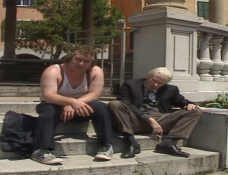
He also turned up in Fitba, a 1990 episode of the Scottish TV sitcom Rab C. Nesbitt (1988-99, 2008-14).  Here, he plays an elderly man, at death’s door, who’s a football fan.  He’s so determined to see the Scottish men’s football team perform in the 1990 World Cup before he passes that he pays the titular character, the garrulous though rough-and-tumble Rab C. Nesbitt, to take him to the country hosting the tournament, Italy.  Baxter’s character is decrepit and moribund and Rab is understandably sceptical about the undertaking.  But he gradually wins Rab’s respect with his determination to make the most of what he has left.  “My time is precious,” he tells Rab in Rome.  “I’m taking a taxi into town.  Then I’ll walk to Via Garibaldi and into Palazzo Doria Tursi to see, among other treasures, Paganini’s violin.”  When he asks about Rab’s plans that afternoon, and is told he’ll maybe get a pizza, he retorts, “A pizza?  In Italy?  My, you’re full of ideas!”  Thanks to Scotland’s recent qualification for the 2026 World Cup in North America, I was thinking about this episode and Stanley Baxter just a few days before he died.


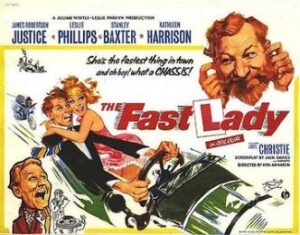
Finally, he featured in a handful of movies too: Geordie (1955), Very Important Person (1961), The Fast Lady (1962), Crooks Anonymous (1962) and Father Came Too! (1963).  Decades later, he was one of the many people (also including Vincent Price, Donald Pleasance, Anthony Quayle, Joan Sims, Kenneth Williams, George Melly and Joss Ackland) who did voice-work for Richard Williams’ legendary, but never properly finished, animated epic The Thief and the Cobbler (1993).


As a kid, I loved The Fast Lady, though I daresay I’d find it juvenile and knockabout if I saw it today.  But what a sublime cast it has – Baxter as the bumbling hero, Julie Christie as the woman he’s in love with, James Robertson Justice as Christie’s irascible and deeply disapproving father, and Leslie Philips as Baxter’s smooth best friend who tries to aid him in his love-life but only makes matters worse.


Ah, it makes me nostalgic.  Who would you get in a British comedy film nowadays?  Danny bloody Dyer – if you’re lucky.


© Independent Artists / Rank Organisation / Continental Distributing