Spying economy class


© Gardner VI Books AMS006


So it’s farewell to Len Deighton, the author, military historian, screenwriter, illustrator and gastronomist who passed away on March 15th at the venerable age of 97.  As a tribute, here’s something I wrote a few years ago after I’d finally got around to reading The IPCRESS File (1962), the spy thriller that made Deighton’s name and supposedly provided an antidote to the more romanticised spy novels popular at the time featuring a certain James Bond.


Regular readers of this blog will know that I’m a James Bond buff.  Because of this, I’d wanted for a long time was get my hands on a copy of Len Deighton’s 1962 spy novel The IPCRESS File – my interest in it being that it’s often touted as the anti-Bond.


Whereas 007 is a posh ex-public schoolboy with oodles of money and charm at his disposal, Harry Palmer, spy hero of The IPCRESS File, is an unprivileged and ordinary-seeming bloke with only his working-class wits to help him negotiate the hazardous, occasionally dangerous world of espionage.  Whereas Bond swans around in glamorous international locations enjoying the finest in cuisine, liquor and cars, Palmer trudges the lugubrious streets of London peering at the rain and pigeons through an oversized pair of glasses.  Whereas Bond wins ladies’ hearts with his unflappable insouciance, Palmer gets dumped on by his superiors for his insolence, which to them signifies that he’s a troublesome oik who doesn’t know his place.


But hold on.  That’s the impression I always had of Deighton’s character thanks to seeing in my youth the 1965 film version of The IPCRESS File, which featured in its lead role that impeccably deadpan man of the people Michael Caine.  (At least, he was a man of the people until the 1970s, when he started moaning about having to pay tax.)  It was a surprise, then, to finally open the original novel recently and discover that it wasn’t what the film version had led me to believe.  It wasn’t quite as different from the Bond novels as I’d expected.


I should qualify that by saying I’m talking in terms of characterisation, not in terms of plot.  For unlike the straightforward, action-adventure plot dynamics of the average Bond novel, the narrative of The IPCRESS File is a twisty, at times head-scratching thing that produces plenty of surprises about who’s working for, and spying on, whom.

 

© Lowndes Productions / Rank Organisation


Anyway, firstly, forget about Harry Palmer.  The hero of Deighton’s novel goes through its 250-odd pages without ever revealing his name.  Early on, somebody calls him ‘Harry’, but he immediately muses: “Now my name isn’t Harry, but in this business it’s hard to remember whether it ever has been.”  All we have is an anonymous narrator recounting events with a laconic turn of phrase whilst giving few clues about his personality and background.  In other words, the main character in The IPCRESS File is a cypher, an empty space into which readers can project their own personalities and so imagine themselves at the centre of the intrigue.


A cypher was pretty much what James Bond was too – not so much a properly-rounded character as a device for drawing in the reader.  His creator Ian Fleming was careful not to give him too much individuality.  This policy extended from his bland name (famously borrowed from the ornithologist who wrote the book Birds of the West Indies) to his lack of a life-history – it was only in You Only Live Twice (1964), the last novel published in Fleming’s lifetime, that we learn much about it and even then it turns out that Bond was orphaned at an early age, i.e. denied anything as character-forming as a family background.


Being a blank canvas isn’t the only thing that Deighton’s protagonist has in common with Bond.  Both their jobs involve some globe-trotting.  Now this came as a shock to me after seeing the film The Ipcress File – unlike the book, ‘Ipcress’ isn’t capitalised in its title – which determinedly confines its action to the British capital.  However, the book sees him pursue a kidnapped scientist to Lebanon – resulting in a deadly blunder that the film has happening in a London car-park – and later being posted to a Pacific atoll that the American military have commandeered in order to observe and measure the explosion of a neutron bomb.  The Pacific episode, set in a remote and inhospitable fragment of the tropics that the Americans have converted into a base containing “two athletic fields, two movie theatres, a chapel, a clothing store, beach clubs for officers and enlisted men, a library, hobby shops, vast quarters for the Commanding General, a maintenance hangar, personnel landing pier, mess hall, dispensary, a PX, post office, a wonderful modern laundry and a power plant”, is at times so odd and surreal it doesn’t so much resemble a spy story as something by J.G. Ballard.


And like Bond, the hero of the literary IPCRESS File has refined taste buds.  We variously see him tucking into ‘Russian tea and apple strudel’, ‘Dgaj Muhshy (chicken stuffed with nutmeg, thyme, pine nuts, lamb and rice and cooked with celery)’, ‘totem poles of lamb, aubergine, onion and green pepper’, ‘iced Israeli melon’ and ‘fine lobster salad and carefully-made mayonnaise’.  Even his sandwiches seem classy by 1962 standards, consisting of ‘cream cheese with pineapple, and ham with mango chutney… with rye bread’.  Admittedly, this theme appears too in the film, which has a scene where Caine’s Harry Palmer bumps into a superior in a shop and is chided for paying “ten pence more for a fancy French label” of button mushrooms.  The disdainful superior adds: “You’re quite a gourmet, aren’t you, Palmer?”


The character’s enthusiasm for a quality meal reflects a similar enthusiasm on his creator’s part.  Indeed, when he was still working an illustrator, Deighton spent four years producing Cookstrips for the Observer newspaper.  These were what nowadays we’d call ‘infographics’.  Each presented a recipe for a particular dish, with pictures, arrows and a minimum of text making the preparation process as simple and clear as possible.

 

From Wikipedia / © Harper Collins


Where Deighton’s hero and Fleming’s hero part ways is in their relationships with their employers.  While Bond seems at ease in the secret service, Deighton’s character lacks the wealthy and privileged background that most of his colleagues and superiors have.  And he isn’t impressed by what that background has produced.  He begins the novel working for Military Intelligence under a man called Ross, “a regular officer, that is to say he didn’t drink gin after 7.30 P.M. or hit ladies without first removing his hat.”  Ross, we hear, has given him plenty of ‘toffee-nosed dressing downs’ and at one point he rambles at inordinate length about his huge and lavish garden.  “Ross,” the perplexed narrator breaks in, “Mrs Laing and Dorothy Perkins are roses, aren’t they?”


Early in The IPCRESS File, though, he’s transferred from Ross’s unit to a civilian intelligence department of the Home Office called the WOOC(P).  Not that he’s much happier with the person in charge there, a character called Dalby who’s “an elegant languid public-school Englishman of a type that can usually reconcile his duty with comfort and luxury.”  When Dalby asks him if he “can handle a tricky little special assignment,” he retorts, “If it doesn’t demand a classical education I might be able to grope around it.”


Having to work with people from moneyed backgrounds presents him with another problem.  His superiors don’t seem to appreciate the fact that he needs a steady income and regular payment of expenses to survive.  When he switches from Ross’s outfit to Dalby’s, he wonders how long he “would have to make the remnants of this month’s pay last before the new scale began.”  Later, he complains that he’s “still two months behind with pay and three with allowances” and that “a claim for £35 in overseas special pay” was “overdue by ten and a half months.”


This also surfaces in the film, with Ross and Dalby (played by Guy Doleman and Nigel Green) depicted as a pair of condescending bowler-hatted toffs who view Palmer as an irritant with ideas above his station.  But the unflattering commentary about Britain’s class system is diluted slightly by the addition of a military theme.  Ross and Dalby are both of upright army-officer stock while Palmer, we hear, had an inglorious time in uniform.  (I assume that as an ordinary soldier he was caught up in illegal black-market activities in Germany, though I could be wrong.)  Anyway, he’s spent time in a military prison and might be thrown into one again if he gets on the wrong side of his employers.


Thus, Palmer’s insolence isn’t just the result of a general social resentment – it comes too from a particular resentment against an institution, the army, that’s blighted his past and could potentially blight his future.  Meanwhile, the film plays down his financial frustrations and shows him protesting instead against the needless bureaucracy of his work.  Dalby, for instance, insists on a lengthy report being written after every excursion he makes ‘into the field’.


Incidentally, James Bond gets the best of both worlds.  He’s well-bred enough to know his way around a flashy casino or expensive golf club, and is choosy about what he eats, drinks and drives, but he knows how to avoid coming across as an arse when mingling with ordinary working folk.  Note how easily he gets into conversation with a pub landlord in Moonraker (1955), say, or with Tiffy, the bargirl at the bordello in The Man with the Golden Gun (1965).  As Henry Chancellor puts it, he’s a ‘snob about things’ but not ‘about people’.


To sum up then, I found the hero of Len Deighton’s The IPCRESS File rather more Bondian than I’d anticipated.  But what distinguishes him from Ian Fleming’s super-spy is class.  One has an ample supply of it.  For the other, it’s the bane of his bloody life.

 

From Wikipedia / © David Rose / The Daily Telegraph

The literary Bond revisited: Moonraker


© Penguin Books


As a ten or eleven-year-old kid I read a lot of Ian Fleming’s James Bond novels.  Indeed, I read most of them before I ever saw any of the films.  However, it was only a few years ago, after Penguin Books brought out new editions of the novels, using the same covers that’d graced them in the 1950s and early 1960s and having contemporary writers like Val McDermid write introductions to them, that I got round to reading the novels I hadn’t come across in my boyhood – Moonraker (1955), The Spy Who Loved Me (1962), On Her Majesty’s Secret Service (1963) and Octopussy and the Living Daylights (1966).   I also reread a few of the novels I’d read at a young age which, for one reason or other, had gone over my head or not left much of an impression – I still vividly remembered Live and Let Die (1954) or You Only Live Twice (1964) from those far-off days, but almost nothing of Diamonds are Forever (1956) or The Man with the Golden Gun (1965).


And in the case of From Russia With Love (1957)…  Well, as a kid, I started reading it, but unfortunately at the time I was staying at my grandmother’s house in rural Northern Ireland.  My grandmother noticed I had my nose stuck in a book, insisted on reading the blurb on its back cover and confiscated it from me, saying she didn’t think it was suitable reading matter for someone my age.  To rub salt into the wound, she then started reading it herself.  “I’m really enjoying it,” she told me a few days later.


Anyway, here is the first in a series of posts in which I describe my reactions to the Fleming / Bond novels I’ve read or re-read in the 21st century.  Starting with Moonraker.


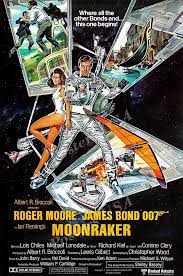
It’s difficult to approach Moonraker the novel without having your brain fogged by memories of Moonraker the 1979 movie, which for good or bad – well, bad, actually – was a milestone in the James Bond cinematic franchise.  The Bond movies had become increasingly absurd over the years and by 1979 both the filmmakers and cinema audiences were firmly aware of their silliness. But with Moonraker, those filmmakers – Cubby Broccoli and his team – seemed to abandon all restraint.  It was as if they decided, “The audiences know that we know the movies are silly…  And we know that they know…  So, let’s have a ball!”  The result was that Moonraker, which has James Bond (Roger Moore) blasting off in a space shuttle and taking on an orbiting space station full of villains, also blasted off into whole new realms of galaxy-sized daftness.


Apart from the far-fetched science-fictional plot (which might have had something to do with the success of a certain movie called Star Wars two years earlier), the stupidity includes the hulking, steel-toothed villain Jaws (Richard Keil), who’s not only invulnerable to mishaps such as falling out a plane and hitting the ground without a parachute or having a cable-car crash down on top of him, but who’s also given a cringe-inducing, comedic love interest.  But even the business with Jaws pales into insignificance compared to the sequence where Bond escapes from some baddies in Venice using a gondola that transforms into a speedboat and then into a hovercraft, whose appearance in St Mark’s Square causes a pigeon – yes, a pigeon – to do a double-take.  I remember the movie critic John Brosnan writing that at that moment he concluded “the Bond series had gone about as far down the tube it could possibly go without reaching China.”


© Eon Films


But… Trying to erase all thoughts of the movie, I started reading the book from 24 years earlier.  Unlike the film version, whose plot ricochets between the USA, Italy, South America and outer space, the novel’s action takes place entirely in England, where immensely rich industrialist, stockbroker and rocket-designer Sir Hugo Drax has built a base, with a launch site, on the south coast.  From this he intends to test-fly a new missile called the Moonraker, potentially a valuable new means of defence against the Soviet Union.  Bond first crosses paths with Drax at Blades, an exclusive and opulent London gentleman’s club, where he discovers he’s been cheating at cards.  This suggests he’s less saintly than the adoring British media has made him out to be.  Later, Bond is sent to investigate the death of a security officer at Drax’s base, where he finds further, and much more serious, evidence that Drax is a bad ’un.  In fact, Drax is an embittered former Nazi, now employed by the USSR, who plans to fit a nuclear warhead into the Moonraker and send it ploughing into downtown London during its test flight.


During his mission, Bond joins forces with a policewoman called Gala Brand, who’s working undercover at the base.  After Drax’s goons make a couple of unsuccessful attempts to eliminate them, they manage to thwart the scheme by sending the Moonraker off course.  Rather than striking London, it niftily lands on top of a submarine transporting Drax and his minions back to the Soviet Union.  The novel ends on a rather un-Bondian note, however.  Gala Brand reveals to 007 that she already has a fiancé and isn’t about to swoon into his arms.  So, instead, Moonraker’s final line is: “He touched her for the last time and they turned away from each other and walked off into their different lives.”


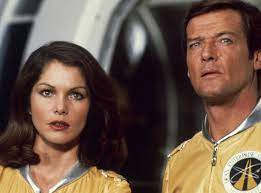
In Moonraker the film, Gala Brand is replaced by an American heroine called Holly Goodhead, played by Lois Chiles.  (Goodhead… Get it?  Goodhead…?)  In fact, according to jamesbond.fandom.com, poor Gala is “the only lead female character of the Fleming canon not to have appeared as a character in a James Bond film”, which is puzzling given the quip-friendly nature of her name.  I could just imagine Roger Moore hoisting a crinkly eyebrow at her and intoning, “Well, this is going to be a Gala affair…” or “I know where I’d like to Brand you…”


© Eon Films


Reading Moonraker, what struck my 21st century self was the shadow that World War II casts over the plot.  It has a heavy bearing on the characters – not just on the villainous ex-Nazi Drax, who draws on German V2 technology for his missile project and intends to destroy London as revenge for his country’s defeat in 1945, but on minor ones like the lift operator in the secret-service headquarters who lost an arm during the conflict.  And of course, there are references to how Bond served in the war himself and has scars on his back to prove it.  I didn’t notice this so much when I read other Bond novels in the 1970s probably because, then, the war didn’t seem so far back in time.  I knew middle-aged people who had vivid memories of it.  And it was still being enacted on television in countless documentaries, comedies and dramas like The World At War (1973-74), Dad’s Army (1968-77), It Ain’t Half Hot Mum (1974-81), Secret Army (1977-79) and Colditz (1972-74), and the stories in practically every boys’ comic on sale in the newsagents at the time – Victor, Battle, Warlord – dealt with nothing else.  Indeed, there were probably some kids my age who believed we were still fighting the Germans.


And no doubt the war, or more specifically the war’s aftermath, played a part in the Bond novels’ huge success in the 1950s.  Those six years of conflict had broken Britain’s economy and Fleming’s readers inhabited a drab, grey world of rationing and austerity.  I recall a remark J.G. Ballard made in his memoir Miracles of Life (2008), about leaving Shanghai and arriving in Britain for the first time in 1946.  Taking his first steps on the soil of his home country, Ballard wondered why the British claimed to have won the war.  From the worn-out faces and rundown landscapes around him, it very much looked like they’d lost it.  Another pertinent quote is one made by Keith Richards, who said that growing up in early 1950s Britain was like living in black and white.  Only when rock ‘n’ roll arrived from America did life suddenly switch to being in colour.


But reading Moonraker, I also realised how far Bond is removed from the dreary reality of post-war Britain.  Fleming portrays him as a shameless consumer, one with a seemingly inexhaustible shopping budget.  He wears the most expensive labels, smokes the costliest cigars, drinks the finest wines and spirits, helps himself to the fanciest foods.  Accordingly, Bond’s first encounter with Drax in Moonraker is in the club Blades, whose service, food-and-drink and furnishings were things that most of Fleming’s 1950s readers could only dream about.  Though Fleming was accused of marketing watered-down pornography in his books, it surely wasn’t pornography of a sexual or violent nature that titillated his readers so much at the time.  It was consumer porn, intended to give a perverse, if futile, thrill to underfed and down-at-heels readers who were still carrying ration books.


Mind you, the fact that Moonraker’s plot is confined to 1950s England didn’t go down well with those readers who’d started reading the Bond books – Moonraker was the third in the series – for the pleasure of being transported in their imaginations to exotic locales, which in real life they lacked the financial means to visit themselves.  My trusty copy of Henry Chancellor’s guide to the novels, James Bond: The Man and his World (2005) tells me that “Fleming received a number of letters from disappointed readers complaining that Kent, even on the most glorious English summer’s day, did not compare with the tropical heat of the Caribbean.  ‘We want taking out of ourselves,’ declared one old couple, who read Bond novels to each other aloud, ‘not sitting on the beach in Dover.’”  Fleming took note of the complaints.  None of his later novels restricted Bond to English soil.


© Hammer Films


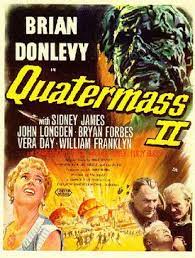
I have to say that nowadays Fleming’s descriptions of Drax’s base and its technology sound decidedly low-fi.  The references to ‘gyros’, ‘radio homing beacons’, ‘ventilation tunnels’ and, indeed, ‘rockets’ had me thinking of some old black-and-white British sci-fi movie.  They particularly made me think of the Hammer film Quatermass 2 (1957), which features both rockets and a big secret base where the villains – aliens – hang out.  For their depiction of the base, the filmmakers used the sprawling and suitably eerie oil refinery at Thurrock in Essex for location shooting, and I imagined Bond and Gala battling Drax and his minions against a similar backdrop.


On the other hand, one element of Moonraker’s plot that feels more relevant than ever is its notion that a super-rich tycoon could become so enthused about, and involved in, developing futuristic rocket technology.  I can think of one billionaire… no, two billionaires… no, three billionaires in 2023 whose fascination with space-going vehicles is like that of little boys with toy train-sets.


Finally, even as a ten or eleven-year-old, one thing I did pick up from Fleming’s novels was a sense of Bond’s melancholia – a melancholia that wasn’t hinted at in the movies until the tenures of Timothy Dalton and, later, Daniel Craig in the lead role.  You get this in Moonraker at the very beginning, with Bond calculating how many more missions he has to go on before he can retire from the secret service and what the odds are for surviving that number of missions.  Retirement for Bond, I was shocked to discover, comes at the age of 45.  Yikes, I thought.  If I’d been an agent in Fleming’s version of MI6, I’d be way beyond pensionable age now.


So, readers of post-war Britain, forget the thrills and spills, and forget the fine living and exotic locations, and forget the fancy cars and beautiful women.  Even Commander Bond has reasons to gripe about his lot.