Democracy dies in Donald-grovelling


From wikipedia.org / © The Washington Post


What would you say to Epstein survivors…?


You are so bad.  You are the worst reporter.  No wonder CNN has no ratings.  She’s a young woman.  I don’t think I’ve ever seen you smile.   They should be ashamed of you.”


On February 4th, CNN reporter Kaitlan Collins was cut off in the middle of a question about the victims of Jeffrey Epstein, notorious paedophile, human trafficker and friend to the rich and famous, at a White House press conference.  Cutting her off was President Donald Trump, coincidentally someone who receives, according to the New York Times, 38,000 mentions in the Epstein files so far released by the US Department of Justice.  Evidently, in Trump’s mind, you need to smile when you ask questions about victims of paedophilia and human trafficking.


I find his objection ironic considering that for the last 21 years Trump’s been married to Melania Trump, a woman on whose visage – gimlet-eyed and as smooth, hard and unyielding as an iron bedpan – anything resembling a smile rarely flickers.  Obviously, though, if you were expected to share a marital bed with Trump, your face wouldn’t be projecting sunbeams and rainbows either.


Lately, Melania Trump has been in the news because of the release of a new documentary movie about her.  Entitled Melania, it focuses on her during the run-up to her husband’s second inauguration as president.  Jeff Bezos’s Amazon paid 40 million dollars for the rights to the documentary – 28 million of that reportedly going straight into Ms. Trump’s pocket – and another 35 million to advertise it.


Reviews of Melania have not been, shall we say, overly enthusiastic.  The last time I checked the review aggregate site Rotten Tomatoes, its ‘Tomato-meter’ had it at seven percent.  William Thomas at Empire magazine advised, “Do try not to choke on your popcorn.”  Sean Burns at North Shore Movies observed, “At least Leni Riefenstahl could frame a shot.”  Mark Kermode at Kermode and Mayo’s Take – The Brand New Podcast described it as “the most depressing experience I have ever had in the cinema.”  He added, “I mean, I’ve seen A Serbian Film (2010), I’ve seen Cannibal Holocaust (1980), I have never felt this depressed…  I thought it was absolutely repugnant.”


By the way, the director of Melania is Brett Ratner, who in 2017 was accused of sexual assault and harassment by six women, accusations he’s denied.  In photos recently released from the Epstein files, he appears sitting on a sofa beside the late, loathsome paedophile, both of them cuddling young women.  The women’s faces are blocked to protect their identities, so you can’t tell how young they are.


I should also say that Melania made seven million dollars on its opening weekend, a decent haul for a documentary.  Obviously, it appeals to a certain audience in the USA, i.e., cultish MAGA dingbats so worshipful of her husband they’d spend a fortune on eBay to acquire pieces of his used toilet paper, which they’d then frame and hang prominently in their living rooms.  However, it still looks like it’ll be a long time before Amazon recoups anything like the 75 million dollars it invested in the movie.

 

From wikipedia.org / © White House


In totally unconnected developments during Trump’s first year as 47th president, the Orange One signed an executive order relaxing environmental rules about space launches (benefiting Bezos’s private space venture Blue Origin); signed an order preventing US states from enforcing their own AI regulations (benefiting Bezos’s AI start-up Project Prometheus); and generally created a oligarch-friendly climate that’s allowed Bezos and fellow magnificoes Elon Musk and Mark Zuckerberg to increase their collective wealth by approximately 250 billion dollars.


But I don’t know why Bezos would take a financial hit by getting involved in Melania, a vanity project that nobody apart from those hardcore MAGA nutters would pay money to see.  I really don’t know.


In other, totally unconnected news last week, the Washington Post, a once-respected newspaper whose motto is ‘Democracy dies in darkness’, and which broke the story about the Watergate scandal that brought down Richard Nixon’s presidency in 1974, has announced a ‘strategic reset’.  This reset involves showing a third of its current workforce the door.  It’s also “ending the current iteration of its popular sports desk… restructuring its local coverage, reducing its international reporting operation, cutting its books desk and suspending its flagship daily news podcast Post Reports.”  The loss of the Washington Post’s books desk means it’ll no longer publish its literary review supplement Book World.


The Washington Post has been on a downward spiral this past year, a spiral of its – or its proprietor’s – own making.  Previously, and unsurprisingly, it’d not been enamoured with Trump.  As 2024’s presidential race neared election day, however, and with Trump looking likely to regain the White House and launch his glorious new thousand-year Reich, the Washington Post’s editorial board was ordered not to publish an editorial endorsing Kamala Harris, Trump’s rival for the presidency.  As a result, more than 200,000 disgusted readers – eight percent of its 2.5 million-strong readership – cancelled their digital subscriptions to the newspaper.


After the announcement of the Washington Post‘s downsizing, its legendary Watergate  reporter Bob Woodward lamented, “I am crushed that so many of my beloved colleagues have lost their jobs and our readers have been given less news and sound analysis.  They deserve more.”  Meanwhile, Trump’s Communications Director Steve Cheung crowed on Twitter, “Just a reminder that printing fake news is not a profitable business model.”


Earlier, the Washington Post’s proprietor had defended his decision to have the newspaper sit on the fence before the 2024 election, which’d started the rot.  He wrote: “Presidential endorsements do nothing to tip the scales of an election…  What presidential endorsements actually do is create a perception of bias.  A perception of non-independence.  Ending them is a principled decision, and it’s the right one.”  Aye, right.  That’s the principled thing to do.  When there’s a choice between a candidate who’s a convicted criminal and convicted sexual abuser and a candidate who isn’t, you say nothing.  Heaven forbid anyone perceives you as being biased and non-independent.

 

From wikipedia.org / © Van Ha, US Space Force


And who’s the proprietor of the Washington Post?  Oh look, it’s Jeff Bezos.  Funny that he should take a hit by alienating his newspaper’s natural readership and sending it down the toilet, just as he took a hit by shelling out 75 million dollars for a dud like the Melania movie.  It’s almost like he has an ulterior motive.  Almost like he’s trying to… curry favour with someone.


But seriously.  A while ago, I posted about “an unholy alliance of authoritarians, kleptocrats, fascists, media tycoons, tech bros and oil barons”, working hard “at stripping freedoms from those of us living in societies that,  until now, have retained some freedoms; at transferring another huge chunk of wealth from our dwindling coffers to their swelling coffers; and at burning and poisoning the planet we live on in their quest for profits whilst aggressively pushing the line that any science questioning this policy is a ‘hoax’.”  You see that here.  Bezos grovelling to Trump by financing his missus’s dreadful movie and nuking the Washington Post.  As a reward, Trump throwing him a few legislative and financial scraps from the White House table so he can carry on making pots of money for himself.


And with Bezos and his ilk embracing automation and Artificial Intelligence to maximise profits by eliminating human employees, and salaries, the future looks grim.  Journalists will soon go the way of lamplighters, elevator operators, switchboard operators and video store clerks.  News copy will be written by AI technology, controlled by billionaires, who’ll make sure that copy panders to their interests and those of their political allies.  And if there’s bad news they can’t avoid reporting, it’ll be blamed on those people not plugged into their extreme-right-wing, white-Christian-nationalist gestalt: blacks, Latinos, Muslims, Jews, atheists, gays, trans-people, liberals, socialists, trade unionists.


Education will be similar.  Teachers will disappear too and kids will be taught by AI, with the likes of Elon Musk deciding what’s in the curriculum.  Indeed, Musk has done a deal with El Salvador’s government to “bring his artificial intelligence company’s chatbot, Grok, to more than 1 million students across the country… to ‘deploy’ the chatbot to more than 5,000 public schools in an ‘AI-powered education program’.”  Yes, that’s Grok, the lovable chatbot that praises Hitler and puts tweens in tiny bikinis for the gratification of paedophiles, coming to a school near you to teach your kids.


The stinking rich and stinking powerful won’t only hoard wealth – they’ll hoard information too, whilst making sure only small, approved increments of it leak down to the masses they regard as their serfs and inferiors.  Especially manipulated will be scientific information about the climate catastrophe posing an increasing threat to our civilisation’s survival on this planet.  So that their environmentally-ruinous cash-generating projects, like power-guzzling and water-guzzling AI data centres, escape censure, they’ll suppress this information or bury it under an avalanche of counter-arguing pseudoscientific gibberish, or not collect it in the first place.


But let’s end positively.  While it’s sickening to watch America’s business magnates, corporations, media organisations, law firms and universities bend over supinely and lick Trump’s gruesome arse, the way ordinary Americans have reacted to his policies gives glimmers of hope.

 

© MS NOW


I’m thinking especially of Minneapolis.  Since December, the city has been overrun and brutalised by up to 3000 of Trump’s masked, violent, badly-trained thugs from Immigration and Customs (ICE) and Customs and Border Patrol.  Ostensibly, they came to crack down on fraud allegedly committed by Minneapolis’s Somali-American community.  In reality, as Wikipedia reports, they’ve assaulted, harassed and detained people  “on the basis of their alleged or suspected immigration status”, including “restaurant, airport and hotel workers, Target employees, children and families, Native Americans, students and commuters”, many of whom “have been US citizens, legal residents with work authorisation, or asylum seekers.”


This has disastrously impacted on the city’s businesses, schools and whole social fabric.  ICE was accused of violating at least 96 court orders during four weeks in January alone; and they’ve executed two citizens during peaceful protests, Renee Good on January 7th and Alex Pretti on January 24th.


Obviously, the operation was designed to intimidate Minneapolis – whose state governor is Tim Walz, Kamala’s running mate against Trump in 2024 – and intimidate liberal-leaning cities generally.  But local people are having none of it.  They’ve protested peacefully, organized strikes, alerted neigbours about approaching ICE patrols, monitored and filmed their activities, and provided support for people at risk from those activities by helping them get to their schools and places of worship unmolested, running errands for them and raising money for them.  They’ve stood by their fellow citizens in a display of decent, old-fashioned community values – values Trump would despise if his reptile brain could ever understand them in the first place.


One thing that particularly impressed and moved me was a viral clip showing a white-bearded old man protesting against ICE on a snowbound and teargas-fogged Minneapolis street on January 24th.  When a reporter and camera crew approached him, he raged, “I’m just angry.  I’m 70 years old and I’m f**king angry.”  Then, wearing neither mask nor goggles, he strode off through a billowing wall of teargas.


That furious but defiant old-timer, it transpired, was Greg Ketter, founder and proprietor of the Minneapolis independent bookstore DreamHaven Books and Comics.  The renowned sci-fi and fantasy writer Harlan Ellison once described DreamHaven as “a book-seeker’s cave of miracles”.


I find it inspiring to see a man who’s devoted a lifetime to books taking a stand against Trump, someone who brags about not reading as if it’s a badge of honour.  And by extension, against Trump’s billionaire toadies, currently trying to create an AI dystopia wherein novels and other human art-forms are replaced by soulless, AI-generated slop.  And against Trump’s toady at Amazon, Jeff Bezos, who’s just axed the Washington Post’s Book World, one of the very few literary supplements the American newspaper industry had left.

 

From wikipedia.org / © DreamHaven Books & Comics

Paul Thomas Anderson wins this battle


© Warner Bros. Pictures / Ghoulardi Film Company


The critics have, almost universally, lavished praise on One Battle after Another (2025), the new movie written and directed by Paul Thomas Anderson.  (Though he didn’t try to adapt it directly, Anderson’s script took some inspiration from Thomas Pynchon’s 1990 novel Vineland.)  The praise is richly deserved.  I went to see it in my local cinema a few days ago and, afterwards, I hadn’t felt so exhilarated by a film since watching Mad Max: Fury Road (2015) on a big screen a decade earlier.


Heading the movie’s cast is Leonard DiCaprio, who plays Pat, a bomb-maker involved in a revolutionary American group called the French 75.  The ’75 stick it to The Man by freeing recent Latin-American immigrants from detention centres and blowing up banks and the offices of right-wing politicians.  Surprisingly, the plodding, unshowy Pat has a relationship, then sires a child, with fellow-revolutionary Perfidia Beverley Hills.  Essayed by Teyana Taylor in a short but devastating performance, Perfidia is the opposite of DiCaprio’s character.  She’s a force of nature: loud, fearless and given to flamboyant gestures, like humiliating the sleazy commander of a detention centre by forcing him to jerk off in front of her.  It’s entirely in keeping with her character when she’s shown firing a machine gun whilst massively pregnant.


To put an end to the French 75, the authorities appoint the ruthless and immoral Captain Steven Lockjaw (Sean Penn), coincidentally the detention-centre commander who was made to have that embarrassing, public wank.  Lockjaw captures Perfidia and compels her to rat on her colleagues, and thereafter it becomes open season on the ’75, with most of them being arrested or – more often – summarily executed.  Pat and his now-infant daughter manage to escape with new identities (‘Bob and Willa Ferguson’) and end up living a low-key, mostly off-grid existence in a Californian town called Baktan Cross.  Pat / Bob decays into a booze and dope-raddled paranoid, terrified the past will catch up with them.  Wilma (Chase Infiniti) grows up with no idea of her real origins and becomes a teenager bemused by, and frequently having to nursemaid, her eccentric old dad.


15 years later, Captain Lockjaw is invited to join an Illuminati-like organization called the Christmas Adventurers Club, whose members belong to the white American elite and are wealthy, powerful… and extremely racist.  Lockjaw’s relationship with Pefidia in the days of the French 75 was more than one of pursuer and quarry.  He came to fetishise her, his obsession triggered by that first, masturbatory encounter, and they were briefly intimate prior to her capture – which highlights what a wild, try-anything-once character Perfidia was.  Now Lockjaw fears that he might be Wilma’s father, not Pat / Bob, and having a mixed-race daughter would obviously torpedo his chances of joining the Christmas Adventurers.  So he launches a military crackdown on Baktan Cross, ostensibly to round up illegal immigrants, but really so he can find Pat / Bob and the inconvenient Wilma and erase them.


© Warner Bros. Pictures / Ghoulardi Film Company


That’s the set-up established during One Battle After Another’s first quarter and it’s all you need to know.  What follows is a cinematic rollercoaster ride as Pat / Bob and Wilma, in separate locations when Lockjaw and his uniformed, heavily-armed goons crash into Baktan Cross, flee, hide, fight back and try to find each other and escape.  Along the way, they  encounter Sensei Sergio St. Carlos (Benicio del Toro), Willa’s local karate teacher who’s much more than he seems; a bounty hunter with a conscience (Eric Schweig); an assassin sent by the Christmas Adventurers to clean up Lockjaw’s mess (John Hoogenakker); some skateboarding radicals; a nasty far-right militia who dispose of people for money; and a secret enclave of nuns with guns


As you’ll gather from the synopsis, One Battle After Another is a politically charged movie.  It regularly focuses on how how the USA reacts to immigrants,  often impoverished, frightened and vulnerable people, both mistreating them and unscrupulously using them as pawns in power games and culture wars.  This is timely considering what Trump and his minions are doing at the moment.  It has to be said, though, that Lockjaw and the police and troops under his command go about their business with much more precision, organization and efficiency than the masked, clumping thugs in Trump’s Immigration and Customs Enforcement (ICE) agency have managed so far.  Predictably, you don’t have to look far on the Internet before you find negative reviews of the movie posted by far-right frothers, incensed by what they see as its Marxist / communist / socialist / radical-leftist leanings.


But as well as being political, One Battle After Another is very funny.  DeCaprio’s Pat / Bob may have been a revolutionary once, but for most of the movie he’s an amusingly grumpy and befuddled middle-aged dad, showing zero patience, say, for his daughter’s insistence that he respects her schoolfriends’ preferred pronouns.  Particularly funny are the scenes where, on the run from Lockjaw, he tries to phone what’s left of the French 75 to beg them for help.  He’s far from impressed when they demand he reels off an array of code-phrases to prove he’s who he says he is – codes he’s mostly forgotten during the past 15 years.  DeCaprio’s subsequent meltdowns are hilarious, though these scenes will strike a chord with anyone who, in the days before voice-recognition, tried to phone their bank but failed to cite the right security numbers.


The film makes interesting parallels between the French 75 and the Christmas Adventurers Club.  Though they’re positioned at different ends of society, at the bottom and at the top, both are shrouded in secrecy and pompous security protocols and both believe they are doing great works and bending history to their wills.  Seen from outside, though, they seem like two groups of overgrown kids who’ve set up gangs with stroppy rules about who gets to be ‘in’ and who doesn’t.


One Battle After Another features, perhaps, Leonardo DeCaprio’s best-ever performance.  His Pat / Bob character is an extension of Rick Dalton, the frustrated over-the-hill movie star he played in Quentin Tarantino’s Once Upon a Time in Hollywood (2019).  But while Dalton had his loyal buddy and stunt double Cliff Booth (Brad Pitt) to keep him from going off the rails, Pat / Bob has no one when the shit hits the fan.  His daughter Willa is elsewhere and he has to overcome his many insecurities and get his act together alone.  At the same time, DeCaprio convinces us that Pat / Bob, despite his chaotic nature, is a loving father.  It’s his desire to save her that keeps him going, no matter what fate throws at him.  And in this film, it throws a lot.


© Warner Bros. Pictures / Ghoulardi Film Company


He’s excellently partnered by Chase Infiniti as Willa.  Though in reality the actress is 25 years old, she convincingly plays a teenager – one who has her head well-screwed-on at the start of proceedings, but who still has to deal with a very steep learning curve.


Meanwhile, Sean Penn is splendidly villainous as Lockjaw.  He’s memorable both because of his grotesque physicality – with his contorted face, weird musculature and lurching gait, he looks like Popeye the Sailor Man rendered in human flesh – and because of his deeply screwed-up personality, which is simultaneously psychotic and pathetic and driven by a juvenile sense of entitlement.


Great though DeCaprio, Infiniti and Penn are, Benicio del Toro comes close to quietly stealing the show.  When he first appears, you see him as a character who’s popped up in DeCaprio’s movie.  But later, having learnt more about him – his character runs an extensive and meticulously-organised sanctuary and support-network for undocumented immigrants in the town – you begin to feel DeCaprio has strayed into his movie.


There’s also a lovely score courtesy of Radiohead’s Johnny Greenwood and, late on, a car chase that could become as legendary as the one in the Steve McQueen classic Bullit (1968).  And Paul Thomas Anderson handles things at all times with aplomb.


One Battle After Another should win a slew of Oscars at next year’s Academy Awards.  By then, though, Donald Trump may have banned all opposition parties in the USA and put the country under martial law, enforced by real-life Steven Lockjaws in ICE, the National Guard and various far-right militias.  So it might not.


If that proves to be the case, I can only say, “Viva la revolution!”


© Warner Bros. Pictures / Ghoulardi Film Company

It has happened here


© Renard Press


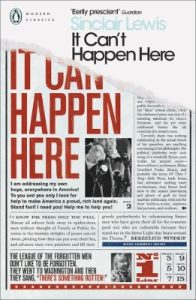
Nowadays, Sinclair Lewis’s It Can’t Happen Here (1935) feels like a story of alternative history, exploring what would have happened in the USA if the historical timeline had taken a twist in the mid-1930s it didn’t actually take.  But when Lewis wrote it, the real timeline and his imaginary one were in the future.  He was peeking ahead to the presidential election of 1936, one year after his novel’s publication, and wondering, “What if…?”  In its original context, then, It Can’t Happen Here was a work of science fiction, though the future imagined was so barely ahead of the present that it probably didn’t seem like that.


It gives me no pleasure to report that reading the book in the middle of 2025, with the USA sliding remorselessly towards authoritarianism under the presidency of Donald Trump, It Can’t Happen Here doesn’t feel dated.  No, it’s surely more relevant than ever.


The novel explores what could have happened if the 1936 election hadn’t been won by Franklin D. Roosevelt – who in fact won it resoundingly, garnering over 60 percent of the popular vote and securing over 98 percent of the electoral college.  In Lewis’s version of events, the presidency is won by a populist maverick called Berzelius ‘Buzz’ Windrip.  It’s commonly assumed Lewis based Windrip on the controversial Louisiana governor and US Senate member Huey Long.  In an ironic twist of fate, Long was assassinated one month before It Can’t Happen Here was published.  The son-in-law of a political rival shot him, though it’s been claimed Long actually died of a wound from a ricocheting bullet fired by one of his trigger-happy bodyguards, who immediately responded to the attacker by pumping him ‘full of lead’.


Early on in It Can’t Happen Here, we get to read Buzz Windrip’s campaign manifesto, The Fifteen Points of Victory for the Forgotten Men.  This is a grab-bag of crowd-pleasing promises – the government giving every family 5000 dollars a year (point 11) while wealth being capped at 3,000,000 dollars per person (point 5) – and nakedly racist, reactionary and jingoistic rhetoric.  You have to swear allegiance to the New Testament and the flag if you want a job in the professions (point 4), threats are made against the Jews (point 9) and blacks and women are disenfranchised (points 10 and 12 respectively).  Oh, and there’s a sneaky final point, number 15, wherein Congress and the Supreme Court have to cede all authority to the Presidency.


The manifesto is popular enough to put Windrip in the White House and, thereafter, the USA experiences a rapid fascist takeover similar to the one Hitler engineered in Germany in 1933-34.  Windrip soon has his own militia / secret police making sure everyone toes the line, media, educational and economic institutions are bullied into acquiescence, and opponents, dissenters and anyone else the regime takes a dislike to are herded into concentration camps – that’s what the novel calls them, several years before the Nazis made the term ‘concentration camp’ synonymous with evil on an industrial scale.


The country’s lurch into dystopia is seen through the eyes of Doremus Jessop, a 60-year-old, liberal-minded editor of a smalltown newspaper in Vermont.  Jessop finds out the hard way that the new regime doesn’t take kindly to criticism – he pens a scathing editorial, which leads to an altercation with some officials, which results in his son-in-law being executed.  Afterwards, he’s forced to do an about-turn with his paper’s editorials and news coverage and make it a propaganda mouthpiece for Windrip and his government, as every other official news outlet in America had become.


Later, a disgusted and horrified Doremus hooks up with a resistance movement, the New Underground, run by a dissident senator called Walt Trowbridge who’s escaped to and based himself in Canada, and he begins surreptitiously writing and distributing an anti-Windrip newsletter called The Vermont Vigilance.  Later still, Doremus and his associates are rumbled and they wind up in a concentration camp.  But the story isn’t quite over yet for the dogged old editor…


© Penguin Books


As I said earlier, when you read It Can’t Happen Here today, there’s an elephant in the room – a corrupt, authoritarian, orange-skinned elephant, one with a bad combover, a ludicrously long red tie, a big mouth, a small pair of hands, a tiny but cunning brain, a criminal record, and a penchant for cheating at golf.  Yes, it’s shocking how much Lewis’s novel anticipates what Trump is up to in America at the moment.


As with Trump and his Immigration and Customs Enforcement (ICE) agency, which is now better funded than most countries’ armies and is no doubt attracting into its ranks all sorts of far-right nutjobs, Windrip sets up a militia called the Minute Men (MMs) and recruits into it thugs and low-life who relish having the power to intimidate, bully, beat up and murder their neighbors.  Doremus’s life gets progressively harder as Shad Ledue – his former handyman, who’s a lazy, ignorant brute and who lusts after his youngest daughter – joins the local Minute Men and, gradually, shins his way up the pole until he becomes District Commissioner.  And Trump’s enthusiasm for creating ‘immigration detention facilities’, like the notorious ‘Alligator Alcatraz’ in Florida, mirrors Windrip’s enthusiasm for creating concentration camps, like the one Doremus latterly finds himself an inmate of.


It Can’t Happen Here makes much of the regime’s assault on academia.  Early on, Doremus receives a worried letter from an acquaintance at his old alma mater, Isiah College, warning about how its Board of Trustees is bending to Windrip’s malevolent will.  “What,” he asks, “can we do with such fast exploding fascism?”  Trump has famously tried to do the same with America’s universities – some, like Columbia University, groveling to him pathetically; others, like Harvard, putting up slightly more of a fight.


Windrip sees to it that the ‘most liberal four members of the Supreme Court resigned and were replaced by surprisingly unknown lawyers who called President Windrip by his first name.”  Trump, of course, has made sure that the present-day Supreme Court is packed with yes-men and yes-women.


And in an effort to bolster its authority, Windrip’s regime launches an operation to end ‘all crime in America forever’.  Criminals are “tried under court-martial procedure; one in ten was shot immediately, four in ten were given prison sentences, three in ten released as innocent… and two in ten taken in the MMs as inspectors.”  That sounds suspiciously like Trump’s recent takeover of Washington D.C., supposedly in the name of ridding the capital city’s streets of crime, though more likely to divert attention from the possibility that Trump’s name appears in the US Justice Department’s files investigating Jeffrey Epstein.


Generally, Lewis’s descriptions of how Windrip manages to captivate the American public, or a section of it sufficiently large to get him into power, are depressingly similar to how Trump weaves a spell over his ‘MAGA faithful’ – portraying himself as an outsider and anti-establishment figure, despite the fact he’s the son of a real-estate millionaire and has had everything handed to him on a plate.  Of Windrip, Lewis says: “…he was the Common Man twenty-times-magnified by his oratory, so that while the other Commoners could understand his every purpose, which was exactly the same as their own, they saw him towering above them, and they raised their hands to him in worship.”


Meanwhile, Lewis highlights how the regime puts in positions of authority people who are worthless but unswervingly loyal to Windrip.  That loyalty, of course, rewards them with wealth, power and prestige.  Trump too has populated his government with sycophantic mediocrities, self-serving grifters and dangerous incompetents like Pete Hegseth, Kristi Noem, Robert F. Kennedy Jr, Tulsi Gabbard, Pam Bondi and Marco Rubio.  Their single virtue, in Trump’s eyes, is their ceaseless willingness to bow, scrape and debase themselves before him.


There’s even a parallel with Elon Musk who, as the world’s richest man and CEO of the social-media platform X, has a massive ability to inform and misinform people and shape their opinions.  The It Can’t Happen Here version of Musk is Bishop Paul Peter Prang, a priest who makes a hugely popular and influential weekly address on the radio.  Like Musk’s voice on social media, Prang’s voice ‘circled the world at 186,000 miles a second’ and practically ‘leapt to the farthest stars.’  (Prang’s character was inspired by a real-life demagogue, the ‘Radio Priest’ Charles Coughlin.)  And like Musk with Trump, Prang enthusiastically backs Windrip for president – but gets short shrift from the man he’s championed once he’s across the threshold of the White House.  Though while Trump merely dropped and humiliated Musk, Windrip sticks Prang in jail and then in an ‘insane asylum’: “No one willing to carry news about him ever saw Bishop Prang again.”


All that said, It Can’t Happen Here is not a perfect book.  It has certain features that earn it the dreaded sobriquet ‘of its time’.  The focus is almost entirely on a handful of comfortably well-off white Americans and, though there are brief references to the horrors Windrip visits upon the black community, the book shows no interest in exploring these.  Also, Lewis makes mocking references to sexuality of Lee Sarason, Windrip’s Machiavellian campaign manager, who wears ‘violet silk pajamas’ and obviously has a fondness for strapping young men.  But no mention is made of the regime’s official policy towards homosexuals, which presumably would have been as murderous as Nazi Germany’s.  And male chauvinists will appreciate how Doremus gets to have his cake and eat it throughout the book, in that he’s simultaneously married to one woman, dull, frumpy Emma, and engaged in an affair with another, the bewitching firebrand Lorinda.  He’s never taken to task for this.


And the book’s tone can be awkward at times.  Lewis writes it in a folksy, sardonic, Mark Twain-like style that sometimes works, especially when its poking fun at the general hypocrisies, absurdities and idiocies of Windrip’s regime.  It works less well when it’s detailing the brutal realities of that regime – the tortures and humiliations, for instance, that Doremus has to endure while he’s in a concentration camp.  For subject-matter as bleak as this, I suspect the only way to record it is with the precise and dispassionate prose of, say, George Orwell’s 1984 (1949).


Sinclair Lewis’s It Can’t Happen Here may not quite make it into the top tier of great dystopian novels, then.  However, in 2025, you’re unlikely to read one that feels more terrifyingly prescient.


From wikipedia.org / © Touring Club Italiano