Nostalgic wallows 6: 1970s visions of the future


From wikipedia.org / © NASA / Josh Valcarcel


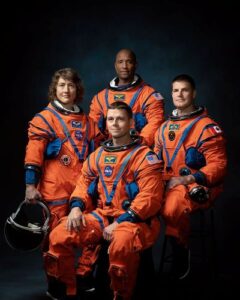
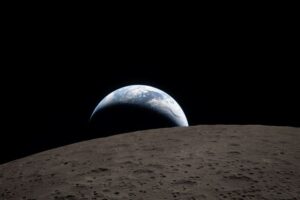
Three days ago, the crew of Artemis II returned to earth.  They had taken part in a lunar flyby mission launched by the United States’ National Aeronautics and Space Administration (NASA) that saw human beings leave low earth orbit and travel around the moon for the first time in over 50 years.  I would have posted something on this blog about Artemis II before now, but didn’t want to tempt fate.  “Let’s wait until they get back safely,” I thought.  The fact that the current US government, which gives NASA its orders, seemingly doesn’t give a f*ck about matters such as health and safety or, indeed, science generally made me worry the mission had been insufficiently prepped and might end in disaster.


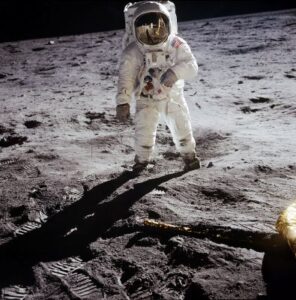
Happily, though, the Artemis II mission has been a resounding success.  It’s also made me think back to when I was a little kid, in the early 1970s, the last time that humans went to the moon.  In fact, it was in 1969, when I was three years old and NASA’s Apollo programme was underway, that the late Neil Armstrong became the first human to set foot on an alien world.  All right, it was only the moon, which is hardly in the same league as Krypton or Tatooine, but for a wee species that evolved out of the Homo genus just 200,000 years ago, Armstrong’s ‘small step’ 57 years ago was pretty impressive.


However, it has also made me wonder.  After all the excited expectations raised by the Apollo programme about space travel, how come the half-century between it and Artemis II has turned out to be so rubbish?


I’m too young to remember seeing Armstrong plant his spacesuit-encased foot on the lunar turf in 1969, but I can just about recall live TV pictures of a subsequent Apollo mission to the moon in the early 1970s.  Admittedly, I wasn’t altogether sure what I was watching.  At the time my family and I were huddled around a tiny black-and-white television in Northern Ireland, which only picked up one channel, the BBC.  (It showed a second channel, RTE, from the Republic of Ireland, if my Dad poked a screwdriver into a hole at the set’s side and did some awkward and potentially dangerous fiddling with the wiring.)  All I could make out on the screen were some fuzzy pale blobs floating against a fuzzy grey background.  However, my Dad assured me these were men walking about on the moon, high above us, at that very moment, so I took his word for it.
 

From wikipedia.org / © NASA


It must have been in 1973 that my imagination took a leap that was almost as giant as the ‘leap for mankind’ that Armstrong spoke of when he descended from the lunar landing module.  The cause of this were two sets of newly-published encyclopaedias that my parents had seen advertised somewhere and ordered – a 15-volume set with lemony-coloured covers called the Childcraft books that, accordingly, were for children; and a 24-volume set called the World Book series that were for adults and came in sombre, mossy-green covers.  That was 39 encyclopaedias in all and, amazingly, they fitted perfectly into the big display shelf that ran along the top of the sideboard in our living room.


I immediately set about reading these encyclopaedias, both the juvenile and adult ones, and my horizons were swiftly widened.  Not all the consequences of this were positive.  My parents had neglected to read the small print in the advertisement.  If they had, they would have discovered that the encyclopaedias had been printed in America, by Americans, for Americans, and their contents were duly biased towards America.  As a result, I wasted a lot of time searching in the fields of our farm for evidence that woodchucks, porcupines, prairie dogs and Gila monsters had been foraging there.  Also, some quaint words started to appear in my vocabulary – diaper, candy store, soda fountain, rest room – which inevitably had my classmates at primary school tearing the piss out of me.


One feature of these encyclopaedias that really rubbed off on me was that, because they were American and because they’d been published just after the moon landings, they were dripping with optimism.  And this was a scientific as well as an American optimism.  Yes, it’s hard to believe today, now that one of the two main American political parties is infested with far-right-wing religious fruitcakes who maintain that the universe was created in six days a few thousand years ago (and vaccines are bad, and manmade climate change is a hoax), but there was a time not long ago when America took science seriously and saw it as one of the key tools in converting the rest of the world to the glories of the American way.  At the age of eight or nine, I lapped all this up – even those assertions in the encyclopaedias that, with the benefit of hindsight, were a bit over-optimistic.


For example, the encyclopaedias predicted that, having reached the moon, it would only be a short time – the 1980s, at the latest – before human beings were tramping around the surface of Mars too.  The ‘S’ volume of the World Book encyclopaedias had a lengthy entry about ‘space travel’ and on one page I found a multi-pictured diagram showing how astronauts were going to get to Mars.  Admittedly, the Mars spaceship in that diagram, as well as having a long, sleek fuselage and a beak-like nose, had wings, which seemed a bit suspicious because by then I knew that in outer space there wasn’t any air and wings were thus superfluous.  (I suspect the artist behind those pictures had been unconsciously influenced by a non-space vehicle that was making a stir at the time, Concorde.)  Elsewhere, there were pictures of what a moonbase – only a few decades away in the future, I was told – would look like, although it was an unprepossessing cylindrical structure that resembled a giant tin can.


Anyway, I assumed this was what I could expect by the time I’d reached my thirties.  I’d be living on a moonbase, watching Concorde-like spaceships streak past on their way to Mars.


My expectations were buoyed further when in the mid-1970s my parents finally got round to buying a new TV set that got three channels, the BBC, RTE and ITV – Independent Television.  Although ITV had (and still has) a reputation for cheap and lowbrow programming in comparison with that made by the BBC, it did broadcast at the time various action / adventure series made by a subsidiary called ITC entertainment, run by the cigar-smoking impresario Lord Lew Grade.  Aimed at international markets and at the American market in particular, ITC’s shows commanded higher-than-average budgets and looked quite glossy by the standards of 1960s and 1970s British TV.  They included The Prisoner (1967-68), Department S (1969-70) and The Persuaders (1971) and a host of science-fiction shows made by the remarkable Gerry Anderson.  I was able to watch these for the first time.
 

From gerryanderson.com / © ITV Studios


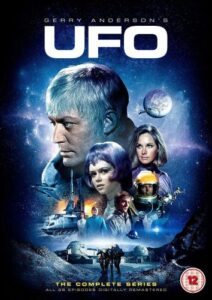
It was watching repeats of Anderson’s live-action sci-fi show, UFO, made in 1970 and starring Ed Bishop, George Sewell, Michael Billington, Peter Gordeno, Wanda Ventham (Benedict Cumberbatch’s mum) and Gabrielle Drake (Nick Drake’s sister), that convinced me that the future was going to be absolutely brilliant.  For UFO, Anderson’s production team envisioned the shape of things to come through a prism of gaudy late-1960s design and fashion, with a smidgeon of then-fashionable psychedelia.  It didn’t just feature spaceships and moonbases, but also sleek super-cars, talking computers with hallucinogenic panels of flashing lights, giant submarines with detachable nose-modules that turned into aircraft when they reached the ocean surface, guys in groovy-looking suits that didn’t have lapels, and ladies wearing silver miniskirts and sporting purple hairdos.


So, I thought, I’d be living on a moonbase, watching spaceships streak past towards Mars, and Gabrielle Drake would be shimmying around me looking fetching in silver and purple.  The future seemed better than ever.


Needless to say, as the 1970s wore on, I began to get uneasy about the fact that very little futuristic stuff was happening any more.  As far as manned spaceflight was concerned, not much occurred after the Skylab project – yes, there was the space shuttle, but that didn’t venture beyond earth’s orbit and, frankly, seemed a bit shit.  Meanwhile, the Viking 1 probe landed on Mars but, alas, found nothing interesting.  There were no aliens, Martian canals or H.G. Wells-style three-legged war machines shooting death-rays – just some boring geological formations that had once been river valleys.  And what had happened to that you-can-do-anything-if-you-put-your-mind-to-it American optimism?  It seemed to fizzle out as the 1970s became one long litany of American trauma: the Vietnam War, the 1973 oil crisis, Watergate and the Iran hostage saga.


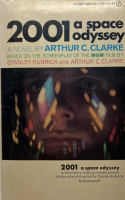
I still had hope, though.  In the mobile library that came to our village every week, I picked up a copy of Arthur C. Clarke’s novelisation of 2001: A Space Odyssey, the classic 1968 sci-fi movie he’d co-written with director Stanley Kubrick.  It was reassuring to read Clarke’s sober, matter-of-fact account of a journey from the earth to the moon and then on to Saturn.  (In Kubrick’s film, the final destination was changed to Jupiter because of the job of convincingly depicting Saturn’s rings was too much for his special effects team.)  By then I was well-versed in astronomy and space travel and the book seemed to reinforce everything I knew already about the subjects.  It also seemed to make the idea that humanity would be out exploring more of space in the early 21st century feasible and, indeed, logical.
 

© Signet Books


When I finally saw 2001 the movie, however, it was in 1982 and even I had to concede it’d become a bit of a museum piece.  In some ways it possessed an admirable, almost documentary-like realism – for instance, I was impressed by the fact that, unlike the spaceships in every other science fiction movie I’d seen, Kubrick’s spaceships didn’t make any noise (because sound doesn’t travel in the vacuum of space) – but it struck me as a historical artefact nonetheless because it was clearly rooted in a past time and in past conceptions of what lay ahead.  It offered a late-1960s view of the future, one that just wasn’t plausible any longer in the early 1980s.


By then, the Mad Max movies (1979, 81 & 85) had started to do the rounds and, after the oil shortages of the 1970s, they presented an unfortunately more credible vision of what the 21st century might be like.  It was also telling that a couple of years earlier, in 1978, Lord Grade’s ITC Entertainment, which had once stimulated my space-age fantasies with Gerry Anderson’s UFO, had produced the movie Capricorn One – a cynical sci-fi thriller about a NASA expedition to Mars that is actually a hoax, with the supposed landing on the Martian surface being filmed in a TV studio in the American desert.


And now in 2026 I find myself inhabiting a world far removed from the visions that Neil Armstrong, Gerry Anderson and Arthur C. Clarke inspired in me during my childhood.  The Artemis programme promises that human beings will once again set foot on the moon but I’m sceptical that people will get to Mars in my lifetime and I’m beginning to wonder if they’ll ever get there at all.  I know Elon Musk keeps vowing to do it but, given the logistics involved and given our current levels of technology, I think that’s bollocks.  (Talking bollocks comes as naturally to Musk as breathing.)


It doesn’t help that the orange narcissist currently residing in the White House is trying to cut 23 percent of NASA’s funding – though he’ll no doubt attempt to grab the credit for Artemis II’s success and make it all about himself.


Still, thank you, Artemis II crew. You’ve kindled some fond nostalgia in me and given me a sliver of hope, at least, that humanity’s future might extend beyond the gravitational pull of its home world.
 

From wikipedia.org / © NASA
Nostalgic wallows 5: Gerry Anderson


From gerryanderson.com / © Anderson Entertainment


This entry in my Nostalgic Wallows series of blogposts was inspired by something I learned recently.  Earlier this month, on September 4th, 50 years exactly had passed since the first broadcast of the first episode of the science-fiction TV series Space: 1999 (1975-77).


Practically every week now, anniversaries of something or other pop up that serve as depressing reminders of how long ago my youth was and how long-in-the-tooth I’m getting.  But being reminded that the first time I watched Space: 1999 – and heard the opening chords of its urgent theme tune by composer Barry Gray, which went: “DUH…! DUH…! DUH-DUH…!” – was a whole half-century ago seemed to hit particularly hard.  Anyway, I guess this is an appropriate time to pay tribute to Gerry Anderson, who was responsible for Space: 1999 and was also, perhaps, the greatest producer of children’s shows in British TV history.


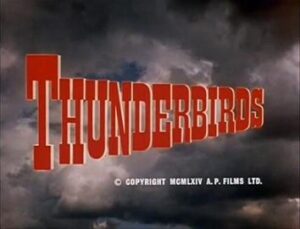
Gerry Anderson is, of course, remembered as ‘the puppet man’.  He and his wife Sylvia began making kids’ puppet TV shows such as The Adventures of Twizzle (1957-59) and Torchy the Battery Boy (1959) in the monochrome, still-austerity-affected 1950s.  Back then, every second children’s programme on British TV seemed to feature cheap-looking wooden figures jerking around in a jungle of marionette strings: Muffin the Mule (1946-55), Flower Pot Men (1952-53), The Woodentops (1955-56) and Pinky and Perky (1957).  What set the Andersons apart from their competitors, however, was their ambition.  Their audiences might have been children and their characters might have been puppets, but that didn’t mean their shows weren’t allowed to be spectacular.  Within a decade, the Andersons refined their puppetry to an art-form – they called their techniques ‘supermarionation’ and began each show with the proud declaration, Filmed in Supermarionation – and the result was Thunderbirds (1965-66).


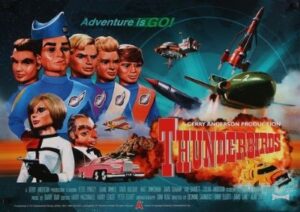
The cast of Thunderbirds might’ve been marionettes, but in all other respects this show – about the adventures of International Rescue, a late-21st century organisation run by the heroic Tracy family who used their fabulous and futuristic vehicles and gadgets to save people from crashing airliners and burning skyscrapers – was like the James Bond movies tailored for children.  As well as gadgetry, explosions and skin-of-the-teeth escapes, it had a secret island hideaway (Tracy Island), an exotic villain (The Hood), a glamorous heroine (Lady Penelope) and a brash 1960s swagger, epitomised in Barry Gray’s strident theme music.  Children’s television had never seen the likes of this before.  No wonder Anderson’s boss at ITC Entertainment, the cigar-loving impresario Lord Lew Grade, informed Anderson after seeing the first rushes of Thunderbirds that he wasn’t making TV anymore, but feature films.  Grade knew showmanship when he saw it.


© Century 21 Television / Associated Television / United Artists


Another feature that Thunderbirds shared with the best Bond movies was that while it gave international audiences the spectacle they wanted, it retained a certain wry British-ness.  The Tracy family might’ve been Americans – indeed, voicing Anderson’s shows surely kept Britain’s small community of North American actors, like Ed Bishop and Shane Rimmer, in employment for years – but for British audiences the real stars of Thunderbirds were Lady Penelope and Parker, her butler and chauffeur of her pink Rolls Royce.


Lady Penelope and Parker represented opposite tiers of Britain’s class system.  She was a posh glamour-puss, he was a working-class Cockney and ex-convict.  Parker was loyal but sometimes downtrodden, though at least his employer tolerated his less socially acceptable talents, which included being light-fingered and knowing how to crack a safe.  Indeed, on occasion, Parker’s talents helped her to escape from a tight corner.  Lady Penelope was famously voiced by Sylvia Anderson and it’s significant that, following their divorce in the mid-1970s, Gerry Anderson claimed that among all his puppet characters Parker (“Yes, m’ lady”) was the one he identified with most.


Sure, Thunderbirds looks creaky when viewed today – what film or TV show from the 1960s doesn’t?  The special effects seem slightly dinky, the puppets’ heads are too big for them to be comfortably lifelike, and their manner of walking always elicits amusement.  Any drunkard having difficulty getting from the bar to the toilets in a British pub is invariably likened to a ‘Thunderbirds puppet’.  I can only testify that, as a kid, once each episode began with that famous countdown (“Five…  Four…  Three…  Two…  One!”), that famous catchphrase (“Thunderbirds are go!”) and that pulse-quickening theme music, even a real-life crashing airliner or burning skyscraper wouldn’t have diverted my attention from the television set.


Anderson also knew the value of merchandising tie-ins.  It wasn’t uncommon to find myself standing with my nose pressed against a toyshop window, wishing my pocket money was lavish enough to buy all the miniature Anderson spacecraft and air-and-land vehicles displayed in front of me – Thunderbirds 1, 2 and 3, plus items from other Anderson shows like the SPV vehicle, the Interceptors, the Mobiles, Skydiver and the Eagles.  The technicians who operated the models of those spacecraft and vehicles and brought them to life in Anderson’s shows, men like Derek Meddings and Brian Johnson, later became the backbone of Britain’s movie special-effects industry.  It was thanks to Anderson’s protégés that even after the indigenous British film industry died on its arse in the late 1970s, international studios at least kept coming to Britain to make movies like the Star Wars and Alien ones because of the technical expertise there.


From wikipedia.org / © AP Films / ATV / ITC Entertainment


Along the way from The Adventures of Twizzle to Thunderbirds, the Andersons had made Supercar (1961-62), Fireball XL-5 (1962-63) and underwater extravaganza Stingray (1964-65).  Stingray is probably the second-best remembered of Anderson’s shows, partly because it was the first British children’s programme to be filmed in colour and partly because of its camp value.  It was never more camp than at the close of each episode, when the ballad Aqua Marina was sung in honour of the mute and enigmatic mermaid Marina, who helped out the Stingray crew in their battles against the despicable Aquaphibians, and on whom hero Captain Troy Tempest obviously had something of a crush.  However, it’s Anderson’s post-Thunderbirds shows that I like best.


Captain Scarlet and the Mysterons (1967-68) also served up spaceships, gadgets, explosions and general spectacle.  The tone was darker, however.  It had a high body-count – well, a high puppet body-count – and the Mars-based Mysterons whom Captain Scarlet and his gang fought off in every episode were, basically, terrorists.  Spookily, their habit of taunting the ‘Earthmen’ with messages threatening death and destruction seemed to prefigure Osama Bin Laden’s mode of operation decades later.  I suspect little Osama owned all the Gerry Anderson toys when he was a kid in Riyadh in the 1960s.


On the other hand, Joe 90 (1968-69) was a charming kids’ espionage show with a likeable juvenile hero.  It was just unfortunate that, on account of Joe’s oversized glasses, ‘Joe 90’ became the nickname of every bespectacled child in a British playground during the next few decades.


From wikipedia.org / © Century 21 Productions


In Captain Scarlet and Joe 90, the puppets had exact human proportions – Anderson’s puppet work had achieved perfection.  Accordingly, with nowhere else to go with puppetry, Anderson moved into live action.  His 1970 show UFO was basically a remake of Captain Scarlet with human actors.   Although UFO is fondly remembered for its kitsch notions of what future fashions would look like, such as Gabrielle Drake’s silver mini-skirt and outrageous purple bob, and although it tapped into every frustrated middle manager’s secret fantasy – Commander Straker (Ed Bishop) pretended to be a film producer, but at the touch of a button his office would descend a giant lift shaft into the huge underground headquarters of anti-alien defence force SHADO, of which he was the secret boss – the show was, like Captain Scarlet, pretty bleak.


The aliens who attacked the earth in UFO only did so because they wanted to harvest human organs, and there was frequently a high death-toll among the guest cast.  One episode, The Psychobombs, even had the aliens brainwashing a handful of ordinary human beings and turning them into superhuman suicide bombers to take out SHADO.  Elsewhere, the harrowing episode A Question of Priorities showed how Straker’s devotion to duty indirectly caused the death of his son.


For a little kid like me, the show was very scary at times.  For example, an episode called The Sound of Silence had a UFO concealed in the waters of a lake amid the bucolic English countryside and an alien stalking the surrounding woodland like a serial killer.  Even the whirring, pulsing sound that emanated from the UFOs while they were in flight was sinister.  Hilariously, Independent Television (ITV), which broadcast Anderson’s shows in the UK, assumed from his past record that UFO was a children’s series and broadcast repeats of it on weekday afternoons, when kids were arriving home from primary school.  That’s how I first saw UFO – I’d come home, switch on the TV and be traumatised by it.


From gerryanderson.com / © ITV Studios


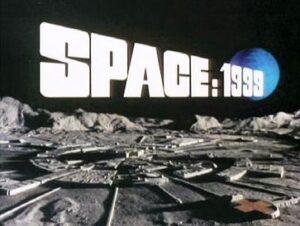
By the mid-1970s Anderson was putting together Space: 1999, which at the time was the most expensive show in TV history.  It should have given him a franchise of Star Trek proportions and made him a fortune.  It didn’t, alas, and the show’s problems were mostly self-inflicted.  Though its special effects were the best yet – some compared them to the space scenes in Stanley Kubrick’s 2001: A Space Odyssey (1968) – its scripts often strayed into the metaphysical and ended up muddled and impossible-to-understand.


Another issue was that its leads, Martin Landau and Barbara Bain, were unaccountably doleful and uninteresting.  That said, the supporting cast, consisting of Nick Tate, Prentis Hancock, Clifton Jones, Ziena Merton, Anton Philips and the excellent veteran character actor Barry Morse, were amiable.  (Sadly, Hancock and Jones died within a week of each other earlier this year.)  And the guest cast – which included Christopher Lee, Peter Cushing, Judy Geeson, Joan Collins, Julian Glover, Anthony Valentine, Richard Johnson, Roy Dotrice, Ian McShane, Leo McKern and the loudest man on the planet, if not in the universe, Brian Blessed – was among the best ever featured in a TV series.


But Space: 1999’s worst problem was that, scientifically, it was rubbish.  Its premise was that a massive explosion on the moon’s surface in 1999 caused it to be blown out of the earth’s orbit, along with a moonbase and its 300-strong crew.  From there, the runaway satellite and its reluctant passengers careered across the galaxy, managing to encounter a new solar system, and an earth-like planet, and a usually unfriendly alien civilisation, in nearly every episode.  The scientist and science-fiction writer Isaac Asimov condemned the show for being preposterous, but even at ten years old I didn’t need Dr Asimov to tell me that.  I knew already that outer space was rather bigger than a fairground ride and a hurtling moon wasn’t going to encounter star-systems with habitable planets as frequently as dodgem cars bumping into one another.


Despite its faults – the pretentious claptrap, the dour leads, the scientific nonsensicality underpinning everything – there was something weirdly compelling about the first season of Space: 1999.  Daft and pompous though much of it was, it was at least unrepentantly so and it deserved kudos for serving up, occasionally, some of the trippiest moments ever seen on British TV.  And it sometimes scared the shit out of me, even more than UFO had.  See the episodes Force of Life, where, near the end, Ian McShane was gruesomely frazzled by a laser beam before coming back to life as a blackened, tattered zombie; or Death’s Other Dominion, which climaxed with Brian Blessed suddenly decaying into a revoltingly putrefied corpse.  Most terrifying, though, was Dragon’s Domain, where the moon blundered into a graveyard of derelict spaceships.  The graveyard was really a giant web, inhabited by a nightmarish spider – a shrieking, tentacled thing that swallowed its victims, drained them and spat them out again as lifeless, desiccated husks.


Unwisely, Anderson hired American producer Fred Freiberger to oversee Space: 1999’s second series.  Freiberger, who was known in American TV circles as ‘the Series Killer’ thanks to his habit of taking over shows shortly before they got cancelled – he produced the last and worst season of the original Star Trek (1966-69) – dumped the things that were good about Space 1999’s first season, including Barry Gray’s theme tune and poor old Barry Morse.  It turned into a tacky, embarrassing piece of juvenilia and was duly cancelled in 1977.


From wikipedia.org / © Group Three Productions


After that, Anderson continued working but never quite captured the zeitgeist as he had in the 1960s.  Into Infinity was a 1976 special that was meant to launch another live-action science fiction series.  It had Brian Blessed, Nick Tate and Ed Bishop on board and was supposed to be based on proper astronomical knowledge of the universe – maybe Anderson was atoning for the scientific absurdities of Space 1999 – but it never got beyond the pilot stage.  In the 1980s he returned to making puppet shows and the result, Terrahawks (1983-86), was a fun but unoriginal rehash of his past glories.  Inevitably, ‘Zelda’, the intensely wrinkled villainess of Terrahawks, became another nickname in Britain, this time for ladies of a certain age who’d crumpled their skins by smoking too many cigarettes and spending too long on the sunbed.  In the 1990s he made the underwhelming live-action show Space Precinct (1994-95), while in 2005 a computer-generated version of Captain Scarlet failed to generate much interest, possibly because, at the time, it was lost amid the fuss made over the rebooting of another classic British science-fiction TV show, Doctor Who (1963-89, 2005-25).


During this period Anderson was financially as well as creatively unlucky.  He no longer held the rights to Thunderbirds when the BBC got around to rescreening it in the early 1990s.  Presumably, when yet another generation of British children went Thunderbirds-daft, and the country’s toyshops filled up again with Thunderbirds merchandising, he didn’t profit as much from it as he should have.  Similarly, Anderson was denied any participation when a live-action film version of Thunderbirds was made in 2004.  The resulting film was directed by an American (Jonathan Frakes) and was aimed only at young children – as opposed to older children and nostalgic adults.  It was, predictably, dreadful.


Hopefully, before his death in 2012, Anderson was at least aware of the great affection the British public had for him and his TV shows and of how his work was stamped on the DNA of modern popular culture.  For instance, you knew immediately what Nick Park was referencing in the opening scene of Wallace and Gromit and the Curse of the Were-Rabbit (2005) when, accompanied by some rousing Barry Gray-type music, his titular heroes got to the seats of their pest-control van via a series of chutes, pulleys and lifts, just as the Tracy brothers had been transported to the cockpits of the International Rescue vehicles.  Even Wallace and Gromit’s garden gnomes parted before their van’s path like the palm trees on Tracy Island used to do when Thunderbird 2 rumbled into view.


And Team America – World Police, the scabrous 2004 puppet movie from Trey Parker and Matt Stone, the men behind South Park (1998-present), might have had as its heroes a bunch of gung-ho terrorist-blasting commandoes rather than the benign and upstanding Tracy family, and as its villain Kim Jong-Il rather than the Hood, but it was basically a grown-up version of Thunderbirds.  I just hope Gerry Anderson was able to see beyond the blood, vomit, swearing and graphic puppet-copulation scenes, get the joke and appreciate the love Parker and Stone obviously had for his work.


And I’ve just heard some news that also makes this post timely.  To mark the 60th anniversary of Thunderbirds, two of its 1965 episodes, Trapped in the Sky and Terror in New York City, have been remastered and released as a double-bill in British cinemas.  The Guardian review of them is here.


From wikipedia.org / © AP Films / Associated Television