Nostalgic wallows 6: 1970s visions of the future


From wikipedia.org / © NASA / Josh Valcarcel


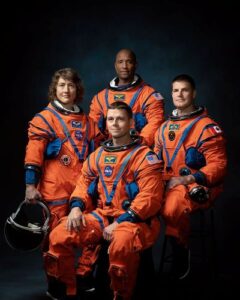
Three days ago, the crew of Artemis II returned to earth.  They had taken part in a lunar flyby mission launched by the United States’ National Aeronautics and Space Administration (NASA) that saw human beings leave low earth orbit and travel around the moon for the first time in over 50 years.  I would have posted something on this blog about Artemis II before now, but didn’t want to tempt fate.  “Let’s wait until they get back safely,” I thought.  The fact that the current US government, which gives NASA its orders, seemingly doesn’t give a f*ck about matters such as health and safety or, indeed, science generally made me worry the mission had been insufficiently prepped and might end in disaster.


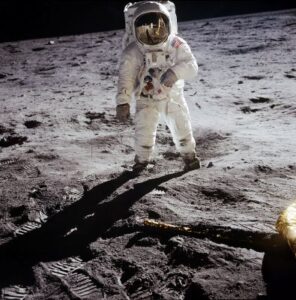
Happily, though, the Artemis II mission has been a resounding success.  It’s also made me think back to when I was a little kid, in the early 1970s, the last time that humans went to the moon.  In fact, it was in 1969, when I was three years old and NASA’s Apollo programme was underway, that the late Neil Armstrong became the first human to set foot on an alien world.  All right, it was only the moon, which is hardly in the same league as Krypton or Tatooine, but for a wee species that evolved out of the Homo genus just 200,000 years ago, Armstrong’s ‘small step’ 57 years ago was pretty impressive.


However, it has also made me wonder.  After all the excited expectations raised by the Apollo programme about space travel, how come the half-century between it and Artemis II has turned out to be so rubbish?


I’m too young to remember seeing Armstrong plant his spacesuit-encased foot on the lunar turf in 1969, but I can just about recall live TV pictures of a subsequent Apollo mission to the moon in the early 1970s.  Admittedly, I wasn’t altogether sure what I was watching.  At the time my family and I were huddled around a tiny black-and-white television in Northern Ireland, which only picked up one channel, the BBC.  (It showed a second channel, RTE, from the Republic of Ireland, if my Dad poked a screwdriver into a hole at the set’s side and did some awkward and potentially dangerous fiddling with the wiring.)  All I could make out on the screen were some fuzzy pale blobs floating against a fuzzy grey background.  However, my Dad assured me these were men walking about on the moon, high above us, at that very moment, so I took his word for it.
 

From wikipedia.org / © NASA


It must have been in 1973 that my imagination took a leap that was almost as giant as the ‘leap for mankind’ that Armstrong spoke of when he descended from the lunar landing module.  The cause of this were two sets of newly-published encyclopaedias that my parents had seen advertised somewhere and ordered – a 15-volume set with lemony-coloured covers called the Childcraft books that, accordingly, were for children; and a 24-volume set called the World Book series that were for adults and came in sombre, mossy-green covers.  That was 39 encyclopaedias in all and, amazingly, they fitted perfectly into the big display shelf that ran along the top of the sideboard in our living room.


I immediately set about reading these encyclopaedias, both the juvenile and adult ones, and my horizons were swiftly widened.  Not all the consequences of this were positive.  My parents had neglected to read the small print in the advertisement.  If they had, they would have discovered that the encyclopaedias had been printed in America, by Americans, for Americans, and their contents were duly biased towards America.  As a result, I wasted a lot of time searching in the fields of our farm for evidence that woodchucks, porcupines, prairie dogs and Gila monsters had been foraging there.  Also, some quaint words started to appear in my vocabulary – diaper, candy store, soda fountain, rest room – which inevitably had my classmates at primary school tearing the piss out of me.


One feature of these encyclopaedias that really rubbed off on me was that, because they were American and because they’d been published just after the moon landings, they were dripping with optimism.  And this was a scientific as well as an American optimism.  Yes, it’s hard to believe today, now that one of the two main American political parties is infested with far-right-wing religious fruitcakes who maintain that the universe was created in six days a few thousand years ago (and vaccines are bad, and manmade climate change is a hoax), but there was a time not long ago when America took science seriously and saw it as one of the key tools in converting the rest of the world to the glories of the American way.  At the age of eight or nine, I lapped all this up – even those assertions in the encyclopaedias that, with the benefit of hindsight, were a bit over-optimistic.


For example, the encyclopaedias predicted that, having reached the moon, it would only be a short time – the 1980s, at the latest – before human beings were tramping around the surface of Mars too.  The ‘S’ volume of the World Book encyclopaedias had a lengthy entry about ‘space travel’ and on one page I found a multi-pictured diagram showing how astronauts were going to get to Mars.  Admittedly, the Mars spaceship in that diagram, as well as having a long, sleek fuselage and a beak-like nose, had wings, which seemed a bit suspicious because by then I knew that in outer space there wasn’t any air and wings were thus superfluous.  (I suspect the artist behind those pictures had been unconsciously influenced by a non-space vehicle that was making a stir at the time, Concorde.)  Elsewhere, there were pictures of what a moonbase – only a few decades away in the future, I was told – would look like, although it was an unprepossessing cylindrical structure that resembled a giant tin can.


Anyway, I assumed this was what I could expect by the time I’d reached my thirties.  I’d be living on a moonbase, watching Concorde-like spaceships streak past on their way to Mars.


My expectations were buoyed further when in the mid-1970s my parents finally got round to buying a new TV set that got three channels, the BBC, RTE and ITV – Independent Television.  Although ITV had (and still has) a reputation for cheap and lowbrow programming in comparison with that made by the BBC, it did broadcast at the time various action / adventure series made by a subsidiary called ITC entertainment, run by the cigar-smoking impresario Lord Lew Grade.  Aimed at international markets and at the American market in particular, ITC’s shows commanded higher-than-average budgets and looked quite glossy by the standards of 1960s and 1970s British TV.  They included The Prisoner (1967-68), Department S (1969-70) and The Persuaders (1971) and a host of science-fiction shows made by the remarkable Gerry Anderson.  I was able to watch these for the first time.
 

From gerryanderson.com / © ITV Studios


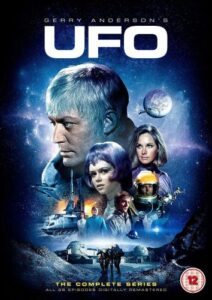
It was watching repeats of Anderson’s live-action sci-fi show, UFO, made in 1970 and starring Ed Bishop, George Sewell, Michael Billington, Peter Gordeno, Wanda Ventham (Benedict Cumberbatch’s mum) and Gabrielle Drake (Nick Drake’s sister), that convinced me that the future was going to be absolutely brilliant.  For UFO, Anderson’s production team envisioned the shape of things to come through a prism of gaudy late-1960s design and fashion, with a smidgeon of then-fashionable psychedelia.  It didn’t just feature spaceships and moonbases, but also sleek super-cars, talking computers with hallucinogenic panels of flashing lights, giant submarines with detachable nose-modules that turned into aircraft when they reached the ocean surface, guys in groovy-looking suits that didn’t have lapels, and ladies wearing silver miniskirts and sporting purple hairdos.


So, I thought, I’d be living on a moonbase, watching spaceships streak past towards Mars, and Gabrielle Drake would be shimmying around me looking fetching in silver and purple.  The future seemed better than ever.


Needless to say, as the 1970s wore on, I began to get uneasy about the fact that very little futuristic stuff was happening any more.  As far as manned spaceflight was concerned, not much occurred after the Skylab project – yes, there was the space shuttle, but that didn’t venture beyond earth’s orbit and, frankly, seemed a bit shit.  Meanwhile, the Viking 1 probe landed on Mars but, alas, found nothing interesting.  There were no aliens, Martian canals or H.G. Wells-style three-legged war machines shooting death-rays – just some boring geological formations that had once been river valleys.  And what had happened to that you-can-do-anything-if-you-put-your-mind-to-it American optimism?  It seemed to fizzle out as the 1970s became one long litany of American trauma: the Vietnam War, the 1973 oil crisis, Watergate and the Iran hostage saga.


I still had hope, though.  In the mobile library that came to our village every week, I picked up a copy of Arthur C. Clarke’s novelisation of 2001: A Space Odyssey, the classic 1968 sci-fi movie he’d co-written with director Stanley Kubrick.  It was reassuring to read Clarke’s sober, matter-of-fact account of a journey from the earth to the moon and then on to Saturn.  (In Kubrick’s film, the final destination was changed to Jupiter because of the job of convincingly depicting Saturn’s rings was too much for his special effects team.)  By then I was well-versed in astronomy and space travel and the book seemed to reinforce everything I knew already about the subjects.  It also seemed to make the idea that humanity would be out exploring more of space in the early 21st century feasible and, indeed, logical.
 

© Signet Books


When I finally saw 2001 the movie, however, it was in 1982 and even I had to concede it’d become a bit of a museum piece.  In some ways it possessed an admirable, almost documentary-like realism – for instance, I was impressed by the fact that, unlike the spaceships in every other science fiction movie I’d seen, Kubrick’s spaceships didn’t make any noise (because sound doesn’t travel in the vacuum of space) – but it struck me as a historical artefact nonetheless because it was clearly rooted in a past time and in past conceptions of what lay ahead.  It offered a late-1960s view of the future, one that just wasn’t plausible any longer in the early 1980s.


By then, the Mad Max movies (1979, 81 & 85) had started to do the rounds and, after the oil shortages of the 1970s, they presented an unfortunately more credible vision of what the 21st century might be like.  It was also telling that a couple of years earlier, in 1978, Lord Grade’s ITC Entertainment, which had once stimulated my space-age fantasies with Gerry Anderson’s UFO, had produced the movie Capricorn One – a cynical sci-fi thriller about a NASA expedition to Mars that is actually a hoax, with the supposed landing on the Martian surface being filmed in a TV studio in the American desert.


And now in 2026 I find myself inhabiting a world far removed from the visions that Neil Armstrong, Gerry Anderson and Arthur C. Clarke inspired in me during my childhood.  The Artemis programme promises that human beings will once again set foot on the moon but I’m sceptical that people will get to Mars in my lifetime and I’m beginning to wonder if they’ll ever get there at all.  I know Elon Musk keeps vowing to do it but, given the logistics involved and given our current levels of technology, I think that’s bollocks.  (Talking bollocks comes as naturally to Musk as breathing.)


It doesn’t help that the orange narcissist currently residing in the White House is trying to cut 23 percent of NASA’s funding – though he’ll no doubt attempt to grab the credit for Artemis II’s success and make it all about himself.


Still, thank you, Artemis II crew. You’ve kindled some fond nostalgia in me and given me a sliver of hope, at least, that humanity’s future might extend beyond the gravitational pull of its home world.
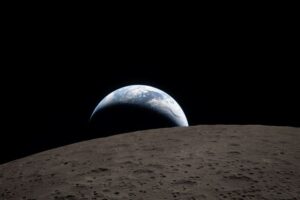
 

From wikipedia.org / © NASA

Furiosa and curiosa


© Warner Bros. Pictures / Kennedy Miller Mitchell


What a strange beast Furiosa: A Mad Max Saga (2024) is.  Yes, it’s a Mad Max movie, directed and co-written by the franchise’s mastermind George Miller.  But it’s one (almost) devoid of Mad Max.  Instead, it concentrates on Imperator Furiosa, the formidable warrior-woman played by Charlize Theron who partnered the title character in 2015’s Mad Max: Fury Road.  Furiosa fills us in on her backstory, from her childhood to early womanhood.  Thus, it’s a prequel to Fury Road and a discombobulating departure from the customary format of the Mad Max films.


If you had to sum up the structure of the earlier four movies in one word, that word would be linear.  Things just barrelled along in a straight line.  Indeed, the two best ones, Mad Max II (1982) and Fury Road, were basically ongoing vehicle chases, with plot and characterisation having to scramble on board during the brief moments when people’s feet eased on the accelerators.  Not that I’m knocking them.  Mad Max II is one of my favourite films of the 1980s and I consider Fury Road one of the best films of the 21st century.


But with Furiosa, Miller – bravely or foolishly, depending on your point of view – abandons the formula that’s hitherto served him so well and presents a movie with other things besides big, metallic, wheeled things hurtling after and crashing into one another.  There are periods of quiet and calm, where the emphasis is on dialogue, characterisation and violence-free drama rather than on hectic, in-your-face action.  Parts of it even get a bit slow.


Which isn’t to say Furiosa lacks action.  It begins with an edge-of-your-seat (if small-scale) chase, and later there are two lengthy action set-pieces that rank among the most thrilling the franchise has produced, even if one of them incorporates a bit too much CGI.  Overall, though, comparing one of the earlier Mad Maxes with this entry is like – to cite two examples from a sub-genre that heavily influenced the series originally, the spaghetti western – comparing Sergio Leone’s lean, taut A Fistful of Dollars (1964) with his sprawling epic Once Upon a Time in the West (1968).


© Warner Bros. Pictures / Kennedy Miller Mitchell


No, I’m not claiming that Furiosa is as good as Once Upon a Time in the West (one of my top half-dozen movies ever, incidentally).  I also think it falls short of the greatness achieved by Fury Road.  But I still found it pretty impressive.  Before I discuss the movie in detail, though, I should warn you – from here on there will be spoilers.


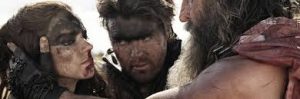
The film gets going with the afore-mentioned chase.  Some scumbag bikers abduct little Furiosa (Alyla Browne) from her community in the Green Place, a Garden of Eden-like hideaway that’s somehow survived the apocalypse that’s ravaged the rest of the earth in the Mad Max version of the future.  Her mother (Charlee Fraser) pursues them into the Wasteland and the scumbag bikers are killed one by one, but not before the last of them manages to deliver Furiosa to Dementus (Chris Hemsworth), leader of a gang with a self-explanatory name, the Biker Horde.


A subsequent attempt to rescue Furiosa results in the mother’s death and Dementus keeps the little girl, partly as his gang’s mascot, partly as a surrogate daughter.  “Do not look away, you mustn’t look away!” he urges her while he crucifies her mother in front of her, believing that the trauma will toughen her up and make her better suited to the Wasteland.  He’s obviously a dad who believes in the ‘school of hard knocks’ approach to raising kids.  He also muses, “When things go bonkers, you have to adapt.”


Later, he and his Horde stumble across the Citadel that figured, or will figure, in Fury Road and come face to face with the Citadel’s implacable, pustular ruler Immortan Joe.  Here, Joe is played by Lachie Hulme.  Hugh Keays-Byrne, the actor who played him in Fury Road (and also played the franchise’s original villain, Toecutter, back in 1979’s Mad Max) passed away in 2020.  The Biker Horde manages to capture the Citadel’s satellite-settlement Gastown, responsible for producing the fuel for Joe’s vehicles.  After some hard bargaining, Joe reluctantly cedes control of Gastown to Dementus, but demands some concessions from the biking warlord in return.  These include him taking custody of Furiosa.


© Warner Bros. Pictures / Kennedy Miller Mitchell


Born in the healthy environs of the Green Place, Furiosa is genetically undamaged and Joe, desperate for some normal-bodied and able-minded offspring, fancies her as a future wife.  As we know from Fury Road, he has a squad of young wives locked away for breeding purposes, though the results have been disappointing so far – as evidenced by the two sons he’s acquired, the hulking, thick-as-mince Rictus Erectus (Nathan Jones) and the psychotic Scabrous Scrotus (Josh Helman).  Not keen on the idea of ending up a spouse to Immortan Joe, Furiosa escapes from his harem, disguises herself as a boy, pretends to be mute and finds employment in the Citadel’s garages.


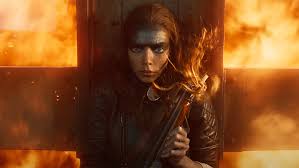
A few years later, after various adventures, and now played by Anya Taylor-Joy, Furiosa becomes apprenticed to the tough but kindly Praetorian Jack (Tom Burke), driver of the War Rig, the giant truck that’s the pride of Joe’s vehicular fleet.  “You have about you a purposeful savagery,” Praetorian Jack informs her, which in the Wasteland is as close to a compliment as you can get.


Praetorian Jack and the now Praetorian Furiosa gradually bond, to the point where Jack agrees to help her return to the Green Place.  But bigger events get in their way.  Namely, Dementus’s running of Gastown becomes such a disaster that Immortan Joe and his allies vow to get rid of him, even if this means a full-scale war raging in the Wasteland…


One thing I liked about Furiosa was the chance to see certain characters from Fury Road again.  Not just Immortan Joe, but subsidiary villains like Rictus Erectus, the People Eater (John Howard), the Bullet Farmer (Lee Perry, replacing the original actor Richard Carter, who died in 2019) and the Organic Mechanic (Angus Sampson), who’s the nearest thing in the Wasteland to a GP and has the thankless task of delivering Joe’s stillborn and / or mutant kids.  But what pleased me most was a fleeting reappearance by the Doof Warrior, the goon who rides in front of a giant wall of speakers whilst playing a splendid, flamethrowing electric guitar.


© Warner Bros. Pictures / Kennedy Miller Mitchell


Furiosa presents us with some cool new characters as well, mostly in Dementus’s entourage.  There’s the piratical Rizzdale Pell (Lachy Hulme in a second role) who, unlike normal movie pirates, doesn’t bother to conceal an empty eye-socket with an eyepatch.  Also facially disfigured is the zombie-like Mr. Norton, who’s actually a Ms. and is played by Elsa Pataky, Chris Hemsworth’s real-life wife, no less.  And I was impressed by the Octoboss (Goran D. Kleut), a satanic figure clad in black, horned armour who rides / flies into battle on a motorbike-cum-kite, trailing a long, black, tendrilous parachute behind him.


Dementus also employs two cheerleaders.  He has a Gollum-like weirdo called Smeg (David Collins) acting out his ever-changing moods in a series of strange, performative dances.  And he has a warm-up man called the History Man (George Shevstov) who warns potential adversaries about his boss’s ‘congress of destruction’, i.e., the thousands of motorbikes massed behind him.  The History Man additionally serves the gang as a bard and as an archivist of knowledge, stories and language, which he has tattooed in tiny writing all over his body.  He’s asked to dredge up appropriate words from the mostly-forgotten lexicon of English to mark special occasions: “History Man!  A word-burger if you please!”  And he provides the film with its narration, which implies the saga of Furiosa has been added to this anarchic society’s repository of legend and lore.


But among the new characters, the biggest star is Dementus himself.  Chris Hemsworth obviously relished the opportunity to set aside his goody-two-shoes image as Thor in the Marvel cinematic universe and play somebody gloriously, evilly unhinged.  While cunning and ruthless enough to make a credible post-apocalyptic warlord, there’s also a touch of ridiculous, Spinal Tap-style heavy metal-ness about him.  This means that, ultimately, he’s never going to be smart enough to defeat Immortan Joe, still Top Dog when Fury Road rolls around.  He’s merely likely to cause a lot of damage along the way. Inevitably, Dementus gets the best lines.  He goadingly demands of Furiosa, “Do you have it in you to make it epic?” or “Where were you going, so full of hope?  There is no hope!”  Best of all is a muttered aside when a minion disputes his orders: “Hmm, questioning my boss-ority…”


© Warner Bros. Pictures / Kennedy Miller Mitchell


It says a lot for the more measured performances by Anya Taylor-Joy and Tom Burke that they manage to make their presences felt, and Hemsworth doesn’t walk away with the film.


With so many good elements, then, why do I feel Furiosa is less effective than Fury Road?  Well, it’s a bit too long and, while earlier parts of the film are languidly paced, there’s rather too much happening, too much Machiavellian scheming and double-crossing going on, in its later stages.  Also, the franchise’s long-term fans will be frustrated that the war between Dementus and Irmmortan Joe, when it finally arrives, is represented only by a brief montage and a voice-over from the History Man.  Instead, the film’s focus becomes personal.  It zooms in on Furiosa pursuing and confronting Dementus over her mother’s long-ago murder.  I can see what Miller was trying to do, and respect his bravery in doing it, but I’d have preferred things to end with a bigger bang.


Still, after seeing it a few days ago, I haven’t stopped thinking about Furiosa.  Things about it that didn’t occur to me in the cinema have occurred to me since.  For example, the nature of Praetorian Jack’s relationship with Furiosa is kept vague and at the time I wasn’t sure if it was supposed to be a romantic one.  Now I see him more as being a father-figure to her, which nicely fills the void left by her mother’s death.  I also appreciate, with hindsight, how the script uses peaches – yes, peaches – as a motif.  Furiosa is seen picking them at the start, her mother gives her a peach-pit as a memento shortly before she dies, and the same pit has a bearing on what Furiosa does to Dementus at the end (at least, according to the story she tells the History Man).


© Warner Bros. Pictures / Kennedy Miller Mitchell


And during a Wasteland sequence that’s particularly brutal and traumatic for Furiosa, Miller’s camera leaps back into the surrounding mountains for a moment, and we see a familiar silhouette watching events from afar, next to his trademark V8 Interceptor.  I wonder now if Mad Max’s cameo is meant to show he has a connection with Furiosa even before he meets her in Fury Road.  Does what he observes here remind him of the loss of his family in the original movie?


Despite its quality, Furiosa has done badly at the box office.  I suspect many blokes who enjoy action movies chose to skip this one because it wasn’t about Mad Max but about – ugh! – a girl.  Conversely, it obviously didn’t appeal to family audiences.  About a girl it may be, but Furiosa is also the most brutal Mad Max film yet.  It’s got the highest body-count and, while the franchise has always managed to be violent without wallowing in gore, there are more moments than usual where bullets strike faces, flamethrowers torch bodies, throats get slashed and body-parts are severed.  Sadly, Furiosa‘s underperformance has cast doubt on whether George Miller’s planned sixth entry in the franchise, Mad Max: The Wasteland, will ever be filmed.


To borrow two of Dementus’s quotes…  It’s a pity that after Furiosa’s box-office flop, people are questioning Miller’s boss-ority.  Because he still has in him to be epic.


© Warner Bros. Pictures / Kennedy Miller Mitchell

Jim Mountfield gets apocalyptic


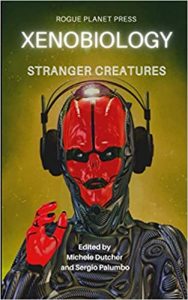
© Rogue Planet Press 


A 7000-word story of mine called The Nuclei has just appeared in a new collection called Xenobiology: Stranger Creatures.  Its subtitle describes it as ‘an anthology of international sci-fi, steampunk and urban fantasy short stories.’


The contents of the anthology are explained in more detail in its introduction by one of its editors, Michele Dutcher: “Since Xenobiology is not a study of naturally occurring organisms, the stories in this anthology deal with biology that has been artificially produced, or biological creatures that have been produced by genetic material being acted upon by outside sources to produce something new.  Those new organisms can be intriguing when thrown into the mind of an imaginative author.”


The Nuclei is classifiable as science fiction but definitely lurks at the horror end of the sci-fi spectrum.  Therefore, in Xenobiology: Stranger Creatures, it’s credited to Jim Mountfield, the pseudonym I use for my macabre fiction.  Basically, it’s a body-horror story set in Edinburgh after an apocalypse.  Now there’s a sentence you don’t get to write too often.


Writing a story with a post-apocalyptic setting was an opportunity for me to address some of the misconceptions people have about what would happen after civilisation collapsed, thanks to watching many Hollywood movies on the theme.


Firstly, and I say this with regret because I’m a big fan of George Miller’s Mad Max franchise, petrol would soon degrade and become unusable.  Thus, within a few years, no survivors would be able to drive around in motorised vehicles – not even in the giant armoured battle-trucks that featured in 2015’s Mad Max: Fury Road.  So in The Nuclei I have the human protagonists riding about on horses or on bicycles.  The bicycles possess solid wheels made of micro closed-cell polymer resin that allow them to be rode over the debris-strewn, weed-sprouting streets of post-apocalyptic Edinburgh without the risk of incurring punctures.  Also, importantly, when the bicycles aren’t on the road, they’re ‘connected to motors and chargers and used to repower the batteries for essentials like the field radio.’


The story also makes references to a few things that seem too mundane to appear in the average post-apocalyptic movie but that would surely be a big thing for survivors of a real-life global meltdown.  For example, scurvy would manifest itself among those survivors if they were suddenly denied access to fruit and vegetables in their diets.  And the danger posed by cuts and infections would be immense after whatever supplies of antibiotics had survived the apocalypse ran out.


One crucial point that the story tries to make is that post-apocalypse the remaining humans wouldn’t immediately degenerate into bands of savages hellbent on killing each other.  This departs from the anarchic scenarios depicted in Cormac McCarthy’s 2006 novel The Road and or in just about every zombie-holocaust movie ever made (the latter suggesting that, when it comes down to it, human beings are even worse than any zombies they’re trying to fight off).


Actually – as reports from the aftermath of any earthquake, tsunami or other natural disaster will testify – human beings are genetically programmed to cooperate and help one another out.  This is not for any uplifting moral reason but simply because cooperation increases their chances of survival.  Hence, in The Nuclei, you get the members of a loopy post-apocalyptic religious cult joining forces with a militia dedicated to the protection of medical science in order to defeat, or at least diminish, a common foe.


And what is that foe?  Well, it’s one of the ‘stranger creatures’ of the collection’s title, the result of genetic tampering.  It’s also the result of me sitting down and attempting to imagine the most revolting monster possible.


Xenobiology: Stranger Creatures is currently available from Amazon here.


© Rogue Planet Press