Democracy dies in Donald-grovelling


From wikipedia.org / © The Washington Post


What would you say to Epstein survivors…?


You are so bad.  You are the worst reporter.  No wonder CNN has no ratings.  She’s a young woman.  I don’t think I’ve ever seen you smile.   They should be ashamed of you.”


On February 4th, CNN reporter Kaitlan Collins was cut off in the middle of a question about the victims of Jeffrey Epstein, notorious paedophile, human trafficker and friend to the rich and famous, at a White House press conference.  Cutting her off was President Donald Trump, coincidentally someone who receives, according to the New York Times, 38,000 mentions in the Epstein files so far released by the US Department of Justice.  Evidently, in Trump’s mind, you need to smile when you ask questions about victims of paedophilia and human trafficking.


I find his objection ironic considering that for the last 21 years Trump’s been married to Melania Trump, a woman on whose visage – gimlet-eyed and as smooth, hard and unyielding as an iron bedpan – anything resembling a smile rarely flickers.  Obviously, though, if you were expected to share a marital bed with Trump, your face wouldn’t be projecting sunbeams and rainbows either.


Lately, Melania Trump has been in the news because of the release of a new documentary movie about her.  Entitled Melania, it focuses on her during the run-up to her husband’s second inauguration as president.  Jeff Bezos’s Amazon paid 40 million dollars for the rights to the documentary – 28 million of that reportedly going straight into Ms. Trump’s pocket – and another 35 million to advertise it.


Reviews of Melania have not been, shall we say, overly enthusiastic.  The last time I checked the review aggregate site Rotten Tomatoes, its ‘Tomato-meter’ had it at seven percent.  William Thomas at Empire magazine advised, “Do try not to choke on your popcorn.”  Sean Burns at North Shore Movies observed, “At least Leni Riefenstahl could frame a shot.”  Mark Kermode at Kermode and Mayo’s Take – The Brand New Podcast described it as “the most depressing experience I have ever had in the cinema.”  He added, “I mean, I’ve seen A Serbian Film (2010), I’ve seen Cannibal Holocaust (1980), I have never felt this depressed…  I thought it was absolutely repugnant.”


By the way, the director of Melania is Brett Ratner, who in 2017 was accused of sexual assault and harassment by six women, accusations he’s denied.  In photos recently released from the Epstein files, he appears sitting on a sofa beside the late, loathsome paedophile, both of them cuddling young women.  The women’s faces are blocked to protect their identities, so you can’t tell how young they are.


I should also say that Melania made seven million dollars on its opening weekend, a decent haul for a documentary.  Obviously, it appeals to a certain audience in the USA, i.e., cultish MAGA dingbats so worshipful of her husband they’d spend a fortune on eBay to acquire pieces of his used toilet paper, which they’d then frame and hang prominently in their living rooms.  However, it still looks like it’ll be a long time before Amazon recoups anything like the 75 million dollars it invested in the movie.

 

From wikipedia.org / © White House


In totally unconnected developments during Trump’s first year as 47th president, the Orange One signed an executive order relaxing environmental rules about space launches (benefiting Bezos’s private space venture Blue Origin); signed an order preventing US states from enforcing their own AI regulations (benefiting Bezos’s AI start-up Project Prometheus); and generally created a oligarch-friendly climate that’s allowed Bezos and fellow magnificoes Elon Musk and Mark Zuckerberg to increase their collective wealth by approximately 250 billion dollars.


But I don’t know why Bezos would take a financial hit by getting involved in Melania, a vanity project that nobody apart from those hardcore MAGA nutters would pay money to see.  I really don’t know.


In other, totally unconnected news last week, the Washington Post, a once-respected newspaper whose motto is ‘Democracy dies in darkness’, and which broke the story about the Watergate scandal that brought down Richard Nixon’s presidency in 1974, has announced a ‘strategic reset’.  This reset involves showing a third of its current workforce the door.  It’s also “ending the current iteration of its popular sports desk… restructuring its local coverage, reducing its international reporting operation, cutting its books desk and suspending its flagship daily news podcast Post Reports.”  The loss of the Washington Post’s books desk means it’ll no longer publish its literary review supplement Book World.


The Washington Post has been on a downward spiral this past year, a spiral of its – or its proprietor’s – own making.  Previously, and unsurprisingly, it’d not been enamoured with Trump.  As 2024’s presidential race neared election day, however, and with Trump looking likely to regain the White House and launch his glorious new thousand-year Reich, the Washington Post’s editorial board was ordered not to publish an editorial endorsing Kamala Harris, Trump’s rival for the presidency.  As a result, more than 200,000 disgusted readers – eight percent of its 2.5 million-strong readership – cancelled their digital subscriptions to the newspaper.


After the announcement of the Washington Post‘s downsizing, its legendary Watergate  reporter Bob Woodward lamented, “I am crushed that so many of my beloved colleagues have lost their jobs and our readers have been given less news and sound analysis.  They deserve more.”  Meanwhile, Trump’s Communications Director Steve Cheung crowed on Twitter, “Just a reminder that printing fake news is not a profitable business model.”


Earlier, the Washington Post’s proprietor had defended his decision to have the newspaper sit on the fence before the 2024 election, which’d started the rot.  He wrote: “Presidential endorsements do nothing to tip the scales of an election…  What presidential endorsements actually do is create a perception of bias.  A perception of non-independence.  Ending them is a principled decision, and it’s the right one.”  Aye, right.  That’s the principled thing to do.  When there’s a choice between a candidate who’s a convicted criminal and convicted sexual abuser and a candidate who isn’t, you say nothing.  Heaven forbid anyone perceives you as being biased and non-independent.
 

From wikipedia.org / © Van Ha, US Space Force


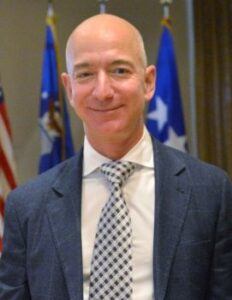
And who’s the proprietor of the Washington Post?  Oh look, it’s Jeff Bezos.  Funny that he should take a hit by alienating his newspaper’s natural readership and sending it down the toilet, just as he took a hit by shelling out 75 million dollars for a dud like the Melania movie.  It’s almost like he has an ulterior motive.  Almost like he’s trying to… curry favour with someone.


But seriously.  A while ago, I posted about “an unholy alliance of authoritarians, kleptocrats, fascists, media tycoons, tech bros and oil barons”, working hard “at stripping freedoms from those of us living in societies that,  until now, have retained some freedoms; at transferring another huge chunk of wealth from our dwindling coffers to their swelling coffers; and at burning and poisoning the planet we live on in their quest for profits whilst aggressively pushing the line that any science questioning this policy is a ‘hoax’.”  You see that here.  Bezos grovelling to Trump by financing his missus’s dreadful movie and nuking the Washington Post.  As a reward, Trump throwing him a few legislative and financial scraps from the White House table so he can carry on making pots of money for himself.


And with Bezos and his ilk embracing automation and Artificial Intelligence to maximise profits by eliminating human employees, and salaries, the future looks grim.  Journalists will soon go the way of lamplighters, elevator operators, switchboard operators and video store clerks.  News copy will be written by AI technology, controlled by billionaires, who’ll make sure that copy panders to their interests and those of their political allies.  And if there’s bad news they can’t avoid reporting, it’ll be blamed on those people not plugged into their extreme-right-wing, white-Christian-nationalist gestalt: blacks, Latinos, Muslims, Jews, atheists, gays, trans-people, liberals, socialists, trade unionists.


Education will be similar.  Teachers will disappear too and kids will be taught by AI, with the likes of Elon Musk deciding what’s in the curriculum.  Indeed, Musk has done a deal with El Salvador’s government to “bring his artificial intelligence company’s chatbot, Grok, to more than 1 million students across the country… to ‘deploy’ the chatbot to more than 5,000 public schools in an ‘AI-powered education program’.”  Yes, that’s Grok, the lovable chatbot that praises Hitler and puts tweens in tiny bikinis for the gratification of paedophiles, coming to a school near you to teach your kids.


The stinking rich and stinking powerful won’t only hoard wealth – they’ll hoard information too, whilst making sure only small, approved increments of it leak down to the masses they regard as their serfs and inferiors.  Especially manipulated will be scientific information about the climate catastrophe posing an increasing threat to our civilisation’s survival on this planet.  So that their environmentally-ruinous cash-generating projects, like power-guzzling and water-guzzling AI data centres, escape censure, they’ll suppress this information or bury it under an avalanche of counter-arguing pseudoscientific gibberish, or not collect it in the first place.


But let’s end positively.  While it’s sickening to watch America’s business magnates, corporations, media organisations, law firms and universities bend over supinely and lick Trump’s gruesome arse, the way ordinary Americans have reacted to his policies gives glimmers of hope.

 

© MS NOW


I’m thinking especially of Minneapolis.  Since December, the city has been overrun and brutalised by up to 3000 of Trump’s masked, violent, badly-trained thugs from Immigration and Customs (ICE) and Customs and Border Patrol.  Ostensibly, they came to crack down on fraud allegedly committed by Minneapolis’s Somali-American community.  In reality, as Wikipedia reports, they’ve assaulted, harassed and detained people  “on the basis of their alleged or suspected immigration status”, including “restaurant, airport and hotel workers, Target employees, children and families, Native Americans, students and commuters”, many of whom “have been US citizens, legal residents with work authorisation, or asylum seekers.”


This has disastrously impacted on the city’s businesses, schools and whole social fabric.  ICE was accused of violating at least 96 court orders during four weeks in January alone; and they’ve executed two citizens during peaceful protests, Renee Good on January 7th and Alex Pretti on January 24th.


Obviously, the operation was designed to intimidate Minneapolis – whose state governor is Tim Walz, Kamala’s running mate against Trump in 2024 – and intimidate liberal-leaning cities generally.  But local people are having none of it.  They’ve protested peacefully, organized strikes, alerted neigbours about approaching ICE patrols, monitored and filmed their activities, and provided support for people at risk from those activities by helping them get to their schools and places of worship unmolested, running errands for them and raising money for them.  They’ve stood by their fellow citizens in a display of decent, old-fashioned community values – values Trump would despise if his reptile brain could ever understand them in the first place.


One thing that particularly impressed and moved me was a viral clip showing a white-bearded old man protesting against ICE on a snowbound and teargas-fogged Minneapolis street on January 24th.  When a reporter and camera crew approached him, he raged, “I’m just angry.  I’m 70 years old and I’m f**king angry.”  Then, wearing neither mask nor goggles, he strode off through a billowing wall of teargas.


That furious but defiant old-timer, it transpired, was Greg Ketter, founder and proprietor of the Minneapolis independent bookstore DreamHaven Books and Comics.  The renowned sci-fi and fantasy writer Harlan Ellison once described DreamHaven as “a book-seeker’s cave of miracles”.


I find it inspiring to see a man who’s devoted a lifetime to books taking a stand against Trump, someone who brags about not reading as if it’s a badge of honour.  And by extension, against Trump’s billionaire toadies, currently trying to create an AI dystopia wherein novels and other human art-forms are replaced by soulless, AI-generated slop.  And against Trump’s toady at Amazon, Jeff Bezos, who’s just axed the Washington Post’s Book World, one of the very few literary supplements the American newspaper industry had left.

 

From wikipedia.org / © DreamHaven Books & Comics

When novelists and films collide


From Wikipedia / © Antonio Monda


May 19th saw the death of Martin Amis, reckoned by some to be the greatest British novelist of his generation.  I have to say that’s not an opinion I shared, although I liked his 1984 novel Money and some of the stories in his 1987 collection Einstein’s Monsters.  Anyway, one thing I noticed about the lengthy obituaries of Amis I read after his passing – none of them mentioned the fact that he wrote the script for 1980’s science-fiction movie Saturn 3.  This features a saucy robot, programmed with the libido of Harvey Keitel, pursuing Farah Fawcett around a base on one of Saturn’s moons.  Why the omission?  No doubt Amis’s obituarists declined to mention it out of respect.  Saturn 3 was an embarrassment and Amis surely left it off his CV.


However, Amis and Saturn 3 do highlight how, over the decades, well-respected authors have been involved with the film industry – a world less interested in creative endeavour and excellence and more interested in giving the public what it wants, putting bums on seats and making a fast buck – and the results have frequently not been pretty.


Here are a few of my favourite examples of novelists and filmmakers colliding and the movies birthed by those collisions being, let’s say, memorable for the wrong reasons.


© Amicus Productions


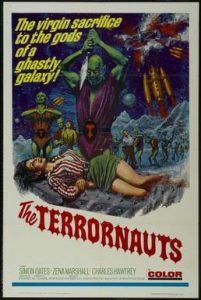
John Brunner and The Terrornauts (1967)

The science-fiction author John Brunner was highly regarded in his day and won both the Hugo and the British Science Fiction Association (BSFA) Awards for his 1968 novel Stand on Zanzibar.  Also, his 1979 novel The Jagged Orbit netted another BSFA award and his pessimistic and prescient 1972 novel, The Sheep Look Up, about extreme pollution and environmental disaster, was much admired too.  Though he’s not so well-remembered now, the BBC website did devote a feature to him in its Culture section a few years back.


Perplexingly, the only film script Brunner ever wrote was for the ultra-low-budget British sci-fi movie The Terrornauts (1967), which is about some astronomers contacting the remnants of an alien civilisation stowed away on an asteroid, being abducted and taken to that asteroid, and eventually having to fight off an invasion fleet that’s heading towards earth.  Brunner’s script was based on a book called The Wailing Asteroid (1960) by another sci-fi writer, Murray Leinster.  I saw The Terrornauts on late-night TV when I was 11 and even at that young age thought it was dreadful, with its poverty-row special effects, its cardboard sets, and the thuddingly incongruous presence of comedy actors Charles Hawtrey and Patricia Hayes, inserted into the proceedings for alleged ‘comic relief’.  Still, The Terrornauts was so terrible that it burned itself into my memory and I’ve never been able to forget the bloody thing since.  For the filmmakers, I guess that was some sort of achievement.


Chief among those filmmakers was producer Milton Subotsky, who ran Amicus Productions with Max J. Rosenberg during the 1960s and 1970s and was better known for making horror movies.  I read an interview with Brunner once and he confessed to writing The Terrornauts as a favour to Subotsky, who was a friend of his.  Subotsky and Rosenberg, incidentally, had form in getting literary folk to pen their screenplays. They drew at various times on Robert Bloch, Margaret Drabble, Harold Pinter and Clive James, the latter for a film that never got off the drawing board.  And for their 1974 lost world / dinosaur epic The Land That Time Forgot, they hired another esteemed science-fiction writer, Michael Moorcock.  The low-budget dinosaurs in The Land That Time Forgot are rubbery and a bit laughable by today’s standards, but Moorcock was gracious enough to describe the film as ‘a workmanlike piece of crap.’


And speaking of dinosaurs…


© Hammer Films


J.G. Ballard and When Dinosaurs Ruled the Earth (1969)

Ballard is one of my all-time favourite writers.  While a few filmmakers have come close to successfully translating his disturbing, dystopian and hallucinogenic literary visions into celluloid, such as David Cronenberg did with Crash (1996) and Ben Wheatley with HighRise (2015), the pulpy When Dinosaurs Ruled the Earth was, weirdly, the only film that Ballard himself scripted.  This was a sequel by Hammer Films – like Subotsky and Rosenberg’s Amicus, a British company best known for making horror movies – to its 1965 epic One Million Years BC, featuring Raquel Welch as a fur-bikini-clad cavewoman and with splendid stop-motion-animation dinosaurs courtesy of special-effects genius Ray Harryhausen.


While One Million Years BC is a movie to watch and enjoy with your brain set at low gear, When Dinosaurs Ruled the Earth is one where you need to switch your brain off altogether.  Aside from the obvious scientific absurdity of human beings and dinosaurs being shown to exist at the same time, when they’d really missed each other by 65 million years, the film ends with a natural cataclysm so violent that part of the earth breaks off and creates the moon.  But somehow, its main characters survive the carnage.  The dinosaurs this time were animated by Jim Danforth and, though not up to Harryhausen’s standard, they’re good fun.


How, you wonder, did Ballard get emmeshed in such hokum?  In his 2008 autobiography Miracles of Life, he gives an amusing account of meeting Hammer producers Aida Young and Tony Hinds when they were trying to brainstorm ideas for the film.  The meeting had not gone well, but then Ballard rather desperately suggested that the big cataclysm at the end contain not a tidal wave crashing in, but one surging out from the shoreline.  This would reveal “’…All those strange creatures and plants…’ I ended with a brief course in surrealist biology…  There was silence as Hinds and Aida stared at each other.  I assumed I was about to be shown the door…  ‘When the wave goes out…’  Hinds stood up, clearly rejuvenated, standing behind his huge desk like Captain Ahab sighting the white whale.  ‘Brilliant.  Jim, who’s your agent?’”


© Rothernorth Films / Redemption Films  


Fay Weldon and Killer’s Moon (1978)

Here’s the most mind-boggling collaboration on this list.  On one hand, we have the feminist author Fay Weldon, who in works like The Life and Loves of a She-Devil (1983) strove to “write about and give a voice to women who are often overlooked or not featured in the media.”  On the other, we have Alan Birkinshaw’s bonkers, grubby, low-budget horror effort Killer’s Moon, which seems the last thing Weldon would get involved with.  Yet, uncredited, she rewrote the film’s dialogue.


Killer’s Moon has a quartet of escaped lunatics (wearing bowler hats like the Droogs in Stanley Kubrick’s controversial 1971 classic A Clockwork Orange) stalking the Lake District and terrorising some teenaged girls on a school trip whose coach has broken down.  The loonies’ psychiatric treatment has included being dosed with LSD and now, mistakenly, they believe themselves to be dreaming.  This makes them think they’re free to indulge without any repercussions in their darkest fantasies, which consist of rape, murder and animal mutilation.  But don’t worry, animal-lovers.  The dog that loses a limb early on, and spends the rest of the film hobbling about on three legs, was three-legged in real life.  According to Killer’s Moon’s Wikipedia entry, she “was originally a pub dog who had lost a leg as the result of a shotgun wound sustained during an armed robbery.  She was later awarded the doggy Victoria Cross award for bravery.”


Weldon’s involvement was for a familial reason.  Director Birkinshaw was none other than her brother.  She grumbled that by working on Killer’s Moon, she’d turned it into a ‘cult film’, but that’s exaggerating things a bit.  Seen in 2023, Killer’s Moon is no cult film.  It’s still daft, badly-made tat, and the bits of it that once seemed shocking just seem funny today.


© ITC Entertainment


Martin Amis and Saturn 3 (1980)

And now the movie that inspired this entry, the dire Saturn 3.  Amis’s script was based on a story by John Barry – not the composer most famous for his work on the James Bond films, but John Barry the set designer on Star Wars (1977), who died of meningitis the year before Saturn 3 was released.  Horror writer Stephen Gallagher was assigned the job of writing Saturn 3’s tie-in novelisation and once said of it: “The script was terrible.  I thought it was bad then but in retrospect, and with experience, I can see how truly inept it was.”  Gallagher added that this may not have been Amis’s fault and the script could have fallen victim to the film industry’s penchant for endless re-writing.  He heard later that “every script-doctor in town had taken an uncredited swing at it, so it’s impossible to say if it was stillborn or had been gangbanged to death.”


Supposedly, Amis based some of his novel Money on his experiences with Saturn 3.  It’s even said that one of Money’s characters, the ageing movie star Lorne Guyland, who’s convinced of his enduring youth and virility and isn’t afraid to disrobe and flaunt his body in an effort to prove it, was inspired by Saturn 3’s star Kirk Douglas.  Years later, Amis remarked: “When actors get old they get obsessed with wanting to be nude…  And Kirk wanted to be naked.”


© Zoetrope Studios / Golan-Globus


Norman Mailer and Tough Guys Don’t Dance (1987)

Three years after the publication of his crime-noir pastiche Tough Guys Don’t Dance, Norman Mailer got the chance to turn the book into a film starring Ryan O’Neal, Isabella Rossellini, Lawrence Tierney and Wings Hauser.  The venerable American novelist was both co-scripter and director.  I wrote extensively about Tough Guys Don’t Dance-the-movie a couple of months ago, so I won’t repeat here too much of what I said.  It was, I wrote, “a delirious slice of so-bad-it’s-good campness”,  where the cast visibly struggle “as they try to get their tongues, and their minds, around Mailer’s dialogue, which is largely fixated on performing the sex-deed with adequate levels of manliness.  At one point Rossellini tells O’Neal that she and her husband, Hauser, ‘make out five times a night.  That’s why I call him Mr Five.’  Though this is contradicted when Rossellini and Hauser have an argument.  ‘I made you come 16 times – in a night.’  ‘And none of them was any good!’”


And of course, there’s the scene where hero Ryan O’Neal “finds out about his wife’s infidelity and reacts with a jaw-dropping display of bad acting – ‘Oh man!   Oh God!  Oh man!  Oh God!’ – which, over the years, has become so infamous it’s now an Internet meme.”


© Scott Free Productions / 20th Century Fox


Cormac McCarthy and The Counselor (2013)

Also not having much success with sexy dialogue was legendary American author Cormac McCarthy, who wrote the script for the Ridley Scott-directed movie The Counselor.  At one point in The Counselor, we get an auto-erotic scene – that’s ‘auto’ as in ‘involving automobiles’ – where Cameron Diaz makes out with Javier Bardem’s sports car.  While grinding against the windscreen on her way to a climax, and flashing a certain part of her anatomy at Bardem on the other side of the glass, he likens the sight to “one of those catfish things, one of the bottom-feeders you see go up the side of the fish tank.”


Most critics panned The Counselor, presumably because they’d hoped that it would combine the intensity of McCarthy’s celebrated ultra-violent Western novel Blood Meridan (1985) with the intensity of Scott’s darkly-perverse space-horror movie Alien (1980).  What they got, though, was a bewildering crime thriller about drug cartels that, to quote Mark Kermode in the Observer, “gets an A-list cast to recite B-movie dialogue with C-minus results.”


Michel Houellebecq and the KIRAC arthouse porn movie (2023)

Many writers have turned up in films as actors, usually in supporting or cameo roles – Maya Angelou, William S. Burroughs, Stephen King, Salman Rushdie and, indeed, Norman Mailer and Martin Amis (who as a blond 13-year-old starred in 1965’s A High Wind in Jamaica).  I doubt, though, if any of these have generated as much noise as French author Michel Houellebecq’s recent, er, performance in a film production from radical Dutch art collective KIRAC (Keeping It Real Art Critics).  I haven’t managed to find the title of the film — which sounds like it belongs to the ‘arthouse porn’ category — in the news reports about it.


Houellebecq, it transpires, agreed to be filmed having sex in the movie and signed a waiver saying that the only restriction on his participation was that his face and his ‘block and tackle’ didn’t appear together in the same shot.  KIRAC didn’t even extend an invitation to him originally.  It was Qianyun Lysis, Houellebecq’s better half, who suggested they use her husband – and no, it’s not her, but another woman who appears in bed with Houellebecq in the film.  Now anyone who’s read his sex-filled and provocative novels, such as Atomised (1998) and Platform (2001), would assume this sort of thing is right up Houellebecq’s street.  However, he lost his enthusiasm for the project after a few days of filming (and after the deed had been captured on camera).  He then denounced the production and has since been trying, and failing, to stop KIRAC releasing the film in France and Netherlands.


If I was crass and prurient, I would roll my eyes at this and give a little cry of “Oh là là!”  But I’m not.  So, I won’t.


© From Wikipedia / © Fronteiras do Pensamento

The Ken and Ollie show


© Russo Productions / Warner Bros.


A few days ago, Murray Melvin – the much-loved British theatrical actor, director and archivist, and a performer too on TV and in film – died at the age of 90.  While the stage was evidently Melvin’s first love, I remember him mainly for turning up in a lot of admirable, or at least memorably oddball, films: Tony Richardson’s A Taste of Honey (1961), Lewis Gilbert’s Alfie (1966), Desmond Davis’s Smashing Time (1967), Stephen Weeks’s Ghost Story (1974) and Stanley Kubrick’s Barry Lyndon (1975). 


Melvin also appeared in four films directed by that wonderful ‘enfant terrible’ of 1960-70s British cinema, Ken Russell: The Devils, The Boy Friend (both 1971), Lisztomania (1975) and Prisoner of Honour (1991), plus in various items of Russell’s television work.  And he was in a half-dozen films directed by the equally-noteworthy Peter Medak: A Day in the Death of Joe Egg (1972), Ghost in the Noonday Sun (1974), The Krays (1990), Let Him Have It (1991), David Copperfield (2000) and The Ghost of Peter Sellers (2018).  That last film was a documentary about the making of Ghost in the Noonday Sun and Medak’s own meditation on why the film was such a disaster, why it never got released by the studio, and why it nearly put an end to his filmmaking career.  (The answer to all those questions is in the documentary’s title.)  Melvin popped up to tell a few anecdotes from his time on Noonday Sun, still as bright as a button even though by then he was well into this eighties.


As a little tribute to Melvin, here’s a reposting of something I wrote back in 2019 about a film that features one of his best performances – Ken Russell’s gloriously provocative The Devils.


I wrote the following piece after watching a 111-minute version of The Devils – the ultra-controversial 1971 film starring Oliver Reed and directed by Reed’s friend, and some would say partner-in-crime, Ken Russell – on a DVD put out by the British Film Institute and introduced by Mark Kermode.  However, I understand that a longer version of the film, with an extra six minutes of restored footage, has been available since 2004.


If you haven’t seen The Devils in any of its versions, don’t read on.  There will be spoilers galore.


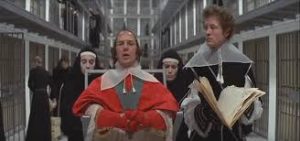
Based on historical events in 17th century France, and on two works inspired by those events, Aldous Huxley’s book The Devils of Loudon (1952) and John Whiting’s play The Devils (1961), the film deals with skulduggery at national and local levels.  The power-hungry Cardinal Richelieu (played by Christopher Logue, who was best known as a poet) encourages Louis XIII (Graham Armitage) to create a centralised and authoritarian France, with the Catholic Church entrenched as keeper of the national faith.  This means taking action against those French cities where power has become so entrenched that they function like autonomous city-states.


© Russo Productions / Warner Bros.


Particularly irksome to Richelieu is the city of Loudon, which has kept its independence thanks to its huge fortified city walls and which has a dismaying tendency to treat its Protestant citizens as equals of the Catholic ones.  Richelieu sends his agent, Baron Jean de Laubardemont (Dudley Sutton), with orders to demolish Loudon’s walls and bring the city to heel.  However, de Laubardemont is thwarted when confronted by Urbain Grandier (Reed), an eloquent and powerful city priest who’s able to bring the citizenry onto the streets to resist him and his soldiers.


Grandier’s political principles might be high-minded but his personal ones are anything but.  A philanderer and predator, he’s already impregnated and abandoned one woman (Georgina Hale) and is busy wooing another (Gemma Jones), whom he marries in a secret ceremony after claiming to have found theological justification that priests can become husbands.


Meanwhile, de Laubardemont joins forces with members of the local clergy, judiciary and trades whom Grandier has offended for personal or professional reasons and they conspire to destroy him.  Their means of doing so comes from an unexpected source – the scoliosis-stricken Sister Jeanne des Anges (Vanessa Redgrave), abbess of a Loudon convent.  Although she’s never met Grandier, Sister Jeanne has worshipped him from afar, first in a spiritual way and then – through a series of increasingly perverse and graphic visions – in an ungodly, sensual one.  Eventually she becomes deranged, her hysteria infects the nuns under her governance, and she accuses Grandier of using witchcraft to possess and corrupt her and her convent.  De Laudardemont and his allies promptly summon the witch-hunting Father Barre (Michael Gothard) to investigate.  When they’ve gathered enough ‘evidence’, they have Grandier charged with witchcraft and put him on trial for his life.


© Russo Productions / Warner Bros.


With its mixture of politics, sex, violence and religion, which Russell respectively depicts cynically, explicitly, unflinchingly and sacrilegiously, The Devils was and still is a provocative watch.  It had an ‘X’ certificate slapped on it in the USA, which meant few Americans got to see it.  X-certificate movies were assumed to be pornographic ones and got few theatre-bookings.  In addition, both the studio, Warner Brothers, and the censors took scissors to its more inflammatory scenes.  And Britain’s establishment critics were aghast.  The prissy and grumpy Leslie Halliwell, whose Filmgoers’ Companion books were for many years the only film-reference books British people read, dismissed it as ‘outrageously sick’ and ‘in howling bad taste from beginning to end’, while the hostility shown by the Evening Standard’s Alexander Walker culminated in a bust-up in a TV studio where Russell smacked the critic over the head with a rolled-up copy of his own newspaper.


These days, predictably, all that condemnatory water has passed well under the bridge.  Younger critics and filmmakers recognise Russell as a flamboyant auteur who added welcome dashes of flair, colour, imagination and daringness to a British film industry that was long accustomed to making stodgy historical costume dramas and dreary kitchen-sink dramas and seemed unaware that cinema is supposed to be, you know, cinematic.  And The Devils is acknowledged as his masterpiece.  For instance, Ben Wheatley, director of Kill List (2011) and High Rise (2016), has said, “The Devils to me stands alone in Ken Russell’s work.  It has all the fierceness and craziness of his movies, but it also has a seriousness and an intensity that isn’t in his other movies.”


Anyway, what’s my assessment The Devils?  Well, I’ll start with what I regard as the movie’s weakness.  Although it’s intended to be over the top, it goes a bit too over the top during the lengthy sequences where Father Barre and his lackeys invade the convent searching for proof of Grandier’s demonic influence.  Barre has already, secretly, threatened the nuns with execution unless they agree to behave hysterically.  And on cue, those nuns put on a hell of a show – a chaotic fracas of nudity, licentiousness, writhing, screaming, eye-goggling, tongue-waggling, attempted copulation with candlesticks and lewd carry-on with a giant effigy of Christ on the cross.  At this point, you feel you’re watching not so much a Ken Russell film as a parody of a Ken Russell film.  Which come to think of it, was what his later Lair of the White Worm (1988) was.


© Russo Productions / Warner Bros.


Otherwise, I think The Devils is magnificent.  Its highlights include the stylised sets by a young Derek Jarman, which eschew the grime, grubbiness and gloom you associate with life four centuries ago and instead are dazzlingly white and clean, but also disturbingly clinical.  These include Sister’s Jeanne’s convent, whose warren of chambers and passageways have the look of some germ-free medical institution – presumably one for the insane – and Richelieu’s headquarters, which resemble a cross between a giant bank-vault and a well-scrubbed prison and are disconcertingly staffed by priests and nuns.  The Devils’ policy of telling a historical story but not with historically accurate backdrops would appear in later British movies, most notably those made by Jarman himself when he became a director, such as Caravaggio (1986) and Edward II (1991).  And I suspect that an also-young Peter Greenaway was making notes, because The Devils has sequences reminiscent of his films, for example, one where Russell’s camera closes in on the still figure of de Laubardemont while he stands against a painting-like tableau.


The performances are another highlight.  The band of conspirators set on eliminating Grandier are played by a splendid rogue’s gallery of British character actors.  Dudley Sutton makes a credibly villainous de Laubardemont, his rottenness tempered with a soldierly practicality and matter-of-factness.  Northern Irish actor Max Adrian and British sitcom stalwart Brian Murphy – yes, that’s George from George and Mildred (1976-80) – are fabulously contemptible as the pair of quack medical practitioners who fall out with Grandier when he catches them trying to treat a plague victim with glass globes containing bees placed over the buboes and, even more bizarrely, a stuffed crocodile.  “What fresh lunacy is this?” Grandier bellows at them, a line that became the title of Robert Sellers’ biography of Oliver Reed, published in 2013.


There are excellent turns too from the impish Georgina Hale, embittered but endearing as the woman Grandier has wronged, and John Woodvine – Doctor Hirsch in the 1981 classic An American Werewolf in London – as her magistrate father, whose enmity for Grandier helps seal his fate.  Meanwhile, decked out in hippy-esque hair and John Lennon specs, Michael Gothard gives a barnstorming performance as the witch-hunting Father Barre.  Gothard’s volubility will surprise viewers who remember him chiefly as Locque, Roger Moore’s silent, expressionless foe in 1981’s For Your Eyes Only.  More nuanced is Murray Melvin, playing Father Mignon, a priest suspicious of Grandier who first alerts the conspirators to what’s happening in the convent.  Later – but too late – he realises that Grandier is innocent of the charges against him.


© Russo Productions / Warner Bros.


Gemma Jones is sympathetic and convincing as Madeleine, the woman whom Grandier covertly marries and the film’s only properly virtuous character.  Abandoning his philandering ways, he comes to regard her as his soulmate.  It’s difficult to imagine that Jones in The Devils is the same actress who plays the title character’s mother in the Bridget Jones trilogy (2001-16) – three smooth, smug and determined-to-play-it-safe movies that seem the polar opposite of everything Russell stood for in the British film industry.


Ultimately, though, The Devils belongs to its two stars.  Vanessa Redgrave’s portrayal of Sister Jeanne ranges from the unhinged and monstrous to the pitiful and pathetic, often within the same scene.  Twisted both mentally and physically, the war in her soul between sensuous yearning and stultifying piety is symbolised externally by the contrast between her comely face and the grotesque hump protruding from her back.


© Russo Productions / Warner Bros.


Then there’s Reed, at the height of his acting powers – powers that, alas, would wane as his thirst for alcohol increased and he became more famous as a drunken fixture on TV chat-shows than as a serious film actor.  He dominates The Devils.  He makes Grandier absolutely believable as, simultaneously, a heroic leader of men, a cerebral theologian and a sensation-hungry scoundrel.   His performance reaches a peak of intensity during the trial scenes.  Reed stuck to films and avoided the theatre, lacking the patience to go out and parrot the same lines night after night.  However, when you see him in verbal combat with Sutton before a row of judges (fearsomely clad in Ku Klux Klan-like white robes), you feel this would have been a brilliant piece of acting to watch live on a stage.


There follows the film’s cruel and despairing finale.  Grandier is found guilty and subjected to torture by Barre, who uses a hammer to smash his feet to a pulp.  Then he’s burned alive in the middle of a city square, in front of a nightmarishly drunken and jeering crowd – no longer does Grandier command the loyalty and affection of Loudon’s citizens.  Particularly horrible are the moments when Grandier continues to pontificate in a half-defiant, half-pleading voice while his face blackens and blisters in the flames.  This was filmed long before the advent of CGI and everything depended on the skills of the actors, the make-up people and the practical special effects team.  I imagine the scene was a difficult and gruelling one to shoot, especially for Reed.


The Devils certainly isn’t everyone’s cup of tea.  My partner, who’s no prude, doesn’t particularly like it.  She admires the film’s performances and set design, but its dearth of sympathetic characters and surfeit of totally unsympathetic ones, and its unrelenting display of human venality, hypocrisy and superstitious stupidity, prevent her from enjoying it much.  However, if you can stomach the film’s bleak view of mankind, and you value Ken Russell’s operatic directing style, The Devils is second to none.


Or indeed, second to nun…  Well, I’m sure Ken and Ollie would have appreciated the pun.


© Russo Productions / Warner Bros.