Cinematically stoned (Part 2)


© Taplin-Perry-Scorsese Productions / Warner Bros


I ended my previous post by promising I’d give a list of my favourite movie scenes wherein songs by the Rolling Stones are employed to memorable effect.  Here it is.


Jumpin’ Jack Flash (1968) in Mean Streets (1973)

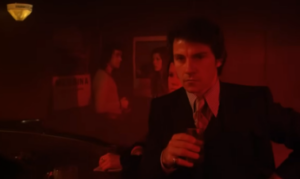
Wow.  Martin Scorsese really likes the Rolling Stones.  Not only has he made a concert movie about them, 2008’s Shine a Light, but he’s used their music in umpteen films: Goodfellas (1990), Casino (1995), The Departed (2006) and the one that first put him on the map, 1973’s Mean Streets.  Even today, more than 50 years later, the scene in Mean Streets where a young Robert De Niro comes swaggering through a bar, in slow motion, towards a pensive Harvey Keitel, while Mick Jagger hollers in the background about being “born in a cross-fire hurricane”, is a great synthesis of rock ‘n’ roll music and rock ‘n’ roll cinema.  Indeed, Jumpin’ Jack Flash is a fitting accompaniment for the arrival in popular consciousness of De Niro, who’d spend the rest of the 20th century showing Hollywood how to do proper acting.  The 21st century, featuring such efforts as The Adventures of Rocky and Bullwinkle (2000), Little Fockers (2010), New Year’s Eve (2011) and Dirty Grandpa (2016)…  Okay, not so much.


Satisfaction (1965) in Apocalypse Now (1979)

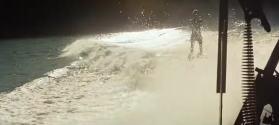
The Stones’ early, primordial and still potent stomper Satisfaction gets a brief but memorable airing in Francis Ford Coppola’s baroque Vietnam War masterpiece, playing on the radio while Captain Martin Sheen and his not-exactly-fighting-fit crew go cruising up the Nùng River in search of Marlon Brando.  Cue some funky on-deck dance moves by a frighteningly young-looking Laurence Fishburne and some funny / cringeworthy water-skiing moves by Sam Bottoms that knock various Vietnamese people out of their fishing boats.
 

© Omni Zoetrope / United Artists


Sympathy for the Devil (1968) in Alien Nation (1988) and in Interview with the Vampire (1994)

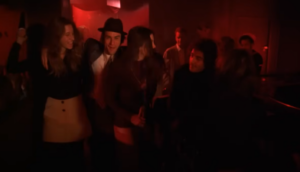
Graham Baker’s sci-fi / cop movie Alien Nation isn’t very good.  Its premise of an alien community getting stranded on earth and having to integrate as best as they can with the curmudgeonly human natives was handled much better in Neill Blomkamp’s District 9 (2009).  But I do like a woozy, hypnotic scene in it where alien-loathing cop James Caan enters a sleazy alien bar while a lady-alien performs an erotic dance to the strains of Sympathy for the Devil.  Not the original Stones song, but a correspondingly woozy, hypnotic cover-version of it by the great Jane’s Addiction.  I can’t find a film-clip of the scene, but here’s the Jane’s Addiction cover.


Meanwhile, Neil Jordan’s adaptation of Anne Rice’s Interview with the Vampire ends with Sympathy for the Devil on the soundtrack.  Again, this isn’t the Rolling Stones version but a cover, this time by Guns n’ Roses.  It’s every bit as ramshackle, shonky and (for me) enjoyable as the other covers Guns n’ Roses have done, for example, of Wings’ Live and Let Die (1973) and Bob Dylan’s Knockin’ on Heaven’s Door (1973).  Sympathy for the Devil kicks in when the vampire Lestat – Tom Cruise in one of his rare interesting roles – pops up to claim Christian Slater as his new vampirical companion for eternity.


Can’t You Hear Me Knocking? (1971) in Casino (1995)

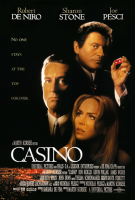
While Martin Scorsese serenades Robert De Niro and Harvey Keitel with Jumpin’ Jack Flash in Mean Streets, he employs the Stones song Can’t You Hear Me Knocking? for another of his regulars, Joe Pesci, in Casino.  Remarkably, Scorsese plays all seven minutes of the Santana-esque Can’t You… as an accompaniment to a lengthy sequence showing how Pesci’s Casino character Nicky Santoro gets established in Las Vegas.  Predictably, the sequence has Pesci doing what Pesci usually does in Scorsese movies: being a psychotic shit, barking orders at hoodlum sidekicks twice his size, eating in restaurants, ingratiating himself with fellow Mafiosi, being a psychotic shit, cursing and swearing, getting a blow-job, being a psychotic shit, talking about food, knocking off jewellery stores, acting the loving family man with his non-criminal relatives… and being a psychotic shit.
 

© Légende Entreprises / Universal Pictures


Ruby Tuesday (1967) in Children of Men (2006)

Wistful Stones ballad Ruby Tuesday features briefly on the soundtrack of Alfonso Cuarón’s gruellingly pessimistic science-fiction thriller Children of Men.  It’s another cover, sung by Franco Battiato.  We hear it during one of the movie’s calmer moments when Theo (Clive Owen) is visiting his old mate Jasper (Michael Caine), whose home provides a small pocket of sanity amid the unfolding dystopian grimness.  Amusingly, Caine, well known in real life for being a right-wing old grump with an aversion to paying tax, here plays an elderly anarcho-hippy with a fondness for smoking exceptionally strong pot.


Gimme Shelter (1969) in The Departed (2006)

Martin Scorsese loves the Rolling Stones and he loves their apocalyptic number Gimme Shelter in particular.  By my count he’s used it in three movies: Goodfellas, Casino and The Departed.  It’s best deployed at the beginning of The Departed, rumbling in the background while gangland thug Frank Costello (Jack Nicholson) expounds his philosophy.  “I don’t want to be a part of my environment,” he intones, imbuing his words with that leery, languid menace that only Nicholson is capable of.  “I want my environment to be a part of me.”  Strangely, in Scorsese’s Shine a Light two years later, Gimme Shelter was one of the songs the Stones didn’t perform on stage.  Marty missed a trick there.
 

© Plan B Entertainment / Warner Bros


Street Fighting Man (1968) in Fantastic Mr Fox (2009)

Director Wes Anderson also sticks Rolling Stones into his movies, but so far I haven’t mentioned him because I think most of his work is smug, pretentious and annoying.  For example, Play with Fire (1965) figures prominently in 2007’s The Darjeeling Limited, an Anderson movie so twee I find it the cinematic equivalent of being force-fed with chocolate-cake mix.  However, I like the scene in his stop-motion-animation adaptation of Roald Dahl’s Fantastic Mr Fox where, to the sound of the rabblerousing Stones anthem Street Fighting Man, Farmers Bean, Boggis and Bunce use three diggers to tear up the den of the titular Mr Fox; forcing the den’s inhabitants to frantically dig an escape-route.  Yes, they really ‘dig’ that song.  Sorry.


And finally…  Out of Time (1968) in Once Upon a Time in Hollywood (2019)

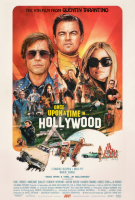
I’m not the biggest fan of the Stones song Out of Time – Jagger’s vocals get a bit too caterwauling for my liking – but it sees good satirical use in Once Upon a Time in Hollywood, Quentin Tarantino’s paean to the American movie-making capital in the late 1960s, a fascinating period when traditional notions about what made a good film were rapidly being undermined by an uppity younger generation.  Played when Rick Dalton (Leonardo DiCaprio), his new Italian spouse Francesca Capucci (Lorenza Izzo) and sidekick Cliff Booth (Brad Pitt) return from Italy, where Rick has been making spaghetti westerns and action thrillers with the likes of Sergio Corbucci and Antonio Margheriti, Out of Time gives an one-the-nose summation of DiCaprio’s sad-sack character – an actor a bit too old, un-hip and uncomprehending of the changing world around him to get the leading roles he once did, now doomed to playing villains in second-rate TV shows.
 

© Columbia Pictures / Sony Pictures Releasing 
Cinematically stoned (Part 1)


© Goodtimes Enterprises / Warner Bros.


Oh God.  I’ve just discovered that the soundtrack of Melania (2026), the vanity-documentary about Melania Trump, financed by Jeff Bezos and directed by Brett Ratner – a man accused of sexual assault by six women (allegations Ratner has always denied) – contains a song I just might identify as my favourite one of all time.   That is Gimme Shelter, the opening track on the Rolling Stones’ 1969 album Let It Bleed.  Yes, a tune that means so much to me features in a movie pithily described by Mikey Smith, deputy political editor at the Daily Mirror, as ‘a bad film made by bad people about bad people’, and about which Variety suggested if they showed it on an airplane ‘people would still walk out’.  I feel besmirched.


It’s quite possible, though, that the Trumps and Brett Ratner bunged Gimme Shelter onto the soundtrack without actually listening to the words.  Supposedly played as an accompaniment to Melania’s preparations for her husband’s inauguration as 47th President of the USA, which one year later would lead to masked, paramilitary-style thugs abducting young children from their homes and schools and executing peaceful protesters on the street, the song has such lyrics as “Rape, murder / It’s just a shot away” and “War, children / It’s just a shot away.”  Very apt, when you think about it.


Anyway, this has at least got me thinking about a different, and nicer, Rolling Stones-related topic – the band and movies.  After all, over the years, there have been plenty of Beatles films: A Hard Day’s Night (1964), Help! (1965), Yellow Submarine (1968), Let It Be (1970), I Wanna Hold Your Hand (1978), Sergeant Pepper’s Lonely Hearts Club Band (1978), The Birth of the Beatles (1979), Give my Regards to Broad Street (1984), The Hours and Times (1991), Backbeat (1994), Two of Us (2000), The Beatles: Get Back (2021) (which is actually a miniseries, but Peter Jackson made it, so it feels like a movie to me) and Sam Mendes’s forthcoming project, The Beatles – A Four-Film Cinematic Event (2027).  But what about the Rolling Stones?  What contribution to cinema has been made by the Liverpudlian mop-tops’ less wholesome London rivals?


© Shangri-La Entertainment / Paramount Classics


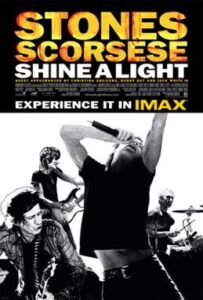
On the face of it, there isn’t a lot.  That is, if you don’t count the various documentaries made about them like Charlie is my Darling (1966), Jean Luc Godard’s oddball Sympathy for the Devil (1968) and Gimme Shelter (1970), a chronicle of their 1969 American tour that ended bloodily with Hells Angels-perpetrated carnage at the Altamont Speedway Free Festival.   And if you don’t count their many concert movies like The Stones in the Park (1969), Let’s Spend the Night Together (1982), Julien Temple’s The Stones at the Max (1991) (the first feature-length movie to be filmed in IMAX – because what you really want to see is a 100-feet-tall close-up of Keith Richards’ face, right?), The Rolling Stones Rock and Roll Circus (1996) (plug your ears for the bit with Yoko Ono) and the Martin Scorsese-directed Shine a Light (2008), which provided the gruesome spectacle of a leathery 60-something Jagger duetting with 20-something pop-moppet Christina Aguilera and prowling around her like a randy velociraptor.


There’s been little effort to film key events in the history of the Rolling Stones.  Off the top of my head, the only one I can think of is the little-known Stoned (2005), about the possible circumstances of Brian Jones’s death.  And as for movies featuring Stones-members as actors, well, there’s just a couple of items with Mick Jagger – epics such as Ned Kelly (1970) and Freejack (1992).  Ouch.


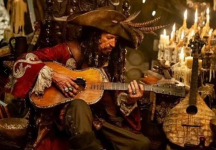
Actually, you could make a case for the Pirates of the Caribbean series being Rolling Stones films as their star Johnny Depp famously based the voice, mannerisms and swagger of his Captain Jack Sparrow character on Keith Richards.  I thought Depp-playing-Keith-playing-a-pirate was a rib-tickling gimmick that elevated the first Pirates of the Caribbean instalment, back in 2003, from being a middling film to being an entertaining one.  Alas, the sequels to it became ever-more convoluted, repetitious and tedious and, by the time of the third in the franchise, At World’s End (2007), when the filmmakers had the bright idea of bringing in the real Keith Richards to cameo as Captain Jack’s pirate dad, the idea had lost its novelty value.


© Buena Vista / Walt Disney Productions / Jerry Bruckheimer Films


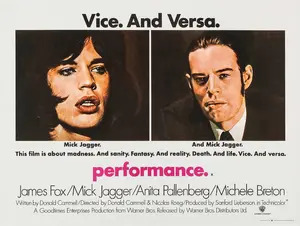
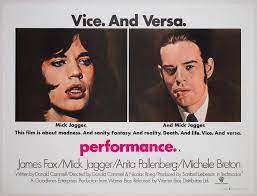
Arguably, the most Rolling Stones-esque film of all is Performance (1968), the psychedelically weird crime-rock movie co-directed by Donald Cammell and Nicholas Roeg.  Its cast includes Mick Jagger and Anita Pallenberg, then lover of Keith Richards.  The story of an on-the-run gangster (James Fox) who holes up in a mansion belonging to a burnt-out rock star (Jagger) and gets involved in some mind-bendingly druggy goings-on, the film neatly captures the dark, dangerous aura that was popularly associated with the Stones at the time.  Neither did it do the film’s scary reputation any harm that afterwards Fox underwent a ‘crisis’, dropped out of acting for the next decade-and-a-half and became an evangelical Christian.  As if the poor man hadn’t suffered enough, during the late 2010s, his son Laurence came out of the closet as a whinging, entitled, far-right-wing rentagob.


Keith Richards had and still has a deep-rooted aversion to Performance, thanks to the sexual shenanigans that Pallenberg supposedly got up to with Jagger during filming.  He believed these shenanigans were orchestrated by Donald Cammell, presumably as a way of getting Pallenberg and Jagger further ‘in character’.  In his autobiography Life (2020) – which was written with the help of a journalist also, confusingly, called James Fox – Richards describes Cammell as “the most destructive little turd I have ever met.”


Because of Richards’ loathing of Performance, one Jagger-Richards song that’s never been played at Rolling Stones gigs and is unlikely to ever be played at future ones is Memo from Turner (1968), which soundtracks a particularly strange sequence at the movie’s climax when everyone is out of their faces, the gangsters start stripping off and Jagger dances amid veering lights.  On the Performance recording of the song, Jagger is the only Stone involved, doing vocal duties, while Ry Cooder plays slide-guitar (wonderfully) and Randy Newman plays piano.  It’s a shame that we’ll never hear a live Stones version of it because it’s a belter.  I’m also partial to this cover of it by forgotten 1980s retro-rockers Diesel Park West.


Anyway, there’s one thing you can say about the Rolling Stones and celluloid.  In the right film, blasting over the soundtrack at the right moment, a Stones song can help create a splendid musical, visual and dramatic alchemy, turning a good cinematic scene into one that’s truly awesome.  In Part 2 of this post, I’ll list my favourite uses of Rolling Stones songs in the movies.  Stay tuned…


© Goodtimes Enterprises / Warner Bros.

Jim Mountfield gets stoned


© Aphelion


Ask me to name my favourite band of all time and four days of the week I’ll say the Rolling Stones, at least during their 1969-1974 period when they had Mick Taylor playing guitar with them.  (If you ask me on the other three days of the week, I’ll say the Jesus and Mary Chain.)


Though nowadays the Rolling Stones are most likely to evoke an affectionate chuckle from all and sundry, usually due to the lovable antics and anecdotes of Mr Keith Richards – Keef falling out of a palm tree in Fiji and needing emergency surgery for the acute cerebral hematoma he incurred, Keef smoking some of his recently deceased and cremated dad’s ashes in a spliff, Keef spilling the beans about Mick Jagger’s ‘tiny todger’ – there was a time when some very dark stuff indeed seemed to swirl around the band.


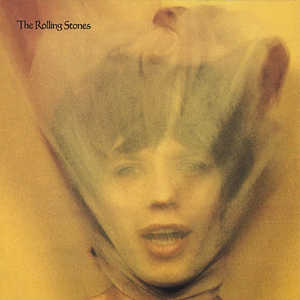
This dark stuff included the mysterious (and conspiracy-theory-laden) death of the Stones’ original lead guitarist Brian Jones, who was found drowned in his swimming pool in July 1969…  The band’s headlining of the ill-fated Altamont Speedway Free Festival in December of the same year, which saw the Hells Angels who’d been hired to act as concert security stab someone to death in the crowd…  Jagger’s involvement with Performance (1970), Nicolas Roeg and Donald Cammell’s dark, sleazy, druggy and violent movie about decadent rock stars and Kray Brothers-style gangsters, which so affected Jagger’s co-star James Fox that afterwards he took a decade-long hiatus from acting and became an evangelical Christian (though, alas, more horror was in store for poor old James, because in 1978 he fathered the idiotic far-right-wing nincompoop Laurence Fox)…  The band’s fondness for referencing Auld Nick when titling albums, such as Their Satanic Majesties Request (1967) and Goat’s Head Soup (1973), and songs, such as Sympathy for the Devil (1968) and Dancing with Mr D (1973)…  And generally, the whole image the band cultivated during the late 1960s and early 1970s. of outrage, hysteria, decadence, heroin, cocaine, Jack Daniels, groupies, partying, dabbling in the occult and doing naughty things with Mars Bars.


© Goodtimes Enterprises / Warner Brothers


Since I write horror stories, under the nom de plume Jim Mountfield, I’d always wanted to pen a macabre tale about the Rolling Stones during their young, hedonistic and scary days.  Well, I’m pleased to announce that I’ve finally managed to do so and the result, a 12000-word story called The Lost Stones, has just been published in the long-fiction section of the May 2023 edition of the ezine Aphelion.


Okay, it’s not quite about the Stones themselves – it’s about a mysterious cover band called the Lost Stones, who bear an uncanny resemblance to the real Stones in their youth, when Brian Jones was still alive and part of their line-up.  And the Lost Stones’ post-gig parties are really not events you want to get invited to…


I had a lot of fun writing The Lost Stones, especially as I managed to set the story in Sapporo, the main city of Japan’s northernmost island and prefecture Hokkaido, where I spent five very happy years during the 1990s.


Furthermore, I was able to mix into the story some folklore from North Africa.  The Maghreb, i.e., Arab and Berber North Africa, is another place where I’ve lived, from 2009 to 2013.  The Stones have a connection with that region because of their hook-up in the late 1960s with the Sufi-music-playing group the Master Musicians of Joujouka, who are based in the Rif Mountains of Morocco.  Brian Jones was particularly enthusiastic about the Master Musicians and an album he produced of their music, Brian Jones Presents the Pipes of Pan at Joujouka, is fascinatingly trippy.


The main page of Aphelion is available here and, until early June, Jim Mountfield’s story The Lost Stones can be accessed here.


© Rolling Stones

Rock star insults


From youtube.com


This blog entry starts with Kate Bush… but isn’t about Kate Bush.


The other day I read a news report about how Kate Bush’s 1985 song Running Up That Hill had just gone to number one in the United Kingdom, Australia, Belgium and Sweden and reached number five in the United States.  The renewed popularity of the song was due to it being featured in season four of the American sci-fi / horror TV series Stranger Things.  My curiosity was sufficiently piqued for me to go to YouTube and type ‘running up that hill’ into its search-bar, wondering if it would provide the clip from the TV show where the song was used.  That didn’t happen, however.  Instead, YouTube – presumably its algorithms had taken note of my past musical preferences at the site – sent me to a cover version of Running Up That Hill performed by the late 1990s / early 2000s band Placebo.  I have to say the cover version didn’t sound bad at all.  And incidentally, the comments below were full of Americans saying things like, “I’d always assumed this was an original Placebo song.  I hadn’t known some English chick had sung it first, back in the 1980s!”


Meanwhile, my reaction at that time was: Placebo?  Wow, I haven’t heard of them for years…


And then I thought: Hold on! They were responsible for the greatest rock ‘n’ roll insult I’ve ever heard live!


Let me explain.  In 1999, I attended T in the Park, then the biggest annual music festival held in Scotland.  Placebo was one of the bands performing on the main stage and I was near the front of the crowd at the start of their set.  Also appearing that day was the rock band Gay Dad, who’d recently scored hit singles with the songs To Earth with Love and Joy, although sceptics grumbled that the hype surrounding the band was nothing to do with quality and everything to do with the fact that its singer Cliff Jones had previously been a music journalist – his former colleagues in the media were promoting his outfit as a favour.  Placebo’s singer Brian Molko was obviously one of the sceptics.  Before they began playing, Molko apologised for the band being slightly late in coming onstage.


This, he said, was because: “I was getting a blowjob backstage from the singer of Gay Dad.”  He paused, then added with timing worthy of a master comedian: “Believe me, it’s not just their music that sucks!”


Anyway, that memory got me thinking about the following question.  What are the best rock star insults of all time?


There are a few famous ones that come immediately to mind.  I recall Robert Smith of the Cure saying of the self-consciously fey and militantly vegetarian frontman of the Smiths, “If Morrissey says not to eat meat, then I eat meat. That’s how much I hate Morrissey.”  Also memorable was Nick Cave’s comment on a well-known Californian funk-rock band: “I’m forever near a stereo saying, ‘What the f*ck is this garbage?’ And the answer is always the Red Hot Chili Peppers.”  Van Halen singer Dave Lee Roth was pretty brutal about a certain post-punk troubadour of the late 1970s and early 1980s: “Music journalists like Elvis Costello because music journalists look like Elvis Costello.”  Though for brutality, you can’t beat the Manic Street Preachers’ Richey Edwards talking about Slowdive, one of the key bands of the shoegaze movement of the late 1980s: “We hate Slowdive more than we hate Hitler.”


George Melly, though strictly speaking not a rock star – he was a jazz / blues singer – deserves inclusion here for his response to Mick Jagger.  Melly had drawn attention to the deep grooves on the Rolling Stone’s face and Jagger had tried to dismiss them as ‘laughter-lines’.  “Nothing,” pronounced Melly, “is that funny.”  Meanwhile, I was never a fan of Boy George but I’ve always chuckled at his verdict on Elton John: “All that money and he’s still got hair like a f*cking dinner lady.”  And just to prove that the art of the rock-star insult remains alive and well in 2022, there was recently a spat between Joan Jett and gun-humping, Trump-worshipping rock-neanderthal Ted Nugent, which produced this Jett-gem: “Ted Nugent has to live with being Ted Nugent.  He has to be in that body, so that’s punishment enough.”


From wikipedia.org / © Will Fresch


The world of rock contains certain individuals who can be relied upon to denigrate their contemporaries practically every time they open their mouths.  Two who spring to mind are siblings Liam and Noel Gallagher, late of Britpop mega-band Oasis.  Among those suffering the wrath of Liam Gallagher have been Keith Richards and George Harrison (“jealous and senile and not getting enough f*cking meat pies”), Bob Dylan (“a bit of a miserable c*nt”), Billie Joe Armstrong of Green Day (“I don’t like his head”), Bono (“he looks like a fanny”) and Florence Welch from Florence and the Machine (“sounds like someone’s stood on her f*cking foot”).  For my money, though, his best insult was heard at a Q Magazine Awards ceremony, where he yelled at Coldplay’s Chris Martin, “You’re a plant pot!”


As the older and supposedly more cerebral Gallagher, Noel’s insults have been more elaborate, if a tad less savage.  Of the musical output of Justin Bieber, he once opined, “My cat sounds more rock ‘n’ roll than that.”   He likened the appearance of the White Stripes’ Jack White to “Zorro on doughnuts” and mused about skatey Canadian punk rockers Sum 41: “After I heard Sum 41, I thought, I’m actually alive to hear the shittiest band of all time.”  Needless to say, Oasis’s Britpop arch-enemies Blur came in for some stick too: “I wish Blur were dead, John Lennon was alive and the Beatles would reform.”  And inevitably he’s had some choice words for his wayward younger brother since they acrimoniously parted company in 2009.  That same year he famously described Liam to “a man with a fork in a world of soup.”  (For his part, the younger Gallagher has repeatedly referred to Noel as a ‘potato’ and called his post-Oasis band the High Flying Birds ‘the High Flying Smurfs’.)


© Weidenfeld & Nicolson


The Rolling Stones’ Keith Richards has also had a famously barbed tongue, powered by his apparent disdain for any form of music that isn’t structured around a 12-bar blues progression.  He’s dissed Prince as “an overrated midget”, REM as “a whiny college rock band” and P Diddy as “bereft of imagination.  What a piece of crap.”  He dumped on the Grateful Dead for “Just poodling about for hours and hours.  Jerry Garcia, boring shit, man. ”  Of Metallica he speculated, “I don’t know where Metallica’s inspiration comes from, but if it’s from me, I f*cked up.”  Hilariously, he said of Elton John after the death of Princess Diana in 1997 and after John had reworked his 1973 ode to Marilyn Monroe, Candle in the Wind, as a tribute to the deceased princess: “His writing is limited to songs about dead blondes.”  (To which Elton John retorted that the venerable Stones guitarist resembled “a monkey with arthritis.”)


But surely the man who’s suffered the most ignominious put-down from Keith Richards is his long-term singer, writing partner and fellow Rolling Stone Mick Jagger.  Jagger’s image as a tireless lothario took a dent when Richards wrote about his manhood in his 2010 autobiography Life: “Marianne Faithful had no fun with his tiny todger.  I know he’s got an enormous pair of balls but it doesn’t quite fill the gap.”


From vassifer.blogs.com


However, when it comes to rock-star insults, one man is – or alas, was – the undisputed champion.  Mark E. Smith, for four decades until his death in 2018 the driving force behind the fascinatingly off-the-wall post-punk / alternative rock group the Fall, was never more entertaining in interviews than when he directed his guns at his peers and rivals in the music world.  Among those getting it in the neck from Smith over the years were Badly Drawn Boy (“fat git”), Echo and the Bunnymen (“old crocks”), Garbage (“like watching paint dry”), Bob Geldof (“a dickhead”), Sonic Youth’s Thurston Moore (“should have his rock licence revoked”), Mumford and Sons (“We were playing a festival in Dublin…  There was this other group, like, warming up… and they were terrible.  I said, ‘Shut them c*nts up!’  And they were still warming up, so I threw a bottle at them…  I just thought they were a load of retarded Irish folk singers”), Pavement (“They haven’t got an original thought in their heads”), Ed Sheeran (like “a duff singer songwriter from the 70s you find in charity shops”) and Suede (“Never heard of them,” said Smith cruelly, just after off coming off a tour where Suede were the support band).


And in fact, not even a songstress as lauded as Kate Bush escaped Smith’s vitriol.  In 2014, when Bush’s Before the Dawn concerts – her first live performances since 1979 – triggered massive interest in her and her music again, Smith told the Manchester Evening News: “Who decided it was time to start liking her again?  I never even liked her the first time round.  It’s like all these radio DJs have been raiding their mam and dad’s record collections and decided that Kate Bush is cool again.  But I’m not having it!”


It’s a shame the wonderfully curmudgeonly Smith isn’t around today to witness Kate Bush’s latest return to prominence with Running Up That Hill.  I’m sure he’d have some entertaining pronouncements to make on the matter.


© EMI

Charlie was our darling


From beatsperminute.com


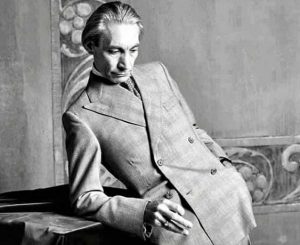
The death of Rolling Stones drummer Charlie Watts on August 24th came as a blow.  Ask me to identify my favourite all-time band and four days of the week I’d say the Stones, at least during the years from 1969 to 1974 when they had Mick Taylor playing guitar with them.  (Ask me the other three days of the week and I’d probably say the Jesus and Mary Chain.)


A drummer who’d schooled himself in jazz music but paradoxically found himself thumping the tubs for the self-styled ‘biggest rock ‘n’ roll band in the world’, Watts performed with none of the bombast of your archetypal rock drummer like Led Zeppelin’s John Bonham – of whom Keith Richards once inquired perplexedly, “Did he have to hit those drums so hard?” But his immaculate backbeat imposed discipline on the Stones’ blues-rock sound, reining it in and holding it together when it could so easily have degenerated into sloppy, all-over-the-place chaos.


Meanwhile, Watts was endearing as a figure of modesty, decorum and decency amid the maelstrom of outrage, hysteria, decadence, heroin, cocaine, Jack Daniels, swimming-pool drownings, Hells Angels slayings, groupies, wild partying, alleged Mars Bar abuse, alleged whole-body blood transfusions, dabbling in black magic and shenanigans with Justin Trudeau’s mum that swirled around the band for the first two decades of its existence.  Among the many, many tributes to Watts this week, one that sticks in my mind is a below-the-line comment in the Guardian.  It was from a guy who’d once worked in a quarantine centre for animals arriving in Britain.  He’d made Watts’s acquaintance when the drummer’s cats and dogs ended up there after he and his wife returned to the UK from tax exile in France.  Apparently, while many owners never looked in on their poor pets for the whole duration of their quarantine, the animal-loving Stone made a point of coming to visit his every day.


As tales about Watts’s mild manners and niceness were legion, when he did lose the rag, it became the stuff of legend.  After he passed away on Monday, I noticed Mick Jagger’s name trending on twitter and discovered this was because people were tweeting and retweeting the tale of what happened in an Amsterdam hotel in 1984 when Jagger referred to Charlie Watts as ‘my drummer’.  Watts responded by yelling, “Never call me your drummer again!” and landing a right hook on him.  Such was the force in the punch, probably the only time that Watts exerted as much unsubtle power as John Bonham did, that the lippy one was knocked back onto a silver platter of salmon.  He then tilted towards an open window that overlooked a canal.  Supposedly, Keith Richards grabbed hold of Jagger before he disappeared out of the window, though only because at the time he was wearing one of Richards’ jackets, which the owner didn’t want to see dunked in a canal.  This is recounted in glorious detail in Richards’ autobiography Life (2010).  Therefore, it’s got to be true.


For me, the height of my Rolling Stones infatuation came during the 1990s, while I was living in Sapporo, capital city of Hokkaido, the northernmost island and prefecture of Japan.  For the first time in my life, I was earning a decent wage and didn’t feel guilty about splurging some of it on music.  By good luck, there was an excellent wee music shop dealing in specialty, bootleg and second-hand records on Hiragishi-dori, the avenue where I lived.  The shop’s lugubrious owner did very well out of me during the five years I was there.  It was at his establishment that I bought remastered versions of classic Stones albums that I’d only owned previously as crackly, crap-sounding cassette tapes: Let It Bleed (1969), Sticky Fingers (1971) Exile on Main Street (1972) and so on.  I also bought albums that people had told me were a bit duff, like Goat’s Head Soup (1973) and Black and Blue (1974), though I ended up thinking they were quite good.


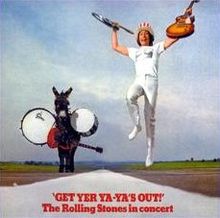
One spooky Stones-related thing that happened during this period was when I held a Christmas party at my Sapporo apartment on December 18th, 1993, and then discovered that the party-date coincided with Keith Richards’ 50th birthday.  As a result, the evening was more Stones-themed than I’d planned.  I spent an early half-hour of it at my record player, playing and replaying a section of Get Yer Ya-Yas Out, the 1970 live album of the Stones performing in New York and Baltimore.  This was at the insistence of my Japanese colleague Tokunaga Sensei, also a Stones buff, who was convinced that there was a bit of it where you could hear members of the audience shouting in Japanese.  (The cover of Get Yer Ya-Yas Out features the shocking sight of the usually dapper Charlie Watts prancing around in white pants and T-shirt and an Uncle Sam hat.  The album also contains Jagger’s affectionate but accurate onstage remark: “Charlie’s good tonight.”)


© Decca 


The party got truly Stones-ian later on.  A lady I’d invited from the local hairdressing salon flipped her lid after a few drinks and started assaulting the other guests, while Sympathy for the Devil played in the background.  As Jagger remarked at the ill-fated Altamont concert in 1969, after someone had been stabbed to death in the crowd, “Something always happens when we play that number.”


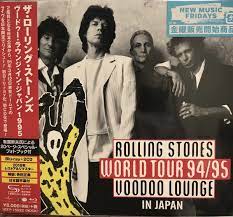
Early in 1995, I heard exciting news.  The Rolling Stones were playing seven concerts at Tokyo Dome in early March as part of their Voodoo Lounge tour.  I hadn’t seen the band live before, so this seemed a golden opportunity to do so.  Unfortunately, I had other commitments at that time.  I’d arranged to do some freelance work with the Fodor’s Travel company, who planned to bring out a new edition of their Japan guidebook and wanted someone to update its chapters on Hokkaido and Tohoku, the northernmost part of the main Japanese island of Honshu.  As I had a break from my regular job during February and March, I’d intended to wander around Hokkaido and Tohoku, doing the guidebook research.  Determined to have my cake and eat it, I bought a ticket for the Stones and planned to spend late February and the first half of March in Tohoku, doing research, but taking a break for a few days in the middle to pop down to Tokyo.


That research trip in Tohoku proved to be one of the most physically punishing things I’ve done in my life.  Hokkaido was cold at that time of year, but I hadn’t expected Tohoku to be so bloody cold too.  Also, in my haste to clinch the Fodor’s job – wow, I thought, here’s my big chance to be a travel writer! – I stupidly agreed to accept a lump-sum payment at the end of it, which meant I got nothing to pay for my expenses while I actually did the work.  Therefore, to minimize costs, I decided to stay in youth hostels and hitchhike around rather than travel by bus or train.  Sleeping in Tohoku’s drafty wooden hostels and thumbing my way along its highways during wintertime proved not to be a good idea.


To make things worse, my itinerary depended on what was written in the previous edition of the Fodor’s Japan Guidebook.  Trying to find many of the tourist sites, whose prices, opening times, attractions, etc., I was supposed to be checking and updating, proved a nightmare because whoever had written the previous edition seemed to have been drunk at the time.  Or more likely, hadn’t actually been to many of those places and had just made it up instead.  Getting hopelessly lost became a daily occurrence.


Looking back on it now, I can laugh, but there were times when I thought I was going to die or go insane.  Trudging in ever-maddening circles around the castle town of Hirosaki in Aomori Prefecture, trying to find a tourist attraction, until a local explained to me that the streets’ layout was deliberately confusing, designed in medieval times to confuse any attackers who entered the town intending to locate and assault the castle.  Getting a lift in a pick-up truck with an old geezer who’d never spoken to a foreigner before and was so excited by my presence that he might have been tripping on LSD while we whizzed at top speed along the highway.  Venturing up to Lake Tazawa in the mountains above Akita City, arriving at night, wandering into a snowbound youth hostel and finding it inexplicably deserted, and wondering if I’d just strayed into an uncanny tale of the supernatural by Lafcadio Hearn.  Coming into a freezing Fukushima City after dark, discovering that a big conference was taking place there and all the hotels were fully booked, and having to spend the night sleeping among the local homeless community in an underpass next to an open sewer.


© Universal Music LLC / From discogs.com


It was after the Fukushima episode that – thank God – the time came for me to jump on a bullet train and head down to Tokyo, where I holed up in a hotel and spent the next couple of days in a bathtub with an unlimited supply of beer. Then, scrubbed up and feeling human again, I went to Tokyo Dome to see the Stones.


No doubt it wasn’t the greatest Stones concert ever.  The set leaned towards the overly familiar – Satisfaction, Start Me Up, Angie, It’s Only Rock ‘N’ Roll – although I was delighted that they played Tumbling Dice off Exile on Main Street.  But as a communal experience where you switched your brain off for a couple of hours and just got into the groove, and especially after the wretched, wintry experiences I’d been through up north, it was rather wonderful.  Jagger tried to show off his mastery of the Japanese language, which was funny.  Keith Richards shambled to the front of the stage to sing a song at one point and, looking at the Tokyo masses, croaked, “I don’t see you very often, but when I do, I certainly see a lot of you.”  At his drumkit, Charlie Watts sported his usual expression, half-bemused, half like that of a man nervously eyeing the misfits around him and thinking, “If I just keep on playing, maybe these nutters won’t notice I’m here…”


Tellingly, when Jagger introduced all the musicians to the crowd near the end of the set, starting with backing vocalists Lisa Fischer and Bernard Fowler, working his way up to Darryl Jones (who’d replaced Bill Wyman on bass) and then onto the Stones themselves, it was Charlie Watts who got by far the biggest and longest cheer of the night.  In fact, for so long did the Japanese crowd show their adulation that the poor guy looked a bit embarrassed by it.


Then again, with his modesty, humility and politeness, with that hardy gaman shimsasho-type attitude he displayed whilst playing with the Stones for 58 years and, simultaneously, the sense of wa that he had with his bandmates, with his love of a sharp suit and his occasional flashes of samurai spirit – which Jagger experienced to his cost when he got lamped in Amsterdam – Charlie Watts exhibited many of the finest Japanese virtues.  No wonder the crowd that night loved him.


From twitter.com/officialKeef