Back with the Chain gang


I once wrote on this blog that the Jesus and Mary Chain, the Scottish alternative rock band whose core members are brothers Jim and William Reid, was “on at least three days of the week… my favourite band of all time.”  Incidentally, I’d say on the other four days of the week my favourite all-time band is the Rolling Stones between 1969 and 1974, when Mick Taylor played with them.


However, when I heard that the Jesus and Mary Chain intended to perform in Singapore, my current abode, in the middle of this month, I felt a little apprehensive.  For one thing, though I often cite the first time I saw the band live – at London’s Brixton Academy in 1992, while they headlined the Rollercoaster tour and the support bands were American alternative rockers Dinosaur Jr, swirly shoegazers My Bloody Valentine, and a young, up-and-coming band called Blur (whatever happened to them?) – as one of the best gigs, if not the best gig I’ve ever attended, the last time I saw them was a different affair.   That was in Edinburgh in 1998, when relations between Jim and William had decayed so badly they spent the show telling each other to shut up.  It presaged a disastrous performance soon after at the Los Angeles venue House of Blues, where Jim turned up drunk and William stormed offstage.  To no one’s great surprise, the following year they announced the band had split up – though they reformed in 2007.


Would 2025’s Singapore gig be closer in spirit to the 1992 one or the 1998 one?


Also, last year, they released a new album called Glasgow Eyes whose sound was something of a departure.  Though simultaneously dreamy and scuzzy in the best Jesus and Mary Chain tradition, a strong dose of electronica infused it.  I assumed their 2025 set would contain a good number of songs from Glasgow Eyes, which was fine, but it’d mean a lot of the music wouldn’t be what I immediately associated with the Jesus and Mary Chain.


There was the age issue too. With Jim and William Reid now 64 and 67 years old respectively, I wondered how kind time had been to their performing abilities.  After all, I hadn’t seen these guys sing and play onstage for nearly 30 years.  30 years – wow!


And lastly, it just seemed weird that the Jesus and Mary Chain was playing in a famously sensible, serious and clean-living place like Singapore.  After all, this is a band that initially made its name with chaos and disreputability.  When the Reids first performed in 1983, they generated controversy with their habit of delivering gigs just 15 minutes long, with their backs to the audience and their sound cloaked in squalls of feedback, which went down so badly with the punters that – according to the British tabloid press – ‘riots’ ensued.  And their Singaporean show was scheduled for the Esplanade Concert Hall, a venue whose floorspace is entirely covered in seating.  I honestly couldn’t imagine a Jesus and Mary Chain gig where everyone had to sit.


Thus, as I entered the Esplanade Concert Hall on the evening of the show, I had plenty of concerns.  But I needn’t have worried.  This was a great concert.


Before things kicked off, I ordered a few beers at a bar just outside the auditorium’s entrance and sipped them whilst taking in the appearances of my fellow concert-goers.  It genuinely surprised me how many Singaporeans had come tonight.  They consisted mainly of young goths or middle-aged folk who looked like they’d been art-college students in an earlier era.  There was a lengthy queue, mainly of Singaporeans, to buy T-shirts.  An especially popular purchase was a T-shirt featuring the cover of the Jesus and Mary Chain’s 1985 debut album, Psychocandy, which depicted Jim and William in their svelte youth.


© Blanco y Negro


(Among the non-Jesus and Mary Chain T-shirts I observed folk wearing were, not unexpectedly, ones bearing the names of the Cure and the Cocteau Twins…  And, in one case, of Radio Clyde, which was unexpected.)


But there were Westerners around too. Whilst queuing for a beer, I got chatting to an English fellow who was wearing a T-shirt featuring the title of Blur’s 1993 album Modern Life is Rubbish.  “I actually saw Blur supporting the Jesus and Mary Chain,” I said, “back before they were famous.”


He replied, “That would have been the Rollercoaster tour.  I saw it in Birmingham.”  He added wistfully, “Don’t remember much about it, though.”


I should have come back with the obvious quip, “Yes, it was all a bit of a blur!”  But, alas, I wasn’t as quick-thinking as that.


Just before eight o’clock, the gig’s start-time, everyone made their way into the auditorium.  However, when the lights dimmed, it wasn’t for the Jesus and Mary Chain’s set but for that of a support act, the Singaporean singer-songwriter Shye.  Although Shye’s Wikipedia page describes the musical genres she works in as ‘folk-rock, neo-soul, electronic, R&B’, what she and her backing band served up tonight sounded pretty shoegazer-ish to me – not too far removed from the songs at the mellower end of the Jesus and Mary Chain’s repertoire.  Her performance went down well.
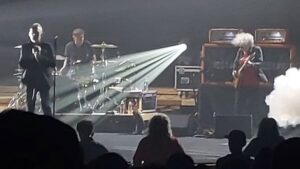


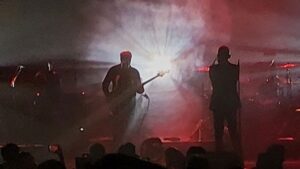
Then the main attraction appeared.  The moment the band – Jim, William, guitarist Scott Von Ryper, bassist Mark Crozer and drummer Justin Welch – came onstage and immediately tore into Jamcod, the most blistering track on Glasgow Eyes, the crowd rose to their feet as one and stayed on their feet for the entire 19-song set.  And I knew at once from the band’s poise and confidence, and the audience’s euphoric reaction to them, that everything about this show was going to be right.


Every phase in the Jesus and Mary Chain’s career was acknowledged tonight, with material played from all eight of the band’s studio albums – plus the 1986 Some Candy Talking EP, unsurprisingly represented by the song Some Candy Talking, whose ambiguous lyrics so upset the late disc jockey Mike Smith that he blacklisted it on the BBC’s Radio One.  As it turned out, four songs were performed from Glasgow Eyes: besides Jamcod, the lowkey Chemical Animal, the lumbering Poor Pure and the jaunty Venal Joy.  These actually fitted in seamlessly with the rest of the set.


I was delighted that the band played three songs from my favourite Jesus and Mary Chain album, 1989’s Automatic: Between Planets, Halfway to Crazy and Head On.  I always felt Automatic got a bad rap from the critics and was sorely underrated.  Also well-represented was 1987’s Darklands, whose brooding numbers added both melody and melancholy to proceedings and balanced the set’s more abrasive parts: the album’s title track, Happy When It Rains and, appropriately, April Skies.  (Well, the show was taking place under the April skies of Singapore.)  And for fans who’d been with the band from the very beginning, three numbers were aired from Psychocandy: In a Hole, Taste of Cindy and Just Like Honey.


On the original Just Like Honey, the female backing vocals were provided by Karen Parker, the then-girlfriend of then-Jesus and Mary Chain drummer Bobby Gillespie (who, of course, would go on to front Primal Scream).  So versatile was Ms. Parker that on one occasion she stepped in and played drums at one of their gigs after Gillespie had hurt his hand.  Also, Scarlett Johannson did those vocal duties when the band played Just Like Honey during their first performance after reforming in 2007.  Tonight, Jim Reid invited Shye, the support act, onstage again to sing it with him.  She also co-sang Sometimes Always from 1994’s Stoned & Dethroned – stepping into the shoes of Mazzy Star’s Hope Sandoval, who’d shared the vocals on the original recording.  Shye acquitted herself beautifully.



I doubt if many people would rate 1998’s Munki or 2017’s Damage and Joy as the best-ever Jesus and Mary Chain albums, but I had absolutely no problem with the songs played from them tonight: Cracking Up and I Hate Rock ‘n’ Roll off the former and All Things Pass off the latter.  Everything, in fact, was performed with great aplomb.  As frontman, Jim Reid kept the talk between songs to a minimum and just got on with delivering the goods, i.e., singing.  At the end of the main set, though, he did comment drily, “We have to go now… But if you make some noise, we might come back.”


My only regrets about the evening were a few songs I’d have liked them to play, but they didn’t.  These included Blues from a Gun and UV Ray from Automatic, and Nine Million Rainy Days from Darklands.  I would also have enjoyed hearing something off their two compilations of singles, B-sides and rarities, 1988’s Barbed Wire Kisses, (for example, Sidewalking) and 1993’s The Sound of Speed (for example, Heat and their cover of the 13th Floor Elevators’ Reverberation).  And I’d have loved to hear more from their excellent 1992 album Honey’s Dead, though the song they did play from it, Reverence, at the end of the encore brought proceedings to a stupendous close.  None of this, of course, was the band’s fault.  It’s a testimony to the greatness of their back catalogue that they could never cram everything you wanted to hear into a single set.


When I left the Esplanade Concert Hall and stepped out into the Singaporean night, I felt quite a buzz, to say the least.  In fact, I felt 30 years younger.


Temporarily, anyway.
 

Charlie was our darling


From beatsperminute.com


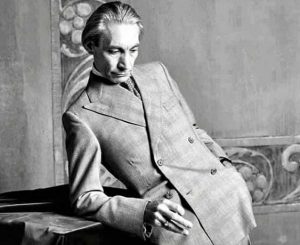
The death of Rolling Stones drummer Charlie Watts on August 24th came as a blow.  Ask me to identify my favourite all-time band and four days of the week I’d say the Stones, at least during the years from 1969 to 1974 when they had Mick Taylor playing guitar with them.  (Ask me the other three days of the week and I’d probably say the Jesus and Mary Chain.)


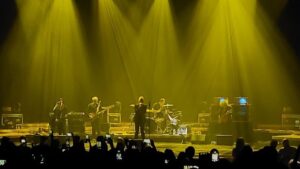
A drummer who’d schooled himself in jazz music but paradoxically found himself thumping the tubs for the self-styled ‘biggest rock ‘n’ roll band in the world’, Watts performed with none of the bombast of your archetypal rock drummer like Led Zeppelin’s John Bonham – of whom Keith Richards once inquired perplexedly, “Did he have to hit those drums so hard?” But his immaculate backbeat imposed discipline on the Stones’ blues-rock sound, reining it in and holding it together when it could so easily have degenerated into sloppy, all-over-the-place chaos.


Meanwhile, Watts was endearing as a figure of modesty, decorum and decency amid the maelstrom of outrage, hysteria, decadence, heroin, cocaine, Jack Daniels, swimming-pool drownings, Hells Angels slayings, groupies, wild partying, alleged Mars Bar abuse, alleged whole-body blood transfusions, dabbling in black magic and shenanigans with Justin Trudeau’s mum that swirled around the band for the first two decades of its existence.  Among the many, many tributes to Watts this week, one that sticks in my mind is a below-the-line comment in the Guardian.  It was from a guy who’d once worked in a quarantine centre for animals arriving in Britain.  He’d made Watts’s acquaintance when the drummer’s cats and dogs ended up there after he and his wife returned to the UK from tax exile in France.  Apparently, while many owners never looked in on their poor pets for the whole duration of their quarantine, the animal-loving Stone made a point of coming to visit his every day.


As tales about Watts’s mild manners and niceness were legion, when he did lose the rag, it became the stuff of legend.  After he passed away on Monday, I noticed Mick Jagger’s name trending on twitter and discovered this was because people were tweeting and retweeting the tale of what happened in an Amsterdam hotel in 1984 when Jagger referred to Charlie Watts as ‘my drummer’.  Watts responded by yelling, “Never call me your drummer again!” and landing a right hook on him.  Such was the force in the punch, probably the only time that Watts exerted as much unsubtle power as John Bonham did, that the lippy one was knocked back onto a silver platter of salmon.  He then tilted towards an open window that overlooked a canal.  Supposedly, Keith Richards grabbed hold of Jagger before he disappeared out of the window, though only because at the time he was wearing one of Richards’ jackets, which the owner didn’t want to see dunked in a canal.  This is recounted in glorious detail in Richards’ autobiography Life (2010).  Therefore, it’s got to be true.


For me, the height of my Rolling Stones infatuation came during the 1990s, while I was living in Sapporo, capital city of Hokkaido, the northernmost island and prefecture of Japan.  For the first time in my life, I was earning a decent wage and didn’t feel guilty about splurging some of it on music.  By good luck, there was an excellent wee music shop dealing in specialty, bootleg and second-hand records on Hiragishi-dori, the avenue where I lived.  The shop’s lugubrious owner did very well out of me during the five years I was there.  It was at his establishment that I bought remastered versions of classic Stones albums that I’d only owned previously as crackly, crap-sounding cassette tapes: Let It Bleed (1969), Sticky Fingers (1971) Exile on Main Street (1972) and so on.  I also bought albums that people had told me were a bit duff, like Goat’s Head Soup (1973) and Black and Blue (1974), though I ended up thinking they were quite good.


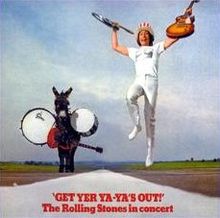
One spooky Stones-related thing that happened during this period was when I held a Christmas party at my Sapporo apartment on December 18th, 1993, and then discovered that the party-date coincided with Keith Richards’ 50th birthday.  As a result, the evening was more Stones-themed than I’d planned.  I spent an early half-hour of it at my record player, playing and replaying a section of Get Yer Ya-Yas Out, the 1970 live album of the Stones performing in New York and Baltimore.  This was at the insistence of my Japanese colleague Tokunaga Sensei, also a Stones buff, who was convinced that there was a bit of it where you could hear members of the audience shouting in Japanese.  (The cover of Get Yer Ya-Yas Out features the shocking sight of the usually dapper Charlie Watts prancing around in white pants and T-shirt and an Uncle Sam hat.  The album also contains Jagger’s affectionate but accurate onstage remark: “Charlie’s good tonight.”)


© Decca 


The party got truly Stones-ian later on.  A lady I’d invited from the local hairdressing salon flipped her lid after a few drinks and started assaulting the other guests, while Sympathy for the Devil played in the background.  As Jagger remarked at the ill-fated Altamont concert in 1969, after someone had been stabbed to death in the crowd, “Something always happens when we play that number.”


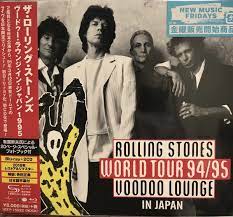
Early in 1995, I heard exciting news.  The Rolling Stones were playing seven concerts at Tokyo Dome in early March as part of their Voodoo Lounge tour.  I hadn’t seen the band live before, so this seemed a golden opportunity to do so.  Unfortunately, I had other commitments at that time.  I’d arranged to do some freelance work with the Fodor’s Travel company, who planned to bring out a new edition of their Japan guidebook and wanted someone to update its chapters on Hokkaido and Tohoku, the northernmost part of the main Japanese island of Honshu.  As I had a break from my regular job during February and March, I’d intended to wander around Hokkaido and Tohoku, doing the guidebook research.  Determined to have my cake and eat it, I bought a ticket for the Stones and planned to spend late February and the first half of March in Tohoku, doing research, but taking a break for a few days in the middle to pop down to Tokyo.


That research trip in Tohoku proved to be one of the most physically punishing things I’ve done in my life.  Hokkaido was cold at that time of year, but I hadn’t expected Tohoku to be so bloody cold too.  Also, in my haste to clinch the Fodor’s job – wow, I thought, here’s my big chance to be a travel writer! – I stupidly agreed to accept a lump-sum payment at the end of it, which meant I got nothing to pay for my expenses while I actually did the work.  Therefore, to minimize costs, I decided to stay in youth hostels and hitchhike around rather than travel by bus or train.  Sleeping in Tohoku’s drafty wooden hostels and thumbing my way along its highways during wintertime proved not to be a good idea.


To make things worse, my itinerary depended on what was written in the previous edition of the Fodor’s Japan Guidebook.  Trying to find many of the tourist sites, whose prices, opening times, attractions, etc., I was supposed to be checking and updating, proved a nightmare because whoever had written the previous edition seemed to have been drunk at the time.  Or more likely, hadn’t actually been to many of those places and had just made it up instead.  Getting hopelessly lost became a daily occurrence.


Looking back on it now, I can laugh, but there were times when I thought I was going to die or go insane.  Trudging in ever-maddening circles around the castle town of Hirosaki in Aomori Prefecture, trying to find a tourist attraction, until a local explained to me that the streets’ layout was deliberately confusing, designed in medieval times to confuse any attackers who entered the town intending to locate and assault the castle.  Getting a lift in a pick-up truck with an old geezer who’d never spoken to a foreigner before and was so excited by my presence that he might have been tripping on LSD while we whizzed at top speed along the highway.  Venturing up to Lake Tazawa in the mountains above Akita City, arriving at night, wandering into a snowbound youth hostel and finding it inexplicably deserted, and wondering if I’d just strayed into an uncanny tale of the supernatural by Lafcadio Hearn.  Coming into a freezing Fukushima City after dark, discovering that a big conference was taking place there and all the hotels were fully booked, and having to spend the night sleeping among the local homeless community in an underpass next to an open sewer.


© Universal Music LLC / From discogs.com


It was after the Fukushima episode that – thank God – the time came for me to jump on a bullet train and head down to Tokyo, where I holed up in a hotel and spent the next couple of days in a bathtub with an unlimited supply of beer. Then, scrubbed up and feeling human again, I went to Tokyo Dome to see the Stones.


No doubt it wasn’t the greatest Stones concert ever.  The set leaned towards the overly familiar – Satisfaction, Start Me Up, Angie, It’s Only Rock ‘N’ Roll – although I was delighted that they played Tumbling Dice off Exile on Main Street.  But as a communal experience where you switched your brain off for a couple of hours and just got into the groove, and especially after the wretched, wintry experiences I’d been through up north, it was rather wonderful.  Jagger tried to show off his mastery of the Japanese language, which was funny.  Keith Richards shambled to the front of the stage to sing a song at one point and, looking at the Tokyo masses, croaked, “I don’t see you very often, but when I do, I certainly see a lot of you.”  At his drumkit, Charlie Watts sported his usual expression, half-bemused, half like that of a man nervously eyeing the misfits around him and thinking, “If I just keep on playing, maybe these nutters won’t notice I’m here…”


Tellingly, when Jagger introduced all the musicians to the crowd near the end of the set, starting with backing vocalists Lisa Fischer and Bernard Fowler, working his way up to Darryl Jones (who’d replaced Bill Wyman on bass) and then onto the Stones themselves, it was Charlie Watts who got by far the biggest and longest cheer of the night.  In fact, for so long did the Japanese crowd show their adulation that the poor guy looked a bit embarrassed by it.


Then again, with his modesty, humility and politeness, with that hardy gaman shimsasho-type attitude he displayed whilst playing with the Stones for 58 years and, simultaneously, the sense of wa that he had with his bandmates, with his love of a sharp suit and his occasional flashes of samurai spirit – which Jagger experienced to his cost when he got lamped in Amsterdam – Charlie Watts exhibited many of the finest Japanese virtues.  No wonder the crowd that night loved him.


From twitter.com/officialKeef